Nuclear Energy Cannot Meaningfully Contribute to a Climate-Neutral Energy System

Nuclear Energy Cannot Meaningfully Contribute to a Climate-Neutral Energy System https://www.counterpunch.org/2021/12/16/nuclear-energy-cannot-meaningfully-contribute-to-a-climate-neutral-energy-system/, BY SCIENTISTS FOR THE FUTURE 16 Dec 21, In light of the accelerating climate crisis, nuclear energy and its place in the future energy mix is being debated once again. Currently its share of global electricity generation is about 10 percent. Some countries, international organizations, private businesses and scientists accord nuclear energy some kind of role in the pursuit of climate neutrality and in ending the era of fossil fuels. The IPCC, too, includes nuclear energy in its scenarios.
On the other hand, the experience with commercial nuclear energy generation acquired over the past seven decades points to the significant technical, economic, and social risks involved. This paper reviews arguments in the areas of “technology and risks,” “economic viability,” ’timely availability,” and “compatibility with social-ecological transformation processes.”

Technology and risks:
Catastrophes involving the release of radioactive material are always a real possibility, as illustrated by the major accidents in Three Mile Island, Chernobyl, and Fukushima. Also, since 1945, countless accidents have occurred wherever nuclear energy has been deployed. No significantly higher reliability is to be expected from the SMRs (“small modular reactors”) that are currently at the planning stage. Even modern mathematical techniques, such as probabilistic security analyses (PSAs), do not adequately reflect important factors, such as deficient security arrangements or rare natural disasters and thereby systematically underestimate the risks.
Moreover, there is the ever-present proliferation risk of weapon-grade, highly enriched uranium, and plutonium. Most spent fuel rods are stored in scarcely protected surface containers or other interim solutions, often outside proper containment structures. The safe storage of highly radioactive material, owing to a half-life of individual isotopes of over a million years, must be guaranteed for eons. Even if the risks involved for future generations cannot be authoritatively determined today, heavy burdens are undoubtedly externalized to the future.

Nuclear energy and economic efficiency: The commercial use of nuclear energy was, in the 1950s, the by-product of military programmes. Not then, and not since, has nuclear energy been a competitive energy source. Even the continued use of existing plants is not economical, while investments into third generation reactors are projected to require subsidies to the tune of billions of $ or €. The experience with the development of SMR concepts suggests that these are prone to lead to even higher electricity costs.
Lastly, there are the considerable, currently largely unknown costs involved in dismantling nuclear power plants and in the safe storage of radioactive waste. Detailed analyses confirm that meeting ambitious climate goals (i. e. global heating of between 1.5° and below 2° Celsius) is well possible with renewables which, if system costs are considered, are also considerably cheaper than nuclear energy. Given, too, that nuclear power plants are not commercially insurable, the risks inherent in their operation must be borne by society at large. The currently hyped SMRs and the so-called Generation IV concepts (not light-water cooled) are technologically immature and far from commercially viable.
Timely availability: Given the stagnating or – with the exception of China – slowing pace of nuclear power plant construction, and considering furthermore the limited innovation potential as well as the timeframe of two decades for planning and construction, nuclear power is not a viable tool to mitigate global heating. Since 1976, the number of nuclear power plants construction starts is declining. Currently, only 52 nuclear power plants are being built. Very few countries are pursuing respective plans. Traditional nuclear producers, such as Westinghouse (USA) and Framatome (France) are in dire straits financially and are not able to launch a significant number of new construction projects in the coming decade. It can be doubted whether Russia or China have the capacity to meet a hypothetically surging demand for nuclear energy but, in any event, relying on them would be neither safe nor geopolitically desirable.
Nuclear energy in the social-ecological transformation: The ultimate challenge of the great transformation, i. e. kicking off the socio-ecological reforms that will lead to a broadly supported, viable, climate-neutral energy system, lies in overcoming the drag (“lock-in”) of the old system that is dominated by fossil fuel interests. Yet, make no mistake, nuclear energy is of no use to support this process. In fact, it blocks it. The massive R&D investment required for a dead-end technology crowds out the development of sustainable technologies, such as those in the areas of renewables, energy storage and efficiency.
Nuclear energy producers, given the competitive environment they operate in, are incentivized to prevent – or minimize – investments in renewables. For obvious technical as well as economic reasons, nuclear hydrogen – the often-proclaimed deus ex machina – cannot enhance the viability of nuclear power plants. Japan is an exhibit A of transformation resistance. In Germany the end of the atomic era proceeds, and the last six nuclear power stations will be switched off in 2021 and 2022, but further steps are still needed, most importantly the search for a safe storage facility for radioactive waste.
By way of conclusion: The present analysis reviews a whole range of arguments based on the most recent and authoritative scientific literature. It confirms the assessment of the paper Climate-friendly energy supply for Germany – 16 points of orientation, published on 22 April 2021 by Scientists for Future (doi.org/10.5281/zenodo.4409334) that nuclear energy cannot, in the short time remaining before the climate tips, meaningfully contribute to a climate-neutral energy system. Nuclear energy is too dangerous, too expensive, and too sluggishly deployable to play a significant role in mitigating the climate crisis. In addition, nuclear energy is an obstacle to achieving the social-ecological transformation, without which ambitious climate goals are elusive.
This article is the English language summary of the findings of the German report by Scientists for Future (S4F) International.
Natalie Bennett, a Green member of UK Parliament deftly separates nuclear facts from nuclear fantasy

Separating fact from fission, https://theecologist.org/2021/dec/15/separating-fact-fission Natalie Bennett , 15th December 2021 Nuclear is no panacea for the climate crisis – even if we build new power plants they will come on line too late. Natalie Bennett is a member of the House of Lords, and a member of the Green party.
“The role of civil nuclear power in meeting the UK’s electricity needs and energy security” has just been debated by peers in the House of Lords. Had a television inquisitor put that question to me, I’d start by saying that I don’t accept the terms of the question.
New nuclear should have no role in the UK’s electricity generation, and policies promoting new plants – far from offering any hope of security – present a threat to that essential provision in this age of shocks.
The failed 20th century technology that is nuclear power is something I’ve been debating for a long time. So I could go on at length about the failure to find a solution to the pressing issue of nuclear waste – as Lib Dem Lord Oates did very effectively in the debate.
Cleanest
I could talk about safety issues – from Three Mile Island to Chernobyl to Fukushima. And while many in the debate tried to say, well “not so many people died” on those occasions, that fails to address the huge risks, and in our age of shocks, the increasing dangers presented by multiple climate, human and physical threats that could hamper recovery efforts when things start to go wrong.
I could talk to the links of “civil” nuclear to nuclear weapons – those hideous weapons of mass destruction. I could talk about the handing of enormous sums of money to multinational companies – or foreign governments.
But there are two important arguments less often aired that deserve to be put.
First, that new nuclear power plants are a distraction from what we should be doing. Think about how often you hear ministers talking about new nuclear – such as the latest championing of the – rather modest – government investment in the Rolls Royce fantasy of “small” nuclear reactors.

You also rarely hear ministers talking about renewables. And consider how seldom you hear the politicians in government in serious discussion about energy conservation. For the cleanest, greenest, energy you can possibly have is the energy that you don’t need to use.
Resilient
The fact that government ministers are not talking about this is unsurprising, given that the Green Homes Grant was such an utter disaster. But, in fact, the silence predates that particular Rishi Sunak mess.
Talking about – and acting on – new nuclear power swallows up the space where the renewables and conservation should be.
That’s something that’s true on a global scale, as a brilliant University of Sussex study last year demonstrated. There are, in the academic jargon, path dependencies that see renewables and nuclear crowding each other out.
And it is most painfully evident in the UK in the failure to pursue the most obvious, and productive, path for renewables, community energy.
Despite promises – and recommendations from the Environmental Audit Committee, the Net Zero Strategy contained no plan of action for a key means of spreading prosperity around the country, as well as helping to secure a resilient, decentralised energy system and engaging people directly in the essential drive to Net Zero.
Fission
Secondly, nuclear power projects are too slow. This is a killer argument for which nuclear proponents can have no answer.
Continue readingUncertainties persist, as France shuts down the 4 largest nuclear reactors, because of corrosion and cracks

Corrosion and cracks: the four largest French nuclear reactors shut down.
Four reactors were shut down by EDF, at the Civaux and Chooz power plants, due to a failure of an essential part in the event of an accident. Many uncertainties persist on the consequences of this discovery.
Reporterre 16th Dec 2021
Challenges 15th Dec 2021
Accepting nuclear and gas as ”green” (or even ”amber”) would jeopardise the credibility of the entire European Green Deal

Granting nuclear and fossil gas the label of sustainability would undermine the EU’s climate targets, divert much-needed green investments in Central and Eastern Europe and jeopardise the credibility of the entire European Green Deal
Gas and nuclear: a lose-lose scenario for Eastern Europe, https://www.forbes.com/sites/jamesconca/2021/12/17/nuscale-nuclear-developer-goes-public-with-a-spac-but-nrc-is-still-a-drag/?sh=6afeedc82c0d EU Observer, By PATRICK TEN BRINKBRUSSELS, 16. DEC, 21 After a year-long fight over the classification of fossil gas and nuclear energy under the EU taxonomy, the Delegate Act defining whether they’re considered as a sustainable investment will finally be released next week by the European Commission.
Yet a last major battle is taking place this Thursday (16 December) in Brussels. The 27 EU leaders will have a final word at the last European Council of the year on whether fossil gas and nuclear should be part of the EU list of environmentally-sustainable economic activities.
The battle lines are drawn: on one side France supporting nuclear with Poland, the Czech Republic and other Eastern partners who, for the most part, are for the inclusion of fossil gas in the EU green labelling; on the other side Italy, Spain, Denmark, Austria and Luxembourg, who are clearly opposed to considering any of them as a sustainable investment.
Paradoxically, central and eastern European governments have been very vocal in advocating for the inclusion of fossil gas on the EU green investment list, while they have most at stake in terms of climate, energy prices and energy sovereignty……………………………..
Nuclear gamble ‘does harm’
The potential contribution of nuclear power to reducing greenhouse gas emissions is as clear as its non-sustainable nature due to severe safety risks, environmental pollution, huge time investment and the unsolved waste problem.
Several inherent risks of nuclear energy, from the disaster potential, to waste management over hundreds of thousands of years, or uranium mining, were not properly addressed in the broadly-criticised report of the Joint Research Centre commissioned by the European Commission to back a decision on the EU taxonomy. It seems obvious that the current nuclear technology cannot ensure the “do no significant harm” EU principle.
Economically, investing in new nuclear plants does not pay off. Newly added capacities are not realistic due to high investment, competition of renewables and time costs.
For example, the Catalan government estimated that with the same budget of 19 billion euros used for the construction of the new nuclear reactor Flamanville 3 in France, they could invest in photovoltaic solar energy that would generate around 5 times more electricity and be operational in a quarter of the time.
Granting nuclear and fossil gas the label of sustainability would undermine the EU’s climate targets, divert much-needed green investments in Central and Eastern Europe and jeopardise the credibility of the entire European Green Deal……… https://euobserver.com/opinion/153831
France’s EDF takes more nuclear reactors offline after faults found.
| France’s EDF takes more nuclear reactors offline after faults found. French power giant EDF said on Wednesday it had found faults on pipes in a safety system at its Civaux nuclear power station, and it would shut down another plant because it used the same kind of reactors. The setback comes as France plans a major nuclear power station building program, diverging from neighbour Germany which retreated from nuclear power after the Fukushima nuclear disaster in Japan in 2011. Reuters 15th Dec 2021 https://www.reuters.com/markets/europe/edf-extend-civaux-nuclear-outage-shut-down-reactors-chooz-safety-measures-2021-12-15/ |
Fukushima toxins in Arctic add to pressure on Japan

Fukushima toxins in Arctic add to pressure on Japan http://www.ecns.cn/news/2021-12-17/detail-ihattyiu7541274.shtml China Daily, Editor : Li Yan
The revelation that radioactive material from the Fukushima nuclear plant has reached the Arctic Ocean is sparking renewed calls for Japan to scrap a decision to dump toxic water from the crippled plant into the sea.
According to a study by Yuichiro Kumamoto, a senior researcher from the Japan Agency for Marine-Earth Science and Technology, radioactive Cesium-134 that flowed into the ocean after the Fukushima nuclear accident in 2011 arrived in the Arctic region about eight years later.
According to the study, which was published on Tuesday, seawater collected at 73 degrees latitude north in the Arctic Ocean in October 2019 contained 0.07 becquerel of Cesium-134 per cubic meter, who has a half-life of around two years.
Kumamoto’s study claimed that it is the first time that Cesium-134 has been detected beyond the marginal sea of the Arctic Ocean.
Chinese Foreign Ministry spokesman Zhao Lijian said on Wednesday that it is not the first report that confirmed a radioactive substance from the Fukushima plant had been detected in the Arctic Ocean. “A Tsukuba University study in November also found that Cesium-137, a radioactive substance that flowed into the sea in the Fukushima nuclear accident, was detected in the Arctic Ocean,” Zhao said.
All these findings show that radioactive substances from the stricken nuclear plant have spread to the Pacific and Arctic oceans and may affect waters around the globe, he said.
“If the more than 1.2 million tons of nuclear contaminated water is discharged into the Pacific Ocean as planned by Japan, it will have an impact on the marine environment in the whole region and even the world. Is this the kind of consequence that can be borne by Japan alone?” Zhao said.
Japan announced in April that it would begin discharging nearly 1.25 million metric tons of treated but still radioactive wastewater from the tsunami-battered plant within two years.
Zhao said the release of the radioactive water is not “a private matter of Japan”, and urged the government to take a responsible attitude toward the marine environment and humanity’s health. It must revoke its wrong decision and stop the preparatory work for the discharge, he said.
Call to rally against extending the lifespan of ageing Koeberg Nuclear Power Station
Call to rally against extending the lifespan of ageing Koeberg Nuclear Power Station, IOL. By Kristin Engel, 17 Dec, Cape Town – The Koeberg Alert Alliance (KAA) and the Southern African Faith Communities Environment Institute (Safcei), together with concerned Capetonians gathered on Bloubergstrand Beach for an anti-nuclear protest to question the safety of the nearby nuclear plant operated by Eskom.
The protesters’ chants of “down with nuclear” came as Eskom tries to extend the Koeberg plant’s operating life by another 20 years, after its initial 40-year lifespan ends in 2024, despite numerous challenges and safety concerns at the plant.
Safcei executive director Francesca de Gasparis said Eskom had been quiet about its plans for South Africa’s only nuclear power plant and have not provided information about this process or given the public sufficient evidence that it was safe and in the interests of electricity users to extend the lifespan of the ageing nuclear plant.
Ubuntu Rural Women and Youth Movement member Vainola Makan said: “We are certain that because of the lack of access to information and the lack of transparency, only private business individuals will benefit from this deal and the interests of citizens is of no concern.”
KAA spokesperson Peter Becker called on Eskom to shut down the Koeberg nuclear power plant as planned in 2024, and stop their attempts to extend its designed lifespan, especially with the old engineering and increasing problems at the plant.
However, the electricity supplier was adamant about the extension of the plant’s lifespan.
……… National Nuclear Regulator (NNR) spokesperson Gino Moonsamy said Eskom’s application would be undergoing a detailed review process in which the NNR would direct Eskom to publish the application for comment in local newspapers and serve notification letters to stakeholders.
Moonsamy said only after the NNR considered the insights and representations from public consultation, would they finalise the decision on the application and announce the decision on whether the plant would be able to operate beyond its current licensing basis. https://www.iol.co.za/capeargus/news/call-to-rally-against-extending-the-lifespan-of-ageing-koeberg-nuclear-power-station-3826d950-5658-410e-9ca9-6dc8d2fc202b
Cracks cause Torness nuclear plant to close early

Cracks cause Torness nuclear plant to close early, The Ferret Rob Edwards. December 15, 2021
Spreading cracks at the Torness nuclear power station in East Lothian mean that it will have to close two years earlier than planned, according to its operator, EDF Energy.
The power company has told stakeholders it now expects to shut the station down in 2028 instead of 2030 because of “impacts on the graphite cores”.
The Ferret revealed in May 2020 that the cores of the two reactors at Torness were predicted to start cracking in 2022, six years earlier than previous thought. At the time EDF maintained that the station could keep generating electricity safety until 2030…………….
A similar reactor at Hunterston B nuclear power station in North Ayrshire was permanently closed down on 26 November 2021, after 46 years of operation. The station’s second reactor is due to be turned off before 7 January 2022, 15 months earlier than previously planned.
Hunterston is 12 years older than Torness, and has been plagued by increasing cracks in its graphite cores caused by radiation bombardment. The Ferret reported in October 2020 that EDF estimated that one of Hunterston’s reactors could end up with nearly a thousand cracks……………
Torness, near Dunbar, was officially opened in May 1989 by then-Conservative Prime Minister, Margaret Thatcher. The site had been the target of anti-nuclear protests since 1978………….
Campaigners are seeking assurances that nuclear safety is not being compromised. “Problems with cracks in the graphite core which led to the closure of Hunterston B are clearly expected to cause similar problems at Torness,” said Pete Roche, an Edinburgh-based nuclear critic.
But Torness has a significant design difference likely to make the problem worse. Judging by statements made by the nuclear regulator it might be expected that Torness should close in 2024 or soon after.”
Roche suggested that EDF would strive to keep the station open as long as possible. “The Scottish Government should seek assurances from the Office of Nuclear Regulation that EDF will not be allowed to drag things out so long that safety is compromised,” he added.
Friends of the Earth Scotland argued that EDF had had to “admit the inevitable” and close earlier than planned. “The remaining question is whether they will make it even that far,” said the environment group’s director, Dr Richard Dixon.
“Nuclear is incredibly expensive, and suffers from complex problems like these cracks, as well as creating waste which will have to be looked after for thousands of years.”
Edinburgh Green councillor, Steve Burgess, also questioned how safe it was to keep running Torness. “This isn’t very reassuring news from Torness,” he said.
“Announcing that they are closing two years early, with mention of the graphite core, means EDF are acknowledging that they are coming hard up against a time when it really isn’t safe to operate.”………… more https://theferret.scot/torness-nuclear-plant-close-cracks/
French nuclear plants out of operation, exacerbating Europe’s energy crisis
On top of an ongoing natural gas crunch, Europe faces the winter season
with reduced nuclear output in France, exacerbating the energy crisis and
leaving large parts of the continent praying for a milder winter.
France’s EDF stopped on Thursday two nuclear power plants after finding a
fault at one during routine maintenance. This brings the total number of
nuclear plants out of operation currently at four, which account for 13
percent of the current power availability in France, a major electricity
exporter to neighboring countries and to the UK.
Oil Price 16th Dec 2021
https://oilprice.com/Latest-Energy-News/World-News/Europes-Energy-Crisis-Just-Got-Worse.html
10 inspiring environmental victories of 2021
Hope is a natural resource too, and it can sometimes feel in short supply. Here are 10 important and inspiring wins for people and the planet this year: let’s joyfully celebrate them and renew our strength to keep pushing for change in 2022.–
EDF shuts down nuclear reactors on safety concerns
| Electricite de France SA’s 2021 earnings could take a slight hit from the temporary closure of reactors at two nuclear plants on safety grounds, the French energy company said late Wednesday. Faults were detected on both reactors during routine safety checks at EDF’s Civaux plant in France’s southwestern Vienne department, EDF said. The faults related to pipes on the safety injection system circuit, it said. The company and the country’s nuclear safety agency, the ASN, have decided to replace the affected parts on the two reactors, meaning their shutdown will be extended. EDF has also decided to shut down the two reactors at another nuclear plant at Chooz in the northeastern Ardennes department to check them for similar issues, since they use the same technology as those at Civaux. One will be shut down Thursday and the other Saturday, EDF said. Market Watch 16th Dec 2021 https://www.marketwatch.com/story/edf-shuts-down-nuclear-reactors-on-safety-concerns-revises-2021-target-271639637549 |
Warmer winters are happening across the globe
As climate scientist Kai Kornhuber walks around New York City this winter,
an eerie feeling creeps into his body. It’s warm enough for a T-shirt in
December, and the birds are chirping loudly.
The temperatures tell birds
and trees that it’s time for action, but the systems are out of sync for
December, says Kornhuber, a postdoctoral researcher at Columbia
University’s Earth Institute. “It’s not right, there’s a disconnect
between how it should be and how it is.” Kornhuber said.
Warmer winters
are happening across the globe, and leading to some big impacts: 2021
brought the planet’s 16th-warmest February since records began. While the
popular imagination might associate the climate crisis with scorching
summers and their attendant droughts, wildfires, hurricanes and heat waves,
milder winters can also be drivers of catastrophic weather events and
profound changes. They range from shifts in agricultural use, triggering
changing weather patterns to boosting the likelihood of violent events,
like the swarm of tornadoes that wreaked havoc in the American midwest and
south over last weekend.
Guardian 17th Dec 2021
https://www.theguardian.com/environment/2021/dec/17/warmer-winters-climate-crisis-scientists
Residents on Taiwan’s Orchid Island hope that the nuclear waste storage facility will now be closed
For decades, Taiwan has been storing barrels of radioactive waste on
Orchid Island, home to some 5,000 — mostly Indigenous people. DW’s Joyce
Lee met residents who hope that the facility will be finally closed after
all those years.
Deutsche Welle 16th Dec 2021
https://www.dw.com/en/living-next-to-taiwans-nuclear-dump-site/av-60154113
Iran and UN inspector reach agreement on reinstalling cameras at Karaj nuclear facility
Iran and the UN inspector have reached an agreement on the imminent reinstallation of cameras at the Karaj nuclear facility, a move that is seen as indispensable to keeping alive the broader nuclear talks and the lifting of US sanctions on Tehran. Those negotiations appear to be hanging by a thread judging by a string of negative comments from European diplomats when they discussed the progress of the talks at the UN security council on Tuesday. Guardian 16th Dec 2021 https://www.theguardian.com/world/2021/dec/16/iran-un-inspector-agreement-cameras-nuclear-facility-us-sanctions |
Sweden’s Non Government Organisations want the government to reject nuclear repositary plans, on safety grounds
The new Minister of Climate and Environment Annika Strandhäll at a press
conference on December 8 presented a timetable for a decision on the
planned repository for spent nuclear fuel in Forsmark, and a decision on
the extension of the current repository for short-lived radioactive waste
(SFR 2).
The nuclear fuel repository decision will be taken on January 27,
2022, and the SFR 2 decision already on December 22. The Swedish Society
for Nature Conservation, the Swedish Friends of the Earth and the Swedish
NGO Office for Nuclear Waste Review (MKG) want the government to say no to
both repositories.
The organisations are of the opinion that it has still
not been shown that the spent nuclear fuel repository is safe enough and
believe that the LOT experiment can, if necessary, be used to develop more
knowledge about copper as a canister material before a decision is made.
If the government intends to say yes to the start of construction repository,
the decision should follow the Swedish Council for Nuclear Waste’s proposal
to condition an approval to more research and that a separate decision
under the Environmental Code be given separately to start operation when
that time.
MKG 8th Dec 2021
1 This Month
26 April – Chernobyl: Inside the Meltdown airs on National Geographic on Sunday 26th April from 4pm

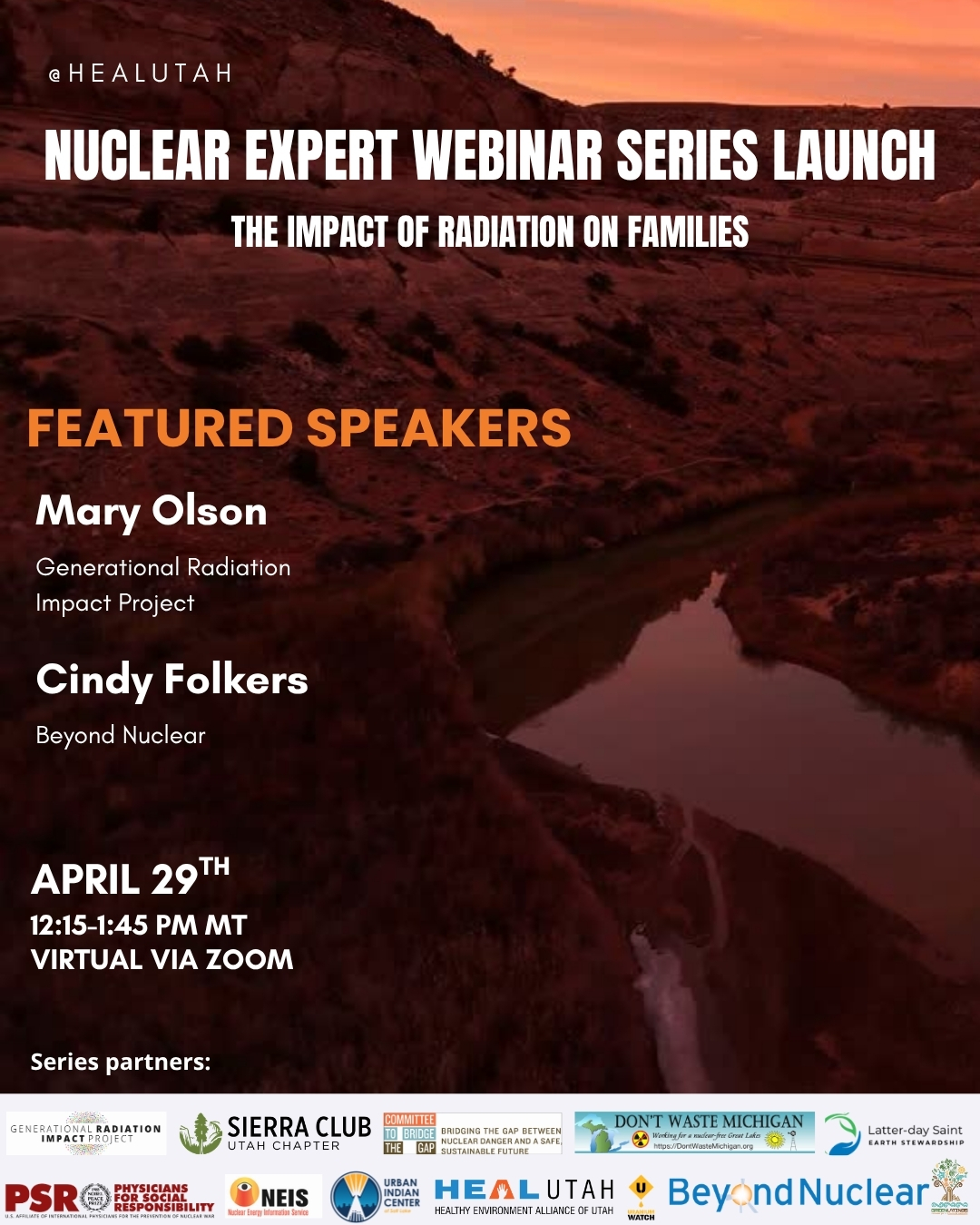
29 April – Nuclear Expert Webinar #1 – Radiation Impacts on Families with Mary Olson and Cindy Folkers
- 12:15 PM MT – 1:45 PM MT
- Location: Virtual – REGISTER TODAY

4 May -West Suburban Peace Coalition to discuss Iran war at May Educational Forum
Monday, May 4, 7:00 – 8:00 PM Central Standard Time
Title: : How Trump’s Narrative Tries to Shape the Reality of the War on Iran.
Contact Walt Zlotow, zlotow@hotmail.com 630 442 3045 for further information
14 May – online event From Bombs to Data Centres: the Face of Nuclear Colonialism

Pine Ridge Uranium is the real threat, not Tehran- Tell Burgum: Stop the Extraction.
Chernobyl: The Lost Tapes – A good documentary on Chernobyl on SBS available On Demand for the next 3 weeks– https://www.sbs.com.au/ondemand/tv-program/chernobyl-the-lost-tapes/2352741955560
To see nuclear-related stories in greater depth and intensity – go to https://nuclearinformation.wordpress.com
-
Archives
- April 2026 (288)
- March 2026 (251)
- February 2026 (268)
- January 2026 (308)
- December 2025 (358)
- November 2025 (359)
- October 2025 (376)
- September 2025 (257)
- August 2025 (319)
- July 2025 (230)
- June 2025 (348)
- May 2025 (261)
-
Categories
- 1
- 1 NUCLEAR ISSUES
- business and costs
- climate change
- culture and arts
- ENERGY
- environment
- health
- history
- indigenous issues
- Legal
- marketing of nuclear
- media
- opposition to nuclear
- PERSONAL STORIES
- politics
- politics international
- Religion and ethics
- safety
- secrets,lies and civil liberties
- spinbuster
- technology
- Uranium
- wastes
- weapons and war
- Women
- 2 WORLD
- ACTION
- AFRICA
- Atrocities
- AUSTRALIA
- Christina's notes
- Christina's themes
- culture and arts
- Events
- Fuk 2022
- Fuk 2023
- Fukushima 2017
- Fukushima 2018
- fukushima 2019
- Fukushima 2020
- Fukushima 2021
- general
- global warming
- Humour (God we need it)
- Nuclear
- RARE EARTHS
- Reference
- resources – print
- Resources -audiovicual
- Weekly Newsletter
- World
- World Nuclear
- YouTube
-
RSS
Entries RSS
Comments RSS
 nuclear-news