TEPCO bungles placement of 100 fire detectors at nuclear plant
September 20, 2021
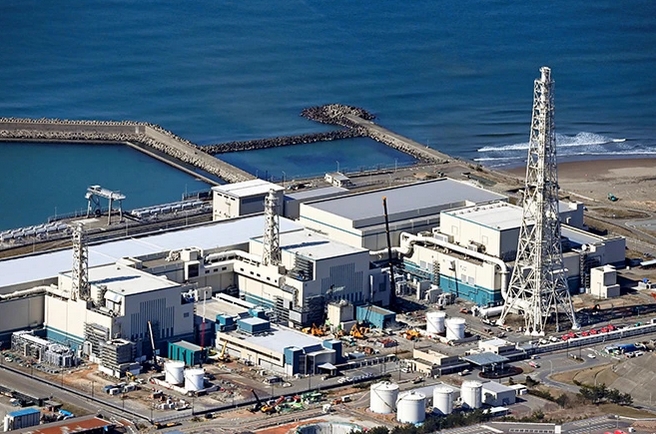
Tokyo Electric Power Co. has continued its bumbling ways concerning safety measures, misplacing dozens of fire detectors at its Kashiwazaki-Kariwa nuclear plant in Niigata Prefecture, sources said.
TEPCO is seeking to restart the No. 7 reactor at the sprawling nuclear plant, but the utility has run into a host of problems following stricter safety standards implemented after the 2011 disaster at its Fukushima No. 1 nuclear plant.
In the latest incident, about 100 fire detectors were not placed in locations set under safety regulations, the sources said.
The misplacements could delay the detection of heat and smoke from a fire, hampering an immediate response to such a potentially disastrous event.
Under the new safety regulations, nuclear plant operators are required to place a fire detector at least 1.5 meters from an air conditioner vent or other opening. That rule is based on the fire protection law.
Inspectors from the government’s Nuclear Regulation Authority in February noticed that a smoke detector was placed only about 1 meter from the ventilating opening in the storage battery room of the No. 7 reactor building.
TEPCO said it has since moved the detector to the proper location and confirmed through visual checks that the other fire detectors were installed in the right places.
But an additional NRA inspection in April found that two other fire detectors were misplaced.
Following that finding, TEPCO undertook a fresh check of about 2,000 detectors throughout the nuclear plant.
The company reported to the nuclear watchdog on Sept. 16 that more cases of misplaced detectors were confirmed, bringing the total to about 100, according to the sources.
With seven reactors, the Kashiwazaki-Kariwa nuclear plant is among the largest in the world in terms of capacity. It is also the only nuclear facility that TEPCO can restart since the company decided to decommission both the Fukushima No. 1 and No. 2 nuclear plants.
TEPCO is eager to put the Kashiwazaki-Kariwa plant back online because burning fossil fuel at its thermal plants has proved costly.
But the NRA in April ordered the company to stop preparations toward a restart following revelations of a number of safety flaws.
In January, the company announced the completion of work to bolster safeguarding of the No. 7 reactor, which has an output of 1.35 gigawatts.
However, fire-prevention work was not finished at many locations of the nuclear plant.
News outlets also reported in January that an employee of the plant entered the central control room of a reactor by using the ID of another employee in September last year, a serious breach of the NRA’s anti-terrorism measures.
In addition, it was found that security devices designed to detect unauthorized entry had not been working properly at 15 sites at the plant since March last year.
TEPCO left most of these devices unfixed for about a month.
The company is expected to submit a report to the NRA on how to prevent a recurrence by Sept. 23.
Is AUKUS pact a signal to India to go for nuclear attack submarines?
With a new aircraft carrier, six new Kalvari class diesel attack submarines and Vishakhapatnam class of destroyers, the Indian Navy is going to be very potent force in the Indo-Pacific by 2025. By Shishir Gupta, Hindustan Times, New Delhi SEP 18, 2021 With Australia signing a pact with US and UK to go in for eight nuclear powered conventional attack submarines or SSNs to deter China in Indo-Pacific, India also needs to have a relook at its 1999 conventional submarine plan and move swiftly towards nuclear powered sub-surface vessels.
The AUKUS pact will not be without security ramifications for the Quad partners as there is a distinct possibility that China may build an SSN for its client Pakistan citing the transfer of nuclear reactor under AUKUS to Australia. This will create a bigger security headache for India and for other countries in the IOR. https://www.hindustantimes.com/india-news/is-aukus-pact-a-signal-to-india-to-go-for-nuclear-attack-submarines-101631944254552.html
Nuclear submarine deal planned for 18 months – French ambassador says this is treasonous
Recalled French ambassador accuses Australia of ‘treason in the making’ https://www.theage.com.au/politics/federal/recalled-french-ambassador-accuses-australia-of-treason-in-the-making-20210918-p58ssg.html. By Anthony Galloway
France’s recalled ambassador to Australia has likened Canberra’s actions to treason after the Morrison government dumped a $90 billion submarine contract with Paris and instead decided to build nuclear-powered submarines with the United States and Britain.
France on Saturday has taken the extraordinary step of recalling its ambassadors from Australia and the US, as the fallout grows from a new defence pact that has infuriated French President Emmanuel Macron.
Speaking to The Sydney Morning Herald and The Age hours before he was recalled, France’s ambassador to Australia, Jean-Pierre Thebault, did not rule out suspending talks to allow French troops greater access to Australian military bases after his nation was “stabbed in the back”.
Adding insult to the process… we have very reliable reports from the independent press, which I thank, about the fact that all this was in the making for 18 months. Which means we have been blind-sided intentionally for 18 months…. The crime was prepared for 18 months,” he said.
France’s recalled ambassador to Australia has likened Canberra’s actions to treason after the Morrison government dumped a $90 billion submarine contract with Paris and instead decided to build nuclear-powered submarines with the United States and Britain.
France on Saturday has taken the extraordinary step of recalling its ambassadors from Australia and the US, as the fallout grows from a new defence pact that has infuriated French President Emmanuel Macron.
Speaking to The Sydney Morning Herald and The Age hours before he was recalled, France’s ambassador to Australia, Jean-Pierre Thebault, did not rule out suspending talks to allow French troops greater access to Australian military bases after his nation was “stabbed in the back”.
“Adding insult to the process… we have very reliable reports from the independent press, which I thank, about the fact that all this was in the making for 18 months. Which means we have been blind-sided intentionally for 18 months…. The crime was prepared for 18 months,” he said.
He slammed Australia for allowing a meeting to go ahead between Mr Dutton and Foreign Minister Marise Payne late last month with their French counterparts where they spoke about enhancing defence ties between the two countries.
“It is us, through letters that were sent by the President [Macron] some months ago to the Prime Minister [Scott Morrison], who proposed to look at more ambitious and new ambitious cooperations,” Mr Thebault said……….. The extraordinary move follows the Morrison government’s decision to tear up a $90 billion contract to buy 12 French submarines in favour of a new nuclear-powered fleet using technology from the US and United Kingdom under a new partnership called AUKUS.
Nuclear submarines may never eventuate; it’s just Scott Morrison’s giant new election ploy

The timing of Mr Morrison’s announcements also merits some consideration. In our view, this project is a political stunt aimed to distract from Covid failures, please coalition constituencies, and split the Labor Party and render the Greens shrill and sidelined.
In reality, it is likely that after a passage of years of staged announcements and pseudo-planning there will be little to show for it, and the enormously expensive, strategically ill-considered, and force-structure distorting project will quietly die.
But, to use Prime Minister Morrison’s phrase, “let us be clear,” in terms of Australian security, it is a gigantic nuclear election stunt that in the long run may increase the risk of nuclear war while drawing Chinese return fire on our vulnerable export sectors, including iron ore.
“To be clear” again, it is utterly mendacious of Prime Minister Scott Morrison to say that these forces have nothing to do with nuclear weapons because Australian submarines won’t be so armed, assuming it does not cross that barrier in the future if the submarines ever come to pass. As noted above, they may play a crucial role in US nuclear strike and defence operations……..
Scott Morrison’s Giant Nuclear Election Ploy, APLN Asial Pacific Leadership Network. 19 Sep 21,
Even leaving aside the fiscal profligacy and defence opportunity costs for Australia of the literal blank cheque issued by the Morrison government, the nuclear submarine decision takes Australia into the heart of naval warfighting in East Asia and Southeast Asia.
Further, the Australian nuclear submarine decision will have knock-on effects in Japan and the Republic of Korea, leading them not only to move their already highly capable submarine fleets to nuclear power, but also thereby heighten the likelihood they will then equip those submarines with nuclear weapons.
For several decades the US has been concerned to negate two military advances the Chinese regard as essential protection against literally existential threats. The Australian submarines will be designed primarily to contribute to negating both of those military advances.
Firstly, over the past decade China has constructed the basis for a submarine-based nuclear deterrence force that could survive the effects of an expected US attack against Chinese land-based nuclear missile sites. If Chinese nuclear missile-launching submarines can safely get out of their homeports and reach the depths of the Pacific Ocean and the South China Sea they may have a small chance of remaining undetected by highly superior US anti-submarine warfare platforms – including US and now, possible Australian hunter-killer submarines. If those Chinese SSBNs are found and destroyed, especially after US attacks on Chinese ground-launched missile silos, and US and Japanese ballistic missile defence destroying most of the missiles that are launched by China, then, in the Chinese view, China in fact has no survivable nuclear-deterrence force. Whatever the validity deterrence by a balance of vulnerability – or of terror – may have, without a survivable second strike, China has no effective nuclear deterrence against the United States.
China’s four operational nuclear missile submarines are mainly based in the north of the South China Sea on the island of Hainan. China’s militarisation of its concrete islands in the SCS is in large part motivated by a desire to provide extended defence in depth for those SSBNs.
The fundamental requirement for that capability—apart from questions of missile range, crew training and naval submarine-launched ballistic missiles (SLBM) and nuclear submarine doctrinal development—is that the submarines are able to reach the deeps of the western Pacific undetected by U.S. and Japanese anti-submarine warfare (ASW) sensor networks. Only there do they have any chance of fulfilling their intended role as a second strike nuclear deterrent force immune to U.S. attack. One key part of US ASW capabilities, in addition to the Fish Hook underwater surveillance network from Japan to the boundary of the South China Sea, are its attack submarines hunting Chinese ballistic missile submarines. Australia’s submarines could play a modest but frontline role, especially in the waters to the west of Borneo, the Philippines and Japan.
For this reason alone, China will view Australia’s decision as a wilful contribution to an existential nuclear threat to China.
Secondly, Australian long-range attack submarines will be deployed in Southeast and East Asian waters to protect US aircraft carrier task forces moving into position close to China for attacks on Chinese coastal facilities, …………
given the acknowledged risks of escalation to use of nuclear weapons in what may begin as a conventional war on the Korean peninsula, especially together with a Taiwan crisis, Australian submarines attached to US carrier battle groups may be sailing into a nuclear war.
Australian nuclear submarines may not be allocated offensive missions against Chinese, Russian or eventually, North Korean ballistic missile firing submarines. But the roles that they likely will be allocated in American naval operations in the Western Pacific, especially in aircraft battlegroups deployed against Russia, China, or North Korea, will enable US anti-submarine operations against the nuclear forces of these states.
Other lone-wolf long-distance missions for Australian nuclear submarines can be envisioned such as inserting special forces onto land, blockading straits, but none of these can justify the crushing direct cost and massive opportunity cost to the rest of Australia’s armed forces already short of essential capacity to defend Australia’s territory against actual maritime attack.
The AUKUS project for Australian nuclear submarines carries a third nuclear risk. ….
For Japan and the Republic of Korea, both US allies of considerably greater military and political significance to the US than Australia, the nuclear submarine technology export to Australia will have two consequences.
Japan and South Korea both have advanced indigenously developed and constructed submarine fleets, for which they will demand equal treatment from the US, further stimulating the dynamic underwater arms race in East Asia.
But more importantly this break-out will occur at a time when powerful political elements in both countries are pressing the case for indigenous nuclear weapons. The preferred nuclear-launch platform in both countries would be from submarines.
Anxiety in both countries about China-US tensions sits alongside not-so-latent long-standing doubts about the reliability of US promises of nuclear protection. Grievances flowing from the Australian submarine deal may well feed the domestic cases for Japanese and South Korean nuclear weapons.
The timing of Mr Morrison’s announcements also merits some consideration. In our view, this project is a political stunt aimed to distract from Covid failures, please coalition constituencies, and split the Labor Party and render the Greens shrill and sidelined. In reality, it is likely that after a passage of years of staged announcements and pseudo-planning there will be little to show for it, and the enormously expensive, strategically ill-considered, and force-structure distorting project will quietly die.
But, to use Prime Minister Morrison’s phrase, “let us be clear,” in terms of Australian security, it is a gigantic nuclear election stunt that in the long run may increase the risk of nuclear war while drawing Chinese return fire on our vulnerable export sectors, including iron ore.
“To be clear” again, it is utterly mendacious of Prime Minister Scott Morrison to say that these forces have nothing to do with nuclear weapons because Australian submarines won’t be so armed, assuming it does not cross that barrier in the future if the submarines ever come to pass. As noted above, they may play a crucial role in US nuclear strike and defence operations……..
About the Author
Allan Behm is Head, International and Security Affairs Program, The Australia Institute, Canberra, Australia. Allan spent 30 years in the Australian Public Service, as a member of the Australian diplomatic service, the Prime Minister’s Department, the Department of Defence and the Attorney General’s Department. He specialised in international relations, defence strategy, counter-terrorism and law enforcement policy, and more recently, climate change.
This commentary was cross-posted on the Nautilus website here. https://www.apln.network/analysis/commentaries/scott-morrisons-giant-nuclear-election-ploy
Big questions remain about Australia’s nuclear submarines, but it’s a massive financial gain for nuclear corporations

The possibility of a submarine deal with Australia came at an opportune moment. It provided Biden with a chance to demonstrate support for a close ally and boost its military strength. For Boris Johnson it could show that
relations with the US had not fallen apart because of the chaotic Afghanistan withdrawal, and it validated claims that the UK can play a prominent security role in the Indo-Pacific region.
For Australians it provides reassurance that it is still backed by its oldest allies. Having abandoned a “forever war”, the US and UK have signed up to what the Australian prime minister, Scott Morrison, has described as a “forever
partnership”. The test will lie in this submarine project being more successful than the French-backed one it has replaced. This is not something that can be taken for granted.
The big questions about the boats’ design and manufacture will not be answered until 2023. The value
of the contract will be massive, and we should expect the competing claims of all three partners to be pressed hard when they are deciding their contributions. Instead of building diesel-powered submarines with the French, Australia upgraded its requirement to nuclear-powered submarines. These are quieter, can spend more time at sea and can travel greater distances, but they are fiendishly difficult to construct. Although the UK’s Astute-class programme is now running reasonably smoothly, with each boat costing almost £1.5 billion, the first vessel was almost five years
late and massively over budget.
Times 19th Sept 2021
https://www.thetimes.co.uk/article/the-submarine-deal-is-a-real-downer-for-china-x6t89v022
Malaysia and Indonesia warn Australia’s Indo-Pacific pact could trigger nuclear arms race
Malaysia and Indonesia warn Australia’s Indo-Pacific pact could trigger nuclear arms race, Taipei Times, 19 Sep 21
The new AUKUS alliance will involve Australia, the US and Britain exchanging technology and intelligence
Australia will have access to US nuclear technology, which will enable it to build nuclear submarines
Australia’s nuclear arms ban remains in new deal
Birmingham said there was no “quid pro quo” in Australia agreeing to step up its strategic relationship with the UK and the US.
He insisted that nuclear weapons would not be based within Australia’s jurisdiction. “We’ve been clear, Australia’s position in relation to nuclear weapons does not change, will not change,” he said yesterday.
“We will meet all of our non-proliferation treaty arrangements and obligations and not be changing any of our policies in relation to the nuclear weapons technology.”
Birmingham did not rule out an increase in the number of UK and US military personnel on Australian shores. “We already have US troops and marines who work in Australia on rotational deployments at times,” he said………….
it is not just the French who have been made uneasy by the AUKUS arrangement, which is still to be worked out in detail. Australia’s allies in the Indo-Pacific have also raised concerns over what the deal will mean for tensions in the region.
Malaysia said on Saturday that Canberra’s decision to build atomic-powered submarines could trigger a regional nuclear arms race, echoing concerns already raised by Beijing.
“It will provoke other powers to also act more aggressively in the region, especially in the South China Sea,” the Malaysian prime minister’s office said, without mentioning China……https://www.taipeitimes.com/News/world/archives/2021/09/20/2003764684
Nuclear reactor worker wins NIS one million cancer compensation.
Nuclear reactor worker wins NIS one million cancer compensation
‘G,’ a 78-year-old pensioner from Beersheba, claimed to have been continually exposed to hazardous materials and radioactive radiation at the Dimona nuclear reactor.By JERUSALEM POST STAFF SEPTEMBER 19, 2021 A Dimona nuclear reactor technician, who twice contracted cancer since his retirement, will be compensated in the sum of over NIS one
million, N12 reported on Sunday.’G,’ a 78-year-old pensioner from Beersheba, worked as a chemistry technician at the Dimona nuclear reactor for 32 years before retiring in 2003.
The retired technician claimed to have been continually exposed to hazardous materials and radioactive radiation, which caused him to develop five cancerous tumors which were surgically removed, as well as battling bladder and prostate cancer.He also claimed that there was no proper supervision and no means of radiation protection given to him during his time working in the reactor.”I went through a troubling period in my life. I couldn’t believe my job would bring me to this situation,” he reportedly noted in a claim filed to social security…….. https://www.jpost.com/israel-news/nuclear-reactor-worker-wins-nis-one-million-cancer-compensation-679783
China fears that the nuclear-powered submarines could be armed with nuclear weapons at short notice

US FORCES US submarine launches Trident II nuclear missiles in stunning show of strength U.S,Sun Olivia Burke, Sep 19 2021
THE US Navy triumphantly test-launched Trident D5LE nuclear missiles on Friday in a stunning show of strength.
The scheduled two-missile deployment of the unarmed revamped weapon took place off the coast of Cape Canaveral, Florida from the USS Wyoming (SSBN-742) submarine……
The Navy boasted of the “unmatched reliability” of the new “sea-based nuclear deterrent” as tensions continue to increase with China.
It was the 184th successful Trident II (D5 & D5LE) SWS missile test flight and follows the last launch in February this year off the coast of Florida……..
“This same team is now developing the next generation of the Trident Strategic Weapon System, which will extend our sea-based strategic deterrent through 2084,”
The Navy also revealed the submarine missiles have been given “a life extension program to address potential impacts from aging and obsolescence”.
They are now primed to be stationed amongst the rest of the fleet alongside the UK Vanguard-class, US Colombia-class, UK Dreadnought-class.
With an estimated annual cost of $170million, the US spend a whopping $2.4million each year to run the Ohio-class submarines.
….the launch comes in the wake of the revelation of the UK’s and US’ plans to build nuclear-powered submarines for Australia.
AUKUS’ ALLIANCE
The alliance has angered China, who fear the subs could be armed at short notice with nukes, despite assurances they will only carry conventional weapons.
The countries leaders carefully navigated the announcement without directly mentioning China’s imposing power – but hinted at their intentions behind the move by discussing “democracy, freedom of navigation, and security.”
The new Indo-Pacific security pact, known as AUKUS, will give the land Down Under the technology to deploy nuclear-powered submarines.
It is part of an agreement intended to counter China’s rising military might – that they have splashed six times more cash on than Australia.
With 42 times more soldiers, 55 times more tanks, 13 times more submarines and 16 times more fighter jets, they eclipse the Aussies artillery.
And with 3.3 million troops in service, Beijing dwarves Australia’s 80,000 soldiers – but AUKUS has still managed to seriously ruffle some feathers.
CHINA’S FURY
Chinese Foreign Ministry spokesman Zhao Lijian condemned the alliance as “seriously damaging regional peace and stability, intensifying the arms race, and undermining the Treaty on the Non-Proliferation of Nuclear Weapons”.
China is believed to have between 250 and 350 nuclear weapons, compared to America’s colossal arsenal of 5,800 and Russia’s total of 6,375. ……. https://www.the-sun.com/news/3691458/us-submarine-trident-ii-nuclear-missiles-chinas-threats/
Regulators: Waste stored poorly at Fukushima plant
Sept. 18, 2021
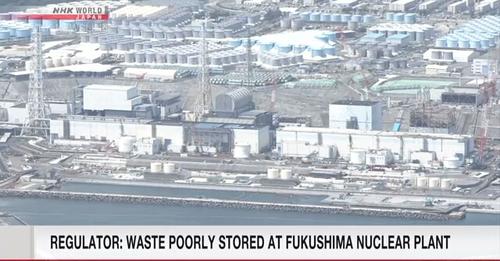
Japanese nuclear regulators have urged the operator of the disabled Fukushima Daiichi nuclear plant to improve the way it manages accumulating waste at the complex.
Most of the radioactive waste generated through decommissioning of the plant is being stored at designated outdoor depots.
But wreckage and other clutter that cannot be quickly transported there is instead being kept at interim sites for up to one year in principle.
The Nuclear Regulation Authority says the volume of waste at the interim sites reached 60,000 cubic meters in July, surging more than eight-fold from the figure in January of last year.
It also says the waste has been kept longer than one year in some sites, and not enough patrols are being conducted.
The plant’s operator, Tokyo Electric Power Company, says it could not send the waste to the outdoor depots while work was underway to rearrange containers there. It adds that the containers had to be inspected following leaks of radioactive substances.
The company says it will review the temporary storage arrangements and manage waste properly.
The total volume of radioactive waste at the plant reached about 480,000 cubic meters as of March of this year, 10 years after the triple nuclear meltdown accident.
Japan’s Plan To Discharge Nuclear Waste Into The Pacific Worries Island Nations
The effects and memory of U.S. nuclear testing endures in the Pacific. “It is a level up from urgent for us,” one Pacific leader says.
Pacific nations and territories aren’t yet convinced their people and waters will be safe when Japan discharges processed nuclear wastewater into the Pacific, as it recently announced it plans to do.
Despite briefings from Japan, and its cooperation with the International Atomic Energy Agency, the Pacific community has yet to fully understand what the ramifications of dropping 1 million tons of wastewater off Japan’s coast might be.
“Currently we are not satisfied there will be no harm to our Blue Pacific,” said Henry Puna, secretary general of the Pacific Islands Forum Secretariat, noting that even basic concerns had not yet been addressed.
Japan triggered immediate and strong opposition when it announced the plan in April, initially from neighboring nations South Korea and China, though countries and territories across the Pacific continue to express their dissatisfaction with Japan’s engagement with them thus far.
The wastewater, which contains debris from the Fukushima Daiichi power station destroyed during the 2011 Tohoku earthquake and tsunami, has been treated and many scientists believe the technology is safe.
But for countries in the Pacific, the nuclear legacy still endures and many have their reservations.
The Pacific Islands Forum Secretariat, an intergovernmental organization comprising 17 Pacific nations and territories, noted the serious concerns over Japan’s plans in a July meeting and, following a briefing on Tuesday, remains unconvinced.
Puna said one issue was the highly technical nature of the briefings. The former Cook Islands prime minister acknowledged Japan was “as committed as we are to having frank and open dialogue,” but the planned action is less than 18 months away.
Puna said a major issue was that the Pacific nations lacked the expertise to interpret the highly technical plans.
“I just want to note that, for us, the issue is very urgent but also requires very careful thinking,” said Puna. “When you have a major development partner explaining that the only way for it to get rid of more than a million cubic tons of treated, but still contaminated water, is to dump it into an ocean, where we share the same tides, current, and fish, it is a level up from urgent for us.”
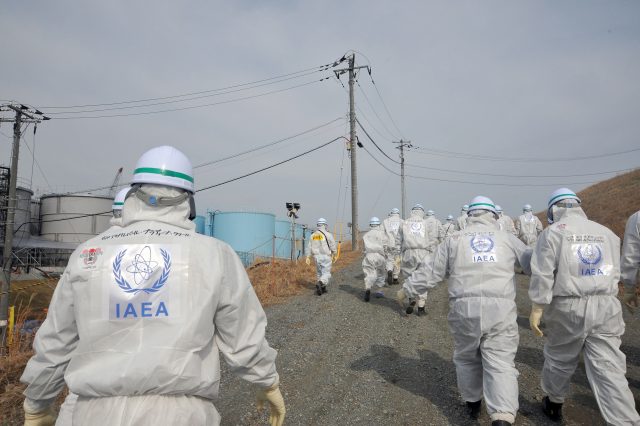
An IAEA review of the waste disposal, agreed to on Sept. 9, would focus on safety, regulation and environmental monitoring, and a team of IAEA experts would review the process in a December visit. PIFs concerns have not been allayed, however, so it was in the process of bringing on three independent scientists to assess the plans.
“This is an area of the planet where people see the ocean as an extension of themselves,” Puna added.
The Republic of the Marshall Islands was subjected to 67 nuclear bombings between 1948 and 1956, and the legacy of nuclear testing endures. Islands were scarred or fully vaporized and people were forced from their homes. Across the Pacific, France and the United Kingdom also tested their nuclear prowess around the same time. The fallout has had generational effects.
A recently released study, conducted as part of ongoing collaboration between IAEA and RMI, found that Bikini Atoll, where the U.S. conducted the Castle Bravo test (a 15 megaton thermonuclear bomb) in 1954, is slowly healing from the test though radioactive material remains.
Given RMI’s nuclear history — even with IAEA’s involvement — Marshallese have maintained a “healthy distrust” of governments and agencies, said Giff Johnson, editor of The Marshall Islands Journal.
He said although Japan and Micronesian nations share a long history, and have enjoyed a healthy diplomatic relationship in more recent times, nuclear issues remain contentious. “That in itself is a big hurdle to get over,” Johnson said. “It makes it complicated, diplomatically.”
This is not the first time Japan has riled Pacific nations with nuclear waste. In 1979, Japanese plans to dump 10,000 drums of nuclear waste in the Marianas Trench were met with virulent opposition from political leaders and protests from citizens.
Given the multi-generational legacy of nuclear testing and waste disposal, young activists are also voicing their concerns. Youngsolwara Pacific, a regional collective of young activists, has condemned the Japanese government’s plans and lack of consultation.
According to Talei Luscia Mangioni, a Pasifika researcher at the Australian National University and Youngsolwara Pacific member, Japan’s nuclear behavior seemed to ignore the region’s ongoing Nuclear Free and Independent Pacific movement and the history of colonizers dumping nuclear waste and testing nuclear weapons.
“Pacific youth acknowledge that this is an act of transboundary harm and is part of a great legacy of where nuclear powers have treated the Pacific as a sacrifice zone,” said Mangioni. “I think that Japan needs to properly consult and engage with Pacific people and their own Japanese civil society instead of making an announcement that they are going to do this, given their history.”
Mangioni was similarly concerned by the proximity of Micronesian nations to the proposed dumping and emphasized that they “have been the vanguard for a lot of nuclear resistance.”
PIFS Secretary General Puna, however, said Micronesia remained part of the forum “family” and said it had endorsed Rhea Moss-Christian, chair of the Marshall Islands National Nuclear Commission, as a representative of its interests on the IAEA safety task force.
Moss-Christian said she was unsure if her involvement with IAEA reassured the Marshallese, and her organization had not yet begun its outreach program in RMI.
Though Japan’s government had been working hard to assure the region’s concerns, whether its plans were robust enough remained to be seen and would be addressed by the task force.
“However, it is still difficult to accept that our backyard should be a dumping ground for our neighbor’s toxic waste, no matter how minimal the risk,” she said.
Mossad assassinated Iran’s top nuclear scientist using an artificial-Intelligence-powered, remote-controlled machine gun
| Mossad assassinated Iran’s top nuclear scientist using an AI-powered, remote-controlled machine gun, report says, Business Insider Joshua ZitserSep. 19, 2021, Mohsen Fakhrizadeh, “father” of Iran’s nuclear weapons program, was on Israel’s hit list since 2007.In November 2020, the Mossad pulled off a hit using a remote-controlled, AI-powered machine gun.It was controlled by operatives outside of Iran, who killed Fakhrizadeh in under a minute, per NYT……………….. https://www.businessinsider.com.au/mossad-remote-controlled-machine-gun-kill-iran-nuke-expert-nyt-2021-9 |
Russia urges IAEA monitoring, ‘transparency’ on US-Australia nuclear sub pact,
Russia urges IAEA monitoring, ‘transparency’ on US-Australia nuclear sub pact, Press TV, Friday, 17 September 2021 Russia warns against Australia’s attempt to becoming a nuclear power under a trilateral pact Canberra signed with the United States and Britain earlier this week.
Russian Permanent Representative to the International Atomic Energy Agency (IAEA) in Vienna Mikhail Ulyanov said on Friday that “time has not come yet for such estimations” about Australia turning into a nuclear power.
Under a new Australia-UK-US alliance (Aukus), Canberra would be building at least eight nuclear submarines, using US technology.
The first of the submarines is expected to enter service is 2036.
Ulyanov warned that the plan “is alarming and makes you keep a close eye on that.”
“Australia is a non-nuclear power,” he said, adding that “all this should be closely supervised by the IAEA and its inspection mechanism.”……..
Many observers warned that the trilateral pact could lead to a situation very similar to the US-Russian arms race during the cold war…… https://www.presstv.ir/Detail/2021/09/17/666731/Russia-Australia-nuclear-powered-submarines-Aukus-
New radiation scrubber begins cleaning water at Fukushima plant
New radiation scrubber begins cleaning water at Fukushima plant, Japan Times 19 Sep 21The operator of the crippled Fukushima No. 1 nuclear plant on Thursday powered up an additional water treatment facility to scrub contamination from the massive quantities of radioactive water stored there.
The new, mobile facility filters radioactive strontium from water used to cool three reactors that partially melted down in March 2011, said operator Tokyo Electric Power Co., and can handle 300 tons of water a day……
The procedure will reduce radioactive strontium in the water to about one-thousandth of its current level, the utility said.
However, removing strontium will not in itself render the water safe. It then needs to be treated by another system at the plant which filters out around 60 kinds of radioactive materials.
But there is an important reason why the strontium takes precedence. Removing that isotope before the others will make the water far less of a hazard in the event of a major leak into the ocean.
Meanwhile, an estimated 400 tons of groundwater continues to seep into the reactor basements every day, forcing the utility to find ways to store it. Tepco already has 400,000 tons of toxic water stored at the site, which will all need to be treated one day. https://www.japantimes.co.jp/news/2014/10/03/national/new-radiation-scrubber-begins-cleaning-water-at-fukushima-plant/
New Australia, Britain, and U.S. military alliance—AUKUS— a serious escalation of the new Cold War on China.

‘Anti-China’ Military Pact ‘Threatens Peace and Stability’ in Pacific, Groups Warn
“The announcement of the new Australia, Britain, and U.S. military alliance—AUKUS—represents a serious escalation of the new Cold War on China.” Common Dreams , KENNY STANCIL, September 16, 2021 Anti-war advocates are denouncing Wednesday’s formation of a trilateral military partnership through which the United States and the United Kingdom plan to help Australia build a fleet of nuclear-powered submarines—a long-term initiative broadly viewed as a challenge to China by Western powers determined to exert control over the Pacific region.
Although Australian Prime Minister Scott Morrison, U.K. Prime Minister Boris Johnson, and U.S. President Joe Biden did not mention Beijing during their joint video announcement of the so-called AUKUS alliance, “the move is widely seen as a response to China’s expanding economic power, military reach, and diplomatic influence,” the Washington Post reported. “China is believed to have six nuclear attack submarines, with plans to increase the fleet in the next decade.”
The Guardian noted that it could take more than a decade for AUKUS to develop submarines propelled by enriched uranium—which allow the attack vessels to operate more quietly and remain deployed for up to five months—”but once at sea, the aim is to put Australia’s currently diesel-powered navy on a technological par with China’s navy, the world largest.”
In addition to “cooperation on naval technology,” the newspaper reported, “the partnership will involve closer alignment of regional policies and actions, and greater integration of the militaries and the defense industries of the three allies,” which “also intend to work together on cyberwarfare and on artificial intelligence capabilities.”
In response to the development, the British chapter of the No Cold War coalition said Thursday in a statement that “the new anti-China military alliance forged between Australia, Britain, and the U.S.—AUKUS—is an aggresive move which threatens peace and stability in the Pacific region.”
According to the coalition of nearly two dozen peace groups, the creation of AUKUS “follows the recent sending of a British warship to the South China Sea in an aggressive and provocative gesture of support for the U.S.’s massive military build-up against China.”
“It should be noted,” the coalition continued, “that New Zealand is not participating in this aggressive military alliance and it’s no nuclear policy means that Australian nuclear-powered submarines will be banned from New Zealand’s ports and waters.”
“It is against the interests of the British people, the Chinese people, and all of humanity for Britain to join the U.S. and Australia in racheting up aggression against China,” No Cold War added. “The world needs global cooperation to tackle shared threats of the pandemic and climate change, not a new Cold War.”
Anti-war progressives from Australia and the U.S. have also condemned the new military alliance.
“It was only a few weeks ago that a generation-long war in Afghanistan came to an end,” Alison Broinowski of the Independent and Peaceful Australia Network, said in a statement shared prior to the official launch of AUKUS. “Instead of reflecting on the pointlessness and horror of U.S. militarism, Australia and the U.S. are already talking about their next military adventure.”
“How can Australia assert an independent and peaceful foreign policy with a military that is so integrated into the U.S.?” Broinowski asked.
During his remarks publicizing the pact, Biden claimed that “we need to be able to address both the current strategic environment in the region, and how it may evolve, because the future of each of our nations, and indeed the world, depends on a free and open Indo-Pacific enduring and flourishing in the decades ahead.”
China Is Not Our Enemy, a project of U.S.-based peace group CodePink, responded by asserting that “if Biden and the Pentagon really want to ‘ensure peace and stability’ in the region, they could simply stop dealing missiles, weapons, [and] nuclear tech to Australia, Japan, South Korea, and Taiwan that escalate conflict and threaten global safety.”
Officials in Beijing also criticized the agreement, with China’s Foreign Ministry spokesperson Zhao Lijian reportedly calling the U.S. and U.K.’s decision to export extremely sensitive nuclear technology to Australia an “extremely irresponsible” move that exposes “double standards.”
AUKUS “seriously undermines regional peace and stability, aggravates the arms race, and hurts international nonproliferation efforts,” Zhao added.
Describing AUKUS as a “disastrous” deal, CodePink co-founder Medea Benjamin tweeted Wednesday that Australia, the U.K., and the U.S. “are ratcheting up the tension that could easily lead to a nuclear war with China.”
Amid growing concerns that Washington’s increasingly hostile approach to China could escalate into a full-blown military conflict, nearly 50 advocacy organizations in July sent a letter to Biden and members of Congress in which they argued that “nothing less than the future of our planet depends on ending the new Cold War between the United States and China.” https://www.commondreams.org/news/2021/09/16/anti-china-military-pact-threatens-peace-and-stability-pacific-groups-warn
1 This Month

of the week – Shut Down Drone Warfare!


Tell the Ukrainian Government to Drop Prosecution of Peace Activist Yurii Sheliazhenko

Petition to revoke the licensing of the Near Surface Nuclear Disposal Facility (NSDF) at Chalk River. https://www.ourcommons.ca/petitions/en/Petition/Details?Petition=e-7247
To see nuclear-related stories in greater depth and intensity – go to https://nuclearinformation.wordpress.com
-
Archives
- April 2026 (57)
- March 2026 (251)
- February 2026 (268)
- January 2026 (308)
- December 2025 (358)
- November 2025 (359)
- October 2025 (376)
- September 2025 (257)
- August 2025 (319)
- July 2025 (230)
- June 2025 (348)
- May 2025 (261)
-
Categories
- 1
- 1 NUCLEAR ISSUES
- business and costs
- climate change
- culture and arts
- ENERGY
- environment
- health
- history
- indigenous issues
- Legal
- marketing of nuclear
- media
- opposition to nuclear
- PERSONAL STORIES
- politics
- politics international
- Religion and ethics
- safety
- secrets,lies and civil liberties
- spinbuster
- technology
- Uranium
- wastes
- weapons and war
- Women
- 2 WORLD
- ACTION
- AFRICA
- Atrocities
- AUSTRALIA
- Christina's notes
- Christina's themes
- culture and arts
- Events
- Fuk 2022
- Fuk 2023
- Fukushima 2017
- Fukushima 2018
- fukushima 2019
- Fukushima 2020
- Fukushima 2021
- general
- global warming
- Humour (God we need it)
- Nuclear
- RARE EARTHS
- Reference
- resources – print
- Resources -audiovicual
- Weekly Newsletter
- World
- World Nuclear
- YouTube
-
RSS
Entries RSS
Comments RSS
 nuclear-news