5 nuclear activities that are now Illegal under international law
 Here are five examples of the type of activities that will be Illegal under international law on 22 January 2021 https://nukewatch.org/new-and-updated-item/here-are-five-examples-of-the-type-of-activities-that-will-be-illegal-under-international-law-on-22-january-2021/
One of the main problems with talking about nuclear weapons is that it often becomes abstract and hypothetical. Most people barely know which countries have nuclear weapons and do not know to what extent other actors are involved in maintaining and upholding nuclear weapons.
WHAT THE TREATY PROHIBITS
Article 1 of the treaty prohibits states parties from developing, testing, producing, manufacturing, transferring, possessing, stockpiling, using or threatening to use nuclear weapons, or allowing nuclear weapons to be stationed on their territory. It also prohibits them from assisting, encouraging or inducing anyone to engage in any of these activities.
#1: THE TREATY BANS THE DEVELOPMENT OF NEW NUCLEAR WEAPONS SYSTEMS
Right now, all nuclear armed states are quantitatively or qualitatively advancing their nuclear arsenals, to the tune of nearly $73 billion in 2019 alone. Developing nuclear weapons is banned for states parties in Article 1(a) of the treaty. So activities like India’s Agni-V intercontinental ballistic missile? Banned under international law. Pakistan’s Babur-3 submarine-launched ballistic missile? Banned under international law. North Korea’s’ growing nuclear warhead arsenal? Banned under international law. Nuclear-armed states may not be legally obligated to comply with a treaty they haven’t joined. But their behavior contradicts this new instrument of international law and the growing norm it represents.
#2: THE TREATY BANS ASSISTING WITH DEVELOPING NUCLEAR WEAPONS
Dozens of U.S. universities are involved in the U.S. nuclear weapons complex, including through direct management and research partnerships with the laboratories that design and can produce nuclear weapons components. The University of California, Texas A&M University, Johns Hopkins University, the Massachusetts Institute of Technology, and the University of Rochester receive billions in contracts to directly manage laboratories that work on nuclear weapons. The University of California and Texas A&M University are both operators of the Los Alamos National Laboratory, which provides design and engineering for several nuclear warhead types, conducts simulated experiments to evaluate warheads, and has the capacity to produce plutonium pits, the core material for nuclear warheads. An average-sized U.S. nuclear weapon, that could be designed and developed at Los Alamos overseen by the University of California and Texas A&M University, detonated over the center of Paris would immediately kill over 500,000 civilians, and injure more than one million, causing third-degree burns all the way out to the suburbs.
From 22 January 2021, these universities, and others that are participating in the development and production of nuclear weapons, are carrying out activities that are banned under international law. Students should demand their universities focus on research to save lives, not end them.
#3: THE TREATY BANS THE HOSTING OF NUCLEAR WEAPONS
Article 1(g) of the TPNW explicitly prohibits allowing the stationing, installation or deployment of nuclear weapons.
|
There are five countries in the world that are currently engaged in this soon to be banned behaviour: Belgium, Germany, the Netherlands, Italy, and Turkey.These five countries currently host collectively about 150 U.S. nuclear weapons at bases on their territory. The fact is, there are likely more nuclear weapons in Italy than in North Korea. Not only does the continued hosting of U.S. nuclear weapons run contrary to international law, it also flies in the face of public opinion. Less than one-third of the public in most nuclear hosting states support the continued existence of weapons of mass destruction on their soil. A recent poll in Belgium shows that 77% of Belgians want their government to join the TPNW. #4: THE TREATY BANS THE MANUFACTURING OF NUCLEAR WEAPONSEven outside of nuclear-armed states companies contribute to the development and production of nuclear weapons. Belarus’ Minsk Automotive Factory manufactures mobile launchers for a Russian intercontinental ballistic missile. The multinational Airbus Group, headquartered in the Netherlands, contributes through a German-headquarted subdivision to the development and production of the French submarine-launched ballistic missiles. These companies are engaging in activities outlawed under international law. There is a growing trend for financial institutions to divest from companies producing weapons banned under international law. If these companies do not choose to adhere to the new norm on nuclear weapons, they may pay the price. #5: THE TREATY BANS ENCOURAGING THE USE OF NUCLEAR WEAPONSNuclear-armed states are always ready to use nuclear weapons. They regularly prepare to use nuclear weapons through joint exercises, where many states contribute to nuclear attack exercises. One example is the annual NATO Steadfast Noon nuclear exercise. Non-nuclear-armed states that participate in these mass murder trial runs would be acting contrary to Article 1(e), the prohibition against encouraging prohibited behaviour. This year, countries like the Czech Republic and Poland contributed conventional aircraft to the Steadfast Noon nuclear strike exercise – something that will be illegal under international law when the TPNW enters into force. CONCLUSIONThe entry into force of the TPNW is the perfect opportunity for all countries, companies, universities and other entities to re-evaluate their relationship to this new international legal standard. Countries producing or hosting nuclear weapons or participating in nuclear strike exercises, as well as the companies manufacturing them and universities helping to design them are acting against international law. All entities should end these illegal activities and join the international community in renouncing nuclear weapons entirely. When the Treaty on the Prohibition of Nuclear Weapons (TPNW) enters into force on 22 January 2021, that will need to change. |
|
|
Protest rally against University of Arkansas’ involvement with nuclear weapons corporation
 Group protests UA involvement with nuclear corporation, https://www.nwahomepage.com/news/group-protests-ua-involvement-with-nuclear-corporation/ by: Megan Wilson, Jan 22, 2021, FAYETTEVILLE, Ark. (KNWA/KFTA) – Northwest Arkansans join peace groups around the world celebrating an international treaty on prohibiting nuclear weapons.
A group gathered at the University of Arkansas to protest its contract with the nuclear weapons corporation Honeywell International.
Abel Tomlinson is the founder of Arkansas Non-Violence Alliance.
He said the University contradicts its mission statement by building non-nuclear components for the bombs.
“Its mission statement says that they’re ‘determined to build a better world.’ and we belive that building nuclear bombs is the complete opposite of that. Nobody should be having them. They’re endangering everyone, it’s unacceptable,” Tomlinson said.
The University of Arkansas was aware of today’s protest, but did not wish to comment.
Arab League hails passing of Treaty on Prohibition of Nuclear Weapons
 Arab League hails passing of Treaty on Prohibition of Nuclear Weapons, Business Standard, 24 Jan 21, The Treaty on the Prohibition of Nuclear Weapons was adopted in July 2017 and was opened for signature in September 2017
The Arab League has welcomed the Treaty on the Prohibition of Nuclear Weapons, commonly known as the Nuclear Weapon Ban Treaty’s coming into force and urged for intensifying international efforts to establish a nuclear-weapon-free zone in the Middle East.
In a statement on Friday, AL Secretary-General Ahmed Aboul-Gheit descibed the move as an important step towards the disarmament and the non-proliferation of nuclear weapons in the world, reports Xinhua news agency.
He explained that the Arab countries were supportive of international efforts during the negotiation process for this treaty, “despite Israel’s boycott of this path as an extension of its anti-nuclear disarmament policies and its stances opposing international efforts aimed at getting rid of nuclear weapons, especially in the Middle East”.
“It is time to intensify efforts to establish a nuclear-weapon-free zone in the Middle East, which is fully consistent with the objectives of this treaty,” the AL chief said… https://www.business-standard.com/article/international/arab-league-hails-passing-of-treaty-on-prohibition-of-nuclear-weapons-121012300306_1.html
Tokyo High Court rules state not liable in 2011 nuclear accident
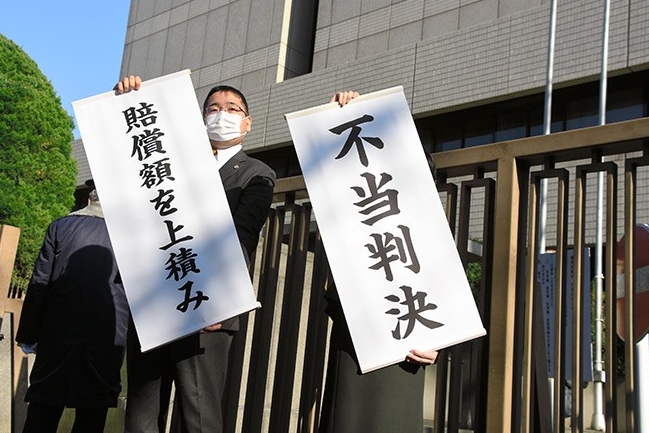
The Tokyo High Court finds the state not liable for the 2011 Fukushima nuclear power plant accident. A legal team member for the plaintiffs holds up a sign stating, “It is an unjust ruling,” in Tokyo on Jan. 21.
January 22, 2021
The Tokyo High Court has ruled the government should not be held responsible for the 2011 Fukushima No.1 nuclear power plant accident and be forced to pay compensation to evacuees.
Residents who evacuated to Gunma Prefecture due to the accident claimed damages against the government and Tokyo Electric Power Co. (TEPCO). But according to the Jan. 21 appellate ruling, the court found the state was not liable and ordered only TEPCO to pay compensation.
That followed a lower court ruling by the Maebashi District Court that found both parties liable.
The Tokyo High Court also raised the total compensation from about 40 million yen ($386,160) for 62 plaintiffs in the lower court ruling to about 120 million yen for 90 plaintiffs.
But the plaintiffs’ lawyers criticized the ruling afterward, contending the court was led astray by the government’s “phony” line of argumentation, and said the increase in compensation still falls far short of the “complete compensation” their clients deserve.
There are about 30 class action suits nationwide filed by evacuees and others over the triple meltdown at the nuclear power plant. Out of 14 lower court rulings, the state was held responsible in seven cases.
The higher court appellate ruling was the second such case since the Sendai High Court ruling last September. But the Sendai court held the state responsible. The rulings were divided both at the lower and higher court levels.
The main issue of contention in this latest ruling was the credibility of a long-term evaluation report, prepared by the government’s Headquarters for Earthquake Research Promotion in 2002.
The Maebashi District Court found the evaluation to be credible in establishing liability. The report suggested the possibility that an 8.2-magintude earthquake and tsunami could occur off the coast of the Tohoku region.
But on the other hand, the Tokyo High Court did not find the evaluation to be credible at establishing liability, partly because it differed from the perspective given by a civil engineering society at the time.
“We can’t say that the occurrence of the tsunami was foreseeable based on the long-term evaluation,” the court said.
Furthermore, the higher court said, “You couldn’t have avoided the accident even if preventative measures were taken based on the long-term evaluation.” That is because there was a big difference between the size and type of the tsunami risk calculated by TEPCO based on the evaluation and the actual tsunami that hit.
The higher court concluded that the government was not acting in a significantly unreasonable manner by not invoking its regulatory authority to order TEPCO to take preventative measures.
Meanwhile, the higher court did find TEPCO responsible, and said that the “plaintiffs’ interests to lead their peaceful daily lives were infringed upon due to the accident.”
The Maebashi District Court had ordered TEPCO to pay 38.55 million yen to 62 out of 137 plaintiffs. But the higher court evaluated their areas of residence prior to the evacuation on a case-by-case basis, and therefore increased the overall amount to about 120 million yen for 90 plaintiffs, with payments to individuals ranging from 70,000 yen to 14.94 million yen.
After the higher court ruling, the legal team for the plaintiffs issued a statement disapproving of the logic behind the ruling.
“The court was tricked by the government’s phony argument and put more importance on the civil engineering evaluation–which was nothing but the standard within the industry–than the long-term evaluation.”
“The ruling was the exact opposite of the Sendai High Court decision,” Izutaro Managi, a lawyer for the plaintiffs, said at a news conference. “The reason why the court did not admit the foreseeability (of the tsunami) is the worst of all the rulings so far.”
Fukushima residents demand stricter decontamination to enable safe return
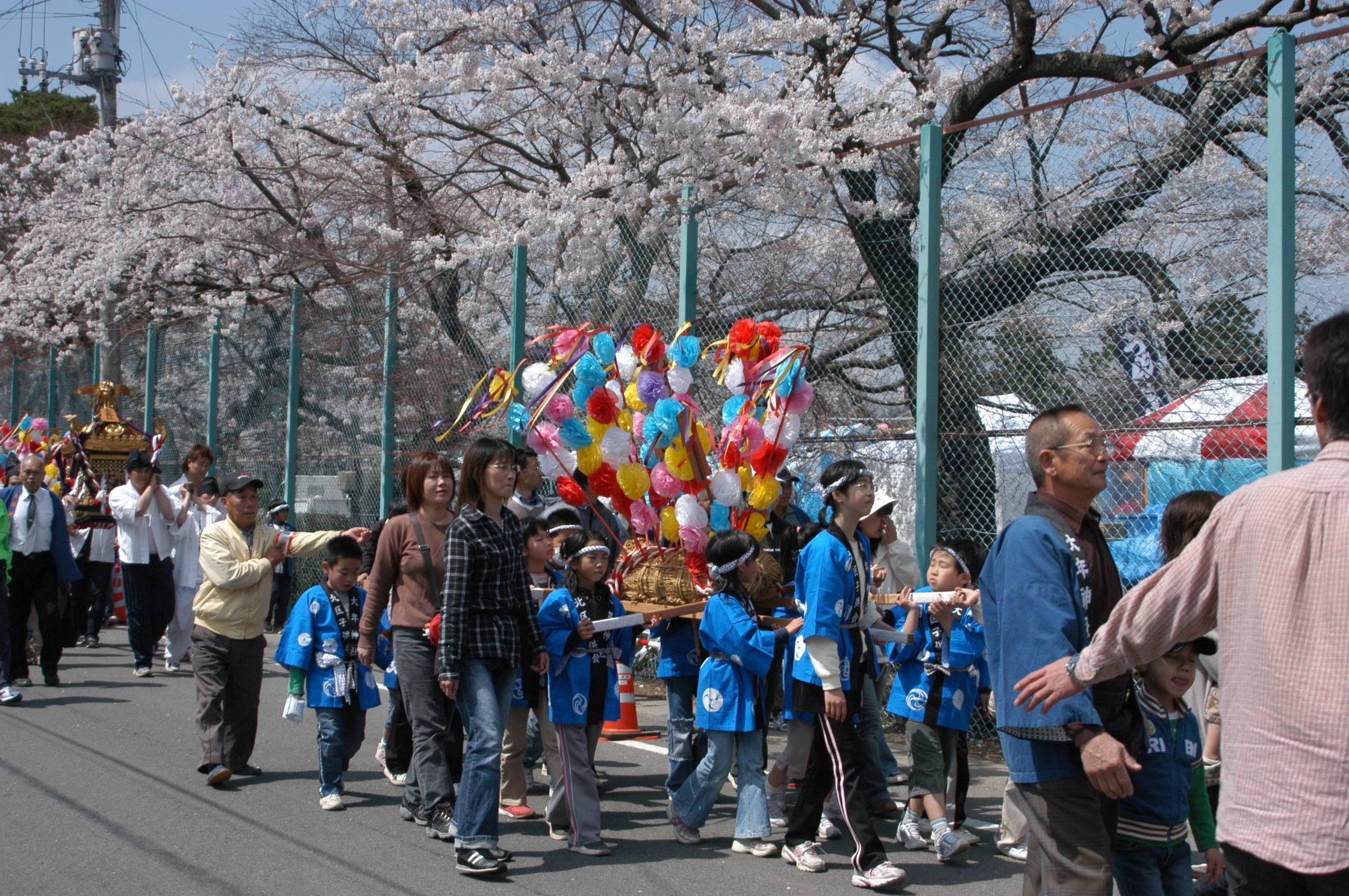
Residents of the Yonomori district in Tomioka, Fukushima Prefecture, march with a portable shrine in April 2007.
January 22, 2021
“Will Tomioka go back to how it was before?” Looking at the results of a survey, Kazuyoshi Kamata, vice head of the Yonomori Station northern administrative district in Tomioka, Fukushima Prefecture, reflects on his hometown and its reconstruction following the Fukushima No. 1 nuclear power plant triple meltdown in 2011.
In the surveys conducted by the Reconstruction Agency last fall, Tomioka residents listed important conditions in deciding whether they would return to their hometown or not, such as the reopening and construction of new medical, welfare and elder care facilities as well as the resumption and improvement of shopping complexes.
One condition that stands out among the list, though, is a further reduction in the amount of radiation, which 1 in 3 residents raised as an important issue. The government has been decontaminating specially designated areas, where it was once thought that settlement was limited for good but which can be reopened for residents. It has set the annual radiation exposure limit to be lower than 20 millisieverts as one of the standards to lift the evacuation orders.
Now that nearly 10 years have passed since the nuclear crisis at the Fukushima No. 1 plant, Kamata stressed the need for the government to decontaminate the area under stricter standards so that residents will feel safer returning to their hometown.
“In order to maintain people’s feelings for their hometowns, I want (the government) to stick to the stance of rebuilding our Tomioka in the form that we all want, including restoring the (basic living) environment.”
Tomioka’s Yonomori district used to be bustling with an increasing population, said Kamata, adding that younger generations supported the local community by planning events utilizing a famous row of cherry blossom trees and developing agriculture centered around rice crops.
“The district was a place full of energy where everyone, regardless of generation, was involved in making the local community,” said Kamata.
At the Yonomori cherry blossom festival held in spring, for example, smiles spread among residents as children strolled around, and the event also featured a mikoshi, or Shinto palanquin, from Otoshi Shrine.
The government is also doing its part in reconstructing the specially designated area in Tomioka by establishing zones focused on revitalizing businesses and agriculture. With creating agricultural corporations and making use of tourism resources such as roadside cherry blossom trees as the two main pillars, the government is working to attract about 1,600 people to live there, which is 40% of the population before the accident.
In the meantime, residents have been raising concerns about the 20 millisieverts condition, demanding a higher standard and more decontamination. In places that have recorded higher radiation levels, it is expected there will be damage from harmful rumors about things including tourism and agriculture.
“Without people, reconstruction would not begin. Creating conditions to invite more people without concerns is of utmost importance,” said Kamata, arguing that alongside other areas, restoring the living environment, including decontamination with the aim of lowering the annual radiation exposure to 1 millisevert or less, will be needed for future generations to live in Yonomori.
“Once the evacuation order is lifted, I want the local community to regain its connections within (the district),” said Kamata, hoping to take on a role of handing down the district’s traditions and way of life, as well as traditional scenery, to younger generations once he returns. As a vice-head of the administrative district, though, Kamata also intends to communicate crucial issues to the local government while residing in the area.
The lifting of the evacuation order in the specially designated area is expected in the spring of 2023, 12 years after the order was first issued.
“Without tackling issues such as restoring the living environment and infrastructure, as well as decommissioning of the Fukushima No.1 plant in a diligent manner, people won’t come back,” said Kamata. Now he hopes the government will share his passion for the hometown’s rebuilding.
This section features topics and issues covered by the Fukushima Minpo, the prefecture’s largest newspaper. The original article was published Jan. 12.
https://www.japantimes.co.jp/news/2021/01/22/national/fukushima-decontaminating-town/
High court denies government responsibility for Fukushima nuclear crisis
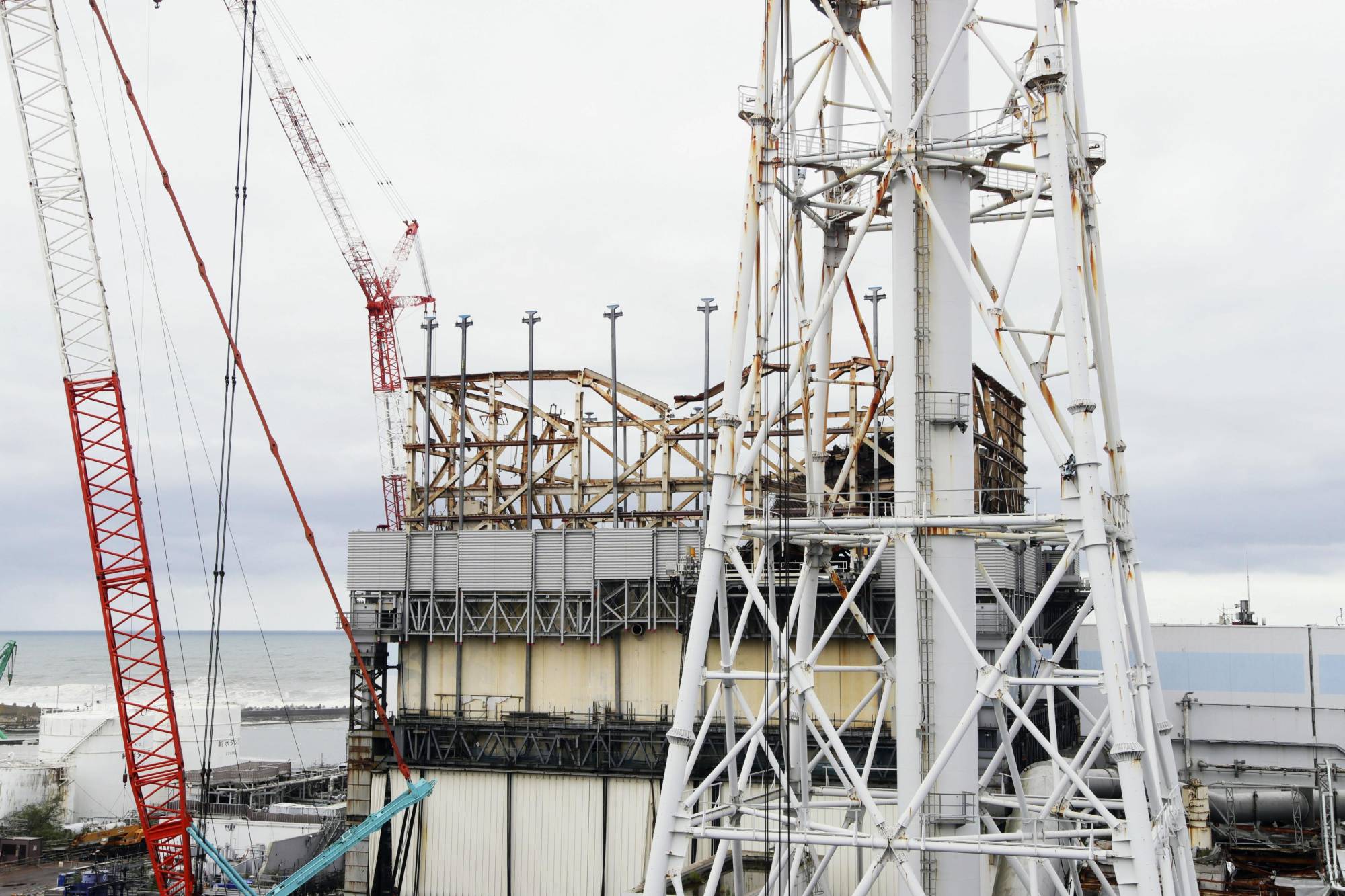
Decommissioning work is under way at the disaster-stricken Fukushima No. 1 nuclear power plant.
January 21, 2021
The Tokyo High Court on Thursday ordered the operator of the crippled Fukushima No. 1 nuclear power plant to pay damages to evacuated residents, but it overturned an earlier ruling by Maebashi District Court that had also acknowledged the central government’s responsibility over the 2011 nuclear crisis.
Among around 30 such lawsuits across the country, the decision of the Tokyo High Court was the first high court ruling absolving the state of responsibility, contradicting an earlier decision of the Sendai High Court in September that ordered both the state and Tokyo Electric Power Company Holdings Inc. to pay damages.
The government’s failure to instruct Tepco to take measures against tsunamis “is not found to be significantly unreasonable,” Presiding Judge Akira Adachi said in handing down the ruling.
The lawsuit focused on the reliability of an official long-term quake assessment made in 2002, which has been used in previous rulings to determine the liability of the state and Tepco for their failure to prevent the nuclear disaster.
Adachi noted the assessment had caused a debate since its release, and that the government was unable to predict a huge tsunami.
Implementing measures such as constructing seawalls would not have prevented the tide from entering the nuclear plant, he added.
Thursday’s ruling instead ordered Tepco to pay a total ¥119.72 million to 90 plaintiffs, more than triple the amount awarded in the lower court ruling.
In March 2017, the Maebashi District Court awarded a total of ¥38.55 million to 62 plaintiffs who evacuated from Fukushima Prefecture, including those who voluntarily left, acknowledging the government and the utility were negligent in preparing for a tsunami like the one that struck the facility.
The district court said the disaster was caused by a failure to cool nuclear fuel as water entered turbine buildings through air supply openings in the wake of the tsunami triggered by a massive earthquake, crippling emergency switchboards.
The lawsuit was filed by a total of 137 plaintiffs relocated to Gunma Prefecture and elsewhere. They sought a combined ¥1.5 billion — ¥11 million each — in damages for emotional distress.
They were forced to leave their hometowns as three reactors suffered meltdowns at the plant after the magnitude 9.0 earthquake and ensuing tsunami hit northeastern Japan on March 11, 2011.
The plaintiffs said they had lost their livelihoods and faced inconvenience for an extensive period, and the amount they received under the current state compensation guidelines was not enough.
Local governments growing more reliant on nuclear taxes
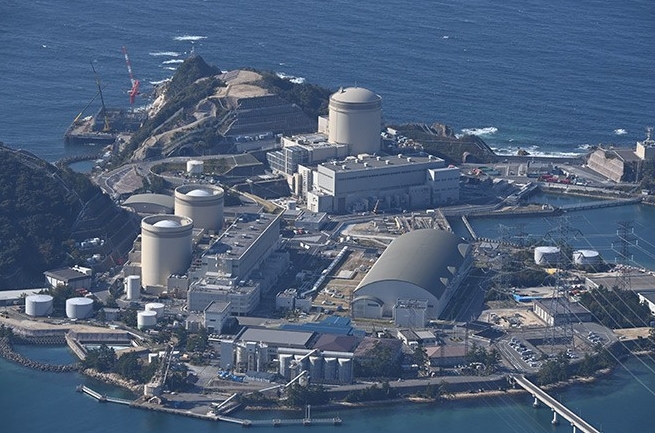
Kansai Electric Power Co.’s Mihama nuclear power plant in Mihama, Fukui Prefecture
January 20, 2021
Local governments are increasingly depending on tax revenues from the nuclear plants they host, a relationship that has deepened over the 10 years since the Fukushima nuclear disaster, an analysis by The Asahi Shimbun shows.
That follows the introduction of new tax regimes that ensure a steady flow of nuclear-related tax yields–even when reactors are idle or in the process of being decommissioned. They were brought about largely through increasing existing taxes on nuclear fuels and levying new taxes on spent nuclear fuels kept at the plants.
In fiscal 2011, right after the triple meltdown at the Fukushima No. 1 nuclear power plant, jurisdictions home to nuclear plants and related facilities yielded some 20.1 billion yen ($193.7 million) in taxes. The bulk of that came from taxes on nuclear fuel; many local governments only began collecting spent fuel taxes years after the accident.
But then the figure more than doubled to an estimated 46.7 billion yen in fiscal 2020, ending in March, despite the nuclear plants being offline.
The Asahi Shimbun studied nuclear-related tax revenues received by host municipalities and the 13 prefectures where those municipalities are located.
Local governments can impose taxes on nuclear fuel and spent nuclear fuel at plants and related facilities through approving ordinances to do so.
Of all the jurisdictions examined, Aomori Prefecture, where nuclear fuel cycle facilities are concentrated, and Fukui Prefecture, which hosts 15 reactors, the most in Japan, account for more than 60 percent earned through those taxes.
The amount for fiscal 2020 is larger than the 40.3 billion yen brought in during fiscal 2010, when the plants were operating.
Nuclear fuel taxes were originally based on the value of reactor fuel.
But all the nuclear plants went offline following the Fukushima disaster in March 2011.
As a result, six prefectures housing nuclear plants reported no tax revenues from nuclear fuel taxes in fiscal 2011.
Desperate to secure income sources even during plant closures, Fukui Prefecture introduced in autumn 2011 a new fuel-tax system based on reactor output capacity–meaning the reactors can be taxed even when shut down.
Other jurisdictions home to nuclear plants followed suit.
In 2014, Ehime Prefecture devised a tax on output capacity that can still be applied when the reactor is undergoing decommissioning. Soon after, Saga Prefecture introduced a similar system.
Nuclear plant operators must pay taxes on spent nuclear fuel to the local government as well as to the prefectural government if ordinances requiring the payment were enacted at both levels.
Ehime and Saga prefectures began taxing spent nuclear fuel in 2019.
Ikata, home to the Ikata nuclear plant in Ehime Prefecture, introduced a tax on spent nuclear fuels in fiscal 2018, after Genakai, which hosts the Genkai nuclear plant in Saga Prefecture, did the same in fiscal 2017.
Mutsu, located in Aomori Prefecture, is ready to capitalize on playing host to an interim storage facility for spent nuclear fuel, which is expected to go into operation in fiscal 2021.
The Mutsu city government established new rules in March last year so it can levy tax on spent nuclear fuels. The tax is projected to bring 9.3 billion yen to the city over five years.
Fukui Prefecture introduced a tax regime for nuclear fuels in 1976, ahead of any other local governments with nuclear facilities in the country.
Since then, tax revenues from nuclear fuels and spent fuels brought in by all jurisdictions totaled more than 1 trillion yen through fiscal 2020. And the figure is projected to grow in the years to come.
The driving force behind these local governments expanding their nuclear taxes in new and creative ways is a decline in tax revenues from fixed assets on nuclear facilities, and fewer grants and subsidies coming in from the national coffers to promote nuclear energy.
Many host communities have underlined the need to secure income from hosting nuclear plants, operating or not, to finance new roads and other infrastructure that would be used to evacuate residents in the event of a serious accident.
But a significant number of local governments used tax revenues derived from nuclear plants to cover upkeep of hot spring resorts and other seemingly unrelated facilities, the study shows.
Regional utilities added the amount of taxes on nuclear fuels and spent nuclear fuels they will pay into the electricity rates that consumers paid until 2016, when the retail electricity market became fully liberalized.
Even after the market liberalization, they can do the same to come up with funds to pay nuclear fuel and spent nuclear fuel taxes.
Dumping Fukushima’s contaminated water into the ocean could be a violation of international law
Environmental implications require an international conversation
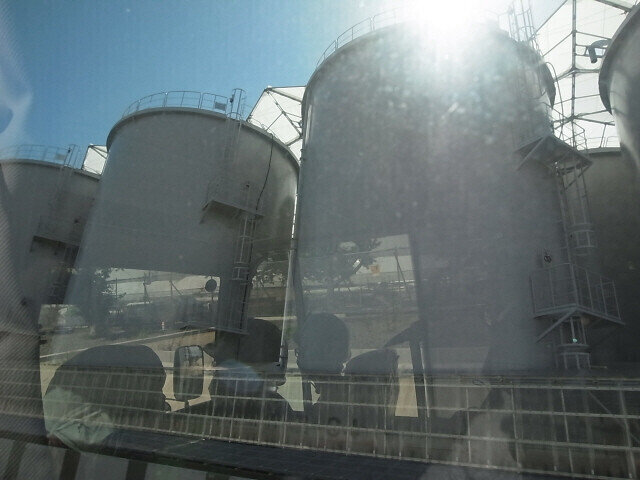
Storage tanks for radioactive water at the Fukushima Daiichi Nuclear Power Plant.
January 10,2021
At a meeting of parties to the London Convention and Protocol on Dec. 14, the South Korean Ministry of Oceans and Fisheries (MOF) clearly stated that the release of contaminated water from the Fukushima Nuclear Power Plant into the ocean was not a sovereign decision for the Japanese government to make. Its reason was that the damage would extend beyond the scope of Japan’s jurisdiction, affecting nearby countries including South Korea.
While the US and France have stated their trust in the safety of releasing the water and referred to it as a matter for the International Atomic Energy Agency (IAEA) to oversee, delegations from China, Russia, and Canada indicated their support for the South Korean government’s position. David Santillo, a Greenpeace Research Laboratories senior scientist who took part in the meeting, stressed that the matter of releasing the water into the ocean was something to be discussed at an international level.
During the meeting, the MOF worked to encourage other countries in the region to indicate their support, while also ensuring an opportunity to continue the debate at the next meeting. Despite these efforts by the South Korean government, some in South Korea still maintain that there is nothing wrong with dumping the water because it’s been treated. This conclusion is faulty.
The 1.37 million tons (as of summer 2022) that are currently set to be released into the Pacific Ocean are just the start of the issue. Even after that enormous amount has been discharged, radioactive material — hundreds of tons produced each week at the Fukushima plant — will continue to be released. Some of the radioactive substances have half-lives in the tens of thousands of years or more. The main reason for the water’s contamination has to do with three reactors that melted down in the Fukushima disaster. Cooling water has to be added daily to control the reactors as they continue to undergo nuclear fission. This means that water is going to continue to be contaminated until the reactors’ nuclear fuel and waste have been completely removed.
The amount of nuclear fuel remaining after the Chernobyl disaster, commonly viewed as the worst nuclear catastrophe in history, has been reported at around 570 tons. The Ukrainian government predicted it would take 100 years to remove it all. This means there is no way to pledge any concrete timeline. Within the Fukushima reactors, there are more than 1,100 tons of remaining nuclear fuel and waste, nearly twice as much as Chernobyl. In particular, most of the strontium, which inflicts the most biological damage, is still in the reactors.
As more water is contaminated by this highly concentrated radioactive material, it accumulates in the ecosystem. The amount of contaminated water that the Japanese government plans to release into the Pacific already exceeds 1 million tons; over the next 10 years, it could rise to 2 million. The radioactive substances in the water are another issue. As cesium and strontium deposit and accrete on the ocean floor, they can release radioactive matter over the long term. The effects on marine life are likewise severe.
The problem is that there is no way of gauging or preventing the damage ahead of time. This is why there are such strict regulations on the disposal of radioactive material into the ocean. The Japanese government has argued that its release of Fukushima water is justified by likening it to the release of cooling water from normally operating nuclear power plants, but no precedent exists where permission has been granted to discharge waste from a nuclear accident into the marine environment. As such, South Korea needs to stop the Japanese government’s decision to avoid a tragic outcome.
To begin with, Seoul has the right to demand that Tokyo perform an official environmental impact assessment. The release of the contaminated water into the ocean would be a violation of international law if it does not conform to the principle of prior notification and the obligation to perform an environmental assessment.
Even the IAEA, which has sided with the Japanese government, explicitly mentioned the need for an environmental impact assessment in its report. The South Korean government must speak out and ensure it happens.
By Chang Mari, Greenpeace energy campaigner
http://english.hani.co.kr/arti/english_edition/english_editorials/978035.html
The nuclear weapons ban treaty is groundbreaking, even if the nuclear powers haven’t signed
 The nuclear weapons ban treaty is groundbreaking, even if the nuclear powers haven’t signed https://theconversation.com/the-nuclear-weapons-ban-treaty-is-groundbreaking-even-if-the-nuclear-powers-havent-signed-153197January 22, 2021 Tilman Ruff, Honorary Principal Fellow, School of Population and Global Health, University of Melbourne, Today, many around the world will celebrate the first multilateral nuclear disarmament treaty to enter into force in 50 years.The UN Treaty on the Prohibition of Nuclear Weapons (TPNW) was adopted at the United Nations in 2017 and finally reached the milestone of 50 ratifications in October. The countries that have signed and ratified include Austria, Ireland, Mexico, New Zealand, South Africa, Nigeria and Thailand. The nuclear weapons ban treaty is groundbreaking, even if the nuclear powers haven’t signed https://theconversation.com/the-nuclear-weapons-ban-treaty-is-groundbreaking-even-if-the-nuclear-powers-havent-signed-153197January 22, 2021 Tilman Ruff, Honorary Principal Fellow, School of Population and Global Health, University of Melbourne, Today, many around the world will celebrate the first multilateral nuclear disarmament treaty to enter into force in 50 years.The UN Treaty on the Prohibition of Nuclear Weapons (TPNW) was adopted at the United Nations in 2017 and finally reached the milestone of 50 ratifications in October. The countries that have signed and ratified include Austria, Ireland, Mexico, New Zealand, South Africa, Nigeria and Thailand.
The treaty completes the suite of international bans on all major weapons considered unacceptable because of their indiscriminate and inhumane effects, including anti-personnel landmines, cluster munitions, biological and chemical weapons. The countries that have signed the TPNW were fed up with over half a century of the nuclear-armed states flouting their obligation to rid the world of their weapons. They have asserted the interests of humanity and global democracy in a way the nuclear-armed states were powerless to stop. It is certainly long overdue for the most cruel and destructive weapons of all — nuclear weapons — to be banned. But this treaty is a sign of hope — a necessary and important step toward a less destructive planet. What will the treaty do?The aim of the treaty is a comprehensive and categorical ban of nuclear weapons. It binds signatories not to develop, test, produce, acquire, have control of, use or threaten to use nuclear weapons. States also cannot “assist, encourage or induce” anyone to engage in any activity prohibited under the treaty — essentially anything to do with nuclear weapons. The TPNW strengthens the current nuclear safeguards found in the 1970 Treaty on the Non-Proliferation of Nuclear Weapons by requiring all states that join to have comprehensive provisions in place and not allowing states to weaken their existing safeguards. The treaty provides the first legally binding multilateral framework for a process by which all nations can work toward eliminating nuclear weapons. For instance, states with another nation’s nuclear weapons stationed on their territory must remove them. States with nuclear weapons can “destroy then join” the treaty, or “join then destroy”. They must irreversibly dismantle their weapons, as well as the programs and facilities to produce them, subject to agreed timelines and verification by an international authority. Further, the TPNW is the first treaty to commit member nations to provide long-neglected assistance for the victims of atomic bombs and weapon testing. It also calls for nations to clean up environments contaminated by nuclear weapons use and testing, where feasible. Nuclear-armed states have been put on noticeCurrently, 86 nations have signed the TPNW, and 51 have ratified it (meaning they are bound by its provisions). The treaty now becomes part of international law, and the number of signatories and ratifications will continue to grow. However, none of the nine nuclear powers — the US, China, Russia, France, the UK, India, Pakistan, Israel and North Korea — have yet signed or ratified the treaty. Many other countries that rely on other nations’ nuclear weapons for their security, such as the 27 members of NATO, Australia, Japan and South Korea, have also not signed. So, why does the treaty matter given these states currently oppose it? And what effect can we expect the treaty to have on them? While any treaty is technically only binding on the states that join it, the TPNW establishes a new international legal standard against which all nuclear policies will now be judged. The treaty, in short, is a game-changer, and the nuclear-armed and dependent countries have been put on notice. They know the treaty jeopardises their claimed right to continue to threaten the planet with their weapons, as well as their plans to modernise and maintain their nuclear arsenals indefinitely. The strength of their opposition is a measure of the treaty’s importance. It will have implications for everything from defence policies and military plans to weapons manufacturing to financial investments in the companies that profit from making now illegal nuclear weapons. For example, a growing number of banks, pension funds and insurance companies around the world are now divesting from companies that build nuclear weapons. These include the Norwegian Pension Fund (the world’s largest sovereign wealth fund), ABP (Europe’s largest pension fund), Deutsche Bank, Belgium’s largest bank KBC, Resona Holdings, Kyushu Financial Group and Mitsubishi UFJ Financial Group in Japan, and the Japanese insurance companies Nippon Life, Dai-ichi Life, Meiji-Yasuda and Fukoku Mutual. A ‘dangerous’ belief nuclear weapons enhance securityWould joining the treaty mean nations like Australia, Japan, South Korea and NATO members would have to end their military cooperation with nuclear-armed states like the US? No. There is nothing in the TPNW that prevents military cooperation with a nuclear-armed state, provided nuclear weapons activities are excluded. Countries like New Zealand and Kazakhstan have already demonstrated that joining the treaty is fully compatible with ongoing military cooperation with, respectively, the US and Russia. In a recent letter urging their governments to join the treaty, 56 former presidents, prime ministers and defence and foreign ministers from these nations said
The signatories include two former NATO secretaries-general, Willy Claes and Javier Solana. Ban treaties have been proven to work with other outlawed weapons — landmines, cluster munitions and biological and chemical weapons. They have provided the basis and motivation for progressive efforts to control and eliminate these weapons. They are now significantly less produced, deployed and used, even by states that haven’t joined the treaties. We can achieve the same result with nuclear weapons. As Hiroshima survivor Setsuko Thurlow said at the UN after the treaty was adopted, This is the beginning of the end of nuclear weapons. |
|
|
Strong opposition to USA’s Nuclear Rubberstamp Commission extending nuclear reactors’ lives to 100 years
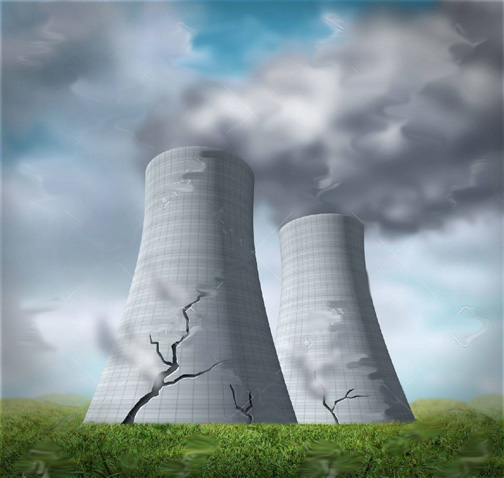

Well, I can’t help think that all these officials are looking out for themselves here. They hope that the disasters and cleanups won’t be their problem, – but the problem of future taxpayers.
|
RESOUNDING NO – TO LETTING NUCLEAR PLANTS RUN FOR 100 YEARS, The Sentinel By Karl Grossman, Jan 22, 2021
The U.S. Nuclear Regulatory Commission held a “public meeting” this week on what it titled “Development of Guidance Documents To Support License Renewal For 100 Years Of Plant Operation.” Comments from the “public” were strongly opposed to the NRC’s desire for it to let nuclear power plants run for a century. “I request you pause and consider before you go ahead on this reckless path,” testified Michel Lee, chairman of the New York-based Council on Intelligent Energy & Conservation Policy. “Our position and that of our constituents is a resounding no,” declared Paul Gunter, director of the Reactor Oversight Project at the national organization Beyond Nuclear. “It’s time to stop this whole nuke con job,” said Erica Gray, nuclear issues chair of the Virginia Sierra Club. There is “no solution” to dealing with nuclear waste, she said. It is “unethical to continue to make the most toxic waste known to mankind.” And, “renewable energy” with solar and wind “can power the world.” Jan Boudart, a board member of the Chicago-based Nuclear Energy Information Service, spoke, too, of the lack of consideration of nuclear waste. Cited was the higher likelihood of accidents with plants permitted to run for 100 years. Whether the NRC—often called the Nuclear Rubberstamp Commission—listens is highly unlikely considering its record of rubberstamping whatever has been sought by other nuclear promoters in government and the nuclear industry. Nuclear power plants when they began being built were not seen as running for more than 40 years because of radioactivity embrittling metal parts and otherwise causing safety problems. So operating licenses were limited to 40 years. But with the major decline of nuclear power—the U.S. is down to 94 plants from a high of 129 and only two are now under construction—the nuclear promoters in the U.S. government and nuclear industry are pushing to let nuclear power plants run for 100 years to somehow keep nuclear power going…….. In further discussing the “Life Beyond Eighty” scheme for nuclear power plants, Rosseel showed a U.S. Energy Information Administration slide projecting the amount of energy nuclear power would contribute to the U.S. energy supply in decline from 19% in 2019 to 12% in 2050 while renewable energy sources would jump from the current 19% to 38%. For the DOE, which inherited the role of promoting nuclear power from the U.S. Atomic Energy Commission, abolished by Congress in 1974 for being in conflict of interest for having a dual role of both promoting and regulating nuclear power, this decline is of great concern. At the start of the “public meeting” on January 21—held online as a teleconference—Allen L. Hiser, Jr., senior technical advisor for the Division of New and Renewed Licenses of the NRC, said the Atomic Energy Act of 1954 gave authority to the U.S. government to license nuclear power plants for 40 years. “But nothing in the AEA [Atomic Energy Act] prohibits a number of license renewals,” said Hiser. Using this lack of prohibition in the Atomic Energy Act, the NRC is now pushing ahead on the scheme to let nuclear power plants run for 100 years.
The NRC—which was supposed to only get the regulatory function from the eliminated U.S. Atomic Energy Commission—has also, with DOE, been a promoter of nuclear power. Earlier, it began extending the operating licenses of nuclear power plants to run for 60 years—and most of the plants in the U.S. now are being allowed to run for 60 years. And in recent years it has given the go-ahead for nuclear plants to run for 80 years, and several have been licensed for that length. In granting the license extensions to 60 and 80 years, the NRC has also been allowing the plants to be “uprated” to generate more electricity—to run hotter and harder—further asking for disaster. Gunter testified about an NRC cover-up involving the extending of nuclear power plant licenses. Using PowerPoint to reinforce his points, Gunter displayed a 2017 report commissioned by the NRC made by the DOE’s Pacific Northwest National Laboratory. The “very critical report,” said Gunter, looked at conducting research on the impacts of extending nuclear power plant operating licenses. It is titled “Criteria and Planning Guidance for Ex-Plant Harvesting to Support Subsequent License Renewal.” http://www.beyondnuclear.org/storage/aging/slr/autopsy_PNNL-27120_harvesting_Dec2017.pdf The report listed many significant issues considering the “harsh” degradation of nuclear power plant components over the years, he said. It pointed to “a host of critical technical gaps.” fter he “raised questions about” issues in the report at a meeting on operating license extensions held in 2018 at the NRC’s headquarters in Rockville, Maryland, the report was “taken down from government websites,” said Gunter. However, Beyond Nuclear saved a copy of the report. He spoke of an email that Beyond Nuclear obtained, after two years of trying under the U.S. Freedom of Information Act, from an NRC employee saying: “Big picture, I think the entire report needs to be scrubbed.” A “sanitized” version of the report, said Gunter, was “republished” in 2019. Gunter spoke of “public safety” being threatened. Gunter, also at the “public meeting” this week, said among the issues not being considered in the NRC’s drive to extend the licenses of nuclear power plants to 100 years is the management of the radioactive waste generated by the plants and “the advent of reliable, competitive and abundant renewable energy.” The oldest nuclear power plant in the U.S. was Oyster Creek in Toms River, New Jersey which opened in 1969 and was shut down 49 years later in 2018. What President Joe Biden does about nuclear power—he has said he is for “advanced” nuclear power—and the pro-nuclear NRC remains to be seen. The president appoints the five members of the NRC, and its current chairperson, a nuclear engineer and Trump appointee, is resigning. Biden could move to have done to the NRC what was done to its predecessor agency, the AEC, to have it abolished. And to push to end nuclear power in the U.S. Most U.S. nuclear power plants, according to a PowerPoint slide shown by the NRC’s Hiser, have already operated more than 40 years—the numbers of years they were seen as running safely when they began operating. https://www.thesentinel.com/communities/montgomery/news/science/resounding-no-to-letting-nuclear-plants-run-for-100-years/article_4cef89fc-5cc1-11eb-bfab-8b68f4bca770.html |
|
|
USA and Iran must overcome 9 hurdles to revive the nuclear deal.
 Nine hurdles to reviving the Iran nuclear deal, Bulletin of the Atomic Scientists, By Seyed Hossein Mousavian | January 19, 2021, Although reviving the agreement is certainly still possible, it won’t be easy. The two sides will need to overcome nine hurdles to make it happen.
First, the sequencing of a mutual return could be an immediate problem. Iran expects the United States to lift sanctions first, because it was the Trump administration that withdrew first. While Tehran’s demand is legitimate, Washington may ask that Iran come into full compliance before lifting sanctions. …….
Second is the issue of what compliance constitutes …….
Third, the Trump administration imposed numerous sanctions against Iran under the guise of terrorism and human rights, aimed at preventing the Biden administration from returning to the deal. For a clean implementation of the agreement, Biden will need to remove all of these sanctions as well.
Fourth, Trump’s withdrawal from the agreement and violation of the UN Security Council Resolution 2231 as well as other international commitments has damaged US credibility abroad. …..Fifth, because of Trump’s maximum pressure policy, the Iranian economy has suffered hundreds of billions of dollars of losses while Iran was in full compliance with the terms and conditions of the deal……..
Sixth, the “snapback” mechanism built into the agreement allows any country to force the UN Security Council to reimpose multilateral sanctions against Iran if Iran fails to fulfill its commitments. But this is one-sided: There is no such remedy for Iran if other parties fail to do their part. ………
Seventh, in the first week of December 2020, the Iranian parliament passed a bill mandating Iran’s Atomic Energy Organization to resume enriching uranium to 20 percent purity. The legislation also requires the Iranian government to cease voluntary implementation of the IAEA’s Additional Protocol within two months of the bill’s enactment if the other signatories fail to fully deliver on their commitments under the agreement. …….
Eighth, there are some in the United States who are worried that Trump may start a reckless last-ditch war with Iran before leaving office. ……
Ninth, some pundits and politicians in Washington want Biden to leverage the Trump administration’s sanctions to pressure Iran to accept additional commitments beyond the original agreement as a condition for US return to compliance……..
Despite these hurdles, Biden should nevertheless seek a reentry into the deal. Only a clean and full implementation by all parties can save the world’s most comprehensive nuclear agreement, contain rising US-Iran tensions, and open the path toward more confidence building measures. That path should include, upon Biden’s issuing an executive order to rejoin the JCPOA, the creation of a working committee of parties to the agreement tasked with ensuring full compliance by all signatories, and a forum, organized by the UN secretary general, in which Iran and the Gulf countries can discuss a new structure for improving security and cooperation in the region. https://thebulletin.org/2021/01/nine-hurdles-to-reviving-the-iran-nuclear-deal/?utm_source=Newsletter&utm_medium=Email&utm_campaign=ThursdayNewsletter01212021&utm_content=NuclearRisk_9hurdles_01192021
Tokyo High Court holds TEPCO responsible for Fukushima nuclear crisis
No wonder that the global nuclear industry is hellbent on nationalising itself – so that the taxpayer is responsible. Nobody will want to invest in private nuclear companies after this.
High court denies government responsibility for Fukushima nuclear crisis, Japan Times, 22 Jan 21, The Tokyo High Court on Thursday ordered the operator of the crippled Fukushima No. 1 nuclear power plant to pay damages to evacuated residents, but it overturned an earlier ruling by Maebashi District Court that had also acknowledged the central government’s responsibility over the 2011 nuclear crisis.
Among around 30 such lawsuits across the country, the decision of the Tokyo High Court was the first high court ruling absolving the state of responsibility, contradicting an earlier decision of the Sendai High Court in September that ordered both the state and Tokyo Electric Power Company Holdings Inc. to pay damages.
The government’s failure to instruct Tepco to take measures against tsunamis “is not found to be significantly unreasonable,” Presiding Judge Akira Adachi said in handing down the ruling.
The lawsuit focused on the reliability of an official long-term quake assessment made in 2002, which has been used in previous rulings to determine the liability of the state and Tepco for their failure to prevent the nuclear disaster.
Adachi noted the assessment had caused a debate since its release, and that the government was unable to predict a huge tsunami.
Implementing measures such as constructing seawalls would not have prevented the tide from entering the nuclear plant, he added.
Thursday’s ruling instead ordered Tepco to pay a total ¥119.72 million to 90 plaintiffs, more than triple the amount awarded in the lower court ruling. ………..https://www.japantimes.co.jp/news/2021/01/21/national/crime-legal/government-denies-fukushima-responsibility/
Russia welcomes US proposal to extend New Start nuclear treaty
Russia welcomes US proposal to extend nuclear treaty, 9 News, By Associated Press
UK’s Centre for Policy Studies about to change its name to Centre for the Promotion of Nuclear Sizewell C?
|
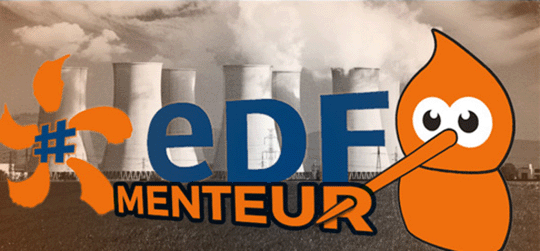
Times 21st Jan 2021. Apparently the Centre for Policy Studies is “Britain’s leading centre-right think tank”. But who knew it was changing its name to the Centre for the Promotion of Sizewell C? Its latest missive comes with a press release headed: “Net zero target at risk without investment in new nuclear”.
And given the report’s general drift, you’d think all 58 pages had been penned by France’s EDF: the cost-overrun and late-delivery specialists behind the consumer-fleecing £22.5 billion Hinkley Point C.
Actually, you’d be wrong. EDF merely “supported” the report. Ask the CPS what that means and it admits it paid for it — or at least “contributed funding”.
True, Britain needs an energy mix…. But Sizewell C? That also brings flood risk and money from the Hong Kong crackdown experts of Beijing.
And the National Infrastructure Commission reckons a “highly renewable power system” plus “flexible technologies”, including hydrogen, “could besubstantially cheaper” than relying on a “fleet of nuclear power plants”. A fake independent report from the CPS hardly improves their
case. https://www.thetimes.co.uk/article/an-airline-takeover-that-might-fly-8t8qbjl07 |
|
More than half of public supports UK joining UN ban on nuclear weapons.
The National 22nd Jan 2021, More than half of public supports UK joining UN ban on nuclear weapons.
https://www.thenational.scot/news/19029821.half-public-supports-uk-joining-un-ban-nuclear-weapons/
-
Archives
- February 2026 (228)
- January 2026 (308)
- December 2025 (358)
- November 2025 (359)
- October 2025 (376)
- September 2025 (258)
- August 2025 (319)
- July 2025 (230)
- June 2025 (348)
- May 2025 (261)
- April 2025 (305)
- March 2025 (319)
-
Categories
- 1
- 1 NUCLEAR ISSUES
- business and costs
- climate change
- culture and arts
- ENERGY
- environment
- health
- history
- indigenous issues
- Legal
- marketing of nuclear
- media
- opposition to nuclear
- PERSONAL STORIES
- politics
- politics international
- Religion and ethics
- safety
- secrets,lies and civil liberties
- spinbuster
- technology
- Uranium
- wastes
- weapons and war
- Women
- 2 WORLD
- ACTION
- AFRICA
- Atrocities
- AUSTRALIA
- Christina's notes
- Christina's themes
- culture and arts
- Events
- Fuk 2022
- Fuk 2023
- Fukushima 2017
- Fukushima 2018
- fukushima 2019
- Fukushima 2020
- Fukushima 2021
- general
- global warming
- Humour (God we need it)
- Nuclear
- RARE EARTHS
- Reference
- resources – print
- Resources -audiovicual
- Weekly Newsletter
- World
- World Nuclear
- YouTube
-
RSS
Entries RSS
Comments RSS
 nuclear-news