Kim Jong Un signals plans to develop new nuclear weapons
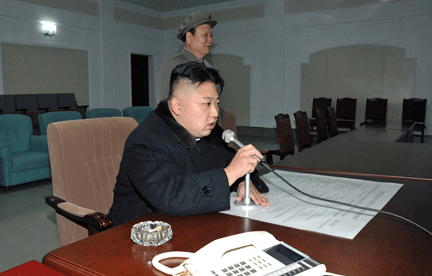 Kim Jong Un signals plans to develop new nuclear weapons. North Korea raises tensions with incoming US administration of Joe Biden. Ft.com Edward White in Seoul JANUARY 9 2021 Kim Jong Un has signalled plans to develop new nuclear weapons and described the US as North Korea’s “biggest enemy”, moves that threaten to raise tensions with US president-elect Joe Biden. The North Korean leader’s comments, made at a rare gathering of top political officials in Pyongyang, marked the dictator’s strongest broadside against Washington since Mr Biden won the presidency in November’s election.
“Our external political activities going forward should be focused on suppressing and subduing the US, the basic obstacle, biggest enemy against our revolutionary development,” Mr Kim said, according to a translation by South Korea’s Yonhap news agency. ………. https://www.ft.com/content/b4971c6e-8b89-43b5-93d2-9098d5f229ef
Iran will expel U.N. nuclear inspectors unless sanctions are lifted
Iran will expel U.N. nuclear inspectors unless sanctions are lifted: lawmaker
By Reuters Staff DUBAI (Reuters) 10 Jan 21, – Iran will expel United Nations nuclear watchdog inspectors unless U.S. sanctions are lifted by a Feb. 21 deadline set by the hardline-dominated parliament, a lawmaker said on Saturday.
Parliament passed a law in November that obliges the government to halt inspections of its nuclear sites by the International Atomic Energy Agency and step up uranium enrichment beyond the limit set under Tehran’s 2015 nuclear deal if sanctions are not eased.
Iran’s Guardian Council watchdog body approved the law on Dec. 2 and the government has said it will implement it….
Nuclear power – a dubious and very costly addition in UK’s energy plan
|
Renew Extra 9th Jan 2021, Dave Elliott: The White Paper on modelling UK electricity supply has some very odd things to say: it seems to see nuclear (and carbon capture) as low cost: ‘low-cost solutions at low carbon intensities can only be achieved with a combination of new nuclear and gas CCUS’.
However, it says that the use of hydrogen makes it more flexible, and it admits that ‘it is
technically possible for higher levels of hydrogen-fired generation to also replace nuclear and gas CCUS’, although it adds that ‘this is dependent on the quantity and cost of hydrogen available for generating electricity’. The White paper promised that a review of all existing energy National Policy Statements (NPSs), and presumably their cost and demand assumptions, would be carried out over the next year.
This is important since the old very dated NPSs (which were all designated by the government in 2011) have been used to justify decisions on energy. For example, the old NPSs were sometimes used to justify nuclear expansion on the basis of then expected growth in demand for electricity, whereas it’s actually fallen a lot.
It may help that the White Paper also noted that BEIS is to further upgrade its energy modelling work, going beyond its Mackay Carbon Calculator, its update of the late Prof. David Mackay’s 2011 modelling system.
There certainly are cost issues to face up to up. As far as it has panned out so far, nuclear would add even more costs (including curtailment costs) and doesn’t seem very suited to balancing variable renewables. CCS/CCSU may be similarly expensive and operationally
constrained. But although renewables have got dramatically cheaper and green hydrogen conversion for balancing may do too, there will still be system integration costs. As I noted in a recent post, they have been put, in an Imperial College London review, at €14 per MWh at up to 35%renewable penetration, right up to £30/MWh at up to 85% penetration, well below typical green generation cost. Some of there costs will fall, as the technology improves, and will be offset by efficiency savings, as energy supply and demand balancing gets better, but they are not zero.
https://renewextraweekly.blogspot.com/2021/01/hydrogen-flexibility-in-energy-white.html |
|
18 Cold War-era nuclear bunkers dotted around Cambridgeshire
These are the 18 Cold War-era nuclear bunkers dotted around Cambridgeshire
The sites can be found all over the county, Cambridgeshire Live, By Harry GoldTrainee Multimedia Reporter, 9 Jan 201,
|
Cambridgeshire is home to several Cold-war era nuclear bunkers, according to an online database. There are 18 of them dotted around the county, each with similar design structures. Officially called Royal Observer Corps (ROC) Monitoring Posts, they consist of a 14-foot-deep access shaft, a toilet/store and a monitoring room. The posts were constructed as a result of the Corps’ nuclear reporting role and operated by volunteers during the Cold War between 1955 and 1991. Half the posts were closed in 1968 during a reorganisation of the ROC and several others shut over the next 40 years as a result of structural difficulties. They were prone to issues such as flooding and vandalism, with the final ones decommissioned in 1991 after the break up of the Soviet Union. Here are the ones you can find in Cambridgeshire, according to online database Subterranea Britannica – along with another historic relic from the Cold war era.,,,,,,,,,,, https://www.cambridge-news.co.uk/news/local-news/cold-war-nuclear-bunker-cambridgeshire-19590971 |
|
Hitachi pulls plug on Horizon nuclear subsidiary
 Hitachi pulls plug on Horizon nuclear offshoot John Collingridge, Sunday January 10 2021, The Sunday Times A project to build a huge nuclear power station in north Wales is to be wound down by the end of March, threatening hopes of its resurrection via a sale.
Japan’s Hitachi has told staff it will shut its Horizon subsidiary, which was to build a £20bn nuclear power plant at Wylfa on Anglesey, by March 31. That could scupper a sale of the site, despite interest from bidders including a US consortium of Bechtel, Southern Company and Westinghouse.
The Wylfa site is seen as one of the…… (subscribers only) https://www.thetimes.co.uk/article/hitachi-pulls-plug-on-horizon-nuclear-offshoot-q0tp0kcpx
Creating jobs and community opportunities -Pickering City Council wants immediate dismantling of nuclear station
Clean Air Alliance (accessed) 8th Jan 2021, Ontario’s new Minister of Finance, Peter Bethlenfalvy, can create 16,000 person-years of employment in Pickering by directing Ontario Power Generation (OPG) to immediately dismantle the Pickering Nuclear Station after its operating licence expires in December 2024.
According to the International Atomic Energy Agency, immediate dismantling is “the
preferred decommissioning strategy” for nuclear plants. In fact, dismantling is the one area of employment growth in the nuclear industry.
Immediate dismantling will permit most of the 600-acre site to be returned to the local community by 2034 for parkland, recreational facilities, dining, entertainment, housing and other employment uses. That is among the reasons why Pickering City Council unanimously supports having the plant dismantled as “expeditiously as possible” after it is shut down.
Unfortunately, OPG wants to delay dismantling until 2054 to put off its
dismantling costs for 30 years despite the fact that it already has more
than $7.5 billion in its decommissioning and dismantling fund.
An act of love — Beyond Nuclear International

Courts threaten freedom of Russian nature protector
An act of love — Beyond Nuclear International
Lyubov Kudryashova loves nature. Now she may be jailed for defending it
By Jack Cohen-Joppa
In Russian, her name means love. And it’s true. Lyubov Kudryashova loves the broad valley of Russia’s Tobol River, where it meanders out of Kazakhstan into the Kurgan Oblast. Her grandfather is buried there, she was born there, and she’s raised three sons there. As far as she knows, her ancestors have always lived there.
There, below the southern Urals, frigid continental winters give way to spring floods that inundate a landscape of oxbow lakes, wetlands, forests and fields. The waters sustain a large aquifer that Russia recognizes as a strategic reserve of fresh water.
“We, native people of the land, are against a barbaric attitude towards nature,” she says. “But our voices are too low.”
Which is why the passion of this campaigning environmentalist and entrepreneur has been met with fabricated charges of encouraging terrorism via the internet. She’s now on trial in a military court in Yekaterinburg, six hours away from her small town.
But Lyubov Kudryashova will not be spurned. “My ecological activity is going to continue. Well, I guess till the day the unjust court could takes away my freedom.”
In 2017, the government awarded an operating license for borehole leeching of uranium to Dalur, a uranium mining subsidiary of the Russian state nuclear agency Rosatom. The license to tap the Dobrovolnoye deposit around the village of Zverinogolovskoye condemned the very farmland Kudryashova’s father managed when she would accompany him as a child.
Dalur has two other leaky in-situ uranium projects in the Kurgan.
Many Tobol Valley residents feared environmental disaster when they learned that hundreds of exploratory wells would be drilled through the aquifer into the mineral deposit lying beneath it, without any public environmental review. Borehole leeching would eventually involve drilling thousands of wells and the injection of a million tons of sulfuric acid over 20-30 years, then withdrawing the dissolved minerals and chemically extracting the uranium.
Several times, activists tried to start a referendum and demand an independent environmental review, but met only refusals from the local officials.
Last fall, environmentalists surveyed some of Dalur’s other boreholes in Kurgan and documented much higher radiation levels than permitted. Despite the concerns, construction began on an in-situ leaching pilot plant and the huge clay-lined “mud pits” needed to receive the massive volume of toxic, acidified sludge produced in the process.
Beginning in 2017, Kudryashova was involved in the legal case against the Russian Federation over its refusal to conduct an environmental impact assessment before awarding the license to develop the mine.
That year, she also co-founded the Public Monitoring Fund for the Environmental Condition and the Population Welfare with the regional branch of the Communist Party of the Russian Federation. One month later, a judge of the Kurgan Regional Court issued an order giving the Russian Federal Security Service (FSB) authority to wiretap her telephone.
The Fund publishes information on the environmental impact of Dalur’s mining activity. Kudryashova writes, “Shortly after the completion of the case in the Supreme Court of the Russian Federation and the registration of the environmental fund, a hidden judgment of another court was rendered that allowed the FSB to begin wiretapping my phone and, I believe, begin to look for fictitious crimes in order to stop my work.
“I guess money is more important than the radioactive contamination of land,” she observed.
So it was that on January 29, 2019, armed men led by an FSB captain broke into her family’s home and spent the day searching it. That summer the FSB got a local court to involuntarily commit Kudryashova to the Kurgan District Psychiatric Hospital for most of the month of July. She was kept from speaking with family or others outside without permission of the agency.
Then in March 2020, the FSB charged Kudryashova with 12 counts of “public justification of terrorism using the Internet” based on a specious forensic analysis of posts on the social network VKontakte, which, according to Kudryashova, never belonged to her page. The actual source of those posts remains unknown because the protocol and the DVD-R capturing those posts show evidence of fabrication and forgery. And at the most recent session of her trial in late December, a CD-R the defense had presented to the court for evidence was found to have been erased by an FSB operative.
Prosecutors say she advocated for violent overthrow of the constitutional order by re-posting memes with such seditious phrases as, “The fate of Russia is determined by each of us, what you personally or I do, then Russia will. A correct position can only be revolutionary” and “If the nation is convinced that the ruling power in the state is directed not at the development of its cultural, economic and other needs, but, on the contrary, at trampling them, then it is not only the right, but also the duty of the nation to overthrow that power and establish one corresponding to the national interests of the people.”
Kudryashova writes, “Nonviolent ecological activism, in the understanding of the rulers of my country, is a crime. That’s why prisons are full of people who wanted to protect nature, but those who harmed it are free… Ecological crimes against present and future generations are not subject to the judgement of a military court.
“I’m 55 years old and my life is not as important as the preservation of nature. My duty and responsibility are to make a small contribution in a great cause — to stop violence against nature and people. The price of atomic energy is the life of future generations.”
Her trial is in the Central District Military Court of Yekaterinburg, where the next hearing is scheduled for 28-29 January, 2021. Agora International Human Rights Group and the Memorial civil rights society in Russia have provided an attorney and other support for Kudryashova.
Letters in support of Lyubov Kudryashova and seeking dismissal of the charges against her should be addressed to the chair of the court collegium examining the case, Judge Sergei Gladkih, st. Bazhova 85, Yekaterinburg, Russia 62005, or by email to opo.covs.svd@sudrf.ru. Refer to Case №: 2-42/2020, Lyubov Kudryashova.
Jack Cohen-Joppa is the co-editor of The Nuclear Resister, the co-founder of the eponymous organization and co-winner with Felice Cohen-Joppa of the 2020 Nuclear Free Future Award in the category of Education.
Radiation levels at Fukushima plant found worse and more lethal than previously assumed

January 5, 2021
Radiation at the Fukushima No. 1 nuclear plant is far worse than previously thought, with the levels estimated at 10 sieverts per hour– a fatal dose for anyone who stays in the vicinity for an hour, according to experts. This means it will be extremely difficult for crews to move shield plugs, raising concerns that the plan to decommission the reactors will have to be reassessed.
Exceedingly high radiation levels inside crippled reactor buildings at the Fukushima No. 1 nuclear plant were described by nuclear regulators as an “extremely serious” challenge to the overall decommissioning of the site.
According to the Nuclear Regulation Authority (NRA), a huge amount of radioactive materials had attached to shield plugs of the containment vessels in the No.2 and No. 3 reactors.
With an estimated 10 sieverts per hour, the radiation levels are fatal for anyone who stays even an hour in the area. The finding also means that it would be extremely difficult for workers to move the shield plugs, which raised the prospect that the decommissioning plan will have to be reassessed.
Removing the highly contaminated shield plugs added to the challenge of recovering unclear fuel debris– the most taxing part of the process, said NRA chairman, Toyoshi Fuketa.
“It appears that nuclear debris lies at an elevated place,” Fuketa said at a news conference in December 2020. “This will have a huge impact on the whole process of decommissioning work.”
At normal times, the shield plug blocks radiation from the reactor core. Workers remove a shield plug to get access to the containment vessel’s interior when unclear fuels need to be replaced.

The Fukushima I Nuclear Power Plant after the 2011 Tōhoku earthquake and tsunami. Reactor 1 to 4 from right to left.
In a study that resumed in September after a five-year hiatus, the NRA conducted fresh measurements of radiation levels in the surrounding areas of the No. 2 and No. 3 reactors.
It found that the amount of radioactive cesium 137 was at 20-40 petabecquerels between the top and middle layers of the No. 2 reactor’s shield plug. This works out to more than 10 sieverts per hour– radiation at these levels can be fatal to a person if they spend an hour in the vicinity. Meanwhile, the estimated figure was 30 petabecquerels for the No. 3 reactor.
The 2011 earthquake and tsunami disaster in Fukushima caused the shield plug of the No. 1 reactor to slip out of place. It was also damaged by a hydrogen explosion at the reactor building.
As larger amounts of cesium 137 leaked from the No. 1 reactor through the damaged plug, the amount of radioactive material was estimated at 0.16 petabecquerels, lower than for the No. 2 and No. 3 reactors. On the other hand, the shield plugs, for the No. 2 and No. 3 reactors remained secure.
The Tokyo Electric Power Co. (TECPO) announced that the removal of nuclear fuel debris will be moved to 2022 or later, rather than the initially planned operation in 2021, due to a delay in the development of equipment.
55% oppose release of treated water from Fukushima plant

Numerous tanks containing contaminated water from the stricken reactors at the Fukushima No. 1 nuclear power plant occupy a large portion of the site’s premises in October.
January 4, 2021
Fifty-five percent of voters in a survey expressed opposition to the government’s plan to release treated contaminated water from the crippled Fukushima No. 1 nuclear power plant into the sea, while 32 percent support the measure.
The Asahi Shimbun survey also found that more than 80 percent of respondents fear the reputation of local seafood would be hurt if the treated water were discharged.
The government is moving to release tons of water from the stricken facility situated on the Pacific coast of northeastern Japan because the plant’s capacity to store radioactive water on its premises is projected to reach its limit in summer 2022.
This will be accomplished by removing most of the extremely hazardous radioactive substances and diluting the polluted water sufficiently so that it comfortably clears the government’s safety standards for disposal.
However, local fishermen and the national federation of fishermen’s groups, along with local municipalities, all staunchly oppose discharging the water.
Fifty percent of voters supporting the Cabinet headed by Prime Minister Yoshihide Suga and 47 percent of Suga’s Liberal Democratic Party are against the plan, outnumbering those who favor it, the survey showed.
By gender, men were sharply divided over the question, with 44 percent endorsing it and 46 percent opposing the plan.
But 62 percent of women took exception to it, compared with 22 percent who approved of the plan.
Asked whether the image of local seafood would be adversely affected after the water is released, 42 percent said they were “deeply concerned” about the matter, while 44 percent replied they were “somewhat concerned.”
The ratio of those who were “not concerned so much” came to 9 percent. Those who were “not concerned at all” stood at 2 percent.
But the survey also showed that 68 percent of voters backing the discharge said it will undermine the reputation of local seafood.
With regard to the government’s handling of the Fukushima nuclear disaster to date, 67 percent gave the thumbs down and 20 percent rated its performance highly.
Among supporters of the LDP, 56 percent had a low opinion of the government’s approach.
The survey also showed that 64 percent of respondents who took exception to government’s response were against the planned discharge of treated contaminated water into the sea.
The survey was conducted from November to December by sending questionnaires to 3,000 eligible voters nationwide selected at random. There were 2,126 valid responses, or 71 percent of the total.
Emperor’s evacuation to Kyoto weighed after Fukushima nuclear disaster
January 2, 2021
The government led by the now-defunct Democratic Party of Japan unofficially proposed that then Emperor Akihito evacuate to Kyoto or somewhere further in the west from Tokyo immediately after the start of the Fukushima nuclear disaster in March 2011, a former administration official has said.
However, the Imperial Household Agency flatly dismissed the idea, saying there was “no way” the emperor would do it at a time when people were not evacuating from Tokyo, leading to the government of Prime Minister Naoto Kan to give up the proposal.
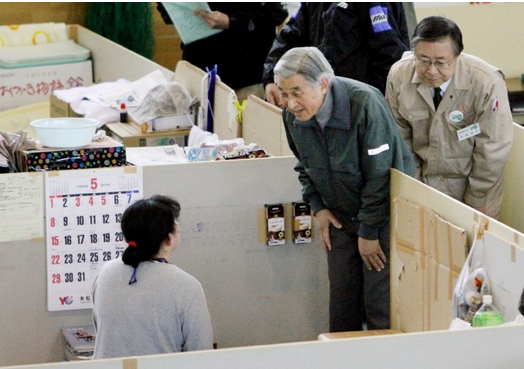
Then-Emperor Akihito speaks to an evacuee in May 2011 in Fukushima Prefecture, which hosts the Fukushima Daiichi Nuclear Power Station that was crippled in the earthquake-tsunami catastrophe of the same year.
Several former senior officials at the prime minister’s office separately said the then DPJ administration also briefly considered evacuating Prince Hisahito, the son of Crown Prince Fumihito and Crown Princess Kiko, from Tokyo to Kyoto.
Prince Hisahito became second in line to the throne when his uncle, Emperor Naruhito, ascended the Chrysanthemum Throne in May 2019. The prince was 4 years old when the Fukushima Daiichi nuclear plant suffered core meltdowns following a devastating earthquake and tsunami in northeastern Japan.
Former Emperor Akihito stepped down from the throne on April 30, 2019, becoming the first Japanese monarch to abdicate in around 200 years, his eldest son succeeding him the following day.
Kan, a House of Representatives member now belonging to the main opposition Constitutional Democratic Party of Japan, admitted he was “thinking in my head” of evacuating the emperor at the time but denied he had conveyed the idea to the then emperor or suggested it to someone else.
However, according to the former Kan administration official, at Kan’s request he unofficially asked Shingo Haketa, then chief of the Imperial Household Agency, via a mediator whether Emperor Akihito would agree to evacuate from the Imperial Palace, possibly to the Kyoto Imperial Palace in the ancient capital in western Japan.
A former agency official said he remembers the agency turned down the proposal.
Asked whether the agency actually conveyed the evacuation proposal to the emperor, he said “maybe, but only after” saying no to the administration.
The Kan administration also treated Prince Hisahito’s evacuation as among items that should be considered in case of a spike in Tokyo’s radiation levels, but eventually decided not to formally consider it, according to the former senior officials at the prime minister’s office.
On March 11, 2011, the six-reactor plant on the Pacific coast was flooded by tsunami waves exceeding 10 meters triggered by the magnitude 9.0 quake, causing the reactor cooling systems to lose their power supply.
The Nos. 1 to 3 reactors subsequently suffered core meltdowns, while hydrogen explosions damaged the buildings housing the Nos. 1, 3 and 4 units. Around 160,000 people were evacuated at one point in the nuclear disaster with a severity level rated on a par with the 1986 Chernobyl accident at maximum 7 on an international scale.
Yutaka Kawashima, who was the agency’s grand chamberlain at the time, wrote in a magazine article shortly after the triple disaster, “It is utterly inconceivable for his majesty to abandon the people of Tokyo and leave Tokyo,” as rumors had circulated about the emperor escaping the capital.
On March 16, 2011, five days after the quake and tsunami, Emperor Akihito said in an unprecedented video message he was hurt by the devastation caused by the disaster and expressed hope the people of Japan would overcome the challenges they faced by caring for each other.
He and his wife then Empress Michiko also voluntarily cut electricity at their residence in Tokyo for two hours daily as they wanted to share the hardship experienced by the people under the power rationing measure taken by electric companies, the agency said at the time.
In parts of Tokyo and its vicinity, rolling blackouts were implemented in the face of substantial power shortages stemming from the crippled nuclear power plant in Fukushima Prefecture. Areas in central Tokyo hosting government offices, parliament and the Imperial Palace were excluded from the measure.
Only 30% of Fukushima residents happy with disaster recovery progress
January 1, 2021
Nearly 10 years after the 2011 earthquake-tsunami and nuclear disasters in northeastern Japan, only 30 percent of Fukushima Prefecture residents say reconstruction has been sufficient, a Kyodo News survey showed Thursday.
The figure was notably lower than 80 percent in Miyagi and 66 percent in Iwate prefectures, which were also affected by the natural disasters.
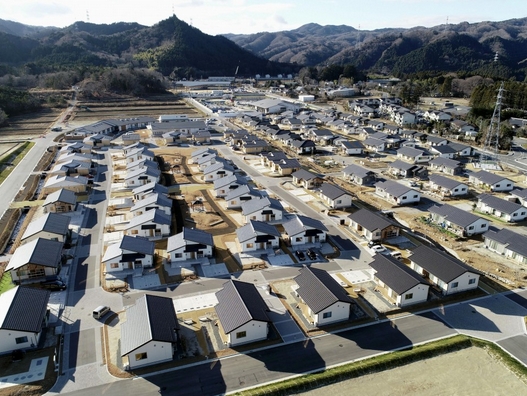
Photo taken Dec. 23, 2020, from a drone shows rows of public houses for residents who lost their homes in the disaster in Okuma, Fukushima Prefecture.
The low number in Fukushima reflects how the nuclear meltdowns at the Fukushima Daiichi power plant and subsequent evacuation orders have slowed reconstruction work.
Face-to-face surveys were conducted in November involving 100 residents in each of the three prefectures to ask about reconstruction of the communities where they lived when the magnitude-9.0 earthquake and subsequent tsunami hit the region March 11, 2011.
A total of 176 people, or 59 percent, across the three prefectures said reconstruction was “progressing” or “progressing to some degree,” while 123 people, or 41 percent, said there had not been enough progress. One person did not answer.
“My hometown is full of vacant plots of land,” said a man in his 50s who evacuated from Futaba, which hosts the Fukushima Daiichi plant, to Iwaki in Fukushima Prefecture. “I cannot imagine the town becoming a place we can return to.”
Many respondents appreciated the rebuilding of infrastructure, but some said it has taken too much time. Among Fukushima residents unhappy with the reconstruction progress, many said they are disappointed that they are still not allowed to return to their hometowns due to radioactive contamination and that townscapes have not been restored.

Photo taken on Sept. 26, 2020, in Okuma, northeastern Japan, shows the disaster-stricken Fukushima Daiichi nuclear power plant where decommissioning work is taking place
Across the three prefectures, 66 percent said their lives were back on track as they were able either to move to public housing for disaster victims or build new homes. By prefecture, the rate was 80 percent in Miyagi and 70 percent in Iwate but significantly lower at 49 percent in Fukushima.
The cost of rebuilding homes and a decrease in income have also been a burden for residents.
“To reconstruct my house, I needed to get another loan (in addition to that for the home destroyed by the disaster). I won’t finish the payments until I’m 80 years old,” said Toshiyuki Naganuma, 58, who runs a construction firm in Natori, Miyagi Prefecture.
The local government in Natori declared the completion of the city’s recovery in March 2020. More houses have been built and tourists are returning. But Naganuma said that while “it may look like the city has recovered, reconstruction is not finished.”
“Jobs are still gone. My income is unstable,” said a man in his 40s who changed jobs three times after the disasters. He used to work at a restaurant in Rikuzentakata, Iwate, but sales dropped when construction workers and others engaged in work to rebuild the city left.
Yukihisa Ojima, 49, who operates a home appliance store in Rikuzentakata, worries about the city’s declining population. “Public facilities were rebuilt but things are slack for businesses here,” he said.
For those affected by the disasters, recovery means “getting back one’s life before the disasters,” said Jun Oyane, a professor at Senshu University and head of the Japan Society for Disaster Recovery and Revitalization.
“The next step after restoring infrastructure will be to focus on the varying needs of individual residents and to stand by them in rebuilding” their lives, he said.
Beatrice Fihn: How to implement the nuclear weapons ban treaty

Beatrice Fihn: How to implement the nuclear weapons ban treaty, Bulletin of the Atomic  Scientists, By John Mecklin, December 7, 2020
………..Beatrice Fihn, ICAN’s executive director spoke with me at length about how the Treaty on the Prohibition of Nuclear Weapons might be implemented once it was ratified by the requisite 50 countries, an event expected to happen, at the time we spoke, within a matter of months. In fact, it occurred just weeks later, and the treaty will enter into force in January 2021.
The treaty was not supported by any of the nine countries that possess nuclear weapons, including the United States. Many of those opposed to the ban treaty have contended it is an unrealistic and naïve effort that could actually undermine nuclear nonproliferation efforts. US officials have been especially critical.
Here, Fihn lays out a possible future in which the ban treaty delegitimizes nuclear weapons, and nuclear weapons countries are persuaded to decide that it is best to give up the most fearsome weapons ever created—in those countries’ own interests…….
we’re trying to sort of remind the people that this issue still exists. This is still dangerous. These weapons are still around, and we’re really hoping that the treaty, and the progression will be the starting point of moving away from these weapons. Creating a new norm, implementing the treaty—in many ways, it’s just building normative pressure, building financial pressure through divestments.
see a lot of people really, really evaluating things during this year. What is it that we prioritize? And what is security? How come 200,000 Americans are dying from a pandemic, and we are still investing $35 billion in nuclear weapons? The structures that people in power have built to protect us, such as the police force and nuclear weapons, actually harm people and kill people. Both through police violence, through nuclear testing, for example. So I see a lot of possibilities for the next term to really start questioning the decisions our governments have made on our behalf around these things. …..
I think we have to be realistic. Ideally, we would want governments to take very strong measures and threaten to boycott if this doesn’t work. But in reality, of course, it’s the big economic powers that have nuclear weapons. And many countries are very dependent on them, and it wouldn’t be realistic to think that a small country in Africa can boycott the nuclear weapon states in that way. But I definitely think that there are a lot of potentials for action. First of all, I think we need to reckon—I think particularly in the West, in Europe and maybe North America—how the power dynamics in the world are changing quite rapidly. And this idea that we in the West are the center of the power in the world might not hold for very long……..
I can also see an emergence of a new power structure. This treaty in many ways is that a lot of countries are basically banning the power tool of the [UN] Security Council. And I think that’s going to have some very significant impact. But in practical terms, what we’re hoping for is, of course, that this treaty stands next to the Chemical and Biological Weapons Convention, like the bans on all weapons of mass destruction. This completes the treaty or treaties, in a way. So that the political pressure and the reputational cost of countries that don’t join this treaty is increased. We’re looking to focus quite a lot on the divestment side, making sure that banks and pension funds are pulling their money out of producing companies. And we’ve seen that influence on landmines and cluster munitions; they have quite a concrete impact in reducing companies’ willingness to be involved in these practices…….
Every year we do this “Don’t Bank on the Bomb” report that shows that it’s growing, the number of banks that have policies against this. We’ve seen just this year, the Norwegian Oil Fund, for example, pulled out of nuclear weapons companies and referred to the TPNW as a reason. One of the super banks in Japan, Mitsubishi Bank Group, or whatever they’re called. They adopted a new policy. Deutsche Bank last year adopted a new policy with nuclear weapons after work with ICAN in Germany. The Deutsche Bank [policy] wasn’t flawless, there’s some holes still, but it’s a sign that they are reacting to this.
So we have two of the five biggest pension funds in the world, the Dutch Pension Fund as well, the public one. We’ve been working on the local cities initiative as well, trying to see if the whole trend on the climate change issue and other issues as well, that cities are taking sort of international action and seeing themselves as almost actors on an international stage. We have over 400 cities around the world now, including I think something like 30 cities with over a million people, that have joined this call to action and that are supporting the treaty and calling on their national governments to join. ……. New York City is supporting the TPNW. And it’s going to divest the city pension funds from nuclear weapons users.
……… this is an issue so solvable. I mean, it’s a lot easier to solve than climate change. It’s nine states. It’s not the whole world, it’s nine states that have them. …….. This is very old fashioned, wiping out a whole city and releasing radioactive fallout. It’s not the best strategy in any kind of warfare situation.
…….. this is all connected to power and holding power. A small group of actors are holding power and oppressing the larger majority. For people like me, for example, I’m Swedish. I live in Switzerland. Me and my family and my two countries will also die in nuclear war if there’s nuclear war. Yet, I don’t get a say. In that way, it’s much like climate change. What one country does, it’s not their own business.
…….. this is an issue that is connected to economic inequalities, sexism, racism, the disproportion in the way we use public funding and tax money in terms of protecting people—like taking the money from things that actually protect us, health care right now, education that will actually make people safer. Yet we divert it towards nuclear weapons and a hugely inflated military budget.
So I think that’s sort of what I would like to say to young people…………….
I think it’s really important to delegitimize nuclear weapons and devalue them. We’ve almost created this mythical perspective on these weapons, that they somehow are safeguarding the world and that they somehow have all these magical attributes, which isn’t true. It’s just a really giant radioactive bomb. It’s not magic, it’s not special. And it costs a lot of money and it’s very dangerous to the countries that have them, and it makes you a target of nuclear weapons. So I think it’s really important, for nuclear arms states also, to understand that the more value that’s put into nuclear weapons—both symbolic value and money value—the more vulnerable you are also to other countries getting that weapon. …….
I think what’s extremely important is that we look also, again, at research and science and see that societies that have a lot of weapons, that invest a lot of money in weapons, are less secure and safe than societies that invest a lot in health care, education, equality, for example. And these are always seen as soft issues, unrelated to national security. We really urgently need leaders who are smart, who understand how to protect their people. And protecting their people is not through spending hundreds of billions of dollars on weapons…….. https://thebulletin.org/premium/2020-12/beatrice-fihn-how-to-implement-the-nuclear-weapons-ban-treaty/?utm_source=Newsletter&utm_medium=Email&utm_campaign=ThursdayNewsletter01072021&utm_content=NuclearRisk_Fihn_12072020
Judge’s refusal to extradite Julian Assange is still part of cowardly process to deny freedom of information
The personal conveniently distracts from the political in the Assange story, https://www.theage.com.au/national/the-personal-conveniently-distracts-from-the-political-in-the-assange-story-20210107-p56siu.html
Elizabeth Farrelly Judge Vanessa Baraitser’s refusal to extradite Julian Assange for “mental health” reasons may look humanitarian but is in fact a deft political move. In reducing what should be an argument of law and principle to a test of personality, Baraitser managed at a blow to impugn Assange’s stability, repudiate any suggestion of innocence and open the door for America to prove the comforts of its solitary confinement and thereby win his extradition.
It’s a story of many twists and turns but underlying it throughout is a profound and widespread moral cowardice.
Baraitser’s 132-page ruling found that although the UK-US Extradition Treaty of 2003 specifically prohibits extradition for “political offence”, this provision never became law in the UK and therefore has no effect. In essence, the treaty is worthless.
The court also supported all 18 of the espionage charges against Assange, arguing that WikiLeaks’ hacking and publication “would amount to” offences in English law. Baraitser identified eight charges under the UK Official Secrets Act that would be, she said, equivalent.
Interestingly, this “would have” construction does not apply to the treaty question. Had Assange engaged in the same conduct in America, targeting British government information, he could not have been extradited because America’s “monist” system regards any treaty as law once signed. So it’s ironic that undermining this particular protection is a key US argument.
Anyone who saw the 2019 docudrama Official Secrets, chronicling the leakage by GCHQ analyst-turned-whistleblower Katharine Gun of information on US-UK dirty dealing in drumming up UN support for the Iraq war, will understand just how murky and terrifying such prosecutions can become.
This fear, and the persistent cowardice of yielding to it, is the theme of Assange’s story. I’ve written about Assange several times. I visited him in Ecuador’s embassy. Yet each time, I’ve found myself reluctant.
Seven years ago, when I met him, Assange was ebullient and hopeful, even funny. Now, as Baraitser says, he is “a depressed and sometimes despairing man who is genuinely fearful about his future”. Assange, she said, was at “high risk of serious depression leading to suicide if he were to be extradited and placed in solitary confinement for a long period”.
Baraitser noted the “bleak” conditions of Assange’s likely US confinement would include “severely restrictive detention conditions designed to remove physical contact and reduce social interaction and contact with the outside world to a bare minimum”, with family limited to one supervised 15-minute phone call a month. Detailing Assange’s mental state, she opined that his risk of suicide, in such conditions, was “very high”. This is the loophole she offers the appellant US prosecutor.
Those fears – his of 175 years in solitary (honestly, who wouldn’t top themselves?) and hers of his suicide – underpin her judgment. But there are other, more insidious fears at play here.
Such fears, I see now, feed my reluctance to revisit the Assange story: fear, in particular, of confronting the terrifying truth about our imperial system. Regardless of Assange’s innocence or guilt, the simple facts of what our controlling powers can do to you if you step out of line are terrifying.
But this small, individual fear also operates, very effectively, at nation level.
From the start, the case against Assange has contrived to turn issues of principle into questions of personality. The initial Swedish rape charges, since dropped for lack of evidence as the witness’s recollections after so long were clouded, were extremely personal, spinning off the cancellation of his credit cards upon his arrival in Stockholm, forcing him to accept hospitality; the seductions, the sex – which everyone agrees was consensual – his failure to wear a condom although asked and reluctance to take an STD test. Then the left turned against him because of the Clinton leaks – which one suspects would have been fine, had they been directed at the other side – and perceptions about Assange’s ego. He was vain, it was said, and narcissistic. As if that itself were a crime, reason enough to let him rot in solitary.
The personal and emotive nature of all this – the Swedish prosecutor’s refusal to interview him in London, Britain’s willingness to imprison him for a year on bail charges, America’s determination to prosecute him for exposing their war crimes (in the Iraq War Logs of October 2010 and the film Collateral Murder showing air crew shooting unarmed civilians from a helicopter) and the description of WikiLeaks by US Secretary of State Mike Pompeo as “a hostile non-state intelligence service” – all suggest a bigger picture, and smaller values, than mere truth or justice.
It’s often said that Assange endangered the lives of US informers but, as Baraitser notes, no causality has been shown. Even the Senate Committee on Armed Service said, “the review to date has not revealed any sensitive sources and methods compromised by disclosure”. It is said that Assange, by dumping hacked emails from Hillary Clinton’s campaign, gave us Trump. But if she was engaged in skulduggery as alleged, wasn’t it better for the world to make its own judgment?
When you look coldly at the facts it’s hard not to suspect that Sweden was coerced into the original charges and that Britain and Ecuador have been similarly pressured. Certainly Australia’s persistent refusal to intervene for Assange, an Australian citizen who has broken no Australian law, suggests a similar abject timidity in the face of US might.
That’s the fear that guys like Assange and Edward Snowden make us confront. And it’s why they deserve, at the very least, a fair and open trial.
What happens to the nuclear bomb codes, if Trump avoids the inauguration of Biden?
Here’s what happens to the ‘nuclear football’ if Trump skips Biden’s inauguration, Business Insider, RYAN PICKRELL, DEC 16, 2020,
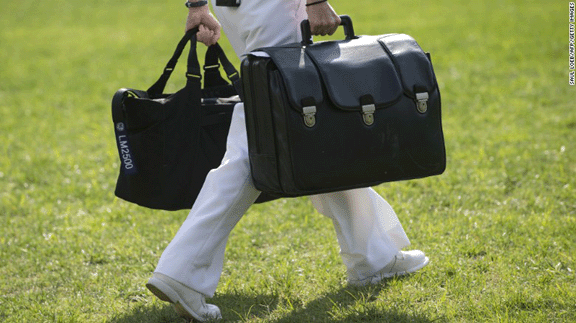
- American presidents are accompanied by a military aide carrying a briefcase with the tools necessary for nuclear war.
- During presidential inaugurations, nuclear command authority and the “nuclear football,” as the briefcase is called, are transferred to the new president.
- But President Donald Trump says he will not participate in President-elect Joe Biden’s inauguration, which could complicate the transfer.
- The Pentagon told Insider there was a plan for the transfer in that scenario but declined to provide details. Nuclear-weapons experts and a former military aide who carried the briefcase were able to offer some insight though.
Trump said Friday that he “will not be going to the Inauguration on January 20th.” He did not say where he will be instead.
So what happens to the “nuclear football” that accompanies the president if Trump doesn’t show? How does it get to Biden?
“That’s a good question,” Hans Kristensen, a nuclear weapons expert at the Federation of American Scientists, told Insider. “It is an unprecedented situation.” In the nuclear age, no president has skipped their successor’s inauguration.
The transfer of the nuclear football is supposed to occur at noon as the new president is sworn in. The military aide who has been carrying the briefcase hands it off to the newly designated military aide, former Vice President Dick Cheney said in a past Discovery documentary. This traditionally happens off to the side and is not a part of the show.
If Trump is not at the inauguration, then the transfer process will be different. Still, the transfer will need to be instantaneous, said retired Air Force Lt. Col. Buzz Patterson, who carried the football for former President Bill Clinton.
USA Congress Speaker Nancy Pelosi asks military to stop Donald Trump accessing nuclear codes
 US politics live updates: Nancy Pelosi asks military to stop Donald Trump accessing nuclear codes https://www.abc.net.au/news/2021-01-09/us-politics-live-updates-donald-trump-nuclear-codes/13043904 Peter Marsh US politics live updates: Nancy Pelosi asks military to stop Donald Trump accessing nuclear codes https://www.abc.net.au/news/2021-01-09/us-politics-live-updates-donald-trump-nuclear-codes/13043904 Peter MarshHouse Speaker Nancy Pelosi says she has spoken to the chairman of the Joint Chiefs of Staff, General Mark Milley (pictured with Donald Trump above), about stopping Donald Trump from launching a nuclear strike during his final days in office. “The situation of this unhinged president could not be more dangerous, and we must do everything that we can to protect the American people from his unbalanced assault on our country and our democracy,” Pelosi said in a letter to colleagues. Reuters is reporting that Milley’s office said that Pelosi had initiated the call and Milley “answered her questions regarding the process of nuclear command authority.” A US official, speaking on condition of anonymity to Reuters, said that any use of nuclear weapons is a highly deliberative process. A person familiar with Friday’s call said Pelosi has told them that Milley has told her there are precautions in place that would prevent Trump from launching a nuclear strike, according to the Associated Press. |
|
1 This Month
23 April – WEBINAR – Why new nuclear reactors are the wrong tools for decarbonization Thursday, April 23 • 1 AM – 2 AM AEST


Pine Ridge Uranium is the real threat, not Tehran- Tell Burgum: Stop the Extraction.
Chernobyl: The Lost Tapes – A good documentary on Chernobyl on SBS available On Demand for the next 3 weeks– https://www.sbs.com.au/ondemand/tv-program/chernobyl-the-lost-tapes/2352741955560
To see nuclear-related stories in greater depth and intensity – go to https://nuclearinformation.wordpress.com
-
Archives
- April 2026 (275)
- March 2026 (251)
- February 2026 (268)
- January 2026 (308)
- December 2025 (358)
- November 2025 (359)
- October 2025 (376)
- September 2025 (257)
- August 2025 (319)
- July 2025 (230)
- June 2025 (348)
- May 2025 (261)
-
Categories
- 1
- 1 NUCLEAR ISSUES
- business and costs
- climate change
- culture and arts
- ENERGY
- environment
- health
- history
- indigenous issues
- Legal
- marketing of nuclear
- media
- opposition to nuclear
- PERSONAL STORIES
- politics
- politics international
- Religion and ethics
- safety
- secrets,lies and civil liberties
- spinbuster
- technology
- Uranium
- wastes
- weapons and war
- Women
- 2 WORLD
- ACTION
- AFRICA
- Atrocities
- AUSTRALIA
- Christina's notes
- Christina's themes
- culture and arts
- Events
- Fuk 2022
- Fuk 2023
- Fukushima 2017
- Fukushima 2018
- fukushima 2019
- Fukushima 2020
- Fukushima 2021
- general
- global warming
- Humour (God we need it)
- Nuclear
- RARE EARTHS
- Reference
- resources – print
- Resources -audiovicual
- Weekly Newsletter
- World
- World Nuclear
- YouTube
-
RSS
Entries RSS
Comments RSS
 nuclear-news