Nothing is more expensive than nuclear power
 Readers sound off on the costliness of nuclear power, By VOICE OF THE PEOPLE, NEW YORK DAILY NEWS |AUG 15, 2020
Manhattan: Re “The inconvenient truth: We need nuclear” (op-ed, Aug. 10): Nothing is more expensive than nuclear power. Estimates for the cleanup of Japan’s 2011 Fukushima disaster range as high as $300 billion, albeit total removal of radioactivity from that land, and ocean, is impossible. In Japan, as everywhere, the costs of such disasters are born by the taxpayer, not the utility companies: There is no such thing as a $300 billion insurance policy.
USA are drifting toward a fraught nuclear arms race
 Politico 5th Aug 2020, U.S.-Russia relations are at a dangerous dead end that threatens the U.S.
national interest. The risk of a military confrontation that could go
nuclear is again real. We are drifting toward a fraught nuclear arms race,
with our foreign-policy arsenal reduced mainly to reactions, sanctions,
public shaming and congressional resolutions. The global Covid-19 pandemic
and the resulting serious worldwide economic decline, rather than fostering
cooperation, have only reinforced the current downward trajectory.
https://www.politico.com/news/magazine/2020/08/05/open-letter-russia-policy-391434
US open to nuclear agreement with Russia before including China
Top arms envoy indicates shift in Washington’s position on trilateral talks, Nikkei Asian Review, RYO NAKAMURA, Nikkei staff writerAugust 16, 2020
WASHINGTON — The U.S. may move forward with a nuclear agreement with Russia first in a bid to apply pressure on Beijing to sign a weapons treaty, Washington’s top arms control negotiator said, despite characterizing China as an “urgent threat.”
Marshall Billingslea, the special presidential envoy for arms control, spoke with Nikkei days before traveling to Vienna to meet Russian Deputy Foreign Minister Sergei Ryabkov on Monday and Tuesday for discussions on brokering an accord. Washington had been keen to strike a trilateral agreement with Moscow and Beijing, but is now open to a bilateral agreement with Russia first.
“That is, I think, a very prudent approach, particularly because we may be able to agree to something with Russia that would be the framework which we would want China to join,” Billingslea said in a phone interview on Friday.
The Vienna meeting, which Washington also invited China to, will focus on a successor to the New Strategic Arms Reduction Treaty. That accord, also known as New START, was signed in 2010 and expires in February. In addition to nuclear warheads, the treaty limits the deployment of land-based intercontinental ballistic missiles, strategic bombers and submarine-launched ballistic missiles.
The Trump administration has sought a new treaty with three conditions: it includes China, adds restrictions on all types of nuclear weapons and strengthens and verification.
The U.S. has been particularly adamant about Beijing’s participation, but China has so far refused…….. https://asia.nikkei.com/Editor-s-Picks/Interview/US-open-to-nuclear-agreement-with-Russia-before-including-China
The United States lost a bid to extend a U.N. arms embargo on Iran
- Russia and China opposed extending the arms embargo, which is due to expire in October under a 2015 nuclear deal between Iran and world powers.
- Eleven members abstained, including France, Germany and Britain, while Washington and the Dominican Republic were the only yes votes.
- The United States could now follow through on a threat to trigger a return of all U.N. sanctions on Iran using a provision in the nuclear deal, known as snapback, even though President Donald Trump abandoned the accord in 2018.
The United States lost a bid to extend a U.N. arms embargo on Iran on Friday as Russian President Vladimir Putin proposed a summit of world leaders to avoid “confrontation” over a U.S. threat to trigger a return of all U.N. sanctions on Tehran.
Russia and China opposed extending the weapons ban, which is due to expire in October under a 2015 nuclear deal between Iran and world powers. Eleven members abstained, including France, Germany and Britain, while Washington and the Dominican Republic were the only yes votes.
………… The United States has argued that it can trigger a sanctions snapback because a U.N. Security Council resolution enshrining the nuclear deal named Washington as a participant. But the remaining parties to the deal are opposed to the move.
Putin said Russia, an ally of Iran in the Syrian civil war, remained fully committed to the nuclear deal and that the aim of a summit would be to outline steps aimed at avoiding “confrontation and escalation of the situation in the Security Council.”…….
Trump, who has walked away from a series of international agreements, has dubbed the 2015 nuclear deal – reached under his predecessor Barack Obama – “the worst deal ever.”
Diplomats have said several countries would argue that the United States legally could not activate a return of sanctions and therefore simply would not reimpose the measures on Iran themselves. https://www.cnbc.com/2020/08/14/un-rejects-indefinite-extension-of-iran-arms-embargo-us-says.html
Work ongoing at US nuclear repository despite virus cases
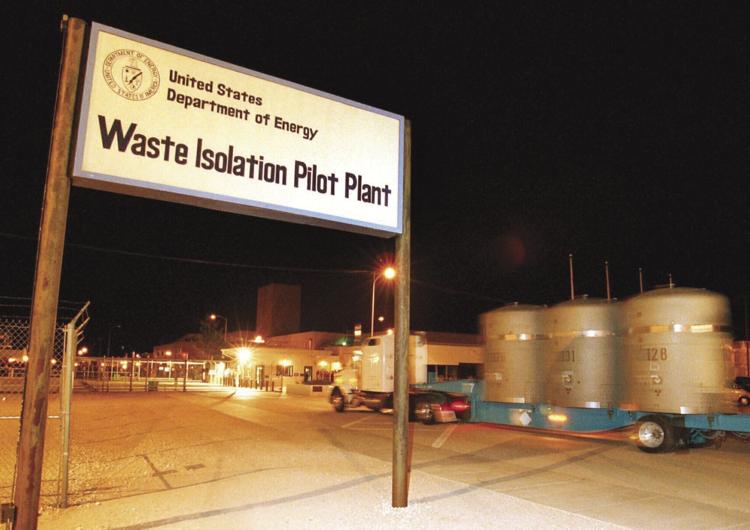
Work ongoing at US nuclear repository despite virus cases, AntelopeValley Press, 16 Aug 20, CARLSBAD, N.M. (AP) — Managers of the federal government’s underground nuclear waste repository in southern New Mexico say operations are ongoing despite a recent increase in COVID-19 cases among workers.
The Waste Isolation Pilot Plant has seen cases among workers more than double in the last week, the Carlsbad Current-Argus reported.
The plant last Monday announced four new cases among employees of Nuclear Waste Partnership, the contractor that oversees daily operations at the facility. In all, the plant has reported at least 14 positive cases among employees and subcontractors.
The plant is in the second phase of resuming normal operations after having slowed the emplacement of waste this spring when the pandemic began, said spokesperson Bobby St. John. ……….
|
The Waste Isolation Pilot Plant is the nation’s only location for disposing of tons of Cold War-era waste generated over years of bomb-making and nuclear weapons research. That includes gloves, clothing, tools and other debris contaminated by plutonium and other radioactive elements. The waste is placed into vaults carved out of an ancient salt formation about a half-mile below the surface. In January, two dozen shipments were accepted by the facility. Records show that was followed by 10 shipments in February, six in March and seven in April. May saw an increase to 20 shipments when the state of New Mexico began easing some restrictions related to the statewide public health order that had been enacted to slow the spread of the Coronavirus…….. The facility also marked a milestone in July, when it received the first shipments of waste from Sandia National Laboratories in Albuquerque since 2012. The shipments included waste that has to be handled remotely due to higher levels of radiation. The shipments were packaged in lead-lined shielded containers that weigh about 1,700 pounds when empty. https://www.avpress.com/business/work-ongoing-at-us-nuclear-repository-despite-virus-cases/article_7821a9e6-df69-11ea-9eea-5f2008c15c73.html |
|
£20 billion Sizewell C nuclear project ‘Costly and dangerous’- actress Diana Quick
why she opposes Sizewell C. Suffolk resident Diana Quick is perhaps taking
on one of her most important roles yet – as a leading campaigner against a
£20billion nuclear power station on the county’s coast. Having moved to
Suffolk in the 1980s, Ms Quick – also a writer and director – quickly took
an interest in plans for Sizewell B which, at that stage, were being
considered by a planning inspector.https://www.eadt.co.uk/news/diana-quick-sizewell-c-suffolk-1-6793919
Trump Hints about Meeting With Putin to Discuss Nuclear Treaty
|
Trump Hints to Meeting With Putin to Discuss Nuclear Treaty, Hamodia, By Sara Marcus Sunday, August 16, 2020 WASHINGTON –
President Donald Trump discussed the possibility of holding a meeting with Russian President Vladimir Putin before the November 3 election. NBC News reported that aides have researched potential opportunities for the two men to meet, with one possibility as early as next month in New York. The summit would be to discuss mutual constraints on nuclear weapons. One possibility would be by extending New START, a nuclear arms treaty between the two countries that is set to expire in 202 ……… People familiar with the discussions in the administration said President Trump hopes to impress with a very public showing of his ability to make a deal…….The Helsinki summit brought President Trump plenty of attention, but much of it was negative and he was accused of being manipulated by Putin. https://hamodia.com/2020/08/16/trump-hints-meeting-putin-discuss-nuclear-treaty/
|
|
Houthis are actively enriching Thorium extracted from Yemeni mountains and sending it to Iran for arms manufacture.
The Yemen Coalition of Independent Women held a virtual seminar titled “Iranian intervention: A History of Disorder in The Arab Countries,” which tackled a variety of issues, including the Iran-backed Houthi militias’ smuggling of Thorium from Yemen to Iran.
Hodeidah Undersecretary Walid al-Qudaimi warned of the impending danger facing Yemen over the ongoing smuggling of the material.
Houthis are actively enriching Thorium extracted from Yemeni mountains and sending it to Iran for arms manufacture.
Qudaimi said that a blast worse than the one that took place at Beirut port on August 4, due to the explosion of highly-flammable ammonium nitrate, was in store for Yemen if the smuggling does not stop.
He said that Iranian proxies in the region like the Lebanon-based Hezbollah, Houthis and the Iraq-based Popular Mobilization Forces have resorted to using certain vulnerable countries to manufacture and store explosives, chemicals and missiles. …
“When we talk about Yemen, the catastrophe is very big and worse than we might expect,” he said, adding that Houthis control the ports of Hodeidah and use them to smuggle weapons and explosive materials of all kinds.
Most of these weapons and explosives are sent by Iran to help Houthi militias control Yemen and threaten neighboring Gulf states, especially Saudi Arabia. They also use them to endanger maritime navigation in the Red Sea.
Qudaimi also tackled the FSO Safer oil tanker issue. Houthis have been obstructing efforts to perform maintenance work on board the derelict ship.
According to international reports, in the event of a leak or explosion in the floating reservoir, 1.1 million liters of crude oil will spill into the Red Sea.
This will cause serious damage to marine life, biodiversity and fish resources that cannot be compensated, in addition to the suspension of ports and international shipping lines in the region. https://english.aawsat.com/home/article/2450796/yemen-official-warns-blast-worse-beirut%E2%80%99s-over-houthi-smuggling-thorium-iran
Maldon District Council now to hold Nuclear Public meeting In Secret

Maldon Nub News 14th Aug 2020, THERE was turmoil at a Maldon District Council meeting yesterday (Thursday,
13 August) when it was abandoned during a row between councillors over whether some of the debate on plans for a nuclear power station at Bradwell should be held in public or private.
The virtual meeting had three major planning applications on the agenda – with a planned exclusion of the
public and press after the first while councillors heard ‘exempt information’ on the two applications listed last on the agenda –including the power station plan. Independent Councillor Chrisy Morris then objected to the exclusion of the public and press.
He argued that the entire discussion of the Bradwell plans should be heard in public and demanded a committee vote on whether to continue in private or not. Chair of the meeting, Deputy Leader and Conservative Councillor Maddie Thompson, did not agree and the discussion became heated before public and press access to the live stream was cut off.
The meeting was not resumed later as planned. A spokesperson for Maldon District Council said: ““Due to the
continued interruptions during the meeting, the Deputy Leader decided that the best option was to call a halt to the meeting.
Discussions are currently taking place as to when this meeting can be reconvened.” In a statement after the meeting, Cllr Morris said: “The councillors quite overwhelmingly refused these applications and we asked the officers to make
our objections watertight if the applicants were to appeal.
It appears that they instead decided to seek legal advice that would make our objections seem unreasonable at appeal in an attempt to change our minds – my personal opinion is this is bullying. “I am against hearing this advice in private as if an attempt to bully us is made – the public have a right to know. I believe that once there was a possibility that this bullying attempt was going to be in the public domain, they used it to shut the meeting. “I am
here to represent the wishes of the people and will not be bullied. The public has a right to know.”
No Japan prefectures positive about hosting nuclear waste site

Aug 14, 2020
Nearly half of Japan’s 47 prefectures said they are opposed to or held negative views about hosting a deep-underground disposal site for high-level radioactive nuclear waste, a Kyodo News survey showed Friday.
None expressed a favorable stance. The result signals further woes for the central government in its attempt to find a permanent geological disposal repository.
Little progress has been made since the process to find local governments willing to host one started in 2002, due mainly to opposition from local residents.
The survey was sent to all prefectures in July, with additional interviews conducted depending on their answers.
While 16 prefectures such as Fukushima, Kanagawa and Okinawa clearly opposed hosting a site, seven others including Hokkaido, Kyoto and Nagasaki also expressed negative views.
Most of the others did not make their positions clear.
Of the total 23 prefectures that opposed or showed negative views, seven host nuclear power plants.
“We are already undertaking a certain amount of social responsibility by hosting nuclear plants and providing energy,” Niigata Prefecture said in its response.
Fukui Prefecture said, “We are generating power. Nuclear waste disposal should be handled by others.”
Meanwhile, Hokkaido mentioned its existing ordinance to prevent nuclear waste from being brought into the northernmost main island, a view that contradicts the relatively positive stance held by one of its municipalities. The town of Suttsu said Thursday it is considering signing up for preliminary research into its land to gauge its suitability for hosting a disposal site.
On Friday, however, its mayor, Haruo Kataoka, said the town has been asked by the prefecture not to apply for the preliminary study.
Before Suttsu, the town of Toyo in Kochi Prefecture applied for the study in 2007, but it later withdrew the application following strong protests by local residents.
In the Kyodo News poll, the western prefecture expressed opposition to hosting a disposal site, saying it faces the need to take measures against a possible major earthquake in the region.
For permanent disposal, high-level radioactive waste, produced as a result of the process of extracting uranium and plutonium from spent fuel, must be stored more than 300 meters underground so that it cannot impact human lives or the environment.
Elsewhere in the world, Finland and Sweden are the only countries to have decided on final disposal sites.
Hokkaido town mayor eyes hosting nuclear waste site
 This facility in Finland is the only one where construction has begun on a final storage site for nuclear waste.
August 14, 2020
The mayor of Suttsu in western Hokkaido is bracing for a backlash after stating that he wants his small town to be considered as a final destination for nuclear waste by the central government.
“When I think about the future of our town, where the population has been shrinking, there is a need for financial resources to promote industry,” said Haruo Kataoka, 71, in an interview with The Asahi Shimbun.
“I am prepared for whatever form of bashing I may encounter.”
Kataoka may be in for a long fight.
Selecting the site for the nation’s final storage of nuclear waste is a three-stage process that can take up to 20 years. At each stage, the central government provides any municipality that has applied with annual grants.
Kataoka said he was considering having Suttsu apply for the first stage in which past records about natural disasters and geological conditions for the area are examined.
This stage normally takes about two years, and the municipality can receive up to 1 billion yen ($9.3 million) a year or a maximum total of 2 billion yen.
The annual budget for the Suttsu town government is 5 billion yen. Its main industries are oyster farming and fishing for Atka mackerel.
As of the end of March, the town’s population was 2,893. The population has decreased by 30 percent over the past two decades.
To encourage municipalities to submit applications, the central government in July 2017 released a map of areas that were considered scientifically appropriate as a site for the final storage of nuclear waste.
Suttsu is the first municipality expressing an interest in applying since that map was released.
But it remains to be seen if local residents will go along with Kataoka’s idea. He will hold a meeting in September to explain his intention and a decision will be made thereafter whether to proceed with the application.
Kataoka has also expressed interest in moving toward the second stage of the selection process in which boring samples are taken from underground. This is part of the four-year process to determine if the area meets general conditions to enable the selection process to move to the third stage, in which a test facility will be constructed underground.
In the second stage, the municipality can receive up to 2 billion yen a year, or a maximum total of 7 billion yen.
A municipal government can decide at any time to withdraw from the selection process and the grants it has received until then do not have to be returned.
Because nuclear waste may take up to 100,000 years for radiation to reach safe levels, any final storage site would have to be constructed at least 300 meters underground.
Suttsu is classified at the highest of four levels of appropriateness, according to the map released by the central government. Its location facing the Sea of Japan makes Suttsu highly suitable for transporting nuclear waste to the storage site.
But in addition to possible local opposition, the town government will also have to take into consideration an ordinance approved by the Hokkaido prefectural government in 2000 regarding nuclear waste that said no such waste should be brought onto the main northern island.
In a statement released on Aug. 13, Hokkaido Governor Naomichi Suzuki said the ordinance, “is an expression of the desire not to allow a final storage site within Hokkaido, and I believe I have no alternative but to abide by the ordinance.”
Kataoka said that the first stage of the selection process was just a study that did not represent a violation of the ordinance.
But at each stage of the selection process, the views of the prefectural governor and municipality mayor are solicited and any opposition will stop the process from proceeding.
Meanwhile, Hiroshi Kajiyama, the industry minister who oversees the process for selecting a final storage site, told reporters on Aug. 13 that a number of municipalities in addition to Suttsu had expressed interest in obtaining information about the selection process.
While Kajiyama acknowledged his awareness of the Hokkaido ordinance, he added that applying for the first stage of the process did not mean the municipality would automatically move to the second stage.
The central government has had to resort to offering annual grants to encourage municipal governments to express an interest in becoming the site for the final storage of nuclear waste.
Commenting on the interest shown by Suttsu, one government source said, “It is a step forward, but if we think about the entire process as a marathon, the race has just started and the runners have not yet even left the stadium (to reach the road).”
Meanwhile, other municipalities that in the past showed some interest in becoming the final storage site have more often than not met with huge local opposition.
In 2007, the mayor of Toyo in Kochi Prefecture on the island of Shikoku expressed interest in applying without first consulting the town assembly. Local opposition was so strong that a candidate opposed to the idea defeated the incumbent in the next election and the application was withdrawn.
There have also been reports of other municipalities expressing an interest in applying, but no formal announcement has been made until now.
Japan now possesses about 19,000 tons of spent nuclear fuel, but no progress has been made in selecting a site for its final storage. Foreign nations have also experienced difficulties in securing a site for such storage.
Finland is the only nation where actual construction of such a facility has begun.
(This article was written by Yasuo Sakuma, Ichiro Matsuo, Rintaro Sakurai and Yu Kotsubo.)
Plaintiffs angered by gov’t appeal in Hiroshima ‘black rain’ suit
 Head of the plaintiffs’ group, Masaaki Takano, right, and attorney Masayasu Takemori hold a press conference after the Hiroshima Municipal Government and the Hiroshima Prefectural Government appealed the Hiroshima District Court’s A-bomb health care aid ruling, in Hiroshima’s Naka Ward, on Aug. 12, 2020.
August 13, 2020
HIROSHIMA — Two weeks after a groundbreaking ruling in Japan to award government health care benefits to people exposed to radioactive “black rain” outside of the currently designated zone, the central government appealed, prompting aging plaintiffs to accuse the government of “buying time” and “waiting for them to die.”
In the lawsuit, the Hiroshima District Court recognized that all 84 plaintiffs in their 70s to their 90s had been exposed to radioactive black rain that fell after the 1945 bombing of Hiroshima by the United States military, outside a zone currently recognized by the government. On Aug. 12, however, the government persuaded the Hiroshima Municipal Government and the Hiroshima Prefectural Government and went ahead with its appeal.
While the central government has said it will review the current zone with an eye to expanding it, nobody knows when and who will be given benefits. The plaintiffs, whose average age is over 82, had hoped that a resolution would be reached in this milestone year — 75 years since the bombing — and are angered and disappointed.
At 2 p.m. on the day the state appealed the ruling, the plaintiffs and their attorneys held a press conference at the Hiroshima Bar Association building in the city’s Naka Ward. Masaaki Takano, 82, head of the plaintiffs’ group, was about 20 kilometers northwest of the hypocenter in what is now Hiroshima’s Saeki Ward when he was exposed to black rain as a 7 year old. He leaned forward and said forcefully, “There is a limit to life. If a decision is put off, there will be that many deaths.” He added, “The state has dismissed our demands multiple times. It cannot be trusted.”
In 1976, the state designated the zone eligible for government health benefits based on a meteorological observatory survey conducted in the chaotic period immediately following the end of World War II that pointed to where there had been heavy rains. Two years later, residents who had been exposed to rain outside the designated zone argued that it was unreasonable for the government to draw a line through the same neighborhood, with one part falling within the zone and the other part not.
The residents who fell outside the line established a predecessor organization to the Hiroshima prefectural black rain hibakusha liaison council. In the 42 years since, they have gathered tens of thousands of signatures for petitions, but have been repeatedly dismissed by the central government. Even when the Hiroshima municipal and prefectural governments argued for a widening of the zone eligible for health benefits, saying that black rain had fallen in an area six times that recognized by the central government, the state refused to acknowledge it. As a last-ditch effort, the plaintiffs filed a lawsuit in 2015. After a trial that lasted four years and nine months, they came out victorious. But by then, 12 of the plaintiffs had died, missing out on the opportunity to rejoice together.
“The state’s thinking of not giving us the recognition of being hibakusha and appealing the ruling, while considering expanding the zone in which people can receive state health benefits, is contradictory,” said plaintiff Kazuko Morizono, 82, who was exposed to black rain in what is currently Hiroshima’s Asakita Ward, some 17 kilometers north of the bomb’s hypocenter. While dealing with hypothyroidism, which is suspected to come from the effects of radiation from the atomic bomb, and other disorders, she has been active in the movement to have the zone for state aid for black rain victims expanded for over 20 years. Referring to the death of a fellow plaintiff in May whom she had often seen at the trial hearings, Morizono said, “I don’t have much confidence in my health, and I feel impatient that we have to hurry. Now the trial’s going to last longer.”
Seventy-three-year-old Kuraso Hirotani, who was 3 when he was exposed to black rain in what is now the Hiroshima prefectural town of Akiota, around 20 kilometers northwest of the hypocenter, said with frustration, “We were all given false hope with the (district court) victory. Both the mayor and the governor were persuaded by the central government.” In the Peace Declaration that the mayor of Hiroshima reads on the anniversary of the atomic bombing of Hiroshima every year on Aug. 6, Mayor Kazumi Matsui has over the past 10 years, including his latest speech, called on the state to “expand the ‘black rain areas.'” Hirotani continued, “If you’re truly a politician in a place where an atomic bomb has been dropped, you would not appeal. If they had not appealed, I would’ve thanked them and bowed my head.”
Meanwhile, there are those who see some hope in the state’s promise to consider expanding the zone designated as having been exposed to black rain. Akie Ueda, 79, who was 4 years old when she was exposed to black rain about 9 kilometers west of the hypocenter in what is now Hiroshima’s Saeki Ward, is unwell and did not join the plaintiffs’ group in the lawsuit. She said, however, that “It made me a little bit happy that they cared.” These days she spends most of the day in bed. “We do not have time left,” she said. “I hope they come out with a good result as soon as possible.”
(Japanese original by Misa Koyama and Akari Terouchi, Hiroshima Bureau, and Shinji Kanto, Fukuyama Bureau)
Japan’s nuclear fuel imports almost zero in 2019 as industry stagnates, 1st time in 50 yrs
 Japan’s imports of nuclear fuel were nearly zero last year, as many reactors remain idle or are slated to be decommissioned.
August 12, 2020
TOKYO (Kyodo) — Japan’s imports of fuel to power nuclear plants were close to zero last year, reflecting the stagnating nuclear industry following the Fukushima accident in 2011, official trade data showed Tuesday.
The effective halt in Japan’s imports of enriched and natural uranium or their assemblies is believed to be the first since the resource-poor country started securing the materials from overseas in the 1960s.
Most nuclear plants in Japan remain idle as stricter safety measures were implemented after a massive earthquake and ensuing tsunami crippled the Fukushima Daiichi nuclear complex. The operations of fuel manufacturing plants have also been suspended.
Japan’s imports of the fuel started around the time the country’s first commercial nuclear power station in the village of Tokai, Ibaraki Prefecture, achieved criticality in 1965.
The value of the three materials reached a record 280.4 billion yen ($2.64 billion) in 1984 as nuclear power plants increased, according to the government data.
In subsequent years, the value was around 100 billion yen to 150 billion yen before the level fell to 82.7 billion yen in 2012, one year after the Fukushima disaster.
In 2016, the value decreased further to 2.9 billion yen as more nuclear power plants were halted. Due to the resumptions of some nuclear plants, it recovered to nearly 50 billion yen in 2017 and 2018. But, it fell to 45 million yen in 2019, with small amounts likely imported for research purposes.
Comparable statistics for such materials are available from 1972.
Of the 54 nuclear reactors that were in operation before the Fukushima crisis, currently, only nine have come back online after clearing harsher safety measures.
In the wake of the accident, 21 reactors have been flagged for decommissioning in consideration of the hefty costs for refurbishments.
All four fuel manufacturing factories are offline as they are undergoing regulatory review under the new safety standards.
Kansai Electric Power Co., Shikoku Electric Power Co. and Kyushu Electric Power Co., which operate the nine plants currently back online, said they have enough fuel to run their reactors for the next several years.
Despite the slumping nuclear industry in Japan, the government has set a target for nuclear power generation to account for 20 to 22 percent of the country’s electricity supply by 2030, which requires resuming operations of 20 to 30 reactors.
https://www.japantimes.co.jp/news/2020/08/12/business/japan-nuclear-fuel-imports-zero/
Japan gov’t to appeal ruling on A-bomb “black rain” victims
August 13, 2020
The Japanese government has decided to appeal a recent court ruling awarding state health care benefits to people who were exposed after the 1945 atomic bombing of Hiroshima to radioactive “black rain” outside a zone it currently recognizes, sources with knowledge of the situation said Tuesday.
Late last month, the Hiroshima District Court ruled in favor of 84 plaintiffs in their 70s to 90s, saying they should receive the same health benefits as provided to atomic bomb survivors who were in the zone where the state has recognized black rain fell.
The ruling was the first court decision regarding the boundary of the area affected by radioactive rain after the world’s first nuclear attack, and on the subsequent health problems among survivors.
 A lawyer representing plaintiffs in a lawsuit demanding that state health care benefits be extended to people who were exposed to radioactive “black rain” after the 1945 U.S. atomic bombing of Hiroshima outside a zone currently recognized by the government holds up a sign after the Hiroshima District Court ruled in favor of the suit on July 29, 2020.
The city and prefectural governments of Hiroshima have long sought more assistance for atomic bomb survivors but accepted the government’s policy, the sources said.
The central government will appeal the district court’s ruling on Wednesday, according to the sources.
In the ruling, the court determined it was possible that black rain fell outside of the designated zone and reasonable to conclude the plaintiffs were affected by radiation if they were exposed to it.
The court then determined that the plaintiffs developed diseases specific to atomic bomb survivors due to the effect of black rain.
Fukushima’s Contaminated Wastewater Could Be Too Risky to Dump in the Ocean
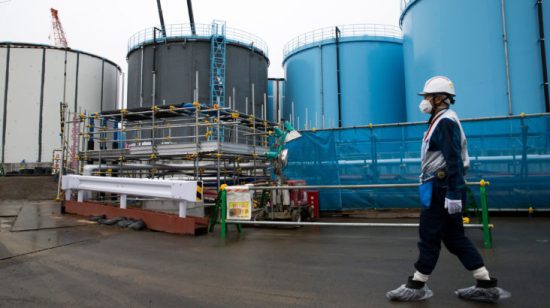 A person walks past storage tanks for contaminated water at the company’s Fukushima Daiichi Nuclear Power Plant
August 7, 2020
Almost a decade ago, the Tohoku-oki earthquake and tsunami triggered an explosion at Japan’s Fukushima Daiichi Nuclear Power Plant, causing the most severe nuclear accident since Chernobyl and releasing an unprecedented amount of radioactive contamination in the ocean. In the years since, there’s been a drawn out cleanup process, and water radiation levels around the plant have fallen to safe levels everywhere except for in the areas closest to the now-closed plant. But as a study from the Woods Hole Oceanographic Institution published in Science on Thursday shows, there’s another growing hazard: contaminated wastewater.
Radioactive cooling water is leaking out of the the melted-down nuclear reactors and mixing with the groundwater there. In order to prevent the groundwater from leaking into the ocean, the water is pumped into more than 1,000 tanks. Using sophisticated cleaning processes, workers have been able to remove some of this contamination and divert groundwater flows, reducing the amount of water that must be collected each day. But those tanks are filling up, and some Japanese officials have suggested that the water should dumped into the ocean to free up space.
The water in the tanks goes through an advanced treatment system to remove many radioactive isotopes. The Japanese utility company TEPCO, which is handling the cleanup processes, claims that these processes remove all radioactive particles from the water except tritium, an isotope of hydrogen which is nearly impossible remove but is considered to be relatively harmless. It decays in about 12 years, which is faster than other isotopes, is not easily absorbed by marine life, and is not as damaging to living tissue as other forms of radiation.
But according to the new study, that’s not the only radioactive contaminant left in the tanks. By examining TEPCO’s own 2018 data, WHOI researcher Ken Buesseler found that other isotopes remain in the treated wastewater, including carbon-14, cobalt-60, and strontium-90. He found these particles all take much longer to decay than tritium, and that fish and marine organisms absorb them comparatively easily.
“[This] means they could be potentially hazardous to humans and the environment for much longer and in more complex ways than tritium,” the study says.
Though TEPCO’s data shows there is far less of these contaminants in the wastewater tanks than tritium, Buesseler notes that their levels vary widely from tank to tank, and that “more than 70% of the tanks would need secondary treatment to reduce concentrations below that required by law for their release.”
The study says we don’t currently have a good idea of how those more dangerous isotopes would behave in the water. We can’t assume they will behave the same way tritium does in the ocean because they have such different properties. And since there are different levels of each isotope in each different tank, each tank will need its own assessment.
“To assess the consequences of the tank releases, a full accounting after any secondary treatments of what isotopes are left in each tank is needed,” the study said.
Buesseler also calls for an analysis of what other contaminants could be in the tanks, such as plutonium. Even though it wasn’t reported in high amounts in the atmosphere in 2011, recent research shows it may have been dispersed when the explosion occurred. Buesseler fears it may also be present in the cooling waters being used at the plant. That points to the need to take a fuller account of the wastewater tanks before anything is done to dump them in the ocean.
“The first step is to clean up those additional radioactive contaminants that remain in the tanks, and then make plans based on what remains,” he said in a statement. “Any option that involves ocean releases would need independent groups keeping track of all of the potential contaminants in seawater, the seafloor, and marine life.”
Many Japanese municipalities have been pushing the government to reconsider its ocean dumping plans and opt to find a long-term storage solution instead, which makes sense, considering exposure to radioactive isotopes can cause myriad health problems to people. It could also hurt marine life, which could have a devastating impact on fishing economies and on ecosystems.
“The health of the ocean — and the livelihoods of countless people — rely on this being done right,” said Buesseler.
1 This Month

of the week – Shut Down Drone Warfare!


Tell the Ukrainian Government to Drop Prosecution of Peace Activist Yurii Sheliazhenko

Petition to revoke the licensing of the Near Surface Nuclear Disposal Facility (NSDF) at Chalk River. https://www.ourcommons.ca/petitions/en/Petition/Details?Petition=e-7247
To see nuclear-related stories in greater depth and intensity – go to https://nuclearinformation.wordpress.com
-
Archives
- April 2026 (114)
- March 2026 (251)
- February 2026 (268)
- January 2026 (308)
- December 2025 (358)
- November 2025 (359)
- October 2025 (376)
- September 2025 (257)
- August 2025 (319)
- July 2025 (230)
- June 2025 (348)
- May 2025 (261)
-
Categories
- 1
- 1 NUCLEAR ISSUES
- business and costs
- climate change
- culture and arts
- ENERGY
- environment
- health
- history
- indigenous issues
- Legal
- marketing of nuclear
- media
- opposition to nuclear
- PERSONAL STORIES
- politics
- politics international
- Religion and ethics
- safety
- secrets,lies and civil liberties
- spinbuster
- technology
- Uranium
- wastes
- weapons and war
- Women
- 2 WORLD
- ACTION
- AFRICA
- Atrocities
- AUSTRALIA
- Christina's notes
- Christina's themes
- culture and arts
- Events
- Fuk 2022
- Fuk 2023
- Fukushima 2017
- Fukushima 2018
- fukushima 2019
- Fukushima 2020
- Fukushima 2021
- general
- global warming
- Humour (God we need it)
- Nuclear
- RARE EARTHS
- Reference
- resources – print
- Resources -audiovicual
- Weekly Newsletter
- World
- World Nuclear
- YouTube
-
RSS
Entries RSS
Comments RSS
 nuclear-news