Britain to nationalize its nuclear weapons industry
Britain to nationalize its nuclear weapons industry. https://www.upi.com/Defense-News/2020/11/02/Britain-to-nationalize-its-nuclear-weapons-industry/5981604341239/ By Ed Adamczyk Nov. 2 (UPI) — Britain announced on Monday that management of its nuclear weapons facilities will return to government control instead of leadership by an industry consortium.
Atomic Weapons Establishment PLC builds nuclear weapons inBritain and has been operated since 2000 by a groupof manufacturers led by Lockheed Martin.
The contract was expected to be completed in 2025 but British Defense Secretary Ben Wallace told Parliament this week that the AWE will be wholly owned by the Ministry of Defense, beginning in June 2021.
“Following an in-depth review, the MOD concluded that AWE plc will become an arms-length Body, wholly owned by the MOD,” Wallace wrote in a Ministry of Defense statement.
“The change in model will remove the current commercial arrangements, enhancing the MOD’s agility in the future management of the U.K.’s nuclear deterrent, whilst also delivering on core MOD objectives and value for money to the taxpayer,” Wallace wrote.
AWE is based at Aldermaston, England, and develops nuclear warheads for the Royal Navy’s submarines.
In February, the ministry announced plans to develop new nuclear warheads, and nationalizing the British nuclear weapons industry reflects the government’s interest in creating a better alignment between AWE and the ministry’s priorities.
The end of the lucrative 25-year contract can be seen as a blow to Lockheed Martin, Serco Group and Jacobs Engineering, all AWE owners. In 2019, AWE paid $105 million to shareholders, despite controversial cost overruns and worker safety violations, and has been the subject of criticism from Britain’s National Audit Office.
The Ministry of Defense has also been a target of demands by the government, under Prime Minister Boris Johnson‘s leadership, to control wasteful spending.
A USA Senator reflects on the anniversary of the Cuban missile crisis
|
Sam Nunn on Cold War & nuclear weapons, Technique, Hope Williams on November 2, 2020 2020 marks the 75th anniversary of the end of World Word II and the start of the Cold War, a conflict that shaped former United States Senator Sam Nunn’s time while serving in Congress, as well as his work afterwards with the Nuclear Threat Initiative.On Oct. 14, Nunn discussed how nuclear weapons still pose a threat to the world today in a talk with the Georgia Historical Society.
Nunn, who was born in Macon, Georgia, attended Tech, Emory University and Emory Law School. He then served in the U.S. Coast Guard and Georgia House of Representatives before being elected in 1972 to the U.S. Senate. One of his earliest experiences with the intersection of foreign policy and nuclear war was the Cuban Missile Crisis in October 1962, during which he was attending a NATO Conference with the Armed Services Committee in Europe. “We were actually briefed by the Air Force with photographs and all the classified information, sort of every step of the way once the Cuban Missile Crisis broke out,” said Nunn. “… We were at Wiesbaden Air Force Base, which was sort of the head of the U.S. Air Force Europe, on the night where it really looked like we were going to war.” That night, Nunn sat next to the top Air Force General in Europe during dinner. “He had a whole big computer back [with] him with all sorts of communication equipment,” said Nunn. “During the course of the dinner, he told me that he had about 20 to 30 seconds, once he got the signal, to basically turn loose his aircraft to go after the Soviet Union, because we thought we were going to war.” This experience shaped his view of nuclear war. “That brought home a sense of reality to me about the dangers of nuclear war that had an effect on the rest of my life,” said Nunn. “… It brought home to me two things: how close we came to war and how much subjective judgment was involved in the [John F.] Kennedy decisions and the [Nikita] Khrushchev decisions to avoid war and second, how little warning time we had.” Nunn points out that during the 1960s, leaders had more decision time because planes flew much slower. “Having very little decision time in a moment of great crisis is extremely dangerous for the world and that’s, to me, one of the prime goals we should have today, which is to give both U.S. and Russian leaders more time so that we do not move into a nuclear war by blunder,” said Nunn. New technology adds additional danger. “When you introduce cyber and possible interference in command and control and warning systems, I still very much worry about compressed decision time,” said Nunn. “And if I had my way today, and I’ve told President Obama this, I’ve told President Trump this and I’ve told President Putin this, that if I had my way, the leaders would call in their military and say ‘Look, we have a mutual existential interest to give each other more warning time.’”………. Relating decisions about the usage of nuclear weapons to presidential politics, Nunn served under six presidents during his terms as a Senator: Presidents Richard Nixon, Gerald Ford, Jimmy Carter, Ronald Reagan, George H.W. Bush and Bill Clinton. As commander-in-chief, presidents have the sole authority to authorize the use of nuclear weapons. “It is a moral question, but every military commander is charged with the responsibility of carrying out orders from the commander-in-chief,” said Nunn. “But those orders have to be moral orders, and how do you determine that?”……. In conclusion, Nunn reiterates there is currently less of a chance of premeditated nuclear attacks than there was during the Cold War, but with a more compressed decision time for leaders, there is a higher risk of a mistake. “We’ve got a lot of work to do so that our children and grandchildren can live in a world that does not have the perils of nuclear, biological and climate change, all of those things hanging over us,” said Nunn. “So it’s very hard under these circumstances to get out to the voters, to get seen.”…….. In conclusion, Nunn reiterates there is currently less of a chance of premeditated nuclear attacks than there was during the Cold War, but with a more compressed decision time for leaders, there is a higher risk of a mistake. “We’ve got a lot of work to do so that our children and grandchildren can live in a world that does not have the perils of nuclear, biological and climate change, all of those things hanging over us,” said Nunn. “So it’s very hard under these circumstances to get out to the voters, to get seen.”…… https://nique.net/life/2020/11/02/sam-nunn-on-cold-war-nuclear-weapons/ |
|
Climate Policy – Scotland
The National 2 Nov 2020 , EXTINCTION Rebellion have walked away from the Scottish Government’s
Climate Assembly, accusing ministers of allowing “vested interests” to
take over. They claim the civil service has tried to water down the urgency
of the summit due to start this weekend.
https://www.thenational.scot/news/18838753.extinction-rebellion-quit-scottish-governments-citizens-assembly-climate/
Shares in nuclear weapons company Serco crash, As UK govt nationalises the industry
 Serco shares crash as outsourcer loses role on nuclear weapons consortium, City A.M. Edward Thickness, 2 Nov 20,
Shares in Serco plummeted this morning after the outsourcing giant confirmed that the government had taken back management of its atomic weapons development facility.
Shares dropped nearly 12 per cent as markets opened as traders digested the news.
Yesterday Sky News reported that the government was due to announce that it would take over the running of the Atomic Weapons Establishment (AWE) from next year.
AWE has been run by a consortium made up of US defence giant Lockheed Martin, Serco and Jacobs since 2000.
The contract was due to expire in 2025, so the government’s decision to renationalise the facility is a considerable blow to the FTSE 250 company.
Serco said that it was expecting to make £17m in profit from its 24.5 per cent stake in AWE this year. In its last full year results the firm reported profit of £120m.
However, it said that it would stick to its full year financial forecasts for 2020/21……..
AWE, which makes nuclear warheads for the UK’s submarines, will pass back into government ownership on 30 June.
Earlier this year the facility came under fire from spending watchdog the National Audit Office (NAO).https://www.cityam.com/serco-shares-crash-as-outsourcer-loses-role-on-nuclear-weapons-consortium/
Nukes in space
Russian company with powerful connections withdraws from Turkish nuclear plant operation
|
Russian company with powerful connections withdraw from Turkish nuclear plant operation, Greek City Times,
by PAUL ANTONOPOULOS, 2 Nov 20, A Russian company withdrew from plans to build Turkey’s first nuclear power plant following tensions between Moscow and Ankara over issues including the conflicts in Libya, Syria, and Artsakh, a columnist for Turkish newspaper Dünya, and translated by Ahval, said on Saturday.The construction of the Akkuyu Nuclear Power Plant to the north of Cyprus is a joint project between Turkey and Russia.Although Turkish President Recep Tayyip Erdoğan and his Russian counterpart Vladimir Putin signed the deal in 2010, major construction only started in March 2018 and the first unit of the four to be constructed will not become operational until at least 2023. According to Dünya columnist Kerim Ülker, Inter RAO, one of Russia’s largest public energy companies, withdrew from the project following a board meeting on October 26 partly because of the Turkish-sponsored invasion attempt of Artsakh by the Azerbaijani military and Syrian mercenaries. ……..https://greekcitytimes.com/2020/11/02/russian-turkish-nuclear-plant/ |
|
Bill Gates has another go at getting taxpayer funding, for another nuclear venture (ships this time)
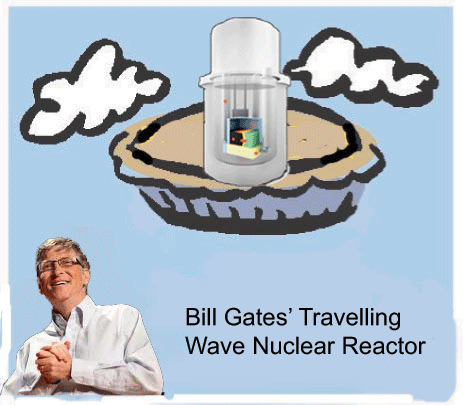 Bill Gates joins nuclear-powered shipping push, Splash Sam ChambersNovember 2, 2020 Bill Gates, one of the richest men in the world, has turned his attention to getting ships powered by nuclear energy.
The Microsoft co-founder, who turned 65 last week, is also chairman of TerraPower, a nuclear tech company that today announced a new venture with Mikal Bøe’s CORE POWER, French nuclear materials handling specialist Orano and American utilities firm Southern Company. The four companies plan to develop molten salt reactor (MSR) atomic technology in the United States………
The four companies have submitted an application to the US Department of Energy to take part in cost-share risk reduction awards under the Advanced Reactor Demonstration Programme to build a prototype MSR, as a proof-of-concept for a medium-scale commercial-grade reactor.
……. we seek to build scale-appropriate technology and broad acceptance of modern and durable liquid-fuelled atomic power to shape the future of how we deal with climate change,” Bøe commented today…….
Thorium is a weakly radioactive metallic chemical element found most commonly in India and is a substance that Gates’ TerraPower has been studying closely of late.
Admitting the technology would not be cheap to install on ships, Bøe has proposed a leasing model for his batteries, similar to those deployed for aircraft engines………. https://splash247.com/bill-gates-joins-nuclear-powered-shipping-push/
Nuclear, climate, pandemic news – in this critical week
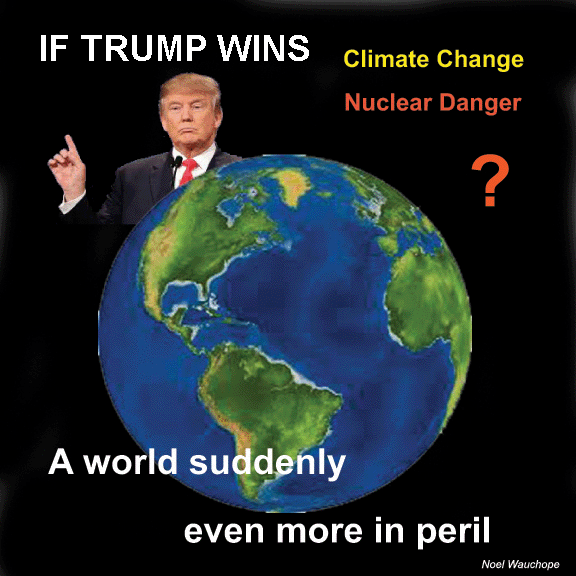
Pandemic As that election day arrives, US coronavirus cases break global daily record with just under 100,000 new infections. Protecting nature is vital to escape ‘era of pandemics’ – report. Urgency to protect nature, or up to 850,000 animal viruses could be caught by humans.
Climate. In all the hooha about the American election, and all the very important coverage of the coronavirus pandemic, – global heating moves on inexorably, with relatively little media coverage of its effects. But the effects are there – in the melting Poles, in continuing wildfires, droughts, extreme weather. Effects are worsein developing countries that have not themselves been the emitters of greenhouse gases. Droughts and floods force populations to leave their homelands.
Nuclear. Not a lot of media coverage on nuclear issues, though some still about the Treaty on Prohibition of Nuclear Weapons. But here’s one important one:
Investigative journalism -The tangled web – well-being of communities has become dependent on the nuclear weapons industry.
Meanwhile, media coverage of nuclear issues continues to be mainly propaganda for the industry.
Some bits of good news – Chameleon last seen a century ago rediscovered in Madagascar. 14-Year-Old Girl Wins $25,000 For a Scientific Breakthrough That Could Lead to COVID-19 Cure. Couple Turns Barren English Estate into Conservation Eden, Rewilding to Attract Rare Species of Astonishing Biodiversity.
The new Nuclear Weapons Ban Treaty supports existing agreements, and in no way conflicts with them. Archbishop Tomasi has led the Vatican’s fight against nuclear weapons.
Documentary history from the perspective of radiation victims.
Plutonium: How Nuclear Power’s Dream Fuel Became a Nightmare.
Despite propaganda from nuclear front group ”Third Way”, research shows that nuclear power as carbon reducer is counter-productive.
The world’s banks must start to value nature and stop paying for its destruction.
Space exploration – to lead to dangerous nuclear-armed totalitarian societies?
Super power: Here’s how to get to 100pct wind, solar and storage by 2030. Renewables, not nuclear, are the solution, for a cleaner world..
The very real risks of radiation accidents on Earth, from nuclear reactors in space.
BRAZIL. Surge in fires in Brazil’s Amazon.
JAPAN. Dumping Fukushima’s Water into the Ocean… Seriously? Fishers and farmers fear impact of Fukushima water release. Compensation claims recognised – workers made ill by working at Fukushima’s wrecked nuclear plant. Japan’s net zero emissions target should be combined with zero nuclear power.
SOUTH KOREA. South Korea’s ‘serious concern’ about Japan’s dumping of Fukushima radioactive water. Parties Blast Foreign Ministry Response to Japan’s Water Discharge Move. Tritium is what makes nuclear reactors so dangerous, not only in Fukushima but also in S. Korea. South Korea to end dependence on coal, switch to renewables.
ARCTIC. Release of methane off East Siberian coast has been triggered.
UK. Pressure on UK Prime Minister to show strong climate leadership. UK government’s economic recovery plan fossil fuels £3.8bn, but renewables only £121m. Strong feeling in UK public that the Covid recovery must be a green recovery, too.
Britain to lose protection of the environment – as a result of Brexit.
90% of Sellafield’s Discharged Plutonium Wastes are on the “Cumbrian Mud Patch” Below which Lies the Coal Mine Plan.
USA.
- Coronavirus cases rise in grim march to America’s Election Day.
- Investigative journalism– How the marketing of American weapons determines U.S. foreign policy on China. Expert guidance for the next President to head off a nuclear catastrophe. A Joe Biden administration would re-examine the U.S. nuclear strategy and arsenal.
- Russia and the U.S. Need a Timeout on Nuclear Weapons, With New START about to expire, the U.S. should accept Moscow’s offer of a one-year extension.
- U.S. Senate unanimously passes resolution supporting nuclear weapons workers made ill by radiation.The human cost in illness and death, caused by working with nuclear weapons.
- Financial red flags warn against Utah’s NuScale small nuclear reactor project. Big questions on the costs and safety of NuScale’s little nuclear reactors. Two more cities opt out of Utah’s dubious small nuclear reactor project. Small nuclear reactors pose a financial danger to municipalities – Utah Taxpayers Association. Another city bites the dust in regard to Utah’s NuScam small nuclear reactors plan.
- Columbus, Cincinnati, take legal action to block Ohio’s nuclear power plant bailout law. Two politicians to plead guilty in Ohio nuclear corruption case.
- Santa Susana Field Laboratory site– historically radioactively polluted, but risks never being cleaned up.
- Nearly 30 US states see renewables generate more power than either coal or nuclear coal
UKRAINE. Using a robot to map the highly radioactive area of the Chernobyl Nuclear Power Plant.
RUSSIA. Russia’s nuclear doctrine – both Russia an USA benefit from nuclear weapons control agreements. Putin’s Russia keen to exploit the Arctic for fossil fuels: more nuclear-powered icebreakers on the way.
FRANCE. EDF trucks enriched uranium to the unfinished Flamanville nuclear reactor. Why so much in advance of the need for it? France trying to market nuclear reactors to Romania.
LITHUANIA. Lithuania protests Belarus’plan for nuclear power station close to their border.
FINLAND. Finland, stuck with increasingly costly Olkiluouti nuclear nightmare, plans and even worse expense, with small nucler reactors!
CANADA. Investigative journalism – While Canadian authorities fall for “New Small Nuclear” spin, U.S. consortium rips off Canada’s nuclear waste disaster. Suspected COVID-19 outbreak declared at Canadian Nuclear Laboratories in Chalk River, Ontario.
IRAN. Iran building underground nuclear facility, replacing the damaged one.
CHINA. China-India competition is not likely to lead to a nuclear weapons exchange.
AUSTRALIA. International Campaign to Abolish Nuclear Weapons (ICAN)- from a tiny group to an International Treaty.
Google headline articles on nuclear issues today are mainly promoting nuclear power
 3 November 20, Leaving out the subject of nuclear weapons, the articles on nuclear power were mainly supporting or promoting it. Of the total of 64 articles, 41 approved of or enthused about nuclear power, while 15 were critical of it, and 8 could be described as neutral, – factual, with no opinion either way.
The favourite topics for pro nuclear articles were the ”need” for new nuclear reactors, both small and large, the promotion of nuclear reactors for shipping, and the need to prolong the lives of existing reactors. Nuclear fusion and nuclear for space travel were also popular topics. Nuclear power praised for safety , climate action and nuclear medicine. Radiation danger -”exaggerated”.
Anti nuclear articles focussed on costs, toxic wastes, and safety risks, with small nuclear reactors singled out for being uneconomic. Nuclear power was also criticised as being ineffective against climate change.
In the 27 articles about nuclear weapons, much of the coverage was done in a neutral way, with factual reporting on the policies of USA , Russia, China. There were 11 articles clearly opposing nuclear weapons, and 4 that could be seen as supporting them – in that they stressed the need for retaining or building up a nuclear arsenal.
Fishers and farmers fear impact of Fukushima water release
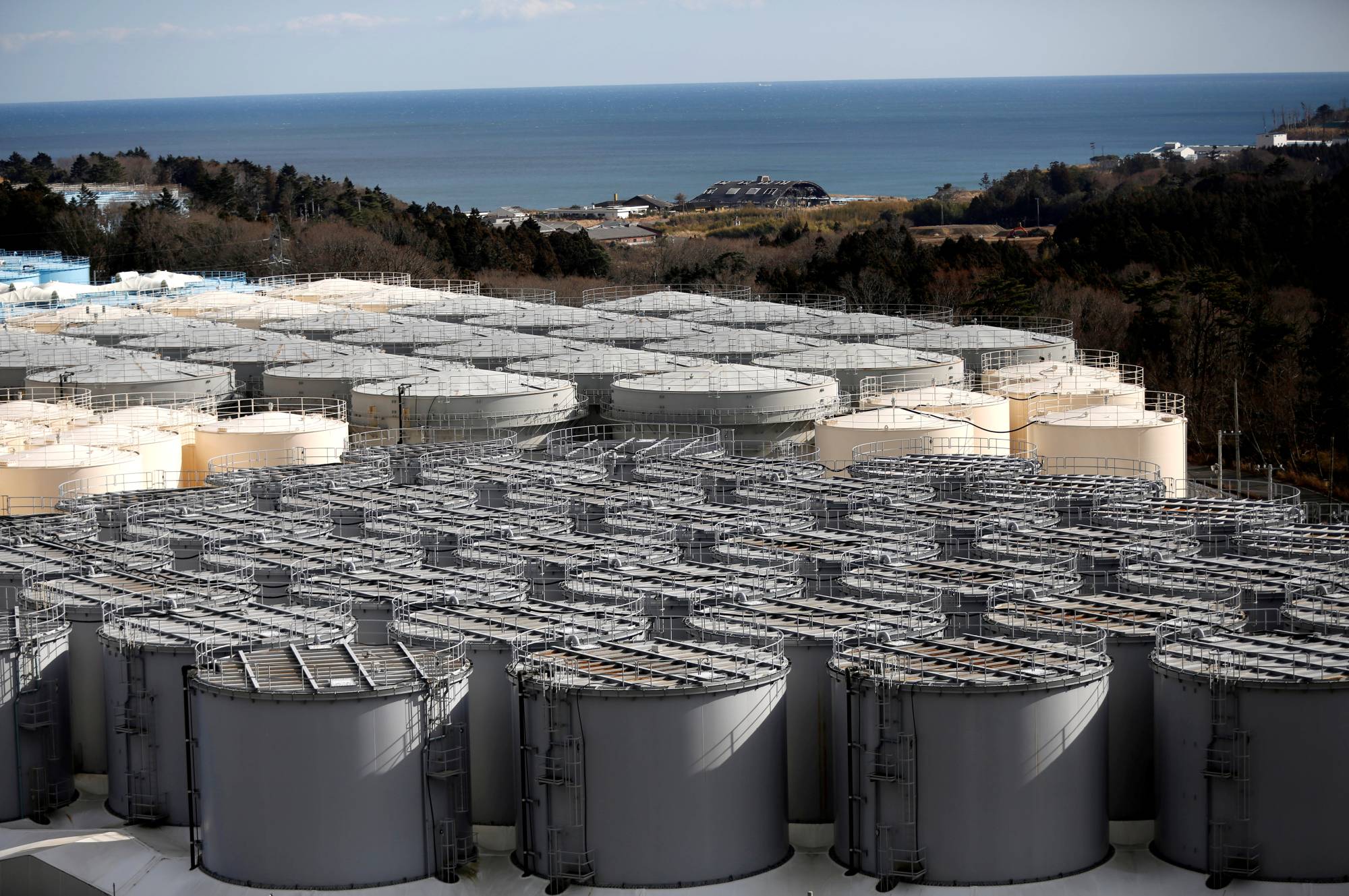
Storage tanks holding water contaminated with radioactive tritium at the Fukushima No. 1 nuclear power plant in 2019
October 30, 2020
Fishermen and farmers in Fukushima Prefecture have voiced concern about the risk of further harmful rumors about produce from the area if the government allows Tokyo Electric Power Company Holdings Inc. (Tepco), the operator of the Fukushima No. 1 nuclear power plant, to release water contaminated with radioactive tritium into the Pacific Ocean.
The government is in the final stages of giving the green light to release the radioactive water accumulating at the plant into the sea.
Nearly 10 years after the triple meltdowns at the nuclear power plant in March 2011, prices for agricultural and fisheries products from the prefecture haven’t fully recovered.
Some producers are still struggling to get retailers to buy their produce. They are concerned that if the government cannot set out detailed measures to tackle the reputational damage, they will need to start all over again from scratch.
“It’s unprecedented, and it’s hard to predict how much and how long it will last,” said deputy trade minister Kiyoshi Ejima, who heads a government task force on nuclear disasters, in an interview, regarding the harmful rumors. “We can’t offer a comprehensive (aid) package at this point of time.”
The government is expected to offer measures of support for the farm and fisheries industries, conduct public information campaigns based on science and compensate for damages as a result of releasing the water into the sea.
But it appears the government has not set out a detailed approach for how it plans to tackle any reputational damage caused by the release.
Since the 2011 disaster, the prefecture’s fisheries cooperative has only been able to conduct experimental fishing on limited days, with restrictions on the areas fished.
It is planning to move to full-scale fishing in April, with all 43 types of fish approved to be shipped.
“What we have been working on will be all for nothing,” said Toshimi Suzuki, 67, who belongs to a cooperative for sea urchin and abalone fishing in the city of Iwaki that is urging the government to decide against releasing the tritium-laced water into the sea. “I want them to listen to the voices of fishermen who are still struggling due to harmful rumors before deciding what measures to take.”
Farmers are also worried.
“If the waters are released when people at home and abroad aren’t adequately informed that it’s safe, based on science, harmful rumors will spread again,” said Yasuaki Kato, 44, a farmer who produces rice and apples.
When Kato worked to promote the safety of Fukushima-made produce in Tokyo, he felt it was extremely difficult to gain the understanding of people from outside Fukushima Prefecture.
“If people don’t understand the safety of the produce and how it has been made, it won’t have a price tag equivalent to what it’s worth,” Kato said.
In northern Fukushima Prefecture, fruit farmers were hit by heavy rain last year, after Typhoon Hagibis swept through the region, and were significantly affected by plant disease this year. Koji Suzuki, 69, who harvests peaches and persimmons in the town of Kunimi, says he was only able to harvest about 40% of his fruit compared to normal years.
He is afraid prices that plummeted after the meltdowns will once again drop.
“I want (the government) to propose measures on what it will do when consumers avoid produce from Fukushima,” Suzuki said.
This section features topics and issues covered by the Fukushima Minpo, the prefecture’s largest newspaper. The original article was published Oct. 21.
https://www.japantimes.co.jp/news/2020/10/30/national/fishers-farmers-fukushima-radioactive-water/
Dumping Fukushima’s Water into the Ocean… Seriously?
By Robert Hunziker
October 30, 2020
For nearly a decade the crippled Fukushima Daiichi Nuclear Power Plant has been streaming radioactive water into the Pacific Ocean. As it happens, TEPCO (Tokyo Electric Power Co.) struggles to control it. Yet, the bulk of the radioactive water is stored in more than 1,000 water tanks.
Assuredly, Japan’s government has made an informal decision to dump Fukushima Daiichi’s radioactive water into the Pacific Ocean. A formal announcement could come as early as this year. Currently, 1.2 million tonnes of radioactive water is stored.
The problem: TEPCO is running out of storage space.
Government of Japan’s solution: Dump it into the Pacific Ocean.
Third-party expert solutions: Build more storage tanks.
Environmental groups insist there is no reason why additional storage tanks cannot be constructed outside the perimeter of the plant. They accuse the government of seeking the cheapest and quickest solution to the problem. All along, authorities have promised the site will be safe in 40 years. Really, only 40 years!
According to IAEA’s Director General Grossi, who visited Fukushima in February 2020, dumping radioactive water that is mainly contaminated with tritium meets global standards of practice. (Source: Michael Jacob in Tokyo, What! Is Japan Really Planning to Dump Radioactive Water From Fukushima Into the Ocean? Sweden-Science-Innovation, June 10, 2020)
In that regard, advocates of nuclear power utilize a subtle storyline that convinces, and deceives, the public into accepting nuclear power, however reluctantly. It goes something like this: “There’s nothing to worry about. Nuclear power plants routinely release tritium into the air and water. There is no economically feasible way to remove it. It’s normal, a standard operating procedure.” Nevertheless, as shall be explained in more detail forthwith, there is nothing positive about that posture, absolutely nothing!
According to TEPCO, all radioactive isotopes will be removed, except tritium, which is hard to separate. Still, similar to all radioactive substances, tritium is a carcinogen (causes cancer), a mutagen (causes genetic mutation), and a teratogen (causes malformation of an embryo).
The good news: Tritium is relatively weak beta radiation and does not have enough energy to penetrate human skin. The principal health risks are ingesting or breathing the tritium.
TEPCO has deployed an Advanced Liquid Processing System that purportedly removes 62 isotopes from the water, all except tritium, which is radioactive hydrogen and cannot easily be filtered out of water.
However, the filtration system has been plagued by malfunctions. According to Greenpeace International, within the past two years TEPCO admitted to failures to reduce radioactivity to levels below regulatory limits in more than 80% of the storage tanks. Reported levels of Strontium-90 (a deadly isotope) were more than 100 times regulatory standards with some tanks at 20,000 times.
“They have deliberately held back for years detailed information on the radioactive material in the contaminated water. They have failed to explain to the citizens of Fukushima, wider Japan and to neighboring countries such as S. Korea and China that the contaminated water to be dumped into the Pacific Ocean contains dangerous levels of carbon-14. These, together with other radionuclides in the water will remain hazardous for thousands of years with the potential to cause genetic damage. It’s one more reason why these plans have to be abandoned.” (Source: Fukushima Reactor Water Could Damage Human DNA if Released, Says Greenpeace, The Guardian, October 23, 2020)
Cancer is the main risk to humans ingesting tritium. When tritium decays it emits a low-energy electron (roughly 18,000 electron volts) that escapes and slams into DNA, a ribosome or some other biologically important molecule. And, unlike other radionuclides, tritium is usually part of water, so it ends up in all parts of the body and therefore, in theory, can promote any kind of cancer. But that also helps reduce the risk because tritiated water is typically excreted in less than a month. (Source: Is Radioactive Hydrogen in Drinking Water a Cancer Threat, Scientific American, Feb. 7, 2014)
Some evidence suggests beta particles emitted by tritium are more effective at causing cancer than the high-energy radiation such as gamma rays. Low-energy electrons produce a greater impact because it doesn’t have the energy to spread its impact. At the end of its atomic-scale trip it delivers most of its ionizing energy in one relatively confined track rather than shedding energy all along its path like a higher-energy particle. This is known as “density of ionization.” As such, scientists say any amount of radiation poses a health risk.
According to Ian Fairlie, Ph.D. (Imperial College/London and Princeton University), a radiation biologist and former member of the 3-person secretariat to Britain’s Committee Examining the Radiation Risks of Internal Emitters: “At the present time, over a million tonnes of tritium-contaminated water are being held in about a thousand tanks at the site of the Fukushima Daiichi nuclear power station in Japan. This is being added to at the rate of ~300 tonnes a day from the water being pumped to keep cool the melted nuclear fuels from the three destroyed reactors at Fukushima. Therefore new tanks are having to be built each week to cope with the influx.” (Source: Ian Fairlie, The Hazards of Tritium, March 13, 2020)
Furthermore, radioactive contaminants in the tanks, such as nuclides like caesium-137 (an extremely deadly isotope) and strontium-90 (which is equally deadly) in reduced concentrations still exist in unacceptable high levels. According to Fairlie: “These problems constitute a sharp reminder to the world’s media that the nuclear disaster at Fukushima did not end in 2011 and is continuing with no end in sight.”
“There are no easy answers here. Barring a miraculous technical discovery which is unlikely, I think TEPCO/Japanese Gov’t will have to buy more land and keep on building more holding tanks to allow for tritium decay to take place. Ten half-lives for tritium is 123 years: that’s how long these tanks will have to last – at least. This will allow time not only for tritium to decay, but also for politicians to reflect on the wisdom of their support for nuclear power.” (Fairlie)
Meanwhile, over the course of seemingly endless years, Fukushima Daiichi remains “the world’s most dangerous active time bomb” for several reasons, and spent fuel rods are at the top of the list.
In addition to the 800 tons of lava-like molten fuel, aka: corium, (the big meltdown) in the three reactor containment vessels, the crippled reactor buildings contain more than 1,500 units of used nuclear fuel rods in open pools of water and must be kept cool at all times or all hell breaks loose. Loss of water from structural damage or another major earthquake (the structures are already seriously compromised) could expose the fuel rods, resulting in uncontrolled massive release of sizzling radiation that could be worse than the original meltdown, possibly exposing Tokyo to an emergency mass evacuation event with people running and screaming.
Tokyo Electric Power has plans for complete removal of the dangerous fuel rods by 2031. That work is being carried out remotely from a control room about 500 metres distance due to extraordinarily high radiation levels inside the reactor buildings.
Dismally, a perverse endlessness overhangs Chernobyl (1986) and Fukushima Daiichi (2011), earmarking these nuclear power meltdowns as the worst industrial accidents in human history.
Yet, with 440 operating nuclear plants worldwide, and 50 new plants under construction, there are plans to build a few hundred more.
Good luck
South Korea’s ‘serious concern’ about Japan’s dumping of Fukushima radioactive water
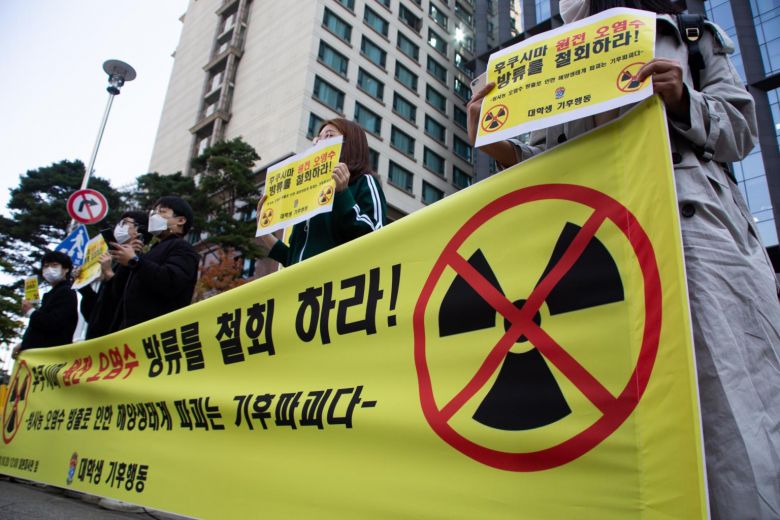
Students protest against Japan’s disposal of radioactive water, outside the Japanese Embassy in Seoul on Oct 20, 2020
South Korea expresses ‘serious concern’ over Japan plan to dump radioactive water from Fukushima
October 29, 2020
SEOUL (REUTERS) – South Korea expressed alarm on Thursday (Oct 29) about the possibility that Japan will dump more than one million tonnes of contaminated water from the tsunami-damaged Fukushima nuclear power plant into the sea.
South Korea’s “serious concern” about the contaminated water was conveyed when senior officials from the uneasy neighbours met for talks in Seoul for the first time since Japan’s new prime minister, Mr Yoshihide Suga, took office last month.
“Director-general Kim highlighted our grave awareness and serious concern about the issue of the Fukushima reactor contaminated water,” the South Korean foreign ministry said in a statement, referring to Mr Kim Jung-han, director-general for Asia and Pacific affairs, who led the South Korean team.
Media has reported that Japanese authorities have decided to discharge some one million tonnes of radioactive water into the sea nearly a decade after an earthquake triggered a tsunami that slammed into the Fukushima nuclear plant north of Tokyo, causing extensive damage.
The Japanese government has said no decision has been made on the disposal of the water from the damaged plant.
Among other issues the two sides discussed were an annual trilateral summit with China and a diplomatic and trade dispute over the issue of South Koreans forced to work at Japanese companies during 1910-45 colonial rule, which has seriously strained ties between the two US allies over the past year.
Mr Kim said Japan needed to show a “more sincere attitude” to resolve the row, urging it to lift trade restrictions imposed on South Korea, the South Korean ministry said.
S Korea expresses concern over any Japanese radioactive water dump
October 30, 2020
SEOUL – South Korea expressed alarm on Thursday about the possibility that Japan will dump more than one million tons of contaminated water from the tsunami-damaged Fukushima Daiichi nuclear power plant into the sea.
South Korea’s “serious concern” about the contaminated water was conveyed when senior officials from the uneasy neighbors met for talks in Seoul for their first time since Japan’s new prime minister, Yoshihide Suga, took office last month.
“Director-general Kim highlighted our grave awareness and serious concern about the issue of the Fukushima reactor contaminated water,” the South Korean foreign ministry said in a statement, referring to Kim Jung-han, director-general for Asia and Pacific affairs, who led the South Korean team.
Media has reported that Japanese authorities have decided to discharge some one million tons of radioactive water into the sea nearly a decade after an earthquake triggered a tsunami that slammed into the Fukushima nuclear plant north of Tokyo, causing extensive damage.
The Japanese government has said no decision has been made on the disposal of the water from the damaged plant.
Among other issues the two sides discussed were an annual trilateral summit with China and a diplomatic and trade dispute over the issue of South Koreans forced to work at Japanese companies during 1910-45 colonial rule, which has seriously strained ties between the two U.S. allies over the past year.
Kim said Japan needed to show a “more sincere attitude” to resolve the row, urging it to lift trade restrictions imposed on South Korea, the South Korean ministry said.
269 compensation claims linked to Fukushima plant work
269 compensation claims linked to Fukushima plant work deemed in Japan
October 29, 2020
TOKYO, Oct. 29 (Xinhua) — A total of 269 cases related to the crippled Fukushima nuclear plant work in Japan have been deemed as job-related accidents and covered by compensation since the nuclear disaster in 2011, labor ministry officials said Thursday.
The compensation claims that have been passed refer to the period since the nuclear accident in March 2011 through Oct. 1 this year.
Among them, six cases of workers developed cancer or leukemia because of radiation exposure, and four suffered from overwork-related illnesses, according to the Ministry of Health, Labor and Welfare officials.
Currently, about 4,000 people still work on site of the Fukushima plant decommissioning every day, with many at risk of radiation exposure, according to local media reports.
The decommissioning work has been under way since nearly 10 years ago when the massive earthquake and tsunami devastated northeastern Japan and triggered meltdowns at the Fukushima Daiichi nuclear plant.
Tokyo Electric Power Company Holdings Inc. (TEPCO), the plant operator, said three people died between fiscal 2011 and 2019.
The company said a total of 98 people suffered from heat-related illnesses between fiscal 2011 and 2019, as they had to wear less permeable masks and protective gear in the scorching summer heat.
Moreover, a total of 313 accidents have occurred in the same period of time at the site of the Fukushima Daiichi plant, including several fatal cases in which workers fell into a tank, TEPCO said. Enditem
http://www.xinhuanet.com/english/2020-10/29/c_139476903.htm
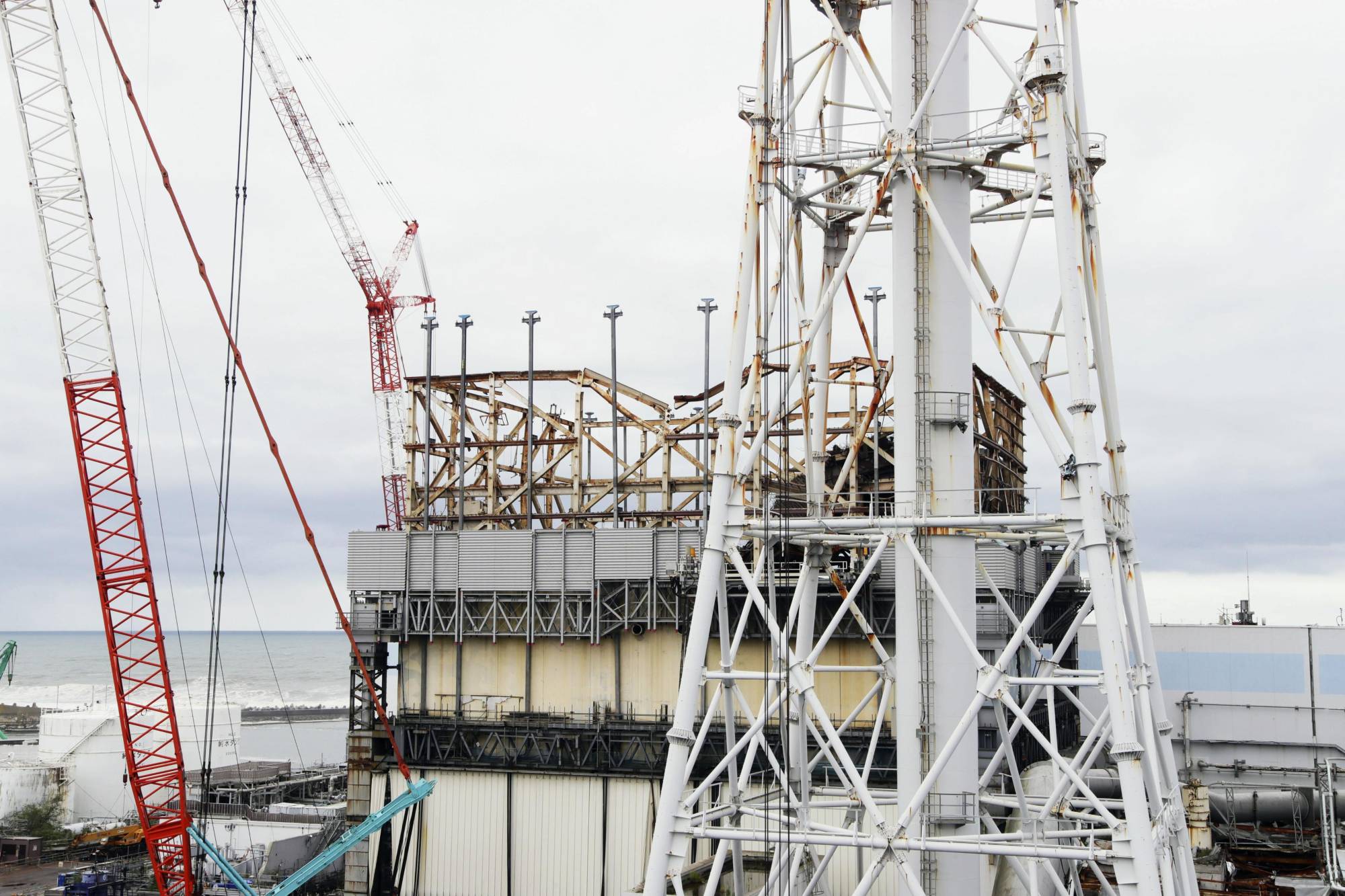
This photo taken on Sept. 26, 2020, in Okuma, northeastern Japan, shows the disaster-stricken Fukushima Daiichi nuclear power plant where decommissioning work is taking place.
Compensation claims related to Fukushima plant work total 269
October 30, 2020
TOKYO (Kyodo) – A total of 269 cases linked to the crippled Fukushima nuclear plant work have been deemed as job-related accidents and covered by compensation since the 2011 nuclear disaster, labor ministry officials said Thursday, underscoring the harsh conditions onsite workers still face.
The workers’ compensation claims that have been recognized by labor authorities include six cases of workers who developed cancer or leukemia due to radiation exposure, and four others who suffered from overwork-related illnesses, according to the Ministry of Health, Labor and Welfare officials.
Decommissioning of the Fukushima plant is still under way nearly 10 years after the massive earthquake and tsunami that devastated northeastern Japan triggered meltdowns at the Fukushima Daiichi nuclear plant. To this day, about 4,000 people still work on site every day, with many at risk of radiation exposure.
The compensation claims that have been approved refer to the period since the March 2011 nuclear accident through Oct. 1 this year.
According to the plant operator, Tokyo Electric Power Company Holdings Inc., three people died between fiscal 2011 and 2019.
One worker, who wished to remain anonymous, told Kyodo News the pressure of working at a nuclear power plant as opposed to a normal working site is “incomparable.”
“I have to deal with so much anxiety and stress as I could never know what may happen inside a nuclear power plant,” said the man from Iwaki, Fukushima Prefecture.
According to the worker, he wears two protective layers of clothing and tapes them together so there is no space between them, and also puts on a raincoat.
“I sweat a lot even in winter and I drink a lot of water,” he said, adding that several of his colleagues suffered from heat stroke or heat exhaustion while working at the plant.
TEPCO said a total of 98 people suffered from heat-related illnesses between fiscal 2011 and 2019, having had to wear masks and protective gear made of less permeable materials under the sweltering summer heat.
At the site of the Fukushima Daiichi plant, 313 accidents have occurred in the same period of time, including several fatal cases between 2014 and 2015 in which workers fell into a tank, TEPCO said.
Acknowledging that many accidents had occurred, a TEPCO official said, “We will continue to work with our contractors to prevent such incidents from happening.”
https://mainichi.jp/english/articles/20201030/p2g/00m/0na/014000c
Parties Blast Foreign Ministry Response to Japan’s Water Discharge Move

October 26, 2020
South Korea’s ruling and opposition parties both criticized the Foreign Ministry’s response to Japan’s reported plan to release radioactive water from the Fukushima nuclear power plant into the ocean.
In a parliamentary audit on Monday, ruling Democratic Party(DP) lawmaker Lee Jae-jung unveiled an internal document from the ministry which stressed that the handling of the contaminated water is Japan’s sovereign issue.
Lee raised concern about whether the ministry was trying to view the issue as a domestic affair, and urged a more aggressive response as Tokyo is currently promoting its stance to the International Atomic Energy Agency(IAEA), while Seoul is not.
DP lawmaker Kim Young-ho also expressed concern that the IAEA may accept Japan’s plan and urged Seoul’s Foreign Ministry to persuade the United States.
Main opposition People Power Party(PPP) Rep. Kim Gi-hyeon also noted that Japan has submitted its final report on research results to the IAEA while the Seoul government is only continuing internal discussions.
He said countries have the obligation to prevent maritime pollution and that legal action must be taken against Japan.
While Canadian authorities fall for “New Small Nuclear” spin, U.S. consortium rips off Canada’s nuclear waste disaster
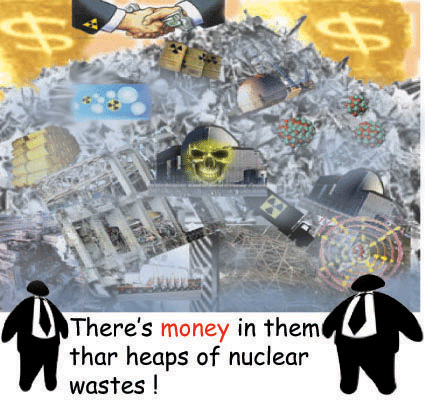
 U.S. corporations profiting from major Canadian nuclear liability, https://rabble.ca/blogs/bloggers/views-
 expressed/2020/10/us-corporations-profiting-major-canadian-nuclear-liability Ole Hendrickson, October 30, 2020
The nearly 70-year history of the federal crown corporation Atomic Energy of Canada Limited (AECL) has left a $16 billion toxic legacy of shuttered reactors, polluted lakes and groundwater, contaminated soils, and hundreds of thousands of cubic metres of radioactive waste.
AECL’s 2018 annual report estimates its undiscounted waste and decommissioning liability at $15.9 billion as of March 31, 2018. Table 5.7 in Canada’s 2019 public accounts estimates AECL’s environmental liabilities at $1.05 billion and “asset retirement obligations” at $6.6 billion.
This $7.7 billion estimate of AECL’s total nuclear liability is heavily discounted. The accounting firm Deloitte does not recommend discounting for environmental liabilities and asset retirement obligations unless the amount of the liability and the amount and timing of cash payments are “reliably determinable.” As explained in a detailed report, neither is true for AECL’s liability.
Prime Minister Stephen Harper thought that the private sector might do a better job of addressing this massive liability than AECL itself. Just before losing power to the Liberals in the 2015 election, his government contracted an American-controlled consortium (creatively called the “Canadian National Energy Alliance”) to manage federal nuclear facilities and reduce the waste liability quickly and cheaply.
According to the main estimates, AECL’s expenditures grew from $326 million in 2014-15 (before the consortium assumed control) to $491 million in 2015-16, $784 million in 2016-17, $827 million in 2017-18 and $829 million in 2018-19. The 2020-21 main estimates for AECL are $1.2 billion.
AECL hands most of this money over to the consortium, whose current members are Texas-based Fluor and Jacobs, and SNC-Lavalin. AECL retains ownership of the waste. A 2017 special examination report of the Auditor General of Canada to AECL’s board of directors says that “approximately $866 million for contractual expenses was paid or payable by the Corporation in the 2016-17 fiscal year.”
Is this “Government-owned, contractor-operated” (GoCo) arrangement providing value for money?
The GoCo contract was supposed to have been reviewed after an initial six-year period. However, AECL — whose president is an American with past ties to consortium members — extended it to a full 10-year period in April 2020, 18 months before its September 2021 renewal date.
The centrepiece of the consortium’s approach — a million-cubic–metre radioactive waste mound on a hillside draining into the Ottawa River – was revealed in May 2016, shortly after the ink dried on the contract. Neither the public, nor Algonquin peoples on whose unceded territory this facility would be built, were consulted.

Technical problems and public opposition have put the “near surface disposal facility” — to be built at AECL’s Chalk River laboratories — years behind schedule. AECL waste management experts who left when the consortium took over have been highly critical, pointing out that an above-ground mound would not contain and isolate the types of radioactive waste that the consortium planned to put in it.
Chalk River, the focal point of Canadian nuclear research since the late 1940s, is where most of AECL’s radioactive waste legacy is found. But AECL also built reactors at four other sites in Manitoba, Ontario and Quebec. All have been shut down for decades — radioactive hulks, yet to be fully decommissioned.
AECL and its American-led consortium have announced quick and cheap plans for Manitoba and Ontario reactors: fill them up with blast furnace slag and concrete, and abandon them in place. Critics say these proposals are seriously flawed, noting that the International Atomic Energy Agency (IAEA) says that “entombment” should only be considered in the event of a serious reactor accident.
Critics say that these sub-standard schemes would pollute major Canadian waterways and could expose workers and future generations to dangerous radiation levels.
The consortium is trying to salvage its Chalk River mound proposal with a promise to reduce the amount of radiation in the wastes it would house. Less radiation would leak into the Ottawa River.
However, management practices during Chalk River’s early years were poor, accidents were frequent and records were lost in a fire. Trying to separate out lower-activity from higher-activity wastes would involve considerable expense and high worker radiation exposures. And if strict limits on the mound’s radioactivity were adhered to, much of the federal waste liability would likely remain unaddressed.
Management of Canada’s radioactive waste by for-profit corporations, combined with a lack of government oversight, creates risks of delays, excessive radiation exposures to workers and the public, and squandering of tax dollars. Critics of AECL’s GoCo contract are asking the federal government to establish a publicly acceptable strategy for addressing its nuclear liability.
In a mission to Canada in late 2019, IAEA reviewers found virtually “no evidence … of a governmental policy or strategy related to radioactive waste management.” The government agreed to their recommendation that this gap be filled, assigning the task to Natural Resources Canada.
But Natural Resources Minister Seamus O’Regan seems preoccupied with promotion of a new generation of mass-produced, “modular” nuclear reactors. Two consortium members — Fluor and SNC-Lavalin — are heavily invested in their own reactor designs. There are plans to build three new demonstration reactors at Chalk River, and talk of building as many as eight. One proposal has already reached the environmental assessment stage.
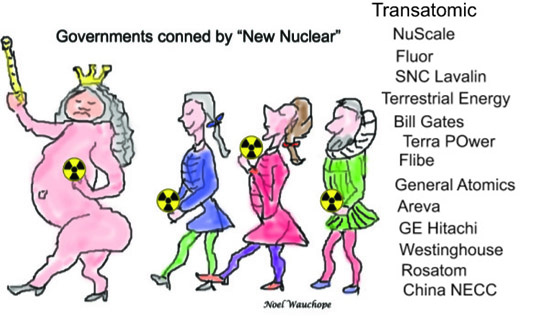
If the Liberal government caves into industry pressure to fund the building of these new reactors — instead of dealing responsibly with its existing waste liability — AECL’s $16 billion radioactive burden on Canadian taxpayers — and risks to workers and the public — will just keep growing.
Ole Hendrickson is a retired forest ecologist and a founding member of the Ottawa River Institute, a non-profit charitable organization based in the Ottawa Valley.
1 This Month

of the week – Shut Down Drone Warfare!


Tell the Ukrainian Government to Drop Prosecution of Peace Activist Yurii Sheliazhenko

Petition to revoke the licensing of the Near Surface Nuclear Disposal Facility (NSDF) at Chalk River. https://www.ourcommons.ca/petitions/en/Petition/Details?Petition=e-7247
To see nuclear-related stories in greater depth and intensity – go to https://nuclearinformation.wordpress.com
-
Archives
- April 2026 (44)
- March 2026 (251)
- February 2026 (268)
- January 2026 (308)
- December 2025 (358)
- November 2025 (359)
- October 2025 (376)
- September 2025 (257)
- August 2025 (319)
- July 2025 (230)
- June 2025 (348)
- May 2025 (261)
-
Categories
- 1
- 1 NUCLEAR ISSUES
- business and costs
- climate change
- culture and arts
- ENERGY
- environment
- health
- history
- indigenous issues
- Legal
- marketing of nuclear
- media
- opposition to nuclear
- PERSONAL STORIES
- politics
- politics international
- Religion and ethics
- safety
- secrets,lies and civil liberties
- spinbuster
- technology
- Uranium
- wastes
- weapons and war
- Women
- 2 WORLD
- ACTION
- AFRICA
- Atrocities
- AUSTRALIA
- Christina's notes
- Christina's themes
- culture and arts
- Events
- Fuk 2022
- Fuk 2023
- Fukushima 2017
- Fukushima 2018
- fukushima 2019
- Fukushima 2020
- Fukushima 2021
- general
- global warming
- Humour (God we need it)
- Nuclear
- RARE EARTHS
- Reference
- resources – print
- Resources -audiovicual
- Weekly Newsletter
- World
- World Nuclear
- YouTube
-
RSS
Entries RSS
Comments RSS
 nuclear-news