Saugeen Ojibway Nation vote ends company’s plans to store nuclear waste near Lake Huron
The decision came following years of Michigan lawmakers asking Ontario Power Generation to reconsider. It took the vote of the Saugeen Ojibway Nation of Ontario Friday to shift the discussions away from the lake. Of 1,232 ballots cast, 1,058 were against the site and 170 in favor.
We were not consulted when the nuclear industry was established in our Territory,” said a news release on the vote. “Over the past forty years, nuclear power generation in Anishnaabekiing has had many impacts on our Communities, and our Land and Waters, including the production and accumulation of nuclear waste.”
The release said that SON leaders will work with Ontario Power Generation “to find an acceptable solution for the waste.
“We will continue to work with OPG and others in the nuclear industry on developing new solutions for nuclear waste in our Territory,” said Chief Greg Nadjiwon of the Chippewas of Nawash Unceded First Nation. “We know that the waste currently held in above-ground storage at the Bruce site will not go away. SON is committed to developing these solutions with our communities and ensuring Mother Earth is protected for future generations. We will continue to ensure that our People will lead these processes and discussions.” ……….
Site had been sought since 2010
On Jan. 24, the Nuclear Waste Management Organization announced it had signed agreements with landowners east of Lake Huron in South Bruce, Ontario, which would allow land access for studies for the site. …….
In January, southeast Michigan state representatives Gary Howell, R-Lapeer, and Shane Hernandez, R-Port Huron, issued statements against locations near Kincardine and Lake Huron. They said the Kincardine locations are too close to Lake Huron, and expressed concerns about drinking water and public health if something went wrong at the site.
They called on the United States Congress to do everything in its power to stop the development. https://www.thetimesherald.com/story/news/2020/02/03/plans-store-nuclear-waster-near-lake-huron-halted/4587366002/
The containers the U.S. plans to use for nuclear waste storage may corrode
|
The containers the U.S. plans to use for nuclear waste storage may corrode
Groundwater exposure could cause the metal and glass binding the waste to break down. Science News, By Maria Temming, 3 Feb 2020Containers that the U.S. government plans to use to store dangerous nuclear waste underground may be more vulnerable to water damage than previously thought.Millions of liters of highly radioactive waste from the U.S. nuclear weapons program are currently held in temporary storage units across the country. The government’s game plan for permanently disposing of this material is to mix radioactive waste into glass or ceramic, seal it in stainless steel canisters and bury it deep underground. Such a nuclear waste dump may be constructed under Yucca Mountain in Nevada, but local opposition has stalled the project (SN: 1/16/02). Now, new lab experiments reveal another potential snafu in the scheme. When a nuclear waste package is exposed to groundwater, chemical interactions between a stainless steel canister and its glass or ceramic contents may cause the materials to corrode slightly faster than expected, researchers report online January 27 in Nature Materials. That corrosion risks exposing the radioactive waste stored in the container. Xiaolei Guo, a materials scientist at Ohio State University in Columbus, and colleagues discovered this problem by pressing pieces of stainless steel against glass or ceramic and submerging the materials in a saltwater solution, simulating groundwater exposure. When water seeped into the boundary between the stainless steel and ceramic or glass, the steel released ferrous iron, ferric iron and other components that created an acidic environment at the metal’s surface. That acidity corroded the neighboring ceramic or glass. ……..https://www.sciencenews.org/article/containers-u-s-plans-use-nuclear-waste-storage-may-corrode |
|
Electric Cooperatives Channel Solar Resources to Rural American Communities — Mining Awareness +
Big TVA style projects are no longer needed and appear to be prone to corruption. Community cooperatives have a long and successful track record since the 1930s and are turning to renewables. Household and neighborhood cooperative solar is also now feasible. “Roosevelt’s New Deal era sparked the creation of 900 electric cooperatives (co-ops) that today […]
via Electric Cooperatives Channel Solar Resources to Rural American Communities — Mining Awareness +
February 3 Energy News — geoharvey

Opinion: ¶ “If There’s A Silver Lining In The Clouds Of Choking Smoke It’s That This May Be A Tipping Point” • As a climate scientist on sabbatical in Australia, I’ve had plenty of conversations about the climate crisis lately. Although the Murdoch media make it seem as if there’s plenty of debate, the reality […]
An example of nuclear corporations conglomerate formed in desperate effort to promote Small Modular Nuclear Reactors
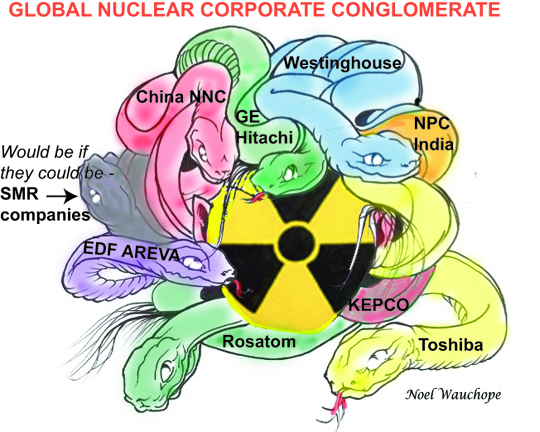 GE Hitachi Nuclear Energy and ČEZ Announce Small Modular Reactor Technology Collaboration in the Czech Republic. WILMINGTON, North Carolina—February 3, 2020—GE Hitachi Nuclear Energy (GEH) and ČEZ, a. s. (ČEZ), an integrated electricity conglomerate, have entered into a Memorandum of Understanding through which the companies have agreed to examine the economic and technical feasibility of potentially constructing a BWRX-300 in the Czech Republic…… https://www.powermag.com/press-releases/ge-hitachi-nuclear-energy-and-cez-announce-small-modular-reactor-technology-collaboration-in-the-czech-republic/
Fukushima Thyroid Cancer Symposium live stream 3 February 2020

The Symposium is mostly in Japanese (awaiting translations for child cancer data)
Posted to Nuclear-news.net
Posted by Shaun McGee
Posted on 3 February 2020
Talks about the recommended treatment for Thyroid Cancer in Adults in different countries.
Partial removal advice, though an option, in most (Apart from one EU group) countries is generally ignored for full removal and resultant life long medication.
Some interesting notes I took From that part of the Symposium
3000 approx Thyroid cancers per year in the USA averaged (Pop 350 million) and 550 per year approx in China (pop 1.5 billion)
Higher rates of Adult Thyroid cancer in Korea and Japan for adults compared to rest of world. Korea has a slightly higher rate than Japan
Maybe the choice of total removal given is because of risky outcomes for Partial mastectomies ie secondary cancer risk concerns?
Full Session on You tube (Still live as I post) below. Peter Angelos presentation (in English) with slides about 120 minutes in
Update; Video was removed by the user. There are only five (at the time of looking) videos on the Our Planet TV Youtube channel with the Peter Angelos presentation not present.
Update 2: I have not been able to confirm if the China figure is a national or a provincial figure. I will update a clarification to this point when I contact the people I have messaged. I will then be doing a full report on this presentations findings with some other info that has come to my attention – Shaun
Maybe the video will be uploaded later, the channel can be found here;
https://www.youtube.com/user/OPTVstaff/videos
【ライブ】2日・3日国際シンポ 「県民健康調査のいま:甲状腺 」
With thanks to Our Planet TV for streaming service
Europe to be the first carbon neutral continent, and WITH NUCLEAR POWER EXCLUDED

 Renew Extra 1st Feb 2020, Dave Elliott: With Climate Change at the top of
  the agenda, the EU aims to be the first carbon neutral continent, working towards net zero greenhouse gas emissions by 2050, with a new climate law being enacted soon. That’s taken some fighting for and fiddling, given the opposition from heavy coal users like Poland, but there’s a proposed Just Transition mechanism to help countries like that move to carbon neutrality, with nuclear excluded from support for this.
So renewables should boom even more. Renewables have
certainly been doing well. Germany will soon get around half of its power
from renewables, Portugal is already at over 54%, Denmark near 60%, while
Sweden is at 66% and Austria over 70%. By 2030 some of these countries
could be getting near 100% of their electricity from renewables and should
also be beginning to meet significant shares of their heat and transport
needs using renewables. Sweden already gets around 54% of all its energy
from renewables, Norway and Iceland are both at around 70%.
https://renewextraweekly.blogspot.com/2020/02/there-have-been-divergent-views-on.html
Indigenous community votes down proposed nuclear waste bunker near Lake Huron,
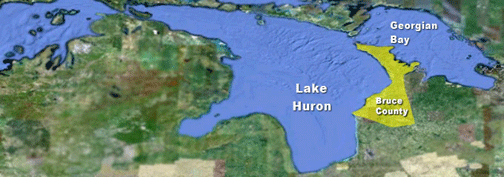
‘We were not consulted when the nuclear industry was established in our territory’,https://nationalpost.com/news/canada/indigenous-community-votes-down-proposed-nuclear-waste-bunker-near-lake-huron The Canadian Press, Colin Perkel. February 1, 2020
TORONTO — An Indigenous community has overwhelmingly rejected a proposed underground storage facility for nuclear waste near Lake Huron, likely spelling the end for a multibillion-dollar, politically fraught project years in the making.
After a year of consultations and days of voting, the 4,500-member Saugeen Ojibway Nation announced late Friday that 85 per cent of those casting ballots had said no to accepting a deep geologic repository at the Bruce nuclear power plant near Kincardine, Ont.
“We were not consulted when the nuclear industry was established in our territory,” SON said in a statement. “Over the past 40 years, nuclear power generation in Anishnaabekiing has had many impacts on our communities, and our land and waters.”
The province’s giant utility, Ontario Power Generation, had wanted to build the repository 680 metres underground about 1.2 kilometres from Lake Huron as permanent storage for low and intermediate-level radioactive waste. The project was tentatively approved in May 2015.
In August 2017, then-environment minister Catherine McKenna paused the process to ensure buy-in from Indigenous people in the area
While Kincardine was a “willing host,” the relative proximity of the proposed bunker to the lake sparked a backlash elsewhere in Canada and the United States. Politicians, environmentalists and scores of communities expressed opposition.
Successive federal governments have withheld final approval. In August 2017, then-environment minister Catherine McKenna paused the process — the last in a string of delays for the project — to ensure buy-in from Indigenous people in the area.
The generating company, which insisted the stable bedrock would safely contain the waste, items such as contaminated reactor components and mops, said it respected SON’s decision.
“OPG will explore other options and will engage with key stakeholders to develop an alternate site-selection process,” Ken Hartwick, head of OPG, said in a statement shortly after the vote was announced. “Any new process would include engagement with Indigenous peoples as well as interested municipalities.”
The apparent end of the road for the project comes shortly after the federally-mandated Nuclear Waste Management Organization said it was making progress toward choosing a site for storing millions of far more toxic spent nuclear fuel bundles.
The organization, comprising several nuclear plant operators, said it had struck deals with landowners in South Bruce — about 30 minutes east of Kincardine — that will allow it to begin site tests. The only other site under consideration for high-level waste storage is in Ignace in northern Ontario.
Despite the rejection of OPG’s proposal, the utility said it planned to continue a relationship “based on mutual respect, collaboration and trust” with the Saugeen Ojibway Nation, which comprises the Chippewas of Saugeen First Nation and the Chippewas of Nawash Unceded First Nation.
Chippewas of Saugeen Chief Lester Anoquot called the vote — 170 for and 1,058 against — a “historic milestone and momentous victory” for the community.
“We worked for many years for our right to exercise jurisdiction in our territory and the free, prior and informed consent of our people to be recognized,” Anoquot said. “We didn’t ask for this waste to be created and stored in our territory.”
At the same time, Anoquot said, the vote showed the need for a new solution for the hazardous waste, a process he said could take many years.
Ontario depends heavily on nuclear power for its electricity but a permanent storage solution for the increasing amounts of waste now stored above ground has proven elusive. The radioactive material, particular from used fuel, remains highly toxic for centuries.
The utility insists exhaustive science shows a repository in stable and impermeable rock offers the best solution.
“Permanent and safe disposal is the right thing to do for future generations,” Hartwick said.
Climate strategies to stave off ecological disaster
 Media on Climate Crisis: Don’t Organize, Mourn, , NEIL DEMAUSE 31 JAN 2920 The year 2019 was, by all accounts, the year of climate awareness. To an unprecedented degree, in the three decades since scientists first warned of the imminent dangers of rising carbon emissions and the resulting global warming, we were transfixed by record-setting heat waves, wildfires in California and Australia, and, of course, Greta Thunberg’s sailboat visit to the US, capped off by her selection as Time‘s Person of the Year (12/23–30/19). Media on Climate Crisis: Don’t Organize, Mourn, , NEIL DEMAUSE 31 JAN 2920 The year 2019 was, by all accounts, the year of climate awareness. To an unprecedented degree, in the three decades since scientists first warned of the imminent dangers of rising carbon emissions and the resulting global warming, we were transfixed by record-setting heat waves, wildfires in California and Australia, and, of course, Greta Thunberg’s sailboat visit to the US, capped off by her selection as Time‘s Person of the Year (12/23–30/19).Yet the newfound attention to climate came with a strange disjunction: Being aware of this massive threat to humanity hasn’t translated into much concerted action to stop it. As Elizabeth Kolbert wrote in the New Yorker (1/13/20):If in the past year (or the past decade) the world began to understand how dangerous climate change is, it certainly didn’t act like it. In the past ten years, more CO2 was emitted than in all of human history up to the election of JFK.
That same disconnect—recognizing the reality of climate change, but not who’s responsible or what could be done about it—is reflected in today’s media coverage of climate. ………….. It’s not that it’s hard to find explanations of which climate strategies would provide the greatest hope for staving off disaster. Project Drawdown, a site that GRADES POTENTIAL SOLUTIONS BY THEIR IMPACT,ranks better management of refrigerants, switching to wind and solar power, and changes in diet and food waste as among the most immediately effective measures. (Electric vehicles, a popular focus for those arguing that technology will save the day, rank a disappointing 26th, in part because they have a large carbon cost to manufacture and won’t help if they’re charged with fossil-fuel-generated electricity; biofuels only made it to 34th, though DRAWDOWN does include them as a possible stopgap measure until more truly renewable energy sources can be brought online.)
The Exponential Roadmap, a study by 22 Swedish scholars, rates switching to solar power, increasing recycling of materials, retrofitting buildings to be more energy-efficient, increasing use of electric vehicles and mass transit, switching to a plant-based diet and reducing deforestation among the most important actions to forestall the climate apocalypse.
None of these methods, climate experts warn, will be possible on a large scale solely by individual action; electric cars, as just one example, are still seen as too expensive and having too few charging stations, two items that are unlikely to be solved without a dramatic shift in government policies. So while that may spare readers from any unnecessary “self-flagellation,” the important corollary is that preventing climate catastrophe will require both individual consumer action and governmental action—as well as addressing the political reasons why governments have been so slow to act.
The media’s shift toward acknowledging the reality of climate change is welcome, if three decades too late, given that the IPCC has been sounding essentially the same alarm about a warming planet since 1988 (Guardian, 3/30/14). But the public presentation of the climate crisis remains carefully constrained to focus on the horrors awaiting us, not on what can be done to ward off the worst, or who stands in the way of doing so. When climate coverage leaves that out, it amounts to mourning the Earth without trying to save it.
|
|
|
“Mercenary science”- crooked science funded by corporations
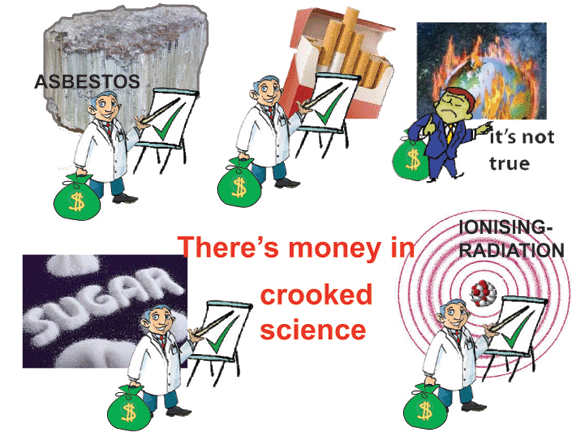
While the vast majority of scientists, both employed publicly and privately, are honest and do their work as part of a larger quest for truth, there are a few notable exceptions. Specifically, a few mercenary science consulting firms have been very effective at helping corporations continue selling harmful chemicals and drugs long after they should have stopped.
Michaels, who has a new book on the topic titled “The Triumph of Doubt: Dark Money and the Science of Deception,” has been studying this problem for years, in part by virtue of his 8-year tenure at OSHA. Now a public health professor at George Washington University, Michaels’ book pulls back the curtain on the way that dark money and for-profit science is quite literally killing Americans.
David Michaels: Mercenary science means [when scientists] produce studies that aren’t designed to better understand the world, or they help make the world a better place — which is why most scientists are in the business of science – but to defend products and to defend corporations. And often to influence regulation or to slow the compensation of victims.
This is the Enron-ization of science. It’s created a fiction in order to promote an actual game, fiction around science. And it is quite mercenary. In fact, this phrase is not one that I invented, but actually is used by these consulting companies whose business model is to provide some using reports and testimonies to corporations, so they can continue to market dangerous products or activities without being hindered by regulation or by compensating the people they’ve hurt.
What would you say is the most shocking, real-life example of something like this — of mercenary science becoming embedded in mainstream discourse?
I think the most famous [example] is in the tobacco industry… who didn’t invent it, but who certainly gained the most from it — and in climate change. There’s actually some overlap between some of the same mercenary scientists in both examples.
But as I write [in my book], this is now become standard operating procedure for virtually every industry, and in many cases, it’s the same so-called scientists who are involved in doing it. Nowadays, the instinct of corporate leaders — CEOs and executives —when there’s an allegation that their product could be causing harm is to say, “How can we show that it isn’t causing harm?” Not, “how can we determine whether or not we cause harm,” and then figure out what to do about it.
Other examples [include] opioids, and essentially how a few pharmaceutical companies misrepresented the studies to make it look like these opioids were not addictive. We have a death toll of tens of thousands a year as a result of that…………
David Michael’s new book, “The Triumph of Doubt: Dark Money and the Science of Deception,” is out from Oxford University Press on February 3, 2020. https://www.salon.com/2020/02/02/the-art-of-scientific-deception-how-corporations-use-mercenary-science-to-evade-regulation/
Katherine Hayhoe on A BETTER WAY TO TALK ABOUT THE CLIMATE CRISIS
Don’t start with fear, judgment, condemnation, or guilt. And don’t start with just overwhelming people with facts and figures. Do start by connecting the dots to what is already important to both of us, and then offer positive, beneficial, and practical solutions that we can engage in.
climate change affects the economy, the availability of natural resources, prices, jobs, international competition, and more. Failing to account for climate change in future long-range planning could lose us a competitive edge even in a best-case scenario, and potentially mean the end of a product line or an entire business in the worst case. By connecting climate impacts to what we already care about, we can recognize the importance and urgency of taking action.
|
A BETTER WAY TO TALK ABOUT THE CLIMATE CRISIS GRETCHEN GAVETT, Harvard Business Review, JANUARY 30, 2020 Many of us care about the climate, but it can be challenging to talk about. It’s easy to get bogged down in stats and statistics, for one. And it can be nerve-racking to approach someone if you don’t already know what their beliefs on the topic are. Sometimes, it’s easier to just keep our mouths shut. Given the urgency of the climate crisis, however, many of us feel that silence is no longer an option. And Dr. Katharine Hayhoe, a climate scientist at Texas Tech University, is the person to talk to about how to talk about climate change. Continue reading |
The reasons behind China’s No First Use nuclear weapons policy
|
Why China Says It Will Never Use Nuclear Weapons First in a Major War
Never ever? National Interest, 2 Feb 2020, by David Axe Follow @daxe on TwitterL Key point: China knows that it has enough nuclear weapons to destroy anyone who attacked them.
This fact gives Beijing enough security to declare it doesn’t need to strike first to deter its enemies.
China has reaffirmed its policy of never being the first in a conflict to use nuclear weapons. Experts refer to this policy as “no first use,” or NFU.
The NFU policy reaffirmation, contained in Beijing’s July 2019 strategic white paper, surprised some observers who expected a more expansive and aggressive nuclear posture from the rising power. Notably, the United States does not have a no-first-use policy. “Retaining a degree of ambiguity and refraining from a no first use policy creates uncertainty in the mind of potential adversaries and reinforces deterrence of aggression by ensuring adversaries cannot predict what specific actions will lead to a U.S. nuclear response,” the Pentagon stated.
Chinese state media posted the government’s white paper in its entirety. “Nuclear capability is the strategic cornerstone to safeguarding national sovereignty and security,” the paper asserts. “This is standard language,” explained David Santoro, a nuclear expert with the nonprofit Pacific Forum. “China’s nukes serve to prevent nuclear coercion and deter nuclear attack.” Then the surprise. “China is always committed to a nuclear policy of no first use of nuclear weapons at any time and under any circumstances, and not using or threatening to use nuclear weapons against non-nuclear-weapon states or nuclear-weapon-free zones unconditionally,” the white paper adds……. It would be difficult to compose a more emphatic rejection of claims that China’s no-first-use policy is changing. The statement also indicates it is not Chinese policy to use nuclear weapons first to forestall defeat in a conventional military conflict with the United States. China does not have an “escalate to de-escalate” nuclear strategy.
China is not preparing to fight a nuclear war with the United States. It does not have “battlefield” or “tactical” or “non-strategic” nuclear weapons. Chinese nuclear strategists don’t think a nuclear war with the United States is likely to happen. And they seem sure it won’t happen as long as the U.S. president believes China can retaliate if the United States strikes first. That’s not a high bar to meet, which is why China’s nuclear arsenal remains small and, for the time being, off alert.
China sees its comparatively modest nuclear modernization program as a means to convince U.S. leaders that a few Chinese ICBMs can survive a U.S. first strike and that these survivors can penetrate U.S. missile defenses. Chinese nuclear planners might be willing to slow or scale back their nuclear modernization efforts if the United States were willing to assure China’s leaders it would never use nuclear weapons first in a military conflict with China. Chinese experts and officials have been asking the United States to offer that assurance for decades. U.S. experts and officials consistently refuse……
Given the impassioned attack on constructive U.S.-China relations currently sweeping U.S. elites off their feet, along with the continued proliferation of misinformation about Chinese nuclear capabilities and intentions, many U.S. commentators are likely to brush aside the new white paper’s reiteration of China’s longstanding nuclear no-first-use policy.
David Axe serves as Defense Editor of the National Interest. He is the author of the graphic novels War Fix, War Is Boring and Machete Squad. This first appeared earlier in 2019.https://nationalinterest.org/blog/buzz/why-china-says-it-will-never-use-nuclear-weapons-first-major-war-119021
|
|
Need to include a No New Nuclear clause in climate emergency planning
 Radiation Free Lakeland 1st Feb 2020, Kevin Frea is co-chair of the Climate Emergency Network and deputy leader of Lancaster City Council and has worked hard to sign local councils up declaring a climate emergency. “This movement is being led by every political group and is involving local people in planning the actions needed to cut carbon …
”. There is one critical action that is being missed – a No New Nuclear Clause! Last September members of Radiation Free Lakeland lobbied Lancaster City Council asking the council to include a No New Nuclear clause in their climate emergency planning.
The council agreed with us that renewables are the way forward and it is brilliant that council members are actively involved in local community renewable schemes.
However, they thought that including a No New Nuclear Clause in their
Climate Emergency Planning was not necessary. Because as Cllr Kevin Frea
said “Heysham, number 8 on the new nuclear plant list it is not likely to
go ahead”. This new nuclear nonchalence rather misses the point that the
continued push (billions of pounds of public money) for new nuclear is
decimating urgent steps towards renewables and energy efficiency. The sole
reason we are in the situation we are in is entirely down to the continued
efforts of the nuclear industry and its vested interests to suppress
renewables.
https://mariannewildart.wordpress.com/2020/02/01/14471/
Oxford City Council says NO to nuclear weapons
 Cherwell 1st Feb 2020 , Oxford City Council has called on the British Government to sign the International Treaty to Prohibit Nuclear Weapons (TPNW). The resolution, proposed by Councillor John Tanner, was agreed “overwhelmingly” by the City Council on Monday. Before backing the Treaty, the City Council want the UK government to renounce its use of nuclear weapons and end the renewal of Trident.
https://cherwell.org/2020/02/01/oxford-city-council-says-no-to-nuclear-weapons/
As forests burn around the world, drinking water is at risk
 As forests burn around the world, drinking water is at risk https://www.westhawaiitoday.com/2020/01/31/features/as-forests-burn-around-the-world-drinking-water-is-at-risk/
In Australia’s national capital of Canberra, where a state of emergency was declared on Friday because of an out-of-control forest fire to its south, authorities are hoping a new water treatment plant and other measures will prevent a repeat of water quality problems and disruption that followed deadly wildfires 17 years ago.
|
“The forest area burned in Australia within a single fire season is just staggering,” said Stefan Doerr, a professor at Swansea University in England who studies the effects of forest fires on sediment and ash runoff. “We haven’t seen anything like it in recorded history.” The situation in Australia illustrates a growing global concern: Forests, grasslands and other areas that supply drinking water to hundreds of millions of people are increasingly vulnerable to fire due in large part to hotter, drier weather that has extended fire seasons, and more people moving into those areas, where they can accidentally set fires. More than 60% of the water supply for the world’s 100 largest cities originates in fire-prone watersheds — and countless smaller communities also rely on surface water in vulnerable areas, researchers say. When rain does fall, it can be intense, dumping a lot of water in a short period of time, which can quickly erode denuded slopes and wash huge volumes of ash, sediment and debris into crucial waterways and reservoirs. Besides reducing the amount of water available, the runoff also can introduce pollutants, as well as nutrients that create algae blooms. What’s more, the area that burns each year in many forest ecosystems has increased in recent decades, and that expansion likely will continue through the century because of a warmer climate, experts say. Most of the more than 25,000 square miles that have burned in Victoria and New South Wales have been forest, including rainforests, according to scientists in New South Wales and the Victorian government. Some believe that high temperatures, drought and more frequent fires may make it impossible for some areas to be fully restored. When rain does fall, it can be intense, dumping a lot of water in a short period of time, which can quickly erode denuded slopes and wash huge volumes of ash, sediment and debris into crucial waterways and reservoirs. Besides reducing the amount of water available, the runoff also can introduce pollutants, as well as nutrients that create algae blooms. What’s more, the area that burns each year in many forest ecosystems has increased in recent decades, and that expansion likely will continue through the century because of a warmer climate, experts say. Most of the more than 25,000 square miles that have burned in Victoria and New South Wales have been forest, including rainforests, according to scientists in New South Wales and the Victorian government. Some believe that high temperatures, drought and more frequent fires may make it impossible for some areas to be fully restored. Very hot fires burn organic matter and topsoil needed for trees and other vegetation to regenerate, leaving nothing to absorb water. The heat also can seal and harden the ground, causing water to run off quickly, carrying everything in its path. That in turn can clog streams, killing fish, plants and other aquatic life necessary for high-quality water before it reaches reservoirs. Already, thunderstorms in southeast Australia in recent weeks have caused debris flows and fish kills in some rivers, though fires continue to burn. “You potentially get this feedback cycle,” where vegetation can’t recolonize an area, which intensifies erosion of any remaining soil, said Joel Sankey, research geologist for the U.S. Geological Survey. The role of climate change is often difficult to pin down in specific wildfires, said Gary Sheridan, a researcher at the University of Melbourne. But he said the drying effects of wildfire — combined with hotter weather and less rainfall in much of Australia, even as more rain falls in the northern part of the country — mean that “we should expect more fires.” But climate change has affected areas such as northern Canada and Alaska, where average annual temperatures have risen by almost 4 degrees since the 1960s, compared to about 1 degree farther south. As a result, the forested area burned annually has more than doubled over the past 20 to 30 years, said Doerr, from Swansea University. Although there might be fewer cities and towns in the path of runoff in those areas, problems do occur. In Canada’s Fort McMurray, Alberta, the cost of treating ash-tainted water in its drinking-water system increased dramatically after a 2016 wildfire. In the Western U.S., 65% of all surface water supplies originate in forested watersheds where the risk of wildfires is growing — including in the historically wet Pacific Northwest. By mid-century almost 90% of them will experience an increase — doubling in some — in post-fire sedimentation that could affect drinking water supplies, according to a federally funded 2017 study. “The results are striking and alarming,” said Sankey, the USGS geologist, who helped lead the study. “But a lot of communities are working to address these issues,” he added. “It’s not all doom and gloom because there are a lot of opportunities to reduce risks.” Denver Water, which serves 1.4 million customers, discovered “the high cost of being reactive” after ash and sediment runoff from two large, high-intensity fires, in 1996 and 2002, clogged a reservoir that handles 80% of the water for its 1.4 million customers, said Christina Burri, a watershed scientist for the utility. It spent about $28 million to recover, mostly to dredge 1 million cubic yards of sediment from the reservoir. Since then, the utility has spent tens of millions more to protect the forests, partnering with the U.S. Forest Service and others to protect the watershed and proactively battle future fires, including by clearing some trees and controlling vegetation in populated areas. Utilities also can treat slopes with wood chips and other cover and install barriers to slow ash runoff. They purposely burn vegetation when fire danger is low to get rid of undergrowth. Canberra’s water utility has built in redundancies in case of fire, such as collecting water from three watersheds instead of two, and it can switch among sources if necessary, said Kristy Wilson, a spokeswoman for Icon Water, which operates the system. Water can be withdrawn from eight different levels within the largest dam to ensure the best-quality water, even if there is some sediment, she said. That is paired with simpler measures such as using straw bales, sediment traps and booms with curtains to control silt, and physically removing vegetation around reservoirs and in watersheds to reduce fire fuel, she said. Eventually, some communities might need to switch their water sources because of fires and drought. Perth, on the western coast, has turned to groundwater and systems that treat saltwater because rainfall has decreased significantly since the early 1970s, said Sheridan of University of Melbourne. But, for now, millions of people will continue to drink water that originates in increasingly fire-prone forests. |
|
1 This Month
26 April – Chernobyl: Inside the Meltdown airs on National Geographic on Sunday 26th April from 4pm

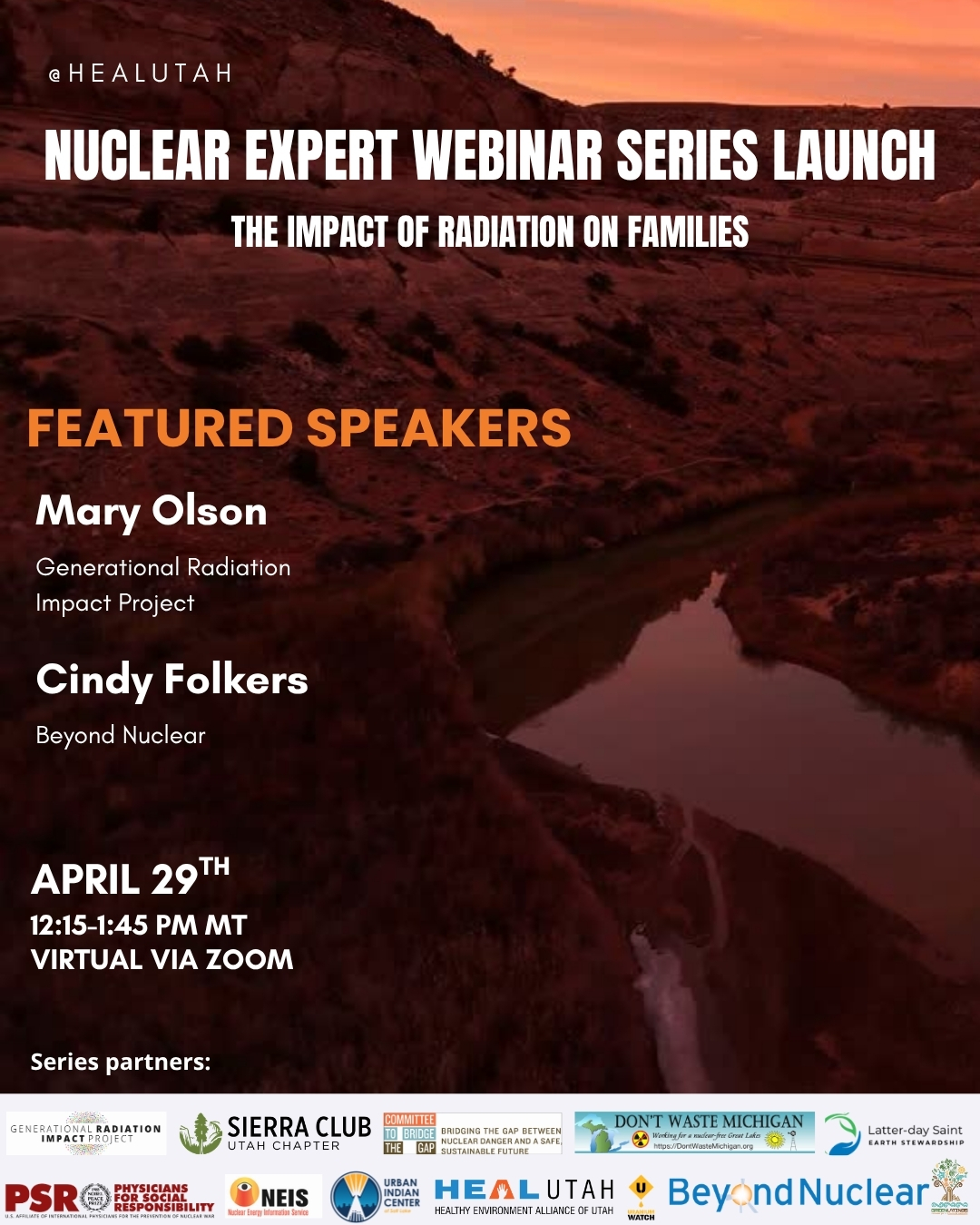
29 April – Nuclear Expert Webinar #1 – Radiation Impacts on Families with Mary Olson and Cindy Folkers
- 12:15 PM MT – 1:45 PM MT
- Location: Virtual – REGISTER TODAY

4 May -West Suburban Peace Coalition to discuss Iran war at May Educational Forum
Monday, May 4, 7:00 – 8:00 PM Central Standard Time
Title: : How Trump’s Narrative Tries to Shape the Reality of the War on Iran.
Contact Walt Zlotow, zlotow@hotmail.com 630 442 3045 for further information
14 May – online event From Bombs to Data Centres: the Face of Nuclear Colonialism

Pine Ridge Uranium is the real threat, not Tehran- Tell Burgum: Stop the Extraction.
Chernobyl: The Lost Tapes – A good documentary on Chernobyl on SBS available On Demand for the next 3 weeks– https://www.sbs.com.au/ondemand/tv-program/chernobyl-the-lost-tapes/2352741955560
To see nuclear-related stories in greater depth and intensity – go to https://nuclearinformation.wordpress.com
-
Archives
- April 2026 (300)
- March 2026 (251)
- February 2026 (268)
- January 2026 (308)
- December 2025 (358)
- November 2025 (359)
- October 2025 (376)
- September 2025 (257)
- August 2025 (319)
- July 2025 (230)
- June 2025 (348)
- May 2025 (261)
-
Categories
- 1
- 1 NUCLEAR ISSUES
- business and costs
- climate change
- culture and arts
- ENERGY
- environment
- health
- history
- indigenous issues
- Legal
- marketing of nuclear
- media
- opposition to nuclear
- PERSONAL STORIES
- politics
- politics international
- Religion and ethics
- safety
- secrets,lies and civil liberties
- spinbuster
- technology
- Uranium
- wastes
- weapons and war
- Women
- 2 WORLD
- ACTION
- AFRICA
- Atrocities
- AUSTRALIA
- Christina's notes
- Christina's themes
- culture and arts
- Events
- Fuk 2022
- Fuk 2023
- Fukushima 2017
- Fukushima 2018
- fukushima 2019
- Fukushima 2020
- Fukushima 2021
- general
- global warming
- Humour (God we need it)
- Nuclear
- RARE EARTHS
- Reference
- resources – print
- Resources -audiovicual
- Weekly Newsletter
- World
- World Nuclear
- YouTube
-
RSS
Entries RSS
Comments RSS
 nuclear-news