Climate change to continue hitting UK with bigger storms
  UK must prepare for more intense storms, climate scientists say UK must prepare for more intense storms, climate scientists say
Government urged to create more natural drainage systems to cope with impact of crisis, Guardian, Jonathan Watts 17 Feb 20, Britain must brace for more storms like Dennis and Ciara because rainfall will be more intense in a climate-disrupted future, scientists have warned.They said the government needed to increase the creation of more natural drainage systems if it wanted to avoid having to raise the level of sea and river defences every few years to counter the growing threat of flooding and storm surges. Storm Dennis killed at least three people and flooded many parts of the country at the weekend. Politicians from all parties have acknowledged the link to the climate crisis, but differ over how to respond. The new environment secretary, George Eustice, said on Sunday that the UK was already spending billions of pounds on flood infrastructure, but that there was a limit to how effective this could be in the face of a worsening threat…… Dr Mohammad Heidarzadeh, the head of coastal engineering and resilience at Brunel University, said the UK’s flood defences were not suited to the current situation, which is characterised by high frequency and high intensity climate events. “While the interval for major floods was 15-20 years in the past century in the UK, it has dramatically shortened to two-to-five years in the past decade. Therefore, it is no surprise that several flood defence systems were overtopped or damaged by flood water,” he said…… After Storm Desmond devastated parts of Scotland, the Lake District and Northern Ireland in 2015, scientists estimated human-driven change to the climate made extreme rain about 40% more probable. Similar attribution studies for the latest downpours will need more time, but the overall trends towards more extreme weather are well established. Compared with 50 years ago, the Met Office says the maximum daily deluge each year has risen by 17% from 64mm to 75mm, while the longest wet spell has increased from an average of 12.4 days to 12.9 days. https://www.theguardian.com/uk-news/2020/feb/17/uk-must-prepare-for-more-intense-storms-climate-scientists-say |
|
Iran would return to 2015 nuclear agreement if Europe would provides “meaningful” economic benefits
 Zarif Says Iran Could Reverse Nuclear Breaches If Europe Acts, Sunday, 16 February, 2020 Munich- Asharq Al-Awsat Zarif Says Iran Could Reverse Nuclear Breaches If Europe Acts, Sunday, 16 February, 2020 Munich- Asharq Al-Awsat
Iran would be willing to move back towards the 2015 nuclear deal (JCPOA) if Europe provides “meaningful” economic benefits, announced Iranian Foreign Minister Mohammed Javad Zarif on the sidelines of Munich Security Conference (MSC).
Zarif met with members of the European Council on Foreign Relations (ECFR) in Munich where they discussed the nuclear deal, Europe’s obligations under the deal, and regional and international issues. He pointed out that Iran is ready to return from reducing its nuclear obligations if Europe abides by its obligations and takes practical steps in this field…… https://aawsat.com/english/home/article/2134461/zarif-says-iran-could-reverse-nuclear-breaches-if-europe-acts |
|
Radioactive leaks and other problems at Westinghouse nuclear fuel factory near Columbia
|
Inspectors at the Westinghouse nuclear fuel factory near Columbia recently found 13 small leaks in a protective liner that is supposed to keep pollution from dripping into soil and groundwater below the plant.
Now, the company plans to check a concrete floor beneath the liner, as well as soil below the plant, for signs of contamination that could have resulted from the tears, which were characterized in a federal inspection report as ‘’pinhole leaks.’’ The pinhole leaks, discovered by Westinghouse late in 2019, may have formed after company employees walked across the liner and weakened it, according to the U.S. Nuclear Regulatory Commission. If that’s true, it would mark the second time in two years that Westinghouse has run into trouble over employees walking across protective liners. Foot traffic weakened a liner in another part of the plant that contributed to a 2018 leak of uranium solution through the plant’s floor, according to the NRC. The 2018 leak, which occurred near a spiking station that mixes solutions, contaminated soil, prompting an outcry from community residents about operating practices at Westinghouse. Since the leak of uranium solution, state and federal agencies have revealed the existence of previously unreported leaks at the plant. Troubles at the plant have sparked public meetings in eastern Richland County, where many neighbors have criticized Westinghouse for not keeping them informed. The Westinghouse plant converts uranium hexafluoride into uranium dioxide to make nuclear fuel assemblies for atomic power plants. Chemicals used in the process can be hazardous if people are exposed to substantial amounts. Among the threats are kidney and liver damage. Uranium is a radioactive material that also can increase a person’s risks of cancer. …… The NRC inspection report, completed in January, said Westinghouse was supposed to ensure that walking pads were across the liner to prevent problems, but “this proved to be ineffective.’’ The report said “13 pinhole leaks were found in the liner, indicating that the liner had been walked on.’’ The problems, discovered Dec. 9, occurred in a section of the plant with a second spiking station, similar to the spiking station where the leak was found in 2018……. Established in 1969 between Columbia and what today is Congaree National Park, the factory makes fuel rods for the nation’s atomic power plants. The company has a decades long history of groundwater contamination. ……. Concerns have risen recently upon the revelation of previously unknown leaks at the plant in 2008 and 2011. Westinghouse knew about the leaks but did not inform regulators for years. Westinghouse also has had multiple problems in the past five years complying with federal nuclear standards. In addition to the 2018 uranium leak, the company also had troubles in 2016 when inspectors found that uranium had built up in an air pollution control device, creating a potentially dangerous situation for workers. Last year, the company dealt with a small fire in a bin containing nuclear plant refuse, as well as uranium-tainted water leaking from a rusty shipping container. https://www.thestate.com/news/local/environment/article240309966.html |
|


High levels of radioactivity in housing complex, Jakarta National Nuclear Energy Agency urges calm.
 Don’t panic’: Nuclear agency urges controlled reaction to radiation in South Tangerang housing complex, Gemma Holliani Cahya, The Jakarta Post, Jakarta Sun, February 16, 2020 The National Nuclear Energy Agency (Batan) has asked residents of the Batan Indah housing complex in South Tangerang, Banten, to remain calm after finding high levels of radiation within the complex. Don’t panic’: Nuclear agency urges controlled reaction to radiation in South Tangerang housing complex, Gemma Holliani Cahya, The Jakarta Post, Jakarta Sun, February 16, 2020 The National Nuclear Energy Agency (Batan) has asked residents of the Batan Indah housing complex in South Tangerang, Banten, to remain calm after finding high levels of radiation within the complex.Agency spokesperson Heru Umbara said locals should not panic because the case was being handled by the relevant authorities. “Residents can carry out activities as usual, as long as they do not enter the area that has been marked as contaminated. If managed properly, exposure to this radiation will not endanger the residents,” Heru said in a statement on Saturday. The Nuclear Energy Regulatory Agency (Bapeten) first detected the radiation during a routine check meant to ensure that the agency’s mobile radiation detection unit was working properly……. “A joint Bapeten and Batan team conducted a search to find the source of the high radiation on Feb. 7 to 8 and found several radioactive fragments,” he said, adding that after the fragments were removed, tests showed that the radiation levels in the area had decreased but were still above normal levels. “Based on those results, we concluded that the contamination had spread in the area and decontamination efforts had to be conducted by removing or dredging contaminated soil and removing contaminated trees and other vegetation.” Bapeten spokesperson Abdul Qohhar Teguh said that the agency was not yet able to confirm the source of the radioactive fragments found in the area. “For the time being, we have not focused on investigating the location of the source, where it came from, why it was there, who brought it. At the moment the joint team is still focusing on clearing the scene,” Qohhar told The Jakarta Post on Saturday. He added, however, that the team’s initial findings indicated that the radiation did not come from a nuclear reactor leak. The Puspiptek building, which is located about five kilometers away from the Batan Indah complex, houses several small reactors used for experimental purposes. “The source of radiation that we found [in the complex] is Caesium-137, which is frequently used for industrial purposes,” he said. “Caesium-137 is also one of the substances that will contaminate the environment when there is a reactor accident, such as at Chernobyl or Fukushima. But in addition to Caesium-137 there would also be other substances [in a reactor accident]. In this case, the only radiation source is Caesium-137, so the hypothesis that this incident is due to a reactor leak is baseless.”…….. Heru said that Batan was currently in the process of cleaning up the exposed area and had collected 52 drums of soil and vegetation from the locations. “The results of the cleanup showed that the material causing the radiation had mixed with the soil. The findings are currently being analyzed in the Batan laboratory,” he said. He added that after the cleanup, the radiation levels fell by 30 percent, from 149 microSieverts per hour to 98.9 microSieverts per hour. The normal exposure rate from background radiation is around 0.03 microSieverts per hour. The clean-up process, Heru said, started on Feb. 12 and would continue until early March. He added that the team would soon conduct a radiation test known as “whole-body counting” on residents who lived in the exposed area to measure their bodies’ radioactivity levels. “We will keep doing the cleanup until the area is thoroughly clean and there is no longer any danger to the people and the environment,” Heru said. https://www.thejakartapost.com/news/2020/02/16/dont-panic-nuclear-agency-urges-controlled-reaction-to-radiation-in-south-tangerang-housing-complex.html |
|
Excess radiation level recorded in Moscow

 Belsat 12th Feb 2020, A sensor of the Russian state enterprise Radon, which specializes in handling radioactive waste, has recorded a 60-fold excess of the radiation background at the construction site of the South-East Chord (multi-lane expressway) in Moscow, the Russian service of Radio Liberty reports.
radiation level of 0.3 microsieverts. Residents of the
Moskvorechye-Saburovo district report that this is the seventh time in
three days, but neither Radon nor the MES have taken any action, claiming
that the sensor works in test mode and there are no actual spikes in
radiation.
of radioactive waste on the South-Eastern Chord route. The mayor`s office
said that “in the case of the construction of the chord, the city faced a
unique and exceptional problem — radioactive waste, which the Moscow
Polymetal Plant stored in its backyard in the 1950s and 1960s”. At the
same time, the City Hall called the discovered traces of radioactive
contamination “insignificant”.
https://belsat.eu/en/news/excess-radiation-level-recorded-in-moscow/
Global Optimism – The Future We Choose
 Observer 15th Feb 2020, Christiana
 Figueres is a founder of the Global Optimism group and was head of the UN climate change convention when the Paris agreement was achievedin 2015.
Your new book is called The Future We Choose. But isn’t it too
late to stop the climate crisis? We are definitely running late. We have
delayed appallingly for decades. But science tells us we are still in the
nick of time. We can only choose it this decade.
Our parents did not have this choice, because they didn’t have the capital, technologies and understanding. And for our children, it will be too late.
So this is the decade and we are the generation. If we all reduce our emissions,
collectively we give a signal to the market. Obviously, corporations have
their own responsibilities but it’s helpful to have a strong demand from
the public. Once you get governments, corporations and the public moving in
the same direction towards low carbon, it can grow exponentially [such as
with renewable energy and electric cars]. People reducing their emissions
– by flying less, eating less meat and using clean energy, for example
– is important.
French govt considers a “0% nuclear” energy plan: and problems in existing nukes
 Europe1 16th Feb 2020, The government is considering a “0% nuclear” energy plan and the Flamanville EPR, still under construction, should open, at best, ten years behind schedule: in the coming years, there will be no shortage of challenges for the first producer electricity in France. If the group
Electricity of France (EDF), will supply “all the sites of Paris 2024 in
renewable energies” , all is not however rosy on the side of the first
electricity supplier in Europe. Several points are to be reviewed on its
copy in the coming years, especially around the construction of new nuclear
power plants in France, including that of Flamanville.
https://www.europe1.fr/economie/epr-de-flamanville-et-part-du-nucleaire-les-defis-dedf-3949806
The plutonium dilemma – Japan and UK

 What should be done with Japan’s plutonium now stored in the UK? ~ Research trip report. BY by Caitlin Stronell, CNIC
From September 11 to 21, Ban Hideyuki and Caitlin Stronell from CNIC visited the UK in order to survey opinions on what should be done with Japan’s 21.2 tons of plutonium presently stored at the Sellafield facility in the UK. As Japan does not have an operating reprocessing plant, spent fuel was shipped to the UK and France for reprocessing and fabrication into MOX fuel from the late 1970s. Including Japan’s 21 tons, a total of approximately 140 tons of separated plutonium are held in the UK, which has offered to take ownership of foreign owned plutonium on its soil, subject to acceptable commercial terms. There have already been several such cases of ownership transfers of plutonium. (For example, in January 2017 the UK took ownership of 600 kg of plutonium previously owned by a Spanish utility and 5 kg previously owned by a German organization.)
Last year Japan’s Ministry for Economy, Trade and Industry (METI) announced that a dialogue concerning plutonium between the UK and Japan had begun. Although the details of this dialogue have not been released, ownership transfer may well be one of the discussion points. If Japan does go through with the ownership transfer, it will be an admission that the plutonium, which it has spent vast sums on extracting from the spent fuel, is not a precious resource at all, but material that now has to be disposed of, again at large cost. This would be another heavy blow against Japan’s reprocessing policy. However, how do people in the UK feel about accepting 21 tons of Japanese plutonium? This was what we tried to find out on our research trip.
Closely related to the issue of plutonium in both Japan and the UK is the issue of nuclear waste and we also wanted to find out about how the UK is planning to deal with this issue, especially in terms of siting a Geological Disposal Facility (GDF). Plans to site the GDF in Cumbria were rejected by the Council in 2013 and since then the national government has introduced a new system where smaller communities are able to request that they be considered as a GDF site. We wanted to find out how people were reacting to this and what the prospects are for the government being able to successfully site a GDF under this system.
We spoke to a large range of people directly concerned with these issues, of course anti-nuclear activists, but also a scientist involved in research on direct disposal methods for plutonium, as well as a number of people who work at Sellafield and local councilors for the area. Their answers to the question of what to do with Japan’s 21 tons of plutonium were varied and, in some cases, a little unexpected. For example, I was expecting that Prof. Neil Hyatt of Sheffield University, who is conducting cutting edge research on plutonium disposal, would be more open to accepting Japan’s plutonium, but he expressed some hesitation, saying that if the UK government agrees to take ownership of such a large amount of plutonium, it will break trust with local people by increasing their waste burden.
Divided opinions
We also noticed a split opinion between the two Cumbrian Councillors we interviewed. Cumbria is the county where the Sellafield Site is located and the nuclear industry obviously plays an important part in the local economy and politics………
The NDA is also tasked with siting the GDF for radioactive waste, which has proved to be a difficult task indeed, as it is all over the world, including in Japan where little progress has been made. There have been three attempts so far in the UK to try to decide on a site for the GDF, none of which have yielded results and so a new process for finding a GDF site began in January 2019. This process allows any community, no matter how small, to express an interest in starting a dialogue regarding hosting a GDF. …….
These and many other campaigns led by local communities show that the authorities and industry claims of transparency and safety cannot be trusted and in this sense it was easy to understand comments by Cr. Celia Tibble regarding the public reaction if the UK government were to accept Japanese plutonium. It would be seen as another lie and breach of trust…….
Conclusion
I thought that there were many similarities between the situation in Japan and in the UK regarding nuclear fuel cycle policy. Both countries must deal with massive amounts of plutonium, extracted at huge cost and risk, which now has no apparent use. Both the governments of Japan and the UK try to convince themselves and the world that it can be used as MOX fuel, but without a fabrication plant or sufficient MOX reactors, this solution is totally unconvincing. In the UK, it seems at least some industry people are facing up to this reality. In Japan, however, the government, at least at a policy level, hasn’t even faced up to the reality that plutonium is not a resource. Transferring ownership of its 21 tons of plutonium held in Sellafield to the UK would be an important step in facing up to this reality and could open the door to more practical and constructive discussions on how to reduce the plutonium stockpile. These discussions will not be easy and require an honest and concerted effort on the part of local and national governments, industry, communities and citizens. https://cnic.jp/english/?p=4681
Hysteria isn’t killing nuclear power — Beyond Nuclear International

It’s the very real dangers and catastrophic costs
via Hysteria isn’t killing nuclear power — Beyond Nuclear International
Stirring up trouble — Beyond Nuclear International

Alarming increase in radioactivity levels follows mud dredging at Hinkley Point
The global grip of the nuclear money cartel
| C.H.W. ChrisWinsYesPositively@dispostable.com 185.207.139.2 The reality is that the true facts on radiation toxicity have been carefully obfuscated for ages by all nations profiteering handsomely from nuclear energy, medical radiation, and nuclear weaponry, such as the US, France, Russia, India, or Japan.The conventional medical-dental industries and the nuclear-military industries (=the radiation cartel) have been, for well over half a century , perpetually lying about, and minimizing, the true toxicity of ionizing radiation (e.g resorting to false sneaky comparisons between radiation exposure from sunlight or an airplane flight to a dental or medical x-ray or the exposure to nuclear fallout, etc. to deliberately deceive the unwitting public) to avoid culpability for the huge number of deaths and injuries that they’re responsible for (discussed and well referenced in the book “The Mammogram Myth” by Rolf Hefti). The official accounts on the Chernobyl debacle, as an example, range from a few dozen to a few hundred people who ended up dead while independent analyses (conducted by people NOT tied to the corrupt corporate mainstream “science” syndicate) estimated the death toll in the tens to hundreds of thousands (in some cases approaching a million) of deceased people (and the radiation cartel-induced massacre is continuing). The distortions and disinformation about the alleged safety of (low dose) radiation or the purported lack of much harm to people, whether from medical x-rays or fallout from disaster sites such as Chernobyl or Fukushima, continues to this day. The real danger and damage caused by Chernobyl and Fukushima are much higher than the officialdom wants the public to believe. You can recognize the global grip of this powerful big money cartel by the ominous absence in the reporting of the allied corporate mass media (the mainstream fake news media) about the ongoing severe disaster at Fukushima, or by any of the solid proofs about the frauds this criminal evil cartel is involved in. You can find out more about that from Dr. Chris Busby, Dr. Helen Caldicott and others who are not tied to the corrupt radiation cartel |
Algeria’s radioactive legacy from France’s nuclear bomb tests
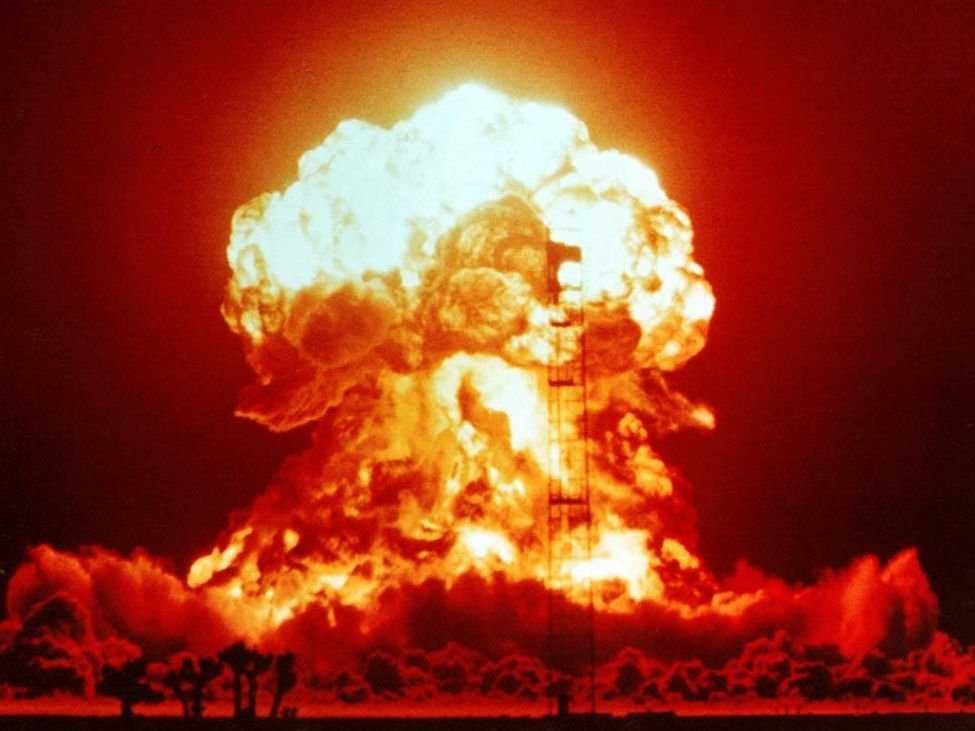 Algeria: 60 years on, French nuclear tests leave bitter fallout https://www.dw.com/en/algeria-60-years-on-french-nuclear-tests-leave-bitter-fallout/a-5235435113.02.2020, Author Elizabeth Bryant (Paris)
Decades after the first French nuclear test in Algeria, thousands of victims are still waiting for compensation from the government. Why is France dragging its feet over the issue?
Jean-Claude Hervieux still remembers joining a crowd of soldiers and high-level officials in Algeria’s Sahara desert to witness one of France’s first nuclear tests. Things didn’t go exactly as planned.
Instead of being contained underground, radioactive dust and rock escaped into the atmosphere. Everyone ran, including two French ministers. At military barracks, the group showered and had their radiation levels checked as a crude means of decontamination. “You don’t see nude ministers very often,” Hervieux chuckled.
But as France marks the 60th anniversary of its first nuclear test — near Algeria’s border with Mauritania, on February 13, 1960 — there is not much to laugh about. Critics have long claimed more than three decades of nuclear testing may have left many victims, first in Algeria and later in French Polynesia, where the bulk of testing took place.
But so far, only hundreds have been compensated, including just one Algerian. And as key nuclear testing anniversaries tick by, the unresolved fallout of the nuclear explosions has also fed into longstanding tensions between Paris and its former colony.
It is part of the whole issue of decolonization, and of Algerians asking for French recognition of crimes committed” as a colonial power, said Brahim Oumansour, North African analyst for the Paris-based French Institute of International Relations. For France, he added, doing so might mean “financial compensations in the millions of euros.”
Such issues are off the French government’s current public radar. A major nuclear policy speech last week by President Emmanuel Macron made no mention of them. France’s compensation commission says it has responded to claims that meet criteria set out by law.
The French Defense Ministry and Algerian authorities did not respond to questions about the tests.
A former electrician, Hervieux spent a decade working on the French nuclear tests, first in Algeria and later in French Polynesia. The botched Beryl explosion he witnessed in May 1962 took place two months after Algeria’s independence from France. The desert testing would continue for another four years, thanks to an agreement Paris secured with Algiers. “The showers cleaned our bodies and clothes,” Hervieux said of the Beryl incident, “but not what we breathed in or swallowed.”
Hervieux asked French authorities for the results of his radiation tests. They were bizarre, he said. One claimed to have screened him when he was on vacation; another named his father. He was told yet another had been destroyed on grounds it was contaminated.
Buried everything
Altogether, Paris exploded more than 200 nuclear devices. Most were in remote atolls of French Polynesia, but the first 17 took place in Algeria’s desert. In 1996, French President President Jacques Chirac called a halt to the testing.
When we left Algeria, we dug large holes and we buried everything,” said Hervieux, now 80, of France’s departure from the desert sites, in 1966.
He later joined AVEN, a pressure group for victims of French nuclear tests, although he says he remains healthy.
While he did not witness ill effects in Algeria, Hervieux describes visiting a village in French Polynesia where high radiation levels had been detected. “A local teacher said children were sick and vomiting,” he recalled. “Mothers were asking why their children’s hair was falling out.”
In Algeria, testing sites are still contaminated, activists say, many fenced off by only barbed wire, at best. “I saw radiation levels emitted from minerals, rocks vitrified by the bombs’ heat, which are colossal,” said retired French physicist Roland Desbordes, who has visited the sites. “These aren’t sites buried in the corner of the desert — they’re frequently visited by Algerian nomads,” who recuperate copper and other metals from the detritus.
Indelible scar?
The former president and now spokesman for CRIIRAD, an independent French research group on atomic safety, Desbordes claims the French army has key classified information about the testing it will not open to public scrutiny, including about the health and environmental effects of the explosions. But he believes Algerian authorities also bear some blame.
Each anniversary they talk about how these nuclear tests were not good,” he said, “but it’s also up to them to close off the sites to ensure nobody can access them.”
Reports, including a pair of decade-old documentaries by Algerian reporter Larbi Benchiha, suggest the testing left an indelible scar on local communities. Unaware of the danger, they collected once-buried scrap metal uncovered by desert winds, and turned them into jewelry and kitchen utensils.
Altogether, between 27,000 to 60,000 people from communities surrounding the test sites were affected, according to one Al Jazeera report, citing differing French and Algerian estimates.
But out of more than 1,600 claims filed under a decade-old French compensation law that finally acknowledged health problems from the tests, only 51 have come from Algeria, according to France’s nuclear compensation commission, CIVEN. A separate Supreme Court ruling recently reinstated two extra compensation claims from French Polynesia.
Among other criteria, the 2010 law requires proof of a minimum level of exposure to weapons tests, and offers a list of 23 types of cancers that qualify for compensation.
“There are very few demands and we can only judge those we receive,” said CIVEN Director Ludovic Gerin, who added the Algerian claims didn’t meet compensation criteria.
“We can’t actively search for victims,” he added, “so we’re a bit blocked.”
Estonia, Latvia and Lithuania oppose energy imports from a Belarusian nuclear power plant
|
Emerging Europe 13th Feb 2020. Estonia, Latvia and Lithuania are joining forces to oppose energy imports from a Belarusian nuclear power plant (NPP) Lithuania has declared a national security threat. The governments of the three Baltic nations have announced that they will sign a declaration of intent to oppose electricity purchases from Russian-built NPP at Astravets near the Lithuanian border.
We are pleased to be moving closer to a common position,”
Lithuania’s prime minister Saulius Skvernelis told reporters, adding that the three Baltic nations and the European Commission will work on finding “an appropriate mechanism controlling the origin of electricity entering our networks from third countries”.https://emerging-europe.com/news/baltic-states-will-not-buy-energy-from-belarus-npp/ |
|
#WETOOARE PROTESTERS FREE JULIAN ASSANGE
 https://weetoo.home.blog/We are a group of mothers, fathers, teachers and students from all over the world, and we are extremely worried about the health condition, as well as the violations of the most basic human rights, of journalist and editor Julian Assange.
The award-winning journalist, in fact, has been held for months in isolation in the maximum security of Belmarsh Prison waiting for extradition to the United States where, confirmed by United Nations experts, it will be difficult for him to have a fair trial and where he risks up to 175 years in prison or even the death penalty.
The motive for the indictment was made mainly by his having published military documents confirming corruption and atrocious war crimes; in particular his website Wikileaks documents show how the wars in Afghanistan and Iraq that have massacred millions of people were created by governments for economic interests and for the exploitation of resources. In these territories the number of terrorists has increased exponentially. Not only that, Assange unveiled the conditions of Guantanamo prisoners, abuses of every type, and tens of thousands of civilian homicides in Iraq and Afghanistan by the American army, including the assassination of two Reuters journalists all documented in the chilling video, Collateral Murder. https://www.youtube.com/watch?v=5rXPrfnU3G0&t=59s
In Julian Assange’s long and frightening persecution, we witnessed seven years of systematic violation of his human rights. The right of citizens to question public interests was also completely ignored. Now, we refuse to participate in a further extension of psychological and physical torture perpetrated against the journalist, as reported by Nils Melzer, the special reporter of the United Nations, who found Assange in a condition of extremely troublesome health. Continue reading
Giant iceberg ‘calves’ from Antarctic ice shelf

Shrinking Antarctic ice shelf Pine Island Glacier sheds giant iceberg, ABC News, Digital Story Innovation Team By Mark Doman 14 Feb 20, In one of the fastest-changing areas of the Antarctic ice sheet, satellites have captured the formation of a giant, 300-square-kilometre iceberg.
Researchers monitoring satellite imagery of the Pine Island Glacier (PIG), in west Antarctica, first noticed two large rifts forming in the shelf in 2019.
Over the next few months, as the glacier moved out towards the Amundsen Sea, the rifts expanded, eventually leading to the splitting of the iceberg from the glacier on February 9.
Within a day, the iceberg had broken up into smaller pieces.
Only one of the pieces was large enough to be named (B-49) and tracked by the United States National Ice Centre.
It comes just days after a station on the Antarctic Peninsula logged its hottest day on record, registering a temperature of 18.3 degrees Celsius.
The peninsula, which juts out to the north-east of the Pine Island Glacier, is among the fastest-warming regions on the planet. Temperatures there have increased almost 3C over the last 50 years, according to the World Meteorological Organisation.
Last month, scientists also recorded unusually warm water beneath the Thwaites Glacier, a neighbour to Pine Island.
While the calving of icebergs from shelves such as the Pine Island Glacier is a natural process in the life of a giant glacier, the rate at which this glacier and others in the region have been disintegrating is a cause of concern for scientists.
Previously the ice shelf calved once a decade. By the early 2000s, it started calving once every five years. But since 2013, the glacier has calved five times, according to Stef Lhermitte, a remote sensing scientist from the Delft University of Technology in the Netherlands……. https://www.abc.net.au/news/2020-02-13/antarctic-ice-shelf-pine-island-glacier-sheds-giant-iceberg/11957770
1 This Month
26 April – Chernobyl: Inside the Meltdown airs on National Geographic on Sunday 26th April from 4pm

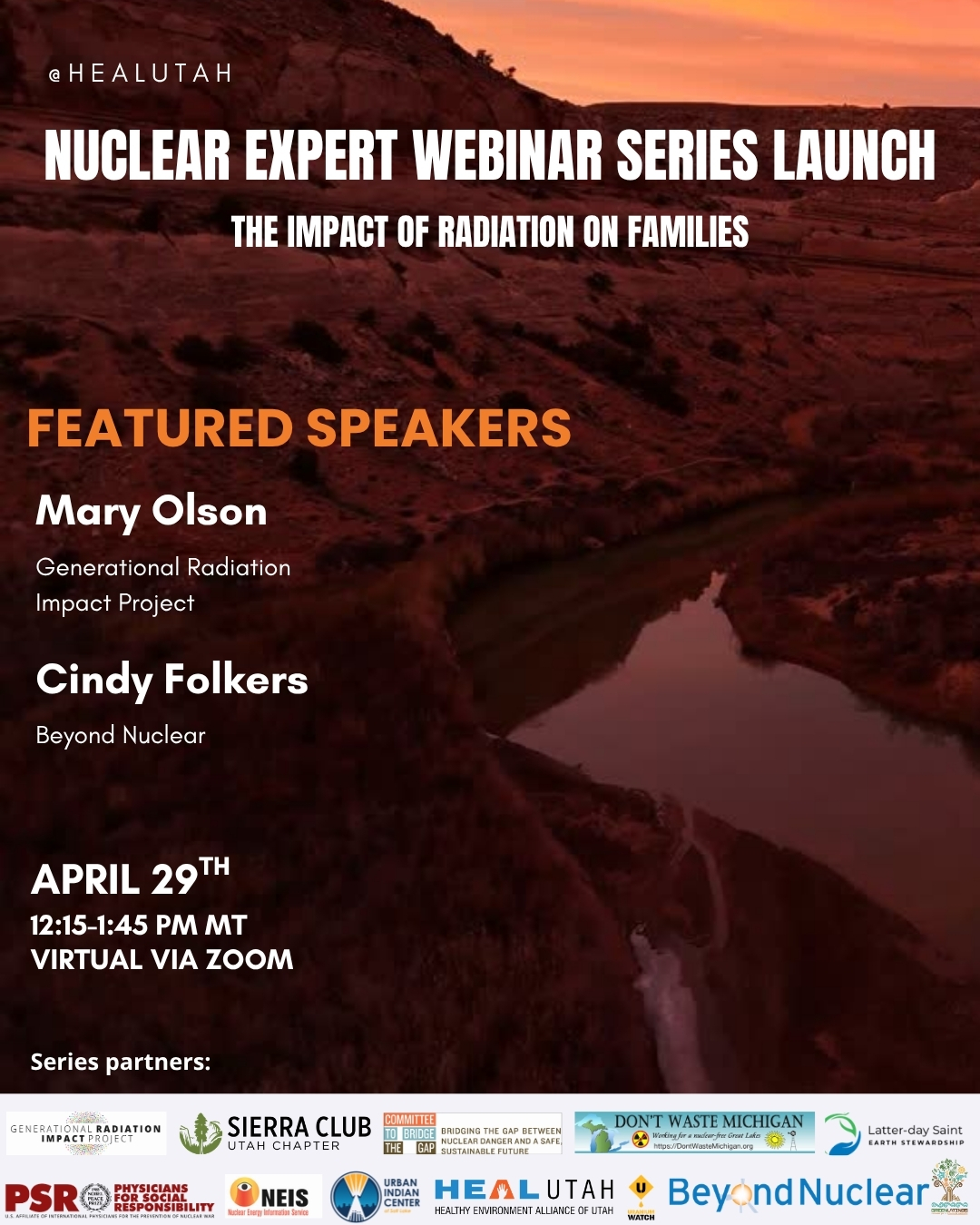
29 April – Nuclear Expert Webinar #1 – Radiation Impacts on Families with Mary Olson and Cindy Folkers
- 12:15 PM MT – 1:45 PM MT
- Location: Virtual – REGISTER TODAY

4 May -West Suburban Peace Coalition to discuss Iran war at May Educational Forum
Monday, May 4, 7:00 – 8:00 PM Central Standard Time
Title: : How Trump’s Narrative Tries to Shape the Reality of the War on Iran.
Contact Walt Zlotow, zlotow@hotmail.com 630 442 3045 for further information
14 May – online event From Bombs to Data Centres: the Face of Nuclear Colonialism

Pine Ridge Uranium is the real threat, not Tehran- Tell Burgum: Stop the Extraction.
Chernobyl: The Lost Tapes – A good documentary on Chernobyl on SBS available On Demand for the next 3 weeks– https://www.sbs.com.au/ondemand/tv-program/chernobyl-the-lost-tapes/2352741955560
To see nuclear-related stories in greater depth and intensity – go to https://nuclearinformation.wordpress.com
-
Archives
- April 2026 (288)
- March 2026 (251)
- February 2026 (268)
- January 2026 (308)
- December 2025 (358)
- November 2025 (359)
- October 2025 (376)
- September 2025 (257)
- August 2025 (319)
- July 2025 (230)
- June 2025 (348)
- May 2025 (261)
-
Categories
- 1
- 1 NUCLEAR ISSUES
- business and costs
- climate change
- culture and arts
- ENERGY
- environment
- health
- history
- indigenous issues
- Legal
- marketing of nuclear
- media
- opposition to nuclear
- PERSONAL STORIES
- politics
- politics international
- Religion and ethics
- safety
- secrets,lies and civil liberties
- spinbuster
- technology
- Uranium
- wastes
- weapons and war
- Women
- 2 WORLD
- ACTION
- AFRICA
- Atrocities
- AUSTRALIA
- Christina's notes
- Christina's themes
- culture and arts
- Events
- Fuk 2022
- Fuk 2023
- Fukushima 2017
- Fukushima 2018
- fukushima 2019
- Fukushima 2020
- Fukushima 2021
- general
- global warming
- Humour (God we need it)
- Nuclear
- RARE EARTHS
- Reference
- resources – print
- Resources -audiovicual
- Weekly Newsletter
- World
- World Nuclear
- YouTube
-
RSS
Entries RSS
Comments RSS
 nuclear-news