New Energy Deputy Secretary nominee (?unwisely) contradicts Trump on Yucca Mountain and nuclear wastes.
Energy deputy secretary nominee faces heat after contradicting Trump https://www.axios.com/energy-deputy-secretary-nominee-contradicts-trump-yucca-mountain-1395063d-bd50-4c20-8494-4150483b0773.html
Alayna Treene, Jonathan Swan, 18 Feb 20, Trump administration officials are internally raising concerns about President Trump’s nominee for Energy deputy secretary, who appeared to openly contradict the president on nuclear waste storage at Nevada’s Yucca Mountain last week.
Driving the news: While speaking at a House Energy and Commerce subcommittee hearing last Wednesday, Mark Menezes told members of the panel that the Trump administration is still interested in storing nuclear waste at Yucca Mountain and that “what we’re trying to do is to put together a process that will give us a path to permanent storage at Yucca.”
- His statement came just weeks after Trump tweeted that he hears and respects Nevadans’ concerns about the nuclear waste repository — part of a long-standing “not in my backyard” battle. “[M]y Administration is committed to exploring innovative approaches – I’m confident we can get it done!”
- Menezes’ remarks also came just days after the White House unveiled its fiscal year 2021 budget, which does not include funding for Yucca Mountain. The administration’s previous budget requests included $120 million and $116 million, respectively, to maintain licensing for the site.
What we’re hearing: Menezes’ comments were flagged internally to White House officials who have been working on Yucca Mountain, an administration official told Axios.
- “It’s a big deal that the possible No. 2 at the Department of Energy came out in defiance [of] the president’s very strong position on a huge issue,” the official said, calling it “shocking” that Menezes would “basically give a middle finger to the president.”
-
- A second administration official told Axios that Menezes knew for weeks that funding for Yucca Mountain was going to be seized, adding to internal frustration over his comments last week: “When the budget comes out, and it has made a change from previous years, everyone’s notified of that. Department of Energy is clearly in the know about that because it’s a core change.”
The other side: “I have spoken to the White House and the Administration will not be pursuing Yucca Mountain as a solution for nuclear waste, and there are no funds in the budget to do so. I am fully supportive of the President’s decision and applaud him for taking action when so many others have failed to do so,” Menezes told Axios.
- A White House official said, “There is zero daylight between the President and Under Secretary Menezes on the issue.”
- Why it matters: Trump’s comments about Yucca Mountain, as well as his decision to cease funding for the repository, come as his re-election campaign seeks to turn Nevada red again after narrowly losing the state to Hillary Clinton in 2016.
- As the New York Times first reported, two of Trump’s top political advisers, Bill Stepien and Justin Clark, have opposed storing nuclear waste at Yucca Mountain for years, and they see the president’s decision to side with Nevada residents as positive for his re-election campaign.
- Trump heads to Nevada this week, where he’ll host a rally in Las Vegas on the eve of the Nevada Democratic caucus and speak at a Hope for Prisoners graduation ceremony at police department headquarters. He’ll stay overnight at his hotel on the Strip.
The backstory: Menezes, currently the Energy undersecretary, was officially nominated as deputy secretary on Thursday, a day after his remarks before members of Congress.
- However, administration officials say these nominations are normally planned weeks before being announced.
Taiwan searches for a solution to its nuclear waste problem
The U.S. government has de-funded its deep geological repository at Yucca Mountain, and most nations have yet to begin development of similar facilities. Finland is the closest to successfully completing deep geological repository. Its Onkalo site is now in the final approval stage, and should begin accepting nuclear waste early in this decade.
Executives from U.S. startup Deep Isolation visited Taiwan last fall with an innovative solution that could serve as either interim or permanent storage. Deploying technologies developed in the oil and gas industry, it would use directional drilling approximately 1 kilometer deep and then another kilometer horizontally. The spent fuel would then be lowered down the borehole inside nickel-chromium-molybdenum alloy canisters.
Developed by University of California at Berkeley physicist Richard Muller, the solution is based on proven technologies. The canisters can even be retrieved. The company has yet to utilize the technology in an actual case, though, and Taipower may be wary of being first in the world to implement it.
In the meantime, Taiwan is continuing a search for its own site for a deep geological depository. The Atomic Energy Council hopes to have a site ready by 2055.
For now, however, the focus is on developing interim solutions for the spent fuel in the cooling pools. Both New Taipei City and Taipower are optimistic that solutions can be found.
“The election is over and the noise is quieting down, so maybe now will be a better time to solve the issue,” says Edward H.C. Chang (張學植), director of Tai-power’s Department of Nuclear Backend Management.
Al Gore’s goal to beat climate change – get Trump out of office!
 Al Gore’s New Campaign To Save The Planet Is Focused On Getting Donald Trump Out Of Office
“For those of us concerned about the future of the Earth’s climate and balance, this election is extremely important,” Gore said.
Zahra HirjiBuzzFeed News Reporter – 19 Feb 20, Former vice president Al Gore is launching a voter registration campaign this week to increase voter turnout in November, focusing on young people concerned about the rapidly warming planet.This new effort by Gore, who starred in the 2006 climate documentary An Inconvenient Truth and won a 2007 Nobel Peace Prize for his climate activism, comes amid dire scientific warnings about the climate crisis and a new explosion in climate activism, driven mostly by young people skipping school and challenging politicians to take action. …
“Young people in particular have been both more concerned about climate than other age groups and traditionally less likely to vote in large percentages,” said Gore. “I want to do everything I possibly can to contribute to the registration and turnout and voting by those who are concerned about the climate crisis.”
The effort will initially focus on key battleground states. Gore will kick off with a voter registration rally on Wednesday at the Texas Southern University, a historically black public college in Houston, followed by visits to the University of Nevada, Las Vegas, on March 10 and the University of Pittsburgh on March 17. Voter registration drives are also being planned at eight additional college and university campuses in Florida, Michigan, Pennsylvania, and Texas over the coming months, and Gore plans to add more sites in the future.
And although he’s largely focused on influencing the presidential election, Gore will encourage voters to consider climate across the ballot…..
https://www.buzzfeednews.com/article/zahrahirji/al-gore-climate-voter-registration-2020
1% World Military Spending Can End Starvation on Earth — limitless life

Statistic on Billboard Explained In 2008, the United Nations said that $30 billion per year could end hunger on earth, as reported in the New York Times, Los Angeles Times, and many other outlets. The Food and Agriculture Organization of the United Nations tells us that number is still up to date. As of 2019, the annual Pentagon base […]
via 1% World Military Spending Can End Starvation on Earth — limitless life
This week’s climate and nuclear news
Climate change is, as always, the big news this week. Some climate models now predict unexpected , unprecedented spike in global temperatures. Can the insurance industry afford the rising flood risk?
Giant iceberg ‘calves’ from Antarctic ice shelf.
The nuclear connection is significant for the UK, too, as sea level rise threatens its new nuclear projects, at Sizewell, Hinkley Point C, as well as existing nuclear reactors and waste facilities at Sellafield and Drigg. https://www.youtube.com/watch?v=6tesHVSZJOg
There are many organisations worldwide, that are pushing for, and working on, action to slow or stall global warming. Global Optimism is the latest example, in which Christiana Figueres features, with her new book “The Future We Choose”
#WETOOARE PROTESTERS FREE JULIAN ASSANGE
189 nuclear and radioactive material incidents in 2019.
Radioactive material ‘a magnet for groups with malicious intent’, warns UN nuclear watchdog chief.
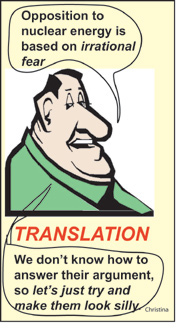
Hysteria isn’t killing nuclear power. – It’s the very real dangers and catastrophic costs. Uranium prices at rock bottom- doesn’t help the struggling nuclear industry.
ANTARCTICA. Giant iceberg ‘calves’ from Antarctic ice shelf.
JAPAN. Tokyo protesting against South Korea’s Tokyo 2020 radioactive Olympics posters. Britain’s trade deal with Japan could lead to Fukushima food restrictions being dropped.
Japan wants cruise ship infected separated from country’s total over economy fears.
Fogwater deposition of radiocesium in the forested mountains of East Japan during the Fukushima Daiichi Nuclear Power Plant accident: A key process in regional radioactive contamination. 5.2-magnitude earthquake near Fukushima.
FRANCE. European Pressurised Reactor at Flamanville: nuclear is expensive and it doesn’t work. French govt considers a “0% ” nuclear energy plan: with problems in existing nukes
UK. Climate change to continue hitting UK with bigger storms. The plutonium dilemma – UK and Japan. Decline and uncertainty in UK nuclear construction. Tortuous progress, ever-increasing costs for UK’s Sizewell and Hinkley Point C nuclear projects. Rolls Royce plans small nuclear reactors near Snowdonia National Park in Wales. Few permanent jobs in small modular nuclear reactors?
RUSSIA. Ultimate Doomsday Weapon: Missiles Powered By Nuclear Reactors. Excess radiation level recorded in Moscow. Anti-terrorism exercises for Russia’s nuclear-powered ice-breakers.
BELARUS. Estonia, Latvia and Lithuania oppose energy imports from a Belarusian nuclear power plant.
USA. Cuts to public benefit programs,$billions to nuclear weapons – Trump’s 2021 budget . Trump’s 2021 budget boosts nuclear energy. Plutonium-affected U.S. airmen, cancers, deaths, a new legal ruling.
Radioactive leaks and other problems at Westinghouse nuclear fuel factory near Columbia. Three South Carolina lawmakers Pressed Trump for More Nuclear Funding.
IRAN. Iran would return to 2015 nuclear agreement if Europe would provides “meaningful” economic benefits.
INDONESIA. High levels of radioactivity in housing complex, Jakarta National Nuclear Energy Agency urges calm.
ALGERIA. Algeria’s radioactive legacy from France’s nuclear bomb tests.
INDIA. India’s problematic nuclear security.
AUSTRALIA. MPs Andrew Wilkie and George Christensen to UK to help free Julian Assange. For Australia “business as usual” on climate change will cost many $billions. Climate change extreme weather making parts of Australia uninsurable.
Tokyo protesting against South Korea’s Tokyo 2020 radioactive Olympics posters
South Korea is definitely right in calling out this shit. No amount of lies and cover ups can bury the truth: 2020 Tokyo Olympics are the radioactive Olympics. Despite the past years gigantic PR campaign to whitewash the still ongoing Fukushima nuclear disater and all its radiation harmful consequences, claiming that all is under control, totally safe, back to normalcy, back to business. Hell no!
So, the multi-billion-dollar propaganda machine of TEPCO and the Japanese Govt is calling out South Korea for creating propaganda against their own propaganda. Again, like always, there is only one truth: radiation kills.
This time, the truth is that Olympians will get high doses of rads that are on the ground in Tokyo, in Fukushima Prefecture, and in every neighboring prefectures all the way down from Fukushima to Tokyo.
There are hot spots all over Eastern Japan. So many of these hotspots have been well documented by folks like you and me, as Japanese citizens had to organized themselves and learned to protect themselves by mapping the radiation present in their living environment, due to the massive campaign of denial of their government prioritizing economics expediency over people’s health.
 VANK put up the posters on the walls of the new Japanese embassy on Jan. 6 before uploading images of the posters on social media. (image: VANK)
Fogwater deposition of radiocesium in the forested mountains of East Japan during the Fukushima Daiichi Nuclear Power Plant accident: A key process in regional radioactive contamination

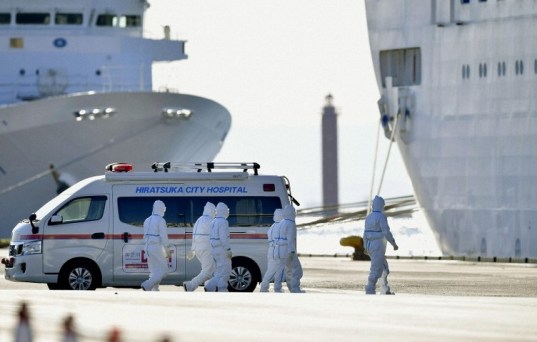
Japan wants cruise ship infected separated from country’s total over economy fears
Young woman leads revival of Fukushima’s fishing industry
When economic considerations take precedence over radioactive contamination and people’s health…

Britain’s trade deal with Japan could lead to Fukushima food restrictions being dropped
UK’s new nuclear projects headed to be submerged due to climate change?
 Speeding Sea Level Rise Threatens Nuclear Plants https://www.ecowatch.com/sea-level-rise-nuclear-plants-2645160125.html?rebelltitem=2#rebelltitem2 Climate News Network, Feb. 15, 2020 By Paul Brown
The latest science shows how the pace of sea level rise is speeding up, fueling fears that not only millions of homes will be under threat, but that vulnerable installations like docks and power plants will be overwhelmed by the waves.
New research using satellite data over a 30-year period shows that around the year 2000 sea level rise was 2mm a year, by 2010 it was 3mm and now it is at 4mm, with the pace of change still increasing.
The calculations were made by a research student, Tadea Veng, at the Technical University of Denmark, which has a special interest in Greenland, where the icecap is melting fast. That, combined with accelerating melting in Antarctica and further warming of the oceans, is raising sea levels across the globe.
The report coincides with a European Environment Agency (EEA) study whose maps show large areas of the shorelines of countries with coastlines on the North Sea will go under water unless heavily defended against sea level rise.
Based on the maps, newspapers like The Guardian in London have predicted that more than half of one key UK east coast provincial port — Hull — will be swamped. Ironically, Hull is the base for making giant wind turbine blades for use in the North Sea.
The argument about how much the sea level will rise this century has been raging in scientific circles since the 1990s. At the start, predictions of sea level rise took into account only two possible causes: the expansion of seawater as it warmed, and the melting of mountain glaciers away from the poles.
In the early Intergovernmental Panel on Climate Change reports back then, the melting of the polar ice caps was not included, because scientists could not agree whether greater snowfall on the top of the ice caps in winter might balance out summer melting. Many of them also thought Antarctica would not melt at all, or not for centuries, because it was too cold.
Both the extra snow theory and the “too cold to melt” idea have now been discounted. In Antarctica this is partly because the sea has warmed up so much that it is melting the glaciers’ ice from beneath — something the scientists had not foreseen.
Alarm about sea level rise elsewhere has been increasing outside the scientific community, partly because many nuclear power plants are on coasts. Even those that are nearing the end of their working lives will be radio-active for another century, and many have highly dangerous spent fuel on site in storage ponds with no disposal route organized.
Perhaps most alarmed are British residents, whose government is currently planning a number of new seaside nuclear stations in low-lying coastal areas. Some will be under water this century according to the EEA, particularly one planned for Sizewell in eastern England.
The agency’s report says estimates of sea level rise by 2100 vary, with an upper limit of one meter generally accepted, but up to 2.5 meters predicted by some scientists. The latest research by Danish scientists suggests judiciously that with the speed of sea level rise continuing to accelerate, it is impossible to be sure.
A report by campaigners who oppose building nuclear power stations on Britain’s vulnerable coast expresses extreme alarm, saying both nuclear regulators and the giant French energy company EDF are too complacent about the problem.
The report said: “Polar ice caps appear to be melting faster than expected, and what is particularly worrying is that the rate of melting seems to be increasing. Some researchers say sea levels could rise by as much as six meters or more by 2100, even if the 2°C Paris target is met.
“But it’s not just the height of the rise in sea level that is important for the protection of nuclear facilities, it’s also the likely increase in storm surges. An increase in sea level of 50cm would mean the storm that used to come every thousand years will now come every 100 years. If you increase that to a meter, then that millennial storm is likely to come once a decade.
Bearing in mind that there will probably be nuclear waste on the Hinkley Point C site [home to the new twin reactors being built by EDF in the West of England] until at least 2150, the question neither the Office of Nuclear Regulation nor EDF seem to be asking is whether further flood protection measures can be put in place fast enough to deal with unexpected and unpredicted storm surges.”
European Pressurised Reactor at Flamanville: nuclear is expensive and it doesn’t work.

 France Culture 14th Feb 2020, EPR: nuclear is expensive and it doesn’t work. A kind of modern replica of the Danaïdes barrel, the EPR at Flamanville, in the Manche department, is once again being talked about: between construction delays (delivery scheduled for 2010, “potentially promised” now in 2022) and additional costs ( estimated three billion, we would exceed 12 billion today), is there ultimately a future for what was sold in the late 90s (1998-2000) as
the new wonder of the genre?
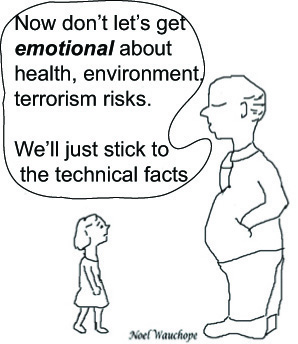
Don’t lets get “emotional” about nuclear-caused deformities, illnesses, deaths..
|
Hysteria isn’t killing nuclear power But the harm it causes should stir emotions, Beyond Nuclear By Linda Pentz Gunter, 16 Feb 20,
Time was, that a woman suffering from menopause, pre-menstrual syndrome, a heightened libido or lack thereof, was labeled “hysterical.” Her very real medical or psychological troubles were put down to an “emotional reaction.” For a while these symptoms were even attributed to a “wandering womb.” What? Yes, really. For years, if you were a woman who opposed nuclear power, you were likely subjected to exactly the same treatment (although luckily not the one for the “wandering womb,” which I won’t go into here). How many of us were told, usually by men, that we were simply far too “emotional”? (Implication? We just didn’t understand the actual “science”.)
Those illustrious scientists Penn & Teller called their takedown show on Helen Caldicott — who has certainly borne the brunt of the “too emotional” slur in our movement — “Penn & Teller vs Dr. Helen Caldicott, Candles & Anti-Nuclear Fearmongering.” …… And here’s what well known columnist, Fareed Zacharia, just wrote in a February 14 column in the Washington Post that appeared to have been cribbed from the cliff notes of any number of pro-nuclear front groups: “Fears about nuclear power, which Sanders clearly shares, are largely based on emotional reactions to the few high-profile accidents that have taken place over the past few decades.” But it’s not fear that has done in nuclear power. It’s the very real risks — along with its exorbitant cost. It’s the fact that it can poison people, animals, air, land and water for millennia. It’s the fact that, despite their ivory tower pontificating, people like Zacharia have never met the mothers of children suffering as a result of the Fukushima disaster or even, still, Chernobyl. Those children may be immaterial statistics to lofty columnists and bloggers, but they aren’t immaterial to those mothers. And it’s not fear that drives politicians like Bernie Sanders to oppose nuclear power. It’s that the subsidies we would squander, and the time we would waste on propping it up, costs us time we don’t have, and money we sorely need to fix climate change fast. So, yes, Mr. Zacharia, I have an “emotional reaction” when I see small children who should be carefree and playing outside, confined indoors, or worse, coming down with thyroid cancer they would never have suffered without Fukushima. I have an “emotional reaction” when I see the sad faces of mentally and physically disabled children dumped into Belarusian orphanages, children harmed by the 1986 Chernobyl nuclear disaster, which happened long before they were born. I even have an “emotional reaction” when I see the photos and videos of dead or dying cows abandoned in Fukushima, their bellowing cries echoing around cowsheds already strewn with the corpses of their herdmates. And yes, I have an “emotional reaction” even when there isn’t an accident. I am disturbed at the alarming increase in leukemias among children living close to nuclear power plants. I get emotional hearing the stories of Navajo uranium miners and their families, who must battle radiation exposure-induced diseases along with deprivation and discrimination. I am disturbed, emotionally, at the toll taken on endangered sea turtles, captured and killed at operating nuclear plants. And I get upset when I see that, once again, the only plans for dealing with radioactive waste are to dump it on poor communities of color…… The American Psychiatric Association dropped the term hysteria in 1952. The pro-nuclear lobby should stop using it to dismiss the very real, medical harms of nuclear power, which most often impact communities the least resourced to fight back. If you don’t have an “emotional reaction” when confronted with the tragedies wrought by nuclear power, then you are the one who needs a doctor. https://wordpress.com/read/feeds/72759838/posts/2591560323 |
|
Ultimate Doomsday Weapon: Missiles Powered By Nuclear Reactors
 Ultimate Doomsday Weapon: Missiles Powered By Nuclear Reactors, With disastrous results. National Interest Ultimate Doomsday Weapon: Missiles Powered By Nuclear Reactors, With disastrous results. National Interest
– 17 Feb 20 Key Point: Russia is resurrecting the demons of our shared Cold War past.
After days of speculation by Western analysts that a deadly accident on August 8 that briefly spiked radiation levels in northwestern Russia was tied to tests of an exotic nuclear-powered “Skyfall” nuclear-powered cruise missile, Russian sources confirmed to the New York Times the explosion of a “small nuclear reactor.”
While there’s a tactical rationale behind Russia’s development of a fast, surface-skimming cruise missile with an unlimited range as a means of bypassing American missile defenses, it strikes many analysts as an inordinately expensive, extremely technically challenging, and—evidently!—downright unsafe. That’s because the United States has tried it before sixty years earlier—and even with the fast-and-loose safety culture of the Cold War 1960s, the poison-spewing radioactive mega missile it began developing was considered too dangerous to even properly flight test. This project was most famously described in a 1990 article by Gregg Herken for Air & Space Magazine, which remains well worth the read. …..
The SLAM missile was expected to soar towards its Soviet targets at tree-top level, traveling at three times the speed of sound. The combination of low-altitude (reducing detection range) and Mach 3 speed was thought to make it too fast for interception by fighters or surface-to-air missile. The sonic shock wave produced by the huge missile was believed to be strong enough to kill anyone caught underneath it.
The huge missile, laden with up to twelve thermonuclear bombs, would proceed to race towards one Soviet city after another, visiting Hiroshima-level human tragedies upon each. And once the bombs were exhausted, the nuclear-powered missile would…simply keep on going and going like a murderous Energizer Bunny. Because installing adequate radioactive shielding on such a small reactor would have proven impossible, the SLAM would have spread in its wake trails of cancer-inducing gamma and neutron radiation and radioactive fission fragments expelled by its exhaust. Project Pluto scientists even considered weaponizing this property by programming the missile to circle overhead Soviet population centers, though how exposing even more people to slow deaths by radiation poisoning would be useful in an apocalyptic nuclear war that would likely leave both nations in ruin in a few days is hard to fathom. However, realizing the SLAM concept involved a succession of serious technical challenges. For example, a separate conventional rocket system would be necessary for the missile to reach the supersonic speeds at which its ramjet motor could function. That, in turn, meant the reactor had to be designed to withstand the heat and stress of those powerful booster rockets. In fact, it’s believed precisely that problem may have resulted in the deadly accident in Russia this August. As a result, the Livermore laboratory devised a 500-megawatt reactor so robust it was nicknamed the “flying crowbar.”……. Having established the workability of the nuclear ramjet, Merkle’s team then ran into a serious practical obstacle: where on Earth, literally, could a long-range weapon prone to trailing plumes of radioactive pollution behind it be tested? And what would happen if the supersonic weapon with theoretically nigh-unlimited range “got away”—ie., fell out of control, and potentially irradiated American communities? …….
Deploying the weapon operationally presented even worse dilemmas, as the missile would likely overfly U.S. allies on its approach to Russia. Even deploying an operational weapon to a remote Pacific island seemed to entail an inordinate amount of radiation poisoning for the surrounding environment. ……
Fortunately, the Pentagon was able to assess that the SLAM did nothing to alter the Mutually Assured Destruction dynamic of Moscow and Washington’s Cold War standoff, except perhaps by provoking an equally terrifying response. Furthermore, it presented undesirable budgetary burdens and intolerable safety and political risks.
Despite technical advances since the 1960s, those same fundamental considerations likely remain true for Russia’s Skyfall missile today.
As John Krzyzaniak succinctly put it in a piece for the Bulletin of the Atomic Scientists: “The problems with a nuclear-powered missile are so numerous and obvious that some have questioned whether Putin is being hoodwinked by his scientists, or whether he is bluffing to scare the United States back into arms control agreements. In any case, what was once a terrible new idea is now just a terrible old idea.”
Unfortunately, in a climate of escalating paranoia and nuclear arms competition, Moscow is not merely devising exotic new nuclear weapons, but resurrecting the demons of our shared Cold War past. https://nationalinterest.org/blog/buzz/ultimate-doomsday-weapon-missiles-powered-nuclear-reactors-123231
|
|
Tortuous progress, ever-increasing costs for UK’s Sizewell and Hinkley Point C nuclear projectsy
 Reports: EDF readies plans for £16bn Sizewell C nuclear plant, Business Green , Michael Holder, 17 Feb 20, EDF is gearing up to formally submit plans for a new £16bn-£20bn nuclear power station at Sizewell in Suffolk within weeks, which if approved could generate enough energy for around six million UK homes, according to reports.The French state-controlled energy giant has again teamed up with CGN – the Chinese state-owned company with which it is currently developing Hinkley Point C power station in Somerset – on the project, which would include two new EPR reactors, reports The Telegraph. Reports: EDF readies plans for £16bn Sizewell C nuclear plant, Business Green , Michael Holder, 17 Feb 20, EDF is gearing up to formally submit plans for a new £16bn-£20bn nuclear power station at Sizewell in Suffolk within weeks, which if approved could generate enough energy for around six million UK homes, according to reports.The French state-controlled energy giant has again teamed up with CGN – the Chinese state-owned company with which it is currently developing Hinkley Point C power station in Somerset – on the project, which would include two new EPR reactors, reports The Telegraph.
A planning application is currently being prepared for the new Suffolk nuclear plant, which would be located at the same site as EDF’s existing Sizewell B nuclear plant, and could be lodged by as soon as the end of this month, or potentially in March, the newspaper revealed on Saturday. Due to the size of the development, the project requires a Development Consent Order (DSO) to proceed from the UK’s Planning Inspectorate, which could take around a year to approve or reject the application. …. concerns reportedly remain about flood risk at the site due to its low lying coastal location, while a framework for funding the new Sizewell nuclear plant still needs to be ironed out, which could potentially delay the plant’s development, according to the newspaper. A spokesperson for EDF said work on the DSO application “is continuing” but declined to comment any further when contacted by BusinessGreen. It comes in the wake of criticism over the decision to proceed with the two firms’ other flagship nuclear project Hinkley Point C due to the high cost associated with the project, which is being paid for through a surcharge on consumer energy bills. In September EDF was once again forced to increase its cost estimates for the Somerset project, admitting that costs are likely to soar £2.9bn over the original budget, and that it may not start generating electricity until 2026, 15 months later than previously scheduled. More broadly the UK’s nuclear sector has suffered setbacks over the past couple of years, with two other major projects at Wylfa in North Wales and Moorside in Cumbria having both been shelved by developers over cost concerns…….. https://www.businessgreen.com/news/4010867/reports-edf-readies-plans-gbp16bn-sizewell-nuclear-plant |
|
1 This Month
26 April – Chernobyl: Inside the Meltdown airs on National Geographic on Sunday 26th April from 4pm

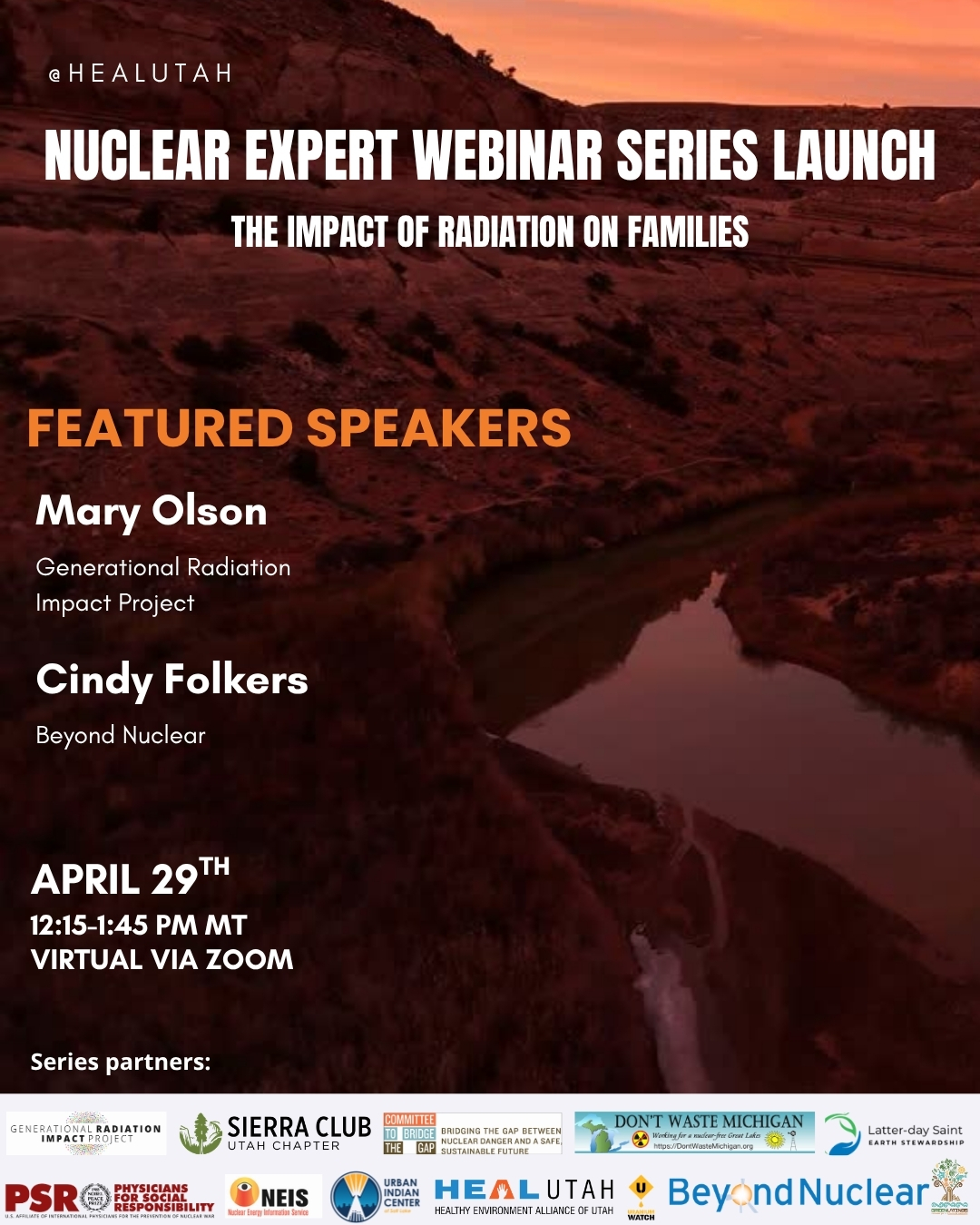
29 April – Nuclear Expert Webinar #1 – Radiation Impacts on Families with Mary Olson and Cindy Folkers
- 12:15 PM MT – 1:45 PM MT
- Location: Virtual – REGISTER TODAY

4 May -West Suburban Peace Coalition to discuss Iran war at May Educational Forum
Monday, May 4, 7:00 – 8:00 PM Central Standard Time
Title: : How Trump’s Narrative Tries to Shape the Reality of the War on Iran.
Contact Walt Zlotow, zlotow@hotmail.com 630 442 3045 for further information
14 May – online event From Bombs to Data Centres: the Face of Nuclear Colonialism

Pine Ridge Uranium is the real threat, not Tehran- Tell Burgum: Stop the Extraction.
Chernobyl: The Lost Tapes – A good documentary on Chernobyl on SBS available On Demand for the next 3 weeks– https://www.sbs.com.au/ondemand/tv-program/chernobyl-the-lost-tapes/2352741955560
To see nuclear-related stories in greater depth and intensity – go to https://nuclearinformation.wordpress.com
-
Archives
- April 2026 (288)
- March 2026 (251)
- February 2026 (268)
- January 2026 (308)
- December 2025 (358)
- November 2025 (359)
- October 2025 (376)
- September 2025 (257)
- August 2025 (319)
- July 2025 (230)
- June 2025 (348)
- May 2025 (261)
-
Categories
- 1
- 1 NUCLEAR ISSUES
- business and costs
- climate change
- culture and arts
- ENERGY
- environment
- health
- history
- indigenous issues
- Legal
- marketing of nuclear
- media
- opposition to nuclear
- PERSONAL STORIES
- politics
- politics international
- Religion and ethics
- safety
- secrets,lies and civil liberties
- spinbuster
- technology
- Uranium
- wastes
- weapons and war
- Women
- 2 WORLD
- ACTION
- AFRICA
- Atrocities
- AUSTRALIA
- Christina's notes
- Christina's themes
- culture and arts
- Events
- Fuk 2022
- Fuk 2023
- Fukushima 2017
- Fukushima 2018
- fukushima 2019
- Fukushima 2020
- Fukushima 2021
- general
- global warming
- Humour (God we need it)
- Nuclear
- RARE EARTHS
- Reference
- resources – print
- Resources -audiovicual
- Weekly Newsletter
- World
- World Nuclear
- YouTube
-
RSS
Entries RSS
Comments RSS
 nuclear-news