Trump’s toxic nuclear sales pitch to India- undermining India’s nuclear liability law
|
In a rush to please the Americans, no matter the cost The recently concluded US President’s visit to India was marked by the odious displays of pomposity for which both Modi and Trump are known to have a soft spot. Even as Delhi burned, with deadly riots engineered and unleashed by majoritarian mobs backed by the ruling party, Modi and Trump continued their photo-ops around the Taj Mahal and Gandhi Ashram. What risks being ignored amid this deafening cacophony are crucial issues concerning the US-imported nuclear reactor project in India, to which both the media and civil society have not paid adequate attention, perhaps due to the fact that these nuclear negotiations have been in the pipeline for more than twelve years now and their mention in bilateral summits and statements appears little more than ceremonious. However, there are additional twists to the India-US nuclear story that deserve our attention. To recap, in 2008, in exchange for the American heavy-lifting of the decades-long nuclear embargo that India faced internationally for testing atomic weapons, a massive contract for a 6-unit nuclear power park was signed with the US nuclear giant, Westinghouse. In a reciprocal gesture for this diplomatic favour, India announced the project without any cost-benefit calculation, safety or environmental impact analysis, and in the stark absence of dialogue, negotiations or the consent of the local communities in Kovvada, a site on India’s eastern coast in Andhra Pradesh. Although the Indian government, in a rush to please its American counterpart, has already pushed through land acquisition in Kovvada, bulldozing grassroots dissent and even resolutions passed by democratically elected local bodies, the project has been stalled by a number of other factors, including the global decline of the nuclear industry post-Fukushima, which led Westinghouse to first sell its stakes to Toshiba and then eventually, declare itself bankrupt.
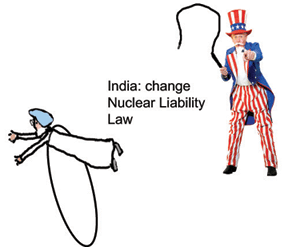
Additionally, certain other India-specific factors have stalled the nuclear power projects which corporations in the US, France and Russia have been eyeing in order to resurrect themselves. Nuclear liability tops the list here – foreign vendors have been wary of the 2010 liability law enacted by the Indian parliament, which they view as overly restrictive, even as civil society activists and safety experts consider the legislation extremely weak. The Indian law provides for a ‘right of recourse’ in Clause 17(b) under which, in case of a future nuclear accident, the nuclear operator can demand liability from the equipment suppliers.
The nuclear industry lobbies have found this provision to be an anathema and the US government has taken the lead in pressuring successive Indian governments to do away with it.
Despite his party’s vociferous criticism of such moves
 by the earlier Singh-led government when in opposition, Modi’s unabashed dalliance with the US has barely remained under wraps – he and Obama jointly declared in 2015 that India would actively take steps to limit liability in the case of a nuclear accident. by the earlier Singh-led government when in opposition, Modi’s unabashed dalliance with the US has barely remained under wraps – he and Obama jointly declared in 2015 that India would actively take steps to limit liability in the case of a nuclear accident.However, Modi didn’t stop at that. Not only did his government ensure that the liability rules were dubbed ‘ultra vires’ and against the spirit of the law by former Solicitor-General Soli Sorabjee, entered into force in 2016, it also went on to ratify the Convention on Supplementary Compensation (CSC) – an international template promoted by the nuclear lobbies to ensure a liability-free market, thereby deliberately creating a contradiction between India’s domestic law and its international commitments. Ever since it assumed power, the Modi government has consistently undermined nuclear liability provisions meant to safeguard the interests of the Indian people.
If the recent utterances of senior officials from the US Department of Energy offer any clues, the American nuclear vendors do not want to settle for anything short of amending the original Nuclear Liability Act – “to be clear, there are still open issues around the liability issue,” the US DoE Assistant Secretary is reported to have said in a Reuters report published last week. As the street protests by indignant survivors of Bhopal’s gas accident during Trump’s recent visit suggest, Indian citizens have had an agonising experience due to the apathy of governments and judicial processes, with the most vulnerable sections having been denied both compensation and justice in the case of the world’s worst industrial disaster. Successive governments in both the US and India have managed to ensure that concerned corporations remain unscathed and that their owners go unpunished.
Neither the routine exhortations of India-US summits being spaces for a rendezvous between two democracies, nor Modi’s much celebrated cleanliness drive, have translated into an open dialogue with the victims of the Bhopal disaster, or the detoxification of the accident site even three decades after the horrific chemical industrial accident.
Trump’s domestic energy policy and budget allocations disproportionately favour the nuclear industry, and exporting American nuclear reactors to developing countries is also a key part of this policy shift. The US under Trump has concluded nuclear deals with the UAE despite massive proliferation concerns………. Despite the hype that Trump’s recent visit generated – of an upgrade of US-India relations to a ‘Comprehensive Global Strategic Partnership’ and so on – there is very little that India stands to gain. In the absence of any new meaningful and people-centric cooperation on trade, environment, education or technology, this nuclear tango will only remain a farcical buildup at the cost of the safety and livelihoods of Indian citizens.
Not long ago, Modi’s own home state of Gujarat had rejected a US-imported nuclear project labeling it unacceptably risk-prone, especially in the wake of the 2011 Fukushima accident. This leaves the Modi government with no moral right to impose the US reactors on people in other parts of the country. Kumar Sundaram is founding editor of DiaNuke.org, an international platform for nuclear-related discussions and campaigns. https://www.thecitizen.in/index.php/en/NewsDetail/index/6/18388/Namaste-Nukes-Trumps-Toxic-Sales-Pitch-for-the-Stalled-Westinghouse-Nuclear-Project-in-India |
|



A Brief Study of Molten Salt Reactors
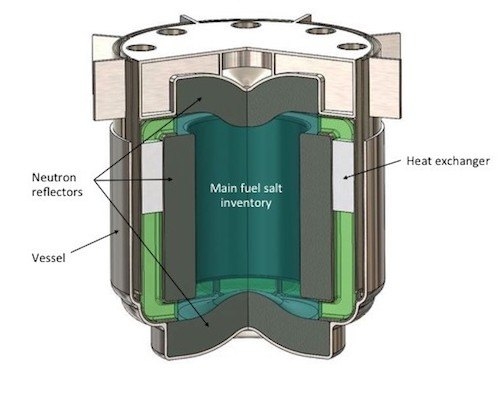 A Brief Study of Molten Salt Reactors https://nonuclearpowerinaustralia.wordpress.com/2020/03/01/a-brief-study-of-molten-salt-reactors/ 3 Mar 20,
Source:
Burning waste or playing with fire? Waste management considerations for non-traditional reactors, Lindsay Krall &Allison MacfarlanePages 326-334 | Published online: 31 Aug 2018 Bulletin of the Atomic Scientists, Volume 74, 2018. Issue 5 at https://www.tandfonline.com/doi/abs/10.1080/00963402.2018.1507791?scroll=top&needAccess=true&journalCode=rbul20
Author information:
Lindsay Krall is a post-doctoral Macarthur fellow at the George Washington University Institute for International Science and Technology Policy. Her research focuses on policies for the back end of the nuclear fuel cycle, particularly as they pertain to radionuclide transport in the environment, systems and organizations for waste storage and disposal, and the long-term behavior of spent fuels from advanced reactors. Allison Macfarlane is Professor of Public Policy and International Affairs at the George Washington University’s Elliott School of International Affairs. She directs the school’s Institute for International Science and Technology Policy Program and is the former chairman of the US Nuclear Regulatory Commission. Macfarlane was a member of the Blue Ribbon Commission on America’s Nuclear Future from 2010-2012.
“Abstract:
Nuclear energy-producing nations are almost universally experiencing delays in the commissioning of the geologic repositories needed for the long-term isolation of spent fuel and other high-level wastes from the human environment. Despite these problems, expert panels have repeatedly determined that geologic disposal is necessary, regardless of whether advanced reactors to support a “closed” nuclear fuel cycle become available. Still, advanced reactor developers are receiving substantial funding on the pretense that extraordinary waste management benefits can be reaped through adoption of these technologies. Here, the authors describe why molten salt reactors and sodium-cooled fast reactors – due to the unusual chemical compositions of their fuels – will actually exacerbate spent fuel storage and disposal issues. Before these reactors are licensed, policymakers must determine the implications of metal- and salt-based fuels vis a vis the Nuclear Waste Policy Act and the Continued Storage Rule.” end quote.Emphasis added for clarity. Mr. O’Brien and Mr. Bernardi need to consider the scientific and technical reality behind the gloss they want to disseminate.
Climate action? – you simply couldn’t build enough nuclear reactors
 New Scientist 26th Feb 2020, Paul Dorfman, University College London Energy Institute, UK; Tom Burke,E3G; Steve Thomas, University of Greenwich, UK; Jonathan Porritt,
environmental campaigner; and David Lowry, Institute for Resource and
Security Studies. Reporting the decline of nuclear power generation, you quote Michael Shellenberger’s view that nuclear power is necessary to prevent climate change (8 February, p 20).
This view is truly dangerous. Climate change poses a number of unique challenges to humanity. One of the most difficult is that the world not only needs to get to a specific place
– a carbon-neutral global energy system – but also must get there by a specific time – the middle of the century. Otherwise the policy fails.
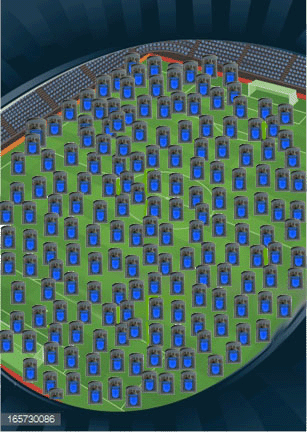
You simply couldn’t build enough nuclear reactors fast enough, even to
replace the existing reactors that will reach the end of their life by
2050, let alone to replace fossil fuels in the existing electricity system
or in the more electricity-intensive global economy we are currently
building. This would be true even if we were willing and able to overcome
all the other unsolved problems that nuclear reactors face. These include
their affordability, accidents, waste management, nuclear weapons
proliferation, the scarcity of talent and system inflexibility.
Radioactive wastes into River Clyde could have devastating effects on community and wildlife
 Row over MoD River Clyde nuclear waste dump plans Row over MoD River Clyde nuclear waste dump plans
By Herald Scotland Online 1 Mar 20, Scotland’s national environment watchdog has denied claims the Ministry of Defence (MoD) is planning to increase discharges of radioactive waste into the River Clyde.Under the plans, liquid waste from reactors which power Royal Navy submarines at the Faslane and Coulport nuclear bases would be drained into the Gare Loch via a new pipeline.
Campaigners warned the rising discharges could have a devastating effect on surrounding wildlife and communities after a report by investigative journalism platform The Ferret stated emissions of one byproduct, cobalt-60, could rise by more than 50 times. …….. The Ferret reported the discharge of cobalt-60 would rise to 23.4 million units of radioactivity annually – around 52 times the current level. It added emissions of a second substance, known as tritium, would increase by 30 times to around 175,000 units, or ‘megabecquerels’, every year…….. SEPA’s public consultation is open until 13th Match and we welcome all responses. All responses will be reviewed in detail to ensure we continue to safeguard the environment and human health.” The bases are due to receive at least five more submarines in the coming years, including an ageing Trafalgar vessel and three new Astute submersible. The Ferret said a 50-strong group of Nuclear-Free Local Authorities (NFLA) had objected to the discharges. NFLA Scotland convener, Glasgow SNP councillor Feargal Dalton told The Ferret: “NFLA is particularly concerned about the considerable uncertainties in modelling doses and an under-appreciation of the effects of tritium”. “There are effective alternatives to nuclear powered submarines, as pioneered by the likes of Japan, and the Ministry of Defence should make a serious attempt to look at them.” https://www.heraldscotland.com/news/18272691.mod-planning-dump-50-times-nuclear-waste-river-clyde/ |
|
International Atomic Energy Agency, run by 5 nuclear weapons nations, backs Fukushima water emptying to the Pacific
China , France , Russia , UK , and the USA, oversee the IAEA – International Atomic Energy Agency, this was expected.
UN SC P5 nuclear nations is a fully integrated system inclusive of the Military-Industrial Complex.
An ecosystem that includes weapons of mass destruction, for peace, a leadership group in a state of cultural cognitive dissonance.
Who as a group know gene sheering radionuclides, have an effect on DNA X10 times half-life of any alpha particles out of nuclear reactors.
IAEA backs release of Fukushima water into sea, AsiaTimes, 27 Feb 20,
Most of the radioactive isotopes have been filtered out, but one – tritium, which has long half-life – remains, The world’s nuclear watchdog gave its backing Thursday to Japanese plans to release contaminated water from the damaged Fukushima nuclear plant into the ocean.
Japan has around a million tonnes of contaminated water stored in tanks at the site of the Fukushima Daiichi plant, whose reactors went into meltdown after a huge tsunami in 2011.
A government panel last month recommended the water be released into the ocean or vaporized, but no final decision has been taken, with all solutions deeply unpopular with sections of the Japanese public.
International Atomic Energy Agency (IAEA) director Rafael Grossi told journalists in Tokyo the panel’s recommendations both appeared suitable…….
“Releasing into the ocean is done elsewhere, it’s not something new, there is no scandal here,” Grossi added.
“But what is important is to do it in a way that is not harmful and you need somebody to monitor before, during and after release, to check that everything is okay.”
The radioactive water comes from several different sources – including water used for cooling at the plant, and groundwater and rain that seeps into the plant daily – and is put through an extensive filtration process.
Most of the radioactive isotopes have been removed by the filtration system, but one – tritium, which has a long half-life – remains…….. https://asiatimes.com/2020/02/iaea-backs-release-of-fukushima-water-into-sea/
Antarctic ice walls protect the climate
|
Antarctic ice walls protect the climate, EurekAlert 27 Feb, UNIVERSITY OF GOTHENBURG Inland Antarctic ice contains volumes of water that can raise global sea levels by several metres. A new study published in the journal Nature shows that glacier ice walls are vital for the climate, as they prevent rising ocean temperatures and melting glacier ice.The ocean can store much more heat than the atmosphere. The deep sea around Antarctica stores thermal energy that is the equivalent of heating the air above the continent by 400 degrees. Now, a Swedish-led international research group has explored the physics behind the ocean currents close to the floating glaciers that surround the Antarctic coast. “Current measurements indicate an increase in melting, particularly near the coast in some parts of Antarctica and Greenland. These increases can likely be linked to the warm, salty ocean currents that circulate on the continental shelf, melting the ice from below,” says Anna Wåhlin, lead author of the study and professor of oceanography at the University of Gothenburg. “What we found here is a crucial feedback process: the ice shelves are their own best protection against warm water intrusions. If the ice thins, more oceanic heat comes in and melts the ice shelf, which becomes even thinner etc. It is worrying, as the ice shelves are already thinning because of global air and ocean warming”, says Céline Heuzé, climate researcher at the Department of Earth Sciences of Gothenburg University. The stability of ice is a mystery Inland Antarctic ice gradually moves towards the ocean. Despite the ice being so important, its stability remains a mystery – as does the answer to what could make it melt faster. Since the glaciers are difficult to access, researchers have been unable to find out much information about the active processes. More knowledge has now been obtained from studying the measurement data collected from instruments that Anna Wåhlin and her researcher colleagues placed in the ocean around the Getz glacier in West Antarctica. The ice’s edge blocks warm seawater……https://www.eurekalert.org/pub_releases/2020-02/uog-aiw022720.php |
|
Americans support a nuclear ban — Beyond Nuclear International

So why aren’t politicians on board?
via Americans support a nuclear ban — Beyond Nuclear International
This is not your grandfather’s planet — Beyond Nuclear International

We’re almost out of time, but not ideas
via This is not your grandfather’s planet — Beyond Nuclear International
No. 2 reactor at Onagawa nuclear plant in Miyagi, halted by 2011 tsunami, passes safety screening
 People protest Wednesday in Tokyo over the Nuclear Regulation Authority giving its approval for the safety measures implemented at the No. 2 unit of the Onagawa nuclear power plant in Miyagi Prefecture.
February 26, 2020
A nuclear reactor in Miyagi Prefecture damaged by the 2011 earthquake and tsunami disaster formally cleared screening by a national nuclear watchdog on Wednesday, paving the way for it to restart after anti-disaster measures are completed by the end of March next year.
The No. 2 unit of Tohoku Electric Power Co.’s Onagawa plant won the approval of the Nuclear Regulation Authority, becoming the second disaster-damaged reactor, after the Tokai No. 2 power plant in Ibaraki Prefecture, to pass stricter safety standards introduced after the Fukushima nuclear crisis.
Construction of an 800-meter seawall is among anti-disaster measures that still need to be completed at the plant, which straddles the town of Onagawa and the city of Ishinomaki. The operator also needs to obtain consent from local residents before it can restart the plant.
On March 11, 2011, all three reactors at the Onagawa complex shut down when a massive earthquake rocked northeastern Japan and a 13-meter tsunami hit the area, flooding the underground floors of the No. 2 unit.
However, the facility’s emergency cooling system operated correctly and there was no meltdown of the type that occurred at Tokyo Electric Power Company Holdings Inc.’s Fukushima No. 1 plant.
Tohoku Electric applied for safety screening for the No. 2 unit in December 2013 and has been constructing the seawall that will top out at 29 meters above sea level. It expects to spend about ¥340 billion ($3.08 billion) in total on the anti-disaster measures.
The company has already decided to scrap the No. 1 reactor, which began operations in 1984, and is considering applying for the restart of the No. 3 unit, which started power generation in 2002.
When it restarts, the Onagawa No. 2 reactor, which began commercial operations in 1995, will be the first boiling water reactor — the same type used at the Fukushima No. 1 plant — to resume operations since the 2011 earthquake and tsunami hit. The disaster claimed nearly 16,000 lives and left more than 2,500 missing.
Other boiling water reactors at Tepco’s Kashiwazaki-Kariwa plant in Niigata Prefecture and the Tokai No. 2 plant of Japan Atomic Power Co. have already secured approval to resume operations from the regulator, but have yet to obtain local consent.
https://www.japantimes.co.jp/news/2020/02/26/national/miyagi-nuclear-reactor-safety/#.Xlare0pCeUk
Japan Lifts Shipment Restrictions on All Fish Species off Fukushima
 People in the fishing industry, including fishermen and brokers, work briskly on Feb. 7, 2019, at the Matsukawaura fishing port in Soma, Fukushima Prefecture.
Japan Lifts Shipment Restrictions on All Fish Species off Fukushima
February 25, 2020
Fukushima, Feb. 25 (Jiji Press)–The Japanese government has lifted shipment restrictions on all of its designated fish species caught off Fukushima Prefecture that were introduced due to the 2011 nuclear disaster, a panel said Tuesday.
The government’s Nuclear Emergency Response Headquarters announced the lifting after fish of the one last remaining species of the 43 satisfied safety standards.
The restrictions had covered the 43 fish species caught off Fukushima, which hosts the disaster-crippled Tokyo Electric Power Company Holdings Inc.’s <9501> Fukushima No. 1 nuclear power plant. The last one is a species of skate.
In August 2016, the shipment restrictions on the fish were lifted. But in January 2019, the restrictions were reinstated after above-limit cesium was detected from skates caught off Fukushima.
Currently, members of the Fukushima Prefectural Federation of Fisheries Cooperative Associations voluntarily refrain from fishing in waters within 10 kilometers of the TEPCO plant, which underwent a triple meltdown after the March 2011 earthquake and tsunami.
Fishermen in Fukushima now free to ship all catches of fish
February 26, 2020
The last restrictions on fish taken off Fukushima Prefecture were lifted on Feb. 25, freeing fishermen here to ship any species caught in the area.
A ban was imposed on ocellate skate after one caught in the area was found to have levels of radioactive cesium exceeding the government standard of 100 becquerels per kilogram in January 2019.
The government task force on the Fukushima nuclear disaster removed restrictions on the bottom-feeding species related to rays after the prefecture measured levels in about 1,000 fish, and found none exceeded the standard.
The maximum amount found in the fish was 17 becquerels.
The prefecture has since asked the government to lift the restrictions.
Restrictions were placed on 43 species of fish caught off the coast of the prefecture following the 2011 accident at the Fukushima No. 1 nuclear power plant.
The restrictions were lifted in stages after the safety of the fish was confirmed, with some fishing allowed on a trial basis.
In 2019, with trial fishing on limited days and in specified areas, the annual catch from the area stood at 3,584 tons, only about 14 percent of that in 2010, a year before the nuclear disaster.
Discussions will now start to resume full operation.
Releasing radioactive water would further damage Fukushima’s reputation
 Fukushima’s fishing industry was one of the prefecture’s hardest-hit sectors following the March 2011 nuclear disaster.
Feb 25, 2020
Releasing the treated radioactive water stored at the Fukushima No.1 nuclear power plant risks further damage to the disaster-hit prefecture’s reputation and negates the nine-year effort to dispel negative perceptions about local agricultural produce, fisheries and tourism.
Although the government is considering dumping the water into the ocean, it should find a different solution and listen to the concerns of the people of Fukushima and local industries.
As the governor of Fukushima Prefecture between 2006 and 2014, I had my work cut out for me after the earthquake, tsunami and nuclear accident in March 2011.
Some of my main challenges after the disaster were securing the safety of the residents, ensuring they had access to evacuation shelters, managing the whereabouts of 160,000 evacuees scattered in and out of the prefecture and deciding on the site for interim storage of the soil and waste generated by the decontamination effort.
Determining the site was very difficult, but in the end the towns of Okuma and Futaba, which co-host the crippled nuclear power plant, honorably made the agonizing decision to accommodate it on condition that the tainted waste would be moved to a final disposal site outside of Fukushima within 30 years after the storage began.
During my term, I visited South Korea and China in 2012 to explain to local media using scientific facts that Fukushima produce is safe. I also helped arrange for several national and international conferences to be held in Fukushima Prefecture, based on the belief that coming to the prefecture and trying the local food was the best way to reassure guests that the area was safe and secure.
In December 2012, I lured an International Atomic Energy Agency meeting to the prefecture. Hundreds of nuclear specialists, ministers and other dignitaries from around the world gathered to share the lessons from the nuclear disaster and discuss the need to reinforce nuclear safety.
Today, nearly a decade after the disaster, Fukushima’s reputation is recovering — but only to a limited extent.
Although the government has prioritized ensuring security based on scientific facts, the public sense of security has yet to be restored.
Notwithstanding the central and prefectural government’s message about safety from radiation, local produce still carries cheaper price tags than those from other prefectures and the number of school trips to Fukushima has not bounced back to pre-disaster levels.
The fishing industry along the eastern coast, which the nuclear power plant faces, has taken one of the biggest hits from the negative perception of Fukushima. The prices of fish caught off the prefecture are extremely low when they are brought to Tokyo.
Fukushima is one of the major rice producers in Japan. After the disaster, officials began to check all of the prefecture’s annual output of around 10 million bags of rice for radioactive materials. The blanket testing takes a lot of effort. Even though the inspection confirms the products’ safety, they are cheaper just because they come from Fukushima.
I heard that farmers in the western region of Aizu — one of the main rice producers in the prefecture — asked the agricultural cooperative to use Aizu labels, rather than those of Fukushima, to avoid stigma. The neighborhood is located more than 100 kilometers from the area that hosts the power plant.
According to the Consumer Affairs Agency, the share of people in Tokyo and other metropolitan areas who said they hesitate to buy food products from Fukushima due to radiation contamination fears was 12.5 percent in February 2019.
The stigma from the nuclear disaster has beleaguered tourism in Aizu, which is finally showing signs of recovery. Because the name of the Fukushima nuclear power plant contains Fukushima, it gives the inevitable impression that the entire prefecture is contaminated with radiation.
Discharging water containing radioactive tritium — which cannot be removed by the current filtering technology — into the environment would only exacerbate these problems. Even though the government insists that releasing the water into the ocean is safe, some in Japan and abroad have yet to change their perceptions of Fukushima.
Gaining the understanding of local residents about the release method would be difficult. Rice farmers, for example, have suffered ever since the disaster. Their prime Koshihikari brand of rice, which was the nation’s second-most popular after Niigata’s before the disaster, used to sell out quickly.
Fukushima is a few more steps away from convincing consumers that its agriculture, forestry and fisheries products are safe and secure, so I want the government and plant operator Tokyo Electric Power Company Holdings Inc. to prioritize the opinions of people in these key industries when discussing the issue of releasing the water.
When I was governor, the government and Tepco started to curb the amount of water being tainted with radioactive particles because the storage tanks, which could hold 1,000 tons of water each, filled up in just two days.
Doing so required preventing groundwater from flowing into the reactor buildings. We set up an impermeable wall of frozen soil around the reactor buildings to stem the flow of groundwater into the area, but this method did not work well at first.
So we used other approaches to divert groundwater away from the reactors. The combination of the methods reduced water flowing into the buildings from 450 tons to 130 tons a day.
But now the tanks are nearing their capacity, with Tepco estimating that they will reach that point by around the summer of 2022.
I understand that we cannot keep building storage tanks for the water. There is a limit to their capacity.
However, this dilemma calls for pooling scientific and other expertise from around the world to explore potential solutions, while building trust with local residents.
Tepco, which created the problem, and the government should take on the bulk of that task.
Is ocean discharge the best solution to Fukushima No. 1’s water crisis?
A government panel has said that releasing radioactive water accumulating at the Fukushima No. 1 nuclear power plant into the ocean is the most reliable option

Feb 25, 2020
The issue of what to do with the treated radioactive water being stored at the Fukushima No. 1 nuclear plant is nearing its boiling point. Despite plans to install more tanks by the end of the year, the plant’s operator is projected to run out of space around summer 2022.
The estimate by the plant’s manager, Tokyo Electric Power Company Holdings Inc., underscores the fast approaching deadline for the tanks, which now number 1,000.
For three years, an industry ministry panel has been examining five disposal methods for the treated water. In December the number of options was reduced to three: diluting it and dumping it into the sea; letting it evaporate; or a combination of both.
In a report to the government on Feb. 10, the panel recommended releasing the water into the ocean as a more “reliable” method than evaporation, given the practice is common at nuclear power plants here and around the world, and said radiation monitoring would be easier.
One of the major concerns, however, is whether it is safe to discharge the water, which is contaminated mainly with tritium that cannot be removed by ALPS, the advanced liquid processing system installed after the triple-core meltdown in March 2011.
Proponents insist dumping will be safe, arguing that tritium emits beta radiation so weak that the health risks posed will be minimal. The industry ministry estimates that even if all the stored water were to be released into the environment over a one-year period, the resulting radiation exposure would be less than a thousandth of that received from natural background radiation.
Both methods have track records.
Since both volume and radiation levels can be regulated, ocean discharge of tritiated water is a method routinely practiced at nuclear power plants around the world.
Despite scientists’ emphasis on safety, however, opponents argue that either method will again hurt Fukushima’s image, damaging the agriculture, fishing and tourism industries that were just starting to recover from the disaster. The panel noted that risk in its report.
Among Fukushima’s hardest-hit sectors since the disaster is the fisheries industry, which is vehemently opposed to ocean release. They fear the water dumps will ruin a nearly decadelong effort to restore the once-thriving industry, which was forced to halt or restrict operations in waters near the plant.
For the past nine years, fishermen have been conducting operations on a trial basis and measuring catches for radiation before shipping. Amid signs of a recovery, they are now talking about full resumption of fishing.
Because of deep-seated negative perceptions, however, some people still avoid buying fish from Fukushima.
The government is facing a difficult decision balancing the interests of the industries with the shortage of storage space.
TEPCO ordered to cough up after it refused deal on compensation
“Earlier in February, a Japanese judge ordered TEPCO to pay over 50 plaintiffs: “Refusing the court’s settlement offer was outrageous. It amounted to ignoring the company’s responsibility for causing this unprecedented nuclear disaster.”
 Plaintiffs and supporters at a news conference in Fukushima after the court ruling on Feb. 19
February 20, 2020
FUKUSHIMA–The district court here sided with local residents seeking compensation for psychological damage resulting from the 2011 nuclear disaster after the operator of the stricken facility snubbed mediation efforts for a settlement.
The court on Feb. 19 ordered Tokyo Electric Power Co. to pay 12.03 million yen ($108,000) to 50 of the 52 plaintiffs.
The plaintiffs had sought 99 million yen in damages for their psychological suffering due to their voluntary evacuation after the triple meltdown at the Fukushima No. 1 nuclear power plant and fear of being exposed to high levels of radiation.
In his ruling, Presiding Judge Toru Endo noted that residents who evacuated voluntarily found themselves living an uncertain and insecure existence with no future prospects.
The court acknowledged that those who didn’t evacuate were also unable to move around freely, given that they lived in fear and anxiety over the prospect of being exposed to radiation.
The court ordered TEPCO to pay between 22,000 yen and 286,000 yen to each eligible plaintiff, in addition to a uniform compensation sum of 120,000 yen per person that the utility had already paid.
The court recommended a settlement last December, the first of its kind among 30 or so class action lawsuits filed around the country over the nuclear accident, but TEPCO refused to comply.
Residents living in designated voluntary evacuation zones in Fukushima city and other areas more than 30 kilometers from the nuclear power plant filed the lawsuit in April 2016, seeking higher compensation than the figure stipulated in the government’s guidelines.
The plaintiffs had sought to settle the lawsuit quickly in light of their mental exhaustion and advanced age rather than engage in a drawn-out process.
In a statement, TEPCO said it will consider how to respond to the ruling after thoroughly examining it.
‘REFUSING SETTLEMENT OUTRAGEOUS’
After the ruling, Yoshitaro Nomura, a lawyer representing the plaintiffs, condemned the stance that TEPCO took on the matter.
“Refusing the court’s settlement offer was outrageous. It amounted to ignoring the company’s responsibility for causing this unprecedented nuclear disaster,” Nomura said.
Groups of disaster victims resorted to a system called alternative dispute resolution, or ADR, in the hope of winning compensation for the nuclear accident. But many of them started facing an impasse in the process two years ago after TEPCO refused to accept deals proposed by the Nuclear Damage Compensation Dispute Resolution Center.
The issue was taken up in the Diet, and the industry minister warned the utility to be more cooperative. However, the number of ADR cases that went nowhere continues to rise.
TEPCO refused to change course even after the district court recommended a settlement in a trial where the plaintiffs and the defendant are required to provide more solid arguments and proof.
The court-ordered compensation of 12.03 million yen comes to almost the same amount as the court proposed in the settlement last December. The government guidelines set individual compensation at 120,000 yen.
“TEPCO has made it clear it intends to make no compromise on settlement offers that may lead to a revision of the government’s guidelines,” said lawyer Izutaro Manaki, a member of the Daini Tokyo Bar Association who is well-versed in compensation issues.
As of Feb. 14, TEPCO had paid more than 9.32 trillion yen in compensation. The company has covered the costs through government loans and higher electricity rates.
Could the 2020 Tokyo Olympics Be a Victim of COVID-19?

February 20, 2020
In a promotional video featuring Japanese tennis superstar Naomi Osaka, as well as fans of different nationalities, the organizing committee for the Tokyo 2020 Olympic and Paralympic Games revealed on Feb. 17 the event’s official motto: United by Emotion.
Yet if there’s one emotion linking the world today, it might be fear. The COVID-19 outbreak shows little sign of weakening. As of Feb. 19, the disease has infected more than 75,000, killed 2,014 and prompted over 50 countries and territories to close their borders to arrivals from China. The “devil” virus, as Chinese President Xi Jinping has called it, has already surpassed the combined death toll of SARS and MERS and lies on the cusp of becoming a pandemic that spreads around the globe. The next few weeks will determine whether containment efforts can prevent COVID-19 becoming the “black swan event” that Alibaba CEO Daniel Zhang has warned may derail the global economy.
The economic repercussions already look severe. According to analysis by research firm Capital Economics, COVID-19 will cost the world economy over $280 billion in the first quarter of this year, meaning that global GDP will not grow from one quarter to the next for the first time since 2009. China’s growth is expected to slow to 4.5% over the same period. Some 5 million companies have Chinese suppliers, according to data company Dun & Bradstreet, and all are under threat from slashed manufacturing capacity.
Korean automaker Hyundai has shut its huge factory in Ulsan due to a shortage of parts. Apple has told investors it will fail to meet quarterly revenue targets and warned of global “iPhone supply shortages” from the shutting of Chinese factories. The slowdown may also undermine U.S. plans to massively boost exports of agricultural goods, energy and services to China, hampering any potential recovery in farming communities and the Rust Belt.
Travel in and around the region has ebbed significantly. Some 21 airlines have cancelled all flights to mainland China. Hong Kong-based Cathay Pacific has cut 40% of network capacity and asked 27,000 employees to take unpaid leave to help it stay afloat. Events from the Hong Kong Rugby Sevens to K-Pop concerts have been cancelled or postponed.
Now, speculation is mounting about one of the year’s biggest events due to take place directly in the orbit of the outbreak—the 2020 Olympic Games, which are to be held in Tokyo beginning July 24. Japan has the second highest rate of COVID-19 infections after China, with 695 people testing positive for the virus, most of them on a cruise ship docked at the city of Yokohama. Yet the Olympics torch relay is due to begin next month and traverse to all of Japan’s 47 prefectures over 121 days, coinciding with its popular cherry blossom bloom.
The chill on visitor numbers across Asia already risk making the Games a subdued affair. Japan received 9.6 million visitors from China in 2019, accounting for a third of foreign tourist expenditure, but Chinese arrivals have virtually ceased since the outbreak. According to Japanese public broadcaster NHK, Tokyo 2020 organizing committee chief executive Toshiro Muto said on Feb.5 he was “extremely worried that the spread of the infectious disease could throw cold water on the momentum toward the Games.”
Officials have since closed ranks as speculation about the Games has increased. Organizing committee president Yoshiro Mori insisted Feb. 13, “we are not considering a cancelation or postponement of the Games—let me make that clear.” As he spoke, some 3,700 people remained quarantined on the Diamond Princess cruise liner, anchored less than two miles from Yokohama Baseball stadium, a key Tokyo 2020 venue. (Those uninfected were scheduled for release beginning Feb. 19.)
Four days later, the city canceled the Tokyo Marathon due to take place on March 1 for all except elite runners. Dick Pound, a former Olympian swimmer and member of the International Olympic Committee, told TIME the organisation was monitoring the situation closely but said no one was talking about relocation or cancelation with five months still to go. “If there’s a legitimate pandemic that is potentially a lot more lethal than normal illnesses of flu, that’s when you need to start thinking about it. But not at this stage.”
Mori’s confidence is in line with projections that COVID-19 will fade during warmer and more humid summer months, as SARS did in 2003. But it’s still not clear why SARS declined as temperatures rose. Some coronavirus strains—like MERS—thrive in the heat, says Prof. Michael Osterholm, an epidemiologist at the University of Minnesota. The theory of COVID-19’s summer regress is simply “based on wishful thinking,” he says. “There is no data to support it.”
It’s hard to overstate the economic impact on Japan were the Olympics forced to be canceled or relocated. The investment surrounding the event is staggering; the Games are set to cost $25 billion, according to latest predictions, nearly four times the original estimate. According to hospitality research firm CBRE Hotels, 80,000 hotel rooms were forecast to open across Japan’s nine major cities between 2019 and 2021. Tokyo’s Okura hotel reopened in September after a $1 billion renovation. In May, national carrier Japan Airlines is due to launch a low cost subsidiary, Zipair Tokyo, at a cost of around $200 million, to meet increased demand surrounding the Olympics. It will be based at Tokyo Narita International Airport, which is currently undergoing an expansion to nearly double capacity. (Tokyo’s other main airport, Haneda, is also due to boost capacity by 70%.)
The coronavirus is already keeping international visitors away beyond China. Capital Economics research suggests tourism arrivals in Japan will fall by 40% this quarter due to COVID-19, knocking off 0.4 percentage points from growth. The U.N.’s International Civil Aviation Organization forecasts that Japan could lose $1.29 billion in tourism revenue over the same period. Koichiro Takahara, CEO of Tokyo-based ride-sharing app nearMe, says he fears the Olympics could get cancelled if the outbreak worsens. That, he says, “would have a big impact on my business, so I am keeping my fingers crossed.”
It would also impose a political cost on Japan’s Prime Minister Shinzo Abe. Already, his insistence during the bidding process that radiation from the 2011 Fukushima Daiichi Nuclear Power Plant meltdown would be tackled has been called out after Greenpeace found radiation hotspots in December near where the Olympic torch relay will pass. Similar assurances that COVID-19 will not disrupt the Games will be treated with skepticism, says Jules Boykoff, a politics professor at Pacific University, Oregon who studies the Olympics and played soccer for Team USA. “For many, when they hear Abe and other officials saying that COVID-19 will not affect the Olympics, they hear the unmistakable ring of previous empty promises.”
But it’s unclear what a Plan B might look like. Simon Chadwick, professor of the Eurasian Sport Industry at France’s Emlyon business School, suggests a networked event held across different countries is a more likely alternative. (The 2020 UEFA European Soccer Championships and 2022 Commonwealth Games are slated for such a format.) Yet there will be considerable resistance from sponsors and broadcasters who have already ploughed vast resources into securing rights deals and promotional activities. NBC alone spent $1.4 billion on broadcasting rights for Tokyo 2020. In this regard, both host and business interests will be furiously resisting any deviation. “The Japanese government is surely lobbying the IOC hard as it seeks to protect its multitude of investments,” says Chadwick.
That might explain an apparent unwillingness to address the uncertainty. Asked what contingency plans were in place for moving or postponing the Games, the Tokyo Metropolitan Government told TIME, “We cannot provide a definitive answer to a hypothetical situation.” Yet as the virus spreads its tendrils further into the Asia region, the risks are only becoming more tangible
Nuclear lobby attacks Australia’s Nuclear Prohibition laws
Jim Green, Online Opinion, 27 Feb 2020, https://onlineopinion.com.au/view.asp?article=20758&page=0
Nuclear power in Australia is prohibited under the Environmental Protection and Biodiversity Conservation (EPBC) Act 1999. A review of the EPBC Act is underway and there is a strong push from the nuclear industry to remove the bans. However, federal and state laws banning nuclear power have served Australia well and should be retained.
 Too cheap to meter or too expensive to matter? Laws banning nuclear power has saved Australia from the huge costs associated with failed and failing reactor projects in Europe and North America, such as the Westinghouse project in South Carolina that was abandoned after the expenditure of at least A$13.4 billion. The Westinghouse / South Carolina fiasco could so easily have been replicated in any of Australia’s states or territories if not for the legal bans.
There are many other examples of shocking nuclear costs and cost overruns, including:
* The cost of the two reactors under construction in the US state of Georgia has doubled and now stands at A$20.4‒22.6 billion per reactor.
* The cost of the only reactor under construction in France has nearly quadrupled and now stands at A$20.0 billion. It is 10 years behind schedule.
* The cost of the only reactor under construction in Finland has nearly quadrupled and now stands at A$17.7 billion. It is 10 years behind schedule.
* The cost of the four reactors under construction in the United Arab Emirates has increased from A$7.5 billion per reactor to A$10‒12 billion per reactor.
* In the UK, the estimated cost of the only two reactors under construction is A$25.9 billion per reactor. A decade ago, the estimated cost was almost seven times lower. The UK National Audit Office estimates that taxpayer subsidies for the project will amount to A$58 billion, despite earlier government promises that no taxpayer subsidies would be made available.
Nuclear power has clearly priced itself out of the market and will certainly decline over the coming decades. Indeed the nuclear industry is in crisis ‒ as industry insiders and lobbyists freely acknowledge. Westinghouse ‒ the most experienced reactor builder in the world ‒ filed for bankruptcy in 2017 as a result of catastrophic cost overruns on reactor projects. A growing number of countries are phasing out nuclear power, including Germany, Switzerland, Spain, Belgium, Taiwan and South Korea.
Rising power bills: Laws banning nuclear power should be retained because nuclear power could not possibly pass any reasonable economic test. Nuclear power clearly fails the two economic tests set by Prime Minister Scott Morrison. Firstly, nuclear power could not possibly be introduced or maintained without huge taxpayer subsidies. Secondly, nuclear power would undoubtedly result in higher electricity prices.
 Nuclear waste streams: Laws banning nuclear power should be retained because no solution exists to for the safe, long-term management of streams of low-, intermediate- and high-level nuclear wastes. No country has an operating repository for high-level nuclear waste. The United States has a deep underground repository for long-lived intermediate-level waste ‒ the only operating deep underground repository worldwide ‒ but it was closed from 2014‒17 following a chemical explosion in an underground waste barrel. Safety standards and regulatory oversight fell away sharply within the first decade of operation of the U.S. repository ‒ a sobering reminder of the challenge of safely managing dangerous nuclear wastes for tens of thousands of years.
 Too dangerous: The Fukushima and Chernobyl disasters results in the evacuation of over half a million people and economic costs in the hundreds of billions of dollars. In addition to the danger of nuclear reactor meltdowns and fires and chemical explosions, there are other dangers. Doubling nuclear output by the middle of the century would require the construction of 800−900 reactors. These reactors not only become military targets but they would produce over one million tonnes of high-level nuclear waste containing enough plutonium to build over one million nuclear weapons.
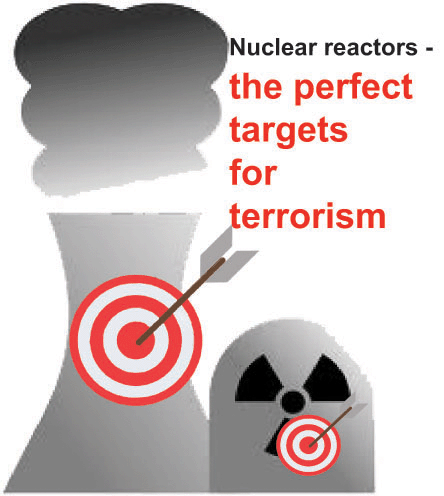 Pre-deployed terrorist targets: Nuclear power plants have been described as pre-deployed terrorist targets and pose a major security threat. This in turn would likely see an increase in policing and security operations and costs and a commensurate impact on civil liberties and public access to information. Other nations in our region may view Australian nuclear aspirations with suspicion and concern given that many aspects of the technology and knowledge-base are the same as those required for nuclear weapons.
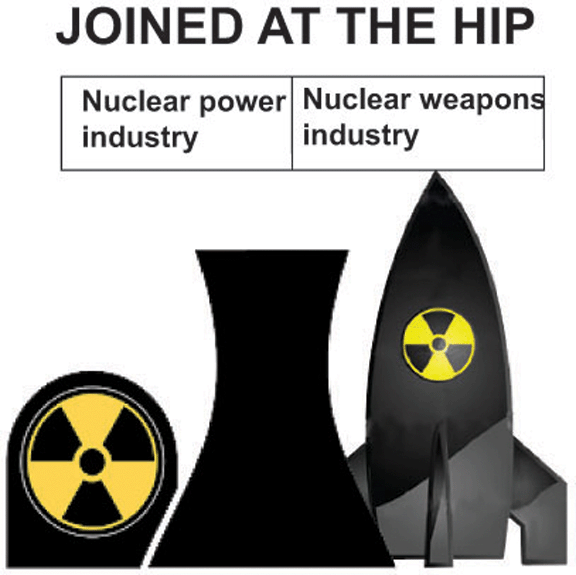 Former US Vice President Al Gore summarised the proliferation problem: “For eight years in the White House, every weapons-proliferation problem we dealt with was connected to a civilian reactor program. And if we ever got to the point where we wanted to use nuclear reactors to back out a lot of coal … then we’d have to put them in so many places we’d run that proliferation risk right off the reasonability scale.”
Too slow: Expanding nuclear power is impractical as a short-term response to climate change. An analysis by Australian economist Prof. John Quiggin concludes that it would be “virtually impossible” to get a nuclear power reactor operating in Australia before 2040. More time would elapse before nuclear power has generated as much as energy as was expended in the construction of the reactor: a University of Sydney report concluded that the energy payback time for nuclear reactors is 6.5‒7 years. Taking into account planning and approvals, construction, and the energy payback time, it would be a quarter of a century or more before nuclear power could even begin to reduce greenhouse emissions in Australia (and then only assuming that nuclear power displaced fossil fuels).
 Too thirsty: Nuclear power is extraordinarily thirsty. A single nuclear power reactor consumes 35‒65 million litres of water per day for cooling.
Water consumption of different energy sources (litres / kWh):
* Nuclear 2.5
* Coal 1.9
* Combined Cycle Gas 0.95
* Solar PV 0.11
* Wind 0.004
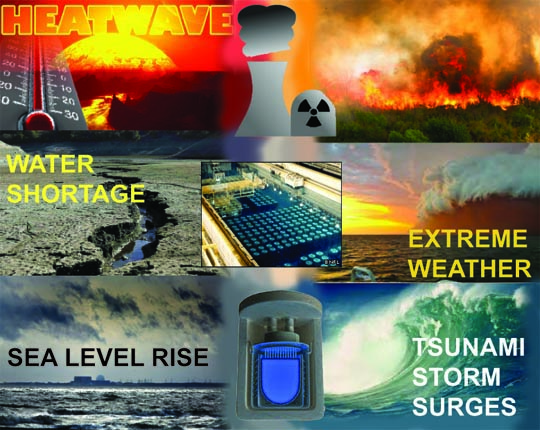
Climate change and nuclear hazards: Nuclear power plants are vulnerable to threats which are being exacerbated by climate change. These include dwindling and warming water sources, sea-level rise, storm damage, drought, and jelly-fish swarms. Nuclear engineer David Lochbaum states. “I’ve heard many nuclear proponents say that nuclear power is part of the solution to global warming. It needs to be reversed: You need to solve global warming for nuclear plants to survive.”
In January 2019, the Climate Council, comprising Australia’s leading climate scientists and other policy experts, issued a policy statement concluding that nuclear power plants “are not appropriate for Australia – and probably never will be”.
By contrast, the REN21 Renewables 2015: Global Status Report states that renewable energy systems “have unique qualities that make them suitable both for reinforcing the resilience of the wider energy infrastructure and for ensuring the provision of energy services under changing climatic conditions.”
 First Nations: Laws banning nuclear power should be retained because the pursuit of a nuclear power industry would almost certainly worsen patterns of disempowerment and dispossession that Australia’s First Nations have experienced ‒ and continue to experience ‒ as a result of nuclear and uranium projects.
To give one example (among many), the National Radioactive Waste Management Act dispossesses and disempowers Traditional Owners in many respects: the nomination of a site for a radioactive waste dump is valid even if Aboriginal owners were not consulted and did not give consent; the Act has sections which nullify State or Territory laws that protect archaeological or heritage values, including those which relate to Indigenous traditions; the Act curtails the application of Commonwealth laws including the Aboriginal and Torres Strait Islander Heritage Protection Act 1984 and the Native Title Act 1993 in the important site-selection stage; and the Native Title Act 1993 is expressly overridden in relation to land acquisition for a radioactive waste dump.
No social license: Laws banning nuclear power should be retained because there is no social license to introduce nuclear power to Australia. Opinion polls find that Australians are overwhelmingly opposed to a nuclear power reactor being built in their local vicinity (10‒28% support, 55‒73% opposition); and opinion polls find that support for renewable energy sources far exceeds support for nuclear power (for example a 2015 IPSOS poll found 72‒87% support for solar and wind power but just 26% support for nuclear power). As the Clean Energy Council noted in its submission to the 2019 federal nuclear inquiry, it would require “a minor miracle” to win community support for nuclear power in Australia.
The pursuit of nuclear power would also require bipartisan political consensus at state and federal levels for several decades. Good luck with that. Currently, there is a bipartisan consensus at the federal level to retain the legal ban. The noisy, ultra-conservative rump of the Coalition is lobbying for nuclear power but their push has been rejected by, amongst others, the federal Liberal Party leadership, the Queensland Liberal-National Party, the SA Liberal government, the Tasmanian Liberal government, the NSW Liberal Premier and environment minister, and even ultra-conservatives such as Nationals Senator Matt Canavan.
 The future is renewable, not radioactive: Laws banning nuclear power should be retained because the introduction of nuclear power would delay and undermine the development of effective, economic energy and climate policies based on renewable energy sources and energy efficiency. A December 2019 report by CSIRO and the Australian Energy Market Operator finds that construction costs for nuclear reactors are 2‒8 times higher than costs for wind or solar. Levelised costs for nuclear are 2‒3 times greater per unit of energy produced compared to wind or solar including either 2 hours of battery storage or 6 hours of pumped hydro energy storage.
Australia can do better than fuel higher carbon emissions and unnecessary radioactive risk. We need to embrace the fastest growing global energy sector and become a driver of clean energy thinking and technology and a world leader in renewable energy technology. We can grow the jobs of the future here today. This will provide a just transition for energy sector workers, their families and communities and the certainty to ensure vibrant regional economies and secure sustainable and skilled jobs into the future. Renewable energy is affordable, low risk, clean and popular. Nuclear is not. Our shared energy future is renewable, not radioactive.
More Information
* Don’t Nuke the Climate Australia, www.dont-nuke-the-climate.org.au
* Climate Council, 2019, ‘Nuclear Power Stations are Not Appropriate for Australia – and Probably Never Will Be’, https://www.climatecouncil.org.au/nuclear-power-stations-are-not-appropriate-for-australia-and-probably-never-will-be/
* WISE Nuclear Monitor, 25 June 2016, ‘Nuclear power: No solution to climate change’, https://www.wiseinternational.org/nuclear-monitor/806/nuclear-power-no-solution-climate-change
Dr. Jim Green is the national nuclear campaigner with Friends of the Earth Australia.
1 This Month
26 April – Chernobyl: Inside the Meltdown airs on National Geographic on Sunday 26th April from 4pm

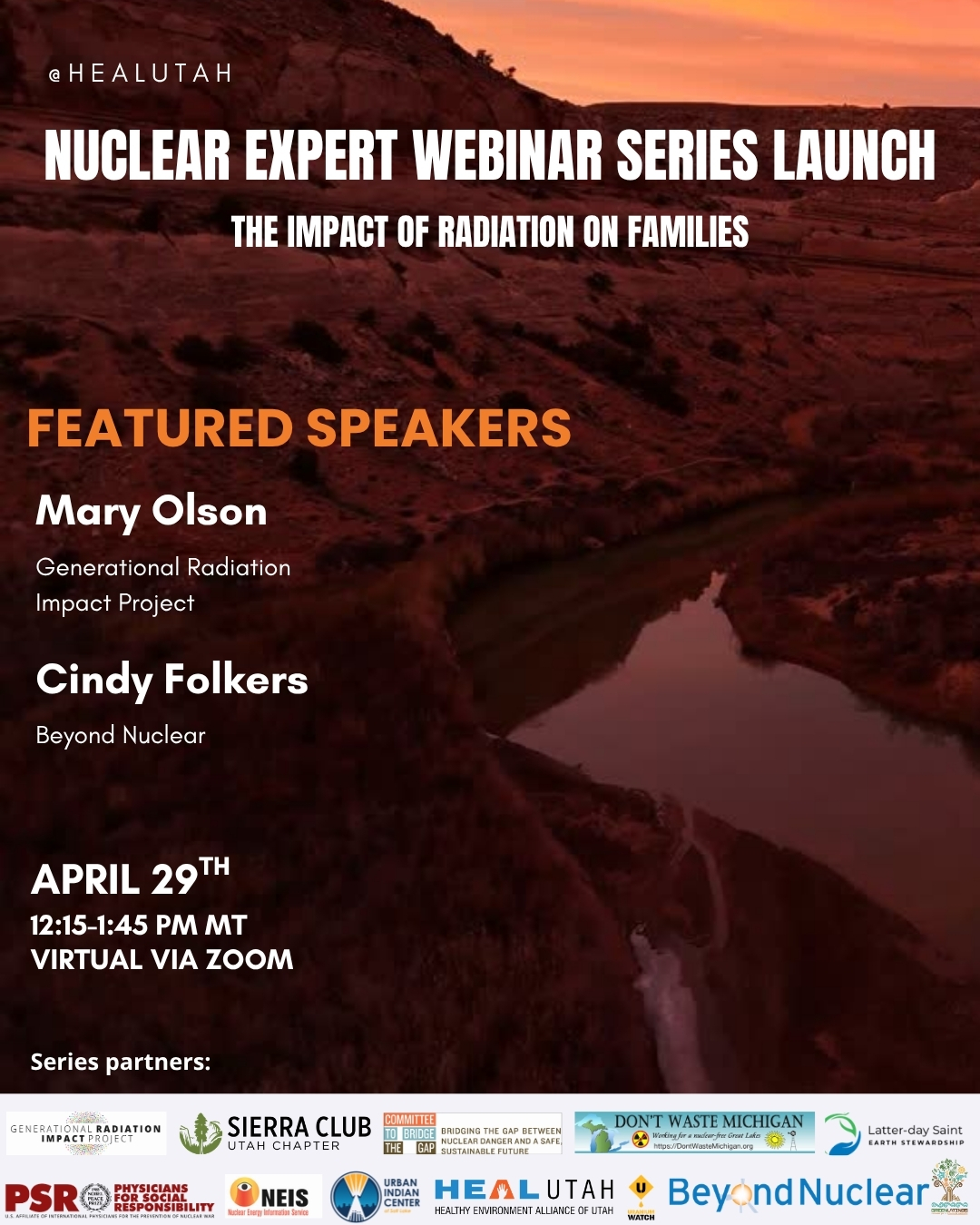
29 April – Nuclear Expert Webinar #1 – Radiation Impacts on Families with Mary Olson and Cindy Folkers
- 12:15 PM MT – 1:45 PM MT
- Location: Virtual – REGISTER TODAY

4 May -West Suburban Peace Coalition to discuss Iran war at May Educational Forum
Monday, May 4, 7:00 – 8:00 PM Central Standard Time
Title: : How Trump’s Narrative Tries to Shape the Reality of the War on Iran.
Contact Walt Zlotow, zlotow@hotmail.com 630 442 3045 for further information
14 May – online event From Bombs to Data Centres: the Face of Nuclear Colonialism

Pine Ridge Uranium is the real threat, not Tehran- Tell Burgum: Stop the Extraction.
Chernobyl: The Lost Tapes – A good documentary on Chernobyl on SBS available On Demand for the next 3 weeks– https://www.sbs.com.au/ondemand/tv-program/chernobyl-the-lost-tapes/2352741955560
To see nuclear-related stories in greater depth and intensity – go to https://nuclearinformation.wordpress.com
-
Archives
- April 2026 (288)
- March 2026 (251)
- February 2026 (268)
- January 2026 (308)
- December 2025 (358)
- November 2025 (359)
- October 2025 (376)
- September 2025 (257)
- August 2025 (319)
- July 2025 (230)
- June 2025 (348)
- May 2025 (261)
-
Categories
- 1
- 1 NUCLEAR ISSUES
- business and costs
- climate change
- culture and arts
- ENERGY
- environment
- health
- history
- indigenous issues
- Legal
- marketing of nuclear
- media
- opposition to nuclear
- PERSONAL STORIES
- politics
- politics international
- Religion and ethics
- safety
- secrets,lies and civil liberties
- spinbuster
- technology
- Uranium
- wastes
- weapons and war
- Women
- 2 WORLD
- ACTION
- AFRICA
- Atrocities
- AUSTRALIA
- Christina's notes
- Christina's themes
- culture and arts
- Events
- Fuk 2022
- Fuk 2023
- Fukushima 2017
- Fukushima 2018
- fukushima 2019
- Fukushima 2020
- Fukushima 2021
- general
- global warming
- Humour (God we need it)
- Nuclear
- RARE EARTHS
- Reference
- resources – print
- Resources -audiovicual
- Weekly Newsletter
- World
- World Nuclear
- YouTube
-
RSS
Entries RSS
Comments RSS
 nuclear-news