|
 The waste problem continues to weigh down nuclear power The waste problem continues to weigh down nuclear power
Trump is using Yucca Mountain to drum up Republican votes in the 2020 elections, Nevada Democrat says, By Benjamin J. Hulac
Roll Call February 26, 2020
The U.S. has more than 90,000 metric tons of nuclear waste that needs to be disposed, the vast majority of which is so-called spent fuel from commercial reactors, meaning it is no longer efficient for power generation.
Generally, all this waste is sitting where it was created: at 76 sites in 35 states. And while the tally of waste is only going to grow, there is no long-term national storage solution, and this month the Trump administration may have put the final nail in the coffin of a long-studied effort to build a permanent repository for high-level waste at Yucca Mountain in Nevada……
President Donald Trump’s fiscal 2021 budget proposal released this month does not include funding for licensing of Yucca Mountain as a nuclear waste repository located about 100 miles northwest of Las Vegas, an abrupt reversal of his administration’s policy.
“Nevada, I hear you on Yucca Mountain and my Administration will RESPECT you!” Trump tweeted on Feb. 6, four days before the budget proposal was released. “Congress and previous Administrations have long failed to find lasting solutions — my Administration is committed to exploring innovative approaches — I’m confident we can get it done!”
The president is using Yucca to drum up Republican votes in the 2020 elections, says Nevada Democratic Rep. Dina Titus. “I think he’s looking at the numbers,” Titus says. “He sees this as a swing issue.”…….
There are more than 76 commercial reactors in the U.S. that are idling with spent nuclear fuel on site, NEI says. The Nuclear Waste Policy Act of 1982 calls for waste to be stored deep in the ground, and amendments to that law bound the Department of Energy to study sites for such a repository in just one place: Yucca Mountain in the Mojave Desert.
While the Bush administration greenlighted storage at Yucca, the Obama administration reversed course and established a commission, which, in 2012, called for a “consent-based” process to the problem. ……
Nevada’s congressional delegation and governor firmly oppose Yucca…….
An interim-storage pilot program worth $22.5 million and sponsored by Sens. Dianne Feinstein, a California Democrat, and Lamar Alexander, a Tennessee Republican, held some promise, but it was stripped out of the latest budget deal…..
https://www.rollcall.com/2020/02/26/the-waste-problem-continues-to-weigh-down-nuclear-power/
|
|
February 27, 2020
Posted by Christina Macpherson |
election USA 2020 |
2 Comments
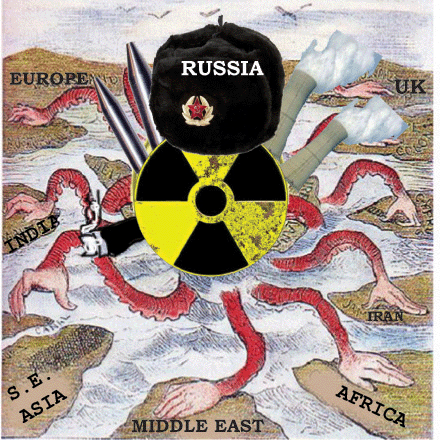
Russia lends Egypt $25 billion for Dabaa nuclear power plant, AL-Monitor, 26 Feb 20, CAIRO — Atomstroyexport, a subsidiary of Russia’s State Atomic Energy Corporation, or Rosatom, announced Feb. 17 that three Egyptian companies were awarded a tender offer for constructing the first phase of Egypt’s Dabaa nuclear power plant.
The three Egyptian companies, competing among 10 others, are Petrojet, Hassan Allam and the Arab Contractors.
The Egyptian government intends to start negotiations within the next few days with the Egyptian Nuclear and Radiological Regulatory Authority to obtain permission to start implementing the Dabaa nuclear plant project. The plant will be constructed in the Dabaa area of Marsa Matrouh governorate in the west of the country.
The Dabaa plant is the first nuclear plant for peaceful uses, with a total capacity of 4.8 gigawatts. The project is financially supported by Rosatom through a Russian loan amounting to $25 billion………….
Yemen al-Hamaki, a professor of economics at Ain Shams University said that under this agreement Egypt will use the loan to finance 85% of the total value of the building, construction, insurance and all other related works. Egypt would bear the remaining 15% in the form of installments. The loan is for 13 years at a 3% annual interest rate. If Egypt fails to repay any of the annual interest within 10 working days, it shall be subject to arrears of 150% of the interest rate calculated on a daily basis
Hamaki also warned that this massive Russian loan of $25 billion could blow up Egypt’s foreign debts. “This loan is a great risk to the future because it burdens the state and should be settled from the wealth and economic assets of the future generations,” she said, adding, “Egypt’s resorting to many loans foretells its inability to attract foreign investments, while tourism revenues continue to decline.” ….. https://www.al-monitor.com/pulse/originals/2020/02/power-plant-nuclear-egypt-russia-loan.html#ixzz6F5iQcolQ
February 27, 2020
Posted by Christina Macpherson |
Egypt, marketing, Russia |
Leave a comment
Nuclear lobby takes aim at Victoria to tackle prohibitions, Michael West Media, by Noel Wauchope | Feb 26, 2020 Having dithered on real action to tackle global warming, some in the Coalition are now taking a keen interest in solving it — by going nuclear. Noel Wauchope investigates what’s behind the sudden push to overturn legislation prohibiting the exploration and mining of thorium and uranium and puts a definitive case against a nuclear industry in Australia.
A batch of Coalition MP’s are pushing nuclear power as Australia’s answer to climate change. The group includes Katie Allen inner-city Melbourne Liberal, Ted O’Brien, Queensland LNP, Trent Zimmerman, North Sydney Liberal, Bridget Archer Tasmanian Liberal, David Gillespie Nationals NSW, Rick Wilson West Australian Liberal, and Keith Pitt, LNP from North Queensland, who was this week promoted to cabinet as Resources Minister. Former deputy prime minister and Nationals leader, Barnaby Joyce, is also a staunch proponent of nuclear power.
Arguing that nuclear power is the answer to bushfires and a heating climate when these are conversely nuclear’s greatest threat is akin to an argument by the Mad Hatter and the March Hare. The US National Academies Press compiled a lengthy and comprehensive report on risks of transporting nuclear wastes. They concluded that among various risks, the most serious and significant is fire. And indeed, climate change, in general, carries serious threats to nuclear reactors and the entire nuclear fuel chain.
But any port in a storm when you’re trying to sell a product that is expensive, unpopular, illegal in Australia and has the problem of long-lasting toxic wastes.
The Australian public’s renewed enthusiasm for action on climate change was timely. The nuclear lobby had, coincidentally already geared itself up for a campaign to overturn Australia’s State and Federal nuclear prohibition laws. The current Victorian inquiry is the latest in a spate of Parliamentary Inquiries aimed at removing these laws. Submissions are due by this Friday, 28 February.
The Inquiry’s Terms of Reference (TOR) are narrow:……..
It is clear the goal is to remove Victoria’s Nuclear Activities (Prohibitions) Act 1983. The very first TOR makes the mining of uranium and thorium as the prime concern. Given Victoria could run a nuclear power station with uranium/thorium sourced from elsewhere, it is clear that, after years of pressure by thorium lobbyists, the underlying goal of this inquiry is to overturn the legislation prohibiting the exploration and mining of thorium and uranium in Victoria.
The Victorian legislation was brought in to protect this State’s precious agricultural land and iconic ocean coast from polluting mining industries. South Gippsland is particularly rich in thorium.
Nuclear lobby tries to water down Victorian prohibition
The Terms of Reference are overtly biased: with no qualification, they promote the nuclear industry as undoubtedly beneficial to Victoria. This is ludicrous, as the global nuclear industry is in a state of decline.
Meanwhile, the renewable energy technologies of wind, solar and storage are now recognised by CSIRO and the Australian Energy Market Operator as, by far, the cheapest form of low carbon options for Australia, and are likely to dominate the global energy mix in coming decades
This first Term of Reference assumes that the “exploration and production” will result in nuclear power plants for Victoria, otherwise why do it? It also assumes that nuclear power will be effective in lowering C02 emissions.
However, there is no point in this “exploration and production” as it has been repeatedly demonstrated that nuclear power is no solution to climate change as in Dr. Paul Dorfman et al’s response to James Hansen on 20 December 2019 in the Financial Times.…….
The Terms of Reference are overtly biased: with no qualification, they promote the nuclear industry as undoubtedly beneficial to Victoria. This is ludicrous, as the global nuclear industry is in a state of decline.
Meanwhile, the renewable energy technologies of wind, solar and storage are now recognised by CSIRO and the Australian Energy Market Operator as, by far, the cheapest form of low carbon options for Australia, and are likely to dominate the global energy mix in coming decades
This first Term of Reference assumes that the “exploration and production” will result in nuclear power plants for Victoria, otherwise why do it? It also assumes that nuclear power will be effective in lowering C02 emissions.
However, there is no point in this “exploration and production” as it has been repeatedly demonstrated that nuclear power is no solution to climate change as in Dr. Paul Dorfman et al’s response to James Hansen on 20 December 2019 in the Financial Times.……… .https://www.michaelwest.com.au/nuclear-lobby-takes-aim-at-victoria-to-tackle-prohibitions/
February 27, 2020
Posted by Christina Macpherson |
AUSTRALIA, politics |
Leave a comment
 The New Republic The New Republic
A report from two economists at JP Morgan Chase pushes back against traditional economic wisdom on climate change. By KATE ARONOFF, February 25, 2020
JP Morgan Chase is the world’s leading financer of fossil fuel projects. And according to a report from within the company, recently leaked to the press, the world is seriously underestimating the adverse effects of climate change. The 22-page report, entitled “Risky Business: the climate and the macroeconomy” and dated January 14, 2020, has been reported by multiple outlets since Friday as containing a gloomy assessment of the risk presented by climate change in the near future. But it also offers a withering takedown of how economists in particular have tended to think about the climate crisis, criticizing findings from several of the field’s experts by name, including a recent winner of the Nobel Prize in economics.
“We cannot rule out catastrophic outcomes where human life as we know it is threatened,” the report concludes. It’s a stunning bit of cognitive dissonance from a bank that is doing so much to fuel the crisis. It also shows a growing push for a more grounded assessment of the crisis than mainstream economics has offered in recent decades….
Essentially an informational document, the report—written by U.K.-based JP Morgan economists David Mackie and Jessica Murray—reviews a battery of academic literature on climate change. It examines several predictions of climate change’s impact on gross domestic product, including economist Richard Tol’s 2018 survey of 26 different climate models—one of the more comprehensive recent works. While Tol has links to organizations that have cast doubt on the scientific consensus around the climate crisis, as his own research has, the findings listed are not especially controversial. But the JP Morgan Chase report authors push back on those and other prominent predictions. “Most likely,” the authors conclude, “these estimates of the income and wealth effects of unmitigated climate change are far too small.”…….. The JP Morgan report doesn’t include clear recommendations for what the company’s own risk analysts should do with the information presented. “Most likely,” it states, “business as usual will be the path that policymakers follow in the years ahead”—something its authors say “opens the earth to a greater likelihood of a catastrophic outcome” than previously estimated. The report does not discuss the bank’s support for polluting industries, which have spent handsomely to block climate action at virtually every level of government.
“It is depressing that JP Morgan are trying to evade responsibility for this thorough and useful report that restates what climate scientists, Greta Thunberg, and Extinction Rebellion alike have been saying for some time now: that our very future as a species is at stake,” Rupert Read, who originally obtained the report, wrote in an email. “It would be so much better if they owned up fully to what is in this report. But then, that would of course require them to completely transform their business model.”
|
|
February 27, 2020
Posted by Christina Macpherson |
2 WORLD, business and costs, climate change |
Leave a comment

|
Pentagon Plan Calls for a $9 Billion Surge in Nuclear Spending by 2025, TIME, BY TONY CAPACCIO / BLOOMBERG, FEBRUARY 26, 2020
The Pentagon’s five-year nuclear weapons plan calls for requesting at least $167 billion through 2025 — building from the $29 billion sought for next year to $38 billion, according to previously undisclosed figures.
The commitment includes research, development, procurement, sustainment and operations. It reflects a major boost to an effort started under President Barack Obama to replace aging nuclear systems, such as Minuteman III missiles and command and control systems.
It doesn’t include funding for the Energy Department’s National Nuclear Security Administration, which is requesting $19.8 billion for fiscal 2021, including $15.6 billion for nuclear weapons activities.
Congressional Democrats have been generally supportive of increased nuclear weapons spending, but Defense Secretary Mark Esper is likely to be questioned about the size and scope of the five-year plan when he testifies Wednesday before the House Armed Services Committee.
Esper is also likely to face bipartisan opposition from the defense-focused committee on President Donald Trump’s plan to shift $3.8 billion from Pentagon programs to his wall on the Mexican border.
The Defense Department’s five-year plan on nuclear programs calls for $29 billion for fiscal 2021, $30 billion in 2022 and $33 billion in 2023, before jumping to $37 billion in 2024 and $38 billion in 2025.
The plan includes $25 billion for research and procurement — but not support and operations for — the new Columbia-class intercontinental ballistic missile submarine that begins construction this year, $24 billion for improved nuclear command and control and $23 billion for the Air Force’s B-21 bomber. ….. https://time.com/5790901/pentagon-nuclear-weapons-spending/
|
|
February 27, 2020
Posted by Christina Macpherson |
business and costs, USA, weapons and war |
Leave a comment
|
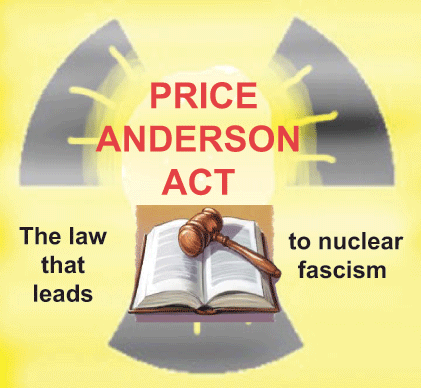
The US government insurance scheme for nuclear power plant accidents no longer makes sense, Bulletin of the Atomic Scientists, By Victor Gilinsky, February 26, 2020 The Japan Center for Economic Research, a source sympathetic to nuclear power, recently put the long-term costs of the 2011 Fukushima accident as about $750 billion. Contrast that with the maximum of $13 billion that could be available after a catastrophic US nuclear accident under the plant owners’ self-insurance scheme defined by the Price-Anderson Act. The Act will have to be renewed before 2025; Congress should seize the opportunity not only to reflect on the lack of insurance in the event of a catastrophic accident, but also to reconsider our approach to nuclear power plant safety altogether.
Price-Anderson frees nuclear plant operators and all firms involved in nuclear construction and maintenance of any liability for offsite accident damage. The only chance for additional compensation lies in the act’s declaration that if accident damages exceed the legal limit “Congress will thoroughly review the particular incident” and will “take whatever action is determined to be necessary” to provide full compensation to the public. In short, a Fukushima-level accident would toss the costs of compensation and cleanup unto the lap of Congress. ……….
The main public risk of nuclear power plants comes from rare but devastating nuclear accidents. Because data on such accidents is sparse, the probability of their occurrence has to be calculated on the basis of a model, rather than obtained from experience. Moreover, the extent of an accident and its monetary consequences are postulated on the basis of models that are limited by analysts’ imagination. Who would have imagined, for example, that the Fukushima accident would involve several reactors? Or that Japan would subsequently shut down all its other nuclear power plants?……….
Curiously, from the chairman on down, the NRC misstates the legal standard for its safety decisions. The NRC and its staff claim their job is to provide “reasonable assurance of adequate protection,” whereas the standard in the Atomic Energy Act is “adequate protection.” Under the law, their job is to provide adequate protection, period. Do the commissioners think the extra cushion of “reasonable assurance” justifies weaker regulation?
To return to the Price-Anderson Act: As we’ve seen, a catastrophic accident would render the US self-insurance scheme for nuclear power plants pretty much irrelevant. But the indemnification of all industry participants would remain highly relevant: The industry would be free of any liability for offsite death or damage, whereas the victims would have to go hat in hand to Congress for restitution. This is an enormous subsidy—consider, again, the $750 billion and counting tab for Fukushima—that the federal government provides the nuclear industry, one without which not a single US nuclear power plant would or could operate. Freedom from liability also has had a perverse effect on nuclear safety. Without the liability protection of Price-Anderson, industry incentives to develop nuclear designs safer than light water reactors would surely have been higher.
Freedom from liability was put into law in the 1950s to get the US commercial nuclear power industry off the ground. It was meant to be temporary, until industry and insurers got some experience with the new technology. But even as time went on, industrial organizations like General Electric and Westinghouse would not participate in the civilian nuclear program if they risked responsibility for offsite damage from a nuclear plant accident………
What is clear is that the nuclear firms—the largest of which possess an understanding of nuclear safety far beyond that of the public—do not believe the NRC safety conclusions that the risk of a catastrophic nuclear accident is infinitesmal. Nor do they accept that probable risk—probability of an accident times the consequences, were one to occur—as the right measure of risk to their companies. They don’t want to risk their companies, period.
If they don’t believe the NRC numbers, why should the rest of us accept them?
Why shouldn’t we have the same protection from physical harm that the nuclear industry has from financial liability? And just as the nuclear vendors will not participate on terms that do not include indemnification from the overwhelming cost of a severe accident, so should the public have the analogous power to only accept future nuclear designs that can demonstrate that they preclude offsite harm. And the designs should demonstrate that level of safety in a clear way, based on physical principles, not on complicated probabilistic calculations put forward by interested parties.
Such new designs would eliminate the current dilemma of a federal nuclear self-insurance scheme that cannot, as a practical matter, cover the financial consequences to the public of catastrophic nuclear power plant accidents. But how to get there? One of the disincentives is the Price-Anderson Act’s limitations on industry liability for offsite accident consequences. That should get phased out. https://thebulletin.org/2020/02/the-us-government-insurance-scheme-for-nuclear-power-plant-accidents-no-longer-makes-sense/#
|
|
February 27, 2020
Posted by Christina Macpherson |
business and costs, Legal, Reference, USA |
Leave a comment
|
Iran Nuclear Accord Parties Meet to Try to Salvage Deal https://www.voanews.com/middle-east/voa-news-iran/iran-nuclear-accord-parties-meet-try-salvage-deal
By RFE/RL, February 26, 2020 The remaining members of the floundering Iran nuclear deal are set to meet in Vienna Wednesday for the first time since Germany, France, and Britain initiated dispute procedures that could reimpose U.N. sanctions on Tehran.
The talks come as the signatories try to rescue the landmark 2015 accord, which has been faltering since U.S. President Donald Trump unilaterally withdrew from it in 2018 and enforced crippling sanctions on Iran.
It will be attended by senior diplomats from Iran, Britain, France, Germany, China, Russia, and the EU.
They have promised to uphold the deal that saw Iran agree to reduce its program of developing nuclear weapons in exchange for an easing of sanctions, even without Washington’s support.
However, since the U.S. withdrawal, Iran has stepped up its program in defiance of Washington’s “maximum pressure” campaign.“
This is a chance — though not of 100 percent — to stop escalation before it’s too late,” Russian Foreign Minister Sergei Lavrov was cited as saying by the Russian Embassy in Vienna on Twitter.
Why EU Powers Rejected Trump’s Call to Leave Iran Nuclear Deal
EU foreign policy chief Josep Borrell said Friday the 28-nation bloc will keep trying to save the Iran nuclear deal despite Trump’s call on EU to join US in breaking away from it
This is a chance — though not of 100 percent — to stop escalation before it’s too late,” Russian Foreign Minister Sergei Lavrov was cited as saying by the Russian Embassy in Vienna on Twitter.
Iran has since breached its main limitations, exceeding the stockpiles of heavy water and uranium allowed, the number and types of centrifuges it can operate to enrich uranium, and the purity of uranium.
As a result, in mid-January, the three European countries said they had “no choice” but to trigger a dispute mechanism in the accord, citing reduced compliance.
The process for ultimately reimposing U.N. sanctions consists of several steps, the final one of which is to notify the U.N. Security Council. The restrictive measures would then automatically be reinstated after 30 days unless the Security Council voted to keep them lifted.
Trump has called the deal “fatally flawed,” in part because it did not restrict Tehran’s ballistic-missile program or address its support for terrorist groups in the Middle East.
Iran insists its nuclear program is for civilian purposes only and that the Joint Comprehensive Plan of Action (JCPOA) allows the country to run reactors to generate power.
|
|
February 27, 2020
Posted by Christina Macpherson |
EUROPE, Iran, politics international |
Leave a comment
|
Nuclear agency finds radioactive substances in South Tangerang house, News Desk. The Jakarta Post Jakarta / Tue, February 25, 2020 A joint team from the Nuclear Energy Regulatory Agency (Bapeten) and the National Police has discovered illegally owned radioactive substances in a house in the Batan Indah housing complex in South Tangerang, Banten.
“The radioactive sources contain caesium-137 and other radioactive isotopes,” Bapeten spokesperson Indra Gunawan said in a press release on Monday.
Indra said the team would further investigate the matter to ascertain whether the illegally owned substances were linked to the recent discovery of caesium-137 radioactive waste in the complex.
Bapeten first detected high levels of radiation in the Batan Indah complex during a routine check at the end of January. Between Feb. 7 and Feb. 8, a joint Bapeten and National Nuclear Energy Agency (Batan) team discovered several radioactive fragments in a vacant lot next to a volleyball court in the housing complex.
The fragments contained caesium-137, which is commonly used for industrial purposes. ….. https://www.thejakartapost.com/news/2020/02/25/nuclear-agency-finds-radioactive-substances-in-south-tangerang-house.html
|
|
February 27, 2020
Posted by Christina Macpherson |
Indonesia, secrets,lies and civil liberties |
Leave a comment
|
Otherwise, the U.S. Department of Energy has concluded the structures on the Hanford Nuclear Reservation could fail and release radioactive contamination, the Tri-City Herald reported Tuesday.
“A number of structures are over-stressed and at risk of age-related failure, which could result in a release of contamination with impacts to human health and the environment,” DOE said in a letter last week to the Environmental Protection Agency, which regulates nuclear waste at Hanford.
The Hanford site, located near Richland, Washington, for decades made plutonium for nuclear weapons. The sprawling site for the past 30 years has been engaged in cleaning up a massive amount of radioactive waste left over from making plutonium.
Two of the underground structures, a trench and a tank, are estimated to be contaminated with a combined 170 to 255 pounds of plutonium.
DOE could award a contract for grouting as soon as March, according to the letter.
After the partial collapse of a waste storage tunnel at Hanford’s PUREX plant in 2017, DOE and its contractor CH2M Hill Plateau Remediation Co. analyzed other old and contaminated structures to determine if they were at risk of collapsing.
They determined that the three below-ground structures at the Plutonium Finishing Plant presented the highest risk.
Hanford Challenge, a Seattle-based Hanford watchdog group, does not object to the grouting as a short-term solution, but it should not be a substitute for complete cleanup, said Tom Carpenter, executive director..
|
|
February 27, 2020
Posted by Christina Macpherson |
safety, USA |
Leave a comment
|
Congresswoman: Science Should Guide Nuclear Storage Decision, By The Associated Press, Feb. 25, 2020, ALBUQUERQUE, N.M. — A member of New Mexico’s congressional delegation wants to ensure a “sound and robust” scientific review is done before federal regulators decide whether to sign off on plans for a multibillion-dollar temporary storage facility for spent nuclear fuel.
U.S. Rep. Xochitl Torres Small in an interview with The Associated Press acknowledged that the growing stockpile of used fuel at commercial reactors around the U.S. is a national problem and that elected leaders need to ensure New Mexico does not pay an unfair price as part of the solution.
“My concern is making sure that we’re looking at the science and that we are doing our best to evaluate based on that, not based on economic considerations or based on fear or bias, but based on how do we solve a challenge that is a national challenge,” the Democrat said.
While elected leaders in Eddy and Lea counties support the project, it has garnered fierce opposition from nuclear watchdog groups, New Mexico Gov. Michelle Lujan Grisham and other members of the state’s congressional delegation. They are concerned about the state becoming a permanent dump since the federal government is far from having any long-term plan for dealing with the tons of spent fuel building up at nuclear power plants around the nation…….
New Jersey-based Holtec International is seeking a
40-year license from federal regulators to build what it has described as a state-of-the-art complex near Carlsbad.
The site in southeastern New Mexico is remote and geologically stable, the company has said. Holtec executives also have said the four-layer casks that would hold the spent fuel would be made of thick steel and lead and transported on a designated train with guards and guns.
The Nuclear Regulatory Commission is in the process of considering Holtec’s application. It could be next year before a decision is made.
Torres Small said the clock is ticking for elected leaders to find a permanent solution as spent fuel is now stored at a variety of dangerous locations scattered across the U.S., including near important waterways.
New Mexico already is home to the U.S. government’s only underground repository for Cold War-era waste generated over decades by nuclear research and bomb-making. Some watchdogs are concerned the Waste Isolation Pilot Plant could become the final destination for other types of waste as the government prepares to ramp up production of the plutonium cores that serve as triggers for weapons in the nation’s nuclear arsenal.
|
|
February 27, 2020
Posted by Christina Macpherson |
politics, USA, wastes |
Leave a comment
 US staged ‘limited’ nuclear battle against Russia in war game
The Pentagon has briefed about the simulated exchange in a move that could signal readiness to fight and win nuclear conflict, Guardian, Julian Borger in Washington, Tue 25 Feb 2020 The US conducted a military exercise last week which simulated a “limited” nuclear exchange with Russia, a senior Pentagon official has confirmed.The war game is notable because of the defence department’s highly unusual decision to brief journalists about the details and because it embodied the controversial notion that it might be possible to fight, and win, a battle with nuclear weapons, without the exchange leading to an all-out world-ending conflict.
The exercise comes just weeks after the US deployed a new low-yield submarine-launched warhead commissioned by Donald Trump, as a counter to Russian tactical weapons and intended to deter their use.
According to a transcript of a background briefing by senior Pentagon officials, the defence secretary, Mark Esper, took part in what was described as a “mini-exercise” at US Strategic Command in Nebraska. Esper played himself in the simulated crisis, in which Russia launched an attack on a US target in Europe……
The official said that “in the course of [the] exercise, we simulated responding with a nuclear weapon”, but described it as a “limited response”.
The limited response could suggest the use of a small number of nuclear weapons, or an existing low-yield weapon, or the new W76-2 low-yield submarine-launched missile which was deployed in the Atlantic for the first time at the end of last year. The deployment only became public at the end of January……
The briefing was first reported by National Defense, a trade magazine of the National Defense Industrial Association.
Hans Kristensen, the director of the nuclear information project at the Federation of American Scientists, pointed out that it was extremely rare for the Pentagon to give such detailed briefings about nuclear exercises and suggested it could have been a marketing exercise for the new weapons being added to the US arsenal.
“Remember, it’s only a few weeks ago that we had the official confirmation that this new low-yield warhead had been deployed,” Kristensen said. “And we’re now moving into a new budget phase where they have to go to Congress and try to justify the next new nuclear weapon that has a low-yield capability which is a sea-launched cruise missile. So all of this has been played up to serve that process.”……
Arms control advocates are concerned that the leadership in both the US and Russia are developing a mindset in which their vast nuclear arsenals are not just the ultimate deterrent but weapons that could be used to win “limited” conflicts. https://www.theguardian.com/world/2020/feb/24/limited-nuclear-war-game-us-russia
February 25, 2020
Posted by Christina Macpherson |
USA, weapons and war |
Leave a comment

 February 24, 2020by cumbriatrust, https://cumbriatrust.wordpress.com/2020/02/24/is-cumbria-about-to-become-the-worlds-plutonium-dump/
 During the last search process for a burial site for the UK’s nuclear waste, which ended in January 2013, the Nuclear Decommissioning Authority (NDA) offered repeated assurances that only the UK’s nuclear waste would be buried in a UK Geological Disposal Facility (GDF). Many questioned at the time whether the NDA could be trusted to keep its word, and it became apparent in mid-2012 that it could not be trusted. The NDA had accepted 4 tonnes of plutonium from Germany in a ‘commercially advantageous arrangement’ according to Charles Hendry, the UK’s Energy Minister at the time. In other words the NDA had been paid to take ownership of the German plutonium.
****
A half-hearted attempt was made to claim that there was no breach of trust, since plutonium did not form part of the UK’s nuclear waste inventory, which while technically correct at the time, it was widely understood that plutonium was expected to be reclassified as waste at a later stage. So while the NDA claim was true in a literal sense, it was also entirely disingenuous. It was clear at the time that the NDA were embarrassed by this, particularly as they were about to ask Copeland, Allerdale and Cumbria to vote to continue the search process for a GDF site. That process ended in January 2013 when Cumbria County Council vetoed the decisions of the two borough councils which had voted to proceed.
****
While there have been a few smaller transactions of this type, it now appears that the NDA is offering to take ownership of a much larger quantity – 19 tonnes (21 US tons) of
plutonium from Japan, in exchange for a substantial payment. The UK and Sellafield where it is stored will then be faced with the problem of what to do with it. It is almost inevitable that it will be reclassified as waste at some point, but it generates too much heat to begin to be buried until the year 2136 according to the NDA.
****
The UK’s search for a GDF site has failed on three occasions, with a lack of public trust being one of the key reasons for the failures. With this latest move by the NDA, public trust is likely to be further diminished. Any claim that a UK GDF is for UK nuclear waste is clearly not to be trusted.
February 25, 2020
Posted by Christina Macpherson |
- plutonium, politics, UK |
Leave a comment
 G20 sounds alarm over climate emergency despite US objections,Group’s first ever reference to global heating signals growing economic concerns over climate change, Guardian, Richard Partington Economics correspondent @RJPartington, Mon 24 Feb 2020 The G20 group of the world’s wealthiest nations have agreed for the first time to collectively sound the alarm over the threat to the financial system posed by the climate emergency.Overcoming objections from Donald Trump’s US administration, G20 finance ministers and central bank governors meeting in Saudi Arabia over the weekend agreed to issue their first ever communique with references to climate change, according to reports from Reuters. G20 sounds alarm over climate emergency despite US objections,Group’s first ever reference to global heating signals growing economic concerns over climate change, Guardian, Richard Partington Economics correspondent @RJPartington, Mon 24 Feb 2020 The G20 group of the world’s wealthiest nations have agreed for the first time to collectively sound the alarm over the threat to the financial system posed by the climate emergency.Overcoming objections from Donald Trump’s US administration, G20 finance ministers and central bank governors meeting in Saudi Arabia over the weekend agreed to issue their first ever communique with references to climate change, according to reports from Reuters.
Sources told the news agency that the statement of priorities included the importance of examining the implications of global heating for financial stability, as part of the work of the G20’s Financial stability Board, the steering group for international banking industry rules.
The language represented a compromise to overcome opposition from US officials at the first major meeting of Saudi Arabia’s year-long presidency of the G20, according to the sources. An attempt to include references to the downside risks for global growth posed by the climate crisis was dropped…….
The International Monetary Fund included climate-related disasters in a list of the risks facing a highly fragile recovery in the global economy this year. However, the increasing focus comes as US officials resist naming global heating as an economic risk, following Trump’s move at the outset of his presidency to withdraw the world’s largest economy from the Paris climate accords. https://www.theguardian.com/world/2020/feb/23/g20-sounds-alarm-over-climate-emergency
|
|
February 25, 2020
Posted by Christina Macpherson |
2 WORLD, business and costs, climate change |
Leave a comment
US blocking mention of climate change in G20 statement, diplomats say Independent UK, ‘Oliver O’Connell, New York, 24 Feb 20,
1 day ago G20 diplomats say the US is against mentioning climate change in the communique of the world’s financial leaders.
A new draft of the joint statement shows the G20 considering including it as a risk factor to growth.
Finance ministers and central bankers from the world’s 20 largest economies are discussing the main challenges to the global economy in Riyadh, Saudi Arabia, this weekend.
G20 sources told Reuters that the US was reluctant to accept language on climate change as a risk to the economy.
The US is represented at the meeting by treasury secretary Steven Mnuchin…….. G20 diplomats say the US is against mentioning climate change in the communique of the world’s financial leaders.
A new draft of the joint statement shows the G20 considering including it as a risk factor to growth. Finance ministers and central bankers from the world’s 20 largest economies are discussing the main challenges to the global economy in Riyadh, Saudi Arabia, this weekend.
February 25, 2020
Posted by Christina Macpherson |
climate change, politics international, USA |
Leave a comment
|
Party leader urges Centre to protect the country’s security
Demanding dropping of nuclear power plant proposed by Nuclear Power Corporation of India Ltd (NPCIL) at Kovvada in Srikakulam district, CPI (M) State Secretariat member Ch. Narsinga Rao on Monday said United States President Donald Trump was on a visit to India to pursue supply of reactor to the plant, among other things.
He told reporters along with Greater Visakha unit president of CPI (M) B.  Ganga Rao that the Government of India should be aware of the fact that Trump’s son-in-law Jared Kushner had ‘vested interest’ in the supply of the reactor to Kovvada plant. Ganga Rao that the Government of India should be aware of the fact that Trump’s son-in-law Jared Kushner had ‘vested interest’ in the supply of the reactor to Kovvada plant.
Mr. Narsinga Rao said Westhouse company, which agreed to supply the reactor to Kovvada, had been acquired by Brookfield Asset Management, an investment company in which Qatar Investment Authority is a major stakeholder.
The CPI (M) leader said Mr. Kushner was an investor in Qatar Investment Authority.
Mr. Trump might be keen on proceeding with the MoU on Kovvada, he alleged and asked the Centre to protect the country’s security by rejecting America’s plea to supply the rector to NPCIL.
He said originally nuclear power plant was proposed at Mithivirdi in Gujarat and due to public protest, it was later decided to set up the plant at Kovvada. He said the Kovvada plant would be expensive and unviable and banks funding it were bound to turn bankrupt.
Mr. Rao said former Union Power secretary E.A.S. Sarma had also strongly opposed the move to sign MoU with the US for supply of six reactors for Kovvada from the erstwhile Westinghouse company.
|
|
February 25, 2020
Posted by Christina Macpherson |
India, marketing, secrets,lies and civil liberties |
Leave a comment










 nuclear-news