Film lauding Japan’s Fukushima heroes warns against complacency,
 Film lauding Japan’s Fukushima heroes warns against complacency, Elaine Lies TOKYO (Reuters) – As aftershocks rock the Fukushima nuclear plant, a small band of workers defy their bosses to stay on and fight to stop an even bigger disaster from irradiating a wide swathe of Japan.
The scene is from a movie that opened on Friday – “Fukushima 50”, which tells the true story of the hours after a quake and tsunami set off meltdowns at the Fukushima Daiichi reactors on March 11, 2011.
Almost nine years to the day after that disaster, its depiction of individual heroism in the face of official bungling and overwhelming catastrophe has struck a chord with early viewers……
nine years on, workers in protective suits are still removing radioactive material from Fukushima’s reactors, and the film’s scenes – mixed in with news footage from the time – still pack an emotional punch. ……
“The Fukushima Fifty” was the name given to the group of workers and engineers who stayed behind after the tsunami knocked out the power and cooling systems at the plant, run by Tokyo Electric Power Co (TEPCO)……
“When I made the film ‘Letters from Iwo Jima,’ I felt that Japan isn’t very good at learning lessons from the past,” Watanabe told a news conference after filming finished last year, referring to the Clint Eastwood film depicting the World War Two battle.
“I feel the same way about Fukushima,” he added.
Editing by Andrew Heavens https://www.reuters.com/article/us-japan-fukushima-film/film-lauding-japans-fukushima-heroes-warns-against-complacency-idUSKBN20T1GV
Belgian nuclear plants now could shut down earlier than planned
 Court ruling could close Doel nuclear reactors earlier, Friday, 06 March 2020 A ruling by the Constitutional Court could mean the nuclear power stations Doel 1 and Doel 2 have to close down earlier than the government planned. Brussels Times, Court ruling could close Doel nuclear reactors earlier, Friday, 06 March 2020 A ruling by the Constitutional Court could mean the nuclear power stations Doel 1 and Doel 2 have to close down earlier than the government planned. Brussels Times, The Court this week struck down a law passed in 2015 which extended the lifetime of the reactors by ten years. The case was brought by two environmental organisations, Bond Beter Leefmilieu (BBL) and Inter-Environnement Wallonie. The two reactors came into service in 1975, and should have closed in 2015. But to fill the requirements of the electricity industry at the time, a law was passed extending the lifetime of the reactors for ten years. However, the Court ruled, that law is unconstitutional, as it required an environmental assessment report be carried out, which never happened. That effectively suspends the 2015 law, but the court said it would allow it to remain in force until the end of 2022. The government must now organise the lengthy procedure to take place of commissioning an environmental assessment report and the public enquiry procedure that goes with it. It must then pass a new law through the various stages in parliament. If that is not completed by the end of 2022, the two reactors will have to close down then, three years earlier than planned. To make matters more complicated still, the government also needs to enter into talks with the Dutch authorities, since Doel – an abandoned village on the estuary of the Scheldt river in the municipality of Beveren in East Flanders – is a stone’s throw from the border with the Netherlands…….. https://www.brusselstimes.com/all-news/belgium-all-news/98803/court-ruling-could-close-doel-nuclear-reactors-earlier-environmental-report-constitutional-court/ |
|
Dark nuclear-lobby money effects political changes in Ohio, and where next?
 Support for HB 6 comes from beyond the state and reaches into some top levels of national politics.

The forces that passed Ohio’s subsidy law are poised for further action to shore up utilities and protect fossil fuel interests.
Dark money helped shift leadership in the General Assembly.Dark money dominated Ohio’s nuclear subsidy saga ENERGY NEWS NETWORK, Kathiann M. Kowalski, March 5, 2020 “…………..Dark money groups such as Generation Now and the Growth & Opportunity PAC spent roughly $1 million in the 2018 election cycle. That election replaced Kasich with Mike DeWine as governor.
Other groups were also active, sometimes popping up for just a few months. At least one group launched a $100,000 negative ad campaign against an Ohio representative running in a congressional primary after she opposed subsidies for FirstEnergy.
The 2018 election also led to a leadership shift in the Ohio House of Representatives. Larry Householder, R-Glenford, the new speaker, proved to be a major force shepherding HB 6 through the General Assembly, even to the point of holding up a budget agreement last summer until the subsidy bill passed.
Dark money efforts while the bill was pending included advertising, coordination of bill testimony, and blocking a referendum effort that would have let voters reject HB 6 this November. Groups’ actions sparked critics to complain about misleading ads, alleged harassment of signature collectors, buyouts of petition workers, and even alleged assault.
At the end of the day, someone paid big money” for all those efforts, Hill said. “They didn’t do that [as] an un-self-interested contribution to a public policy debate.”
Groups’ efforts overlapped and linked with each other from before 2017 through the present.
Public reports reflect partial funding and cross-transfers among organizations whose backers remain secret.
Generation Now formed in 2017 as a tax-exempt organization under Section 501(c)(4) of the Internal Revenue Code. That code section covers a broad range of civic and “social welfare” organizations. An IRS filing identified its president/secretary as JPL & Associates, rather than a specific individual.
Generation Now gave $1,050,000 to the Growth & Opportunity PAC in 2018, which in turn ran ads and took other steps to support candidates who would favor Householder’s selection as House speaker, preparing the way for the subsidy bill. In 2019, Generation Now continued to spend money for pro-HB 6 ads and to discourage voters from signing referendum petitions. The total amount of its spending is not yet known.
Neither Generation Now spokesperson Curt Steiner nor Jeff Longstreth, a principal at JPL & Associates, responded to questions about the organization’s funding and its activities.
Unions reported giving $840,000 to Generation Now in 2018 and 2019. Generation Now also got money from other 501(c)(4) organizations, according to IRS filings. A group called Empowering Ohio’s Economy gave $100,000 to Generation Now in 2017 and another $50,000 for advocacy in 2018. That group also gave $200,000 for public advocacy to the Coalition for Growth & Opportunity in 2017, which in turn gave $59,000 to Generation Now over the course of 2017 to 2018.
The Coalition for Growth & Opportunity has also donated money to the Growth & Opportunity PAC. And it paid roughly $103,000 in 2018 for services from Communications Counsel, Inc., a public relations firm that has represented many Republicans in Ohio politics. Mark Weaver, a principal in the firm, is also an attorney with the Isaac Wiles law firm in Columbus. Other lawyers there filed incorporation papers and serve as registered agents for Ohioans for Energy Security. That group was formed on July 30, a week after Gov. DeWine signed HB 6.
When asked about that organization, Weaver said the law firm “represent[s] a wide range of political action committees and non-profit organizations” that have free speech rights and that its lawyers “follow the law and ethical rules in every respect.” He did not answer questions about the group’s funding.
As a for-profit entity, Ohioans for Energy Security doesn’t have to report its funding sources or spending. The group’s print and video ads featured a debunked Chinese conspiracy claim. The group also took part in some blocking activities related to the referendum, such as working to hire or otherwise “buy out” workers who had been hired to collect signatures from voters.
An affidavit filed in federal court in October provides a copy of a form contract for one of those proposed buyouts. The contracting party is shown as Ohioans for Energy Security. However, it said, any notices for Ohioans for Energy Security should go to Generation Now, care of Jeff Longstreth in Columbus.
Additional blocking efforts included the circulation of rival petitions, arranged by Ohioans for Energy Security. Those petitions had no binding value. Yet they looked enough like the real thing to cause some confusion, said critics, such as Hill.
“Under the shroud of disclosure loopholes, corporations can outright lie to voters without any accountability,” said Jen Miller, executive director of the League of Women Voters of Ohio. “This is particularly concerning about complex issues like Ohio’s energy policy, which ultimately will affect Ohioans economically and environmentally for years to come.”
Yet another group, Protect Ohio Clean Energy Jobs, bought Facebook ads urging people to remove their names from referendum petitions. Its treasurer, Alex Thomas, also played a coordinating role for the Ohio Clean Energy Jobs Alliance. The alliance’s website says it’s a “coalition of Ohio community leaders and organizations” and is “powered by FirstEnergy Solutions.” The spokesperson, Carlo LoParo, also acted as spokesperson and president for Ohioans for Energy Security.
LoParo did not answer questions about funding for either Ohioans for Energy Security or the Ohio Clean Energy Jobs Alliance.
FirstEnergy Solutions is connected to dark money groups through its spending and through several consultants and lobbyists.
Even before the July 2019 wire payment from FirstEnergy Solutions to Generation Now, its lobbyists, Matt Borges and Alex Thomas, then with Roetzel Consulting Services, worked behind the scenes for passage of HB 6. During that time, Thomas helped get organizations to sign on to a June 12 letter to the Ohio Senate Energy and Public Utilities Committee in support of HB 6. Committee records show that letter as coming from the Ohio Clean Energy Jobs Alliance.
Other FirstEnergy Solutions lobbyists and consultants coordinated efforts on HB 6. Among other things, materials in the FirstEnergy Solutions bankruptcy case reflected payments to help get the Ohio Clean Energy Jobs Alliance underway. A former FirstEnergy external affairs director, Murphy Montler, who is now deceased, was a consultant for FirstEnergy Solutions. He provided local public officials linked to the alliance with drafts of their testimony on HB 6.
Labor unions that provided funds to Generation Now also appear to have members who work at the Davis-Besse and Perry nuclear power plants. The political education arm of International Union of Operating Engineers, Local 18 gave $250,000 in 2018 and another $105,000 through November 2019. The AFL-CIO also ran anti-referendum ads in 2019. And an AFL-CIO affiliate gave $250,000 to Generation Now in 2018.
Meanwhile, employee “contests” at the Davis-Besse and Perry nuclear plants recruited workers as part of the Ohio Clean Energy Jobs Alliance’s “employee ambassador” program. FirstEnergy Solutions employees appeared in a pro-HB 6 ad presented by the Ohio Clean Energy Jobs Alliance.
At least two employees at FirstEnergy Solutions’ nuclear plants are also in a video ad from Ohioans for Energy Security. “Don’t sign the petition to allow China to control Ohio’s power,” the ad’s voiceover announcer said.
FirstEnergy Solutions’ spokesperson declined to answer questions about the company’s relationship with the nonprofits.
Law firm links also factor prominently in activities linked to HB 6.
Australia’s former foreign minister calls on Australian govt to intervene to release Julian Assange
As anger mounts over Assange’s persecution, former foreign minister Carr calls for moral appeals to Australian government, WSWS, By Richard Phillips, 6 March 2020
Popular opposition to the ongoing imprisonment and state persecution of WikiLeaks publisher Julian Assange is increasing following last week’s extradition hearing in Britain. The four-day show trial, which blatantly violated Assange’s basic legal rights and subjected him to even more psychological torture, has deeply shocked many people and intensified the determination of those fighting for Assange’s release.
Addressing a public meeting last week in the New South Wales (NSW) parliament, Bob Carr, a former federal foreign minister and state Labor premier from 1995–2005, denounced the bogus espionage charges against Assange and warned that if extradited to the US, he would die.
Carr and other speakers, including Assange’s Australian lawyer Greg Barns and former SBS television journalist Mary Kostakidis, insisted, however, that those defending Assange should concentrate on lobbying state and federal MPs.
This orientation, they suggested, would pressure the Liberal-National Coalition government and Foreign Minister Marisa Payne to ask Washington to release the WikiLeaks publisher.
Carr called for Payne to have a “friendly chat” with Mike Pompeo, the former CIA chief and current US Secretary of State, and offered some talking points…….
Carr said nothing about Pompeo’s threatening denunciations of WikiLeaks as a “non-state hostile intelligence service,” his visit to Sydney last August when he demanded greater Australian involvement in Washington’s aggressive confrontations with Beijing and Iran, or his role as former CIA chief.
As for Payne, she rejected any defence of Assange, declaring in the Senate a day earlier that the WikiLeaks publisher would receive a fair trial and disparaging UN Special Rapporteur on Torture Nils Melzer’s reports on the decade-long persecution of Assange.
Carr’s opposition to the US-led vendetta against Assange, which he first voiced in May, appears to constitute a remarkable political turn around. Eight years ago, as foreign minister in the Labor government of Prime Minister Julia Gillard—from early 2012 to September 2013—Carr, like other federal Labor MPs and the party as a whole, was virulently hostile to Assange…….
The demonisation of Assange by Australia’s political establishment and the corporate media, which is part and parcel of its commitment to the US alliance, has not convinced tens of thousands of ordinary Australians. Important layers of workers, young people, students and middle-class people have taken up Assange’s defence as part of a growing international movement. …… https://www.wsws.org/en/articles/2020/03/06/carr-m06.html
The world’s Big Oil giants now turn to plastics to grow their industries
PLANET PLASTIC, How Big Oil and Big Soda kept a global environmental calamity a secret for decades, Rolling Stone, By TIM DICKINSON, MARCH 3, 2020
|
As the world begins to wean itself off of fossil fuel for transportation, Big Oil giants from Texas to Saudi Arabia are turning to plastic to support future growth. The International Energy Agency predicts that “oil demand related to plastic consumption overtakes that for road-passenger transport by 2050,” and its top executive warns plastics are “one of the key blind spots in the global energy debate.” The industry is counting on a tidal wave of new demand from emerging economies. A 2018 IEA report underscores that advanced economies use up to 20 times more plastic per capita than consumers do in India or Indonesia. And it warns that increased recycling and single-use bans in places like Europe and Japan “will be far outweighed by developing economies sharply increasing their shares of plastic consumption (as well as its disposal).” Global plastics production and incineration currently creates the CO2 pollution of 189 coal plants. By 2050, that’s expected to more than triple, to the equivalent of 615 coal plants. At that rate, plastics would hog about 15 percent of the world’s remaining “carbon budget,” or what can be emitted without crossing the 2-degrees Celsius threshold in global temperature rise that scientists warn can trigger calamity. The plastic industry’s damage to the planet is vast, but not immeasurable. In fact, the industry has published a detailed accounting that reveals its pollution is on pace to cause trillions in environmental harm by midcentury……… “The environmental cost to society of consumer plastic products and packaging was over $139 billion in 2015,” the report reveals. Without a dramatic change in course, Trucost predicts, that annual figure will soar to “$209 billion by 2025.”……… Much of the world is waking up to the plastics crisis. As China has shut its doors to the global plastic-waste trade, the European Union, Canada, and India are stepping up bans on single-use plastics like cutlery, plates, straws, and ear swabs. “How do you explain dead whales washing up on beaches across the world, their stomachs jam packed with plastic bags?” Canadian Prime Minister Justin Trudeau asked, introducing his country’s initiative. “As a dad, it is tough trying to explain this stuff to my kids.” But under President Trump, the United States is lurching in the opposite direction, promoting the plastic industry’s aggressive expansion. “It’s war,” says Puckett of BAN, “between policies that are totally at odds with each other — of making more plastics and banning plastic.” American fracking is literally fueling the global surge in plastics. The glut of cheap natural gas here has sparked an explosion in new plastics infrastructure. Since 2010, according to the ACC, U.S. companies have ramped up “334 chemical and plastics projects cumulatively valued at $204 billion.” Europe has built new plastics plants fed by fracked U.S. exports. Environmentalists warn that these facilities will lock in demand for fossil-fuel consumption for a generation. Trump is an unabashed booster of plastics — in keeping with his service to the fossil-fuel industry. The former CEO of Dow led Trump’s manufacturing council. And last July, the president visited a new Shell plastics complex outside Pittsburgh. “This facility will transform abundant natural gas — and we have a lot of it — fracked from Pennsylvania wells into plastic,” Trump said. That material, he boasted, would be embossed with “that very beautiful phrase: ‘Made in the USA.’” With the president championing its interests in Washington — and even triggering the libs with Trump 2020 campaign-branded plastic straws — the plastics industry is working to undermine grassroots activism in cities and states across the country. The Plastics Industry Association, or PLASTICS, is a top trade group headquartered on K Street in Washington, D.C. Hiding its handiwork inside a nesting doll of front groups, PLASTICS has worked to thwart state and municipal bans on single-use plastics. PLASTICS has gotten an assist from the American Legislative Exchange Council, or ALEC, which pushes right-wing state legislatures to pass nearly identical bills. In 2013, the plastic trade group wrote a pitch to ALEC members, arguing a ban on plastic “results in the picking of winners and losers in a ‘not-so-free’ marketplace.” By 2015, ALEC began advocating state laws best known for “banning bans” on plastic bags, but which are often far more sweeping, prohibiting limits on styrofoam and “auxiliary containers” — a catchall term for to-go packaging. PLASTICS obscures its involvement in these state fights through a “special purpose” front group called the Progressive Bag Alliance, which rebranded in January as the American Recyclable Plastic Bag Alliance. The organization runs public relations through another front group, Bag the Ban, which touts plastic as “the most environmentally friendly option at the checkout.” (The bag alliance claims it is self-funding, but PLASTICS employs its director, per IRS filings, and the groups share offices and overhead.)…… The success of blue states, from Hawaii to New York, in banning plastic bags has been countered by the industry-led push. PLASTICS says it has parted ways with ALEC, but some 15 red states now have laws pre-empting local plastic bans, with Oklahoma, North Dakota, and Tennessee joining the pack in 2019. (ALEC did not respond to questions from Rolling Stone.) For now, the state bans on bans are holding up in court……. As the global plastics crisis grows — and photos of albatross chicks decomposing around the indigestible plastic waste that killed them go viral — the industry is quietly agonizing over backlash from the metal-straw and Hydroflask-toting members of Generation Z. “The [plastic] water bottle has, in some way, become the mink coat or the pack of cigarettes,” a senior sustainability manager for Nestlé Waters confessed at a conference last year. “It’s socially not very acceptable to the young folks, and that scares me.” In contrast to climate change, the plastics crisis has not been met with corporate denial. The companies of Big Plastic are instead seeking to convince consumers and regulators that — despite having unleashed this torrent of pollution on the planet — they can be trusted to pioneer solutions that will make plastic use sustainable. They’re touting a “circular economy,” in which used plastic doesn’t become waste but, instead, a feedstock for new products. A cynic might translate the concept into: Recycling, but for real this time. “There are a lot of different corporate commitments,” says Shilpi Chhotray, a leader of the Break Free From Plastics movement. While some show promise, others “are just greenwashing,” she insists, with the intent of giving the industry cover for its true aim: “growth.”……… The industry’s voluntary actions to curb plastic pollution are driven by two clear motives: One is protecting the environment, the other is protecting profits from regulation…….. In Washington, the plastics industry is asking government, and American taxpayers, to foot the bill to revitalize the moribund recycling industry. The RECOVER Act — backed by both PLASTICS and the ACC — would offer $500 million in federal-matching funds for investment in new infrastructure……. For Sen. Tom Udall, our involuntary ingestion of plastic waste is proof that the country can’t wait decades for plastic polluters to reform their own practices, or rely on half-measures to bolster the current recycling system. “We are beyond the crisis point on plastic waste,” he says, “and people are starting to wake up.” Udall wants consequences for an industry that has sloughed its environmental harms onto the rest of us for long enough. Washington is late to the game when it comes to plastics regulation, and Udall’s strategy is to adopt best practices from across the globe. . The Break Free From Plastic Pollution Act would mimic Europe in banning commonly polluted single-use plastics, including plastic bags, styrofoam cups and carry-out containers, and plastic utensils. Plastic straws would be allowed only by request. The bill would expand the market for recycled plastics by creating a minimum recycled content for beverage containers, while also imposing a 10-cent deposit on each container sold — roughly nationalizing the models of Michigan and Oregon, where residents return nearly nine in 10 containers for recycling. The bill would create “extended producer responsibility” — making the industry responsible for the waste it creates by requiring that producers “design, manage, and finance programs to collect and process waste that would normally burden state and local governments.” Udall emphasizes that today’s industry is hardly trying, often slapping an unrecyclable label on an otherwise recyclable bottle….. The companies of the plastics industry, Lowenthal says, are ultimately “going to have to deal with the sticker shock that they are now responsible and they’re going to have to pay” to keep plastics out of the environment. The alternative, he insists, has become untenable: “What we have in plastic is something that has made our lives more convenient and easier. But unless we figure out how to keep this out of the waste stream, it’s just going to kill us.” https://www.rollingstone.com/culture/culture-features/plastic-problem-recycling-myth-big-oil-950957/?fbclid=IwAR2i19CqoMXj7HMbvmzM6uGkEx02ESd69vjlxVVgpUZV-VMbhPQJ_iZ3o3w
|
|
The Threat of a Nuclear War Between the US and Russia Is Now at Its Greatest Since 1983 — limitless life

OpEdNews Op Eds 3/5/2020 at 15:47:47 H3’ed 3/5/20 The Threat of a Nuclear War Between the US and Russia Is Now at Its Greatest Since 1983 By Scott Ritter (View How Many People Read This) 5 comments Become a Fan (3 fans) General Wolters’ response was straight to the point ‘Senator I’m a fan of flexible first use policy’ (Image by Vox) Details DMCA […]
50 Years of “Enriching the Future” —

The Urenco Uranium Enrichment plant in leafy rural Cheshire has a rather Orwellian tagline “Enriching the Future”. For fifty years this plant has been enriching uranium for the civil/military nuclear industry, causing a snowball of Nukiller blight. At the invitation of campaign group Close Capenhurst, representatives of groups including Japanese Against Nuclear, Radiation Free Lakeland […]
Worker at Hinkley Point nuclear station has now developed coronavirus COVID-19
Nuclear and other toxic wastes dumped in Beaufort’s Dyke, which lies between Scotland and Northern Ireland
The National 4th March 2020, FOR decades, Scotland has been used by the Ministry of Defence to dump
everything from nuclear waste to unwanted munitions. For example,
Beaufort’s Dyke, which lies between Scotland and Northern Ireland, is
packed with laboratory waste, chemical munitions and artillery rockets. The
decision by the MoD to use it as a dumping ground has effectively ruled out
any possibilty of using that crossing for a Scotland to Northern Ireland
bridge (if ever such a thing was viable in the first place).
https://www.thenational.scot/news/18280377.uk-used-scotland-nuclear-dumping-ground-decades/
We can now see the full horror of nuclear plans for Bradwell B
|
BANNG 4th March 2020, Bradwell B to use Cooling Towers. At last we can see the full horror of what is proposed for Bradwell B! The pre-application for planning permission public consultation documents have just been published by the Chinese developer.
TV 4th March 2020, People in Bradwell-on-Sea in Essex will get to have their say on plans for a new nuclear power station from today. A 12 week public consultation is starting on proposals for Bradwell B – a twin reactor on the same site as a power station which stopped operating in 2002. The consultation will include fifteen exhibition events across Essex which will give local residents the chance to review the proposals. |
|
Protesters call for Capenhurst Urenco nuclear plant to be closed down
|
Protesters call for Capenhurst nuclear plant to be closed down https://www.cheshire-live.co.uk/news/chester-cheshire-news/protesters-call-capenhurst-nuclear-plant-17873816 Demonstration held as Urenco celebrated its 50th birthday By
David HolmesChief reporter 6 MAR 2020
Urenco’s nuclear plant at Capenhurst this week celebrated 50 years since the government-owned international company was founded . But outside protesters lamented the damage to human health and the environment caused by disasters like Chernobyl in Ukraine and Fukushima in Japan. Close Capenhurst campaigners argued the sector was unsafe from uranium mining to nuclear power production and the transportation and storage of highly radioactive waste.
Concerns have been raised about the Urenco plant itself which enriches uranium for use as fuel in nuclear reactors with the depleted uranium – a low level radioactive and toxic byproduct of the process – stored on site. Marianne Birkby, an anti-nuclear campaigner from Cumbria, speaking at the small demonstration outside the plant, said: “The start of the nuclear fuel cycle is here and where it ends up is Sellafield in Cumbria and every day, virtually, there’s nuclear waste transported on the roads, rail, sea and nobody wants the waste. “It’s all very well for Urenco to say ‘enriching the future’ and how fantastic it all is but nobody wants nuclear waste at the end of the day. And nuclear waste is the product of nuclear power.” Japanese campaigner Kaori Mikata-Pralat read out a statement on behalf of a group pursuing legal action against the Tokyo Electric Power Company over the 2011 Fukushima disaster when a tsunami swamped the plant leading to the release of radioactive contamination. Explaining that Fukushima had alerted her to the dangers, she told CheshireLive: “I wasn’t quite aware of the scale of the problem of this nuclear industry.” She has met victims of nuclear accidents, adding: “What they want is this tragedy should not be repeated any where in the world. Fukushima people suffered a lot.” Kaori said the ocean had also been poisoned. Even nuclear power stations functioning normally affected the eco-system as sea and river water was used to cool the reactors with the hot water put back, harming fish and plant life. Pointing at the sun, fellow protester Philip Gilligan said: “That nuclear power station up there is supplying the energy. It’s the only nuclear power station we want. So the energy coming to earth could easily be used with zero carbon output and zero nuclear. The problem is we need a bomb. And it’s hidden in statements like ‘energy as cheap as water’ which was current when Sellafield went critical in the ‘70s.” Urenco highlights the alleged green credentials of nuclear because there are no CO2 emissions during energy generation but the protesters claim the carbon footprint is ‘enormous’ after taking into account uranium mining, transport and the manufacture of thousands of tons of concrete for the installations. But what of the job losses if plants like Capenhurst, which employs 550 people, were closed? The campaigners argue the Government should reskill the workforce to produce renewable technology like solar panels. |
Work on Fukushima plant, halted during 2016 G7 summit, to continue during Tokyo Olympics
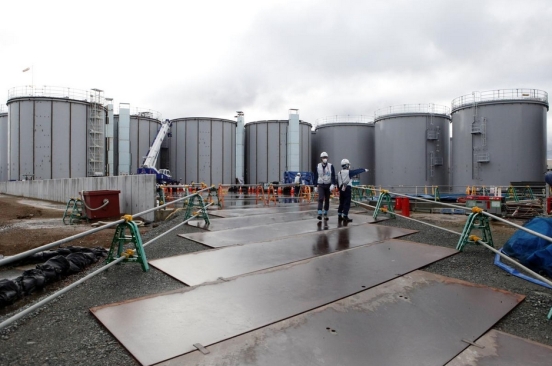 Workers are seen near storage tanks for radioactive water at Tokyo Electric Power Co’s (TEPCO) tsunami-crippled Fukushima Daiichi nuclear power plant in Okuma town, Fukushima prefecture, Japan January 15, 2020. Picture taken January 15, 2020
March 4, 2020
TOKYO (Reuters) – Decommissioning work at Japan’s crippled Fukushima nuclear power station, halted during a G7 summit in Japan in 2016, will not stop during this summer’s Tokyo Olympics, the plant operator said.
There are about a third fewer workers now – 4,000 compared with 6,000 in 2016 – which makes the decision to keep working easier, said Akira Ono, Tokyo Electric Power Co’s (Tepco) chief decommissioning officer.
“When I was the plant manager, I suspended operations at the time of the Ise-Shima summit. But the situation is totally different now,” Ono told Reuters in an interview.
Although the coronavirus outbreak – which has sickened more than 1,000 Japanese – has disrupted supply chains, there has been no shortage of protective gear at the plant, he added. Workers must wear special clothing to protect them from residual radiation in some parts of the facility.
“There was a time when coverall supply became quite tight … But after talking with various sources, we are now sure that we can procure what we need,” Ono said in the interview conducted on Tuesday but embargoed till Wednesday.
A powerful earthquake and tsunami hit eastern Japan in March 2011 and knocked out cooling systems at Tepco’s Fukushima Daiichi nuclear power plant, triggering the worst nuclear accident since Chernobyl in 1986.
Since then, the operator has been working to clean up the damage and contain any spread of radiation.
For the last nine years, Tepco has been pouring water over melted reactor cores to keep them cool. Nearly 1.2 million tonnes of tainted water, enough to fill 480 Olympic-sized swimming pools, is stored at the plant. The company treats the water to remove most radioactive material.
A government panel reviewing potential disposal methods has recommended releasing the water into the sea after dilution. Local residents, fishermen in particular, strongly oppose the ocean discharge.
Ono said that the plant will likely run out of tank space by summer 2022.
“The time is getting near,” Ono said, referring to a decision on the disposal method. “We are cutting it very close.”
Japanese trade and industry minister Hiroshi Kajiyama said last month the government would decide after hearing opinions from people in local communities and others, without committing to a deadline.
The Coronavirus Exposes Why the Tokyo 2020 Olympics Should Be Canceled
The Tokyo Olympics were already unsafe. Now, they’re even more so.
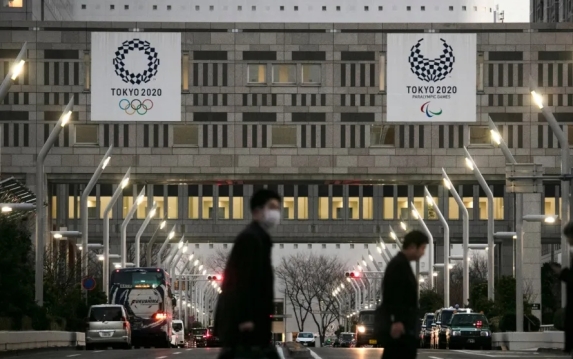 People walk across a pedestrian crossing near the Tokyo Metropolitan Government building adorned with signs promoting the 2020 Olympics.
March 4, 2020
Can anime become prophecy? The 1988 Japanese anime classic Akira predicted that Tokyo would host the 2020 Olympics. One scene featured a billboard reading “147 Days Until the Games”—directly beneath it someone scrawled in graffiti, “Just cancel it!” Here we are roughly 140 days ahead of the Tokyo Summer Olympics, and the cancellation—or postponement—of the Games is a real possibility, because of the emergence of COVID-19, or the novel coronavirus.
As Stanford University professor Yvonne Maldonado put it, with the Olympics, “You bring a lot of people together, and then you ship them back all over the world: That’s the perfect way to transmit.” The infectious disease specialist added, “If you really want to disseminate a disease, that would be the way to do it.”
At least one member of the International Olympic Committee, Dick Pound of Canada, seems to agree. In an interview with the Associated Press, he set off alarm bells, stating that the International Olympic Committee (IOC) probably needs to decide whether to press ahead with the Tokyo Games by the end of May. “In and around that time, I’d say folks are going to have to ask: ‘Is this under sufficient control that we can be confident about going to Tokyo or not?’” Postponing the Games—an idea posed by Seiko Hashimoto, Japan’s Olympic minister this week—is now an open possibility, but also unrealistic, as doing so would interfere with the US college and NFL fall football schedule. Given the billions that NBC has plunged into the Olympics—the network forked over $4.4 billion in 2011 for broadcasting rights through 2020 and then a whopping $7.7 billion for the Games running through 2032—its insistence would almost certainly be that the Games must go on, short of a global pandemic.
In truth, though, the Games should have been canceled well ahead of the coronavirus outbreak, especially if Olympic organizers and their allies in Japan’s government cared about public health. Tokyo organizers have branded the Olympics the “Recovery Games,” replete with “recovery monuments” to honor the triple-whammy earthquake, tsunami, and nuclear meltdown at the Fukushima Daiichi nuclear power plant in 2011. They even created a bizarre graphic (pictured below) that depicts a circle of appreciation, with “the disaster-affected areas” offering support for the Olympic athletes, which will “cheer up” the world. “The world,” in turn, will express gratitude, which will “cheer up” the disaster-affected areas. (The graphic was available on this website until today.)
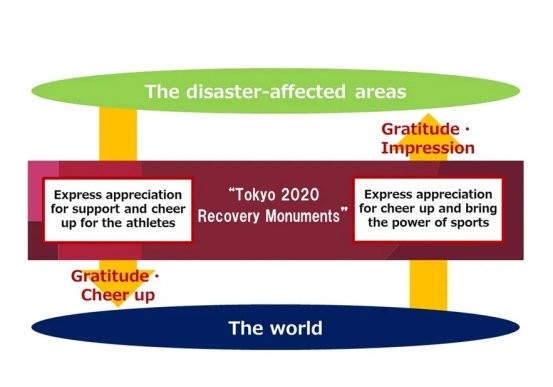 Graphic of “the disaster-affected areas” that will “cheer up” the world, which was available on Tokyo 2020’s website until today.
This, of course, is pure-grade PR gibberish. We visited Fukushima in July 2019 and spoke with locals who were livid that Fukushima was being used as an Olympic prop. We saw “black pyramids” comprised of large plastic bags of radiation-drenched soil. We saw abandoned homes and businesses that surely could have used the billions that are being funneled into the Games—some $26 billion, according to a government audit, despite the fact that the original price tag for the Tokyo Olympics was $7.3 billion.
Instead of material support, Olympic honchos have offered Fukushima residents mere symbolism: The Olympic torch relay will kick off in Fukushima next month, despite the fact that Greenpeace recently uncovered radiation hot spots along the torch relay route. Olympic bigwigs have also scheduled baseball and softball games in Fukushima Prefecture. In short, the “Recovery Games” moniker amounts to a cruel joke. As Satoko Itani, a professor of sport, gender, and sexuality studies at Kansai University, told us, “This Olympics is literally taking the money, workers, and cranes away from the areas where they are needed most.”
The coronavirus may well benefit elected officials with an authoritarian streak, as public health crises can be a recipe for free-range autocracy. Japanese Prime Minister Shinzo Abe has long demonstrated a “disturbing authoritarian pattern,” as Bloomberg News referred to it. And he has also shown an alarming capacity to lie to get what he wants. Shinzo Abe has been adamant that there is no need to postpone the Tokyo Games, but there’s a “prime minister who cried wolf” dynamic at play here. After all, back in 2013 when Tokyo was bidding on the Olympics, he told voting members of the IOC who were jittery about Fukushima that the situation was “under control” even though it clearly wasn’t. For many, when they hear Abe and other officials saying that the coronavirus will not affect the Olympics, they hear the resounding echo of previous empty promises.
It must be noted that even if they cancel the Tokyo Games, the damage has already been done. Everyday people have been displaced for Olympic facilities and that cannot be rolled back. Workers have set up infrastructure in Fukushima and their exposure to radiation has already taken place.
What about relocating the Games to a previous host? Shaun Bailey, a candidate running for mayor of London, suggested transferring the Olympics there, but many of the 2012 venues are gone and residents are now living in the apartments that previously made up the Olympic Village. Rio, host of the 2016 Olympics is an obvious no-go, with venues in various states of dilapidation and the country mired in a right-wing hatescape that does not even vaguely chime with the lofty principles enshrined in the Olympic Charter. And cariocas—Rio’s residents—have little interest in the Olympics’ returning to town. The IOC left a bitter taste in Rio, when it said it was unwilling to help them pay off a few bills left in the Games’ wake.
As for the economic damage that canceling the Olympics could do to Japan, one could argue that the harm has been done. In addition to the displacements, the Olympics have already granted huge giveaways of land to the developers who are building the Athletes Village and that will not change because of a virus—or even a cancellation. The writing is on the wall: There is ample reason to cancel these Olympics for the good of Japan. The coronavirus only lays those reasons bare.
https://www.thenation.com/article/society/coronavirus-tokyo-2020-olympics/
Japan lifts evacuation order for town hit by Fukushima disaster
Futaba to reopen for start of Olympic torch relay after being deserted for nine years
 The entrance of Futaba town, which has been empty since the leak at the nearby Fukushima Daiichi nuclear power plant in 2011.
March 4, 2020
Japan has lifted an evacuation order for parts of a town in the shadow of the wrecked Fukushima Daiichi nuclear power plant, weeks before the area is to host the start of the Olympic torch relay.
Futaba, 2.4 miles (4km) west of the plant, has been almost deserted since the nuclear meltdown nine years ago, while other areas in the region have mounted a partial recovery after the government declared them safe for residents.
The start of the relay’s Japan leg at the end of the month is supposed to showcase Fukushima’s recovery from the world’s worst nuclear accident since Chernobyl in 1986, but some residents say their home towns may never return to normal.
Futaba’s 7,000 residents were forced to evacuate after the March 2011 disaster, which was triggered by a powerful earthquake and tsunami that killed more than 18,000 people along Japan’s north-east coast.
The reopening of a 1.5 sq mile area of Futaba means reconstruction workers can stay in accommodation near the railway station, but residents will not be able to return for another two years, when its water supply and other infrastructure will have been restored, according to local officials.
They will be able to enter and leave for short visits without going through security, and will no longer need to wear protective clothing, but will not be allowed to stay overnight.
While the coronavirus outbreak has prompted speculation that the Olympics could be cancelled or postponed, Japan’s government is keen to promote Tokyo 2020 as proof that the region, including Fukushima, has recovered from the triple disaster.
“I’m overwhelmed with emotion as we finally bring part of our town operations back to our home town,” said Futaba’s mayor, Shiro Izawa. “I pledge to push forward with our recovery and reconstruction.”
The domestic leg of the torch relay is due to begin on 26 March at J-Village, a football training complex that functioned for years as a logistics hub for crews working to control and decommission the damaged nuclear plant 12 miles away.
Although organisers have said the route is subject to change, the torch is scheduled to pass through Futaba later the same day, before being taken through other parts of Fukushima prefecture over the following two days.
 A guard opens the gate to the town in Futaba.
“In addition to building excitement across the country ahead of the Tokyo 2020 Games and promoting the Olympic values, the Olympic torch relay aims to demonstrate solidarity with the regions still recovering from the 2011 earthquake and tsunami,” the organisers said last month.
More than 160,000 people were forced to flee their homes during the Fukushima meltdown. Many have decided not to return, despite government reassurances on safety, and many of those who have returned are older residents.
Futaba is no exception, with just 10% of residents saying they intend to return. Some, particularly those with young children, are concerned about radiation levels, while others have built new lives elsewhere.
Yuji Onuma, a Futaba resident, said recent work to repair streets and decontaminate the town centre was designed to give the world a false impression before the Olympic torch relay.
“I wish they wouldn’t hold the relay here,” Onuma told Reuters. Pointing at workers repaving a road expected to be on the relay route, he added: “Their number one aim is to show people how much we’ve recovered. I don’t think people will understand anything by just seeing cleaned-up tracts of land.”
Radiation readings in the air taken in February near Futaba’s railway station were around 0.28 microsieverts per hour, higher than the government-set target of 0.23 microsieverts an hour.
Another part of the town had a reading of 4.64 microsieverts per hour on the same day, meaning a person would reach the annual exposure upper limit of 1 millisievert, recommended by the International Commission on Radiological Protection, in just nine days.
The torch is due to pass through the village of Iitate the following day, but campaigners this week described the relay as inappropriate and warned they had found radiation “hotspots” in the village.
In a survey of 69 locations along and around the proposed relay route, the grassroots group the Radioactivity Monitoring Centre for Citizens said it had found 44 sites with radioactive levels above 0.23 microsieverts per hour, including one “severe hotspot” of 0.85 microsieverts per hour along the torch relay route.
The discovery of hotspots near J-Village by Greenpeace Japan at the end of last year prompted the environment ministry and the nuclear plant’s operator, Tokyo Electric Power, to perform extra decontamination work.
While some independent monitors have said the discovery of isolated hotspots does not present an accurate picture of the overall situation in Fukushima, Nobuyoshi Ito, an Iitate farmer, said the civic group’s findings cast doubts on government claims that decontamination work had been a success.
“Radiation exposure for runners passing along the route may not be very high, but the overall situation in places like Iitate is severe,” Ito said. “Levels are several times to as many as 20 times higher in the village than they were before the disaster, and people who moved back have to put up with that 24 hours a day, 365 days a year.”
Of Iitate’s pre-disaster population of 6,100, only 1,200 people have returned, Ito said. “The small number of people coming means that the nuclear disaster is not over yet. The truth is that full recovery from a nuclear disaster like this is just not possible.”
Aoki, Ito and Nakamura: “Radioactive Hotspots along Olympic Torch Relay Route
“
Kazumasa Aoki: Vice President, Radioactivity Monitoring Center for Citizen / Nobuyoshi Ito: Iitate Village Resident / Jun Nakamura: Co-Chairman, Fukuichi Area Environmental Radiation Monitoring Project
Thanks to FCCJ for this interview and also for restoring bilingual format. Thanks also for an excellent translation by Mary Joyce, whose contribution is often unmentioned. Although the Covid-19 and Fukushima disaster appear unrelated, I see parallel relationship. Abe’s Japanese government tends to hide the truth as if the politicians believe in the three monkeys carved in Nikko Shrine. See no evil, Hear no evil, Speak no evil. The government’s reluctance to measure and publish the soil contamination at Fukushima is analogous to that of their reluctance to conduct PCR test to grasp the real spread of the corona virus. I used to use a term “Okami to Hitsuji (sheep)” to describe the relationship between Japanese government and the docile citizens. Making a reference to the above observations, however, it is more like “Okami to Hatsuka Nezumi (white mice)” because people are used as a subject of a massive Bio-Medical experiments. I do not know any other countries, in which the government can get away with their misconducts of this magnitude. However, I see some hope by listening to the three gentlemen who gave the interview. They speak the facts in much better Japanese than the average Japanese politicians. Thanks again to FCCJ to shed a light on the news, which would be buried otherwise.
1 This Month
26 April – Chernobyl: Inside the Meltdown airs on National Geographic on Sunday 26th April from 4pm

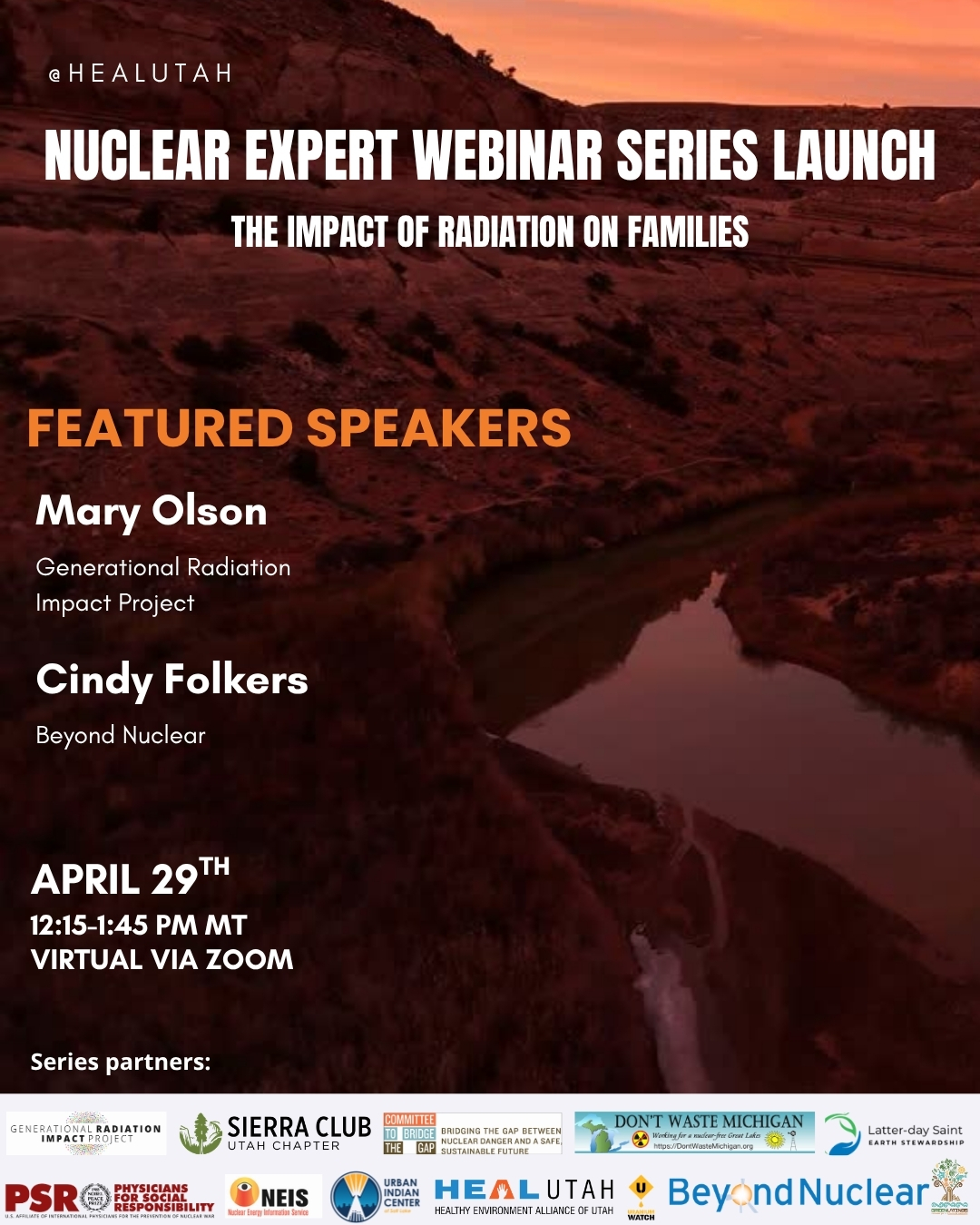
29 April – Nuclear Expert Webinar #1 – Radiation Impacts on Families with Mary Olson and Cindy Folkers
- 12:15 PM MT – 1:45 PM MT
- Location: Virtual – REGISTER TODAY

4 May -West Suburban Peace Coalition to discuss Iran war at May Educational Forum
Monday, May 4, 7:00 – 8:00 PM Central Standard Time
Title: : How Trump’s Narrative Tries to Shape the Reality of the War on Iran.
Contact Walt Zlotow, zlotow@hotmail.com 630 442 3045 for further information
14 May – online event From Bombs to Data Centres: the Face of Nuclear Colonialism


Pine Ridge Uranium is the real threat, not Tehran- Tell Burgum: Stop the Extraction.
Chernobyl: The Lost Tapes – A good documentary on Chernobyl on SBS available On Demand for the next 3 weeks– https://www.sbs.com.au/ondemand/tv-program/chernobyl-the-lost-tapes/2352741955560
To see nuclear-related stories in greater depth and intensity – go to https://nuclearinformation.wordpress.com
-
Archives
- April 2026 (288)
- March 2026 (251)
- February 2026 (268)
- January 2026 (308)
- December 2025 (358)
- November 2025 (359)
- October 2025 (376)
- September 2025 (257)
- August 2025 (319)
- July 2025 (230)
- June 2025 (348)
- May 2025 (261)
-
Categories
- 1
- 1 NUCLEAR ISSUES
- business and costs
- climate change
- culture and arts
- ENERGY
- environment
- health
- history
- indigenous issues
- Legal
- marketing of nuclear
- media
- opposition to nuclear
- PERSONAL STORIES
- politics
- politics international
- Religion and ethics
- safety
- secrets,lies and civil liberties
- spinbuster
- technology
- Uranium
- wastes
- weapons and war
- Women
- 2 WORLD
- ACTION
- AFRICA
- Atrocities
- AUSTRALIA
- Christina's notes
- Christina's themes
- culture and arts
- Events
- Fuk 2022
- Fuk 2023
- Fukushima 2017
- Fukushima 2018
- fukushima 2019
- Fukushima 2020
- Fukushima 2021
- general
- global warming
- Humour (God we need it)
- Nuclear
- RARE EARTHS
- Reference
- resources – print
- Resources -audiovicual
- Weekly Newsletter
- World
- World Nuclear
- YouTube
-
RSS
Entries RSS
Comments RSS
 nuclear-news