Coronavirus: Tokyo 2020 Olympics could be postponed?
 Seiko Hashimoto says Tokyo 2020 organisers are “doing all we can” to make sure the Games go ahead as planned
Coronavirus: Tokyo 2020 could be postponed to end of year – Japan’s Olympic minister
March 3, 2020
Japan’s Olympic minister says the Tokyo 2020 Games could be postponed from the summer until later in the year amid fears over the coronavirus outbreak.
In a response to a question in Japan’s parliament, Seiko Hashimoto said Tokyo’s contract with the International Olympic Committee (IOC) “calls for the Games to be held within 2020”.
She added that “could be interpreted as allowing a postponement”.
The Games are due to be held from 24 July to 9 August.
“We are doing all we can to ensure that the Games go ahead as planned,” Hashimoto added.
Under the hosting agreement the right to cancel the Games remains with the IOC.
IOC president Thomas Bach says his organisation remains “very confident with regard the success” of the Games in Tokyo.
“I would like to encourage all the athletes to continue their preparations with great confidence and full steam,” added the German.
A number of high-profile sporting events have already been cancelled or postponed as a result of the coronavirus outbreak, including the World Athletics Indoor Athletics Championships and the Chinese Grand Prix, which was scheduled for 19 April.
Coronavirus, which originated in China, has spread to more than 60 countries and claimed more than 3,000 lives so far.
The IOC executive board met in Lausanne, Switzerland on Tuesday and in a statement “expressed its full commitment to the success of the Olympic Games Tokyo 2020 taking place from 24 July to 9 August”.
It said a “joint task force” was started in mid-February, involving the IOC, Tokyo 2020 organisers, the host city of Tokyo, the government of Japan and the World Health Organization.
The executive board added that it “appreciates and supports the measures being taken, which constitute an important part of Tokyo’s plans to host safe and secure Games”.
“We will continue to support the athletes and their NOCs with regular updates of information, which we will provide,” Bach added.
 The Olympic rings outside the International Olympic Committee headquarters in Lausanne, Switzerland, where leaders discussed the Tokyo Games and the threat of the coronavirus outbreak
Japanese official raises possibility of postponing 2020 Summer Olympics
March 3, 2020
Even as Olympic leaders reiterated their confidence that the coronavirus outbreak will not force the cancellation of the upcoming 2020 Tokyo Games, a Japanese official suggested the host city has a contractual right to postpone the competition until the end of the year.
The dueling pronouncements came Tuesday as the International Olympic Committee’s executive board convened for a regularly scheduled meeting in Lausanne, Switzerland. Board members devoted much of the day to discussions on the matter.
“We remain very confident with regard to the success of these Olympic Games,” IOC President Thomas Bach said.
Half a world away, a question in the Japanese parliament prompted that country’s Olympic minister to discuss nuances of the contract that all host cities must sign when they are awarded the Games.
“The IOC has the right to cancel the Games only if they are not held during 2020,” Seiko Hashimoto told parliament, according to the Associated Press. “This can be interpreted to mean the Games can be postponed as long as they are held during the calendar year.”
Hashimoto added that officials “are making the utmost effort so that we don’t have to face that situation.”
Since the COVID-19 virus was detected in China late last year, more than 92,000 people have been infected and 3,100 have died worldwide. Still, as of early Tuesday, the World Health Organization had yet to classify the outbreak as a pandemic because it has severely affected only a handful of countries.
Some health experts have questioned the wisdom of holding any mass public gathering in light of the outbreak; others have said it is too early to make any such decisions,
The modern Olympics have been canceled only three times, during the first and second World Wars. In other instances, they have endured through various concerns, including the spread of the Zika virus around the time of the 2016 Summer Games in Rio de Janeiro.
This time, there is concern because the coronavirus has caused events such as international soccer games and a major car race to be postponed, moved or canceled.
Tokyo is expecting more than 10,000 athletes and an estimated 600,000 tourists from around the globe. Organizers have devoted billions of dollars to venue construction and other preparations but would likely have insurance to cover cancellation for unforeseeable reasons.
American broadcasters said Tuesday they also would be covered in case of cancellation.
“We try to anticipate for big events what might happen so that we’re protected there, and we also have insurance for any expenses we make,” Comcast chairman Brian Roberts, adding: “We’re optimistic the Olympics are going to happen.”
As for postponement, any date later this year or into 2021 could conflict with world championships and other competitions already scheduled. There is an additional, historical perspective.
The Spanish flu pandemic of 1918 was relatively light when it first appeared during the winter and spring. But after a dormant summer, it returned with greater force in the fall, ultimately infecting as many as 500-million people and killing 20 million to 50 million worldwide.
Last month, the IOC formed a task force that includes representatives from the WHO, the Tokyo 2020 organizing committee and the Japanese government.
“Of course we will continue this regular consultation with this joint task force to be able to address any developments which may occur,” Bach said.
Olympic leaders dismissed suggestions of a postponement, repeating their expectation that the Tokyo Games will begin as scheduled on July 24.
“You can come up with all sorts of speculation, all sorts of doomsday scenarios,” IOC spokesman Mark Adams told reporters. “We would prefer to stick to the advice from the experts.”
Japan pushes to remove Fukushima references from U.N. exhibition
 Protesters hold placards during a demonstration against the Olympics, Prime Minister Shinzo Abe and nuclear energy, near the crippled Fukushima No. 1 nuclear power plant on Feb. 29, 2020.
Mar 3, 2020
The Foreign Ministry has pushed for references to the Fukushima nuclear disaster to be removed from an upcoming exhibition at the United Nations, an anti-nuclear group said Tuesday.
The Japan Confederation of A- and H-Bomb Sufferers Organizations is slated to mount the exhibition during the review conference for the Nuclear Non-Proliferation Treaty from April 27 to May 22.
The ministry, which has supported the confederation’s three previous exhibitions, suggested it could withdraw its backing unless the requested changes are made, said Sueichi Kido, the group’s secretary general.
The exhibition in the lobby of the U.N. headquarters in New York will consist of around 50 panels mainly describing the horrors of nuclear weapons, including the aftermath of the 1945 atomic bombings of Hiroshima and Nagasaki.
Two of the panels will touch on the nuclear disasters at the Fukushima No. 1 power plant in 2011 and Ukraine’s Chernobyl power plant in 1986.
According to Kido, the ministry argues the panels contradict the spirit of the nonproliferation treaty, which allows for the peaceful use of nuclear technology.
A ministry official said its support for the exhibition was under review and declined to confirm whether any pressure had been applied to change its content.
Kido said there had been a “breach of trust” and the confederation, which represents survivors of the atomic bombings, plans to hold the exhibition as planned with or without the ministry’s support.
“Atomic bombs and nuclear accidents are the same in the sense that they cause harm through radiation. As a victim of atomic bombing, Japan has a responsibility to work toward the elimination of nuclear weapons,” Kido added.
In Fukushima, Olympic torch relay faces cool welcome from nuclear evacuees

March 2, 2020
FUTABA, Japan (Reuters) – Dressed in protective plastic coveralls and white booties, Yuji Onuma stood in front of the row of derelict buildings that included his house, and sighed as he surveyed his old neighborhood.
On the once-bustling main street, reddish weeds poked out of cracked pavements in front of abandoned shops with caved-in walls and crumbling roofs. Nearby, thousands of black plastic bags filled with irradiated soil were stacked in a former rice field.
“It’s like visiting a graveyard,” he said.
Onuma, 43, was back in his hometown of Futaba to check on his house, less than 4 kilometers from the Fukushima nuclear power plant, which suffered a triple meltdown in 2011 following an earthquake and tsunami, leaking radiation across the region.
The authorities say it will be two more years before evacuees can live here again, an eternity for people who have been in temporary housing for nine years. But given the lingering radiation here, Onuma says he has decided not to move back with his wife and two young sons.
Most of his neighbors have moved on, abandoning their houses and renting smaller apartments in nearby cities or settling elsewhere in Japan.
Given the problems Futaba still faces, many evacuees are chafing over the government’s efforts to showcase the town as a shining example of Fukushima’s reconstruction for the 2020 Tokyo Olympics.
While there has been speculation that the global spread of the coronavirus that emerged in China last month might force the cancellation of the Olympics, Japanese officials have said they are confident the Games will go ahead.
The Olympic torch relay will take place in Fukushima in late March – although possibly in shortened form as a result of the coronavirus, Olympic organizers say – and will pass through Futaba. In preparation, construction crews have been hard at work repairing streets and decontaminating the center of town.
“I wish they wouldn’t hold the relay here,” said Onuma. He pointed to workers repaving the road outside the train station, where the torch runners are likely to pass. “Their number one aim is to show people how much we’ve recovered.”
He said he hoped that the torch relay would also pass through the overgrown and ghostly parts of the town, to convey everything that the 7,100 residents uprooted of Futaba lost as a result of the accident.
“I don’t think people will understand anything by just seeing cleaned-up tracts of land.”
“UNDER CONTROL”
In 2013, when Prime Minister Shinzo Abe was pitching Tokyo as the host of the 2020 Games to International Olympic Committee members, he declared that the situation at the Fukushima nuclear plant was “under control”.
The Games have been billed as the “Reconstruction Olympics” – an opportunity to laud Japan’s massive effort to rebuild the country’s northeastern region, ravaged by the earthquake and tsunami, as well as the meltdowns at the nuclear plant owned by Tokyo Electric Power Co.
After the disaster, the government created a new ministry to handle reconstruction efforts and pledged 32 trillion yen ($286.8 billion) in funding to rebuild affected areas.
 Yuji Onuma, an evacuee from Futaba Town near tsunami-crippled Fukushima Daiichi nuclear power plant, walks next to a collapsed shop on the street in Futaba Town, inside the exclusion zone around the plant, Fukushima Prefecture, Japan February 20, 2020.
Signs of the reconstruction efforts are everywhere near the plant: new roads have been built, apartment blocks for evacuee families have sprouted up, and an imposing tsunami wall now runs along the coastline. An army of workers commutes to the wrecked plant every day to decommission the reactors.
In March, just days before the Olympic relay is scheduled to be held across Fukushima, Japan will partially ease a restriction order for Futaba, the last town that remains off-limits for residents to return.
This means that residents like Onuma will be able to freely come and go from the town without passing through security or changing into protective clothing. Evacuees will still not be able to stay in their homes overnight.
After a few years bouncing between relatives’ homes and temporary apartments, Onuma decided to build a new house in Ibaraki, a nearby prefecture. His two sons are already enrolled in kindergarten and primary school there.
“You feel a sense of despair,” said Onuma. “Our whole life was here and we were just about to start our new life with our children.”
When Onuma was 12, he won a local competition to come up with a catchphrase promoting atomic energy. His words, “Nuclear Energy for a Brighter Future” was painted on an arch that welcomed visitors to Futaba.
After the nuclear meltdowns, the sign was removed against Onuma’s objections.
“It feels like they’re whitewashing the history of this town,” said Onuma, who now installs solar panels for a living.
The organizing committee for the Tokyo 2020 Olympics did not respond to requests for comment from Reuters.
“BACK BURNER”
Other residents and community leaders in nearby towns say the Olympics may have actually hindered the region’s recovery.
Yasushi Niitsuma, a 60-year-old restaurant owner in Namie, said the Olympics stalled local reconstruction projects because of surging demand and costs to secure workers and materials ahead of the games in Tokyo.
“We need to wait two years, three years to have a house built because of the lack of craftsmen,” said Niitsuma. “We are being put on the back burner.”
Fukushima’s agriculture and fisheries industries have also been devastated.
“I was astonished by the “under control” comment made in a pitch to win the Olympic Games,” said Takayuki Yanai, who directs a fisheries co-op in Iwaki, 50 kilometers south of the nuclear plant, referring to Abe’s statement.
“People in Fukushima have the impression that reconstruction was used as a bait to win the Olympic Games.”
A government panel recently recommended discharging contaminated water held at the Fukushima plant to the sea, which Yanai expects to further hurt what remains of the area’s fisheries industry.
At a recent news conference, Reconstruction Minister Kazunori Tanaka responded to a question from Reuters about criticism from Fukushima evacuees.
“We will work together with relevant prefectures, municipalities and various organizations so that people in the region can take a positive view,” he said, referring to the Olympics.
Local officials also say they are making progress for the return of residents to Futaba.
“Unlike Chernobyl, we are aiming to go back and live there,” Futaba Mayor Shirou Izawa said in an interview, calling the partial lifting of the evacuation order a sign of “major progress”.
There were a lot of misunderstandings about the radiation levels in the town, including the safety of produce and fish from Fukushima, Izawa said.
“It would be great if such misunderstanding is dispelled even a little bit,” he said.
Radiation readings in the air taken in February near Futaba’s train station were around 0.28 microsieverts per hour, still approximately eight times the measurement taken on the same day in central Tokyo.
Another area in Futaba had a reading of 4.64 microsieverts per hour on the same day, meaning a person would reach the annual exposure upper limit of 1 millisievert, recommended by the International Commission on Radiological Protection, in just nine days.
Despite the official assurances, it’s hard to miss the signs of devastation and decay around town.
The block where Takahisa Ogawa’s house once stood is now just a row of overgrown lots, littered with concrete debris. A small statue of a stone frog is all that remains of his garden, which is also scattered with wild boar droppings.
He finally demolished his house last year after he failed to convince his wife and two sons to return to live in Futaba.
Ogawa doubts any of his childhood friends and neighbors would ever return to the town.
“I’ve passed the stage where I’m angry and I’m resigned,” he said.
In pre-Olympics propaganda, Japan’s govt opens just 4% of Futaba town
 Japan opens part of last town off-limits since Fukushima nuclear disaster, Japan Times, AP, JIJI, MAR 4, 2020 The government on Wednesday opened part of the last town that had been off-limits due to radiation since the Fukushima nuclear disaster nine years ago, in a symbolic move to show the region’s recovery ahead of the Tokyo Olympics.
The entire population of 7,000 was forced to evacuate Futaba after three reactors melted down, when the nuclear plant in the town was damaged by a magnitude 9 earthquake and tsunami on March 11, 2011.
The partial lifting of the entry ban comes weeks before the Olympic torch is carried through another town in Fukushima. The torch could also pass through Futaba, about 4 kilometers (2.4 miles) from the wrecked nuclear plant.
The town also saw the first easing of the evacuation order that was issued after the nuclear disaster. The move also marked the first such loosening of restrictions for a “difficult-to-return” zone with relatively high radiation levels.
Unrestricted access, however, is only being allowed to an area in the northeastern part of Futaba, or 4 percent of the town’s total area, as well as difficult-to-return zones around Futaba Station on East Japan Railway Co.’s Joban Line. The station will reopen later this month to reconnect it with the rest of the region for the first time since the accident. Access to the vast majority of Futaba is restricted to those who can secure permission for a day visit.
The three reactor meltdowns at the town’s Fukushima No. 1 nuclear power plant caused the release of massive amounts of radiation that contaminated the surrounding area and, at the disaster’s peak, forced more than 160,000 people to flee.
At midnight on Tuesday, the gate at a checkpoint was opened, and Futaba officials also placed a signboard at their new town office……
Town officials say they hope to see Futaba’s former residents return, but prospects are grim because of lingering concern about radiation. Many residents also found new jobs and ties in other communities after evacuating, and only about 10 percent say they plan to return.
The number of residents registered in Futaba has already decreased by 1,000 from the town’s pre-disaster population of 7,000. After long bus trips, stopovers and time spent staying in shelters at an athletic arena and an abandoned high school, many evacuees ended up remaining in the city of Kazo, Saitama Prefecture. Futuba’s government reopened in a makeshift office in Iwaki, another Fukushima town…….. https://www.japantimes.co.jp/news/2020/03/04/national/japan-opens-part-of-futaba-fukushima/#.XmANQKgzbIU
Japan won’t back U.N. exhibition unless Fukushima references removed, hibakusha say
|
Japan won’t back U.N. exhibition unless Fukushima references removed, hibakusha say https://www.japantimes.co.jp/news/2020/03/04/national/japan-pushes-remove-fukushima-references-u-n-exhibition/#.XmAll6gzbIUKYODO The Foreign Ministry has said it may withdraw its backing for an upcoming exhibition at the United Nations unless references to the Fukushima nuclear disaster are removed, a group representing hibakusha has said.
The Japan Confederation of A- and H-Bomb Sufferers Organizations is set to mount the exhibition during the review conference for the Nuclear Non-Proliferation Treaty, from April 27 to May 22. The ministry, which has supported the confederation’s three previous exhibitions, suggested it could halt such support unless the requested changes are made, said Sueichi Kido, the group’s secretary general. The exhibition in the lobby of the U.N. headquarters in New York will consist of around 50 panels mainly describing the horrors of nuclear weapons, including the aftermath of the 1945 atomic bombings of Hiroshima and Nagasaki. Two of the panels will touch on the nuclear disasters at the Fukushima No. 1 power plant in 2011 and Ukraine’s Chernobyl power plant in 1986. According to Kido, the ministry claims the panels contradict the spirit of the nonproliferation treaty, which allows for the peaceful use of nuclear technology. A ministry official said its support for the exhibition was under review and declined to confirm whether any pressure had been applied to change its content. Kido said there had been a “breach of trust” and that the confederation, which represents survivors of the atomic bombings, plans to hold the exhibition as planned with or without the ministry’s support. “Atomic bombs and nuclear accidents are the same in the sense that they cause harm through radiation. As a victim of atomic bombing, Japan has a responsibility to work toward the elimination of nuclear weapons,” Kido added. |
|
France starts a series of nuclear power shutdowns
|
France begins winding down its reliance on nuclear powerFrance began shutting down its oldest nuclear plant last month after 43 years of operation, the first in a series of closures the government has proposed though the the country won’t altogether abandon its reliance on nuclear power. Bellona March 4, 2020 by Charles Digges
France began shutting down its oldest nuclear plant last month after 43 years of operation, the first in a series of closures the government has proposed though the the country won’t altogether abandon its reliance on nuclear power. Yet the closure of the two reactors at the Fessenheim plant along the Rhine River on France’s border with Switzerland and Germany, is part of a broad energy strategy to rely more on renewable energy sources. That strategy would see French dependence on nuclear energy from supplying three-quarters of its electricity to about half by 2035. The shutdown has also been a key goal of anti-nuclear campaigners since the Fukushima disaster in 2011. Experts have noted that the reactors at Fessenheim, brought online in 1977, fall far short of even those reactors at Fukushima, with some warning that seismic and flooding risks in the Alsace region have been underestimated. Prime Minister Edouard Philippe says the plant’s second reactor will be shut down in June 30 – though it will be several months before both reactors go cold and their used fuel can start to be removed. Another dozen reactors that will soon exceed their 40-year age limit must close by 2035 to meet the phase-down target. The plan also sees France closing its remaining coal plants, and moving to renewables like solar and wind to close the energy gap and help fight climate change. But at the same time, state-owned energy giant EDF is racing to get its first next-generation reactor running at the Flamanville plant in 2022– already 10 years behind schedule – and more may be in the pipeline. France’s history with nuclear power runs deep. The country runs 58 nuclear power plants, which sprang up largely as a response to the oil crisis in the 1970s. Those were built on the foundation of the CEA atomic energy commission, which was established in the wake of World War II in an effort to reestablish the nation’s sovereignty. Activists like Charlotte Mijeon, who is the spokesperson for the anti-nuclear group Sortir du nucléaire, told Voice of America news the Fessenheim closure is welcome news, but contended it doesn’t go far enough. “The government is closing one nuclear power plant, but it should not make us forget that the rest of the nuclear fleet is aging,” she told the agency. She also pointed to the huge subsidies nuclear power receives from the government, which they say makes it difficult for renewable power to compete……… France’s long insistence on using nuclear power has irritated Germany and Switzerland, which, as minority shareholders in Fessenheim, have long urged its shutdown. Germany also has plans of its own to phase out its nuclear power plants completely, a task it says it will finish by 2022. Polls among the French show growing resistance to nuclear power, with one survey taken in 2018 showing 53 percent of the population against the technology. https://bellona.org/news/nuclear-issues/2020-03-france-begins-winding-down-its-reliance-on-nuclear-power |
|
Flinders University, South Australia: collusion with nuclear power promotion, Prof Pam Sykes, and the scam of “hormesis”

The Industry Push to Force Nuclear Power in Australia, Part 1 of A Study of the “Report of the inquiry into the prerequisites for nuclear energy in Australia” Australian Parliamentary Committee 2020.by nuclearhistory, February 29, 2020“………….The most recent nuclear collaboration between Australia and a nuclear power for nuclear purposes commenced in the year 2000. At that time a US Department of Energy Contractor named Bobby Scott, based at Los Alamos and at Lovelace Respiratory Research Laboratory, New Mexico, came to Adelaide carrying contract documents. The documents were to be signed by the US DOE and involved personnel of Flinders University. Bobby Scott is a well known (to people in the field) as a leading advocate for the theory of radiation hormesis. The contract to be signed was the first of a number. From the time of the signing of that contract, Flinders University engaged in very strong advocacy of the expansion of nuclear industry in South Australia. Prof Pam Sykes was flown from Adelaide to Los Almos and undertook training and seminars in Hormesis. The concept that radioactive substances are, in her words, “like vitamins”.
I have fully explained that this unproven theory flies in the face of reality in terms of radiological safety and data from monitoring of dose and disease all over the world, including, contrary to the claims of the school hormesis, the naturally high background radiation regions of Iran and India. In those parts of Iran and India, (the five northern provinces in Iran, and Kerala in India) some cancer rates are among the highest in the world. Further, in those Iranian provinces breast cancer in teenage women is more common than it is even in the West. And so on. There are five types of cancer in northern Iran which have very high rates. In south western Kerala, the rates of female thyroid cancer is very, very high.
Contrary the to statements made by the school of hormesis, headquartered at Los Alamos, USA and Flinders University Adelaide. From 2000 on, Flinders University promoted the idea of radioactive substances such as uranium and its decay products and the fission products as being “like vitamins”, necessary for life. By 2011 the university was promoting the idea that an expansion of the state’s uranium mines would be good for the health of South Australians, because the natural background here is “too low” for good health. Presumably the transport of tons of additional uranium ore by train from the mines to the ports in open railway trucks would result in faint clouds of radionuclide “vitamins” being dispersed over the whole population of the state in precisely the right theoretical dose, taking into account, somehow, automatically, the age, gender and health status of each South Australian. (I didn’t write what Sykes did, so don’t blame me.). In 2011 the US DOE funded Flinders University put its pedal to the metal and flew into the debate, labelling South Australians who disagreed with it’s position in words which were insulting and which labelled us as lunatics, radiophobes and totally ignorant of radiological safety principles, cowardly, and devoid of reason. Read it here: https://news.flinders.edu.au/blog/2011/07/14/radiation-response-a-meltdown-in-reason/
Marshall islanders continue their fight for nuclear justice
Fight for nuclear justice continues in the Marshall Islands https://www.rnz.co.nz/international/pacific-news/410871/fight-for-nuclear-justice-continues-in-the-marshall-islands 3 March 2020
The fight for nuclear justice continues in the Marshall Islands where people have been gathering to call for the US to atone for its legacy of testing.The country marked National Nuclear Victims Remembrance Day on Monday, the 64th anniversary of the Castle Bravo hydrogen bomb test that exposed thousands of people to downwind effects.At a ceremony in the capital, Majuro, a tribute was paid to 22 living survivors from the communities affected by the nuclear testing.
This comes as the Marshall Islands and the United States have begun preliminary talks on a new agreement to address the legacy of testing.
The compact of free association, which guarantees relations and funding for the Marshalls from the US, expires in two years.
Last year, it was revealed the US withheld information about nuclear waste it left behind when the Marshalls gained independence, and the extent of the tests it carried out.
Washington previously said there would be no replacement compact. But the chair of the Marshall Islands Nuclear Commission, Rhea Moss-Christian, said nuclear issues were a key, ongoing aspect of negotiations.
“Well we are coming up on renegotiating the economic provisions of the compact, and we’ve had some initial discussions with the US officials.
“So yes internally we are working on our strategy and pulling together all the key issues to include in those negotiations, including the nuclear legacy.”
Ms Moss-Christian, who said formal talks should start later in the year, vowed that the fight for nuclear justice for Marshall Islanders would continue.
“Really it comes down to compensation for loss of land. It’s about health care for those who might be having medical issues,” she said.
“It’s about livelihoods and how much their lifestyles were forced to change when they were moved from their land. These are just a few examples.”
Meanwhile, an essay competition for high schoolers was held as part of Monday’s commemoration programme.
The winner was a senior at Marshall Islands High School on Majuro, Rosie Ammontha, who wrote:
“They had the choice to test those bombs, we didn’t. They had the choice to be truthful about the consequences that awaited us, we didn’t. They had the choice not to endanger innocent lives, we didn’t. They had the choice to help protect our oceans and environment, we didn’t. At the end of the day, nuclear justice means righting what was wronged.”
India retains its nuclear weapons no-first-use policy
There has been no change in India’s nuclear doctrine, the Ministry of External Affairs (MEA) said on March 4.
Responding to a question in the Lok Sabha, Minister of State for External Affairs V. Muraleedharan said India is committed to maintaining credible minimum deterrence and the policy of no-first use of nuclear weapons.
There has been no change in India’s nuclear doctrine,” he said.
Strange turnaround for South Africa’s EFF leader Julius Malema – nuclear best for blacks, renewables for white elites??
Malema goes nuclear on Eskom’s future, Daily Maverick, By Ferial Haffajee• 1 March 2020 Twice in the past month, EFF leader Julius Malema has used high-profile platforms to bat for nuclear energy as a key plank of South Africa’s energy planning. It’s a clear U-turn for the populist leader who was for years vehemently opposed to Zuma’s proposed nuclear deal with Russia.
On Friday, capping a march of thousands of supporters to the Eskom HQ, EFF leader Julius Malema handed over a memorandum to CEO Andre de Ruyter.
In it, he stated a demand he had first made in February in his debate on the state of the nation:
“Eskom should build nuclear power stations using a build, operate and transfer model with a clear illustration of how the private sector will use their money, operate them for an agreed period, transfer operation and maintenance skills to state-employed engineers, artisans, electricians and other skills needed to operate a nuclear power station.”
In his speech in the pouring rain outside Eskom, Malema did not mention nuclear energy, but it is a prominent part of the three-page memorandum, now in Eskom’s hands.
The red sea of EFF marchers who marched for nine kilometres from the Innes Free Park to Megawatt Park signals that Malema and the EFF have entered the energy battle as key protagonists. He appears to now be the political leader of a loose coalition of interests pushing for nuclear energy procurement, the maintenance of coal as a key feedstock for the national grid as well as a slowdown in the pace of renewable energy production.
This places Malema in clear opposition to the “green revolution” pledged by President Cyril Ramaphosa in his 2019 State of the Nation Address and the much larger role for the private sector in energy production outlined by Finance Minister Tito Mboweni in #Budget2020 last week. ….
Nuclear — the black option?
Malema and his deputy president Floyd Shivambu have been long-term opponents of independent power producers selling renewable energy in bid windows opened by Eskom.
There is a growing view across the EFF and sections of the ANC that nuclear is a “black option” for energy professionals who want in on a new market while “renewable energy” is dominated by white capital, in South Africa’s race short-hand.
The reason for this is that the first bid windows featured many European and US multinational companies making a gambit for some of what were then the biggest renewable energy deals in the developing South and also among the most expensive.
Malema’s audacious Eskom march on Friday also revealed a new political front opening up in the energy wars. The EFF aligned with Transform RSA, the movement led by nuclear energy proponent Adil Nchabeleng who is the most prolific and powerful mover behind the lobby opposing renewable energy procurement by Eskom. Nchabeleng was on the EFF stage on Friday; he is also well regarded in the ANC…….
Rosatom, the Russian nuclear agency, uses a build, operate and transfer model across the continent where it has enjoyed great success in getting deals from African leaders.
In addition, it also provides the start-up capital for nuclear power stations in vendor financing deals. Rosatom was close to signing an estimated R1-trillion deal which was strongly punted by former president Jacob Zuma who fired two finance ministers for slow-footing his nuclear ambitions. The company is still hoping South Africa will see the light on energy.
Zuma almost achieved the deal with Russia, but it was stopped in court when Judge Lee Bozalek in April 2017 ruled in favour of the case brought by Earthlife Africa Johannesburg and the Southern African Faith Communities’ Environment Institute (Safcei) against government’s plans to build a fleet of nuclear power stations.
In 2016, Malema set his stall against the nuclear deal. …..
SA’s IRP downgrades nuclear
The pro-nuclear lobby has lost governing party political influence in South Africa – the integrated resource plan launched by Mineral Resources and Energy minister Gwede Mantashe in late 2019 suggested a limited role for nuclear in the future.
It now appears to have powerful new friends in the EFF which has switched its opposition to nuclear power to active support.
While the pro-nuclear, anti-renewables energy lobby says the costs of nuclear are more competitive, the cost of water, solar and other power is steadily coming down. Coal-fired power stations are also quickly losing investor interest as financiers turn away from fossil fuels.
Daily Maverick approached two EFF spokespersons for comment, but did not get a response. DM https://www.dailymaverick.co.za/article/2020-03-01-malena-goes-nuclear-on-eskoms-future/
Catholic prelate calls on President Duterte to reject nuclear energy
By Leslie Ann Aquino A Catholic prelate has called on President Duterte to reject the proposal to use nuclear energy in the country.
“I am greatly concerned with the proposed Executive Order that is said to be drafted by (Department of Energy or DOE) Secretary Al Cusi which would include nuclear power in our energy mix,” San Carlos Bishop Gerardo Alminaza said in a statement.
“We urge President Duterte not to sign this Executive Order and instead remind Sec. Cusi to make renewable energy our primary source of electricity.”
The vice chairman of the Catholic Bishops’ Conference of the Philippines National Secretariat for Social Action (CBCP-NASSA) said the disasters in Chernobyl, Three Mile Island, and Fukushima are “sorrowful reminders” of the risks of nuclear power that Filipinos need not be exposed to.
The prelate asked Duterte to stand firm on his previous directive to the DOE to promote renewable energy, which is a cheaper and safer source of energy.
“We hope and pray that President Duterte will not turn back on his word in the 2019 SONA (State of the Nation Address) which charged the DOE with the task of promoting renewable energy,” Alminaza said.
“This is what would truly be beneficial for our people, and would also serve as a concrete act of care for our Common Home.”
On Tuesday, Presidential Spokesperson Salvador Panelo told reporters that Duterte will be studying the proposed inclusion of nuclear power in the Philippines’ energy mix.
Nuclear power a very bad option for the Philippines
Greenpeace: Proposal to add nuclear to country’s energy mix ‘plain irresponsible, irrational’ Gaea Katreena Cabico (Philstar.com) – March 4, 2020 MANILA, Philippines — The inclusion of nuclear power in the Philippines’ energy mix will only bring more problems and debt to Filipinos, an environmental organization said as it urged the government to reject the proposal of the Energy department.
Energy Secretary Alfonso Cusi sought President Rodrigo Duterte’s nod for a proposed executive order to add nuclear power to the country’s energy sources, Malacañang said Tuesday.Presidential spokesperson Salvador Panelo said Cusi claimed that tapping nuclear power can help solve the country’s energy gap.’
According to environmental group Greenpeace Philippines, there is no rational reason for the Energy department to push a nuclear power agenda.
“Nuclear power is the most dangerous source of electricity and throughout their life cycle, nuclear plants contribute significantly to climate change. In other parts of the world, nuclear facilities are being decommissioned and phased out from energy plan,” Greenpeace campaigner Khevin Yu said.
From the 1960s until the mid 1980s, Ferdinand Marcos adopted a nuclear energy program and built the Bataan Nuclear Plant, called by critics the “monster” of Morong town. It was mothballed after President Corazon Aquino assumed office in 1986 due to safety concerns.
Nuclear power a costly option
Yu also said that nuclear is the most costly option for power generation.
In 2003, the Massachusetts Institute of Technology estimated the cost of a plant without financing would be US$2,000 per kilowatt. In their updated study released in 2009, the estimated cost was at US$4,000.
“Nuclear power will bring more problems and debt to the Filipino people,” Yu said, adding that pushing it as an energy source is “plain irresponsible and irrational.”
Safety concerns
Another big issue is the absence of safe and permanent storage of radioactive spent fuel, Yu said.
In 2018, Philippine Nuclear Research Institute Director Carlo Arcilla stressed the need to put forward radioactive waste management for discussion.
“It’s (nuclear power development) like putting up a mansion without toilets if you’re not talking of radioactive wastes,” Arcilla said then.
Duterte in 2018 said safety should be the priority when deciding whether to tap nuclear energy for the power needs of Filipinos.
Focus on renewable energy instead……https://www.philstar.com/headlines/2020/03/04/1998107/greenpeace-proposal-add-nuclear-countrys-energy-mix-plain-irresponsible-irrational
Trump picks nuclear envoy – Marshall Billingslea, formerly involved in torture program
 Trump picks official involved in Bush-era torture program as his nuclear envoy
- Marshall Billingslea oversaw Guantánamo detainees’ treatment
- Trump wants to negotiate new deal with Russia and China, Julian Borger in Washington, 5 Mar 2020 The Trump administration has chosen a special envoy for nuclear talks, with the principal task of negotiating a new arms control agreement with Russia and China, according to congressional sources and former officials. The proposed special negotiator, Marshall Billingslea, is currently the under-secretary for terrorist financing at the US Treasury. His nomination last year for a top human rights job at the state department was stalled by controversy over the extent of his involvement in the torture programme established by the George W Bush administration, in which he oversaw the conditions of detainees in Guantanamo Bay.
Neither the state department nor the Treasury responded to a request for comment, but congressional staffers and former officials said Billingslea had accepted the post.
The Trump administration has been trying to recruit a high-level arms control negotiator for several months, but several former Republican officials with significant experience in the field turned down the offer.
Billingslea, who has a long record as a hawk on nuclear weapons issues, faces a daunting task. Donald Trump wants to negotiate a new agreement to reduce the vast nuclear weapons arsenals of the major powers, to replace the New Start deal with Russia agreed by Barack Obama.
Trump wants China to be included in a new agreement but Beijing has so far refused on the grounds that the Chinese arsenal is a small fraction (estimated at about a 20th) of its US and Russian counterparts.Trump has accepted an invitation from Vladimir Putin to take part in talks on nuclear arms control and other strategic issues at a summit meeting of the five permanent members of the UN security council, most likely at the time of the UN general assembly in September.
One of Billingslea’s tasks would be to prepare for the summit, but in the absence of a major shift by China, he would have to advise Trump on whether or not to extend the New Start deal – the last nuclear arms control agreement to have survived the Trump era – as an interim measure. That is something the president is highly reluctant to do, because the 2010 agreement is part of the Obama legacy Trump has been eager to expunge.
Billingslea is a former aide to the late Republican senator Jesse Helms, who was a fervent opponent of arms control efforts during the cold war, for example blocking US ratification of the Comprehensive Test Ban Treaty, and campaigning for the US withdrawal from the Anti Ballistic Missile treaty. AT TOP https://www.theguardian.com/us-news/2020/mar/04/trump-nuclear-talks-envoy-marshall-billingslea
Tennessee Valley Authority violated whistleblower protections for nuclear workers
|
Federal regulators say TVA willfully violated safety standards in firing nuclear engineers, Chattanooga Times Free Press TVA disputes NRC findings, claims employee concerns program improving.by Dave Flessner March 3, 2020,The Tennessee Valley Authority improperly fired two nuclear engineers after they raised concerns about safety and management in TVA’s nuclear power program, according to federal regulators.
In a letter to TVA made public Tuesday, the head of regulatory enforcement at the U.S. Nuclear Regulatory Commission said TVA violated whistleblower protections for nuclear workers by disciplining and then dismissing the nuclear engineers who worked on programs at the Sequoyah and Watts Bar nuclear power plants. George A. Wilson, director the NRC’s Office of Enforcement, said “the actions taken against (by TVA) these former employees were in apparent violations (of NRC safety standards) and the apparent violations were willful” and “are being considered for escalated enforcement action,” which could include a civil penalty against TVA. The NRC did not identify the affected employees. But they are similar to concerns reviewed in an earlier U.S. Department of Labor finding that ordered TVA to rehire a nuclear engineer after she raised safety concerns and questioned the performance of her boss in TVA’s corporate nuclear program. Despite objections by TVA, the NRC said the engineers working on programs at the Sequoyah and Watts Bar nuclear plants were first subject to a harassment investigation, then placed on paid administrative leave and ultimately were discharged after raising concerns about safety problems and corporate nuclear licensing activities from 2015 to 2018. NRC has yet to issue a notice of violation, but a civil penalty for the violations could be forthcoming……….. The NRC finding comes after the U.S. Department of Labor ordered TVA earlier this year to reinstate nuclear engineer Beth Wetzel after she was fired for raising safety concerns and complaining about her boss. The Labor Department ordered TVA to give Beth Wetzel her job back and pay more than $200,000 in back pay, lost bonuses and benefits, compensatory damages and legal fees, according Department of Labor records obtained by the Knoxville News Sentinel. TVA spokesman Jim Hopson said the disputes in the DOL investigation were resolved, but he said under the agreement details of the settlement are not publicly disclosed…… Wetzel filed a series of nuclear safety complaints with Henderson and the NRC, including violations of worker fatigue rules, as part of her job, according to the Labor Department……. The NRC is continuing to inspect and evaluate the safety conscious work environment at all three of TVA’s nuclear sites after the regulatory agency found in 2016 that TVA had a “chilling” environment for worker concerns at its Watts Bar Nuclear Plant near Spring City, Tennessee. NRC cited TVA for the ongoing problem and confirmed the chilled work environment at TVA again in 2017. In 2018, TVA’s Inspector General also found that TVA was not adequately addressing nuclear safety concerns voiced by its workers. ……https://www.timesfreepress.com/news/business/aroundregion/story/2020/mar/03/federal-regulators-tva-violated-safety-standards/517214/ |
|
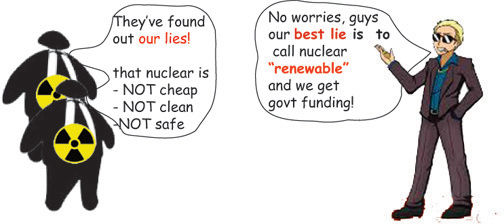
Bill in California to call nuclear power “renewable”!
|
Should California classify nuclear power as renewable? San Diego Union Tribune By ROB NIKOLEWSKI, MARCH 3, 2020
Although he admits it’s a long shot, a member of the California Legislature from the district that includes the Diablo Canyon nuclear plant has introduced a bill that would add nuclear power to the state’s list of renewable energy sources……..
Established in 2002, California’s Renewables Portfolio Standard spells out the power sources eligible to count toward the state’s goals to wean itself of fossil fuels. The list includes solar, wind, biomass, geothermal, small hydroelectric facilities and even tidal currents. The standard has been updated, currently calling for 60 percent of California’s electricity to come from renewables by 2030 and 100 percent from carbon-free sources by 2045. Nuclear power is not part of the portfolio standard and Diablo Canyon — the only remaining nuclear plant in California — is scheduled to stop producing electricity by 2025. Pacific Gas & Electric, the operators of Diablo Canyon, announced in 2016 an agreement with a collection of environmental and labor groups to shut down the plant. PG&E said Diablo will become uneconomical to run due to changes in California’s power grid — such as growth of renewable energy sources, increased energy efficiency measures and the migration of customers from traditional utilities to community choice energy programs. But Cunningham thinks the passage of Assembly Bill 2898, which he introduced last week, could give the plant literally a new lease on life…….. When told of Cunningham’s bill, David Weisman, outreach coordinator for the Alliance for Nuclear Responsibility, said flatly, “Diablo Canyon has become a burdensome, costly nuclear white elephant.” Critics say nuclear power by definition cannot be considered renewable because it leaves behind waste in the form of spent nuclear fuel that then has to be stored. The federal government has not found a site to deposit the waste that has built up over decades from commercial nuclear power plants……. https://www.sandiegouniontribune.com/business/energy-green/story/2020-03-03/should-california-count-nuclear-power-count-as-renewable |
|
1 This Month
26 April – Chernobyl: Inside the Meltdown airs on National Geographic on Sunday 26th April from 4pm

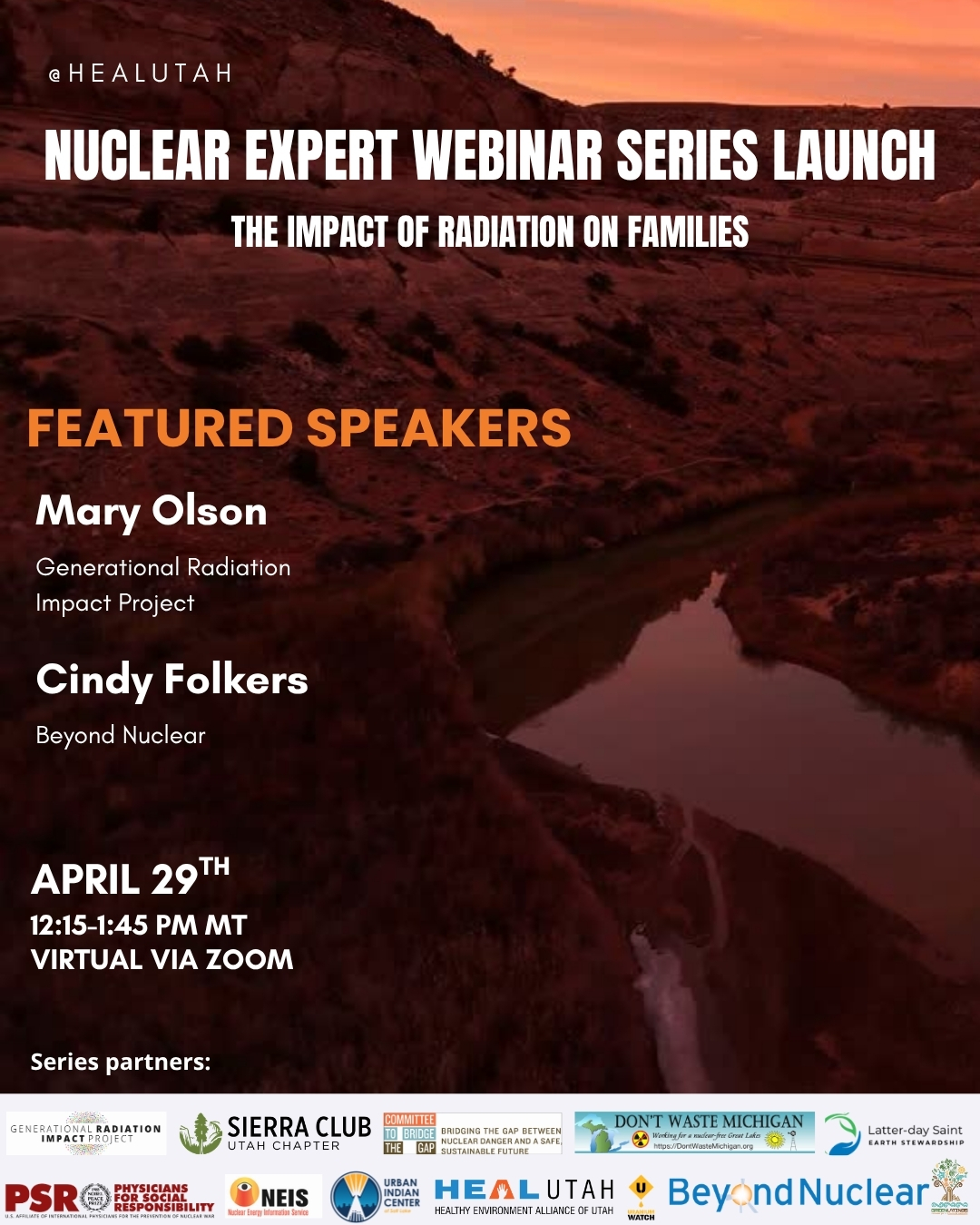
29 April – Nuclear Expert Webinar #1 – Radiation Impacts on Families with Mary Olson and Cindy Folkers
- 12:15 PM MT – 1:45 PM MT
- Location: Virtual – REGISTER TODAY

4 May -West Suburban Peace Coalition to discuss Iran war at May Educational Forum
Monday, May 4, 7:00 – 8:00 PM Central Standard Time
Title: : How Trump’s Narrative Tries to Shape the Reality of the War on Iran.
Contact Walt Zlotow, zlotow@hotmail.com 630 442 3045 for further information
14 May – online event From Bombs to Data Centres: the Face of Nuclear Colonialism

Pine Ridge Uranium is the real threat, not Tehran- Tell Burgum: Stop the Extraction.
Chernobyl: The Lost Tapes – A good documentary on Chernobyl on SBS available On Demand for the next 3 weeks– https://www.sbs.com.au/ondemand/tv-program/chernobyl-the-lost-tapes/2352741955560
To see nuclear-related stories in greater depth and intensity – go to https://nuclearinformation.wordpress.com
-
Archives
- April 2026 (288)
- March 2026 (251)
- February 2026 (268)
- January 2026 (308)
- December 2025 (358)
- November 2025 (359)
- October 2025 (376)
- September 2025 (257)
- August 2025 (319)
- July 2025 (230)
- June 2025 (348)
- May 2025 (261)
-
Categories
- 1
- 1 NUCLEAR ISSUES
- business and costs
- climate change
- culture and arts
- ENERGY
- environment
- health
- history
- indigenous issues
- Legal
- marketing of nuclear
- media
- opposition to nuclear
- PERSONAL STORIES
- politics
- politics international
- Religion and ethics
- safety
- secrets,lies and civil liberties
- spinbuster
- technology
- Uranium
- wastes
- weapons and war
- Women
- 2 WORLD
- ACTION
- AFRICA
- Atrocities
- AUSTRALIA
- Christina's notes
- Christina's themes
- culture and arts
- Events
- Fuk 2022
- Fuk 2023
- Fukushima 2017
- Fukushima 2018
- fukushima 2019
- Fukushima 2020
- Fukushima 2021
- general
- global warming
- Humour (God we need it)
- Nuclear
- RARE EARTHS
- Reference
- resources – print
- Resources -audiovicual
- Weekly Newsletter
- World
- World Nuclear
- YouTube
-
RSS
Entries RSS
Comments RSS
 nuclear-news