EDF’s UK nuclear projects in doubt after Court of Audit report
EDF’s UK nuclear projects in doubt after Court of Audit report 13 JUL 2020 BY LEM BINGLEY
Japanese bishops’ anti-nuclear power book available in English
Japanese bishops’ anti-nuclear power book available in English, Crux, Catholic News Service, Jul 12, 2020 TOKYO — An English version of a book by Japan’s bishops appealing for the abolition of nuclear power is now available for free on the internet, reported ucanews.com.
Abolition of Nuclear Power: An Appeal from the Catholic Church in Japan is available as a PDF file on the website of the Catholic Bishops’ Conference of Japan.
The bishops wrote the book after Japan’s Fukushima Daiichi Nuclear Power Station suffered a serious accident including a meltdown after a 2011 earthquake and tsunami.
Nuclear power is essentially incompatible with the image of the earth as a symbiotic society, which Pope Francis shows in his encyclical “Laudato Si’,” the bishops say.
- The bishops concluded that nuclear power generation should be immediately abolished in the face of the insoluble dangers it presents, including widespread health damage to children.
They worked with researchers in various fields to explore the damage caused by the Fukushima accident, the technical and sociological limitations of nuclear power production, and ethical and theological considerations concerning it.
They said they believe that Japan, having suffered such a severe nuclear accident, has a responsibility to inform the world of the reality of the damage and to appeal for the abolition of nuclear power generation……..Once a severe accident occurs, they argue, nuclear power generation destroys the environment over a wide area for generations and damages the right to life and livelihood……. https://cruxnow.com/church-in-asia/2020/07/japanese-bishops-anti-nuclear-power-book-available-in-english/
New Mexico nuclear facility is bad news
|
New Mexico nuclear facility is bad news, https://lasvegassun.com/news/2020/jul/06/new-mexico-nuclear-facility-is-bad-news/ By Judy Treichel Monday, July 6, 2020 It may seem like good news in Nevada that an effort is underway in New Mexico to build a private storage facility for nuclear waste there.
But don’t be mistaken: This facility wouldn’t be an alternative to the disastrous Yucca Mountain nuclear waste repository. In fact, its existence depends on Yucca Mountain becoming an operating repository. That’s unacceptable, because the Nevada facility poses far too many risks for our state.
The license application for the New Mexico facility calls for it to operate over 40 years, after which the waste stored in it would go to Yucca Mountain. Twelve years ago, the Department of Energy submitted an application for a construction authorization and license to make Yucca Mountain the nation’s high-level nuclear waste repository. Two years later, in 2010, the department attempted to withdraw the application. It had determined that the plan was “unworkable” due to the opposition and unending resistance of the people of Nevada, but the court decided that the licensing process should proceed. It did, until funding ran out, and today those deliberations are on an indefinite hold. Now comes the New Mexico license application to the Nuclear Regulatory Commission, which in the opinion of the Nevada Nuclear Waste Task Force the commission should not have accepted with the assumption that Yucca Mountain would be an operating repository. We have submitted comments to that effect to the commission. During all of the time that Nevada has been fighting the Yucca Mountain proposal, we were repeatedly assured that we could place our trust in the commission because before any license was granted for construction or operation, a thorough and unbiased process would fully play out. We were told there was no reason for questioning the fairness of the commission’s licensing process. Nevadans have been accused of having a NIMBY (not in my backyard) attitude about nuclear waste — that we would be pleased if some other place were forced to host a repository instead of us. That is not true. We know that Yucca Mountain is unsuitable and should have been disqualified, and we have respected the democratic right of others to oppose dangers or threats where they live. Any siting of a facility that creates risk for the community should require informed consent, and the people of New Mexico do not consent. What we see happening with this so-called interim site is that it does not solve the nuclear waste problem. In fact it increases the risks by putting the waste on the roads and rails, and requiring it to be loaded and unloaded multiple times and transported more than once. Additionally, the only way a site can be considered “interim” is to know that the waste will leave, and the assumption here is that it will leave New Mexico and come to Nevada. The incentive for the company proposing to build the facility is purely financial — specifically, it’s to gain access to the $42 billion in the federal nuclear waste fund. An interim site does not increase or improve public safety, but rather does just the opposite. It creates one more nuclear waste site and provides more room at reactor sites for more waste. And it moves the waste closer to Nevada. A national high-level nuclear waste repository at Yucca Mountain is an overwhelmingly unsafe idea. Nevada residents, elected officials and people across the country living near transport routes know it. For 20 years, the Department of Energy studied the site and discovered — or were forced to admit — that there were conditions present that, according to their own guidelines, disqualified the site. If the licensing process ever restarts, how could we trust the Nuclear Regulatory Commission to fairly judge the science when it has previously assumed a licensed and operating repository at Yucca Mountain? Congress needs to reverse the action it took naming Yucca Mountain as the only site to be considered for a national repository, and take a fresh and fair look at nuclear waste disposal. Initiatives like the interim storage site in New Mexico are simply misguided and misleading diversions. Judy Treichel is executive director of the Nevada Nuclear Waste Task Force. |
|
Deeply flawed public consultation on Bradwell nuclear power plan: it should be suspended
 SPRU 9th July 2020, A public consultation on plans for the UK’s newest nuclear power station
is deeply flawed and should be suspended, according to two leading energy
policy experts. Professor Andrew Stirling and Dr Philip Johnstone say the
consultation into Bradwell B is invalid because the UK government has
repeatedly failed to make the case for nuclear in the face of its
ever-rising costs, slow lead times and poor value-for-money comparison to
renewables.
Unit (SPRU) at the University of Sussex Business School have criticised the
restrictive nature of the consultation’s scope which they argue excludes
crucial underlying questions over the rationale for building more nuclear
power stations in the UK. Prof Stirling and Dr Johnstone say the
consultation should resume only when the government publish a long-promised
rigorous justification for nuclear power compared to other low carbon
energy sources – something they argue it has failed to do for the past 17
years.
Maldon District Council Planning Committee does an about turn, now rejects Bradwell nuclear power project
BANNG 9th July 2020, Maldon District Council Planning Committee’s comprehensive rejection
today of the Chinese state-backed nuclear developer’s (CGN) application
for permission to undertake ground investigations came like a bolt from the
blue.
For so long a firm supporter of a new nuclear power station at
Bradwell, Maldon has done a complete volte-face.
Prof. Andy Blowers, Chair of the Blackwater Against New Nuclear Group (BANNG) commented: ‘From the
moment CGN revealed its plans just before lockdown it became clear the
Bradwell B project would be dead in the water. The massive scale of the
project which would totally overwhelm the Blackwater area and the Dengie
peninula has proved too much to stomach, even for those who were seduced by
the promise of thousands of jobs. The price, in terms of loss of
environment and wellbeing, was simply too high.’
But the project is also
being threatened by the political fallout in relations with China. Chinese
ambitions to build a new nuclear power station at Bradwell do not come
without serious risks to national security and the threat of Chinese
economic dominance over the UK’s sensitive infrastructure.
Suffolk coast – time to choose whether it is to be a nuclear or a renewable coast
East Anglian Daily Times11th July 2020, Green councillor Andrew Stringer says now is the time to choose if Suffolk will become the nuclear coast, or the renewable coast. “We are the first
to understand climate change, and the last that can do something about
it.”
This quote is not from a protestor trying to change the world by
non-violent direct action. These are the words of James Kelloway, the
energy intelligence manager for the National Grid. And right now Suffolk
needs all the energy intelligence we can get. We sit on the horns of a
dilemma. We have significant energy production resources in and around our
coast line.
And, perfectly understandably these resources are trying to
grow – not only to help meet the country’s energy needs but to face the
challenge of moving towards a low carbon economy. Governments in the past
have left us with a legacy of an unclear energy policy. Almost as if they
were trying to ride two horses at the same time. This conflict is playing
out in real time, right now on our Suffolk Coast. The choices we make now
leave less and less room for error.
We simply must deliver a low carbon
future in less than a decade, while the focus on value for money has never
been more crucial. If we are to continue with our current quality of life
let alone leave a legacy that allows us to thrive. If that challenge
wasn’t hard enough, this all plays out on a spectacular heritage coast.
https://www.eadt.co.uk/business/andrew-stringer-sizewell-c-opinion-1-6741099
How to deal with the thousands of fish threatened by Hinkley Point C nuclear plants cooling turbines
Nuclear Plant And Sound Projector Developers Fight Over Acoustic Fish Deterrent In The Severn Estuary
Emanuela Barbiroglio Senior 11 Jul
As Hinkley Point C power plant is being built in South West England, hundreds of thousands of fish living in the Severn estuary, including protected Atlantic salmon, may be under threat from the plant’s cooling turbines.
An acoustic deterrent could help deflect fish away from the water intakes. Developed by Fish Guidance Systems Ltd, the Sound Projector Array would use underwater sound projectors to prevent fish being drawn.
Hinkley Point C’s owner, the energy company EDF, would prefer to proceed with a change to the Secretary of State’s Development Consent Order that requires the device. Although they originally proposed the installation as part of the environmental protection package, the company is now proposing to avoid it.
According to some scientists, however, removing this piece of environmental protection would threaten the biodiverse ecosystem of the UK’s largest estuary and designated Special Area of Conservation. It could also set a precedent for future projects like Sizewell nuclear power stations in Suffolk.
“I have lost sleep over the danger to the fish and the risk of devastating the ecosystem of the Severn estuary,” a researcher in coastal governance, Natasha Bradshaw, said. “There is little proof that fish will survive the journey through 3 km of tunnels or what impact returning them (dead or alive) into the estuary will have on the ecosystem.”
The Severn estuary supports up to 110 fish species, with fish nurseries serving the whole of the Bristol Channel and Celtic Sea, and an average of 74,000 wintering birds each year.
“In such a large and complex ecosystem, effects of individual projects are always difficult to pinpoint. The situation is complicated further by ongoing changes wrought by climate change,” says David Lambert, managing director of Fish Guidance Systems. “The provision of an acoustic fish deterrent as required under the existing Development Consent Order is to mitigate the uncertainty over these impacts which will perpetuate through the 60 year lifespan of the plant.”
EDF, on the other hand, wants to build fish protection measures like low velocity side entry water intakes designed to minimize the number of fish taken into the system and a fish return system………. https://www.forbes.com/sites/emanuelabarbiroglio/2020/07/11/nuclear-plant-and-scientists-fight-over-acoustic-fish-deterrent-in-the-severn-estuary/#6570da4e791c
Thisweek’s climate and nuclear news

Can’t keep up with the Covid-19 news. Crazy world? Disney reopens Florida theme parks as state smashes US record for new coronavirus cases. Big global problems now more obviously intertwining – From Covid-19 to climate: what’s next after the global oil and gas industry crash?
Extreme weather, exacerbated by global heating just keeps on happening. The new normal for Northern Siberia – thawing permafrost,forests on fire. Millions in southern China face floods caused by heavy rains. Floods and landslides lash Nepal, scores dead. Deadly Flooding in Japan. Record heat possible from California to Florida on Sunday.
While the world is preoccupied with Covid-19, and with national responses, and economic effects, climate change should not be forgotten, as it moves on inexorably. Climate change’s big problem – there’s no quick fix. Climate change is seriously hitting women, right now.
July 16 will be the 75 years’ anniversary of the first nuclear bomb detonation. Why do we hear so little about this other sword of Damocles hanging over our collective heads. ? Globally taxpayers $billions go to nuclear weapons, with the ever increasing risk of nuclear war and nuclear winter, resulting from accident, human error, misunderstanding, or “limited” or unlimited nuclear attack.
A bit of (qualified) good news. – Why New Zealand decided to go for full elimination of the coronavirus. Coronavirus: No new cases of COVID-19 in managed isolation in New Zealand. Covid-19 coronavirus: Ashley Bloomfield’s warning as NZ records lowest testing day since March.
Paul Ehrlich warns that overpopulation and overconsumption are driving us over the edge .
Warning of serious brain disorders in people with mild coronavirus symptoms.
American-Israeli strategy developing for clandestine not-quite-war strikes on Iran?
Lower-latitude oceans drive complex changes in the Arctic Ocean. Faith in Climate Action — The Church’s Response to Hothouse Earth. Facebook allows climate denial propaganda, and restricts climate scientists.
Radiation-related health hazards to uranium miners.
INDIA. 90 Coronavirus cases among India’s nuclear workers, most at Rooppur Nuclear Power Plant.
IRAN. Explosion at Iran’s nuclear facility probably caused by Israel. Iran says world ‘must respond’ to Israel after blast at nuclear site.
UKRAINE. In 2020, a new radiological danger in Chernobyl.
USA.
- Democrats split on Trump plan to use development funds for nuclear projects. Senators urge US Development Finance Corp not to fund ‘risky’ overseas nuclear projects. U.S. Rep. Ben McAdams announces opposition to nuclear testing, hopes to extend compensation for downwinders.
- Mega-rich Americans prepare for nuclear war, with luxury bunkers.
- New research shows serious health effects from Three Mile Island nuclear accident. Problems and dangers face the dismantlement of damaged Three Mile Island nuclear reactor.
- The massive task of transporting a massive dead nuclear reactor. Dangerous nuclear waste casks should stay off roads and rails.
- $192.5 million legal settlement over failed SC nuclear project. South Carolina nuclear worker dies of Covid-19.
- “The Hanford Plaintiffs: Voices from the Fight for Atomic Justice”- Book Review. New Book: Doom With A View: Historical and Cultural Contexts of the Rocky Flats Nuclear Weapons Plant.
EUROPE. EU lawmakers ban nuclear from green transition fund, leave loophole for gas. Rapid coal phase-out could drive European green recovery: Bloomberg.
FRANCE. The umpteenth financial slide of the Flamanville EPR. France’s state auditor questions the wisdom of EDF’s Hinkley Point nuclear project in UK. Court reveals that EDF deceived UK about the true financial risks of Hinkley Point nuclear project.
JAPAN. Rally opposes proposal for Fukushima wastewater . Movement in Japan to suspend Olympic Games. Fukushima’s Olympic makeover: Will the ‘cursed’ area be safe from radioactivity in time for Games? Nine years on, Fukushima’s mental health fallout lingers. Fukushima nuclear waste decision also a human rights issue.
UK. UK Ministers losing enthusiasm for small nuclear reactors developed with China. Britain’s nuclear future in trouble, aging reactors, and not enough money without China’s help. The connections between nuclear weapons and nuclear power.
MARSHALL ISLANDS. Anniversary of nuclear bomb test on Mururoa Atoll.
SPAIN. Reducing radioactive waste in processes to dismantle nuclear facilities.
RUSSIA. Evacuation of a tiny Russian village, – in preparation for a nuclear missile test?
AUSTRALIA. Australia a big world player in producing greenhouse gas emissions. Australia now the biggest exporter of global heating– the Saudi Arabia of coal and gas.
The connections between nuclear weapons and nuclear power in the UK
 How much do you know about the connections between nuclear weapons and nuclear power? https://mariannewildart.wordpress.com/2020/07/13/how-much-do-you-know-about-the-connections-between-nuclear-weapons-and-nuclear-power/ JULY 13, 2020 BY MARIANNEWILDART Why is the UK government so addicted to nuclear? How much do you know about the connections between nuclear weapons and nuclear power? https://mariannewildart.wordpress.com/2020/07/13/how-much-do-you-know-about-the-connections-between-nuclear-weapons-and-nuclear-power/ JULY 13, 2020 BY MARIANNEWILDART Why is the UK government so addicted to nuclear?Nuclear weapons and nuclear power share several common features. In fact, the UK’s first nuclear power stations were built primarily to provide fissile material for nuclear weapons during the Cold War. The development of both the nuclear weapons and nuclear power industries is mutually beneficial. And now it appears that the government is using the Hinkley Point C nuclear power station to subsidise Trident, Britain’s nuclear weapons system. As part of a Parliamentary investigation into the Hinkley project, it emerged that without the billions of pounds earmarked for building this new power station in Somerset, Trident would be ‘unsupportable’. Professor Andy Stirling and Dr Phil Johnstone argued that the nuclear power station will ‘maintain a large-scale national base of nuclear-specific skills’ essential for maintaining Britain’s military nuclear capability. Join CND for an online discussion with Professor Stirling and Dr Johnstone about these connections.
|
|
Democrats split on Trump plan to use development funds for nuclear projects
Democrats split on Trump plan to use development funds for nuclear projects, The Hill, BY REBECCA BEITSCH – 07/13/20 Democratic lawmakers are split over a Trump administration proposal that would allow international development funds to be used for overseas nuclear projects.
The U.S. International Development Finance Corp. (DFC), a fledgling government fund with an aim to alleviate poverty, has proposed lifting the longtime ban it inherited from its predecessor that bars funding for any nuclear projects.
Proponents say nixing the ban, originally conceived to limit the risks of nuclear proliferation, will allow the U.S. to help provide nuclear power to countries that will need more energy to grow their economies.
But opponents of removing the prohibition see a number of issues arising if the ban is lifted, including how to handle spent nuclear fuel, the potential for money to be funneled away from poorer nations and the challenge of dealing with risky and expensive projects.
“International nuclear power projects described by DFC are not a cost-competitive form of zero-carbon energy, remain unproven, will divert funds from higher-priority low-income countries, and are not supported by other development banks,” Sens. Ed Markey (D-Mass.) and Bernie Sanders (I-Vt.) wrote in a letter to the DFC on Friday.
“DFC financing of overseas nuclear reactors may offshore the physical risks associated [with] nuclear power, but they would keep U.S. taxpayers on the hook for the steep financial ones,” the senators added. ………
Sen. Sheldon Whitehouse (D-R.I.) and Rep. Conor Lamb (D-Pa.) along with seven other Democratic lawmakers, called the ban “outdated because of advances in nuclear technology.”…….
Lifting the DFC’s prohibition against financing nuclear power would likely direct more funding toward wealthier countries, instead of to the countries that the DFC was created to help,” Markey and Sanders wrote in their letter, pointing to Eastern Europe and the Middle East……… The DFC should not be dedicating its limited financing to unproven technologies that present both safety and security risks. Pushing experimental research and development is not part of the DFC’s mandate.”…… https://thehill.com/policy/energy-environment/507052-democrats-split-on-trump-plan-to-use-development-funds-for-nuclear
Problems and dangers face the dismantlement of damaged Three Mile Island nuclear reactor
“The smell was a combination of rotting eggs, diesel fuel and a smoldering fire pit,” he said.
The plant’s Unit 2 reactor had partially melted down about 4 a.m. March 28, 1979, and as Mohr remembers it, locals panicked, fearing for their safety. Some fled, others hid inside.
“I can remember this like it was yesterday,” said Mohr, who has been a longtime township supervisor. “There was definitely an air of uncertainty. People were confused.”
Four decades later, confusion and concern have returned near the now-inactive power plant as officials at Utah-based EnergySolutions plan to dismantle the historic reactor.
It’s a plan that has state environmental officials and local nuclear watchdogs ringing proverbial alarm bells, pointing to concerns that money set aside for the decommissioning could run out before the work is finished.
That’s in addition to fears about the potential for indefinite radioactive contamination on the island, which sits just upstream from Lancaster County on the Susquehanna River.
Old concerns resurface
To Arthur Morris, Lancaster city’s mayor from 1980 to 1990, some of those worries are familiar. They existed in the years after the 1979 accident, when Morris sat on a state advisory board that focused on radioactive decontamination of Unit 2.
Back then — and now — the Susquehanna River served as the primary source for several downstream Lancaster County drinking water systems, including in Lancaster city.
As mayor, Morris said one of his priorities on the panel was to make sure radiation wasn’t carried downstream and piped through Lancaster residents’ faucets — a priority that led to regular testing near the plant that persists today.
Last week, Morris said he isn’t surprised that some of those old concerns have resurfaced with Unit 2 coming back under scrutiny.
“Those things don’t go away until the island is cleaned up,” Morris said.
‘Worst-case scenario’
However, it’s a cleanup plan that has nuclear watchdog Eric Epstein speaking out on signs of pending danger.
“It’s the worst-case scenario,” said Epstein, a leader of the Harrisburg-based group Three Mile Island Alert.
Last fall, Unit 2’s owners at Ohio-based FirstEnergy Corp. announced that they planned to transfer all related licenses and assets to TMI-2 Solutions LLC, an EnergySolutions subsidiary.
The transfer would mean that EnergySolutions also would take over the responsibility of eventually dismantling the Unit 2 reactor.
And that eventuality had already been planned for by the time the proposed transfer was announced in October. Then, EnergySolutions revealed plans to contract decommissioning work out to New Jersey-based construction company Jingoli, which has had past success with nuclear projects in the United States and Canada.
Despite a track record, state Department of Environmental Protection officials warned that planning for and beginning decommissioning work too early could put the island and surrounding areas at risk.
After all, DEP Secretary Patrick McDonnell noted, Unit 2 is the site of the worst commercial nuclear accident in United States history — an accident that released radioactive gases and grossly contaminated the reactor and its surrounding buildings.
“Because of this, we understand there are very high radiation areas within TMI Unit 2 that present a grave risk to personnel that enter,” a letter signed by McDonnell reads.
That high radiation has prevented all but minor exploration of the Unit 2 area, meaning the radiological conditions inside large portions of the plant remain a mystery, according to the letter.
“I firmly believe TMI Unit 2 is the most radiologically contaminated facility in our nation outside of the Department of Energy’s weapons complex,” it reads.
Postponing the cleanup for “several decades” could allow for a decrease in radioactive potency, possibly lessening the chance of further environmental contamination, McDonnell wrote.
All of that is in addition to raising questions about how radioactive waste will be disposed, transported and stored. That includes concerns about whether any of that waste will be stored on the island — a site that Epstein believes could remain indefinitely radioactive.
Both McDonnell’s writings and Epstein’s concerns were submitted this spring to officials at the U.S. Nuclear Regulatory Commission, which must approve the FirstEnergy-to-EnergySolutions transfer request.
Commission officials have been reviewing the request since November, and similar reviews have been completed in a year or less, according to spokeswoman Diane Screnci.
Financial concerns
But it’s not only environmental issues that will be weighed as part of that review, with Epstein and state officials also raising serious financial concerns.
Specifically, they’ve drawn attention to a largely ratepayer-funded $901 million trust set aside to cover the cost of decommissioning, which has been estimated at upward of $1.2 billion.
Further complicating the issue, according to McDonnell’s letter, is the fact that trust fund dollars are tied to the stock market, which has seen large fluctuations due to the ongoing COVID-19 pandemic.
“Given the obvious uncertainties and complexities associated with cleaning up the remains … the demonstration of adequate funding to complete the decommissioning of TMI-2 and restoration of the site, is a significant concern of the department and the citizens of Pennsylvania,” McDonnell wrote.
Beyond sharing McDonnell’s letters, DEP officials said they could not further discuss the proposed decommissioning, citing litigation. Nondisclosure agreements stipulated by EnergySolutions also prevent DEP and Epstein from sharing some details.
EnergySolutions spokespeople did not respond to multiple requests for comment, though they indicated they are aware of concerns about their work.
Jennifer Young, a FirstEnergy spokeswoman, said company officials have faith the job will be completed on budget despite the existing disparity between the trust fund and estimated cost.
Cost estimates show there are sufficient funds given the project schedule for decommissioning,” she said. “Keep in mind that those funds will continue to accumulate value throughout the decommissioning process, which takes place over many years. Not all the money will be required or spent at one time.”
Epstein said it’s important to point out that the Unit 2 trust is full of ratepayer money, which will be under the full control of EnergySolutions’s TMI-2 Solutions LLC, a private company, with little public scrutiny.
Right company for the job
Despite those concerns, Young said FirstEnergy officials believe EnergySolutions is the right company to dismantle Unit 2. In fact, EnergySolutions decommissioning proposal was selected over offers from two other companies, she said. The unsolicited EnergySolutions proposal was made in 2018, Young said.
By Nuclear Regulatory Commission decree, the plant must be decommissioned within 60 years of halting operation, and Three Mile Island’s functioning Unit 1 was taken offline by its owner, Exelon, in 2019.
“We were faced with a decision to decommission the unit now or wait to start in the 2030s,” Young said.
“Waiting would not guarantee there would be companies available to start the dismantlement in time to comply with the 60-year requirement due to the large number of nuclear plant licenses that will expire in the 2030s,” he said.
Still, Epstein said he’d like a Nuclear Regulatory Commission decision on the transfer to remain delayed until his and DEP’s concerns can be worked through.
Like a big gravestone
Back in Conoy Township, Mohr said his full faith is in the commission to make the right decision — an opinion steeped in the immediate aftermath of the 1979 partial meltdown.
It was a commission official, Harold Denton, who shared the first details with locals, offering assurances that everything would be alright, he said.
“When he was done speaking, it was like the world calmed down,” Mohr said of the commission official. “He put it into a perspective that even we understood.”
For decades since, the plant has meant local jobs and local money, but since the 2019 shutdown, much of that has fallen by the wayside, he said. And it’s mostly for that reason that Mohr said he’s indifferent to the island’s fate.
“It’s almost to the point now that it was never there. If we drive north, we see it,” he said. “It reminds me of the biggest gravestone that I ever saw.”
The new normal for Northern Siberia – thawing permafrost,forests on fire
The Moscow Times reports economic losses from thawing permafrost alone is expected to cost Russia’s economy up to $2.3 billion US per year. Last year’s fires likely cost rural communities in the region almost $250 million US. In March, Russia announced 29 measures it would be taking to try to deal with climate change over its vast landmass but critics complained the efforts have been more focused on exploiting natural resources in the Arctic than mitigating the impacts of a warming climate.
“They are actively going after every mineral and oil and gas deposit that they can,”
As permafrost thaws under intense heat, Russia’s Siberia burns — again, https://www.cbc.ca/news/world/siberia-burning-climate-change-russia-1.5645428
Russia’s northern landscape is being transformed by heat and fire, Chris Brown · CBC News : Jul 12, Right around now, University of British Columbia climatologist and tundra researcher Greg Henry would usually be up at Alexandra Fiord on the central-east coast of Canada’s Ellesmere Island experiencing the Arctic’s warming climate up close.
Instead, the pandemic has kept his research team grounded in Vancouver — and his focus has shifted to observing the dramatic events unfolding across the Arctic ocean in northern Siberia.
“It’s remarkable — it’s scary,” said Henry of the incredible run of high temperatures in Russia’s far north that have been breaking records for the past month.
This week, a European Union climate monitoring project reported temperatures in June were up to 10 degrees higher than usual in some parts of Russia’s Arctic, with an overall rise of five degrees.
The heat and dry tundra conditions have also triggered vast forest fires. Currently, 1.77 million hectares of land are burning with expectations that the total fire area could eventually surpass the 17 million hectares that burned in 2019.
Equally striking is where the fires are burning.
“Now we are seeing these fires within 15 kilometres of the Arctic Ocean,” said Henry. “Usually there’s not much fuel to burn there, because it’s kept cold by the ocean so you don’t get ignition of fires that far north.”
This year though, he said the heat has dried the ground out enough to change the dynamics.
“It’s a harbinger of what we are in for because the Arctic has been warming at twice the rate of the rest of the planet.”
Environmental disaster Continue reading
75 years after the first nuclear bomb explosion, why aren’t we all worried about nuclear war?
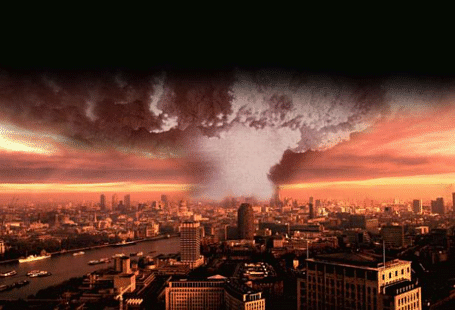
Renewed nuclear danger https://independenttribune.com/news/local/column-renewed-nuclear-danger/article_d71499e9-187c-53c0-8b37-6b9b8f06e2f0.html, By Gerry Dionne, 12 July 20
- July 16 of this year marks the 75th anniversary of the first nuclear bomb detonation. I don’t foresee any dancing in the street to mark the occasion. In fact, I imagine your nightly newscast will ignore it entirely. Oh, we’ll probably hear something about Hiroshima three weeks later. That first use of the weapon in malice has more historic significance. The two bombs dropped on Japan resulted in 214,000 deaths by the end of 1945.
Frankly, I’m mystified that we hear so little about the threat of nuclear war today considering how consequential such an event would be. It’s a danger far more clear and present than an errant asteroid, or an eruption of the Yellowstone Caldera. Currently, we’re all agog about the novel coronavirus. We’ve lived with a nuclear Sword of Damocles hanging over our collective head for 75 years now, and we tend to think we experienced real danger of thermonuclear war for a period of only 13 days back in 1962. We survived that physically unscathed; that’s probably it for one lifetime, right?
The post-World War II arms race has seen 2,056 nuclear test detonations by at least eight nations; more than half of that total (1,030) were American. The United States has not conducted a nuclear test since 1992, when a bipartisan congressional majority mandated a nine-month testing moratorium. In 1996, the United States was the first to sign the Comprehensive Test Ban Treaty, which verifiably prohibits all nuclear test explosions of any yield. Today, the CTBT has 184 signatories and almost universal support. But it hasn’t formally entered into force due to the failure of the United States, China, Egypt, Iran and Israel to ratify the agreement; and by India, Pakistan and North Korea, which have neither signed nor ratified the measure.
This leaves the door to renewed testing open. According to a May 22 article in The Washington Post, senior national security officials discussed the option of a demonstration of nuclear air detonation at a May 15 interagency meeting. A senior official told the Post that a “rapid test” by the United States could prove useful from a negotiating standpoint as the Trump administration tries to pressure Russia and China to engage in talks on a new arms-control agreement.
The push to restart nuclear weapons testing is happening at a time when tensions between the United States and Russia have stepped up provocative moves in airborne “show of force” demonstrations that can turn hazardous when combat aircraft come nail-bitingly close to each other. The danger expands exponentially when the aircraft involved are nuclear-capable, and when the operations are staged in militarily sensitive areas, such as a first-time U.S. B-1B bomber flight May 21 over the Sea of Okhotsk; or a May 29 flight by two B-1B bombers across Ukrainian-controlled airspace for the first time, coming close to Russian-controlled airspace over Crimea.
Not wanting to be left out of the merriment, Russia conducted a March 12 flight of two nuclear-capable Tu-160 “Blackjack” bombers over Atlantic waters near Scotland, Ireland and France from its base on the Kola Peninsula in Russia’s far north, prompting France and the United Kingdom to scramble interceptor aircraft. In conducting these operations, U.S. and Russian military leaders appear to be delivering two messages to their counterparts. First, despite any perceived reductions in military readiness caused by the coronavirus pandemic, they are fully prepared to conduct all-out combat operations against the other. Second, any such engagements could include a nuclear component at an early stage of the fighting.
Although receiving precious little media attention in the U.S. and international press, these maneuvers represent a dangerous escalation of U.S.-Russian military interactions and could set the stage for a dangerous incident involving armed combat between aircraft of the opposing sides. This by itself could precipitate a major crisis and possible escalation. Just as worrisome are the strategic implications of these operations, suggesting a commitment to the early use of nuclear weapons in future major-power engagements.
The U.S. Air Force Global Strike Command has long since supplanted the Strategic Air Command in its function as our nuclear war delivery system. Its commander, Gen. Timothy Ray, has said, “We have the capability and capacity to provide long-range fires anywhere, anytime, and can bring overwhelming firepower, even during the pandemic.” It really doesn’t matter whether those words reassure or horrify you; the eventual outcome of merely holding weapons of nearly limitless lethality is written in stone.
Sources: Arms Control Association Newsletter, July/August 2020; The Washington Post, May 22, 2020; and JanesDefenseWeekly.com, July 5, 2020.
American-Israeli strategy developing for clandestine not-quite-war strikes on Iran?
 Long-Planned and Bigger Than Thought: Strike on Iran’s Nuclear Program Long-Planned and Bigger Than Thought: Strike on Iran’s Nuclear Program
Some officials say that a joint American-Israeli strategy is evolving — some might argue regressing — to a series of short-of-war clandestine strikes. NYT, By David E. Sanger, Eric Schmitt and Ronen Bergman, 12 July 20 As Iran’s center for advanced nuclear centrifuges lies in charred ruins after an explosion, apparently engineered by Israel, the long-simmering conflict between the United States and Tehran appears to be escalating into a potentially dangerous phase likely to play out during the American presidential election campaign.
New satellite photographs over the stricken facility at Natanz show far more extensive damage than was clear last week. Two intelligence officials, updated with the damage assessment for the Natanz site recently compiled by the United States and Israel, said it could take the Iranians up to two years to return their nuclear program to the place it was just before the explosion. An authoritative public study estimates it will be a year or more until Iran’s centrifuge production capacity recovers.
Another major explosion hit the country early Friday morning, lighting up the sky in a wealthy area of Tehran. It was still unexplained — but appeared to come from the direction of a missile base. If it proves to have been another attack, it will further shake the Iranians by demonstrating, yet again, that even their best-guarded nuclear and missile facilities have been infiltrated.
Although Iran has said little of substance about the explosions, Western officials anticipate some type of retaliation, perhaps against American or allied forces in Iraq, perhaps a renewal of cyberattacks. In the past, those have been directed against American financial institutions, a major Las Vegas casino and a dam in the New York suburbs or, more recently, the water supply system in Israel, which its government considers “critical infrastructure.”
Officials familiar with the explosion at Natanz compared its complexity to the sophisticated Stuxnet cyberattack on Iranian nuclear facilities a decade ago, which had been planned for more than a year. In the case of last week’s episode, the primary theory is that an explosive device was planted in the heavily-guarded facility, perhaps near a gas line. But some experts have also floated the possibility that a cyberattack was used to trigger the gas supply.
Some officials said that a joint American-Israeli strategy was evolving — some might argue regressing — to a series of short-of-war clandestine strikes, aimed at taking out the most prominent generals of the Islamic Revolutionary Guards Corps and setting back Iran’s nuclear facilities…….. https://www.nytimes.com/2020/07/10/world/middleeast/iran-nuclear-trump.html
|
|
|
Lower-latitude oceans drive complex changes in the Arctic Ocean,
The University of Alaska Fairbanks and Finnish Meteorological Institute led the international effort, which included researchers from six countries. The first of several related papers was published this month in Frontiers in Marine Science.
Climate change is most pronounced in the Arctic. The Arctic Ocean, which covers less than 3% of the Earth’s surface, appears to be quite sensitive to abnormal conditions in lower-latitude oceans.
“With this in mind, the goal of our research was to illustrate the part of Arctic climate change driven by anomalous [different from the norm] influxes of oceanic water from the Atlantic Ocean and the Pacific Ocean, a process which we refer to as borealization,” said lead author Igor Polyakov, an oceanographer at UAF’s International Arctic Research Center and FMI.
Although the Arctic is often viewed as a single system that is impacted by climate change uniformly, the research stressed that the Arctic’s Amerasian Basin (influenced by Pacific waters) and its Eurasian Basin (influenced by Atlantic waters) tend to differ in their responses to climate change.
Since the first temperature and salinity measurements taken in the late 1800s, scientists have known that cold and relatively fresh water, which is lighter than salty water, floats at the surface of the Arctic Ocean. This fresh layer blocks the warmth of the deeper water from melting sea ice.
In the Eurasian Basin, that is changing. Abnormal influx of warm, salty Atlantic water destabilizes the water column, making it more susceptible to mixing. The cool, fresh protective upper ocean layer is weakening and the ice is becoming vulnerable to heat from deeper in the ocean. As mixing and sea ice decay continues, the process accelerates. The ocean becomes more biologically productive as deeper, nutrient-rich water reaches the surface.
By contrast, increased influx of warm, relatively fresh Pacific water and local processes like sea ice melt and accumulation of river water make the separation between the surface and deep layers more pronounced on the Amerasian side of the Arctic. As the pool of fresh water grows, it limits mixing and the movement of nutrients to the surface, potentially making the region less biologically productive.
The study also explores how these physical changes impact other components of the Arctic system, including chemical composition and biological communities.
Retreating sea ice allows more light to penetrate into the ocean. Changes in circulation patterns and water column structure control availability of nutrients. In some regions, organisms at the base of the food web are becoming more productive. Many marine organisms from sub-Arctic latitudes are moving north, in some cases replacing the local Arctic species.
“In many respects, the Arctic Ocean now looks like a new ocean,” said Polyakov.
These differences change our ability to predict weather, currents and the behavior of sea ice. There are major implications for Arctic residents, fisheries, tourism and navigation.
This study focused on rather large-scale changes in the Arctic Ocean, and its findings do not necessarily represent conditions in nearshore waters where people live and hunt.
The study stressed the importance of future scientific monitoring to understand how this new realm affects links between the ocean, ice and atmosphere.
###
Co-authors of the paper include Matthew Alkire, Bodil Bluhm, Kristina Brown, Eddy Carmack, Melissa Chierici, Seth Danielson, Ingrid Ellingsen, Elizaveta Ershova, Katarina Gårdfeldt, Randi Ingvaldsen, Andrey V. Pnyushkov, Dag Slagstad and Paul Wassmann.
1 This Month


Pine Ridge Uranium is the real threat, not Tehran- Tell Burgum: Stop the Extraction.
Chernobyl: The Lost Tapes – A good documentary on Chernobyl on SBS available On Demand for the next 3 weeks– https://www.sbs.com.au/ondemand/tv-program/chernobyl-the-lost-tapes/2352741955560
To see nuclear-related stories in greater depth and intensity – go to https://nuclearinformation.wordpress.com
-
Archives
- April 2026 (288)
- March 2026 (251)
- February 2026 (268)
- January 2026 (308)
- December 2025 (358)
- November 2025 (359)
- October 2025 (376)
- September 2025 (257)
- August 2025 (319)
- July 2025 (230)
- June 2025 (348)
- May 2025 (261)
-
Categories
- 1
- 1 NUCLEAR ISSUES
- business and costs
- climate change
- culture and arts
- ENERGY
- environment
- health
- history
- indigenous issues
- Legal
- marketing of nuclear
- media
- opposition to nuclear
- PERSONAL STORIES
- politics
- politics international
- Religion and ethics
- safety
- secrets,lies and civil liberties
- spinbuster
- technology
- Uranium
- wastes
- weapons and war
- Women
- 2 WORLD
- ACTION
- AFRICA
- Atrocities
- AUSTRALIA
- Christina's notes
- Christina's themes
- culture and arts
- Events
- Fuk 2022
- Fuk 2023
- Fukushima 2017
- Fukushima 2018
- fukushima 2019
- Fukushima 2020
- Fukushima 2021
- general
- global warming
- Humour (God we need it)
- Nuclear
- RARE EARTHS
- Reference
- resources – print
- Resources -audiovicual
- Weekly Newsletter
- World
- World Nuclear
- YouTube
-
RSS
Entries RSS
Comments RSS
 nuclear-news