Statement of opinion of a resident of the city of Date, Fukushima Prefecture, presented to the Tokyo Regional Court

Nuclear news – last week of September
Greta Thunberg gave an impassioned speech at the United Nations Climate Summit, It has resulted in some quite vicious media attacks on her, while it has highlighted the inability of world leaders to take effective action to stop or slow global heating.
It has also sparked a new burst of climate denialism. Nevertheless, science persists in uncovering the unwelcome facts. The French National Center for Scientific Research has just released a report warning that Earth could warm 7 degrees C by the year 2100. Numerous scientific bodies warn on increasing greenhouse gases, and increasing pace of global heating.
The World Nuclear Energy Status Report 2019 was launched on September 24. Some brief notes on its findings are here. They indicate that the commercial nuclear industry is in decline.
AUSTRALIA
CLIMATE. Sir David Attenborough slammed the Australian government’s response to climate change. Scott Morrison and Donald Trump happily together against action on climate change. Scott Morrison on climate change: he just doesn’t “get it. Behind closed doors: Australia pushes reputation as world’s leading fossil fuel dealer. Minerals Council of Australia makes global top 10 climate policy opponents. Australian schoolgirl attends United Nations Youth Climate Summit.
NUCLEAR. 50+ groups sign joint civil society statement on domestic nuclear power. Submission for the public good: to Federal Nuclear Inquiry – Noel Wauchope. Lyn Allen and Richard Ledger’s nuclear submission – for the public good. Nuclear submarines for Australia? Dangerous, would require costly taxpayer insurance. NSW Deputy Premier John Barilaro wants to “normalise”nuclear power.
Nuclear waste dump ballot to go ahead in Kimba, South Australia.
RENEWABLE ENERGY. Clean Energy Finance Corporation and National Farmers Federation back ready-made clean energy solutions for Australian farmersTwo huge renewable hydrogen projects planned for Queensland. Small but “smart” Kanowna solar farm comes on line in northern NSW. Australia’s main grid copes just fine with minimal amount of coal.
INTERNATIONAL
Leaders of world’s largest emitting economies do not have real plans to meet goal of net zero emissions.
Nuclear weapons an unacceptable danger to humanity – U.N.Secretary-General António Guterres.
Weapons proliferation risk of nuclear power in space.
Climate change makes nuclear waste even more of a deadly threat. Nuclear power is on the skids: it’s really not going to help address climate change. Nuclear energy too slow, too expensive to save climate: report .
Uranium industry in permanent collapse? And thorium industry probably no better.
IRAN. Iran prepared to make a new nuclear agreement with Trump.
UK.
- UK energy chief advises that Hinkley Point nuclear project should be scrapped. Britain’s nuclear white elephant – Hinkley Point costs – $28 billion and rising. Britain’s nuclear power future might be ended, with Hinkley Point C’s escalating costs.
- Nuclear waste is piling up – governments need to stop dithering and take action .
- Sizewell C nuclear plan puts iconic British nature reserve in danger. Will Brexit mean a race to the bottom, in UK’s environmental protection standards?
RUSSIA. Russia’s deadly explosion in August has awakened Russians to the nuclear danger. The worst nuclear disaster you’ve never heard of.
USA. Nuclear power’s future is threatened by a mix of solar, wind and batteries. Shadowy sources, dark money, funding Chinese conspiracy ads against Ohio’s nuclear referendum.
JAPAN.
- ‘What Corporate Impunity Looks Like’: Court Acquits Tepco Executives for Role in Fukushima Nuclear Disaster. ‘No one has taken responsibility’: Fukushima victims decry nuclear bosses’ acquittal. TEPCO acquittals spark ire: ‘People who died cannot rest in peace’.
- From March 29, 2011: Special Report: Japan engineers knew tsunami could overrun plant.
- CITIZENS’ RADIOACTIVITY DATA MAP OF JAPAN.
- ‘It will take 300 years before contaminated water is safe to discharge into sea’ Osaka mayor Ichiro Matsui offers to take in tainted Fukushima water and dump it into Osaka Bay. Fukushima fishermen concerned for future over release of radioactive water. Radioactive water at Fukushima should be stored not dumped.
- Chief of Japan nuclear fuel processer JCO makes fresh apology over deadly 1999 accident.
TAIWAN. Taiwan warns Japan over radioactive water release.
SOUTH KOREA. Exasperation in South Korea as US-North Korea nuclear talks are failing. S. Korea slams Japan’s actions over Fukushima plant water crisis. Dispute between Japan and South Korea, over radiation levels in Fukushima food exports.
MARSHALL ISLANDS. A rude concrete sign indicates a deadly truth about nuclear radiation and cancer.
PACIFIC ISLANDS. Pacific Island nations urge action on climate change at UN.
CHINA. China ‘poised to unveil new nuclear missile’ at military parade in warning to Trump.
INDIA. India has 130 to 140 nuclear warheads—and more are coming, according to a new report. Should the world worry?
AUSTRALIA. 50+ groups sign joint civil society statement on domestic nuclear power. Sir David Attenborough slammed the Australian government’s response to climate change. Scott Morrison and Donald Trump happily together against action on climate change. Scott Morrison on climate change: he just doesn’t “get it. Behind closed doors: Australia pushes reputation as world’s leading fossil fuel dealer. Minerals Council of Australia makes global top 10 climate policy opponents. Australian schoolgirl attends United Nations Youth Climate Summit.
UK energy chief advises that Hinkley Point nuclear project should be scrapped

Telegraph 28th Sept 2019 Scrap Hinkley Point: nuclear plant is expensive and out of date, says Ovo Energy chief, Britain’s next nuclear power plant should be scrapped because it is wastefully expensive and out of date, according to the boss of Ovo Energy. The industry should instead look to the future with ever-cheaper renewable energy, said Stephen Fitzpatrick, the founder and chief executive of the group that will soon be the UK’s second-biggest supplier as Ovo acquires SSE’s consumer business.
“We should just call it a day. I thought at the time the deal was struck at £92.50 per megawatt
hour (MWh), inflation-linked, that it was a bad deal for customers. Unfortunately the technology, the design it is based on, is unproven,” he said. “Looking at the cost for customers of renewables, solar, and wind, the cost just keeps coming down. The cost for nuclear keeps going up.
It strikes me that this does not represent value for money for consumers, never more so than this week when the cost went up by £2.9bn.” The Hinkley Point C reactor will cost up to £22.5bn to build as costs keep rising above initial plans.
Mr Fitzpatrick would prefer the industry to invest in restructuring the energy network to handle more renewables, including the variable supply of wind and solar. This could be handled in
part with a “smart network” using batteries to handle shifting supply and demand.
“If you think about the £39/MWh that was achieved at the last auction for offshore wind, and when Hinkley Point goes live it is going to be about £100 more per MWh some time in the late 2020s,” he said. “If we make smart decisions and focus on value for money and what is best for the end consumer, I am quite sure we can keep costs [of decarbonising thenetwork] under control.” https://www.telegraph.co.uk/business/2019/09/28/scrap-hinkley-point-nuclear-plant-expensive-date-says-ovo-energy/
Nuclear waste is piling up – governments need to stop dithering and take action
Nuclear waste is piling up – governments need to stop dithering and take action https://theconversation.com/nuclear-waste-is-piling-up-governments-need-to-stop-dithering-and-take-action-123977 Claire Corkhill
Research Fellow in nuclear waste disposal, University of SheffieldSeptember 26, 2019 The UK government has launched a process to find a volunteer community who would be willing to host a £12 billion geological disposal facility for nuclear waste. It’s about time – the initiative comes after seven decades of successive governments putting the decision off. The situation is similar in many other countries, with dangerous nuclear material being stored unsafely because of political inaction.
In the UK, nuclear waste is currently kept in safe but high-maintenance conditions, with some canisters deteriorating, at Sellafield in Cumbria. This is costing tax payers £3 billion per year.
The new geological disposal facility is a vast underground bunker, to be buried around 500m below the Earth’s surface. It is intended to safely store approximately one Wembley Stadium’s worth of highly radioactive waste that has been generated over the past 70 years. Here, it will be isolated from the biosphere – and human populations – for the 100,000 years it will take for the radioactivity to decay to safe levels.
Radioactive waste is generated from nuclear energy, military uses and also the extensive use of isotopes in medicine. The most highly radioactive portion comes from spent nuclear fuel – the used uranium fuel from inside nuclear reactors and the materials produced through recycling of spent nuclear fuel. The latter includes fission products that are transformed to glass and plutonium (which is currently neither a resource nor a waste).
These materials contain radioactive isotopes that have half-lives (the amount of time taken for half of the radioactivity to decay) of tens to hundreds of thousands of years. This means any storage solution must be extremely long-lived. That’s a significant challenge – the oldest known man-made materials are of the order of several thousands of years old.
The principle of geological disposal of nuclear waste is to use multiple barriers, much like a set of Russian Dolls. This makes it possible to contain the waste and prevent it from meeting with groundwater which would start to dissolve it – releasing radioactive materials to the environment. Engineered barriers are intended to contain the waste until most of the radioactivity has decayed.
If the disposal vaults are dug in a good, impermeable rock (such as clay or mudstone), the geology provides a natural barrier that will isolate the waste from the biosphere. This will reduce the likelihood of human intrusion into the facility. Being several hundreds of metres below the ground, there will also be long transport pathways to delay any significant migration of radioactive materials from the waste to the biosphere until far into the future.
International issue
The UK is not the only country opting for this solution. In Finland, construction of the Onkalo facility has already begun. A licence application has even been made to start disposing of spent nuclear fuel.
But progress in other nations has stalled: in France protesters surround the disposal facility in the village of Bure, while in Sweden, the Environmental Court has rejected the construction licence for a facility near the coastal town of Forsmark, due to safety concerns over the corrosion resistance of copper canisters.
In the USA, senators are suing the Federal Government for not building a disposal facility. The lack of a disposal facility has meant that thousands of metric tonnes of spent nuclear fuel, have built up – stored temporarily in dry casks at sites across the country.
The controversy is expected to extend to the UK’s new geological disposal siting process. Recent media articles have criticised the idea that see all areas of the UK – including national parks – could be suitable to host a facility. A previous siting process, launched in 2003, failed to find a site. Although two local authorities from near the Sellafield site came forward, Cumbria County Council was able to veto the vote.
The government hopes that new communities will step forward in this second process. It has proposed an incentive package offering communities £1m per year for having discussions about hosting the facility. This will increase to £2.5m per year when geological investigations are undertaken.
But environmentalists are likely to object, as they fear a better storage facility will only lead to more nuclear power stations. And indeed, Oliver Eden, former parliamentary undersecretary for energy under Theresa May’s government between 2017-2019, highlighted the disposal facility as being “the key to the future of the UK’s new nuclear build programme … providing a safe and secure way to dispose of the waste new nuclear reactors produce.”
Whatever the outcome of the current siting process, something must be done about nuclear waste. Leaving it for our grandchildren to deal with is simply not fair. What’s more, we can’t assume that future civilisations will be able to keep it safe.
The first step on the road to a solution is to initiate a public conversation about what we should do with the world’s most dangerous materials in the long term. If you are interested, a good first step could be to watch the video above and start discussing the topic with your friends, family and local authorities.
The 2019 World Nuclear Industry Status Report (WNISR)
with a summary on page 19, and a country by country analysis p 200 – 208, closing with a devastating conclusion on SMRs.
www.global2000.at/events/conference-climate-crisis
September 29 Energy News — geoharvey

Opinion: ¶ “Greta Thunberg Got The World’s Attention. But Are Leaders Really Listening?” • The science is clear that we need to act now on climate change. But commitments to reduce planet-warming emissions that were announced at the UN Climate Summit this week show some world leaders are not yet willing to take really transformative […]
The worst nuclear disaster you’ve never heard of — Beyond Nuclear International

Mayak may still be churning radioactivity into the environment
via The worst nuclear disaster you’ve never heard of — Beyond Nuclear International
Russia’s deadly explosion in August has awakened Russians to the nuclear danger
|
Blast, Radiation Unnerve Russians Living Near Test Site Deadly August explosion during missile trial was wake-up call; ‘We’re worried it could happen again’ WSJ, By Ann M. Simmons The Wall Street Journal, Sept. 25, 2019 SEVERODVINSK, Russia—For decades, the Russian military conducted trials at a restricted site near this northern city, testing missiles that Moscow loaded onto Cold War-era submarines. Residents paid little heed for years. That changed on Aug. 8, when an explosion during a missile test killed at least seven people and caused radiation levels to spike in the area around Severodvinsk. U.S. officials said the explosion confirmed that Russia is endeavoring to develop high-grade specialized nuclear weapons, as Moscow makes fresh efforts to produce a new generation of arms capable of overcoming U.S. defense systems. University student Alexandra Volkova closed all her windows when she heard about the blast hours after it occurred, but is afraid she acted too late. “I’m not sure if I have been exposed to radiation,” the 22-year-old said. “I’m not sure whether it’s a serious problem. I’m not sure whether I should have taken some iodide.”……… Russian President Vladimir Putin said the incident occurred during the test of a “promising weapons system” and praised the personnel who perished as national heroes.
The demise in August of the 1987 Intermediate-range Nuclear Forces Treaty lifted decades-old constraints on Russia and the U.S. on developing nuclear and conventional ground-based ballistic and cruise missiles with ranges of 300 to 3,400 miles.
It is now unclear whether a parallel accord, New START, which limits U.S. and Russian long-range nuclear arms, will be renewed when it expires in 2021. The Kremlin hasn’t named the weapon that was being tested in the explosion in an area called Nyonoksa, which a CIA report declassified in 2013 described as a prominent weapons testing site. Experts believe the explosion resulted from Russia’s failed test of its nuclear-powered Burevestnik missile, known as Skyfall, which it started developing in the 2000s. Mr. Putin unveiled the weapon last year in a slick animated video, showcasing a guided missile gliding untracked over oceans and circumventing air-defense systems. The Kremlin has described the missile as virtually unstoppable, with potentially unlimited range and an unpredictable flight pattern. Little is publicly known about it. Matt Korda, a research associate for the Nuclear Information Project at the Federation of American Scientists in Washington, said it wouldn’t be an overstatement to describe it as “a kind of flying Chernobyl,” referring to the 1986 nuclear accident at this Soviet nuclear power plant.
If completed, Skyfall would be an “unshielded nuclear reactor that’s essentially just flying around pumping out radiation,” Mr. Korda said. The accident sowed concerns among residents around Severodvinsk, home to a naval base and around 183,000 people. “As far as we knew, there was never any nuclear testing here and there had never been any accidents with radiation involved,” said Oleg Mandrykin, a businessman and environmental activist in the city. “People died because of this explosion, because of high exposure to radiation,” he said. “Now people here are worried because they just don’t understand what happened.” Russian authorities’ Soviet-era style secrecy in the aftermath of the explosion exacerbated fears. A notice on the Severodvinsk city website announcing a spike in radiation levels following the blast was quickly deleted. An initial order for residents of Nyonoksa to evacuate was canceled. And at least four Russian monitoring stations designed to detect nuclear radiation were switched off soon after the blast, the Comprehensive Nuclear-Test-Ban Treaty Organization said. Authorities in Severodvinsk, where foreigners still need official permission to visit, didn’t respond to requests for comment on the statements following the incident and accusations that officials are deceiving the public about the severity of the radiation and the current risk. https://www.wsj.com/articles/blast-radiation-unnerve-russians-living-near-test-site-11569403801
|
|
|
Nuclear power’s future is threatened by a mix of solar, wind and batteries
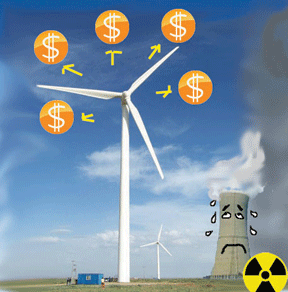 A mix of solar, wind and batteries threatens the future of nuclear power, Stars and Stripes By WILL WADE | Bloomberg September 28, 2019
The natural gas boom is killing America’s nuclear industry. Wind and solar may finish the job…….
Battery prices have plunged 85% from 2010 through 2018, and huge storage plants are planned in California and Arizona. Meanwhile, science is advancing on new technology — including chemical alternatives to lithium-ion systems — with the potential to supply power for 100 hours straight, sun or no sun.
“All signs point to the acceleration of renewable energy that can out-compete nuclear and fossil fuels,” said Jodie Van Horn, director of the Sierra Club’s Ready for 100 campaign, a group seeking a grid powered solely by renewables.
The drive for grids that are 100% emissions-free is being pushed by a growing number of U.S. states citing increasingly aggressive time frames. In July, New York mandated that 70% of the state’s power come from renewables by 2030, and 100% by 2040. Seven other states, including California, have similar mandates, and Virginia’s governor this month announced an executive order calling for 100% clean energy there by 2050. ….
By 2050, BNEF expects renewables to account for 48% of the U.S. power system, paired with multiple types of supplemental, peaking plants that can supply electricity when needed…… Meanwhile, over the same period, nuclear will wane, as high costs force most reactors to just shut down.
The U.S. isn’t the only place where the nuclear industry is struggling. Some nations that rely heavily on the technology, including France and Sweden, are reducing nuclear’s load as old reactors retire, and diversifying into cheaper solar and wind power. ……
The first modular nuclear reactors in the U.S. aren’t set to go into service until 2026, and the salt technologies are still largely in the research stage. At the same time, installed capacity of nuclear in the U.S. is forecast to fall to 6 gigawatts by 2050, down from 101 gigawatts now, according to BloombergNEF. ……. https://www.stripes.com/news/us/a-mix-of-solar-wind-and-batteries-threatens-the-future-of-nuclear-power-1.600949
Nuclear weapons an unacceptable danger to humanity – U.N.Secretary-General António Guterres
 Elimination of nuclear weapons ‘only real way’ to allay fear of a constant threat, Guterres insists, https://news.un.org/en/story/2019/09/1047712 Progress made in reducing the danger posed by nuclear arsenals has not only come to a halt, “it is going in reverse”, and any use of a nuclear weapon in the future would ignite “a humanitarian catastrophe.” Elimination of nuclear weapons ‘only real way’ to allay fear of a constant threat, Guterres insists, https://news.un.org/en/story/2019/09/1047712 Progress made in reducing the danger posed by nuclear arsenals has not only come to a halt, “it is going in reverse”, and any use of a nuclear weapon in the future would ignite “a humanitarian catastrophe.”
Secretary-General António Guterres surveyed the state of the disarmament debate during a high-level meeting of the 74th Session of the UN General Assembly on Thursday, coinciding with the commemoration of the International Day for the Total Elimination of Nuclear Weapons. “A qualitative nuclear arms race is underway”,’ he warned, and rising tensions, mistrust between nuclear-armed States, and muddy rhetoric about the utility of nuclear weapons are some of the factors to blame. Although atomic weapons have only been used twice, by the United States in 1945, around 14,500 remain in the world today, with over 2,000 nuclear tests conducted to date according to the UN’s disarmament wing (UNODA) . “The elimination of nuclear weapons has been the United Nations’ highest disarmament priority from day one,” Mr. Guterres said in his opening remarks. “We strive for a world free of nuclear weapons because we know these weapons pose a unique and potentially existential threat to our planet.” Born at a time of heightened distrust, the United Nations must do everything to ensure that the tragedy suffered by the people of Hiroshima and Nagasaki never happens again, President of the General Assembly, Tijanai Mihammad-Bande reminded delegates in attendance. Remembering such devastation “makes it crucial” that everything that can be done, is done, to ensure this moment in history “was the last time such weapons are deployed,” he said. “‘Never again,’ must remain our main refrain” he urged. Last year the Secretary-General launched a new disarmament agenda with a clear implementation plan; a complement to the cornerstone Treaty on the Non-Proliferation of Nuclear Weapons (NPT) which entered into force in 1970, with a total of 191 States joining – more than any other arms limitation agreement. The UN’s disarmament plan supports a number of other treaties with the aim of exterminating nuclear proliferation and testing, including the Treaty on the Prohibition of Nuclear Weapons (TPNW), and the Comprehensive Nuclear-test-Ban Treaty (CTBT). The Secretary-General urged all State Parties to collaborate at the upcoming 2020 Review of the NPT to further ensure its fundamental goals are met. “Failure to do so will only further undermine the regime,” he warned. “Nuclear weapons present an unacceptable danger to humanity. Let us not forget that the only real way to eliminate the threat of nuclear weapons is to eliminate nuclear weapons themselves,” Mr. Guterres maintained. |
|
Will Brexit mean a race to the bottom, in UK’s environmental protection standards?
Russell MSP has now written to Michael Gove demanding to know why the Government wishes to move away from these alignment regulations.
https://www.heraldscotland.com/news/17934543.fears-uk-government-race-bottom-environment-protection/
Dispute between Japan and South Korea, over radiation levels in Fukushima food exports
|
Japan embassy in Seoul posts radiation data amid escalating row, Straits Times TOKYO (REUTERS) 29 Sept 19, – Japan’s embassy in South Korea has begun posting data on its website to show there is little difference in radiation levels between the two countries, in its latest retort in a diplomatic and trade row rooted in wartime history.South Korea said last month that it will double the radiation testing of some Japanese food exports due to potential contamination from the tsunami-damaged Fukushima nuclear plant.
The embassy said the radiation reading in Seoul as of last Friday (Sept 27) was 0.12 microsieverts per hour, around the same as 0.135 in Fukushima City, and higher than Tokyo’s 0.036. It will update the data every day the embassy is open, it said……. https://www.straitstimes.com/asia/east-asia/japan-embassy-in-seoul-posts-radiation-data-amid-escalating-row |
|
Uranium industry in permanent collapse? And thorium industry probably no better
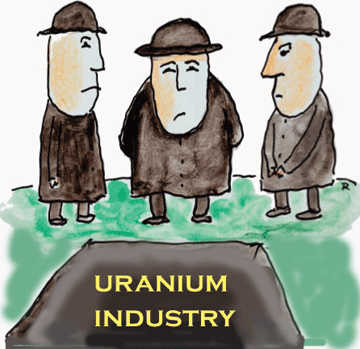 Uranium Sector Won’t Catch A Break, Share Cafe, By Rick Mills September 23, 2019 One week ago Cameco announced it will maintain low output levels until uranium prices recover. The Canadian uranium miner also said it might cut production further, having already closed four mines in Canada and laid off 2,000 of its workers in the uranium mining hub of Saskatchewan.
No end to supply glut“We are not restarting mines until we see a better market and we may close more capacity, although no decision has been taken yet,” Cameco CEO Tim Gitzel told Reuters recently at the World Nuclear Association’s annual conference.
Just over a year ago Cameco made the difficult decision to close its MacArthur River and Key Lake mines, in response to low uranium prices, leaving the company’s flagship Cigar Lake facility as its only operating mine left in northern Saskatchewan, home to the world’s highest grade uranium deposit.
The mine closures by Cameco were preceded by 20% production cuts in Kazakhstan, the number one uranium-producing country. The former Soviet bloc country has said 2020-21 output will not rise above 2019 levels. In Canada, the second largest U producer, 2018 production was cut in half to 7,000 tonnes.
An estimated 35% of uranium supply has been stripped from the market since Kazakhstan’s supply reductions in December 2017…..
Eight years later, only nine of 33 remaining reactors have been re-started, and Japan’s nuclear operators are reportedly starting to sell their uranium fuel, as the chances fade of more reactors coming online, and adding to the six currently operating. Long-term contracts are also being canceled.
In another blow to the industry, Japan’s new environment minister, Shinjiro Koizumi, has said he wants all reactors shuttered to avoid a repeat of the Fukushima catastrophe that leaked radiation and forced 160,000 people to flee the area, many of whom have not returned.
As reactors close in the United States, Germany, Belgium and other countries, “traders and specialists say the market is likely to remain depressed for years,” Reuters reported in August.
Germany has pledged to shut down all its reactors by 2022 and the Belgian government has agreed to a new energy pact that will see nuclear power phased out over the next seven years…….
(makes case for thorium)….As far as disadvantages, thorium takes extremely high temperatures to  produce nuclear fuel (550 degrees higher than uranium dioxide), meaning thorium dioxide is expensive to make. Second, irradiated thorium is dangerously radioactive in the short-term.
Detractors also say the thorium fuel cycle is less advanced than uranium-plutonium and could take decades to perfect; by that time, renewable energies could make the cost of thorium reactors cost-prohibitive. The International Nuclear Agency predicts that the thorium cycle won’t be commercially viable while uranium is still readily available………… https://www.sharecafe.com.au/2019/09/23/uranium-sector-wont-catch-a-break/
Britain’s nuclear white elephant – Hinkley Point costs – $28 billion and rising
This Is What Britain’s Biggest Construction Project Looks Like EDF’s Hinkley Point nuclear project has already racked a $28 billion bill and a string of superlatives. By Jeremy Hodges and Rob Dawson, September 28, 2019
Britain’s biggest construction project is emerging from the ancient flatlands in the west, overlooking the sea where humans have lived for more than 10,000 years.
Over an area covering 245 soccer fields, Electricite de France SA is building the U.K.’s first new nuclear power plant in more than 20 years. The project employs 4,500 people and will cost up to 22.5 billion pounds ($28 billion), a sum the French utility boosted this week after discovering more difficult conditions on the ground. …... (subscribers only) https://www.bloomberg.com/news/features/2019-09-28/uk-hinkley-point-c-nuclear-plant-what-it-costs-when-it-starts
Australian government ‘doesn’t give a damn’about rest of the world

David Attenborough says Australian government ‘doesn’t give a damn’about rest of the world, Telegraph, UK, Giovanni Torre, perth
24 SEPTEMBER 2019
Sir David Attenborough slammed the Australian government’s response to
climate change as the country’s prime minister Scott Morrison skipped
the United Nations Climate Summit in favour of a rally for President Donald
Trump.
While the United Kingdom has reduced its carbon emissions over the past 12
years, emissions from Australia have increased and the country is among the
worst polluters per capita.
Sir David said the current Australian government had departed from the
previous government’s commitment to tackling climate change.
“(They had been) saying all the right things… then you suddenly say, ‘No it
doesn’t matter… it doesn’t matter how much coal we burn… we don’t give a
damn what it does to the rest of the world’,” he said.
Sir David noted that Mr Morrison brought a lump of coal into one of
Australia’s houses of Parliament in 2017, calling out to the opposition:
“Don’t be scared, it won’t hurt you”.
“If you weren’t opening a coal mine okay I would agree, it’s a joke. But you
are opening a coal mine,” he said.
Sir David noted that Mr Morrison had campaigned for re-election on a
platform of support for new coal mines.
Speaking from Chicago, Mr Morrison defended his government’s record on
climate change…… https://www.telegraph.co.uk/news/2019/09/24/david-attenborough-says-australian-government-doesnt-give-damn/?WT.mc_id=tmg_share_fb&fbclid=IwAR0GancZNjQW1CgrE7UF2WExXW2B4HvkM9brL0huaFKom6msYAz79qtjjd0
1 This Month

of the week – Shut Down Drone Warfare!


Tell the Ukrainian Government to Drop Prosecution of Peace Activist Yurii Sheliazhenko

Petition to revoke the licensing of the Near Surface Nuclear Disposal Facility (NSDF) at Chalk River. https://www.ourcommons.ca/petitions/en/Petition/Details?Petition=e-7247
To see nuclear-related stories in greater depth and intensity – go to https://nuclearinformation.wordpress.com
-
Archives
- April 2026 (57)
- March 2026 (251)
- February 2026 (268)
- January 2026 (308)
- December 2025 (358)
- November 2025 (359)
- October 2025 (376)
- September 2025 (257)
- August 2025 (319)
- July 2025 (230)
- June 2025 (348)
- May 2025 (261)
-
Categories
- 1
- 1 NUCLEAR ISSUES
- business and costs
- climate change
- culture and arts
- ENERGY
- environment
- health
- history
- indigenous issues
- Legal
- marketing of nuclear
- media
- opposition to nuclear
- PERSONAL STORIES
- politics
- politics international
- Religion and ethics
- safety
- secrets,lies and civil liberties
- spinbuster
- technology
- Uranium
- wastes
- weapons and war
- Women
- 2 WORLD
- ACTION
- AFRICA
- Atrocities
- AUSTRALIA
- Christina's notes
- Christina's themes
- culture and arts
- Events
- Fuk 2022
- Fuk 2023
- Fukushima 2017
- Fukushima 2018
- fukushima 2019
- Fukushima 2020
- Fukushima 2021
- general
- global warming
- Humour (God we need it)
- Nuclear
- RARE EARTHS
- Reference
- resources – print
- Resources -audiovicual
- Weekly Newsletter
- World
- World Nuclear
- YouTube
-
RSS
Entries RSS
Comments RSS
 nuclear-news