nuclear-news

The News That Matters about the Nuclear Industry Fukushima Chernobyl Mayak Three Mile Island Atomic Testing Radiation Isotope

Donald Trump can launch nuclear weapons anytime: even Secretary of Defense Jim Mattis (now sacked) could not have stopped him.

December 24, 2018 Posted by | politics, USA, weapons and war | 2 Comments

Melting Arctic ice pouring out water at an accelerating rate -14,000 tons of water per second

Melting Arctic ice is now pouring 14,000 tons of water per second into the ocean, scientists find

A new survey finds that the region has contributed almost an inch to rising seas since 1971.https://www.washingtonpost.com/energy-environment/2018/12/21/melting-arctic-ice-is-now-pouring-tons-water-per-second-into-ocean-scientists-find/?utm_term=.45ab481784ea By Chris MooneyDecember 21

new scientific survey has found that the glaciers of the Arctic are the world’s biggest contributors to rising seas, shedding ice at an accelerating rate that now adds well over a millimeter to the level of the ocean every year.

That is considerably more ice melt than Antarctica is contributing, even though the Antarctic contains far more ice. Still, driven by glacier clusters in Alaska, Canada and Russia and the vast ice sheet of Greenland, the fast-warming Arctic is outstripping the entire ice continent to the south — for now.

However, the biggest problem is that both ice regions appear to be accelerating their losses simultaneously — suggesting that we could be in for an even faster rate of sea-level rise in future decades. Seas are rising by about three millimeters each year, according to NASA. That’s mainly driven by the Arctic contribution, the Antarctic and a third major factor — that ocean water naturally expands as it warms.

For Arctic ice loss, “the rate has tripled since 1986,” said Jason Box, first author of the new study and a scientist at the Geological Survey of Denmark and Greenland. “So it clearly shows an acceleration of the sea-level contribution.”

“Antarctica will probably take over at some point in the future, but during the past 47 years of this study, it’s not controversial that the Arctic is the largest contribution of land ice to sea-level rise,” he said.

Scientists in the United States, Chile, Canada, Norway and the Netherlands contributed to the work, published in Environmental Research Letters.

The Arctic is also losing floating sea ice at a rapid pace, but that loss does not contribute substantially to rising seas (though it has many other consequences). Sea ice losses closely match what is happening on land, which makes sense because both phenomena are being driven by the fast warming of the atmosphere in the Arctic, which has heated up at a rate much faster than seen in lower latitudes. Warming seas are also driving some of the ice loss.

Here’s the new study’s tally of where all the Arctic ice loss has come from since 1971:  [diagram on original]

The total Arctic loss at present is 447 billion tons of ice per year — which Box calculated is about 14,000 tons of water per second. That’s for the period between 2005 and 2015. Between 1986 and 2005, the loss is calculated at around 5,000 tons per second — therefore, the rate has almost tripled.

Separate research has recently found that the Antarctic’s loss rate has also tripled in just a decade, reaching 219 billion tons per year from 2012 to 2017.

Assuming these numbers are correct and summing them together, the world’s polar regions are losing about 666 billion tons of ice to the ocean each year — amounting to a little bit less than two millimeters of sea-level rise annually.

Treating the Arctic as a whole can miss something, though, notes Christopher Larsen, a glacier expert at the University of Alaska at Fairbanks.

Namely, the Arctic acceleration documented in the study is really being driven by Greenland, which contains more than 20 feet of potential sea-level rise, dwarfing all other Arctic ice sources.

“With respect to the present rate of ice mass loss, and the increasing rates thereof, it is Greenland that has the most significant rate of increased mass loss in the present day,” Larsen said in an email.

“This is especially noteworthy as ultimately Greenland has the most ice to lose in the Northern Hemisphere,” he said. “As rapid as ice loss is now or may become anywhere in the north, the regional totals of ice mass within Alaska or the Arctic Canada are smaller than what Greenland holds.”

To give a sense of the scale of the Arctic losses, Box imagined what it would mean if they were distributed among Earth’s human population.

“If you take the 7.7 billion people on Earth and divide the present-day numbers, from 2005 to 2015, each person on Earth would have the equivalent of 160 liters per day, every day, every year,” Box said.


December 24, 2018 Posted by | oceans | Leave a comment

Drones pose potential danger to nuclear facilities, not just to airports

David Lowry’s Blog 22nd Dec 2018 Labour backbencher Paul Flynn MP raised in a question on drone risks in April 2016 in the House of Commons, there is also the spectre of a droneattack on critical energy infrastructure, such as nuclear power plants, in a question on drone risks, to be dismissed by the then Transport Secretary Patrick McLoughlin: “There is no complacency whatever from the Government on the use of drones.” It seems he was wrong.

David Lowry’s Blog 22nd Dec 2018

http://drdavidlowry.blogspot.com/2018/12/droning-on-ministerial-complacency-real.html

December 24, 2018 Posted by | Uncategorized | Leave a comment

Britain’s historic nuclear records removed from public view

December 24, 2018 Posted by | secrets,lies and civil liberties, UK | Leave a comment

Top court orders TEPCO to pay compensation for voluntary evacuation from Fukushima

December 18, 2018 (Mainichi Japan) TOKYO — The Supreme Court on Dec. 13 upheld the lower court ruling ordering Tokyo Electric Power Co. (TEPCO) to pay about 16 million yen in compensation to a man in his 40s and his family that voluntarily evacuated Fukushima Prefecture to western Japan after the 2011 nuclear disaster.

December 24, 2018 Posted by | Japan, legal | Leave a comment

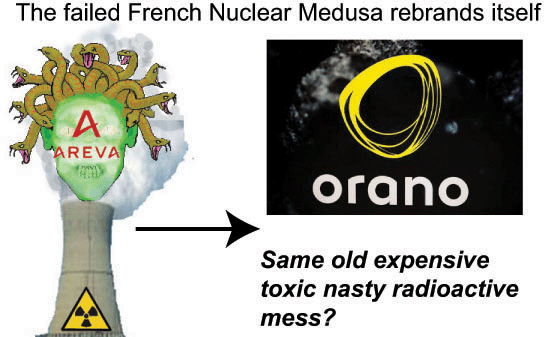
Orano or is it Framatome or is it Areva – shaken by a new corruption case

Ouest France 19th Dec 2018, A new case is shaking the French nuclear group Orano, formerly known as
Areva. An investigation was opened by the Paris prosecutor’s office for “corrupt foreign public official”, involving one of the providers of Orano, the company Eurotradia International. “We did not notice anything abnormal
and we are now at the disposal of justice,” said the spokesman of Orano, which ensures to have terminated its contracts with Eurotradia.
https://www.ouest-france.fr/economie/entreprises/areva/orano-anciennement-areva-visee-par-une-enquete-judiciaire-pour-corruption-6140465

December 24, 2018 Posted by | general | Leave a comment

Communities call on France’s government to stop EDF from setting up nuclear facilities on agricultural land.

December 24, 2018 Posted by | France, opposition to nuclear | Leave a comment

$billions cost to South Carolina residents, as a result of the failed VC Summer nuclear project

2018 Newsmaker: V.C. Summer Nuclear Debacle

V.C. Summer nuclear cancellation costs SC residents billions https://www.postandcourier.com/news/v-c-summer-nuclear-cancellation-costs-sc-residents-billions/article_5e47be44-f711-11e8-b849-7fd4061473e5.html

·      By Andrew Brown abrown@postandcourier.com,24 Dec18

·         Electric customers with South Carolina Electric & Gas got stuck paying another $2.3 billion for two unfinished nuclear reactors at V.C. Summer station in Fairfield County this year.

·         The state’s regulators on the Public Service Commission ruled that SCE&G’s parent company, SCANA Corp., could charge customers for the failed South Carolina nuclear project and approved Dominion’s takeover of the utility in December.

·         It capped off a year-long struggle between the utility company and the Office of Regulatory Staff, the state’s utility watchdog agency.

·         The $9 billion nuclear boondoggle was cancelled last year, but the financial fiasco continued to consume the state’s political and legal systems in 2018.

·         The public service commission’s ruling largely seals the fate of SCE&G customers, but the future of Santee Cooper, the minority owner of the failed project, remains up in the air.

·         The legislature is preparing to consider whether to sell Santee Cooper, a state-run utility. Meanwhile, federal law enforcement officials continue to probe the debacle and explore possible criminal charges.


ReplyForward

December 24, 2018 Posted by | Uncategorized | Leave a comment

Nuclear power is losing its glow in China

Why Is China Losing Interest In Nuclear Power? Oil Price, 

The real change here regards discussions of the future. Pre-Fukushima, China’s power planners were considering adding 400 GWs of nuclear power by the year 2050. It appears plans of this magnitude are no longer under consideration.

Whatever the underlying cause, China has de-emphasized its massive nuclear new build strategy. We suspect the reason is a combination of slowing demand for electricity and deteriorating cost competitiveness of the nuclear plants compared to the alternatives.

December 22, 2018 Posted by | China, politics | Leave a comment

AREVA – ORANO? -Framatome? – corruption in the air yet again for France’s nuclear corporation?

Orano’s activities in Mongolia under judicial investigation for suspicion of corruption  https://www.lemonde.fr/energies/article/2018/12/19/les-activites-d-orano-en-mongolie-visees-par-une-enquete-judiciaire-pour-des-soupcons-de-corruption_5399983_1653054.html 19th Dec 2018 These suspicions of “bribery of a foreign public official” involve one of the service providers of Orano, the consulting firm Eurotradia International.

The French nuclear group Orano, [or is it Framatome?] formerly Areva, is in the sights of the national prosecutor’s office that investigates suspicions of corruption in Mongolia, it was learned, Wednesday, December 19,from sources close to the case. These suspicions of “bribery of a foreign public official” involve one of the service providers of Orano, the consulting firm Eurotradia International.

Anti-corruption campaign in Mongolia

In October 2013, under the chairmanship of Luc Oursel, Areva entered into a strategic partnership to exploit two uranium deposits in the Gobi Desert (southeast) with Mongolian Mon-Atom and Japan’s Mitsubishi. The agreement came after more than ten years of exploration of the French group in Mongolia, but it remained uncertain until the last moment. The project had sparked strong environmental opposition in this huge country of three million inhabitants, whose subsoil is rich in ores (uranium, copper, gold, coal).

The case is part of an anti-corruption campaign in Mongolia where, in another case, two former prime ministers were jailed in April for controversial deals with the mining giant, Anglo-Australian Rio Tinto.

In addition, the French nuclear group has already been targeted since 2015 by a preliminary survey of the PNF. This case, dubbed “uraniumgate”, is about the controversial sale in the fall of 2011, a large amount of Nigerian uranium for $ 320 million.  https://www.lemonde.fr/energies/article/2018/12/19/les-activites-d-orano-en-mongolie-visees-par-une-enquete-judiciaire-pour-des-soupcons-de-corruption_5399983_1653054.html


December 22, 2018 Posted by | France, Mongolia, secrets,lies and civil liberties | 4 Comments

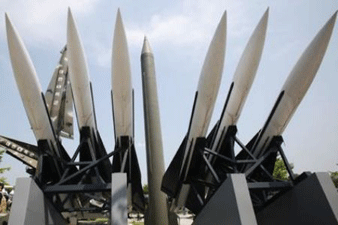
We will never give up nuclear weapons unless USA removes nuclear threat – says North Korea

North Korea Says It Won’t Give Up Nuclear Weapons Unless the U.S. Removes Nuclear Threat, TIME,  By KIM TONG-HYUNG / AP  December 20, 2018  (SEOUL, South Korea) — North Korea said Thursday it will never unilaterally give up its nuclear weapons unless the United States first removes what Pyongyang called a nuclear threat. The surprisingly blunt statement jars with Seoul’s rosier presentation of the North Korean position and could rattle the fragile trilateral diplomacy to defuse a nuclear crisis that last year had many fearing war.

The latest from North Korea comes as the United States and North Korea struggle over the sequencing of the denuclearization that Washington wants and the removal of international sanctions desired by Pyongyang. The statement carried by the North’s official Korean Central News Agency also raises credibility problems for the liberal South Korean government, which has continuously claimed that North Korean leader Kim Jong Un is genuinely interested in negotiating away his nuclear weapons as Seoul tries to sustain a positive atmosphere for dialogue.

The North’s comments may also be seen as proof of what outside skeptics have long said: that Kim will never voluntarily relinquish an arsenal he sees as a stronger guarantee of survival than whatever security assurances the United States might provide. The statement suggests North Korea will eventually demand the United States withdraw or significantly reduce the 28,500 American troops stationed in South Korea, a major sticking point in any disarmament deal.

Kim and President Donald Trump met June 12 in Singapore where they agreed on a vague goal for the “complete denuclearization” of the Korean Peninsula without describing when and how it would occur. The leaders are trying to arrange another meeting for early next year.

But North Korea for decades has been pushing a concept of denuclearization that bears no resemblance to the American definition, with Pyongyang vowing to pursue nuclear development until the United States removes its troops and the nuclear umbrella defending South Korea and Japan. In Thursday’s statement, the North made clear it’s sticking to its traditional stance on denuclearization. It accused Washington of twisting what had been agreed on in Singapore and driving post-summit talks into an impasse.

“The United States must now recognize the accurate meaning of the denuclearization of the Korean Peninsula, and especially, must study geography,” the statement said.

“When we talk about the Korean Peninsula, it includes the territory of our republic and also the entire region of (South Korea) where the United States has placed its invasive force, including nuclear weapons. When we talk about the denuclearization of the Korean Peninsula, it means the removal of all sources of nuclear threat, not only from the South and North but also from areas neighboring the Korean Peninsula,” the statement said.

The United States removed its tactical nuclear weapons from South Korea in the 1990s. Washington and Seoul have not responded to the North Korean statement……..

“If we unilaterally give up our nuclear weapons without any security assurance despite being first on the U.S. list of targets for pre-emptive nuclear strikes, that wouldn’t be denuclearization — it would rather be a creation of a defenseless state where the balance in nuclear strategic strength is destroyed and the crisis of a nuclear war is brought forth,” the KCNA said.

“The corresponding measures we have asked the United States to take aren’t difficult for the United States to commit to and carry out. We are just asking the United States to put an end to its hostile policies (on North Korea) and remove the unjust sanctions, things it can do even without a snap of a finger.”…….http://time.com/5485553/north-korea-nuclear-weapons-us-threat/

December 22, 2018 Posted by | North Korea, politics international | Leave a comment

New report concludes nuclear “will play no meaningful role” in climate change abatement

 NUCLEAR MONITOR  Author: Nuclear and Information and Resource Service NM870.4766

Nuclear power is frequently promoted as a necessary msolution to global warming, and a key means to achieve emissions goals. This is a major mistake, according to a new report published by the Rosa Luxemburg Stiftung‒ New York City. The report ‒ “Nuclear Power and Climate Action: An Assessment for the Future” ‒ presents an industrial analysis of nuclear energy to assess its viability as a climate solution. From real and practical evidence, the report concludes that nuclear power is not a viable tool in the climate solutions toolbox, and that nuclear- free paths to phasing out greenhouse gas emissions are necessary, feasible, and cost-effective.

The report evaluates the technology from all sides: the potential for building new reactors, the prospects for continuing to operate existing reactors, and the commercialization of so-called “advanced reactor designs” in the mid-century timeframe. Analysis shows that nuclear power may not be available in any meaningful capacity by 2050. Existing reactor fleets in most of the world are already reaching the end of their mechanical lives and will mostly phase out within the critical climate timeframe, and strategies to reduce gas reduction must take this into account.

“Those who argue that nuclear power is necessary to reduce GHG emissions are gravely mistaken,” said author of the report Tim Judson, Executive Director of the Nuclear and Information and Resource Service (NIRS). “The practical realities about nuclear energy show that it is a failed technology, which is on its way out. We have many more effective and promising tools in the climate action toolbox,” continued Judson. “We must not waste time and money on trying to preserve a role for nuclear power, and align energy policies and investments with rapidly transitioning to renewables, efficiency, and carbon-free, nuclear-free climate solutions.”

With the immense threats of climate change, it is tempting to overlook other environmental hazards in the effort to address it. That is a mistake with nuclear power especially, because its environmental impacts are so severe and long-lasting and so many of them intersect with and compound impacts of global warming as well as issues of climate justice. At every stage of its production ‒ from uranium mining to the production of radioactive wastes ‒ nuclear power pollutes the environment with some of the most dangerous, long-lived contaminants in the world and places undue stress on water resources.

Because fossil fuels make up 86% of global energy, decarbonization will require a total transformation of energy systems in most parts of the world. Renewable energies have proven to be the most promising option ‒ complemented by investments in energy efficiency, development of complementary technologies, and integrated reliably and resiliently. Evidence from places like Germany and California shows that nuclear power does not integrate well with renewables and phasing it out is likely to create greater opportunities to accelerate the phaseout of fossil fuels and the transformation of the energy system.

The report includes case studies showing that promotion of nuclear power entails significant climate opportunity costs, wasting time and financial investments that could reduce greenhouse gas emissions and decarbonize energy systems much more rapidly and cost-effectively.

For instance, in the United States, the Summer 2 and 3 reactors were cancelled after major cost overruns and construction delays bankrupted their manufacturer, after US$9 billion had already been spent. Had utilities invested in energy efficiency and renewables, the report finds, the utilities would have made substantial reductions in emissions and reduced electricity costs for their consumers.

Similarly, the state of New York in the US decided in 2016 to subsidize four aging, uneconomical reactors, at a projected cost of $7.6 billion by 2029 ‒ three times as much as will be spent to achieve 50% renewable energy standard in 2030. Had New York invested in energy efficiency instead of nuclear, it could achieve greater emissions reductions in 2030, at a cost reduction of $10.6 billion.

“The pursuit of nuclear power in South Africa would have permanently locked us into complicity in putting our country as a radioactive waste zone for centuries,” said Makoma Lekalakala, Director, Earthlife Africa Johannesburg, and 2018 awardee of the Goldman Environmental Prize for Africa. “By challenging the secret $76 billion agreement between South Africa and Rosatom, we exposed the role of corruption at the highest level of our government. The agreement would have forced South Africans to pay all the costs of a nuclear disaster, contaminated our environment and water with radioactive waste, and made electricity unaffordable for generations,” continued Lekalakala. “We have all of the clean, affordable wind and solar energy we need in South Africa, and overturning the nuclear agreement has put us back on track for a healthy, sustainable future, free of fossil fuels.”

“The imperatives of rapidly eliminating greenhouse gas emissions demand greater ambition in the implementation of the Paris Agreement,” said Kerstin Rudek of Bürgerinitiative Umweltschutz Lüchow-Dannenberg of Germany, on behalf of the international Don’t Nuke the Climate Coalition (a global network working to keep nuclear out of the climate agreements ‒ http://www.dont-nuke-the-climate.org. “Nuclear power has proved too expensive, too slow, and too unreliable to rapidly reduce emissions, and the vast majority of reactors around the world are likely to retire before 2050. A carbon-free, nuclear-free world is possible, but we can’t get there by wasting time, money, and political will on failed technologies and false solutions like nuclear power.”

The report concludes that the primary obstacles to rapidly phasing out fossil fuels and greenhouse gas emissions are political, not technological or economic. In particular, deceptive interventions by corporations invested in fossil fuels and nuclear energy have engendered inertia and confused the debate by, alternately, denying the reality of global warming and by presenting false solutions.

Mitigating the economic and social impacts of climate action by ensuring a just transition for workers and impacted communities is key to charting a clear vision and building and sustaining the political will to accelerate emissions reductions and the phase-out of greenhouse gas emissions.

The report is online: Tim Judson, Nov 2018, ‘NuclearPower and Climate Action: An Assessment for the Future’, Rosa Luxemburg Stiftung: New York, http://www.rosalux-nyc. org/wp-content/files_mf/judson_eng.pdf

December 22, 2018 Posted by | Uncategorized | 3 Comments

Tohoku disaster reconstruction to miss ’20 deadline for completion

hkl
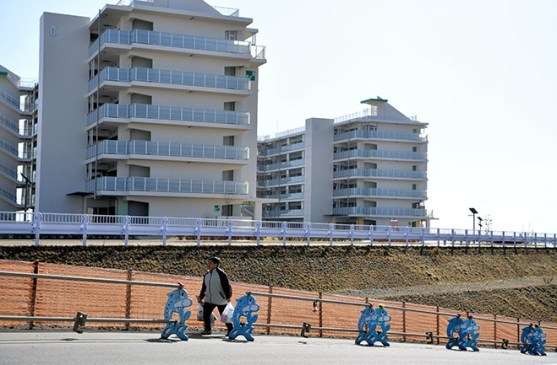
A resident in the Yuriage district of Natori, Miyagi Prefecture, returns to her home after shopping. The housing complex was built after the 2011 Great East Japan Earthquake and tsunami.
 
December 19, 2018
Reconstruction of areas devastated by the 2011 triple disaster will not be completed by fiscal 2020 as initially scheduled, and Fukushima Prefecture residents could be hit hardest by the delay, the Reconstruction Agency said.
Agency officials said Dec. 18 that further measures would be needed after fiscal 2020 to help areas affected by the triple meltdown at the Fukushima No. 1 nuclear power plant, as well as municipalities heavily damaged by the tsunami triggered by the Great East Japan Earthquake on March 11, 2011.
The government had set a 10-year reconstruction period as its basic policy, with the first five years described as an “intensive reconstruction period” and the second five years labeled as the “reconstruction and revitalization period.”
The Reconstruction Agency will also be eliminated at the end of March 2021, meaning the government will need new legislation to designate an agency that will handle the reconstruction effort in the Tohoku region from fiscal 2021.
Reconstruction Agency officials conducted studies in the five prefectures of Aomori, Iwate, Miyagi, Fukushima and Ibaraki during the current fiscal year to determine the extent of progress as well as what support measures should be continued beyond fiscal 2020.
The officials said some public works projects were taking longer than expected because of delays in buying land for those projects and revisions in reconstruction plans.
Although no specific project names or locations were revealed, the officials said all of those public works projects would not be completed by the end of fiscal 2020.
Under the government’s plan, the need for temporary prefabricated homes will no longer exist at the end of fiscal 2020.
However, elderly people who move out of such housing will still require care and supervision especially if they live alone and are suffering from psychological damage stemming from the natural disaster.
The situation looks especially dire in the locales most seriously affected by the nuclear accident.
Mountains of decontaminated soil will be moved outside of Fukushima Prefecture, but the relocation is not expected to happen for another 20 years. That means support measures for evacuees as well as Fukushima farmers and fishermen still dealing with negative publicity about their harvests will have to continue well beyond fiscal 2021.
A total of 32 trillion yen ($285 billion) has been set aside for the reconstruction effort. Whatever is left can be carried over after fiscal 2021 for still-incomplete projects.
At the end of fiscal 2017, 4.6 trillion yen had still not been spent. Reconstruction Agency officials did not say if additional budgetary measures would be needed.

December 22, 2018 Posted by | Fukushima 2018 | , , , | Leave a comment

Nuclear Fox Revealed! France’s Hervé Courtois of Nuclear-News, Rainbow Warriors – NH #391

Screen-Shot-2018-12-19-at-12.58.42-PM.jpgNuclear Fox Hervé Courtois & Nuclear Hotseat’s Libbe HaLevy @ the Window Rock of Window Rock AZ

 

This Week’s Featured Interview:

  • Nuclear FoxHervé Courtois of France, aka D’un Renard, or “The Fox” – has been a steadfast provider of reliable nuclear  news, especially from Fukushima, since the first months after the disaster began in 2011.  After many years of trying, at the International Uranium Film Festival, Libbe HaLevy succeeded in cornering him for an interview on why he became so involved with providing nuclear news, and what keeps him going.  Here are his links:

Numnutz of the Week (for Outstanding Nuclear Boneheadedness):

Nuclear disaster?  Radiation?  Contamination of Japanese food?  Fukushima sake in Manhattan?  I’ll drink to that!  (… or NOT…)

Activist Links:

  • Public Comment needed on Department of Energy’s proposal to abandon high-level radioactive wastes in situ –  meaning right where it is now, on site at reactors and on already contaminated lands.
  • LA Times article on Marco Kaltofen: “Hidden Danger: Radioactive Dust is Found in Communities Around Nuclear Weapons”
  • For the dust testing protocols after the Woolsey Fire, CLICK HERE.
    Key facts to remember:

    • Protect yourself from the dust and dirt with a mask and clothing that can be easily washed or even thrown away.
    • Do NOT simply send in to Fairewinds; you MUST get approval and registration with them or your sample will be disposed of without being opened.
    • The results will take at least 5 months, if not longer, to show up.  This is because of the intensity of the testing program and the number of steps that must be taken.   BE PATIENT.  When you get the data, it will be solid and scientific.

http://nuclearhotseat.com/2018/12/19/nuclear-fox-revealed-frances-herve-courtois-nuclear-news-rainbow-warriors-dun-renard/

December 22, 2018 Posted by | Fukushima 2018 | , , , | Leave a comment

Top court orders TEPCO to pay compensation for voluntary evacuation from Fukushima

iopm
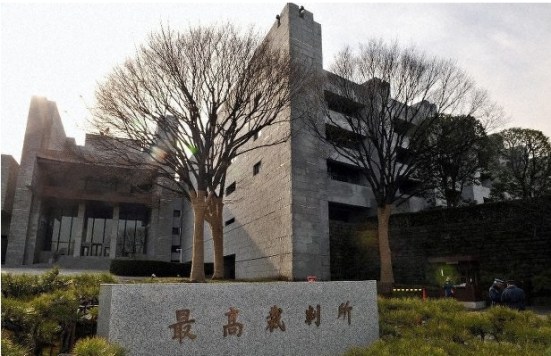
The Supreme Court building is seen in Tokyo.
 
December 18, 2018
TOKYO — The Supreme Court on Dec. 13 upheld the lower court ruling ordering Tokyo Electric Power Co. (TEPCO) to pay about 16 million yen in compensation to a man in his 40s and his family that voluntarily evacuated Fukushima Prefecture to western Japan after the 2011 nuclear disaster.
The top court’s First Petty Bench confirmed an Osaka High Court ruling handed down in October 2017 that recognized the man had developed depression due to the disaster and became unable to work. It marked the first time that a ruling awarding compensation to voluntary evacuees from the Fukushima Daiichi Nuclear Power Station disaster has been finalized by the top court, according to a legal team for victims of the nuclear crisis.
Meanwhile, the First Petty Bench led by Justice Katsuyuki Kizawa avoided mentioning the rationality of voluntary evacuation and other points in question as it turned down appeals from both sides against the high court ruling due to “insufficient grounds.”
According to the lower court rulings, the man from Japan’s northeastern Fukushima Prefecture city of Koriyama owned multiple restaurants and voluntarily evacuated with his family to locations outside the prefecture shortly after the outbreak of the nuclear crisis. The owner suffered from insomnia and was diagnosed with depression in September 2011, after relocating to the western Japan city of Kyoto.
TEPCO had already paid around 2.9 million yen to the family of five based on the government’s compensation standards. However, the man and his family deemed the amount inadequate and filed a lawsuit demanding about 180 million yen from TEPCO.
In its ruling handed down in February 2016, the Kyoto District Court ordered the utility pay about 30 million yen to the family after recognizing the causal relationship between the nuclear disaster and the man’s depression. The amount included compensation for the man and his wife’s mental suffering and damage caused by the man’s taking a leave of absence from work.
However, it upheld the government’s evacuation order standards. District court judges determined that voluntary evacuation would be rational only until August 2012 because “it’s difficult to recognize health damage from exposure to radiation below 20 millisieverts per year.”
After both parties appealed the district court ruling, the Osaka High Court basically agreed with the decision but ruled that the man only needed treatment for depression for two years due to the disaster, instead of four and a half years. Consequently, the high court had considerably reduced the compensation money awarded to the man due to his absence from work.

December 22, 2018 Posted by | Fukushima 2018 | , , , , | Leave a comment