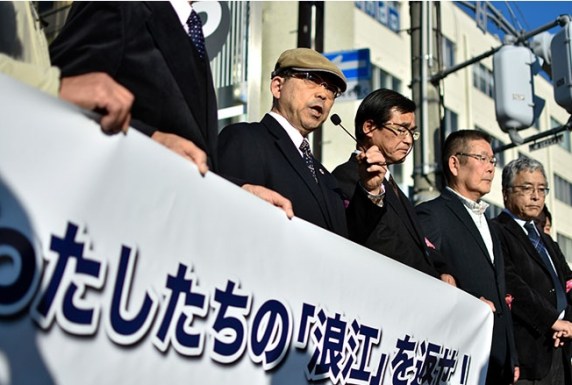
Plaintiffs in the lawsuit against TEPCO and the government gather in front of the Fukushima District Court in Fukushima on Nov 27.
November 28, 2018
FUKUSHIMA–Dismayed at a breakdown in talks for compensation, residents of the disaster-stricken town of Namie filed a lawsuit against Tokyo Electric Power Co. and the central government for damages stemming from the nuclear accident here in March 2011.
The plaintiffs are seeking 1.3 billion yen ($11.4 million) in financial redress.
The entire town was evacuated in the aftermath of a triple core meltdown at TEPCO’s Fukushima No. 1 nuclear power plant triggered by the Great East Japan Earthquake and ensuing tsunami.
The lawsuit was filed at the Fukushima District Court on Nov. 27 after five years of negotiations between the town and TEPCO collapsed in April over the utility’s refusal to meet demands for more compensation.
According to court papers, 109 plaintiffs of 49 households are seeking 12.1 million yen in individual compensation.
They stated that the nuclear accident destroyed their community and forced them to live as evacuees for a prolonged period.
TEPCO, under guidelines established by the central government, has been paying 100,000 yen a month to each resident forced to evacuate.
However, town officials argued that the figure was painfully low and should be increased to compensate for psychological suffering caused by the disaster.
In May 2013, the Namie municipal authorities, acting on behalf of residents, asked the nuclear damage claim dispute resolution center, an organization established by the central government in response to the Fukushima disaster, to mediate in the dispute.
About 15,000 residents, more than 70 percent of the town’s population, signed a petition for the mediation in an alternative dispute resolution (ADR) process at the center.
In March of 2014, an ADR proposal called for the monthly compensation to be uniformly increased by 50,000 yen.
The town accepted the offer but TEPCO rejected it, citing potential unfairness to others who had been compensated. In April, the center discontinued the reconciliation process.
Pointing out that TEPCO had reneged on its promise to “respect ADR reconciliation proposals,” the plaintiffs argued that the utility should pay for betraying the trust of residents.
An additional 2,000 or so townsfolk are planning to join the lawsuit.
In a statement, TEPCO said, “We will listen to the plaintiffs’ requests and complaints in detail and respond sincerely.”
Not only were the lives of residents turned upside down by the nuclear disaster, but more than 180 perished in the tsunami that engulfed the town.
Although the evacuation order was lifted for some parts of the town at the end of March 2017, entry to most of the area remains prohibited. http://www.asahi.com/ajw/articles/AJ201811280053.html?fbclid=IwAR1O0aNAvKOkAVVRm2UH44C6RT88xLhOntskaKyVvL3VSZmDlYSd7SMC1Vs
TAIPEI – Taiwan and Japan will hold annual trade talks in Taipei this week, coming after a weekend referendum in the former that could have a negative impact on bilateral relations.
Sources familiar with the two-day talks from Thursday say that both sides are planning to sign at least six agreements or memorandums of understanding.
They will cover a wide range of areas, including cooperation in management of medical equipment and materials, joint research by young researchers, and the mutual support and advancement of cooperation between small and medium-size businesses.
On Saturday, a majority of Taiwanese voted in favor of maintaining a ban on food imports from five Japanese prefectures that was imposed after the 2011 Fukushima nuclear disaster.
Taiwan’s representative to Japan, Frank Hsieh, earlier warned that if the referendum were approved, Taiwan would have a “grave price” to pay.
That “grave price” could include Taiwan’s bid to join a Japan-led trade pact, the Comprehensive and Progressive Agreement for Trans-Pacific Partnership.
Taiwan has expressed its desire to participate in the second-round of accession talks on numerous occasions.
Taiwan has also been seeking to sign a full-fledged free trade agreement with Japan. However, the ban on the imports of Japanese food products has stalled negotiations on the trade pact.
Despite the absence of diplomatic ties, which were severed in 1972, the unofficial relationship between Taiwan and Japan has remained robust.
Japan is Taiwan’s third-largest trading partner after China, including Hong Kong, while Taiwan is Japan’s fourth-largest trading partner.
Bilateral trade totaled $62.7 billion last year, up about 4 percent from the previous year. Japanese investment in Taiwan last year also increased more than 84 percent from the previous year to $649 million. https://www.japantimes.co.jp/news/2018/11/27/national/politics-diplomacy/taiwan-japan-hold-trade-talks-shadow-vote-keep-post-fukushima-food-ban/#.W_6-RfZFzIX
Elementary school pupils in Iwaki, Fukushima Prefecture, watch drone footage of their hometown of Futaba, which they are not permitted to enter due to high levels of radiation, and talk to local officials there via a satellite hookup.
Children living as evacuees are glued to images shot by a drone of their hometown of Futaba during a special presentation at their temporary campus in Iwaki, Fukushima Prefecture, on Nov. 26.
The children learn about decontamination work under way in Futaba via a satellite hookup during a field trip class held in Iwaki, Fukushima Prefecture, 80 kilometers away from the hometown they were forced to abandon after the 2011 nuclear disaster.
November 27, 2018
IWAKI, Fukushima Prefecture–With barely no recollections of growing up in Futaba, a town rendered uninhabitable by the 2011 nuclear disaster, 11 young evacuees had a “homecoming” of sorts on Nov. 26.
The children, fourth- to sixth-graders at two public elementary schools who currently study at a temporary campus in Iwaki, 80 kilometers south of Futaba, attended a special 45-minute presentation in a school gym to watch drone footage of the area where they were born.
A satellite feed allowed the pupils to talk to local officials about efforts to decontaminate the once-bustling community.
Futaba was transformed into a ghost town by the triple meltdown at the Fukushima No. 1 nuclear power plant triggered by the earthquake and tsunami disaster. High radiation levels mean that entry still remains restricted.
The children watched aerial footage of scenic spots shot by drones on three 70-inch monitors. Beautiful images of beaches and mountains in fall colors caused them to lean forward and express amazement.
Fifth-grader, Mao Oyano, 11, who has few memories of living in Futaba as she left at the age of 3, expressed surprise at seeing “many more houses than I expected.”
The children fell silent when eerie images appeared of the wrecked nuclear plant.
Ninety-six percent of Futaba, a town that co-hosts the stricken nuclear facility, is located in a difficult-to-return zone because of high radiation levels and remains uninhabited.
Adults must receive permission to enter the area, but children under the age of 15 are not allowed access.
The children were aged between 2 and 4 when they left, and have not set foot in Futaba since then.
Prior to the disaster, Futaba had two elementary schools with 309 pupils. In spring 2014, the town opened a temporary school facility in Iwaki, a coastal city to where many Futaba residents evacuated, but the number of pupils dropped to 31.
The “homecoming” was the school’s first attempt to give the children an opportunity to ponder the tragedy that befell their hometown, according to a school official. http://www.asahi.com/ajw/articles/AJ201811270053.html
Abstract
Plutonium and radiocaesium are hazardous contaminants released by the Fukushima Daiichi nuclear power plant (FDNPP) disaster and their distribution in the environment requires careful characterisation using isotopic information. Comprehensive spatial survey of 134Cs and 137Cs has been conducted on a regular basis since the accident, but the dataset for 135Cs/137Cs atom ratios and trace isotopic analysis of Pu remains limited because of analytical challenges. We have developed a combined chemical procedure to separate Pu and Cs for isotopic analysis of environmental samples from contaminated catchments. Ultra-trace analyses reveal a FDNPP Pu signature in environmental samples, some from further afield than previously reported. For two samples, we attribute the dominant source of Pu to Reactor Unit 3. We review the mechanisms responsible for an emergent spatial pattern in 134,135Cs/137Cs in areas northwest (high 134Cs/137Cs, low 135Cs/137Cs) and southwest (low 134Cs/137Cs, high 135Cs/137Cs) of FDNPP. Several samples exhibit consistent 134,135Cs/137Cs values that are significantly different from those deposited on plant specimens collected in previous works. A complex spatial pattern of Pu and Cs isotopic signature is apparent. To confidently attribute the sources of mixed fallout material, future studies must focus on analysis of individual FDNPP-derived particles.
Isoscapes of 134, 135, 137Cs and 239, 240Pu for part of the Fukushima prefecture surrounding FDNPP. The green marker is used to highlight an anomalous 240Pu/239Pu atom ratio of 0.64. R1, R2 and R3 correspond to ORIGEN estimated isotope ratio values for Reactor Units 1, 2 and 3, respectively27. SW indicates the mean value for the Cs isotope ratios measured to the southwest of FDNPP by Snow et al.19. 240Pu/239Pu atom ratio for Northern Hemisphere integrated global fallout is denoted by NHF28.
November 18, 2018 this person drove by the crippled Fukushima Daiichi Power Plant. His Geiger counter showed.
Please send this info to any Olympic athletes you know in the world. Tokyo will never be safe but will be ready for 2020 Olympic Games, by sacrificing everyone’s health and global environment for a handful people’s wealth.
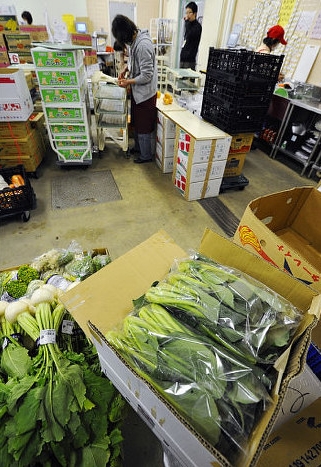
Vegetables produced in Fukushima Prefecture are withdrawn from the shelves of a supermarket in the city of Fukushima on March 23, 2011
November 25, 2018 FUKUSHIMA (Kyodo) — Farmers and fishermen in Fukushima called for further efforts to convince the public that their food is safe to eat on Sunday after Taiwan decided to maintain its import ban on Japanese food from areas affected by the 2011 nuclear disaster. Taiwan’s public voted in a referendum Saturday to maintain the ban on agricultural products and other food from Fukushima and four other prefectures.
“All we can do is to work harder until people understand that our products are safe,” said Masao Koizumi, a rice farmer in Fukushima.
The prefectural government of Fukushima has been conducting radiation checks on all rice produced in the prefecture. Since 2015, all shipments cleared the screening, with radioactive cesium levels below the 100-becquerel-per-kilogram limit set by the central government.
“When people see the inspection readings, they will know that there is no threat of radioactive materials,” Koizumi said.
Tetsu Nozaki, the head of an association representing fishery cooperatives in the prefecture, said, “We are disappointed, but we just need to make sure that we keep communicating the safety of our products.” https://mainichi.jp/english/articles/20181125/p2g/00m/0dm/049000c
The horrific murder of Jamal Khashoggi shed light on the reckless and dangerous decisionmaking process of Saudi Arabia’s Crown Prince Mohammad Bin Salman (MbS). In addition to the latest crisis The New York Times recently published a story about how the prince’s closest security personnel sought to hire private foreign companies to assassinate senior Iranian officials—an act that could have trigger a regional military conflict. This conduct follows a string of other bizarre events in the last few months, initiated by MbS.
The crown prince has demonstrated arrogant, cruel, amateur and capricious behavior. His aggression has been left almost unmonitored by checks and balances inside the Saudi hierarchy. Indeed, MbS has constrained all his potential rivals and has taken full controlof Saudi Arabia’s security and intelligence bodies. As the Khashoggi scandal has proven—such power enables dictators to secretly execute dangerous operations. In parallel, he managed to become the darling of the West after he initiated economic reforms and launched his so called modern 2030 vision .
Now add Saudi’s long history of nuclear ambitions to the mix. For years, Saudi officials have warned that Saudi Arabia will not curb its nuclear ambitions if it will sense a threat to its national security, or if Iran advances in its nuclear program. Rumors were that Pakistan was obliged to provide the Saudis a ready-for-use nuclear weapon if and when the time comes. Things only got more complicated once the nuclear agreement (JCPOA) with Iran was signed in 2015, practically legitimizing Iran’s rights to maintain and develop its uranium enrichment capabilities. At the beginning of November 2018, the crown prince participated in the opening ceremony marking the launch of construction of Riyadh’s first research reactor . It’s still early days and only a symbolic act—the Saudis lack knowhow, technicians, infrastructure and academic expertise—but the country has both enough ambition and funds to advance anyway. Shortly after that the Saudi energy minister said the kingdom launches uranium exploration program.
Over the last decade, purchasing sixteen nuclear power reactors—later scaled back to two reactors—plus uranium enrichment capabilities preferably from the United States, has
featured prominently on the Saudi agenda. The official rationale is the country’s future needs to supply energy —with self-sufficient nuclear materials. While having enrichment capabilities can serve to counterbalance Iran, it may also constitute a future military nuclear program. During previous negotiations with Saudi officials, the Obama administration insisted that Saudi Arabia must comply with the “ gold standard ,” reflective of the conditions imposed on the UAE when it agreed to buy U.S. reactors in 2009. This standard requires a commitment not to enrich uranium or to produce plutonium as a strict condition for any agreement to sell nuclear reactors. According to current Secretary of State Mike Pompeo, the Trump administration has maintained this policy . In an interview with CBS in March 2018, MbS maintained that “without a doubt, if Iran developed a nuclear bomb, we would follow suit as soon as possible.”
Following the murder of Khashoggi, Senate members urged the Trump administration to curb any intention to sell nuclear reactors to the Saudi regime. This move is certainly necessary, but not nearly enough. An American refusal to his demands can push the prince to seek an alternative option elsewhere, with producers that will be all too happy to assist—for the right price.
Much of MbS’s current conduct lies parallel to previous experience with three other Middle East tyrants: former Iraqi president Saddam Hussein, Libya’s leader Muammar el-Qaddafi, and Syrian president Bashar al-Assad. These cynical dictators have a common denominator in their infinite ambitions, which ultimately led them to secretly promote a nuclear weapons program. They all relied heavily on their security systems in initiating these plans. Libya and Syria had no sufficient nuclear infrastructure, so they bought a turnkey nuclear project from Pakistan’s A.Q. Khan Network, and in the Syrian case from North Korea .
The Saudi nuclear issue has placed a challenge before the administration. If the prince is successful in surviving the current crisis, then that could prompt him to make even riskier decisions, including taking the nuclear path. Much like in Iraq, Libya and Syria, all the necessary components for that are now in place: A de facto dictator with delusions of grandeur and poor judgment, full control over the security services, unlimited funds for the purpose, a national sense of isolation, an acute threat, and a long-term nuclear vision. As Iran seems to be complying with the JCPOA, a Saudi move could instigate a nuclear arms race in the Middle East. To avoid this, the Trump administration should warn and restrict the Saudi heir. It should also keep a very close eye on Saudi Arabia’s nuclear connections and activities.
Ronen Dangoor is the former deputy head of the research and analysis division at the Israeli prime minister’s office.
For nuclear plants, that warning is particularly grave. Reactors require 720 gallons of water per megawatt-hour of electricity they produce……Solar plants, by contrast, use approximately 20 gallons per megawatt-hour, mostly for cleaning equipment
Trump Administration’s Climate Report Raises New Questions About Nuclear Energy’s Future
The thirstiest source of electricity is already struggling, and greater risk of droughts will only add to those woes. Huffington Post.By Alexander C. Kaufman, 28 Nov 18,
Call it the nuclear power industry’s thirst trap.
The United States’ aging fleet of nuclear reactors ― responsible for one-fifth of the country’s electricity and most of its low-carbon power ― has never been more necessary as policymakers scramble to shrink planet-warming emissions. Yet the plants are struggling to stay afloat, with six stations shut down in the last five years and an additional 16 reactors scheduled to close over the next decade. So far, new coal- and gas-burning facilities are replacing them.
The nuclear industry blames high maintenance costs, competition from cheaper alternatives and hostile regulators concerned about radiation disasters like the 2012 Fukushima meltdown in Japan. But the country’s most water-intensive source of electricity faces what could be an even bigger problem as climate change increases the risk of drought and taxes already crumbling water infrastructure.
That finding, highlighted in the landmark climate change report that the Trump administration released with apparent reluctance last Friday, illustrates the complex and at times paradoxical realities of anthropogenic, or human-caused, warming. It also stokes an already hot debate over the role nuclear energy should play in fighting global warming, a month after United Nations scientists warned that carbon dioxide emissions must be halved in the next 12 years to avoid cataclysmic climate change leading to at least $54 trillion in damage.
The report ― the second installment of the Fourth National Climate Assessment, a congressionally mandated update on the causes and effects of anthropogenic warming from 13 federal agencies ― devoted its entire third chapter to water contamination and depletion. Aging, deteriorating infrastructure means “water systems face considerable risk even without anticipated future climate changes,” the report states. But warming-linked droughts and drastic changes in seasonal precipitation “will add to the stress on water supplies and adversely impact water supply.”
Nearly every sector of the economy is susceptible to water system changes. And utilities are particularly at risk. In the fourth chapter, the report’s roughly 300 authors conclude, “Most U.S. power plants … rely on a steady supply of water for cooling, and operations are expected to be affected by changes in water availability and temperature increases.”
For nuclear plants, that warning is particularly grave. Reactors require 720 gallons of water per megawatt-hour of electricity they produce, according to data from the National Energy Technology Laboratory in West Virginia cited in 2012 by the magazine New Scientist. That compares with the roughly 500 gallons coal requires and 190 gallons natural gas needs to produce the same amount of electricity. Solar plants, by contrast, use approximately 20 gallons per megawatt-hour, mostly for cleaning equipment, according to the Solar Energy Industries Association, a trade group.
Nuclear plants are already vulnerable to drought. Federal regulations require plants to shut down if water in the river or lake that feeds its cooling drops below a certain level. By the end of the 2012 North American heat wave, nuclear generation fell to its lowest point in a decade, with plants operating at only 93 percent of capacity.
The availability of water is one problem, particularly for the majority of U.S. nuclear plants located far from the coasts and dependent on freshwater. Another is the temperature of the water that’s available.
Nearly half the nuclear plants in the U.S. use once-through cooling systems, meaning they draw water from a local source, cool their reactors, then discharge the warmed water into another part of the river, lake, aquifer or ocean. Environmental regulations bar plants from releasing used water back into nature above certain temperatures. In recent years, regulators in states like New York and California rejected plant operators’ requests to pull more water from local rivers, essentially mandating the installation of costly closed-loop systems that cool and reuse cooling water.
In 2012, Connecticut’s lone nuclear power plant shut down one of its two units because the seawater used to cool the plant was too warm. The heat wave that struck Europe this summer forced utilities to scale back electricity production at nuclear plants in Finland, Germany, Sweden and Switzerland. In France the utility EDF shut down four reactors in one day.
“Already they’re having trouble competing against natural gas and renewable energy,” said John Rogers, a senior energy analyst at the Union of Concerned Scientists. “Add onto that high water temperatures, high air temperatures and drought. It’s just another challenge.”
…….. the heart of the biggest question looming over the nuclear industry: Is it, given the radioactive waste it produces, clean energy?
……… For the Sierra Club, the environmental giant making a huge push to get cities and states to go all renewable, nuclear power is “a uniquely dangerous energy technology for humanity” and “no solution to climate change.”
“There’s no reason to keep throwing good money after bad on nuclear energy,” Lauren Lantry, a Sierra Club spokeswoman, said by email. “It’s clear that every dollar spent on nuclear is one less dollar spent on truly safe, affordable, and renewable energy sources like wind, solar, energy efficiency, battery storage, and smart grid technology.” https://www.huffingtonpost.com.au/entry/nuclear-energy-climate-change-report_us_5bfdb9cae4b0a46950dce58f
France to close 14 nuclear reactors by 2035 an all coal-fired power plants by 2022, The Local 28 Nov 18President Emmanuel Macron said on Tuesday that France would shut down 14 of the country’s 58 nuclear reactors currently in operation by 2035, of which between four and six will be closed by 2030.
The total includes the previously announced shutdown of France’s two oldest reactors in Fessenheim, eastern France, which Macron said was now set for summer 2020.
He also announced that France would close its remaining four coal-fired power plants by 2022 as part of the country’s anti-pollution efforts……
Macron said France would aim to triple its wind power electricity output by 2030, and increase solar energy output fivefold in that period.
He added that he would ask French electricity giant EDF to study the feasibility of more next-generation EPR nuclear reactors, but will wait until
2021 before deciding whether to proceed with construction.
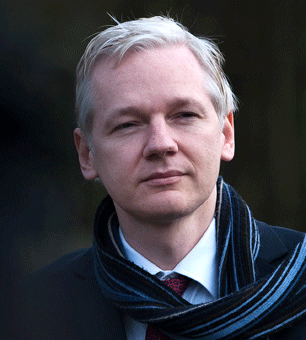
Gareth Porter 28 Nov 18 The accidental revelation in mid-November that U.S. federal prosecutors had secretly filed charges against WikiLeaks founder Julian Assange underlines the determination of the Trump administration to end Assange’s asylum in the Ecuadorian Embassy in London, where he has been staying since 2012.
Behind the revelation of those secret charges for supposedly threatening U.S. national security is a murky story of a political ploy by the Ecuadorian and British governments to create a phony rationale for ousting Assange from the embassy. The two regimes agreed to base their plan on the claim that Assange was conspiring to flee to Russia. Continue reading →
Sellafield: Europe’s most radioactively contaminated site
Inside Sellafield’s death zone with the nuclear clean-up robots,By Theo Leggett, Business correspondent, BBC News, 27 November 2018
The Thorp nuclear reprocessing plant at Sellafield, Cumbria, has recycled its final batch of reactor fuel. But it leaves behind a hugely toxic legacy for future generations to deal with. So how will it be made safe?
Thorp still looks almost new; a giant structure of cavernous halls, deep blue-tinged cooling ponds and giant lifting cranes, imposing in fresh yellow paint.
But now the complex process of decontaminating and dismantling begins.
It is a dangerous job that will take decades to complete and require a great deal of engineering ingenuity and state-of-the-art technology – some of which hasn’t even been invented yet.
This is why.
Five sieverts of radiation is considered a lethal dose for humans. Inside the Head End Shear Cave, where nuclear fuel rods were extracted from their casings and cut into pieces before being dissolved in heated nitric acid, the radiation level is 280 sieverts per hour.
We can only peer through leaded glass more than a metre thick at the inside of the steel-lined cell, which gleams under eerie, yellow-tinged lighting.
This is a place only robots can go.
They will begin the first stage of decommissioning – the post-operative clean-out – removing machinery and debris……….. Cleaning up other parts of the plant will also need robots and remotely operated vehicles (ROVs).
Some will need to be developed from scratch, while others can be adapted from systems already used in other industries, such as oil and gas, car manufacturing and even the space sector……..
The site in Cumbria contains a number of other redundant facilities, some dating back to the 1950s and many of them heavily contaminated, which are currently being decommissioned………
Remote submarines have explored and begun cleaning up old storage ponds. Other remote machines are being used to take cameras deep inside decaying bunkers, filled with radioactive debris.
The job of developing machines like these is shared with a large network of specialist companies, many of them based in Cumbria itself. They form part of a growing decommissioning industry within the UK, as the country grapples with the legacy of its first era of nuclear power.
The NDA believes that these companies can use what they learn at Sellafield, and other plants, to attract further business from overseas……..https://www.bbc.com/news/business-46301596
Why Saudi Arabia Will Acquire Nuclear WeaponsIf the Trump administration continues to turn its nuclear negotiations into a boondoggle, then nothing will prevent Riyadh from building bombs.,National Interest by Paul R. Pillar, 28 Nov 18
The Trump administration’s handling of nuclear negotiations with Saudi Arabia promises to lay bare some realities about security issues and nuclear programs in that part of the world that the administration has refused to acknowledge. A front-page article by David Sanger and William Broad in the New York Timesreviews some of the still-unresolved questions. The Saudi regime insists on producing its own nuclear fuel, which would be different from terms the United States has negotiated with some other states, including the United Arab Emirates, that have sought U.S. assistance in developing their nuclear programs. The Saudis have balked at comprehensive international inspections to detect any work on nuclear weapons. And Saudi Arabia’s Crown Prince Mohammed bin Salman (MbS) has explicitly threatened to develop nuclear weapons, ostensibly in response to any similar development by Iran.
A useful model for approaching this situation involves Iran. The model is the Joint Comprehensive Plan of Action (JCPOA), the multilateral accord commonly known as the Iranian nuclear deal, which Donald Trump has castigated and on which his administration has reneged by imposing new economic sanctions despite continued Iranian compliance with the JCPOA. The JCPOA closed all possible pathways to development of an Iranian nuclear weapon through stringent restrictions on enrichment of uranium, the gutting of reactors that otherwise might be used to produce plutonium, and the prohibition of any reprocessing by Iran of nuclear fuel. The agreement also established a thorough inspection system that involves not only routine monitoring of nuclear facilities but also the ability of international inspectors to inspect any other sites they may have reason to suspect are housing nuclear-related activity, with the other parties to the agreement being able to outvote Iran in the event of disagreement about the relevance of a requested inspection. This is the kind of highly intrusive inspection arrangement that the Saudis reportedly are refusing to apply to themselves.
The principal U.S. negotiator has been Secretary of Energy Rick Perry, for whom this is a learning-on-the-job experience. Perry was initially unaware of the Department of Energy’s nuclear responsibilities and believed his job would consist of promoting the oil industry. (This contrasts with Perry’s predecessor, Ernest Moniz, a nuclear physicist who played a key role in negotiation of the highly detailed JCPOA.)………
Amid all the talk among opponents of the JCPOA about ballistic missiles, it is worth noting that Saudi Arabia has been ahead of its regional neighbors on that count as well. Two decades ago, Saudi Arabia secretly purchased medium-range missiles from China that, although reportedly configured to carry conventional weapons, were of a type originally designed to deliver a nuclear warhead. The Saudis in more recent years have modernized their missile force, again relying on China as the supplier.
Destabilizing regional activity also implies that Saudi Arabia is more of a worry than most states regarding the implications of possible acquisition of nuclear weapons. Saudi Arabia has bombed Yemen into becoming a humanitarian catastrophe, has kidnapped and attempted to coerce into resignation the prime minister of Lebanon, and has used diplomatic facilities in foreign countries to assassinate nonviolent dissidents. The impetuous young prince behind these policies has been moving toward one-man rule, shedding even the restraints of what had been a collective family autocracy.
The murder of Jamal Khashoggi has drawn some recent and welcome attention to this pattern of behavior, although it has not budged Donald Trump from his stance of sticking with MbS no matter what he does. California Rep. Brad Sherman has appropriately observed, “A country that can’t be trusted with a bone saw shouldn’t be trusted with nuclear weapons.”
The administration’s assault on the JCPOA may provide the trigger for Saudi Arabia to try to obtain such weapons. If the U.S. “maximum pressure” campaign succeeds in negating completely the economic relief Iran was supposed to have received under the JCPOA, then Iranian leaders may yet throw up their hands in disgust and pronounce the agreement null and void. This would release Iran from all its nuclear restrictions under the agreement, which in turn might provide the perfect rationale for Riyadh, especially as long as MbS is in charge, to acquire the bomb.
TRUMP SAYS HIS ‘VERY HIGH LEVELS OF INTELLIGENCE’ MEANS HE CAN’T BELIEVE IN CLIMATE CHANGE, SCIENTISTS DESPAIR News Week ,BY BRENDAN COLEON 11/28/18 Scientists have reacted with dismay to President Donald Trump’s assertion that he was not among the “believers” in the seriousness of climate change.
His administration released a dense report compiled by 13 federal agencies last week that painted a bleak picture of the severity of the impact of climate change on the lives of Americans, and the U.S. economy.
But Trump dismissed it.
“One of the problems that a lot of people like myself, we have very high levels of intelligence but we’re not necessarily such believers,” Trump told The Washington Post in an interview in the Oval Office.
“As to whether or not it’s man-made and whether or not the effects that you’re talking about are there, I don’t see it,” he said, doubling down on his initial reaction to the National Climate Assessment report on Monday, when he said: “I don’t believe it.” ….
The White House report warned that rising temperatures had already harmed the U.S., and that limiting greenhouse gases would substantially benefit the American economy…..
Andrew Dessler, a professor of atmospheric sciences at Texas A&M University, called the president’s comments “idiotic,” The Post reported.
And Katharine Hayhoe, a climate scientist at Texas Tech University, told The Post: “Facts aren’t something we need to believe to make them true, we treat them as optional at our peril.
There has been great concern about extensive and extremely toxic and radioactive waste at the SSFL for years.
According to Daniel Hirsch, who recently retired as director of the Program on Environmental and Nuclear Policy at the University of California, Santa Cruz, SSFL is “one of the most contaminated sites in the country
There are multiple human health impacts that have been known to stem from the site well before the Woolsey Fire began.
A study prepared by Professor Hal Morgenstern for the federal Agency for Toxic Substances and Disease Registry studied the community surrounding SSFL and found a greater than 60 percent increase in incidence of key cancers associated with proximity to the site.
“DTSC is a classically captured regulatory agency, captured by the polluters it is supposed to regulate,”
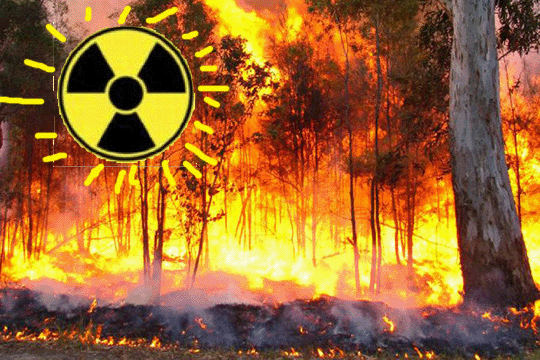
The fire may also have released large amounts of radiation and toxins into the air after burning through a former rocket engine testing site where a partial nuclear meltdown took place nearly six decades ago.
“The Woolsey Fire has most likely released and spread both radiological and chemical contamination that was in the Santa Susana Field Laboratory’s soil and vegetation via smoke and ash,” Dr. Bob Dodge, president of Physicians for Social Responsibility-Los Angeles (PSR-LA), told Truthout.
The fire has been widely reported to have started “near” the Santa Susana Field Laboratory site (SSFL), but according to PSR-LA, it appears to have started at the site itself.
The contaminated site — a 2,849-acre former rocket engine test site and nuclear research facility — is located just 30 miles northwest of downtown Los Angeles.
 Plaintiffs in the lawsuit against TEPCO and the government gather in front of the Fukushima District Court in Fukushima on Nov 27.
 Elementary school pupils in Iwaki, Fukushima Prefecture, watch drone footage of their hometown of Futaba, which they are not permitted to enter due to high levels of radiation, and talk to local officials there via a satellite hookup.
 Children living as evacuees are glued to images shot by a drone of their hometown of Futaba during a special presentation at their temporary campus in Iwaki, Fukushima Prefecture, on Nov. 26.
 The children learn about decontamination work under way in Futaba via a satellite hookup during a field trip class held in Iwaki, Fukushima Prefecture, 80 kilometers away from the hometown they were forced to abandon after the 2011 nuclear disaster.

 Isoscapes of 134, 135, 137Cs and 239, 240Pu for part of the Fukushima prefecture surrounding FDNPP. The green marker is used to highlight an anomalous 240Pu/239Pu atom ratio of 0.64. R1, R2 and R3 correspond to ORIGEN estimated isotope ratio values for Reactor Units 1, 2 and 3, respectively27. SW indicates the mean value for the Cs isotope ratios measured to the southwest of FDNPP by Snow et al.19. 240Pu/239Pu atom ratio for Northern Hemisphere integrated global fallout is denoted by NHF28.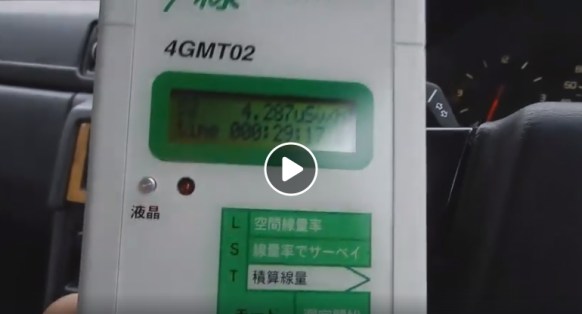
 Vegetables produced in Fukushima Prefecture are withdrawn from the shelves of a supermarket in the city of Fukushima on March 23, 2011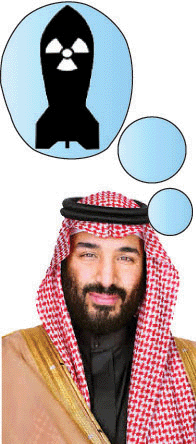







 nuclear-news