Japan must halt returns to Fukushima, radiation remains a concern, says UN rights expert

TEPCO to scrap Onagawa NPP’s reactor#1

Utility plans to scrap reactor at Onagawa plant
Tohoku Electric to scrap aging No. 1 unit at Onagawa nuclear plant
Draft bill omits state burden for nuclear accident compensation

France presents vitrification process for Fukushima

More time needed for confidence to return on Fukushima produce: Lam

Abe and Xi expected to discuss food import ban, but chances of progress uncertain

Stop the return of women and child evacuees to radioactive parts of Fukushima – UN’s call to Japan
 U.N. rights expert urges Japan to halt women and child evacuee returns to radioactive parts of Fukushima https://www.japantimes.co.jp/news/2018/10/26/national/science-health/u-n-rights-expert-urges-japan-halt-women-child-evacuee-returns-radioactive-parts-fukushima/#.W9PVHmgzbIU
KYODO GENEVA – The Japanese government must halt the return of women and children displaced by the March 2011 nuclear disaster back to areas of Fukushima where radiation levels remain high, a U.N. human rights expert said Thursday.
The special rapporteur on hazardous substances, Baskut Tuncak, also criticized in his statement the government’s gradual removal of evacuation orders for most of the radioactive areas as well as its plan to lift all orders within the next five years, even for the most contaminated areas.
“The gradual lifting of evacuation orders has created enormous strains on people whose lives have already been affected by the worst nuclear disaster of this century. Many feel they are being forced to return to areas that are unsafe,” he said.
An official of Japan’s permanent mission to the international organizations in Geneva rebuffed the statement, saying it is based on extremely one-sided information and could fan unnecessary fears about Fukushima.
Tuncak expressed concerns about people returning to areas with radiation above 1 millisievert per year, a level previously observed by Japan as an annual limit so as to prevent risks to the health of vulnerable people, especially children and women of reproductive age.
“It is disappointing to see Japan appear to all but ignore the 2017 recommendation of the U.N. human rights monitoring mechanism to return back to what it considered an acceptable dose of radiation before the nuclear disaster,” he said.
In the wake of the Fukushima reactor meltdowns, the Japanese government heightened the annually acceptable level of radiation to 20 millisieverts, raising concerns for the health of residents.
In August, Tuncak and two other U.N. human rights experts jointly criticized the Japanese government for allegedly exploiting and putting at risk the lives of “tens of thousands” of people engaged in cleanup operations at and around the crippled Fukushima No. 1 nuclear plant, a claim Tokyo dismissed.
Japan’s government refuses UN call to stop returning evacuees to irradiated areas of Fukushima
 Japan rejects UN call to stop returns to Fukushima, Channel News Asia, 27 Oct 18 TOKYO: Japan’s government on Friday (Oct 26) rejected calls from a UN rights expert to halt the return of women and children to areas affected by the Fukushima nuclear disasterover radiation fears.
UN special rapporteur Baskut Tuncak on Thursday warned that people felt they were “being forced to return to areas that are unsafe, including those with radiation levels above what the government previously considered safe.”
In the wake of the Fukushima disaster, Japan’s government lifted its standard for the acceptable level of radiation to 20 millisieverts per year from 1 millisievert.
It has been urged to revise that level back down again, but has rejected calls to do so, a decision Tuncak called “deeply troubling.”
“Japan has a duty to prevent and minimise childhood exposure to radiation,” he said.
But Japan’s government rejected the criticism, saying Tuncak’s comments were based on “one-sided information and could fan unnecessary fears about Fukushima,” a foreign ministry official told AFP.
Japan’s government has gradually lifted evacuation orders on large parts of the areas affected by the disaster, which occurred when a massive tsunami sent reactors at the Fukushima Daiichi plant into meltdown in March 2011.
But other areas remain under evacuation orders because of continued high levels of radiation.
Japan’s government has pushed hard to return affected areas to normal, but has faced criticism that what it refers to as “safe” radiation levels are not in line with international standards. …….. https://www.channelnewsasia.com/news/asia/japan-fukushima-meltdown-radiation-fears-10867932
NATO – Europeans urge USA not to quit nuclear treaty:
NATO urges Trump officials not to quit nuclear treaty: diplomats https://www.reuters.com/article/us-usa-nuclear-nato/nato-urges-trump-officials-not-to-quit-nuclear-treaty-diplomats-idUSKCN1MZ2KZ, Robin Emmott, BRUSSELS (Reuters) 26 Oct 18, – European members of NATO urged the United States on Thursday to try to bring Russia back into compliance with a nuclear arms control treaty rather than quit it, diplomats said, seeking to avoid a split in the alliance that Moscow could exploit.
In a closed-door meeting at NATO, Pentagon, U.S. State Department and National Security Council officials briefed alliance envoys on U.S. President Donald Trump’s decision to pull out of the 1987 Intermediate-range Nuclear Forces Treaty, which rid Europe of land-based nuclear missiles.
Diplomats present said Germany and other European allies called for a final effort on Washington’s part to convince the Kremlin to stop what the West says are violations, or possibly renegotiate it to include China.
“Allies want to see a last-ditch effort to avoid a U.S. withdrawal,” one NATO diplomat said on condition of anonymity because of the classified nature of the meeting, which took place two days after senior U.S. official John Bolton informed Russian President Vladimir Putin of the plans in Moscow.
“Nobody takes issue with Russia’s violation of the treaty, but a withdrawal would make it easy for Moscow to blame us for the end of this landmark agreement,” a second diplomat said.
NATO declined to comment on the details of the meeting but issued a statement saying that allies assessed “the implications of Russia’s destabilizing behavior on our security.”
“NATO allies will continue to consult on this important issue,” it added.
Earlier this week, NATO Secretary-General Jens Stoltenberg laid the blame on Russia for violating the treaty by developing the SSC-8, a land-based, intermediate-range Cruise missile which also has the name of Novator 9M729.
Russia denies any such violations.
NATO allies including Belgium and the Netherlands, which host U.S. nuclear weapons facilities in Europe, warned in the North Atlantic Council, NATO’s highest decision-making body, of a public outcry if the United States were to try to install medium-range nuclear weapons on their territory again.
Stoltenberg said on Wednesday he did not think this would lead to reciprocal deployments of U.S. missiles in Europe as happened in the 1980s.
European allies see the INF treaty as a pillar of arms control and, while accepting that Moscow is violating it by developing new weapons, are concerned its collapse could lead to a new arms race with possibly a new generation of U.S. nuclear missiles stationed on the continent.
Diplomats said the U.S. officials did hold out the possibility that the United States may delay its formal withdrawal to after a planned meeting between Putin and Trump in Paris on Nov. 11.
The treaty foresees a six-month notification period for any withdrawal, also potentially giving Washington time to negotiate with Moscow before finally pulling out.
Reporting by Robin Emmott; Editing by Hugh Lawson
Putin warns European nations on hosting US nuclear weapons – risk to them of counter-strike
 Putin says Russia will target nations who host US nuclear weapons https://www.independent.co.uk/news/world/europe/russia-putin-missiles-us-arms-treaty-inf-john-bolton-moscow-a8600146.html
‘European countries… must understand that they are putting their own territory at risk of a possible counterstrike,’ says Russian president, Oliver Carroll, Moscow
Nuclear power lobbyists for Saudi Arabia finding it (a bit) tough following Jamal Khashoggi ‘s murder

 Saudi’s Lobbyists Feel Heat of Khashoggi Murder, Bloomberg By Kathleen Hunter, October 26, 2018 It’s not just Donald Trump who has cultivated a cozy relationship with Riyadh. Saudi Arabia has been a cash cow for Washington’s influence industry.
Over the past decade, D.C.’s lobbyists have raked in $76.9 million advocating for the Saudis on everything from nuclear power to fending off legislation that would leave the kingdom liable in lawsuits filed by family members of victims in the Sept. 11 terrorist attacks, Ben Brody, Naomi Nix and Bill Allison report.
That lucrative business is now facing its biggest test in years as the killing of U.S.-based journalist Jamal Khashoggi inside the Saudi consulate in Istanbul draws worldwide criticism. ….https://www.bloomberg.com/news/articles/2018-10-26/saudi-lobbyists-feel-heat-of-khashoggi-murder-balance-of-power?
Utah state regulators reject EnergySolutions’ request for burying depleted uranium
 Utah says no to EnergySolutions accepting depleted uranium from military, but will it change course in the future? Salt Lake Tribune, By Brian Maffly 26 Oct 18 Radioactive munitions won’t be buried in Utah’s West Desert anytime soon after a decision issued Thursday by state regulators, who rejected EnergySolutions’ emergency request to accept several thousand tons of armor-piercing projectile points made of heavier-than-lead depleted uranium.
Climate change. Prolonged dry weather leads EDF to curb Fessenheim 2 nuclear reactor output

 EDF curbs Fessenheim 2 nuclear reactor output due to dry weather https://www.reuters.com/article/france-drought-nuclearpower/edf-curbs-fessenheim-2-nuclear-reactor-output-due-to-dry-weather-idUSL8N1X63FD
PARIS, Oct 26 (Reuters) – French utility EDF reduced output at its 900 megawatts (MW) Fessenheim 2 nuclear reactor on Friday as prolonged dry weather across west and central Europe has led to low water levels at the Rhine river which it uses to cool the reactor.
French grid operator RTE said EDF cut output at Fessenheim 2 by 130 MW due to environmental issues. EDF use water from the Rhine river as coolant for the plant, France’s oldest, which has two 900 MW reactors.
EDF could not be reached for comment on the situation.
Sea level rise -the threat to nuclear power plants -Pilgrim to move nuclear waste to higher ground
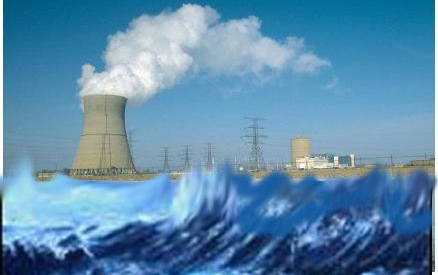 Pilgrim to move nuclear waste to higher ground, http://www.patriotledger.com/news/20181026/pilgrim-to-move-nuclear-waste-to-higher-ground By Joe DiFazio
The Patriot Ledger PLYMOUTH — Officials at the Pilgrim Nuclear Power Station said they want to move nuclear waste at the site to higher ground over the next few years with an eye toward sea level rise.
Patrick O’Brien, spokesman for Entergy, the plant’s owner, said that the new proposed site will be located in what is now a parking lot 75 feet above sea level and 350 feet away from Rocky Hill Road. The site is 700 feet away from the closest point on the shoreline, O’Brien said.
Pilgrim is slated to be shut down by June 1. Entergy announced in August it plans to sell the station to Holtec International who will decommission the plant. O’Brien said the plan to move the waste was made in conjunction with Holtec.
O’Brien said that the proposed site was chosen as the best of three under consideration and that it was evaluated for nine regulatory and technical requirements. O’Brien saidEntergy will apply for the required permits and plans to begin construction on the new site before Pilgrim shuts down.
Nuclear Regulatory Commission spokesman Neil Sheehan said that the move doesn’t need approval from his agency, but it would monitor construction of the new site and movement of the spent nuclear fuel. The NRC will need to approve Pilgrim’s sale to Holtec.
The personal struggle – a rare brain cancer – nothing to do with his radiation exposure at Los Alamos National Laboratory?
 Half Life Chad Walde believed in his work at Los Alamos National Laboratory. Then he got a rare brain cancer, and the government denied that it had any responsibility , Pro Publica, by Rebecca Moss, The Santa Fe New Mexican, 26 Oct 18,“………A Gap Between Records and Recollection
CHAD WAS CLEARED TO RETURN TO HIS JOB at the lab in late January 2015, four months after his diagnosis. He’d undergone radiation and two chemotherapy treatments, and Los Alamos’ occupational medicine staff said he was fit to continue working with classified material, his medical records show. At risk for seizures, he couldn’t drive or climb stairs or ladders. Chad carpooled and had Angela drive him to the laboratory several times a week. His supervisor offered him a desk job, a step down from his managerial role — but one that kept his health insurance running. He accepted. The only real alternative was termination.
Roark says the lab’s goal is to treat all employees with debilitating conditions with “utmost respect” and says when employees are unable to perform the functions of their jobs, Los Alamos “makes reasonable efforts to accommodate them,” which can result in job reassignment.
Separately, to process his claim for cancer benefits, the Department of Labor also told Chad it would need all of his medical and radiation exposure records from the lab. The Department of Labor sends these to the National Institute for Occupational Safety and Health, another federal agency that uses a probability equation to determine if a worker had a high enough dose of radiation to cause cancer. If the computer found a 50 percent or higher correlation, Chad would get benefits.
When the records arrived from Los Alamos, containing a single CD and a brief letter, it was the first time Chad realized that his own experience differed from what the lab had noted in its records.
The lab had found “no records” of Chad having been exposed to anything or other environmental occupational hazards, the letter said. And his dosimetry report, a spreadsheet that showed his total dose of radiation annually, was scant.
The lab had not tracked Chad’s radiation exposure in 1999, his first year on the job, the report indicated, or in 2000, when the Cerro Grande fire burned. External monitoring began in 2001 but showed a clean zero for 11 out of the next 14 years. (Only in 2008, 2013 and 2014 were there any hits on the report.)
The report said his total dose was 0.254 rems over his career, well below safety limits and slightly less than an average person gets from background radiation from the sun and environment in a single year. A rem is a unit used to measure the absorbed dose of radiation, with 1 rem equivalent to a CT scan, according to the Nuclear Regulatory Commission.
Chad marveled at the document. It didn’t track with his memory — or hold any record of the time he’d been called in for going over his limit and accused of taking his badge to the airport, or when he was sent home wearing disposable clothes.
“They aren’t on here,” Chad said when he looked at the document.
It also seemed impossible there were so many years that were completely blank.
Asked about the discrepancy between Walde’s memory and the reports, Los Alamos spokesman Roark said, in general, that the lab “maintains a comprehensive archive of worker radiation dosimetry data” and that it “provides any and all records in response to requests as quickly as possible.”
When NIOSH reviewed the records, it had a simple way to fill in the gaps. For the two years when Chad was not monitored, NIOSH assumed the maximum dose he could have been exposed to was the maximum background radiation at the lab (which was 0.4 rem), adding in the possibility of a couple missed readings.
NIOSH said Chad’s records showed he had been exposed to “various sources of radiation during his employment,” but the maximum dose he could have received at the lab, based on its calculations and assumptions, was a 3.744 rem dose to the brain. The agency modeled his probability for cancer based on how this amount of radiation would affect and mutate cells of the thyroid. It does not have a model for how external radiation might impact brain tissue.
On a phone call with a NIOSH claims representative in September 2015, Chad asked why the agency used general air monitoring data to fill in his missed readings. Chad, who made a recording of the call, said this would fail to account for the radiation present at the more dangerous nuclear areas he had been assigned to.
He told the representative how his badge often took hits. Like he’d told his father-in-law, and his friends, Chad said his boss kept asking him why his readings were “above the reporting levels.”
I “wonder if we are not missing something,” Chad said on the recording. “I also worry about the Los Alamos reporting,” relaying instances in which the lab certified an area free of radiation only to discover contamination later while he was working on a maintenance job. Chad began to talk about something he witnessed at the liquid radioactive waste plant but trailed off, saying, “I don’t know if I am allowed to say any of this stuff — never mind.”
Chad Walde’s radiation shells hang in the garage of his family’s home. The shells help keep the head still while a patient receives radiotherapy. (Adria Malcolm, special to ProPublica)
Stu Hinnefeld, director of the divis Stu Hinnefeld, director of the division of compensation analysis and support for NIOSH, said in an interview that those exposed to radiation have a “relatively low” likelihood of developing brain cancer compared with lung and thyroid cancers. He said the institute’s risk models, as a result, require a worker to have a much higher documented exposure to radiation than many of the other cancers in order to get compensation.
The Department of Labor concluded there was just a 2.67 percent chance his cancer was related to his radiation exposure history. His claim was denied on Jan. 14, 2016.
Chad’s dates of employment made him more likely to be rejected than if he had worked at the lab in a prior era. Overall, the Department of Labor has approved nearly 60 percent of claims filed by Los Alamos workers for cancer and beryllium disease. But for workers who started working at the lab after 1996, that figure falls to 45 percent, according to data requested under the Freedom of Information Act.
A spokesperson for the Department of Labor said, “While gaps in past records have existed at some sites, workers in the modern era have more extensive monitoring records. There are no unexplained gaps or readings in this employee’s radiation dose records.”
Still, Chad wanted to appeal. Over the next year, he would undergo another surgery and start experiencing frequent seizures, at one point spending two days in a coma in Texas, where the family had traveled for the twins’ volleyball tournament, when the spasms refused to subside. The family held “Gray Be Gone” fundraisers, referring to the color of the tumor tissue, to raise money to send Chad to MD Anderson for treatment. He also started clinical trials with a doctor in New Mexico.
During that time, Chad learned that he was not the only person at Los Alamos who thought missing records had led the Department of Labor to deny a claim.
For more than a decade, workers at Los Alamos have been telling federal officials that similar data and records problems have prevented them from getting compensation. In June 2005, at a NIOSH forum for the lab’s technical workers’ union, one worker said the lab “had lied and falsified documents right and left … the monitors were turned off, people weren’t qualified to be doing the monitoring, the equipment was never calibrated,” according to meeting minutes.
Another man, an X-ray technician, said his personal radiation badge always showed up with zero contamination.
Falsified radiation data or medical records have been documented at other labs, including in 2003 at Savannah River Site in South Carolina and Hanford Site in Washington state. Radiation records also were falsified at an Ohio nuclear facility in 2013. The Department of Energy fined lab managers in South Carolina and Ohio more than $200,000 each for “willful falsification.”
Los Alamos has not been fined for willful falsification of health records, but it has been cited within the past year for serious safety violations and for failing to check laboratory rooms for toxic chemicals before allowing workers to enter. Internal incident reports from the early 2000s, obtained by NIOSH, described how records had been removed from radiation log books, “deliberate tampering” with nasal swipe samples (used to test if a worker inhaled radioactive particles) and problems with workers not wearing their radiation badges.
Soon after Chad’s diagnosis, another electrician on his crew, Cesario Lopez, told Chad he’d recently had part of his kidney taken out after being diagnosed with cancer. Both Lopez’s mother and uncle, who worked at the lab before him, had been diagnosed with cancer, too. Lopez applied for and was denied compensation by the Department of Labor but has appealed.
Then Chad learned about his friend Gilbert Mondragon. Mondragon started working as an electrician on the fire protection crew in August 1999, three months before Chad. Mondragon was just 19 and from the beginning saw Chad as a mentor. Chad, he said, taught him how to have a good attitude at work and find value in it. That became harder after Mondragon was diagnosed with kidney cancer in the spring of 2014 at the age of 34.
Like Chad, Mondragon’s radiation report showed 14 straight years of zeroes, and only two years, 2006 and 2007, in which his badge took any hits, totaling 67 millirems of radiation over 16 years.
“It’s not like people think it is,” Mondragon said about lab safety. He, like Chad, recalled several times he’d been decontaminated and given new work clothes or boots.
Mondragon believes some of the zeroes are also the result of being told, by his supervisors, to take his badge off when he was doing work in contaminated places. “Now I know better,” he said, “but it’s too late.”
Roark, the lab spokesman, denies workers were ever told to remove their badges, saying its “Radiation Protection Program would never allow, endorse or recommend removing dosimeters to avoid contamination.”
Ken Silver, who sits on a Department of Labor advisory board and is a professor of environmental health at East Tennessee State University, testified before Congressin 2007 that instructing workers to remove their radiation badges was a common practice for “cleanup crews” at Los Alamos in the past. Silver said this practice was based on the belief that if a badge was contaminated, workers would go on to spread radiation throughout the laboratory, which he called a “flimsy assumption.”
Los Alamos officials did not testify at the hearing. But the lab says its rate of injuries has dropped significantly since 2006 and is well below the industry average. The laboratory says it does not track the cause of death for its employees.
Hinnefeld said NIOSH has looked into allegations that workers were told to remove their badges and, “We hear that on occasion.” But he said, in the past, officials have concluded that this wouldn’t affect how the agency reconstructs a worker’s radiation exposure because a single missed reading is unlikely to hold much weight in the overall career of a worker.
Diagnosed with chronic obstructive pulmonary disease and asthma, which his physician has linked to chemical exposure, Mondragon resigned from the lab this winter. The doctors’ visits have consumed his life. His cancer claim, like Chad’s, also was rejected by the Department of Labor, but he was told he would likely be accepted if he were to develop another cancer.
For the last six months, he has relied on the help of an oxygen tank to breathe, trailing a long, green plastic tube wherever he goes…..more https://features.propublica.org/los-alamos/chad-walde-nuclear-facility-radiation-cancer/
1 This Month
Chernobyl: The Lost Tapes – A good documentary on Chernobyl on SBS available On Demand for the next 3 weeks– https://www.sbs.com.au/ondemand/tv-program/chernobyl-the-lost-tapes/2352741955560

of the week–London Campaign for Nuclear Disarmament

Tell the Ukrainian Government to Drop Prosecution of Peace Activist Yurii Sheliazhenko
To see nuclear-related stories in greater depth and intensity – go to https://nuclearinformation.wordpress.com
-
Archives
- April 2026 (126)
- March 2026 (251)
- February 2026 (268)
- January 2026 (308)
- December 2025 (358)
- November 2025 (359)
- October 2025 (376)
- September 2025 (257)
- August 2025 (319)
- July 2025 (230)
- June 2025 (348)
- May 2025 (261)
-
Categories
- 1
- 1 NUCLEAR ISSUES
- business and costs
- climate change
- culture and arts
- ENERGY
- environment
- health
- history
- indigenous issues
- Legal
- marketing of nuclear
- media
- opposition to nuclear
- PERSONAL STORIES
- politics
- politics international
- Religion and ethics
- safety
- secrets,lies and civil liberties
- spinbuster
- technology
- Uranium
- wastes
- weapons and war
- Women
- 2 WORLD
- ACTION
- AFRICA
- Atrocities
- AUSTRALIA
- Christina's notes
- Christina's themes
- culture and arts
- Events
- Fuk 2022
- Fuk 2023
- Fukushima 2017
- Fukushima 2018
- fukushima 2019
- Fukushima 2020
- Fukushima 2021
- general
- global warming
- Humour (God we need it)
- Nuclear
- RARE EARTHS
- Reference
- resources – print
- Resources -audiovicual
- Weekly Newsletter
- World
- World Nuclear
- YouTube
-
RSS
Entries RSS
Comments RSS
 nuclear-news