Federal court upholds New York program to subsidize nuclear plants, Washington Examiner, by Josh Siegel, September 27, 2018 The U.S. Court of Appeals for the 2nd Circuit on Thursday upheld the legality of New York’s program that props up struggling nuclear plants to provide electricity without carbon dioxide emissions.
The court said the state subsidy program does not interfere with the power that the Federal Energy Regulatory Commission has over wholesale electricity markets, as charged by other electricity suppliers who filed suit, including the Electric Power Supply Association.
The three-judge panel acknowledged that New York’s program would keep nuclear plants alive, and raise costs for competitors, but said those effects were “incidental.”
……..The ruling comes a few weeks after the U.S. Circuit Court of Appeals for the 7th Circuit upheld a similar policy in Illinois………
FERC has filed amicus briefs in the cases affirming the programs do not preempt the agency’s legal authority set by the Federal Power Act.
Critics say the programs bailout failing nuclear plants in the state, that are struggling to compete with lower cost natural gas and renewables.
The Trump administration is considering a bigger, widely contested plan, on a national scale, to require grid operators to buy power from a select list of coal and nuclear plants.
Environmentalists cheered the state court rulings as a signal that courts consider states to have broad power to set clean energy goals, and to impose policies to achieve them. For example, many states have renewable portfolio standards requiring generators to obtain more and more of their electricity from clean sources.
“The 2nd Circuit’s decision rejecting a challenge to [New York’s] ZEC program may be narrowly covered as a decision affecting nuclear resources, but the much bigger reason it is major news is because it eliminates legal uncertainty for states in designing clean energy programs,” said Miles Farmer, a clean energy attorney at the Natural Resources Defense Council, in a Twitter post. https://www.washingtonexaminer.com/policy/energy/federal-court-upholds-new-york-program-to-subsidize-nuclear-plants
The Supreme Court could hear cases related to the EPA’s climate obligations and other environmental issues, Scientific American, By Mark K. Matthews, E&E News on September 27, 2018
If Senate Republicans plow ahead and confirm Brett Kavanaugh to the Supreme Court, the longtime jurist could have near-term impact on a slew of environmental cases.
Among the disputes the high court has agreed to hear this fall: a case that pits villagers from India against the World Bank in a fight over a coal plant. If the villagers prevail, it could have worldwide economic and political repercussions.
Several other climate-related issues have a decent shot, too, of getting a future date with the Supreme Court, including one closely watched fight—the “kids’ climate case”——that makes the far-reaching argument that the government must take action on global warming so as not to imperil future generations.
Kavanaugh—currently a judge on the U.S. Court of Appeals for the District of Columbia Circuit—would replace Justice Anthony Kennedy, who retired in July after three decades of service and dozens of landmark decisions.
Kennedy was often a swing vote on the ideologically divided court, and he played a key role in several major environmental cases.
Arch. Gallagher: Holy See will continue opposing nuclear weapons, Vatican News
Archbishop Paul Richard Gallagher, the Vatican Secretary for Relations with States, addresses a United Nations General Assembly meeting on the elimination of nuclear weapons. By Robin Gomes, 27 Sept 18
The Holy See said on Wednesday it will continue to argue against both the possession and the use of nuclear weapons, saying the total elimination of nuclear weapons is not only a security issue, but a moral, humanitarian and environmental imperative.
The Vatican Secretary for Relations with States, Archbishop Paul Richard Gallagher made the statement at a high-level meeting at the 73rd session of the United Nations General Assembly to mark the September 26 International Day for the Total Elimination of Nuclear Weapons.
Threat of annihilation
“The world is not safer with nuclear weapons; it is more dangerous,” Archbishop Gallagher said. “A policy that relies on the possession of nuclear weapons,” he said, “is contradictory to the spirit and purpose of the United Nations because nuclear weapons cannot create for us a stable and secure world, and because peace and international stability cannot be founded on mutually assured destruction or on the threat of total annihilation.”
Environmental, humanitarian consequences
Speaking about the environmental disasters and humanitarian consequences of the use of nuclear weapons, the Holy See official whose portfolio is equivalent to that of foreign minister, encouraged all countries to make the Comprehensive Nuclear Test-Ban Treaty (CTBT) a reality by ensuring its entry into force….https://www.vaticannews.va/en/vatican-city/news/2018-09/holy-see-un-gallagher-nuclear-weapons.html
The owner of what was considered to be America’s oldest nuclear power plant until its shutdown last week says it has removed the nuclear fuel from the reactor.
Chicago-based Exelon Corp. has notified the U.S. Nuclear Regulatory Commission that it removed the last of the fuel rods from the Oyster Creek Nuclear Generating Station on Tuesday.
The material was placed into a spent fuel pool where it will cool down for at least two years.
The fuel eventually will be placed into sealed concrete casks for longer-term storage on the grounds of the former plant in Lacey Township in New Jersey.
A Jupiter, Florida company, Holtec International, plans to buy the plant and move the fuel to an interim disposal site it is proposing in New Mexico.
Earthquake Studies Reveal the True Cost of North Korea’s Nuclear Tests Inverse, By Emma Betuel September 26, 2018
On September 3, 2017, North Korea tested a nuclear bomb 17 times larger than the one that leveled Hiroshima, sending ripples of alarm across the world. More than just raise the eyebrows of policy makers, the blast also piqued the interest of experts at Columbia University’s Lamont Doherty Earth Observatory, who show in a pair of recent papers that last September’s nuclear test may be responsible for many of the aftershocks that occurred in the past year.
While some existing research argues it’s unlikely that a nuclear test could cause a massive earthquake, the two papers identify 13 high-frequency tremors that traveled through North Korea in the months following the September test. More importantly, they confirm which of them were triggered by the explosion, which were unrelated earthquakes, and which — as some have feared — were caused by additional nuclear tests.
“North Korea has conducted six nuclear tests, but the latest one was huge. That’s what we’ve analyzed the signals from,” Woon Young Kim, Ph.D., the lead author of the Seismological Research Letters paper and a professor of seismology geology and tectonophysics, tells Inverse. “The question was: Were they explosions or were they earthquakes?”
The earliest rumblings occurred just eight minutes after the initial nuclear test but were not included in the paper’s aftershock count. But two occurred later that month and another on October 12. In December there were five more. The tremors continued into 2018, with four in February and the final one on April 22.
The issue, explains Kim, is that scientists were aware of these tremors as they occurred but nobody knew why they were happening. At the time, some expertsidentified these tremors as evidence that North Korea was testing more nukes on a smaller scale, but Kim’s new paper, published in conjunction with another studyauthored by his colleague David Schaff, Ph.D., suggests not only that some of those tremors were actually just earthquakes but also that they were tightly grouped along a fault line, where similar events will likely occur in the future.
Bomb or Earthquake?
To find out whether these shakes were organic or the result of nuclear testing, Kim analyzed two major wave types measured after the tests. Whenever the earth shakes (whether it’s due to an explosion or not), the first rumble to roll by is called an “P-wave” or primary wave. It’s typically the first wave to get picked up by monitoring stations and travels around six kilometers per second.
…….. After more analysis, the researchers concluded that “event 8” was actually an earthquake, together with two other suspected explosions.
“There have been about three events at the North Korea test site that we feel were misclassified,” Schaff tells Inverse. “No method is 100 percent certain, but combining the two methods, I was able to say with a very high probably of certainty that these were earthquakes.”
The Real Consequences of September 3, 2017
The good news is that these results suggest that North Korea isn’t testing bombs as frequently as some might fear They do, however, suggest that there could be something going on underneath the surface as a result of the September 3 explosion.
Using the data provided by Kim, Schaff showed that the tremors following the explosion were clustered along a unified path. As it turns out, what had originally looked like a random spattering of explosions and earthquakes over an area spanning five kilometers was actually a cluster of tremors that occurred within about 700 meters of one another near North Korea’s Chinese border.
The activity around this fault line can actually be traced back to that initial explosion in September of last year, explains Kim. “It’s not 100 percent sure, but I think somehow that the nuclear test was so large that it triggered these small seismic events to the north of the area,” he says.
As some have feared, it appears that North Korea’s testing hasaltered the landscape, at least near the surface of the Earth. In April, Kim Jong-Un announced that North Korea would stop testing nukes in its mountainous hideaway beneath Mt. Mantap, a move that Chinese scientists have suggested is due to the fact that a number of underground tunnels have collapsed beneath the mountain. Other studies have also suggested that continued testing has blown bits of Mt. Mantap to smithereens, making it a non-useful test site.
Should North Korea start testing again, says Schaff, he will be eager to continue the project. “It’s nice to be working on something that affects the state of the world we’re living in,” he says. “This is more than just knowledge for knowledge’s sake. https://www.inverse.com/article/49304-north-korea-nuclear-test-caused-earthquakes
Radiation Free Lakeland 25th Sept 2018 The rain returned several weeks ago and our gardens and fields have
returned to their usual shades of green. However, United Utilities still
finds it necessary to take full-page advertisements urging us all “to use
a little less water,” to spend less time in the shower, to turn off the
tap when brushing teeth etc. These are, of course in themselves, laudable
actions, but it also seems reasonable to ask ‘Where has all the water
gone? ‘ and, subsequently, to speculate that a big part of the answer
lies in the enormous quantities of water being extracted from Cumbria’s
rivers and lakes to cool and service the many serious hazards that remain
at the Sellafield nuclear site, including Building 30. https://mariannewildart.wordpress.com/2018/09/25/nuclear-costing-the-earth-rivers-and-sea/
Solar Power Portal 26th Sept 2018 A Labour government would look to treble the UK’s current solar capacity
and create more than 400,000 green jobs by 2030. Those were the key facts
from this week’s Labour Party conference which comprised speeches from
some of the opposition party’s central figures. Yesterday the party’s
shadow business, energy and industrial energy secretary Rebecca Long-Bailey
said that Labour had been working with an “expert team” of energy
professionals, engineers and academics to assess how the country could meet
such a target. A near trebling of the UK’s solar capacity would equate to
around 39GW of operational solar in the UK, enough, according to
Long-Bailey, to power seven million homes. Leonie Greene, director of
advocacy at the Solar Trade Association, stressed that expanding wind and
solar capacity should be an economically-driven decision that crosses party
political lines. “The government estimates that around £180 billion
needs to be invested in the electricity sector alone to 2030, so enabling
the lowest cost technologies which do not need public subsidy and which do
not contribute to climate change – namely solar and onshore wind – would be
very good news for consumers.” https://www.solarpowerportal.co.uk/news/corbyns_labour_government_would_treble_uk_solar_capacity_create_400000_gree
,Fortune, By GRACE DOBUSH , 27 Sept 18, The Alvin W. Vogtle Electric Generating Plant in Georgia, the only nuclear power reactors currently under construction in the U.S., got a last-minute save last night as warring partners agreed to new funding terms.
Southern Co. subsidiary Georgia Power, which owns 45.7% of the project, will shoulder more of the costs past a certain level, and agreed to purchase future tax credits at a discounted cost from co-owners Oglethorpe Power Corp. (30%), the Municipal Electric Authority of Georgia (22.7%) and Dalton Utilities (1.6%).
Costs for the two new nuclear reactors have nearly doubled to more than $27 billion. Partners and politicians are worried the costs will trickle down to rural customers’ electric bills, but the sunk costs of halting construction would also be expensive for consumers.
The existing two reactors at Vogtle have been in operation since the 1980s. The new reactors, now expected to come online in 2021 and 2022, are five years behind schedule and $13 billion over budget. The Vogtle owners have been struggling since the designer and lead construction contractor, Westinghouse Electric Co., filed for bankruptcy in March 2017.
The Department of Energy has paid the project’s owners $5.6 billion of an $8.3 billion loan guarantee for the project. The Trump administration has promised the project another $3.7 billion if construction continues. But if the project were stopped, the DOE would demand an accelerated repayment schedule.
John Sneed, executive director of the DOE Loan Programs Office, had said in a letter to project leaders that his agency acknowledges continuing construction is a “commercial decision” but that the owners must realize Vogtle’s “profound impact on the U.S. nuclear industry.” He added: “The decision each owner makes should be made with an understanding of the ripple effect this project is already having, including job creation and the positive signal of the continued value of commercial nuclear power in our country.”……..http://fortune.com/2018/09/27/vogtle-nuclear-power-plant-construction-deal/
This July 17, 2018 file photo shows the Tokai No. 2 nuclear power plant, front, in the village of Tokai in Ibaraki Prefecture.
26 sept 2018
TOKYO — The Nuclear Regulation Authority (NRA) officially determined on Sept. 26 that the Tokai No. 2 nuclear power plant north of Tokyo meets new, more stringent safety standards introduced after the March 2011 triple core meltdown and massive radiation leaks at the Tokyo Electric Power Co. (TEPCO) Fukushima No. 1 nuclear power plant.
Tokai plant operator Japan Atomic Power Co. intends to restart the reactor and operate it 20 years beyond its original 40-year lifespan.
The only nuclear power station in the greater Tokyo area became the first nuclear power station to pass the NRA screening among those affected by the 2011 Great East Japan Earthquake, which triggered the nuclear disaster at TEPCO’s Fukushima No.1 plant in northeastern Japan.
Restarting the 1.1-million-kilowatt Tokai No. 2 plant in the village of Tokai in Ibaraki Prefecture, about 160 kilometers northwest of central Tokyo, is no easy task, however. Japan Atomic needs to obtain approval from neighboring municipalities to resume reactor operations. Devising an evacuation plan in case of an accident for the some 960,000 residents living within a 30-kilometer radius of the plant is also a major challenge.
To get permission for the 20-year reactor life extension, Japan Atomic must also obtain government approval for relevant construction and extension plans before Nov. 27 this year, when the reactor will turn 40. The construction plan and the operational extension screening is almost finished, and both will be approved before the deadline.
Japan Atomic plans to complete safety enhancement work by March 2021 and then restart the plant at a later date. The work will cost some 174 billion yen, and Japan Atomic is depending on financial support from TEPCO and Tohoku Electric Power Co. to cover the outlay.
Tokai No. 2 became the eighth nuclear power station, and the 15th reactor, to pass the NRA safety screening. It is the second boiling water reactor after TEPCO’s Kashiwazaki-Kariwa nuclear power station certified as meeting the new safety standards. The reactors are a similar type to the ones at the Fukushima No. 1 plant that suffered core meltdowns.
(Japanese original by Riki Iwama, Science & Environment News Department)
Tsunami-hit nuclear plant near Tokyo wins formal restart approval
Tokai Reactor #2, Hit By March 11, 2011 tsunami gets NRA approval to reopen but needs approval of surrounding communities to do so. NRA sounds just like NRC.
Sept 26, 2018
The nuclear watchdog on Wednesday formally approved the restart of an almost 40-year-old nuclear power plant northeast of Tokyo that has sat idle since it was damaged during the 2011 earthquake and tsunami disaster, which also caused meltdowns at the Fukushima No. 1 plant.
The Tokai No. 2 plant in Tokai, Ibaraki Prefecture, operated by Japan Atomic Power Co., is the first nuclear plant affected by the disaster to clear screening by the Nuclear Regulation Authority.
The earthquake on March 11, 2011, left the plant without an external power source, and a 5.4-meter tsunami incapacitated one of its three emergency power generators. The plant managed to cool down its reactor over three and a half days after the disaster as the two other power generators remained operational.
The Fukushima plant, which used the same boiling water reactor as the Tokai plant, suffered core meltdowns and spewed out a massive amount of radioactive material after losing its external power supply and emergency power generators in the calamity.
Still, it is unclear when the Tokai plant will actually restart as construction work to enhance its safety will not be completed until March 2021. Also, it needs to obtain consent from all of its surrounding communities. It is the only nuclear power plant in the country to need consent from local governments beyond its host municipality.
In addition, the sole reactor in the complex turns 40 years old in November and faces two more screenings to extend its operation by up to 20 years beyond the normal 40-year limit. It is expected to pass the screenings.
It operator must also compile an evacuation plan covering the 960,000 residents within a 30-kilometer radius of the plant — the largest number of potential evacuees for a nuclear plant in the country due to its location in the metropolitan region.
In Tokyo, protesters gathered in front of the NRA office in the morning and shouted slogans against the restart.
Some civic group members submitted to the watchdog a letter calling for a decision against the plant’s resumption with the signatures of some 8,000 people. “A plant that passes a lax screening is not safe,” the document said.
Sengetsu Ogawa, 54, a local anti-nuclear activist in Ibaraki Prefecture, said, “I have doubts about the way the NRA conducts screenings as it is believed to rubber stamp operators’ applications (for restarts).”
“Japan has been rocked by major disasters such as floods and earthquakes for the past two months. Based on these circumstances, the NRA should conduct a screening again,” he said.
Tokai No. 2 is the eighth nuclear plant approved by the NRA to restart under stricter safety rules introduced after the Fukushima disaster.
Among plants with boiling water reactors, it is the second to be given the green light following the Kashiwazaki-Kariwa nuclear complex run by Tokyo Electric Power Company Holdings Inc., the operator of the crisis-hit Fukushima plant.
Japan Atomic Power applied for the restart in May 2014 with a plan to construct a 1.7-km-long coastal levee, predicting a potential tsunami as high as 17.1 meters.
With costs for safety measures at the plant estimated to reach some ¥180 billion ($1.6 billion), the operator, whose sole business is nuclear energy production, has struggled as none of its reactors has been online since the 2011 disaster.
Tepco and Tohoku Electric Power Co., which receive power supply from Tokai No. 2, have offered to financially support Japan Atomic Power.
Poor region of Japan is now very dependent on Rokkasho nuclear recycling project
Japan Nuclear Fuel Ltd.’s plant in Rokkasho, Japan , Aug. 2, 2018.
Japan has amassed a large stockpile of plutonium and neighbours fear that the country may decide to build more nuclear weapons.
25 Sept 2018
More than 30 years ago, when its economy seemed invincible and the Sony Walkman was ubiquitous, Japan decided to build a recycling plant to turn nuclear waste into nuclear fuel.
It was supposed to open in 1997, a feat of advanced engineering that would burnish its reputation for high-tech excellence and make the nation even less dependent on others for energy.
Then came a series of blown deadlines as the project hit technical snags and struggled with a Sisyphean list of government-mandated safety upgrades. Seventeen prime ministers came and went, the Japanese economy slipped into a funk and the initial $6.8 billion budget ballooned into $27 billion of spending.
Now, Japan Nuclear Fuel Ltd, the private consortium building the recycling plant, says it really is almost done. But there is a problem: Japan does not use much nuclear power anymore.
The country turned away from nuclear energy after the 2011 Fukushima disaster, and only nine of its 35 reactors are operational.
It is a predicament with global ramifications. While waiting for the plant to be built, Japan has amassed a stockpile of 47 metric tons of plutonium, raising concerns about nuclear proliferation and Tokyo’s commitment to refrain from building nuclear arms even as it joins the United States in pressing North Korea to give up its arsenal.
In August, North Korea’s state-run Rodong Sinmun newspaper accused Japan of accumulating plutonium “for its nuclear armament.”
Japan pledged for the first time this past summer to reduce the stockpile, saying the recycling plant would convert the plutonium into fuel for use in Japanese reactors.
But if the plant opens as scheduled in four years, the nation’s hoard of plutonium could grow rather than shrink.
That is because only four of Japan’s working reactors are technically capable of using the new fuel, and at least a dozen more would need to be upgraded and operating to consume the plutonium that the recycling plant would extract each year from nuclear waste.
“At the end of the day, Japan is really in a vice of its own making,” said James M. Acton, a researcher at the Carnegie Endowment for International Peace in Washington.
“There is no easy way forward, and all those ways forward have significant costs associated with it.”
A handful of countries reprocess nuclear fuel, including France, India, Russia and the United Kingdom.
But the Japanese plan faces a daunting set of practical and political challenges, and if it does not work, the nation will be left with another problem: about 18,000 metric tons of nuclear waste in the form of spent fuel rods that it has accumulated and stored all these years.
A storage facility for spent fuel rods at Japan Nuclear Fuel Ltd.’s plant in Rokkasho, Japan, Aug 2018.
Japan’s neighbours, most notably China, have long objected to the stockpile of plutonium, which was extracted from the waste during tests of the recycling plant and at a government research facility, as well as by commercial recycling plants abroad.
Most of this plutonium is now stored overseas, in France and Britain, but 10 metric tons remain in Japan, more than a third of it in Rokkasho, the northeastern fishing town where the recycling plant is being built.
Japan says it stores its plutonium in a form that would be difficult to convert into weapons, and that it takes measures to ensure it never falls into the wrong hands.
But experts are worried the sheer size of the stockpile — the largest of any country without nuclear weapons, and in theory enough to make 6,000 bombs — could be used to justify a nuclear buildup by North Korea and others in the region.
Any recycling plan that adds to the stockpile looks like “a route to weaponise down the road,” said Alicia Dressman, a nuclear policy specialist. “This is what really concerns Japan’s neighbours and allies.”
Japan maintains that its plutonium is for peaceful energy purposes and that it will produce only as much as it needs for its reactors. “We are committed to nonproliferation,” said Hideo Kawabuchi, an official at the Japan Atomic Energy Commission.
But the launch of the Rokkasho plant has been delayed so long — and popular opposition to restarting additional nuclear reactors remains so strong — that scepticism abounds over the plan to recycle the stockpile.
Critics say Japan should concede the plant will not solve the problem and start looking for a place to bury its nuclear waste.
“You kind of look at it and say, ‘My God, it’s 30 years later, and that future didn’t happen,’” said Sharon Squassoni, a nonproliferation specialist at George Washington University.
“It’s just wishful thinking about how this is going to solve their myriad problems.”
Ruling puts onus on anti-nuclear plaintiffs citing volcanic risks
Lawyer Hiroyuki Kawai, center, explains the Hiroshima High Court’s decision on Sept. 25 to lift a temporary injunction barring operations of the Ikata nuclear plant.
September 26, 2018
HIROSHIMA–The Hiroshima High Court has significantly raised the bar for plaintiffs seeking suspensions of nuclear plant operations on grounds of a possible volcanic eruption.
In a ruling handed down on Sept. 25, the court overturned a temporary injunction order that had halted operations at the Ikata nuclear plant, saying the plaintiffs must present highly credible evidence of the risk of a catastrophic volcanic eruption.
The plaintiffs argued that Shikoku Electric Power Co. must suspend operations of its Ikata plant in Ehime Prefecture because of the dangers posed by Mount Aso in central Kyushu, Japan’s southern main island.
They said a pyroclastic flow from the volcano would reach the plant about 130 kilometers away in the event of an eruption on a scale similar to one that occurred about 90,000 years ago.
But the high court dismissed their argument by referring to “socially accepted ideas.”
“The frequency of such an eruption is extremely low,” Presiding Judge Masayuki Miki said. “The government has not taken any measures to deal with it, and a large majority of the public don’t see the risks of a major eruption as a problem, either.”
He added, “Unless the court is given reasonable grounds for the possibility of a major eruption, it is a socially accepted idea that the safety of a facility will not be undermined even if measures are not in place to prepare for such a scenario.”
The ruling was based on an assessment issued in March by the Secretariat of the Nuclear Regulation Authority that risks to nuclear facilities from a catastrophic volcanic eruption are within a socially acceptable range.
Kenta Tsunasaki, one of the plaintiffs, said he was appalled by the ruling.
“We are again witnessing the exact same attitude toward a massive eruption of a volcano,” he said, referring to the magnitude-9.0 Great East Japan Earthquake and tsunami that caused the 2011 triple meltdown at the Fukushima No. 1 nuclear plant. “The judiciary must have forgotten about the Fukushima disaster.”
Tokyo Electric Power Co., the plant operator, has argued that the scale of the tsunami that struck the nuclear complex could not be foreseen.
Many volcanologists agree that catastrophic eruptions rarely occur.
But Yoshiyuki Tatsumi, professor of volcanology at Kobe University, questioned the court’s dismissal of the possibility of a huge eruption.
“The low occurrence does not assure safety,” he said. “A catastrophic eruption is one of the worst disasters in terms of the degree of danger, which is calculated by multiplying the expected number of victims and the rate of occurrence.”
Tatsumi also said it is difficult to predict when Mount Aso will have a major eruption because its eruption cycle is irregular.
(This article was compiled from reports by Sotaro Hata, Toshio Kawada and Shigeko Segawa.)
Reactor can restart in Japan after little risk seen from volcano
Shikoku Electric plans to resume operations at the Ikata plant in October
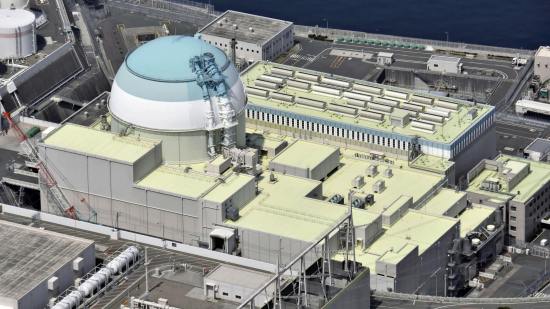
The No. 3 unit at the Ikata power plant in Ehime Prefecture
September 25, 2018
OSAKA — A Japanese court ruled Tuesday that a nuclear reactor operated by Shikoku Electric Power could restart, clearing the way for it to join the small handful of nuclear facilities that have resumed operating following a catastrophic earthquake in 2011.
The Hiroshima High Court overturned Tuesday its own provisional injunction from December, accepting the utility’s claim that a volcano in the vicinity poses little risk.
Following the decision, Shikoku Electric said it will restart the No. 3 unit at its Ikata power plant in Ehime Prefecture on Oct. 27.
High courts have often overruled suspensions handed down by district courts. Examples include the Nos. 3 and 4 units at Kansai Electric Power’s Oi and Takahama plants in Fukui Prefecture. With the Hiroshima high court’s decision, all reactors that had temporary suspension orders on them are able to restart.
The chief issue in the Ikata case was whether a nearby caldera of Mt. Aso in Kumamoto Prefecture is at risk of erupting.
“No proof has been shown of the possibility that a large-scale, catastrophic eruption will occur, and the likelihood that [lava flows] will reach the reactor is sufficiently low,” the court said in its ruling Tuesday.
But the restart could be stopped again by an Oita District Court decision due Friday on another provisional injunction to halt the Ikata unit.
The 890-megawatt No. 3 reactor is one of five across three plants nationwide to restart under standards introduced after the 2011 tsunami. It resumed operations in August 2016, but was halted in October 2017 for routine inspections. The shutdown has cost Shikoku Electric about 30 billion yen ($266 million), the company said.
Shikoku Electric Power Co.’s Ikata nuclear power plant is seen in Ehime Prefecture.
Sept. 25, 2018
HIROSHIMA – The Hiroshima High Court on Tuesday accepted an appeal by Shikoku Electric Power Co. allowing it to restart a halted reactor at its Ikata nuclear power plant in Ehime Prefecture, saying worries over a volcanic eruption damaging the plant are groundless.
The decision is an about-face from its earlier provisional injunction that demanded the utility halt the No. 3 unit at the plant until the end of this month, citing safety risks associated with potential volcanic activity in a nearby prefecture.
The temporary suspension order, issued last December following a request from a local opposition group, marked the first case in which a high court had prohibited operations at a nuclear plant since the 2011 triple meltdowns at the Fukushima No. 1 nuclear power plant led to a nationwide halt of such plants.
Presiding Judge Masayuki Miki said in the ruling, “There is no reason to believe in the possibility of a destructive volcanic eruption during the plant’s operating period and there is only a small chance of volcanic ash and rocks reaching the plant,” which is about 130 kilometers away.
Following the court’s decision, Shikoku Electric said it will reboot the No. 3 reactor on Oct. 27. The unit has been idle for maintenance since October last year.
The Nuclear Regulation Authority, the country’s nuclear watchdog, said, “Drawing on the lessons learned from the nuclear accident at the Fukushima No. 1 plant, we will continue to impose strict regulations based on scientific and technical knowledge.”
Separately, residents in nearby Oita, Kagawa and Yamaguchi prefectures have also been seeking to stop the reactor in pending court cases. The Oita District Court is scheduled to hand down a decision on Friday.
In addition, a request to extend the period of the injunction beyond Sunday has been filed with the Hiroshima District Court.
In the injunction, the high court had said the power company underestimated the risks of heated rocks and volcanic ash reaching the plant if a big eruption occurs at Mount Aso in Kumamoto Prefecture.
That decision constituted a major victory for the nation’s anti-nuclear movement and dealt a blow to the central government and utility firms, which are hoping to bring more reactors back online.
Shikoku Electric claimed in the appeal that it believes there is a “low possibility” of the volcano having a large-scale eruption while the reactor is in operation.
Plaintiffs, however, argued that the resumption of operations at the plant is “unreasonable” because of a “high risk of an accident.”
Following up on the reporting of the arrest of Chris Busby on the 12th September 2018 where media were reporting the raid and these reports continued for more than 24 hours.
There is just one point I would like to mention here. In this video (https://www.youtube.com/watch?v=ix2-B5bSKeU&t=529s ) there are a few small inaccuracies but nothing too drastic, the message of support was clear. On the single point that was made in the video that the police were called to a domestic situation where he and his female friend were having a row is not correct. I left a comment on the thread under the video correcting this (my tag is arclight2011 on YT). This got me thinking about that inaccuracy and where it may have come from?
In fairness to the You Tuber, the wording on the media does sort of hint that there was a domestic situation. The exact phrase without the full context was repeated by all media except the more cautious Telegraph was;
“Police were called to an address because of concerns for the welfare of a woman” (source links below)
Checking the Google search on the subject today on the 27th September 2018 (last month search parameter), the first page has all the original inaccurate articles with no right of reply except for the Devon Live link that had been updated with prof Busby`s response to the incident. Even the 3 videos I could see today had no right of response though there are a few videos that report the situation much more fairly with the right of reply. It seems Google search does not want Prof Busby`s voice to be heard.
This is a well worn tactic found in the Britains media and they were giving that impression even though I was posting regular updates explaining that Prof Busby was in Wales (200 miles away) at the time on his FB page hour by hour (which the press must have been well aware of.).
The UK press is beholding to the Police Press Office and I think the way it was reported it was a bit slanted, though some press did eventually give him a right of reply where he did explain the situation though the reach of those articles was not as good as the initial click bait fake inaccurate ones as I mentioned above re Google search. The fact that most media used the exact phrases like the one above means that this copy most likely came from the Police Press Office within a very short space of time of the home invasion.
Then there was George Monbiots article in the Guardian (In 2011) claiming that Prof Busby was selling vitamin supplements for his own personal benefit after the Fukushima story (used widely by anonymous pro nuclear commenter’s all over the internet). The Guardian still refuses ,to this day, to allow Prof Busby a right of reply but you can find his response to this slander on the source notes below as well as the Guardian “slant” on this fake news story.
In fact they did something similar with George Galloway (In 2013) when he called police because 2 new employees were found accessing his personal off line computer so he called the police to have them arrested. It eventually transpired that these two were working on behalf off or were MI5 agents. In the early press coverage of that story the press did not mention that the employees were arrested at Mr Galloways request but that “The police raided George Galloways office and removed a computer” .. Sounds a bit more scary doesn’t it? hinting that he had child porn or the like! I will leave you a link to my blog post on that story for your entertainment https://nuclear-news.net/2013/03/25/max-keiser-and-george-galloway-and-john-catt-pensioner-under-attack-the-uks-security-state-gone-mad/
On 26 September, three people – including a teacher and a soil scientist – became the first anti-fracking protesters sent to jail. Two were sentenced to 16 months, one to 15 months, and a fourth person received a suspended sentence of 12 months.
The four were convicted of causing a public nuisance following a trial in August. As part of the protests at the Preston New Road fracking site, they climbed on top of lorries delivering equipment to the site and stayed there for four days.
Jailed for peaceful protest
The prosecution argued that the protest cost the fracking firm Cuadrilla £50,000 and the police £12,000. But the protesters’ barrister Kirsty Brimelow pointed out it was a peaceful protest. Brimelow further stated that freedom of speech was not just “simply standing and shouting”.
We have a long history of civil disobedience on conscientious grounds that has successfully challenged historical injustices and that was subsequently vindicated. In Lancashire, the government’s decision to overrule local democratic decision-making has left direct action against fracking as one of the few options left.
These are non-violent campaigners, motivated by sincere beliefs. There is no reason to send them to already overcrowded prisons when the courts regularly suspend sentences based on “good character” for convictions up to and including causing death by dangerous driving.
It appears the sentences imposed on the Frack Free Four are intended to serve as a warning to other opponents of fracking that the criminal justice system intends to crack down hard on direct action. This looks less like justice and more like retribution.
“An inspirational mentor”
One of the men sentenced, Richard Loizou, is a teacher from Devon. A mother of two of his pupils was at court to support him. According to a press release seen by The Canary, she said:
Richard has taught my son for the last two years and is an inspirational mentor and beautiful soul. We are shocked and deeply upset by what is happening here, and felt compelled to come and offer our support today.
Loizou was sentenced to 15 months in jail.
Stronger
In a press release, soil scientist Simon Roscoe Blevins said:
This won’t break us, we will come out stronger. Some may view us as victims, but we refuse to be victimised by this. The real victims will be future generations suffering preventable disasters caused by climate change. Our friends and fellow campaigners outside will continue to fight for a ban on fracking and for a just transition to a renewable and democratically owned energy system.
Public nuisance
But those who oppose fracking know that it is fracking itself, not protest, that is the public nuisance. The judge and the police might like to believe a deterrent sentence will send shock waves and put people off protesting. But it won’t. It will heighten resistance. People are not staying on top of trucks for four days because it’s a ‘bit of fun’ but because the environmental impacts of not acting are too great.
This year, we celebrated the suffragettes. There is a long and proud history of direct action in this country and these sentences, while shocking, shameful and abhorrent, will do nothing to change that.
It is not a secret that nuclear radiation is dangerous. Not only does it cause cancer, even seemingly small amounts of the stuff can be lethal. Exposure to high enough levels can be deadly in frighteningly short period of time. But for the survivors of the Fukushima disaster, and those living in surrounding areas, radiation and cancer aren’t the only health concerns. New research has shown that in communities nearest the power plant, cases of type 2 diabetes are on the rise.
Researchers have been analyzing the secondary health effects of the nuclear disaster, which took place seven year ago now. Dr. Masaharu Tsubokura, from the Department of Radiation Protection at Minamisoma Municipal General Hospital in Fukushima, has been working alongside other researchers to better understand the full scope of Fukushima’s health consequences. Their findings indicate both an increase in the number of cases, and a rise in severity of, health conditions like diabetes, high blood pressure, obesity and depression.
Dr. Tsubokura says that the social disruption caused by the evacuation has played and under-reported role on public health. As the research reveals, the elderly in particular have been hardest hit by the disaster – especially when it comes to diabetes. In the wake of Fukushima, “diabetes trumps radiation as a threat to life expectancy by a factor of 33,” souces say.
This is not to say that diabetes is more dangerous than radiation – but the finding shows that the number of people being affected by diabetes post-disaster is surprising high. The risk of type 2 diabetes, and poor diabetes management, as an indirect effect of the nuclear spill is substantial………..
Some research from Ukraine has documented a staggering increase in cases of diabetes and other non-cancer endocrine disorders. Even 30 years after the Chernobyl power plant incident, increased cases of diabetes and other conditions in survivors are still being documented. Scientists from the Ukraine reported in 2017 that levels of diabetes in radiation-exposed survivors ( Including site clean-up workers) remain noticeably higher than the rest of the population.
This finding could raise questions about the purported increase of diabetes in Fukushima survivors. While scientists say that this increase is due to the massive social disruption caused by the evacuation , one might wonder if there’s more to it than that. As the Ukrainian scientists note, research has shown that the endocrine system may be more affected by exposure to radiation than previously thought.
The idea that an increase in diabetes could be related to radiation exposure and not just lifestyle changes alone isn’t all that far-fetched, is it?
With strong solidarity with the Japanese Anti-Nuclear movement including every Friday evening Anti-Nuclear Power demo in front of the Prime Minister’s residence and the Diat in Tokyo, we, Japanese Against Nuclear-UK and CND are planning to organise the monthly vigil and leafleting including Statement-Read-Out to Japanese Prime Minster and TEPCO on 28th Sept 2018.
Our Friday action in front of the Japanese Embassy starts from 10:30 AM and Read-Out of the statement from 11:30 AM. After handing in a copy of the statement to the Embassy, we wll move onto the TEPCO office. ( 14-18 Holborn near Chancery Lane Tube station). There will be vigil/leafleting and Statement Read-Out to TEPCO. A copy of the statement will be posted to the TEPCO HQ in Tokyo.
Chernobyl London meeting (27 April 2013) Speech by Tamara Krasitskava from Zemlyaki
On Sunday the 27 April 2013 in a little room somewhere off Grays Inn road London, a meeting took place. In this meeting was Ms Tamara Krasitskava of the Ukrainian NGO “Zemlyaki”.
In this meeting she quoted that only 40 percent of the evacuees that moved to Kiev after the disaster are alive today! And lets leave the statistics out of it for a moment and we find out of 44,000 evacuated to Kiev only 19,000 are left alive. None made it much passed 40 years old
…..3.2 million with health effects and this includes 1 million children…
T .Kraisitskava
“….I was told to not talk of the results from Belarus as the UK public were not allowed to know the results we were finding!….”
* A draft movie report from Chernobyl Day meeting is now ready. It’s a speech by Tamara Krasitskava from Ukraine. She is a chairperson of Zemlyaki, Ukraine NGO in Kiev to represent evacuees from Pripyat city.
Uploaded on 1 May 2013
* Tamara Krasitskava is a chairperson of Zemlyaki, Ukraine NGO in Kiev to represent those who had to collectively evacuate from Pripyat
* Speech was done by Russian, and interpreted into English.
* Chernobyl Day London Public Meeting was organized by “JAN UK” on Sat 27 April 2013. http://www.JANUK.org http://twitter.com/JAgainstNukesUK http://www.facebook.com/JapaneseAgain…
* The nuclear accident happened on Saturday 26 April 1986, 1:23am. It was, for the most of he residents, midnight of Friday 25 April.


 A storage facility for spent fuel rods at Japan Nuclear Fuel Ltd.’s plant in Rokkasho, Japan, Aug 2018.






 nuclear-news