Power balance is changing, with the flexibility of renewable energy systems
By 2040 Bloomberg New Energy Finance predicts that more than half of global energy capacity will come from renewables and flexible sources, such as battery storage and demand side response
 NuClear News Sept 18 Tom Greatrex of the Nuclear Industry Association (1) says we should ignore the National Infrastructure Commission’s (NIC’s) recommendation that we only order one more nuclear station on top of Hinkley Point C before 2025 (2), because cutting carbon without the help of nuclear is a “risky business”. He says the Government understands the inherent value of a baseload low carbon source of generation.
The NIC says: “It is now possible to conceive of a low-cost electricity system that is principally powered by renewable energy sources.” It says at least 50% and up to 65% of electricity in 2030 should come from renewables. (3)
Australia is having similar debates where the fossil fuel lobby argues that because “coal” is “baseload”, it must therefore be “reliable”, but wind and solar are intermittent, so they cannot be relied upon to keep the lights on. It’s political rhetoric that belies the reality of the electricity system. Australia’s grid has challenges, but they are not necessarily ones that can be solved just by having more “baseload”. What is really needed – as the Australian Energy Market Operator, chief scientist Alan Finkel, and any number of other independent experts point out – is dispatchable and reliable generation, one that the grid operator can count on, at times of peak demand and heat stress. And the answer does not lie in traditional “baseload” generation – the more than 100 trips of big fossil fuel plants since December, often at times of soaring heat, underline that point.
The energy debate is usually dominated by simple political rhetoric – based around emissions or no emissions, cheap prices or expensive ones, baseload versus intermittency. That just skims over the surface. Behind the scenes, as the clean energy transition continues, debates are raging about good engineering practices and the design of markets. One of Australia’s leading electrical engineers, Kate Summers says large diverse renewable resources are far more stable in output than singular sources. She uses a series of graphs to illustrate that at moments when stability can be won or lost it has been wind and solar that have held firm, and acted as what one might consider to be “baseload”. And it has been coal and gas that has proved “intermittent” at the very minutes that stability is needed. (4)
It’s the Flexibility Stupid
A new report from Chatham House says evidence is growing that highly flexible electricity systems could deliver lower whole-system costs, especially given the dramatic projected falls in solar and wind power costs by 2030.
While the renewables rollout is a key part of global climate policy, the challenge is that the costs associated with managing the system start to escalate once renewables exceed a 30% share of generated electricity. Unless properly planned for, the growth in electric vehicle use and electric heating could further amplify these ‘system integration costs’. They include the cost of holding fossil fuel power plants in reserve for periods of low renewable supply, grid upgrades and the dumping of power from renewables when system constraints are reached. Governments can ensure electricity is affordable by promoting ‘flexibility’. Grid operators and power companies should pursue a diverse range of flexible, decentralized, modular technologies.
New technologies that enhance system flexibility, including smart electric vehicle (EV) charging, battery storage, digitalization with intelligent control and demand-side management, are unleashing a new phase of transformations in the power sector, for which existing companies are ill prepared. Companies providing these solutions may come to dominate the power sector in the coming decades. The accelerating deployment of this array of ‘flexibility enablers’ means the spectre of cost escalation – resulting from the expense of managing intermittent wind and solar power at huge volumes – may never materialize.
Smart, staggered EV charging could enable significant advances in system flexibility. By 2030, smart EV charging in the UK could be equivalent to 18% of the country’s current generating capacity. Rapid cost reductions in battery manufacturing, driven by increased deployment of EVs, are enabling affordable static, grid-level storage, in turn enhancing power system flexibility.
Digitalization of the electricity sector will lead to significant advances in system efficiency and flexibility. Residential demand will become flexible and networks functionally ‘smarter’. Machine-learning algorithms could be a game-changer, helping to manage the increasing complexity of electricity systems and identify new system-level efficiencies.
Enhanced system flexibility and a growing role for these technologies will provide new entry points for highly disruptive market actors, many of them not traditionally associated with the power sector. These actors include powerful technology companies and automotive manufacturers such as Google, Tesla and BMW. More widespread electrification of transport, and eventually of heating, will change the political and regulatory landscape of the electricity sector.
The transformations which have happened so far, with the rapid introduction of renewable technologies and falling demand due to greater energy efficiency, have undermined the business models of traditional power utilities. Now they face the prospect that renewables will achieve ever higher penetrations within the electricity market, aided by greater system flexibility. This will continue to erode the role of large power stations in ‘system balancing’ – balancing supply and demand – and will put further pressure on existing business models.
Evidence is growing that highly flexible electricity systems could deliver lower whole-system costs, especially given the dramatic projected falls in solar and wind power costs by 2030. But new regulatory approaches are needed to encourage market actors to deliver flexibility. Regulatory frameworks need to prioritize and incentivize investment in these areas, and encourage alternative business models. And in this future, our reliance on large fossil fuel power plants would fade, along with the utility business models that have long been based on a centralized power system.
New business models are emerging to aggregate and manage behind-the-meter investments. One example: storage-as-a-service. The innovative US utility, Green Mountain Power (GMP), in Vermont offers customers a Tesla Powerwall 2.0 battery for $15 a month so long as the customer allows GMP to manage when and how the battery is charged and discharged. Alternatively, customers can buy one for $1,500 – which is roughly a fifth of the actual cost of the battery. In either case, substantial subsidies, approved by the Vermont’s Public Utilities Commission, are offered. The regulator has been convinced that the scheme will more than pay for itself in the sense that all customers, not just those participating, will benefit from the program. The distributed storage paid off handsomely during a heat wave in early July 2018. The company was able to discharge stored energy out of about 500 Tesla Powerwall batteries installed in the homes of some 400 customers and feed it into the grid when it was sorely needed. It saved roughly half a million dollars by avoiding the need to buy expensive power from suppliers at the time of peak demand. GMP, which serves roughly a quarter-million customers in VT uses the batteries in customers’ premises as a virtual power plant (VPP). Customers like the batteries because they typically replace an emergency generator when power fails – which is not uncommon during storms in rural areas. (6)
UK Power Networks
The UK’s largest electricity distributor has proposed adopting a “flexibility first” approach to the delivery of extra grid capacity, in a move that could bring renewable energy onto the network at a lower cost. UK Power Networks has revealed plans to “supercharge” local markets for flexibility services, which rely on customers changing their energy consumption or generation to balance network demand, possibly by creating them itself.
The company claims that if flexibility services were made available to the 8.2 million buildings it serves, new markets for distributed renewable generation would open across London, the South East and the East of England. It speculates that such increased competition would result in a higher proportion of renewable power being bought onto the network, but at a lower cost. The Flexibility Roadmap proposes a radical rethink to the way we do business, moving away from automatically building new assets and instead giving the distributed energy resources market the opportunity to offer their services. If the market can provide the capacity we need at a more cost-effective rate than building new infrastructure, that’s exactly what we should do.
Specifically, UK Power Networks believes that the actions outlined in the roadmap will lower costs for consumers by delaying or avoiding expensive grid reinforcements, increase the resilience of the network and provide new sources of revenue for flexibility providers. To ascertain how it should best meet demand for flexibility, the company has launched a consultation on its Flexibility Roadmap. The consultation will run from August to 8 October. If accepted the proposals will come into effect from 2019.
Earlier this summer, UK Power Networks unveiled its plan to create the nation’s first “virtual” solar power station by the end of the year, using PV panels on the rooftops of its London customers’ homes. (7)
Demand-Side Response
By 2040 Bloomberg New Energy Finance predicts that more than half of global energy capacity will come from renewables and flexible sources, such as battery storage and demand side response. At 7% of global capacity, flexible sources such as batteries and demand side response – where homes and businesses automatically cut energy usage a peak times – will account for the same level of global energy capacity as oil-fired power plants today. And more than half of this energy storage capacity will come from small-scale batteries installed by households and businesses alongside rooftop solar panels. This trend away from larger power plants and towards smaller, decentralised energy systems is happening already in both developed and developing nations.
Energy, like every other sector, is going digital. From smart home products such as Hive that allow home owners to control their energy use from their smartphone, through to companies like REstore employing artificial intelligence to calculate just how much energy capacity a factory can offer as a virtual power plant. Centrica’s CEO Iain Conn says he expects demand side response to become one of the fastest growing elements of the energy market over the next few years. Europe’s largest demand side response aggregator, REstore, was acquired by Centrica in 2017.
In the same way as demand side response aggregators are emerging as a new type of energy company for the decentralised era, a new breed of companies is providing a route to market services for small generators. Centrica acquired one of Europe’s leading route to market companies, the Denmark-based Neas Energy, in 2016. Neas is able to take all of the Big Data coming from smart meters and Internet of Things (IoT) connected devices to build an accurate real-time picture of energy demand, as well as demand trends. Neas also uses software that combines this data with smart algorithms that judge weather patterns, so that it knows how much any given wind turbine or solar panel is likely to generate, and when. This helps balance the grid by matching supply and demand more accurately. And for the smaller energy producer, it helps them sell their energy at the most accurate market price. The growth in services supplied by companies like Neas is being driven by the rapid improvement and increasing availability of smart digital technology to both energy companies and their customers.
Greater insight through digital technology is just the start of the shift of power away from energy companies and towards the customer. Centrica is currently piloting a project in the south west of England that will allow local residents and businesses to buy and sell energy between themselves without the intervention of their energy supplier. The £19 million Local Energy Market in Cornwall is enabling 200 homes and businesses to do this using a digital record known as Blockchain. It is used to create a secure electronic ledger of transactions between participants. Iain Conn says he believes such local networks will become the norm in a new decentralised energy market.
Home owners using Blockchain to become their own micro-energy companies may seem like something for the distant future, but Microsoft’s Michael Wignall says that digital technology is accelerating at such a pace that these kinds of radical changes will be delivered over a short period of time. The Fourth Industrial Revolution we are currently experiencing will make energy systems of the future completely unrecognisable from what they are today. (8)
“Energy storage is all the rage”, says Dave Elliott, Emeritus Professor of Technology Policy at the Open University. But while the field is full of innovation at present, pumped hydro storage continues to dominate. And while storage offers one way to respond to the variability of some renewables, there are other options, including smart grid demand management (to time-shift demand peaks) and super-grid imports and exports (to balance local supply and demand variations across wide areas). (9) “There is nothing that storage can do that something else can’t do,” according to Professor Mark O’Malley of Canada’s McGill University and University College Dublin. (10)
Batteries, capacitors, and flywheels, along with smart-grid demand adjustments, may all be fine for brief periods, dealing with short-term variations in renewable inputs, but are not much use for longer-term lulls in renewable availability. Pumped hydro projects may be able to deliver power for perhaps a day or so, depending on their scale, but for longer term storage that’s when big hydrogen gas or compressed air underground storage facilities may come into their ownlinked to back-up generators. The stores can be charged using green energy already produced, when there was surplus, locally or on a wider basis, with super-grid links for transfers. http://www.no2nuclearpower.org.uk/wp/wp-content/uploads/2018/09/NuClearNewsNo110.pdf
Top Cancer Researcher Fails to Disclose Corporate Financial Ties in Major Research Journals
One of the world’s top breast cancer doctors failed to disclose millions of dollars in payments from drug and health care companies in recent years, omitting his financial ties from dozens of research articles in prestigious publications like The New England Journal of Medicine and The Lancet.
The researcher, Dr. José Baselga, a towering figure in the cancer world, is the chief medical officer at Memorial Sloan Kettering Cancer Center in New York. He has held board memberships or advisory roles with Roche and Bristol-Myers Squibb, among other corporations, has had a stake in start-ups testing cancer therapies, and played a key role in the development of breakthrough drugs that have revolutionized treatments for breast cancer.
According to an analysis by The New York Times and ProPublica, Dr. Baselga did not follow financial disclosure rules set by the American Association for Cancer Research when he was president of the group. He also left out payments he received from companies connected to cancer research in his articles published in the group’s journal, Cancer Discovery. At the same time, he has been one of the journal’s two editors in chief……..
Dr. Baselga’s extensive corporate relationships — and his frequent failure to disclose them — illustrate how permeable the boundaries remain between academic research and industry, and how weakly reporting requirements are enforced by the medical journals and professional societies charged with policing them
……..The penalties for such ethical lapses are not severe. The cancer research group, the A.A.C.R., warns authors who fill out disclosure forms for its journals that they face a three-year ban on publishing if they are found to have financial relationships that they did not disclose. But the ban is not included in the conflict-of-interest policy posted on its website, and the group said no author had ever been barred.
Many journals and professional societies do not check conflicts and simply require authors to correct the record.
Officials at the A.A.C.R., the American Society of Clinical Oncology and The New England Journal of Medicine said they were looking into Dr. Baselga’s omissions after inquiries from The New York Times and ProPublica. The Lancet declined to say whether it would look into the matter……..https://www.nytimes.com/2018/09/08/health/jose-baselga-cancer-memorial-sloan-kettering.html?emc=edit_th_180909&nl=todaysheadlines&nlid=114249920909
.
 |
ReplyForward
|
Julian Assange’s fate – in the hands of Eduador government?
WikiLeaks Whistleblower Awaits Fate, American Free Press , he fate of gutsy WikiLeaks founder and whistleblower Julian Assange rests in the hands of the government of Ecuador, first reported here in AFP’s Issue 33&34. Assange has lived at the Ecuadorian embassy in London since 2012 and will be instantly arrested by the UK if he leaves the building. Just-released news that his health is deteriorating rapidly makes even more urgent Ecuadorian action’s even more urgent.
By S.T. Patrick As the future of WikiLeaks founder Julian Assange twists in the political winds, the United States, Great Britain, and Ecuador continue to negotiate over the life of the Australian computer programmer and hacker.
Assange has been housed at the Ecuadorian embassy in London since 2012. According to one of his lawyers, Assange’s health is suffering and, for the past four months, he has been held in a situation that can be more accurately described as “solitary confinement.” The end of WikiLeaks, as well as Assange’s own version of freedom, may soon be near.
Technically, Assange is not a prisoner of any government. That is the inevitability that he is trying to avoid. He may leave the embassy, but doing so would trigger the execution of an active warrant that still exists in the UK for jumping bail. If arrested, extradition to the United States seems likely.
Because there is a clause in the UK-Ecuadorian extradition treaty that bars one country turning citizens over to the other, Assange’s Ecuadorian citizenship may have to be rescinded for extradition to occur.
…..In April, Attorney General Jeff Sessions hinted to the media that he would consider bringing criminal charges against Assange.
“We are going to step up our efforts and already are stepping up our efforts on all leaks,” Sessions said. “We will seek to put some people in jail.”…….
Former U.S. litigator Glenn Greenwald, founder of “The Intercept” website, believes that extradition to the United States would not be as automatic as is being reported by many news outlets. He calls the British government “subservient” to the United States, yet he points out that the British judges lean more independent. He also points out that the specifics of the U.S.-UK treaty may not allow extradition.
“Political crimes, like publishing documents and engaging in journalism—that really isn’t what extradition is for,” Greenwald said. “And in fact . . . is excluded from most extradition treaties, including the one between the U.S. and the UK.”……
For Assange, his life is now in the balance, wavering like the First Amendment freedoms that Americans once thought were constitutionally guaranteed. http://americanfreepress.net/wikileaks-whistleblower-awaits-fate/
#Fukushima #UNSCEAR Radiation #debunk – Dr. Alex Rosen, #IPPNW REDUX – Nuclear Hotseat 375
This Week’s Featured Interview:
- Dr. Alex Rosen is a German pediatrician and Vice President of International Physicians for the Prevention of Nuclear War in Germany. We spoke originally in July of 2014, just after the United Nations UNSCEAR report was released.
LINK to Full IPPNW report in English, Critical Analysis of the UNSCEAR Report “Levels and effects of radiation exposure due to the nuclear accident after the 2011 Great East-Japan Earthquake and tsunami”
Numnutz of the Week (for Outstanding Nuclear Boneheadedness):
A practice run dropping a nuclear bomb from a B-2 stealth bomber? What are they practicing FOR?
Activist Links:
Olympics and Paralympics Warning:
This Week’s Featured Interview:
- Dr. Alex Rosen is a German pediatrician and Vice President of International Physicians for the Prevention of Nuclear War in Germany. We spoke originally in July of 2014, just after the United Nations UNSCEAR report was released.
LINK to Full IPPNW report in English, Critical Analysis of the UNSCEAR Report “Levels and effects of radiation exposure due to the nuclear accident after the 2011 Great East-Japan Earthquake and tsunami”
Numnutz of the Week (for Outstanding Nuclear Boneheadedness):
A practice run dropping a nuclear bomb from a B-2 stealth bomber? What are they practicing FOR?
Activist Links:
Olympics and Paralympics Warning:
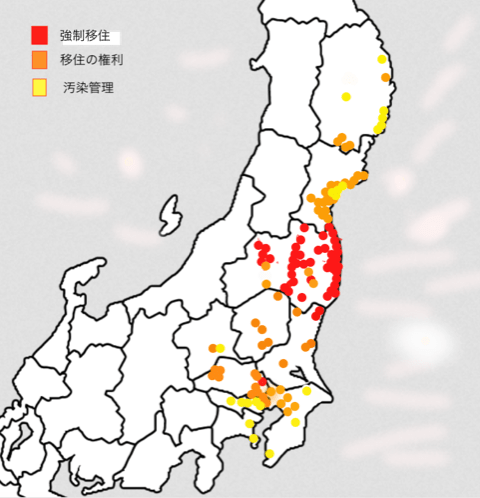
Radiation map of Tokyo area, computed in accordance with Chernobyl radiation standards.
Red indicates areas w/right to immigrate and cities under contamination surveillance.
Is attending the Olympics really worth the exposure?
- Indigenous and women filmmakers – and others – encouraged to submit your films to the International Uranium Film Festival for the 2018 screenings in Window Rock, NM and the US Southwest.
- Bob Alvarez article for Union of Concerned Scientists: Under siege: Safety in the nuclear weapons complex
- Nuclear Safety Board Slams Energy Department Plan to Weaken Oversight by Rebecca Moss
Radiation map of Tokyo area, computed in accordance with Chernobyl radiation standards.
Red indicates areas w/right to immigrate and cities under contamination surveillance.
Is attending the Olympics really worth the exposure?
- Indigenous and women filmmakers – and others – encouraged to submit your films to the International Uranium Film Festival for the 2018 screenings in Window Rock, NM and the US Southwest.
- Bob Alvarez article for Union of Concerned Scientists: Under siege: Safety in the nuclear weapons complex
- Nuclear Safety Board Slams Energy Department Plan to Weaken Oversight by Rebecca Moss
CLICK HERE FOR PODCAST FULL INTERVIEW AND MORE HERE; http://nuclearhotseat.com/2018/09/05/united-nations-fukushima-radiation-lies-dr-alex-rosen-ippnw-nh-375/#prettyPhoto
#Fukushima – An unresolved life #ONHCR #InternalDisplacement @NRC_Norway
Repost According to Ms. Sonoda, the Government of Japan does not recognise those uprooted by the Fukushima accident as internally displaced persons, although 20 years ago the Guiding Principles on Internal Displacement acknowledged human-made disasters. Further, they have not been allowed to participate in the Government’s decisions that affect them.
“We don’t want to return with children and stay in radioactive and contaminated areas. We can’t see radiation, we can’t smell radiation,” Ms. Sonoda says. “We really need the Government to check the children’s health. They only scanned for thyroid cancer but no other health checks were made. We don’t know how [radiation] will affect children in the future.”
“Many people also struggle financially so we need basic housing support to stay evacuate,” she adds.
Over 40 million people around the world are currently internally displaced because of conflict and violence in the world, and an average of 25 million people is displaced each year due to natural disasters. Millions of other displacements are not systematically captured including those caused by land grabs, slow-onset disasters such as drought, and criminal violence…..


Image source; http://www.internal-displacement.org/globalreport2016/
Ms. Sonoda was living in Fukushima, Japan, with her husband and their child in a beautiful natural environment and with a strong local community. The day of the nuclear disaster, 11 March 2011, they felt an enormous earthquake and unrelenting aftershocks. They later saw the explosion of reactor one, live on television.
“It was a massive shock. We began preparing in case we needed to move quickly and two days later reactor three exploded,” she recalls. “We decided to evacuate because we knew reactor three used mops fuel which contains plutonium. It was a nightmare. Suddenly the nuclear disaster destroyed our lives in Fukushima.”
With the Mayor and the local school, Ms. Sonoda tried to arrange the evacuation of children but she says the local Government stopped them. Because of the damage caused by the earthquake, roads were blocked; the provision of food and fuel started to…
View original post 665 more words
To 8th September – nuclear and climate news
 Japan acknowledges that prolonged exposure to ‘low level’ ionising radiation caused the cancer death of a Fukushima nuclear worker, and compensation will be paid to his family. This is the first time that the Japanese Health, Labour and Welfare Ministry have ruled on a radiation-caused death.
This will no doubt upset the nuclear lobby, who like to say that only high level radiation is harmful. It’s like the tobacco companies suggesting that only smoking 100 cigarettes a day would cause lung cancer – a few a day would be harmless, or actually good for you.
In fact, worker deaths from low level radiation have been reported many times, notably in the USA research by McClatchy News, which recorded 33,480.
Nuclear power: molten salt reactors and sodium-cooled fast reactors make the radioactive waste problem WORSE.
Nuclear reactors shutting down faster than ones are being built.
Climate change talks – in Bangkok – which sinking below rising sea
Rising CO2 levels could push ‘hundreds of millions’ into malnutrition by 2050.
JAPAN.
- Hokkaido’s Tomari NPP using emergency generators after powerful M6.7 earthquake. Japan nuclear plant’s power restored after quake triggers Hokkaido blackout.
- Fukushima episode of Netflix’s Dark Tourist sparks offence in Japan. Fukushima government considers action over Dark Tourist episode.
- Japan holds public hearings on what to do with growing amounts of radioactive water from the ruined Fukushima No. 1 nuclear power plant.
- Mainstream media carefully avoids mentioning the typhoon danger to Japan’s nuclear power stations and waste dumps.
- Nuclear reprocessing has little future in Japan, as utilities end funding.
UK. A report on Sellafield highlights the likely nuclear damage to Ireland. Spinning’O-Wind Turbine captures wind from any direction.
RUSSIA. Russia’s nuclear wastes, and the clean-up of Andreeva Bay .
USA.
- If Democrats take over Congress in November, there’ll be cuts to USA’s nuclear weapons spending. USA and Russia – in 20th Century -devised hideously elaborate ways of blowing each other up. A National Campaign Emerges to Prevent Nuclear War.
- Duke Energy rules out any new nuclear plants in its long range plans. Companies Orano – formerly AREVA, and Holtec aim for private-public partnerships on USA’s nuclear wastes. The economic pain of nuclear power station closures.
- Tropical storms pose danger to America’s nuclear power stations.
NORTH and SOUTH KOREA. Third summit this year between Moon Jae-in and Kim Jong-un.
GERMANY. New highs for solar power generation in Germany, as extreme heat shut nuclear and coal plants.
AUSTRIA. Austria continues its legal action crusade against nuclear power in Europe.
‘Key insights’ from the 2018 World Nuclear Industry Status Report
 The World Nuclear Industry Status Report 2018 As always there is much of interest in the latest edition of the World
NM865.4747 The 2018 edition of the World Nuclear Industry Status Report has just been released. Here are the ‘key insights’ from the report:
China Still Dominates Developments
• Nuclear power generation in the world increased by 1% in 2017 due to an 18% increase in China.
• Global nuclear power generation excluding China declined for the third year in a row.
• Four reactors started up in 2017 of which three were in China and one in Pakistan (built by a Chinese company).
• Five units started up in the first half of 2018, of which three were in China ‒ including the world’s first EPR and AP1000 ‒ and two in Russia.
• Five construction starts in the world in 2017.
• No start of construction of any commercial reactors in China since December 2016.
• The number of units under construction globally declined for the fifth year in a row, from 68 reactors at the end of 2013 to 50 by mid-2018, of which 16 are in China.
Operational Status and Construction Delays
• The nuclear share of global electricity generation remained roughly stable over the past five years with a long-term declining trend, from 17.5% in 1996 to 10.3% in 2017.
• Seven years after the Fukushima events, Japan had restarted five units by the end of 2017 ‒ generating still only 3.6% of the power in the country in 2017 ‒ and nine by mid-2018.
• As of mid-2018, 32 reactors ‒ including 26 in Japan ‒ are in Long-Term Outage (LTO).
• At least 33 of the 50 units under construction are behind schedule, mostly by several years. China is no exception, at least half of 16 units under construction are delayed. Of the 33 delayed construction projects, 15 have reported increased delays over the past year.
Only a quarter of the 16 units scheduled for startup in 2017 were actually connected to the grid.
• New-build plans have been cancelled including in Jordan, Malaysia and the U.S. or postponed such as in Argentina, Indonesia, Kazakhstan.
Decommissioning Status Report
• As of mid-2018, 115 units are undergoing decommissioning ‒ 70% of the 173 permanently shut-down reactors in the world.
• Only 19 units have been fully decommissioned: 13 in the U.S., five in Germany, and one in Japan. Of these, only 10 have been returned to greenfield sites.
Interdependencies Between Civil and Military
Infrastructures
• Nuclear weapon states remain the main proponents of nuclear power programs. A first look into the question whether military interests serve as one of the drivers for plant-life extension and new-build.
Renewables Accelerate Take-Over
• Globally, wind power output grew by 17% in 2017, solar by 35%, nuclear by 1%. Non-hydro renewables generate over 3,000 TWh more power than a decade ago, while nuclear produces less.
• Auctions resulted in record low prices for onshore wind (<US$20/MWh) offshore wind (<US$45/MWh) and solar (<US$25/MWh). This compares with the “strike price” for the Hinkley Point C Project in the U.K. (US$120/MWh).
• Nine of the 31 nuclear countries ‒ Brazil, China, Germany, India, Japan, Mexico, Netherlands, Spain and United Kingdom (U.K.) ‒ generated more electricity in 2017 from non-hydro renewables than from nuclear power.
Mycle Schneider, Antony Froggatt et al., Sept 2018,
‘The World Nuclear Industry Status Report 2018’, www.
worldnuclearreport.org/Nuclear-Power-Strategic-Asset- Liability-or-Increasingly-Irrelevant.html
Pro nuclear lobbyist Michael Shellenberger enthuses for nuclear weapons. Has he lost the plot?

In 2015, Nuclear Monitor published a detailed critique of the many ways nuclear industry insiders and lobbyists trivialize and deny the connections between nuclear power (and the broader nuclear fuel cycle) and nuclear weapons proliferation.
Since then, the arguments have been turned upside down with prominent industry insiders and lobbyists openly acknowledging power-weapons connections. This remarkable about-turn has clear origins in the crisis facing nuclear power and the perceived need to secure increased subsidies to prevent reactors closing and to build new ones. Continue reading
Climate change takes its toll on nuclear reactors that can’t cope with the heat
 Weatherwatch: nuclear power plants feel the heat, During this summer’s heatwave, nuclear reactors in five European countries had to be shut down or put on reduced power, https://www.theguardian.com/news/2018/sep/07/weatherwatch-nuclear-power-plants-feel-the-heat Guardian, Paul Brown, 8 Sep 2018 An argument of the nuclear lobby is that renewables, particularly wind and solar, are unreliable because of changing weather. Only nuclear power can guarantee to keep the lights on or the air conditioners running.
This weekend – marches for climate action in many countries
 Hundreds of thousands expected to join global climate marches this weekend, Protests against politicians’ failure to tackle the environmental crisis will take place in more than 90 countries, Guardian, Matthew Taylor Environment correspondent, 7 Sep 2018 Hundreds of thousand of people in more than 90 countries are expected to take part in demonstrations this weekend to protest about the failure of politicians to tackle the global environmental crisis.
Organisers say more than 800 events – from marches to street theatre, acts of civil disobedience to mini festivals – will take place in towns and cities amid growing frustration at the lack of meaningful political action over the emerging climate breakdown.
Nick Bryer from campaign group 350.org which is organising the event said: “Politicians are failing. They are still protecting the interests of the fossil fuel companies over the interests of people, despite mounting evidence of the devastation these companies and this system is causing the planet.”…….
In the UK there are events organised in cities from London to Wigan, Bradford to Durham.
Jane Thewlis, from Fossil Free West Yorkshire, is organising an event in Bradford……….
One of the biggest protests is expected in Paris where up to 100,000 people are expected. Events in other European cities including Copenhagen, Brussels and Lisbon are also expected to attract tens of thousands of protesters.
The events come ahead of the Global Climate Action Summit that starts in San Fransisco next week and will see politicians and city leaders from around the world gather to discuss the climate crisis.https://www.theguardian.com/environment/2018/sep/07/hundreds-of-thousands-expected-to-join-global-climate-marches-this-weekend
Deplorable conditions of Japan’s ‘informal’ nuclear workers: Fukushima, radiation and leukaemia
 Sworn to secrecy, after a superficial safety education drill, they are sent into highly contaminated, hot and wet labyrinthine areas.
the state also raised nuclear workers’ limits from no more than 50 mSv per year (mSv/y) and 100 mSv/5 years to 250 mSv/y to deal with emergency conditions, and determined that there would be no follow-up health treatment for those exposed to doses below 50 mSv/y, while TEPCO decided to not record radiation levels below 2 mSv/y in the misplaced justification that the effects  would be negligible.
poor monitoring and record-keeping has meant that many former nuclear workers who develop leukaemia and other illnesses have been denied government compensation
Informal Labour, Local Citizens and the Tokyo Electric Fukushima Daiichi Nuclear Crisis: Chapter Author(s): Adam Broinowski Book Title: New Worlds from Below [many footnotes and references on original] Sept 18
Nuclear workers are important as sentinels for a broader epidemic of radiation related diseases that may affect the general population. We live with contradictions everyday
Introduction The ongoing disaster at the Fukushima Daiichi nuclear power station (FDNPS), operated by Tokyo Electric Power Company (TEPCO), since 11 March 2011 can be recognised as part of a global phenomenon that has been in development over some time. This disaster occurred within a social and political shift that began in the mid-1970s and that became more acute in the early 1990s in Japan with the downturn of economic growth and greater deregulation and financialisation in the global economy. After 40 years of corporate fealty in return for lifetime contracts guaranteed by corporate unions, as tariff protections were lifted further and the workforce was increasingly casualised, those most acutely affected by a weakening welfare regime were irregular day labourers, or what we might call ‘informal labour’.
During this period, many day labourers evacuated rented rooms (doya どや) and left the various yoseba (urban day labour market よせば, or lit. ‘meeting place’) to take up communal tent living in parks and on riverbanks, where they were increasingly victimised. With independent unions having long been rendered powerless, growing numbers of unemployed, unskilled and precarious youths (freeters フリーター) alongside older, vulnerable and homeless day labourers (these groups together comprising roughly 38 per cent of the workforce in 2015)3 found themselves not only lacking insurance or industrial protection but also in many cases basic living needs. With increasing deindustrialisation and capital flight, regular public outbursts of frustration and anger from these groups have manifested since the Osaka riots of 1992.
In this chapter, first I outline the conditions of irregular workers at nuclear power plants and the excess burden they have borne with the rise of nuclear labour in Japan since the 1970s. I then turn to post-3.11 conditions experienced by residents in radiation-contaminated areas. Contextualising these conditions within the genealogy of radiodosimetry standards, I seek to show, through personal interviews and localised responses, how those who are regularly exposed to radiation from Fukushima Daiichi are now confronting problems similar to those faced by informal nuclear labour for decades in Japan. This analysis shows how, after 40 years or more of environmental movements as discussed in Chapter Four, the struggle continues to find viable solutions to the systemic production of the intertwined problems of environmental crises and labour exploitation, and suggests how potential alternative directions for affected populations may lie in their mutual combination.
Conditions for Informal Labour Employed in Nuclear Power Stations Continue reading
Congress must curb Trump’s power to start a nuclear war. He is not a well man
 President Trump is not well. Congress must curb his power to start a nuclear war. The fate of the earth depends on it The Inquirer, Will BunchWithin seconds after someone at the New York Times hit the “send” button about 4 p.m. on Wednesday, an op-ed by a supposed senior official in the Trump administration — the identity known to less than a handful of Times editors — instantly became the lodestar, to borrow a suddenly popular word, of those hoping to end Donald Trump’s presidency before Jan. 20, 2021.
The most depressing thing about the anonymous op-ed from this high-level Trump insider was not its assertions that the “amorality” of America’s 45th president is a threat to the nation’s welfare, or that the commander-in-chief is fundamentally antidemocratic, or that The Donald’s leadership style is “impetuous, adversarial, petty and ineffective.” Nor is it the less-than-“cold comfort” (to steal another hot phrase) that there’s some sort of “resistance” within the White House, claiming it’s somehow saving America from the absolute worst of Trump.
No, the most depressing thing is that a majority of Americans already knew most, if not all, of these things about the short-fingered vulgarian currently ensconced in 1600 Pennsylvania Avenue from the day he descended from Trump Tower in June 2015 to launch his hate-laden, xenophobic campaign. And the people elected him anyway. And that now that he’s here, President Trump seems impossible to remove. ……
Even if the overall tone of the Woodward book and the Times’ op-ed is to confirm what we already instinctively knew about Trump’s unfitness for office and the massive dysfunction that stems from that, the post-Labor Day bombshells still raised enough questions for four or five different potential columns. There’s the fun but wildly overrated parlor game of speculating who wrote the anonymous diatribe (cough, cough, director of intelligence Dan Coats? … maybe, although he denies it) to questioning whether the Times should have granted anonymity (yes … although other journalists disagree) to whether going semi-public with the view from inside the White House “resistance” was an act of courage … or cowardice (more on that in a minute).
For example:
— Just one month into his presidency, according to Woodward’s Fear, Trump ordered the chairman of the Joint Chiefs of Staff, Gen. Joseph Dunford, to begin drawing up plans for a preemptive military strike against nuclear-armed North Korea — a request that “rattled” the Marine Corps veteran. The fact that, for the time being, Trump has chosen to get along with — if not venerate — North Korean strongman Kim Jong Un is indeed cold comfort, especially as we gain more insight into the dangerous, flip-flopping mind of the American president. Military experts say a war of the type that Trump coveted would kill 20,000 South Koreans a day — and that’s before it went nuclear.
— An emotional reaction to a disturbing event — an April 2017 lethal chemical attack traced to the Syrian government — provoked a Trump command that was both troubling and potentially illegal. The president called in the secretary of defense, James Mattis, and issued an order to assassinate the Syrian dictator, Bashar al-Assad. “Let’s f–ing kill him! Let’s go in. Let’s kill the f–ing lot of them,” Trump said, according to Woodward. The book says the Trump cabinet member assured the commander-in-chief that he’d take care of it, even as he told a top aide he’d do no such thing. Instead, America bombed a Syrian airfield,killing an unknown number of soldiers and civilians. There seems to be little discussion of how any of this might affect the tinderbox that is the Middle East.
— With surprisingly little fanfare, the Trump administration continues to actively weigh a military invasion of Venezuela, where the socialist government of Nicolás Maduro has been imploding, with a sometimes violent crisis bringing economic despair and a growing number of refugees. As with other proposed military interventions, the main proponent of this highly dubious course of action is the president himself — with top advisers continually trying to convince the commander-in-chief that a U.S. invasion would not only destabilize South America but turn much of the region against us. At one point last year, Trump reportedly raised his enthusiasm for an invariably bloody incursion with four top leaders from the region, adding, “My staff told me not to say this.”
Beyond that, the Founding Fathers vested the power to declare war with Congress — a sound idea that’s been completely lost in our post-World War II national security state, even after efforts to rein in the president’s war powers after the debacle in Vietnam. Some of that stems from the arrival of the nuclear age — the realization that snap decisions about a war that would kill millions of people might have just a 5- or 10-minute window. But in the last 20 months, the fear that America’s “nuclear football” travels with a president that even his close advisers now say is both mentally and morally unfit — and that there’s currently nothing to prevent Donald Trump from initiating a nuclear war — has grown palpable.
“Under existing laws, the president of the United States can start a nuclear war – without provocation, without consultation and without warning,” Massachusetts Democratic Sen. Ed Markey told a hearing last year. “It boggles the mind.” It’s even more mind-boggling the more we know about the ugly state of mind of the current president. Markey and Capitol Hill lawmakers introduced landmark legislation that would prevent any U.S. president — not just Trump but those who come after him — from launching a nuclear first strike without a declaration of war by Congress. Not surprising, their bill has so far gone nowhere in a do-nothing Congress dominated by Trump allies. And while there are legitimate questions about how such a law would work in practice (hopefully the world never finds out), the measure would provide a sound legal basis for military leaders to refuse an unlawful and irrational order.
Nuclear enthusiasts not impressed with Michael Shellenberger’s “incoherent” support for nuclear weapons
 Nuclear lobbyist Michael Shellenberger, learns to love the bomb, goes down a rabbit hole, NUCLEAR MONITOR , 7 Sept 18 Author: Jim Green ‒ Nuclear Monitor editor and national nuclear campaigner with Friends of the Earth Australia, NM865.4744 [original has many footnotes and references]
Call to USA’s military to save the nuclear power industry
Senators from both parties look to the military to save nuclear power https://www.washingtonexaminer.com/policy/energy/senators-from-both-parties-look-to-the-military-to-save-nuclear-powerm by John Siciliano, September 06, 2018 A bipartisan bill introduced in the Senate on Thursday would leverage the buying power of the U.S. military to help along the struggling nuclear energy industry, if the Pentagon is OK with paying above market rates.
“Our bipartisan bill will help rejuvenate the U.S. nuclear industry by providing the tools, resources, and partnerships necessary to drive innovation in advanced reactors,” said Sen. Lisa Murkowski, R-Alaska, chairwoman of the Energy and Natural Resources Committee and a sponsor of the legislation.
The bipartisan legislation, called the Nuclear Energy Leadership Act, would establish at least one power purchase agreement with the Defense Department, or another federal agency, by Dec. 31, 2023, to buy electricity from a commercial nuclear reactor.
Joining Murkowski on the bill are Democratic Sens. Cory Booker of New Jersey, Richard Durbin of Illinois, Joe Manchin of West Virginia, Sheldon Whitehouse of Rhode Island, and Chris Coons of Delaware. Republicans James Risch and Mike Crapo of Idaho and Shelley Moore Capito of West Virginia also cosponsored the bill.
Since the Defense Department is the largest consumer of energy in the federal government, its role would seem paramount in implementing the legislation once passed.
But the cost for the nuclear-powered electricity would be higher than the market rate, as the bill is focused on driving ahead advanced and “first-of-a-kind” technology, according to the bill.
“An agreement to purchase power … may be at a rate that is higher than the average market rate,” reads the bill.
The bill would also extend the maximum length of federal power purchase agreement from 10 to 40 years, according to a summary of the bill issued by the Nuclear Energy Institute.
The industry group explains that the length of the agreement is important for new reactors, which need the extra revenue from longer agreements to pay for the initial capital costs. The current 10-year agreements used in energy contract with federal facilities are not sufficient.
The industry group says the longer federal agreement could also help the existing fleet of reactors, which are currently not being “adequately compensated for their carbon-free electricity, by establishing longer term, guaranteed revenue streams.”
“This legislation sends an unmistakable signal that the U.S. intends to re-commit itself as a global leader in clean, advanced nuclear technology,” said Maria Korsnick, the nuclear group’s president. “Next generation nuclear technology is being aggressively pursued globally, and in order for the American nuclear industry to compete with state-owned or state-sponsored developers in rival nations — especially China and Russia — we must have significant collaboration between the federal government, our national labs, and private industry in order to accelerate innovation.”
Myanmar President U Win Myint Urges Parliament to Back Nuclear Weapon Ban Treaty
President Urges Parliament to Back Nuclear Weapon Ban Treaty The Irrawaddy, NAN LWIN 7 September 2018
YANGON—Myanmar President U Win Myint is seeking lawmakers’ approval to sign the Treaty on the Prohibition of Nuclear Weapons, with a final decision to be made next week in the Union Parliament.
Union Minister for International Cooperation U Kyaw Tin explained Myanmar’s stand on the abolition of nuclear weapons and the details of the president’s proposal to sign the prohibition treaty to lawmakers on Thursday in the Union Parliament.
“The government supports nuclear disarmament,” U Kyaw Tin said. He said the Myanmar government believed nuclear disarmament is the only way to prevent the spread of nuclear weapons, and the use of such weapons, whether intentional or accidental.
According to the Signature and Ratification terms of the Treaty on the Prohibition of Nuclear Weapons, members need to follow a comprehensive set of prohibitions on participating in any nuclear weapon activities such as undertakings not to develop, test, produce, acquire, possess, stockpile, use or threaten to use nuclear weapons. The treaty also prohibits the deployment of nuclear weapons on national territory and the provision of assistance to any state in the conduct of prohibited activities.
Myanmar became a non-nuclear weapon state party to the Treaty on the Nonproliferation of Nuclear Weapons (NPT) in 1992, and signed the Southeast Asia Nuclear Weapon-Free Zone Treaty in 1995, committing not to develop nuclear weapons. The country also signed the Comprehensive Safeguards Agreement and a Small Quantities Protocol with the International Atomic Energy Agency (IAEA) in 1995………..
A total of 60 countries have signed the treaty and 14 have agreed to sign, including ASEAN members Indonesia, Laos, Malaysia and Vietnam.
Union Parliament Speaker U T Khun Myat said a final decision would be made on Sept. 14. He said if lawmakers want to discuss the issue in Parliament, they have until Monday evening to propose their names. https://www.irrawaddy.com/news/burma/president-urges-parliament-back-nuclear-weapon-ban-treaty.html
1 This Month
Chernobyl: The Lost Tapes – A good documentary on Chernobyl on SBS available On Demand for the next 3 weeks– https://www.sbs.com.au/ondemand/tv-program/chernobyl-the-lost-tapes/2352741955560

of the week–London Campaign for Nuclear Disarmament

Tell the Ukrainian Government to Drop Prosecution of Peace Activist Yurii Sheliazhenko
To see nuclear-related stories in greater depth and intensity – go to https://nuclearinformation.wordpress.com
-
Archives
- April 2026 (139)
- March 2026 (251)
- February 2026 (268)
- January 2026 (308)
- December 2025 (358)
- November 2025 (359)
- October 2025 (376)
- September 2025 (257)
- August 2025 (319)
- July 2025 (230)
- June 2025 (348)
- May 2025 (261)
-
Categories
- 1
- 1 NUCLEAR ISSUES
- business and costs
- climate change
- culture and arts
- ENERGY
- environment
- health
- history
- indigenous issues
- Legal
- marketing of nuclear
- media
- opposition to nuclear
- PERSONAL STORIES
- politics
- politics international
- Religion and ethics
- safety
- secrets,lies and civil liberties
- spinbuster
- technology
- Uranium
- wastes
- weapons and war
- Women
- 2 WORLD
- ACTION
- AFRICA
- Atrocities
- AUSTRALIA
- Christina's notes
- Christina's themes
- culture and arts
- Events
- Fuk 2022
- Fuk 2023
- Fukushima 2017
- Fukushima 2018
- fukushima 2019
- Fukushima 2020
- Fukushima 2021
- general
- global warming
- Humour (God we need it)
- Nuclear
- RARE EARTHS
- Reference
- resources – print
- Resources -audiovicual
- Weekly Newsletter
- World
- World Nuclear
- YouTube
-
RSS
Entries RSS
Comments RSS
 nuclear-news