Pessimism mounts ahead of historic Trump-Kim nuclear summit, Analysis by Stephen Collinson, CNN
May 23, 2018 Washington (CNN)President Donald Trump’s spur-of-the-moment decision to agree to a face-to-face meeting with North Korea leader Kim Jong Un represented an unprecedented opportunity, but also a huge risk, most recently highlighted by a case of cold feet on both sides.
Anticipation about the June 12 meeting in Singapore is turning to pessimism, as the complexity of the initiative, the stark divides between Washington and Pyongyang, and inconsistencies in the White House’s approach to the meeting all become clear.
First, the Kim government threatened to pull out, blaming the “repugnance” of national security adviser John Bolton and his nuclear disarmament schemes.
Now Trump has switched from dreaming of Nobel prizes to warning that there is a “very substantial chance” that the meeting will not happen next month.
Trump is also speculating that China’s President Xi Jinping, who he called a “world class poker player” on Tuesday, may be behind Kim’s new hard line.
The atmosphere has soured from the euphoric optimism with which Trump welcomed home three US prisoners from North Korea two weeks ago to doubt and uncertainty.
There seems a good chance that the challenge coins minted by the White House Communications Agency to commemorate the summit may get left on the shelf.
…….Tough talk from Trump and other members of the administration on what will happen to Kim if he doesn’t toe the US line may also risk alienating the North Koreans.
“This will only end like the Libyan model ended if Kim Jong Un doesn’t make a deal,” Vice President Mike Pence told Fox News on Monday.
Michael Green, who served as the top White House East Asia hand in the George W. Bush administration, said such rhetoric could play poorly in Pyongyang.
“The rhetoric matters, and we know the North Koreans are very sensitive and very insecure about any narrative about assassination,” Green told CNN’s Brian Todd……https://edition.cnn.com/2018/05/23/politics/donald-trump-north-korea-summit-stakes/index.html
Bill seen costing customers more than $300 million a year
Exelon, Public Service Enterprise Group own reactors in state
New Jersey Governor Phil Murphy plans to sign a bill requiring utility customers to spend more than $300 million a year to rescue struggling nuclear power plants run by Exelon Corp. and Public Service Enterprise Group Inc., according to a person familiar with the matter.
The legislation, approved in April by the state’s Democratic legislature, aims to keep the state’s three nuclear plants operating, after owners warned the facilities were no longer economic amid lower power prices.
Murphy, a Democrat who was sworn-in in January, has not said publicly if he supports the measure, which some environmentalists oppose. A schedule released by his office Tuesday said he planned to sign “energy bills” at 11 a.m. Wednesday.
…….. Exelon and PSEG didn’t immediately comment. A spokesman for the Electric Power Supply Association, which represents independent power producers and has opposed subsidies for coal and nuclear plants, called the move “disconcerting.”“If news reports are true that Governor Murphy will sign the nuclear bailout legislation without seeking amendments, it is a sad day for New Jersey consumers and the future of competition in the state,” John Shelk, president of the Washington-based association, said in an email.
Small Nuclear Passes a Milestone – But Does it Have a Future? U.S. regulators for the first time have approved a design for a ‘small modular reactor,’ but it remains to be seen whether going small can save nuclear power. S. News, By Alan Neuhauser, Staff Writer May 22, 2018 “… the nuclear power industry is betting its future on going small.
Even as cheap natural gas and falling prices for solar, wind and battery storage have all but killed the prospects for expensive new nuclear power projects in much of the developed world – and especially the U.S. – a handful of companies is plunging ahead in an effort to design a small modular reactor promised to offer flexible, carbon-free electricity at a competitive price.
Earlier this month, NuScale Power, based in Oregon, passed a significant milestone, earning Phase 1 approval from U.S. regulators for the design of its nearly $3 billion small modular reactor – an early but crucial step in the development of small nuclear technology.
…….. An operational small modular reactor, however, remains a decade or longer away from becoming concrete-and-steel reality. And in that time, the question remains whether the market for costly new nuclear plants – already a challenge, and all but dead in the U.S. – will become even more challenging in the intervening years as renewable and battery prices continue to fall and U.S. gas production booms.
One major consulting firm, which declined to comment on the record, stated bluntly, “There are doubts in terms of the economic viability of these projects.”
Some environmental groups have also shared that assessment: “Unless a number of optimistic assumptions are realized, SMRs are not likely to be a viable solution to the economic and safety problems faced by nuclear power,” the Union of Concerned Scientists, which is generally skeptical of nuclear power,wrote in 2013.
……. NuScale Chief Commercial Officer Tom Mundy has predicted that the first small modular reactors would cost about $100 per MW-hour and drop to about $90 or lower – roughly the same cost that the U.S. Energy Information Administration has estimated for large-scale advanced nuclear projects, including tax credits. Renewables such as new solar or onshore wind, by contrast, cost about $47 and $37, respectively, while advanced natural gas plants cost about $48…….. some organizations remain skeptical of nuclear’s role in addressing climate change, arguing that the technology – even for small modular reactors – remains too vulnerable to accident or deliberate attack and that solar or wind plus battery storage offer a safer option.
The Union of Concerned Scientists, for example,allows that while smaller reactors are less dangerous than larger ones, such a view can be “misleading, because small reactors generate less power than large ones, and therefore more of them are required to meet the same energy needs. Multiple SMRs may actually present a higher risk than a single large reactor, especially if plant owners try to cut costs by reducing support staff or safety equipment per reactor.” ……https://www.usnews.com/news/national-news/articles/2018-05-22/small-nuclear-passes-a-milestone-but-does-it-have-a-future
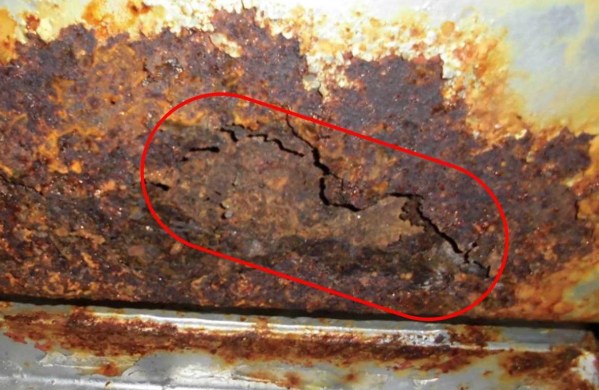
Corrosion is seen in a ventilation duct at the No. 3 unit of the Kashiwazaki-Kariwa nuclear power plant in Niigata Prefecture. | NUCLEAR REGULATION AUTHORITY
Corrosion and holes have been found in ventilation ducts at 12 reactors at seven nuclear plants across the country, the Nuclear Regulation Authority said Wednesday, raising concerns that workers could be exposed to radiation in the event of an accident.
The governmental nuclear watchdog released the results of a nationwide survey it had ordered following a revelation in December 2016 that corrosion had left multiple holes in the air ducts of the No. 2 reactor at Chugoku Electric Power Co.’s Shimane plant in western Japan. That reactor was not included in the survey.
Serious corrosion was found at the No. 3 unit of the Kashiwazaki-Kariwa plant in Niigata Prefecture operated by Tokyo Electric Power Company Holdings Inc. and may have abnormally affected ventilation of the central control room, the watchdog said.
Although the No. 7 unit at the same plant has passed a test to resume operation, the NRA said it will inspect the impact of any corrosion found at the reactor. No abnormality associated with corrosion has been found at the remaining 10 units, it said.
Corrosion or holes were found in steel or galvanized steel ducts at Tohoku Electric Power Co.’s Onagawa nuclear plant, Japan Atomic Power Co.’s Tokai No. 2 nuclear plant, Tepco’s Fukushima No. 1 nuclear plant and Kashiwazaki-Kariwa nuclear plant, Chubu Electric Power Co.’s Hamaoka plant, Hokuriku Electric Power Co.’s Shiga nuclear plant and Chugoku Electric’s Shimane plant.
If an accident occurs, radioactive materials could flow into a plant’s central control room through such holes, putting workers in danger of radiation exposure.
At the No. 3 reactor at the Kashiwazaki-Kariwa plant, a crack as large as 13 centimeters in length and 5 cm in width was found. A total of nine holes and cracks have been discovered at the Nos. 3 and 7 units at the plant.
All the reactors with corrosion were boiling-water reactors, the same type used at the Fukushima No. 1 plant, which spewed a massive amount of radioactive material into the atmosphere following the March 2011 earthquake and tsunami.
No problems have been detected at pressurized-water nuclear reactors, as filtering and other measures take place near air inlets.
The holes at the No. 2 unit at the Shimane plant were discovered when insulation materials covering the ducts were removed for inspection.
The holes, the largest of which measured about 100 centimeters wide and about 30 centimeters long, are believed to have been caused by dew condensation and rainwater that seeped inside the building, as well as salt deposits on the ducts, given that the corrosion extended about 50 meters from the air inlet and spread from the inner surface of the ducts.
Chugoku Electric has decided to increase the number of inspection points at sections near fresh-air inlets and bolster anti-corrosion measures, including the installation of a dehumidifier.
TAIPEI (Kyodo) — Taiwan authorities said Wednesday that Japanese 100-yen shop chain Daiso has been fined NT$41.64 million (US$1.38 million) for falsifying import application documents and banned from importing goods from Japan for two years.
Foreign Trade Bureau deputy chief Lee Guann-jyh told a legislative committee that the punishments have been meted out to Hiroshima-based Daiso Industries Co., which has been operating in Taiwan since 2001 and has about 60 stories here.
In November 2015, Daiso received a six-month import ban for having illegally imported food products from parts of Japan affected by 2011 Fukushima nuclear disaster between July 2014 and March 2015, and selling them with falsified labels of origin.
During that six-month period, Daiso could still import goods from Japan on a case-by-case basis after obtaining permission from the bureau.
But in doing so, it falsified the dates of the imported goods, altering them to predate the six-month ban period that began in November 2015. A total of 694 import application documents were fraudulent, according to the bureau.
On April 27, the company held a press conference in which it apologized to Taiwanese consumers.
As the cleanup of a triple meltdown following an earthquake and tsunami at the Fukushima nuclear power plant drags into its seventh year, one of the biggest continuing threats is less from airborne radioactivity than it is simple water.
A waterlogged radiation and tsunami warning sign found on Fukushima beaches in 2013.
May 22, 2018
As the cleanup of a triple meltdown following an earthquake and tsunami at the Fukushima nuclear power plant drags into its seventh year, one of the biggest continuing threats is less from airborne radioactivity than it is simple water.
On March 11, 2011, the Fukushima plant was devastated by a tsunami, which over the ensuing days sent three of its six reactors into meltdown, while hydrogen explosions cast radioactive iodine, cesium and other fission by-products into the air. More than 160,000 people were forced to evacuated in the wake of the disaster, which has now become synonymous with Chernobyl.
At the time, officials began pumping millions of liters of water into the destroyed reactors to keep them cool, often dumping it from helicopters and spraying it through water cannons. In the years since, the water inundation has become less dramatic, but in the absence of any other way to keep the molten fuel cool, the flow of water continues to flow through the remains of the reactors at the rate of some 160 tons of water a day.
While much of that water undergoes purification to remove significant amounts of radiation, filters can’t cleanse the water of tritium, a radioactive isotope of hydrogen — a process likened by some scientists to separating water from water.
As a result, water contaminated with tritium is building up and space to store it at the disaster site is running out. Of the 1.13 million-ton water storage capacity that the plant has, some 1.7 million tons have been used up.
Cleanup workers have to build a new steel water tank at the rate of one every four days to contain it all, and space to build more is becoming scarce. According to Japan’s Ministry of Economy, Trade and Industry, the tanks already sprawl over an area that could accommodate 32 football fields. All of the storage, says the government, will run out by 2021.
This looming crisis has left the Japanese government and Tokyo Electric Power Company, which owns Fukushima, pondering how to get rid of this water – a decision that is generating anxiety and scare headlines as an expert committee weighs whether or not to release the water into the Pacific Ocean.
Despite the national and worldwide case of nerves such a decision might provoke the Japanese government says it can do it without a threat to the country’s fishing industry. Tritium, after all, is a substance that naturally occurs in rivers and seabeds – even tap water. What’s problematic with the tritium at Fukushima, though, is that its levels in the Fukushima water are 10 times higher than Japanese national standards for dumping it.
Because of that, the government’s expert panel is considering several methods for the water’s disposal, including evaporating it, releasing it into the sea after electrolysis, burying it underground or injecting it deep into the geology.
But as cleanup costs continue to spiral, with some Japanese think tanks speculating the final bill could be as much as $470 billion to $660 billion, releasing the water into the sea – after diluting it – may turn out to be the cheapest option.
It’s not the first battle against water that the cleanup effort has fought. As recently as two years ago, some 400 tons of ground water flowed into the facility daily. Tokyo Electric Power somewhat stemmed that by building an underground wall of frozen soil to staunch the seepage of radioactive water.
has managed to decrease the inflow by installing a 30-yard-long “ice wall” fence that freezing cold brine is pumped through to freeze the soil around it, reports Wired. The chilled soil is meant to create a barrier to keep additional groundwater from spilling into the radioactive area.
But this year, on the seventh anniversary of the disaster, an expert group commissioned by the Japanese government concluded that the subterranean wall is not entirely effective against the deluge, and that other methods of battling leakage have to be devised.
More than seven years have passed since the Great East Japan Earthquake and subsequent accident at Tokyo Electric Power Co.’s Fukushima No. 1 nuclear power plant in 2011. A successful decommissioning of the plant and reconstruction of Fukushima is one of the most important missions of the government, especially the Ministry of Economy, Trade and Industry. Since 2016, I’ve been involved in the ministry’s special unit on Fukushima reconstruction, and mainly charged with a mission to eliminate reputational damage.
After the accident, the government set very stringent standards on the level of radioactive substances in food (in principle, 100 becquerel/kg: 10 times stricter than the Codex radionuclides standard), and any food product exceeding that level is prohibited for market distribution. Food products from Fukushima have undergone stringent monitoring, including all-volume inspection on rice and beef. Since 2015, not a single grain of rice or any piece of beef has been found with radioactive substances exceeding that level.
Nevertheless, around 12 percent of consumers in Japan tend to avoid agricultural and fishery products from Fukushima, according to a Consumer Affairs Agency survey. Since such reputational damage lingers even at home, the popular perception gap concerning Fukushima is likely even more serious overseas. With a view toward bridging that gap, I would like to highlight the following facts.
First, in the 12 municipalities in Fukushima Prefecture where evacuation orders were introduced after the nuclear disaster (Futaba, Hirono, Iitate, Kawamata, Kawauchi, Katsurao, Minamisoma, Namie, Naraha, Okuma, Tamura and Tomioka), the number of companies in the industrial estates has doubled from 35 before the disaster (in December 2010) to 70 in January. Some of the companies that have newly launched operation there engage in business that are relatively new to this area, such as the recycling of lithium-ion batteries and the production of internet-of-things devices that are wearable.
The establishment of the new companies have been facilitated by government incentives, including subsidies on investments that cover up to three-quarters of the investment cost, as well as the development of industrial infrastructure, such as the Fukushima Robot Test Field in Minamisoma and Namie. The test field, where any entity can use an extensive site (approximately 50 hectares) for demonstration experiments of robots and drones, is the core facility of the Fukushima Innovation Coast Framework.
This shows that the areas of Fukushima hit by the nuclear disaster have already become safe enough for businesses to operate. Private-sector companies never launch operations in locations where their employees’ safety is not ensured, even when the government provides most favorable incentives.
Second, as another proof of the area’s safety, the current situation of the Fukushima No. 1 plant should be highlighted. Today, workers can enter 96 percent of the site without any special radiation protection gear because the air dose rate has significantly decreased compared with right after the accident.
In addition, through multi-layered measures (e.g., the construction of frozen soil walls to suppress the inflow of groundwater as well as the pumping up of groundwater), the generation of contaminated water has been significantly reduced and prevented from leaking into the ocean. As a result, the concentration of radioactive materials in the sea water surrounding the plant has declined from 10,000 becquerels per liter as of March 2011 to below the detection limit (less than 0.7 becquerel per liter) since 2016.
The successful management of contaminated water has resulted in the improved safety of Fukushima’s fishery products. No marine products caught off Fukushima has exceeded the standard limit (100 becquerel/kg) in monitoring surveys over the fiscal years from 2015 to 2017.
Third, evacuation orders were lifted in many parts of the 12 municipalities by April 2017, and areas still under such orders account for approximately 2.7 percent of the prefecture’s total space — compared with 8 percent when the zoning was set in 2013. In several municipalities where evacuation orders were lifted up relatively early (such as the city of Tamura and the village of Kawauchi), around 80 percent of local residents have returned to their homes. Even in the areas where evacuation orders remain in place, efforts to improve the living environment have begun to pave the way for return of residents at the earliest possible time.
Needless to say, many challenges remain toward the successful reconstruction of Fukushima. The decommissioning of the Fukushima No. 1 plant is expected to take 30 to 40 years. To carry out the decommissioning, the retrieval of the melted nuclear fuel debris will be a major hurdle, and efforts to probe the inside of the reactor structures just started in 2015. In several towns where the evacuation orders were lifted only last year, less than 10 percent of local residents have returned to their homes. The improvement of living environment is an urgent task for those towns in order to encourage more residents to return.
Despite these challenges, the safety of Fukushima both in terms of its food products and the living/working environment in most parts of the prefecture has been proven. It is a pity that several countries/regions still impose import restrictions on Japanese food products (including those from Fukushima) and some people still hesitate to visit Fukushima for tourism or business. I wish that more people will visit Fukushima to taste the delicious and world’s safest rice, peaches and fish, and that more companies would be interested in utilizing advanced facilities/infrastructure such as the Fukushima Robot Test Field, and invest in Fukushima by taking advantage of the most favorable incentives in this country. Peaches will be harvested every year, but subsidies and other incentives will not last forever — so, the fast-movers will get the advantages.
Hideyasu Tamura is director the Fukushima Reconstruction Promotion Group at the minister’s secretariat of the Ministry of Economy, Trade and Industry.
The thousands of radiation-monitoring posts installed in Fukushima Prefecture after the 2011 nuclear crisis have malfunctioned nearly 4,000 times, sources said Sunday as the Nuclear Regulation Authority prepares to remove them after spending ¥500 million a year on repair costs.
“It’s all about the budget in the end. They can’t reuse the devices and there seem to be no concrete plans,” said Terumi Kataoka, a housewife in Aizuwakamatsu who formed a group of mothers to petition the NRA last month to keep the monitors in place. The NRA refused.
Around 3,000 of the monitors were installed in the wake of the triple core meltdown at the Fukushima No. 1 power plant following the March 2011 mega-quake and tsunami. The NRA, which operates the monitoring posts, plans to remove around 80 percent of them by the end of fiscal 2020 on the grounds that radiation levels in some areas have fallen and stabilized.
But the move is being viewed by some as an attempt to cut costs because the government is also looking to terminate its special budgetary account for rebuilding Tohoku by the same year.
Some municipalities and residents oppose scrapping the monitoring posts because they will no longer be able to gauge the risk to their health. They were installed in kindergartens, schools and other places to measure radiation in the air, according to the NRA.
But in the five years since the network was activated in fiscal 2013, the system has been plagued by problems including inaccurate readings and data-transmission failures. The tally of cases stands at 3,955.
Each time, the undisclosed makers of the device and security companies were called to fix it, costing the central government about ¥500 million a year.
In March, the NRA decided to remove about 2,400 of the monitoring posts from areas outside the 12 municipalities near the wrecked power plant and reuse some of them in the municipalities.
Local citizens’ groups have asked the NRA not to remove the monitoring posts until the plant, run by Tokyo Electric Power Company Holdings Inc., is decommissioned. That project is expected to take decades.
Kataoka asked the NRA to disclose information on its plans to reuse the devices, but she was told no official documents on the plans had been drafted yet.
On Monday, Fukushima Gov. Masao Uchibori urged the central government to investigate the cause of the monitor malfunctions and take measures to address the issue.
“The accuracy of the system is important,” he said.
Safecast, a global volunteer-based citizen science organization formed in 2011 to monitor radiation from the Fukushima disaster, said some devices had to be replaced because they didn’t work or were not made to the required specifications. Many were placed in locations that had notably lower ambient radiation than their surroundings, and so were not adequately representative of the situation, it added.
“Removing the units seems like a huge step away from transparency,” said Azby Brown, lead researcher at Safecast.
Brown said the public will certainly view the move with suspicion and increasingly mistrust the government, while the continuity of the database is lost.
“We achieved the sixth straight year of victory despite the severe situation due to rumors about radiation contamination”.
Fukushima Governor Masao Uchibori, speaking at a ceremony after the National Research Institute of Brewing awarded Fukushima Prefecture the national sake title for an unprecedented sixth straight year.
The number of storage tanks for contaminated water and other materials has continuously increased at the Fukushima No. 1 nuclear power plant in Japan, and space for still more tanks is approaching the limit.
It is seven years since an eathquake and tsunami overwhelmed Fukushima and a way to get rid of treated water, or tritium water, has not been decided yet.
The Government and Tokyo Electric Power Company will have to make a tough decision on disposal of tritium water down the road.
At the Fukushima No. 1 nuclear plant, groundwater and other water enters the reactor buildings that suffered meltdowns, where the water becomes contaminated.
This produces about 160 tons of contaminated water per day. Purification devices remove many of the radioactive materials, but tritium – a radioactive isotope of hydrogen – cannot be removed for technical reasons. Thus, treated water that includes only tritium continues to increase.
Currently, the storage tanks have a capacity of about 1.13 million tons. About 1.07 million tons of that capacity is now in use, of which about 80 per cent is for such treated water.
Space for tanks, which has been made by razing forests and other means, amounts to about 230,000 sq m – equivalent to almost 32 football fields. There is almost no more available vacant space.
Efforts have been made to increase storage capacity by constructing bigger tanks when the time comes for replacing the current ones. But a senior official of the Economy, Trade and Industry Ministry said, “Operation of tanks is close to its capacity.”
TEPCO plans to secure 1.37 million tons of storage capacity by the end of 2020, but it has not yet decided on a plan for after 2021. Akira Ono, chief decommissioning officer of TEPCO, said, “It is impossible to continue to store [treated water] forever.”
Tritium exists in nature, such as in seas and rivers, and is also included in tap water. The ordinary operations of nuclear plants produce tritium as well.
Nuclear plants, both in Japan and overseas, have so far diluted it and released it into the sea or elsewhere. An average of 380 trillion becquerels had been annually released into the sea across Japan during the five years before the accident at the Fukushima No. 1 nuclear plant.
Bottles that contain the treated water continue to be brought one after another to a building for chemical analysis on the grounds of the Fukushima No. 1 nuclear plant. The tritium concentration of the treated water is up to more than 1 million becquerels per liter, which is more than 10 times higher than the national standard for release into the sea – 60,000 becquerels per liter. But if diluted, it can be released into the sea.
The industry ministry’s working group compiled a report in June 2016 that said that the method of release into the sea is the cheapest and quickest among five ideas it examined. The ideas were:
– release into the sea;
– release by evaporation;
– release after electrolysis;
– burial underground;
– injection into geological layers.
The committee plans to hold a public hearing in Fukushima Prefecture and other places to hear citizens’ opinions on methods of disposal.
By Daryl G. Kimball and Thomas Countryman Daryl G. Kimball is Executive Director, Arms Control Association & Thomas Countryman is Board of Directors, Chairman, and former U.S. Assistant Secretary of State for Nonproliferation WASHINGTON DC, May 16 2018 (IPS) – We are deeply disappointed by the counterproductive response from the Trump administration to the statements from senior Saudi officials threatening to pursue nuclear weapons in violation of their nonproliferation commitments.
We call on the White House to immediately reiterate the longstanding, bipartisan policy of the United States that it will actively work against the spread of nuclear weapons to any country, friend or foe.
President Donald Trump’s reckless decision to violate the Joint Comprehensive Plan of Action (JCPOA), which has blocked Iran’s pathways to nuclear weapons and put in place a robust monitoring system to detect and deter cheating, has not only opened the door to an expansion of Iran’s capability to produce bomb-grade nuclear material, but it has increased the risk of a wider nuclear arms race in the Middle East, which is already home to one nuclear-armed state.
Saudi Arabia’s foreign minister Adel Al-Jubeir told CNN May 9, that his country, which, like Iran, is a party to the 1968 nuclear Nonproliferation Treaty (NPT), stands ready to build nuclear weapons if Iran restarts its nuclear program.
Al-Jubeir also praised Trump’s decision to abandon the Iran nuclear deal and seek to reimpose sanctions on firms and business engaging in legitimate commerce with Iran.
Asked what his country will do if Iran restarts its nuclear program, he told CNN’s Wolf Blitzer that “we will do whatever it takes to protect our people. We have made it very clear that if Iran acquires a nuclear capability, we will do everything we can to do the same.”
Asked to clarify whether that means the kingdom will work to acquire its own nuclear capability, al-Jubeir replied, “That’s what we mean.”
This follows similar comments by Saudi Crown Prince Mohammed bin Salman in a March 15 interview with CBS News that Saudi Arabia will quickly follow suit if Iran acquires nuclear weapons.
“Right now, I don’t know that we have a specific policy announcement on that front, but I can tell you that we are very committed to making sure that Iran does not have nuclear weapons,” she stated.
The administration’s nonresponse to Prince Salman’s threat in March and Sanders’ weak response May 9 amounts to an irresponsible invitation for mischief.
They imply that Trump administration would look the other way if Saudi Arabia breaks its NPT commitments to pursue nuclear weapons.
It is bad enough that the Trump administration, by violating the 2015 Joint Comprehensive Plan of Action, has threatened the NPT regime by opening the door for Iran to expand its nuclear capacity.
President Trump and his advisors must not compound that error by swallowing their tongues when another NPT member state in the region threatens to pursue the bomb.
We call on the White House to immediately clarify that it is the longstanding policy of the United States, as an original party to the NPT:
“…not to in any way to assist, encourage, or induce any non-nuclear-weapon State to manufacture or otherwise acquire nuclear weapons …” and “… to pursue negotiations in good faith on effective measures relating to cessation of the nuclear arms race at an early date and to nuclear disarmament ….”
We also call on the U.S. Congress to reject any proposed agreement with Saudi Arabia that permits U.S. nuclear cooperation if Saudi Arabia seeks to or acquires sensitive uranium enrichment or plutonium separation technology which can be used to produce nuclear weapons.
WASHINGTON — For the White House, these have been dramatic days for nuclear disarmament: First President Trump exited the Iran deal, demanding that Tehran sign a new agreement that forever cuts off its path to making a bomb, then the administration announced a first-ever meeting with the leader of North Korea about ridding his nation of nuclear weapons.
But for the American arsenal, the initiatives are all going in the opposite direction, with a series of little-noticed announcements to spend billions of dollars building the factories needed to rejuvenate and expand America’s nuclear capacity.
The contrast has been striking. On Thursday evening, hours after Mr. Trump announced that his meeting with Kim Jong-un, the North Korean leader, would take place on June 12 in Singapore, the Pentagon and the Energy Department announced plans to begin building critical components for next-generation nuclear weapons at the Savannah River Site in South Carolina.
The idea is to repurpose a half-built, problem-ridden complex that was originally intended to turn old nuclear weapons into reactor fuel to light American cities. Now the facility will be used to revitalize America’s aging nuclear weapons, and to create the capacity to make many hundreds more.
…… While it is possible that the American buildup is part of a negotiating strategy, offering Mr. Trump something he can trade away before it gets started, the White House has made clear, in both statements and strategy, that it envisions the reduction of nuclear weapons as a one-way street.
….. President Barack Obama argued that the United States could not urge other countries to give up nuclear programs while expanding its own. But many of his own aides later said they wished he had done far more to reduce America’s arsenal, arguing that it could safely drop below the number the Russians deployed.
Now Mr. Trump is heading in the other direction. The United States has dramatically stepped up the effort to overhaul the existing arsenal and prepare for the day when it might once again be enlarged. Unless the New Start Treaty is renewed for five years, any limits on the American and Russian arsenals will expire in February 2021, just days after Mr. Trump would enter his second term.
In the meantime, the American government is doing all it can to make clear it is preparing for an era of nuclear buildup.
…….. Los Alamos is to make 30 pits per year, and the South Carolina plant 50. That setup, the Energy and Defense Departments said, will improve “the resiliency, flexibility and redundancy of our nuclear security enterprise by not relying on a single production site.” But it also signals a return to production of new weapons, even as Mr. Trump is withdrawing from the 2015 deal with Iran in part because of “sunset provisions” that he says will eventually allow Tehran to do the same.
The federal rationale for making up to 80 pits a year is hidden in layers of secrecy but turns on stated fears that the plutonium fuel at the heart of American weapons will deteriorate with age, eventually rendering them useless.
Whether that fear is justified is a matter of debate. In 2006, a federal nuclear panel found that the plutonium pits aged far better than expected, with most able to work reliably for a century or more.
That judgment led critics to contend that the federal government was seeking a new generation of nuclear pits for reasons not of national security but of saber-rattling.
“No new pits are needed for any warhead,” Greg Mello, the executive director of the Los Alamos Study Group, a private organization in Albuquerque that monitors the nation’s nuclear complex and opposes expansion, said recently. “There are thousands of pits stockpiled for possible reuse.”
The Pentagon’s Nuclear Posture Review, published in February, called for the new capability to produce plutonium pits. It also called on Congress to approve the new low-yield nuclear weapons.
Last week, the full House Armed Services Committee endorsed the Nuclear Posture Review, but with Democrats overwhelmingly voting against it.
“We have to have a credible deterrence, but I think the Nuclear Posture Review goes way beyond credible nuclear deterrence,” said Representative Adam Smith of Washington, the top Democrat on the committee, warning that “we could stumble into a nuclear war.” https://www.nytimes.com/2018/05/14/world/trump-nuclear-savannah-river.html
The Path of Broke Nuclear Agreements, Yahoo News, Tom Z. Collina, Catherine Killough, Philip Yun The National Interest•May 20, 2018 Unlike North Korea today, Iran does not possess a single nuclear weapon. By trashing the Iran deal, President Trump risks turning Iran into North Korea.
The Path of Broke Nuclear Agreements
President Donald Trump, at the urging of National Security Advisor John Bolton, has withdrawn from the Iran nuclear agreement, putting the future of the deal in jeopardy. Trump did this despite the fact that Iran is in compliance with the deal, that the deal has served to shrink Iran’s nuclear program and keep it away from a bomb, and that it has prevented another costly war in the Middle East.
Just how bad will things get with Iran now that Trump has acted? Hard to say, but we can see the writing on the wall: Tehran could restart its nuclear program and edge closer to building a bomb. This would lead to increased calls from the right to—once again—stop Iran from acquiring nuclear capability, by military force if necessary. Trump is already indicating that things are heading in that direction. Just one day after breaking out of the Iran deal, Trump warned of “very severe consequences” if Iran resumes its nuclear program.
To fully understand the risks of the Trump administration abandoning the Iran deal, one need only recall what happened in North Korea after Bolton, then in the Bush administration as an under secretary of state, did his part to kill another landmark nuclear deal—the Agreed Framework.
In 1994, the North Korean regime threatened to go nuclear for the first time. To prove the point, Pyongyang expelled all international inspectors and made preparations to extract weapons-grade plutonium from its Yongbyon research reactor. The risks of a conventional conflict—even then— were high because the Clinton Administration was seriously considering military intervention in case diplomacy failed. An unprecedented meeting between former president Jimmy Carter and North Korean leader Kim Il-sung eventually led to the first U.S.-North Korea nuclear deal, the Agreed Framework.
Though only four pages long, the Agreed Framework served a similar purpose to the 159-page Iran agreement: to prevent a state from developing nuclear weapons. And, though neither agreement was perfect, the Agreed Framework—like the Iran deal thus far—proved successful, preventing the North from producing dozens more nuclear weapons worth of fissile material. For nearly a decade, the North readmitted international inspectors, stopped producing plutonium and shelved plans to build two large reactors.
……. Instead of working to improve the Agreed Framework by adding additional, stronger measures to what already existed, the Bush administration chose to back out of the agreement in 2002. Since that time, North Korea has consistently shocked the world with the speed, sophistication, and fulfillment of its nuclear ambitions.
……. Now, it is difficult to conceive of North Korea relinquishing a nuclear arsenal it has worked for two decades to achieve. But in 1994, long before North Korea tested its first bomb, the North did not have nuclear weapons to give up. Since then, the chance of convincing North Korea to give up its nuclear program has become less likely and more costly.
That history begs the question: What would North Korea look like today had we kept the Agreed Framework and built on it, rather than throwing it away?
Unlike North Korea today, Iran does not possess a single nuclear weapon, only the theoretical capability to one day produce them. By trashing the Iran deal, President Trump risks turning Iran into North Korea.
John Bolton was a central player in withdrawing U.S. support from the North Korea deal in 2002 and from the Iran deal now. History has shown that abandoning the North Korea deal made the problem worse, not better. Similarly, we can expect that the Iran crisis will now get worse, not better, as Tehran resumes its nuclear program and Trump responds with military threats.
Beware John Bolton, serial killer of nuclear agreements. He is shooting us all in the foot.
Philip Yun is Executive Director of Ploughshares Fund, a San Francisco-based peace and security foundation. He was a member of a government working group that managed U.S. policy and negotiations with North Korea under President Clinton and was part of the U.S. delegation that traveled to North Korea with Secretary of State Madeleine Albright in 2000.
Tom Collina is the Director of Policy at Ploughshares Fund. He has over 25 years of Washington, DC experience in nuclear weapons, missile defense and nonproliferation issues.
Catherine Killough is the Roger L. Hale Fellow at Ploughshares Fund, focusing on North Korea’s nuclear and missile development, inter-Korean relations, the US alliance system in East Asia, and the transnational politics of Asia.
Asahi Shimbun 20th May 2018 [Machine Translation]Hitachi announced plans to delay the goal of starting
nuclear power plans planned in the UK for about two years to 2027. The collection of funds necessary for the project is difficult, and reconsideration of sharing has started between companies that undertake design and construction.
The continuation of the project itself is increasingly uncertain.
In the plan, two nuclear reactors will be built on Anglesey island in the UK. The goal of starting operation has been
announced as “early 20’s”.However, according to officials, the Hitachi side recently proposed a new goal “April 27” to companies and others involved in the plan. It is planned to decide whether to start construction in 2019,
but it seems to be assuming a case where this time is delayed. https://www.asahi.com/articles/ASL5M4HZ3L5MULFA001.html
Europe reassures Iran of commitment to nuclear deal without U.S, Alissa de Carbonnel 19 May 18 TEHRAN (Reuters) – The European Union’s energy chief sought to reassure Iran on Saturday that the bloc remained committed to salvaging a nuclear deal with Tehran despite U.S. President Donald Trump’s decision to exit the accord and reimpose sanctions.
Miguel Arias Canete delivered the message on a visit to Tehran and also said the 28-nation EU, once the biggest importer of Iranian oil, hoped to strengthen trade with Iran.
“We have sent a message to our Iranian friends that as long as they are sticking to the (nuclear) agreement the Europeans will… fulfill their commitment. And they said the same thing on the other side,” Arias Canete, European Commissioner for energy and climate, told reporters after talks with Iran’s nuclear chief Ali Akbar Salehi.
Salehi said it would be disastrous if EU efforts fail to preserve the 2015 deal, in which Tehran agreed to curb its nuclear work in return for the lifting of most Western sanctions. “The ball is in their (EU leaders) court,” Salehi said. “We hope their efforts materialize.”
Since Trump’s announcement of the U.S. exit on May 8, EU leaders have pledged to try to keep Iran’s oil trade and investment flowing but admitted that will not be easy to do so.




 White House Should State Opposition to Saudi Threat to Acquire Nuclear Weapons http://www.ipsnews.net/2018/05/white-house-state-opposition-saudi-threat-acquire-nuclear-weapons/
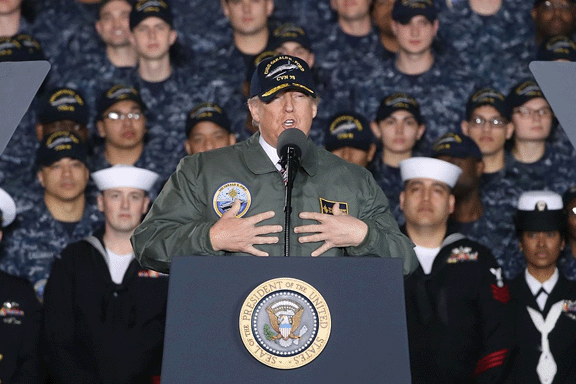 As U.S. Demands Nuclear Disarmament, It Moves to Expand Its Own Arsenal, NYT. By David E. Sanger and William J. Broad, May 14, 2018
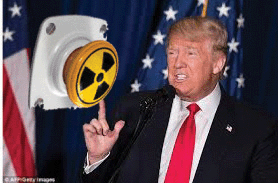 The Path of Broke Nuclear Agreements, Yahoo News, Tom Z. Collina, Catherine Killough, Philip Yun The National Interest•May 20, 2018 Unlike North Korea today, Iran does not possess a single nuclear weapon. By trashing the Iran deal, President Trump risks turning Iran into North Korea.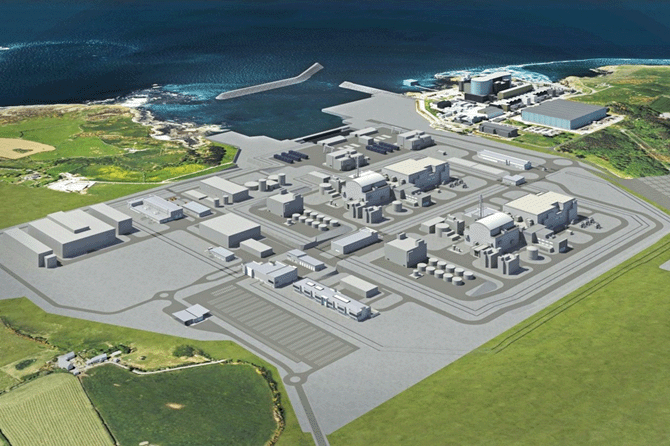

 Europe reassures Iran of commitment to nuclear deal without U.S, Alissa de Carbonnel 19 May 18 TEHRAN (Reuters) – The European Union’s energy chief sought to reassure Iran on Saturday that the bloc remained committed to salvaging a nuclear deal with Tehran despite U.S. President Donald Trump’s decision to exit the accord and reimpose sanctions.



 nuclear-news