France’s EDF to spend 8 billion euros ($9.8 billion) by 2035 on energy storage
Utility Dive 29th March 2018. French national utility EDF says it plans to spend 8 billion euros ($9.8
billion) by 2035 in a move to become “the European leader” in energy
storage. EDF’s goal is to develop 10 GW of storage around the world by that
same timeframe. The company already operates 5 GW of storage facilities. In
particular, EDF is targeting the residential sector in France and Europe
with a variety of self-consumption services that use batteries, as well as
Africa where the utility company hopes to develop a portfolio of 1.2
million off-grid customers by 2035 through local partnerships.
https://www.utilitydive.com/news/edf-to-invest-nearly-10b-in-energy-storage-by-2035/520212/
Russia (discarded) plan for Nuclear ICBM’s on Trains
Russia Almost Brought Back a Terrifying Weapon: Nuclear ICBM’s on Trains, National Interest Robert Beckhusen, 3 Apr 18,
In October 1987, the first rail ICBM became operational in the form of the “Moldets,” a train armed with a 77-foot-long RT-23 — a type of ICBM which was also stored in silos — carrying 10 multiple-reentry warheads with 550 kilotons of explosive power each. In the 1990s and 2000s after the START II treaty, Russia decommissioned these missiles, which NATO referred to as the SS-23 Scalpel. The Kremlin produced 12 of these trains.
In 2013, the Russian military announced it would bring back rail-mobile intercontinental ballistic missiles. In other words, trains with big nukes crammed inside, capable of darting around Russia, raising their launchers and firing at a moment’s notice. It was called Barguzin and would begin testing in 2019.
That was the idea. In December 2017, the Russian government put the Barguzin project on hiatus, saving the world from the specter of doomsday trains roaming Siberia. The ostensible reason — the weapon is too expensive, according to Rossiyskaya Gazeta, the government’s paper of record.
The Barguzin project was a revival of a retired leg of the Soviet Union’s ground-based nuclear “triad.” While the Soviets had nuke-equipped submarines and nuclear-armed bombers, its ground-based component had nuclear missiles mounted on huge trucks, inside underground silos and on trains. The Soviet military first signed the order for the creation of rail-mobile ICBMs in 1969, but the launchers came later.
In October 1987, the first rail ICBM became operational in the form of the “Moldets,” a train armed with a 77-foot-long RT-23 — a type of ICBM which was also stored in silos — carrying 10 multiple-reentry warheads with 550 kilotons of explosive power each. In the 1990s and 2000s after the START II treaty, Russia decommissioned these missiles, which NATO referred to as the SS-23 Scalpel. The Kremlin produced 12 of these trains.
And that was the end of Russia’s rail-mobile missiles until the Kremlin announced in 2013 that it would create a new nuke-armed train under the moniker Barguzin, or BZhRK, this time equipped with the more advanced RS-24 Yars ICBM.
The RS-24 has a similar range to the RT-23 but is three meters shorter and weighs half as much — a considerable advantage for mobile missiles. The RS-24 is also, by the way, road-mobile.
……….During peacetime they require a network of bases for storage and maintenance, where international treaties require them to stay, and extensive security detachments to protect the missiles when they move during wartime. And they’re still stuck on railroad tracks — so U.S. spies have a general idea of where to look.
Which also begs the question as to whether the nuclear-war trains could even make it out of their bases in time before incoming missiles hit in the opening minutes of a nuclear war. Sure enough, the Pentagon studied the issue during the Cold War, and even built two prototype train cars intended for the Peacekeeper ICBM, but found them to be not worth the cost and rather vulnerable……. http://nationalinterest.org/blog/the-buzz/russia-almost-brought-back-terrifying-weapon-nuclear-icbms-25193
Breaking! Craig Murray: Foreign Office sources told me 2 weeks ago that Porton Down couldn’t say it was Russia

Image source; https://www.telegraph.co.uk/news/picturegalleries/uknews/3400728/The-power-of-propaganda-wartime-posters.html
“Sources in Foreign and Commonwealth Office told me 2 weeks ago that Porton Down were unable to say it was Russia but were under pressure by Conservatives to say it was” says Craig Murray as scientists have been unable to prove Russia made the nerve agent A-234 used to poison the Skripals. MORE: https://on.rt.com/92g3
Porton Down CEO: It’s Novichok but we don’t know where it came from
“We’ve been able to establish it’s Novichok” says Porton Down CEO Gary Aitkenhead as its scientists can’t determine where the poison came from in the Skripal case despite Russia getting the blame. MORE: https://on.rt.com/92g3
Novichok A234 – The facts – Exclusive to nuclear-news.net
After some research on Novichok i discovered that;
1/ Militarised Organophosphates (MOP) can be processed into a sticky oil or a fine powder and there are at least 4 types
2/ New Nuclear, biological and chemical NBC suits were developed before Desert Shield as the Novichok series of chemical agents were designed to circumnavigate the old Noddy suits supplied to the military.
3/ Novichok series compounds are detectable easily with testing equipment developed prior to Desert Shield
4/ It is very likely that an antidote was developed prior to desert shield (especially as Skripals daughter and the policemen are recovering)
5/ By making all references to Novichok series a matter of national security the OPCW was not told that these compounds were so dangerous thus allowing the USA and UK to keep such weapons on their shelves.
6/ Most of the Russian peer reviewed studies on this were done under the guise of fertiliser/insecticide production
7/ Although some of the precursors like SO2 are very nasty making this product difficult to produce a synthetic chemist in a lab could produce it
8/ Concerning the Polonium 210 poisoning of Litvinyenko, this polonium could have been synthesised by reducing radium tubes and dials etc reasonably easily

Posted to nuclear-news.net by Shaun McGee (aka arclight2011)
Posted on 29th March 2018

Thanks to Prof. Chris Busby for proofreading the chemical composition from the chemist source materials ( linked here link) and for his input into this article.
After some research on Novichok i discovered that;
1/ Militarised Organophosphates (MOP) can be processed into a sticky oil or a fine powder and there are at least 4 types
2/ New Nuclear, biological and chemical NBC suits were developed before Desert Shield as the Novichok series of chemical agents were designed to circumnavigate the old Noddy suits supplied to the military.
3/ Novichok series compounds are detectable easily with testing equipment developed prior to Desert Shield
4/ It is very likely that an antidote was developed prior to desert shield (especially as Skripals daughter and the policemen are recovering)
5/ By making all references to Novichok series a matter…
View original post 689 more words
Toyoshi Fuketa: Chairman of the Nuclear Regulation Authority (NRA) – FCCJ

Posted by Shaun McGee
Posted to nuclear-news.net on the 4 April 2018
Q and A from Toyoshi Fuketa, the Chairman of Japans Nuclear Regulatory Agency (NRA) in the Foreign Correspondence Club of Japan on the 29th March 2018
The moderator began by stating that there would be no speech from Toyoshi Fuketa and they would move straight into the Q and A session.
Concerning the issue of the build up of the tritium laced decontaminated water, the NRA has held the view that only releasing it into the ocean was the only viable solution.
Should people be worried about returning to live in areas around the plant?
He replied that people should not consider any health risks in doing so…
(NOTE from Shaun McGee This issue is being debated still in Japan – https://europeannewsweekly.wordpress.com/2016/12/27/campaign-to-stop-bad-nuclear-health-practice-in-fukushima-concerning-thyroid-cancer-epidemic/ and https://europeannewsweekly.wordpress.com/2016/03/18/shocking-health-effects-in-fukushima-nuclear-workers-found-under-the-official-radiation-dose-limits/ )
… limited numbers of people have returned but with few families with children doing so. The problem of infrastructure within these areas means that there are little in the way of schools, employment and that the ease of living there is difficult. He went onto state that was no health risk in the decontaminated areas.
Concerning the time that “complete” decommissioning would take, the moderator mentioned a few decades or even 100 years and the response was stated that this was an “ambiguous definition” that was “difficult to answer” for instance;
A totally cleared area returned fully to nature
An industrial area with certain areas sealed from the public.
The moderator said that now we know the earthquake was the actual cause of the disaster and not the Tsunami so what would happen if there was another damaging earthquake at the site and what would be the safety response? Toyoshi Fuketa responded that the earthquake did not trigger the meltdowns. The stored water on the site would be problematic but any contamination issues would not effect the surrounding areas and therefore there would be no reason for evacuation. The moderator mentioned after the answer that a Parliamentary committee had designated the Earthquake as the actual trigger but got no response to that. The next question quickly followed;
The issue of the Monshu nuclear reactor and the nuclear processing fuel cycle that has largely failed was mentioned and the questioned asked whether the continuation of this programme despite being a costly failure might be because of the needs of the military research and development?
Toyoshi Fuketa Said that the NRA concentrates on safety issues and with the help of the IAEA is involved in military research and development oversight.
Asked whether Japans nuclear plans for 20 to 22 percent of future energy being supplied by nuclear being realistic … said that the NRA has no opinion on this question but later in the Q and A … confessed a personal position that he would hope that Japan would develop alternative energies and an energy saving policies instead (his own specialisation being engineering and not nuclear specific engineering).
When the issue of the IAEA`s 2016 report mentioning 4 points there was a critique of the NRA
1/ Human resources and training
2/ The lack of a self questioning attitude
3/ failure in onsite safety inspections
4/ Japans large threat of natural disasters including volcanoes, earthquakes and Tsunamis being the a threat.
Toyoshi Fuketa said that there was a problem with funding, employment and training in that there was not enough funding available for best practise policies and implementation. Concerning the self questioning attitude the NRA relied on the input from utility companies whist using public forums and platforms, open to the public, for increased scrutiny and transparency. Also, the OECD had input and did reports (Full critiques of OECD report with sources can be found here https://europeannewsweekly.wordpress.com/2016/08/15/japans-dodgy-deep-geological-nuclear-waste-disposal-hopes-and-fears-2016/ ).
The reason given for the lack of onsite inspections mentioned in the IAEA 2016 report was to look at other countries with different policies using the USA and Switzerlands more safety conscious approach. The NRA wishes to use the USA policies and is in year 2 of a 3 year improvement plan which began in 2017 and that this was being developed with onsite agencies and other bodies.
The issue of Japans proclivity to natural disasters was deemed by Toyoshi Fuketa to be the “most contentious issue in the report. He went onto say “what is adequate protection”?
He said that Press challenges to the official reports were important in this regard and that made the NRA have to offer technical responses to questions raised in public debates but that the NRA would ultimately make its own technical decision on issues.
The next question concerned the different policies utilities have on their policies on safety and working practices and should all nuclear utilities come under one unifying structure (A national merger of the many utilities was mentioned) to simplify the complicated inspection and advice procedures found in Japan. …. said that Japan should develop the US model (or similar) where nominated safety officers at each plant hold monthly meetings (2017 report on the US NRA safety culture can be found here www.ucsusa.org/nuclear-power/whos-responsible-nuclear-power-safety/nrc-safety-culture#.WsOVtZ_OBhE ) to decide best practice on safety and other issues but he didnt mention any plans ongoing to deal with this issue.
The last question was from the moderator who asked if, in his personal opinion, would Japan stop using nuclear energy? Toyoshi Fuketa`s response, after a rather long pause, was to say that he wished for Japan to move further towards renewable energy solutions and to further reduce the consumption of energy. He mentioned that it would be difficult for Japan to completely stop nuclear energy production in the near future as the infrastructure and policies in Japan were not completely ready for zero nuclear energy yet. He finished of this statement by saying that “I am not originally a nuclear engineer but was a structural engineer”
Source video in English with Japanese translation here;
The #FusionDoctrine #RIPA #JTRIG effect on the blog statistics causes a 50% decline from Google search

Posted to nuclear-news.net
Posted by Shaun McGee aka arclight2011 on the 2nd April 2018
OK I have been harping on about this issue for some time and bothered to sit down and go through all the stats on nuclear-news.net to see if I could find any patterns.
Firstly, its worth looking at the years 2013/2014 when Theresa May as Home Office minister signed off on a Special Branch (MI5) action that left me homeless and without a job which I put up with as I was chased around the UK and Wales until I could run no more and had spent all my savings and credit lines to friends and colleagues. Then I was chased out of the UK for being a naughty Blogger smashing the nuclear industry and Facebook, Twiiter etc reduced the reach of this blog. T. May also updated the Official Secrets Act to include nearly everything in April 2014.
Secondly, came June 2017 when Theresa May, as Prime minister, called in the Social Media Giants to Parliament where she instructed them to filter out “Fake News” ie activists, NGO`s journalists and bloggers in conjunction with the USA authorities and even Democracy Now was targeted for serious Google search filtering.
Thirdly, Terrible May pushed for the RIPA laws that made legal that which was illegal (Human Rights stuff). Then this year she capped it off with a dose of the “Fusion Doctrine” making legal that which Special Branch was doing illegally to people like me, George Galloway and many others all supported by the most intrusive civilian spy system known to man ref E. Snowden.
It took me ages waiting for enough stats to come in to prove definitively that this blog stats have been manipulated as has many others (mostly without knowing it). For our regular subs, this will be no surprise but here are the stats in a nice clean spreadsheet so you can see the patterns and timing for yourselves.
I am sure I have a lot more to say about this but I will cut short the diatribe and just present you all with the evidence. You need to request our email service which will deliver the posts in full if you want to be informed about the nuclear madness currently happening in the world if you value you family and friends health and well being. Get active, the more there are the harder it is for the authorities to keep track of what is going on. As John Pilger said he has never seen things this bad!! And he is absolutely correct, the evidence is there if you can get around the filtering of information that is currently happening.
In the spreadsheet below are the referrals to the blog;

The problem with the BBC and Brexit – Response to Scientists for the EU
If I was a betting man I would say that the UK Gov will use Pesco funding and EU citizens rights as a bulwark against the EU Tax avoidance law and concede to a Norway style EEA agreement.. but they surely are not doing that? It is what the Atlantic Alliance would go for (ie NATO) as the UK could then continue as the leading country defending Northern region Fascist Latvia etc as agreed last year giving EU PESCO command of the southern region. So actually all this is a distraction for the plebs and copy for the journalists .. Just saying
UPDATE; Another helpful EU agency is apparently ESMA (security and markets authority) they have currently scared the living daylights out of many companies selling high risk financial ‘trading’ services…

BBC have failed public on quality education over Brexit. As they launch an investigation into themselves – here’s how they could fix the problem with a more evidence-based approach.
Follow “Scientists for EU” on Facebook, G+ and Twitter (@Scientists4EU), subscribe to our YouTube channel – and see our website (scientistsforeu.uk)
Posted to europeannewsweekly
Posted by Shaun McGee aka arclight2011
2 April 2018
Some food for thought here.. On the 1st January 2019 the EU will enact a new policy concerning tax policy and transparency issues concerning the same. Anti-Tax Avoidance Directive https://ec.europa.eu/taxation_customs/business/company-tax/anti-tax-avoidance-package/anti-tax-avoidance-directive_en
And the BBC has a pension fund;
“…BBC pension fund
One can also look at the top 20 equity holdings held by the BBC pension fund – of course, the BBC being behind the Panorama programme which aired on Sunday night on the Paradise Papers.The scheme has substantial investments in the following:
Google…
View original post 1,274 more words
Nuclear lobby no longer touts Peaceful Nuclear Power – now it’s Essential for Nuclear Weapons
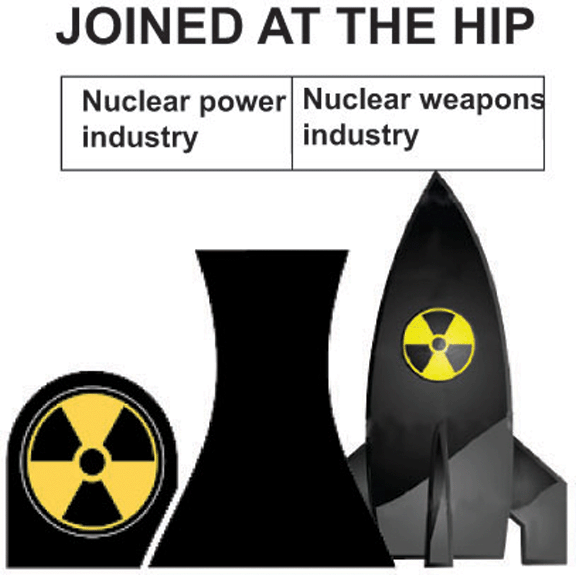 Should Nuclear Energy Be a U.S. National Security Concern? Inside Sources March 29, 2018 by Erin Mundahl Sixty years ago, nuclear power was the energy of the future, promising a nearly limitless supply of clean, cheaper power. That future has yet to arrive. In fact, today, utilities are increasingly transitioning out of nuclear generation, shuttering aging reactors and shelving plans to reinvest in new technology. This is more than just a shift from one fuel to another, says David Gattie, an associate professor of environmental engineering at the University of Georgia. The decline in interest in nuclear energy has significant impacts on America’s national security.
“Nuclear energy is a unique resource because of its unmatched energy density and dual-purpose utility for electric power generation and nuclear weaponry,” Gattie writes in a recently published paper………. Although American scientists began the atomic age, more recently, research and development in nuclear technology, including civilian nuclear, has decreased to a level that threatens American primacy and, by extension, national security….
The U.S. is running the risk of falling behind the rest of the world in terms of nuclear technology, rather than maintaining its position of global leader.
To combat this trend, Gattie advocates specific legislative action to provide fixed support for nuclear research and development. For the purposes of longevity, this would optimally be a legislative, rather than executive action. This space to resurrect research in technologies like molten salt and breeder reactors would signal that the U.S. is committed to the future of nuclear energy. http://www.insidesources.com/nuclear-energy-should-be-a-us-national-security-concern/
Has the world forgotten the catastrophic danger if a plutonium-powered space rocket crashed to Earth
Beyond Nuclear 31st March 2018, President Trump has announced that he wants the National Aeronautics and Space Administration (NASA) to “lead an innovative space exploration program to send American astronauts back to the moon, and eventually
Mars.” But the risks such ventures would entail have scarcely been touched upon.
For those of us who watched Ron Howard’s nail-biter of a
motion picture, Apollo 13, and for others who remember the real-life drama
as it unfolded in April 1970, collective breaths were held that the
three-man crew would return safely to Earth. They did.
What hardly anyone remembers now — and certainly few knew at the time — was that the
greater catastrophe averted was not just the potential loss of three lives,
tragic though that would have been. There was a lethal cargo on board that,
if the craft had crashed or broken up, might have cost the lives of
thousands and affected generations to come. It is a piece of history so
rarely told that NASA has continued to take the same risk over and over
again, as well as before Apollo 13. And that risk is to send rockets into
space carrying the deadliest substance ever created by humans: plutonium.
https://beyondnuclearinternational.org/2018/03/31/the-real-houston-problem/
Japan warns that North Korea is digging new tunnel, “preparing for nuclear test”
 North Korea is ‘preparing for nuclear test by digging tunnel’ http://www.news.com.au/world/asia/north-korea-is-preparing-for-nuclear-test-by-digging-tunnel/news-story/69fe873a70328b72addac06b9924c3d2 JAPAN has warned that North Korea is “doing everything possible” to prepare for the next nuclear test by digging a new tunnel.

NORTH Korea is gearing up for a new nuclear test by digging an underground tunnel, Japan has warned.
The country’s Foreign Minister Taro Kono said: “[North Korea] is doing everything possible to prepare for the next nuclear test: it is currently extracting earth from an underground tunnel where the previous test was carried out.”
The minister said previously the secretive state “does not reveal its intentions to the outside world in terms of denuclearisation”.
The claim comes just days after Kim Jong-un promised to bin his beloved nuclear weapons if he could be guaranteed security and US military threats against North Korea were to stop.
At the end of last year the tyrant declared his country a fully fledged nuclear power after launching a new missile he claimed was capable of hitting anywhere on the planet.
Nuclear devices are often tested underground to prevent radioactive material released in the explosion reaching the surface and contaminating the environment — this method also ensures a degree of secrecy.
The release of radiation from an underground nuclear explosion — an effect known as “venting” — would give away clues to the technical composition and size of a country’s device.
A test site is carefully geologically surveyed to ensure suitability — usually in a place well away from population centres.
The nuclear device is placed into a drilled hole or tunnel usually between 200-800m below the surface, and several metres wide. Last year a tunnel at an underground North Korean nuclear site was said to have collapsed.
Up to 200 people were thought to have died at the Punggye-ri nuclear test site in the northeast of the country.
The accident was believed to have been caused by Kim Jong-un’s sixth nuclear test which weakened the mountain, according to the report.
Former British Defence Secretary Sir Michael Fallon previously warned that Britain is at risk from North Korea’s long-range nuclear missile program as some cities are closer than American targets.
Revised estimates suggest the total number of missiles the rogue state has is believed to be between 13 and 21.
And the regime is estimated to have at least four nuclear warheads.
Satellite images of Jong-un’s main missile test site in August revealed North Korea’s weapons were more powerful than initially thought.
Careful analysis of North Korean tests sites, using images from Planet, reveal the regime has been gradually building up the size of its missiles.
UK’s secret air transport of nuclear wastes – a cause for concern


 “Transporting nuclear waste is a risky business”. “It is disturbing to discover we are now using an extra airbase in heavily populated areas for a stop-off to transport nuclear waste”. “There is no truly safe way to move this nuclear waste from A to B”.
Top secret flights carrying NUCLEAR WASTE from Britain to US ‘to run until late next year’, Mirror UK, JIM LAWSON 1 APR 2018
Four US Air Force flights carrying highly enriched uranium from Dounreay power station in the Scottish Highlands are said to have left Wick John O’Groats airport bound for South Carolina. Top secret fights taking nuclear waste between Britain and the US will reportedly continue until late next year.
Four US Air Force flights carrying highly enriched uranium from Dounreay power station in the Scottish Highlands are said to have left Wick John O’Groats airport bound for South Carolina.
Dounreay, the Nuclear Decommissioning Authority, Police Scotland, the Civil Nuclear Constabulary and Wick Airport all refused to comment when asked.
Details of the flights apparently became public when Highland Council informed residents about road closures surrounding the airport – as it is legally obliged to do so. An order published last week was said to be code for “nuclear waste on the move”, suggesting the next consignment could be imminent.
The authority’s notice, published in two local newspapers, said: “The order has been made by reason that the council, as highway authority , is satisfied that traffic on the road should be restricted due to the likelihood of danger to the public.” It adds: “The purpose of the order is to enable abnormal load movements”.
The order will run from yesterday to September 30, 2019 with up to seven more flights expected during the period, it was reported.
A deal to transport highly enriched uranium – the basic building block for making a nuclear bomb – to be flown from Wick to the US was trumpeted by then Prime Minister David Cameron in 2016.
……..Highlands and Islands MSP John Finnie said: “Transporting nuclear waste is a risky business. By using two airports you are doubling the take-offs and landing in this country, which doubles the risk.
“It is disturbing to discover we are now using an extra airbase in heavily populated areas for a stop-off to transport nuclear waste”.
…….. Dr. Richard Dixon, director of Friends of the Earth, said flatly: “There is no truly safe way to move this nuclear waste from A to B”.
A spokesman for the Nuclear Decommissioning Authority said: “Our priority is to comply with the regulations governing the safety and security of nuclear material. Compliance with the regulations includes protecting information about the routes, times, dates and location”.
Flights left Britain on September 17, 2016, June 3, 2017, September 16, 2017 and December 9, 2017, it was reported. Wick John O’Groats airport is closed to civilian aircraft on Saturdays.https://www.mirror.co.uk/news/uk-news/top-secret-flights-carrying-nuclear-12287170
Closing down of Fukushima nuclear power plant has skyrocketed to US$75 billion
 Oil Price 30th March 2018, The decommissioning of the Fukushima nuclear power plant will cost an
annual US$2 billion (220 billion yen) until 2021, an unnamed source told
the Japan Times. Half of the money will be used to tackle the radioactive
water buildup at the site of the plant and for removing radioactive fuel
from the fuel pools. A small amount of funds will be used to research ways
of retreating melted fuel from the reactors that got damaged during the
2011 tsunami disaster.
The US$6 billion for the three years is only part of
the total estimated cost for taking Fukushima out of operation. The total
decommissioning tally came in at US$75 billion (8 trillion yen), as
estimated by the specially set up Nuclear Damage Compensation and
Decommissioning Facilitation Corp (NDF).
That’s four times more than the initial estimate of the costs around the NPP’s decommissioning. Now theoperator of Fukushima, Tepco, and the NDF are due to submit their financial plan for the facility to the government for approval by the energy industry
minister. In addition to the US$6 billion allocated for the cleanup, Tepco
will spend another US$1.88 billion (200 billion yen) on preparing to start
extracting the melted fuel from the three damaged reactors. This seems to
be the biggest challenge for the cleanup efforts because of the still high
radiation levels as well as technical difficulties. https://oilprice.com/Latest-Energy-News/World-News/Total-Tally-For-Fukushima-Decommission-Is-75-Billion.html
Irish Government ‘dozing at wheel’ over UK nuclear power plans
 Irish Times 29th March 2018, Irish Government and public urged to comment on Hinkley facility before April
17th. The UK’s nuclear power expansion programme, including the building
of the Hinkley Point C facility in Somerset, poses an unacceptable risk to
the island of Ireland, according to an alliance of political parties and
environmental groups.
Green Party Senator Grace O’Sullivan said the
Government “has been dozing at the wheel… and essentially failed the
Irish people because we have not had timely opportunity to be consulted”
about Hinkley, which is located less than 250km from south east Ireland.
Speaking at a press conference in Dublin, she said the UK government was
found to have failed to consult neighbouring states under the UN Espoo
Convention. After a five-year legal battle, in which Irish environmental
groups – An Taisce, Friends of the Irish Environment and the
Environmental Pillar – fought to uphold the rights of the Irish public,
“a long overdue consultation” began on February 20th. “People can
make their submissions to their relevant local authority. We strongly
encourage them to do so before April 17th.” https://www.irishtimes.com/news/environment/government-dozing-at-wheel-over-uk-nuclear-power-plans-1.3445065
Isle de Jean Charles – America’s first climate refugees to evacuate
 America’s first climate change refugees are preparing to leave an island that will disappear under the sea in the next few years, Business Insider David Usborne, The Independent, 1 April 18
An insider saboteur could cripple Britain’s nuclear power stations with a simple USB stick.

Mirror 31st March 2018, Britain’s nuclear power stations swept for Russian sleeper agents over
fears of crippling insider attack. An ex-senior intelligence officer has
warned that an insider could launch a malware attack with a simple USB
stick. https://www.mirror.co.uk/news/politics/britains-nuclear-power-stations-swept-12283716
1 This Month

Chernobyl: The Lost Tapes – A good documentary on Chernobyl on SBS available On Demand for the next 3 weeks– https://www.sbs.com.au/ondemand/tv-program/chernobyl-the-lost-tapes/2352741955560

of the week–London Campaign for Nuclear Disarmament

Tell the Ukrainian Government to Drop Prosecution of Peace Activist Yurii Sheliazhenko
To see nuclear-related stories in greater depth and intensity – go to https://nuclearinformation.wordpress.com
-
Archives
- April 2026 (173)
- March 2026 (251)
- February 2026 (268)
- January 2026 (308)
- December 2025 (358)
- November 2025 (359)
- October 2025 (376)
- September 2025 (257)
- August 2025 (319)
- July 2025 (230)
- June 2025 (348)
- May 2025 (261)
-
Categories
- 1
- 1 NUCLEAR ISSUES
- business and costs
- climate change
- culture and arts
- ENERGY
- environment
- health
- history
- indigenous issues
- Legal
- marketing of nuclear
- media
- opposition to nuclear
- PERSONAL STORIES
- politics
- politics international
- Religion and ethics
- safety
- secrets,lies and civil liberties
- spinbuster
- technology
- Uranium
- wastes
- weapons and war
- Women
- 2 WORLD
- ACTION
- AFRICA
- Atrocities
- AUSTRALIA
- Christina's notes
- Christina's themes
- culture and arts
- Events
- Fuk 2022
- Fuk 2023
- Fukushima 2017
- Fukushima 2018
- fukushima 2019
- Fukushima 2020
- Fukushima 2021
- general
- global warming
- Humour (God we need it)
- Nuclear
- RARE EARTHS
- Reference
- resources – print
- Resources -audiovicual
- Weekly Newsletter
- World
- World Nuclear
- YouTube
-
RSS
Entries RSS
Comments RSS
 nuclear-news