Why Trump Might Bend Nuclear Security Rules To Help Saudi Arabia Build Reactors In The Desert, NDTV, 20 Feb 18, The issue is a test of President Donald Trump’s foreign policy and his self-professed bargaining prowess.
World |
© 2018 The Washington Post |
Steven Mufson, The Washington Post | Updated: February 20, 2018 Next month, Saudi Arabia will announce the finalists of a sweepstakes. The prize? Multibillion-dollar contracts to build a pair of nuclear power reactors in desolate stretches of desert along the Persian Gulf.
For Saudi Arabia’s crown prince Mohammed bin Salman, the reactors are a matter of international prestige and power, a step toward matching the nuclear program of Shia rival Iran while quenching some of the kingdom’s domestic thirst for energy.
For the Trump administration, the contest poses a thorny choice between promoting U.S. companies and fighting nuclear proliferation. If the administration wants to boost the chances of a U.S. consortium led by Westinghouse, it might need to bend rules designed to limit nuclear proliferation in an unstable part of the world. That could heighten security risks and encourage other Middle Eastern countries to follow suit.
“If the Saudis were to get an agreement without restrictions, it would set a dangerous precedent in the region and [be] a significant break with American nuclear policy for the last 50 years,” said Jon Wolfsthal, a consultant on nuclear weapons who was a director for arms control and nonproliferation at the National Security Council under President Barack Obama.
The issue is a test of President Donald Trump’s foreign policy and his self-professed bargaining prowess. Trump, his son-in-law, Jared Kushner, and Energy Secretary Rick Perry have made pilgrimages to Riyadh to cozy up to the young crown prince and win big contracts for U.S. firms. Yet little has come to fruition.
Now, as Mohammed prepares to visit the United States in March, the Saudi deadline looms for Westinghouse, which is winding its way through bankruptcy and is eager to find customers for its much-praised AP1000 design. Without a diplomatic deal, Westinghouse and a South Korean group, which uses U.S. parts and technology and would be bound by the same rules, could be sidelined in favor of Russian or Chinese state companies.
The key rules governing nuclear sales to Saudi Arabia are spelled out in a document known as a 123 agreement, named after a section in the 1954 Atomic Energy Act.
The United States has 123 agreements with 23 countries, Taiwan and Euratom, a group of 27 nations. The 123 agreement for Saudi Arabia imposes limits on uranium enrichment and the reprocessing of spent fuel, both of which could be used to produce material for nuclear bombs.
Saudi Arabia has argued that it should be free to mine and enrich its own uranium deposits, as long as it abides by the international Non-Proliferation Treaty,which bars the diversion of materials to a weapons program. The China National Nuclear Corp. has signed preliminary agreements with the Saudis to explore nine potential uranium mining areas. Former intelligence chief Prince Turki al-Faisal told Reuters in December that Saudi Arabia would “have the same right as the other members of the NPT, including Iran.”
Mohammed, who harbors ambitions for an invigorated, more diverse Saudi economy, invited foreign firms to submit proposals last fall. In mid-November, executives from the world’s five leading nuclear reactor design and construction firms – including the Pennsylvania-based Westinghouse – made presentations to Saudi officials.
Khalid Al-Falih, Saudi Arabia’s energy and natural resources minister, told Reuters on Dec. 20 that he aims to sign contracts by year’s end.
The push to provide nuclear power to Saudi Arabia has divided U.S. policymakers.
Henry Sokolski, the executive director of the nonprofit Nonproliferation Policy Education Center who served in President George H.W. Bush’s Pentagon, asked, “How do we feel about the stability of the kingdom? The reactors are bolted to the ground for a minimum of 40 years and a maximum of 80 years. That’s enough for the whole world to change.”
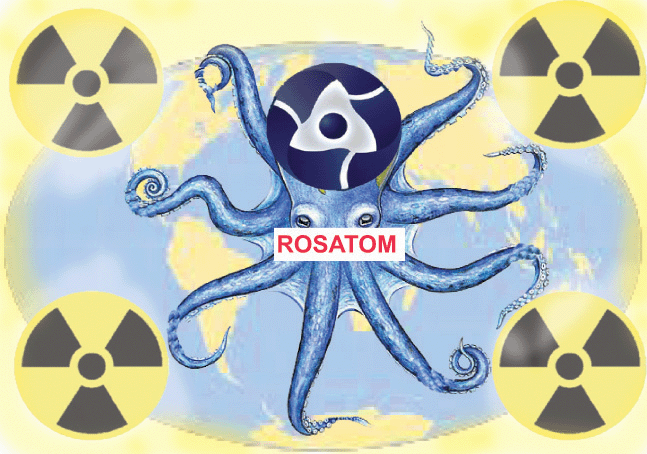
But others say that if the United States doesn’t build the reactors, then Russia’s Rosatom or the China Nuclear Engineering and Construction Group will, providing fewer safeguards against proliferation and eroding U.S. diplomatic strength in the region.
“I would prefer to have America’s nuclear industry in Saudi Arabia than to have Russian or China’s, so I think it’s useful that we’re reengaging with the Saudis. We should try to get the best restraints on enrichment and reprocessing, including a ban for some significant length of time, say 20 or 25 years,” said Robert Einhorn, a senior fellow at the Brookings Institution and a former State Department adviser for nonproliferation and arms control. “We should show some flexibility.”
The need to build nuclear reactors in Saudi Arabia, which has the world’s largest petroleum reserves, isn’t obvious. The kingdom says it wants to curtail the burning of oil to generate electricity at home. Doing so would free up more oil for exports, the kingdom’s main source of revenue.
Saudi electricity consumption doubled between 2005 and 2015. During the peak summer months, when temperatures soar past 120 degrees Fahrenheit, the kingdom burns about 700,000 barrels of oil a day for air conditioning. Add industrial and transportation use, and Saudi Arabia’s domestic crude consumption has neared 3 million barrels a day, more than a quarter of its total output.
Solar is another option. The Saudis could also tap its plentiful supplies of natural gas, much of which is flared and wasted.
Prestige is another lure for Saudi Arabia. Its smaller oil-rich neighbor, the United Arab Emirates bought four South Korean-model nuclear reactors now under construction.
“If ever there was a place that could take care of own energy needs without nuclear, it’s the UAE,” said F. Gregory Gause, a professor of international affairs at Texas A&M University. “I think it becomes a prestige thing, like international airports.”
But the UAE also signed a 123 agreement in January 2009 that is called the gold standard. It agreed not to enrich or reprocess – although a passage says it could reconsider if others in the region start doing so. It plans to buy uranium from the United States and ship spent fuel to Britain or France for reprocessing.
For Saudi Arabia, the UAE’s gold standard set a high bar. “During the Obama administration, we were at an impasse,” said Gary Samore, a former White House arms control coordinator now at Harvard’s Kennedy School of Government. “We wanted them to make a commitment similar to what Abu Dhabi did. We never overcame that issue in our negotiations.”
………… In the end, the fate of the U.S. proposal will circle back to the political and diplomatic efforts to forge a 123 agreement.
February 22, 2018
Posted by Christina Macpherson |
politics international, Saudi Arabia, USA |
Leave a comment

February 17, 2018
Translation by Herve Courtois from the ACRO article
http://fukushima.eu.org/chiffres-cles-septieme-anniversaire/
All the figures quoted in this article are from TEPCO and the Japanese government. We can safely assume the true figures to be somehow higher, as we know from the past 7 years that TEPCO and the Japanese government have never been straightforward with their figures.
As we approach the seventh anniversary of the nuclear disaster at the Fukushima Daiichi nuclear power plant, here are some key figures as they appear in the media and official websites. This article will be updated as they appear.
Situation of the reactors
The work is aimed primarily at securing the damaged reactors that are still threatening. Nearby, the dose rates are such that the work time of the workers must be very limited, which complicates the work.
Reactor # 4
The reactor vessel was empty on March 11, 2011 so there was no core melting, but a hydrogen explosion destroyed the reactor building. Since December 2014, the reactor fuel pool has been emptied and work is stopped because it is no longer threatening. http://www.tepco.co.jp/en/press/corp-com/release/2014/1246703_5892.html
The few dose rates available inside the reactor building are here expressed in mSv / h, knowing that the limits are in mSv / year. They date from 2016. www.tepco.co.jp/en/nu/fukushima-np/f1/surveymap/images/sv-u4-20160630-e.pdf
Reactor # 3
There was a core meltdown and a hydrogen explosion destroyed the reactor building. All top debris were removed using remotely controlled gear. A new building is being finished. Fuel removal is expected to begin this year and end in 2019.
The first images taken inside the containment led to a revision of the core fusion scenario.
http://photo.tepco.co.jp/en/date/2017/201707-e/170721-01e.html
http://photo.tepco.co.jp/en/date/2017/201707-e/170722-01e.html
www.tepco.co.jp/en/nu/fukushima-np/handouts/2017/images/handouts_170722_01-e.pdf
The few dose rates available inside the reactor building are here expressed in mSv / h, knowing that the limits are in mSv / year. They date from 2016.
www.tepco.co.jp/en/nu/fukushima-np/f1/surveymap/images/sv-u3-20160630-e.pdf
There would be between 188 and 394 tonnes of corium in this reactor, with a nominal value of 364 tonnes for reactor No. 3. The latter contains MOx fuel, which contains plutonium. To know more:
http://www.fukushimaminponews.com/news.html?id=739
Reactor # 2
There was a melting of the core, but the reactor building is whole. TEPCO has not started removing used fuel from the pool. The company sent several robots into the containment to locate the corium, the mixture of molten fuel and debris.
Several series of images have been put online by the company. Those taken in January 2017 were analyzed and put back online in December 2017. There is a gaping hole just below the vessel, most likely due to the passage of molten fuel.
www.tepco.co.jp/en/nu/fukushima-np/handouts/2017/images/handouts_171130_01-e.pdf
Those obtained in January 2018 at the bottom of the containment enclosure show what TEPCO thinks is corium and fragments of fuel assembly.
http://photo.tepco.co.jp/en/date/2018-e/201801-e/180119-01e.html
http://www.tepco.co.jp/en/news/library/archive-e.html?video_uuid=uikti9fd&catid=61785
www.tepco.co.jp/en/nu/fukushima-np/handouts/2018/images/handouts_180119_01-e.pdf
Dose rates inside the containment enclosure are lethal within minutes. The latest results published following the January 2018 exploration are quite surprising: not higher near what TEPCO thinks is corium, but higher outside.
www.tepco.co.jp/en/nu/fukushima-np/handouts/2018/images/handouts_180201_01-e.pdf
The few dose rates available inside the reactor building are here expressed in mSv / h, knowing that the limits are in mSv / year. They date from 2016.
www.tepco.co.jp/en/nu/fukushima-np/f1/surveymap/images/sv-u2-20160630-e.pdf
There would be between 189 and 390 tonnes of corium in this reactor, with a nominal value of 237 tonnes. To know more:
http://www.fukushimaminponews.com/news.html?id=739
Reactor # 1
There was a core meltdown and a hydrogen explosion destroyed the reactor building. This building was covered by a new structure in 2011, which was completely dismantled in November 2016. TEPCO began removing the debris from the upper part of the reactor, then rebuilding a new structure to empty the pool. fuels.
The dose rates inside the reactor building are here expressed in mSv / h, knowing that the limits are in mSv / year. They date from 2016.
www.tepco.co.jp/en/nu/fukushima-np/f1/surveymap/images/sv-u1-20160630-e.pdf
There would be between 232 and 357 tons of corium in this reactor, with a nominal value of 279 tons. To know more:
http://www.fukushimaminponews.com/news.html?id=739
Reactors 5 and 6
Reactors 5 and 6 were partially unloaded on March 11, 2011, and a backup diesel generator was still functional, which prevented the core from melting. These reactors are now fully unloaded and will be dismantled.
Contamination of the plant
The last dose rates on the plant site published by TEPCO are from February 2017:
Groundwater also remains contaminated. Figures to come.
Contaminated water
The fuel that has melted and drilled the vessels must always be cooled. To this end, TEPCO injects 72 m3 of water per day into each of the reactors 1, 2 and 3 for this purpose. This makes a total of 216 m3 per day. This water is highly contaminated by contact with the molten fuel and infiltrates the basements of the reactor and turbine buildings where it mixes with the groundwater that infiltrates it.
www.tepco.co.jp/en/press/corp-com/release/betu18_e/images/180205e0101.pdf
At the beginning of the disaster, the infiltration amounted to about 400 m3 per day, which became contaminated and had to be stored in tanks. Inversely, the water of the basements, highly contaminated, leaked towards the groundwater then the ocean.
To reduce groundwater seepage, TEPCO pumps upstream of reactors before this water is contaminated and releases it directly into the ocean. It has also built a barrier all along the shoreline and pumps groundwater at the foot of the reactors. Part of this is partially decontaminated and released into the ocean. Another part, too contaminated, is mixed with the pumped water in the basements of the reactors to be put in tanks after treatment, waiting for a better solution.
The last barrier put in place is the freezing of the ground all around the 4 accidented reactors, on 1.4 km in order to stop the infiltrations. After many setbacks, the ice wall is finished since November 2017, but the effect remains limited. Even the Nuclear Regulatory Authority, the NRA, seriously doubts the effectiveness of this technique, which it now considers secondary.
A year ago, during our previous assessment, TEPCO pumped 135 m3 of contaminated water daily in the basements of reactor and turbine buildings, in addition to the one it injected for cooling and 62 m3 of groundwater, which made a total of 197 m3 which accumulated daily in tanks after treatment. It’s more in case of rain, or even more during typhoons.
www.tepco.co.jp/en/nu/fukushima-np/handouts/2017/images/handouts_170213_01-e.pdf
Now that the soil freeze is over, these flows have been reduced. According to the latest report published by the company, 75 m3 of groundwater infiltrate daily in the basements of reactors to which must be added 15 m3 per pumped groundwater too contaminated to be treated directly before discharge to sea. therefore makes a total of 90 m3 per day. These values correspond to a week without rain. In case of heavy rainfall, it is much more, even if TEPCO has paved and concreted all soils to limit infiltration.
www.tepco.co.jp/en/nu/fukushima-np/handouts/2018/images/handouts_180205_01-e.pdf
The water pumped into the basements is treated and stored in tanks at the plant site. TEPCO removes 62 radioelements, but it remains notably tritium, radioactive hydrogen, which is difficult to separate. The company announces that it has already treated 1,891,070 m3 of contaminated water, which generated 9,219 m3 of highly radioactive liquid waste and 597 m3 of radioactive sludge. Part of this is used for cooling and the rest is stored in tanks. According to the company, the stock of treated or partially treated water amounts to 1,037,148 m3 plus 35,010 m3 of water in the basements of the reactor and turbine buildings. There are nearly a thousand tanks to keep this water that occupy almost the entire site of the plant.
www.tepco.co.jp/en/press/corp-com/release/betu18_e/images/180205e0101.pdf
What to do with this treated water? After considering several unrealistic solutions, there remains only the rejection at sea. The concentration in tritium would be one to five million becquerels per liter, which is more than the authorized limit, set at 60 000 Bq / L. But, just dilute, as is done in normal operation. The problem is rather on the side of the total stock, estimated at 3.4 PBq (3.4 billion million becquerels), which represents about 150 years of rejection to the authorized limit.
www.meti.go.jp/earthquake/nuclear/pdf/140424/140424_02_003.pdf
By way of comparison, the discharge authorization at the Areva plant in La Hague is 18.5 PBq for tritium and the actual releases in recent years ranged from 11.6 to 13.4 PBq per year. The Fukushima tritium stock therefore represents 3 ½ months of discards at La Hague. What make the Japanese authorities jealous!
https://apnews.com/5d0932a5a57a4c94821d7e8b5b3f8d4b/japan-prepares-release-tritium-fukushima-plant
On the other hand, we do not know the concentration of other radioelements after filtering. This is important for an impact study before rejection. Toyoshi Fuketa, the president of the Nuclear Regulatory Authority, has asked for a decision to be made this year, saying that the rejection at sea is the only solution. The preparation of the rejection should take two to three years, according to him, and TEPCO will quickly run out of space.
https://www.japantimes.co.jp/news/2018/01/11/national/regulator-urges-tepco-release-treated-radioactive-water-damaged-fukushima-no-1-nuclear-plant-sea/
Workers
At the Fukushima daiichi nuclear power plant
• From March 11, 2011 to March 31, 2016, 46,956 workers were exposed to ionizing radiation at the site of the Fukushima daï-ichi power station, including 42,244 subcontractors. It is the subcontractors who take the highest doses, with an average that varies from 0.51 to 0.56 mSv per month between January and February 2016. It is between 0.18 and 0.22 for employees of TEPCO.
There are also 1,203 people who have a higher limit to continue to enter the site. Their average cumulative dose since the beginning of the accident is 36.49 mSv and the maximum value of 102.69 mSv.
www.mhlw.go.jp/english/topics/2011eq/workers/irpw/ede_160430.pdf
• On April 1, 2016, TEPCO reset all meters. For example, 174 workers who exceeded the dose limit of 100 mSv over 5 years may return. Since then, until December 31, 2017, 18,348 people have worked in controlled areas, including 16,456 subcontractors (90%). It is impossible to know how many of them have been exposed in the first five years. During this period, subcontractors took a cumulative average dose of 4.29 mSv, with a maximum of 60.36 mSv, while TEPCO employees took a cumulative average dose of 1.79 mSv with a maximum of 22.85 mSv. Subcontractors thus took 95.4% of the cumulative collective dose of 74 men.sieverts.
https://www.japantimes.co.jp/news/2016/04/01/national/150-fukushima-no-1-workers-got-maximum-radiation-dose-start-crisis-can-now-return-plant/#.VwAt8quVSiu
www.tepco.co.jp/en/press/corp-com/release/betu18_e/images/180131e0101.pdf
TEPCO has put online many other data on the doses taken, with distributions by age, year …
http://www.tepco.co.jp/en/press/corp-com/release/2018/1475822_15409.html
TEPCO reduced the risk premiums paid to workers because dose rates decreased on the site. This subject would be one of the main complaints of the staff engaged on the site. It could reach 20,000 yen (150 €) per day, even if, for the subcontractors, this premium was punctuated at each level of subcontracting, to be reduced, sometimes, to less than half. In March 2016, TEPCO divided the site of the accident site into 3 zones, red, yellow and green, depending on the level of risk. But for many workers, this zoning is meaningless: debris from the red zone is transferred to the green zone. The dust raised by the machines does not respect the boundaries … Thus, subcontractors wear protective equipment such as masks in the green zone, even if TEPCO does not require it.
https://www.japantimes.co.jp/news/2018/02/17/national/media-national/media-reports-de-romanticize-cleanup-work-fukushima-nuclear-power-plant/
About the decontamination sites
In the evacuated areas, it is the government that is prime contractor for the decontamination sites and in the areas not evacuated, it is the communes. The monthly report of the Ministry of the Environment (source, page 16) states:
13 million decontaminators in the evacuated areas and
17 million decontaminators in the areas not evacuated according to the data transmitted by the communes.
josen.env.go.jp/en/pdf/progressseet_progress_on_cleanup_efforts.pdf
These numbers are completely unrealistic. This is probably the number of contracts signed. This means that the authorities do not know the number of decontaminators and therefore do not know the individual doses.
An individual dosimetric follow-up was introduced in November 2013 for the decontaminators (source in Japanese) who work in the evacuated zone and who are subject to the same dose limits as the nuclear workers. Data for 2016 show 36,000 decontaminators. We are far from the millions of decontaminators reported by the Ministry of the Environment. The majority (87%) received a dose of less than 1 mSv / yr and the highest dose was 7.5 and 10 mSv. There is also data by number of sites or by zone.
http://www.rea.or.jp/chutou/koukai_jyosen/H28nen/English/honbun_jyosen-h28-English.html
www.rea.or.jp/chutou/koukai_jyosen/H28nen/English/1zuhyo_jyosen-H28-English.pdf
The most recent data in English, dated January 8, 2018, covers the period October 2016 – September 2017. Doses are reported by period of 3 months while the limits are annual. It is difficult to interpret these numbers. If it appears that the vast majority of decontaminators received less than 1 mSv over 3 months, it is not known how much below this limit over one year. The average annual dose is 0.5 mSv.
www.rea.or.jp/chutou/koukai_jyosen/shihanki/English/From%20October%202016%20to%20September%202017.pdf
Other people exposed
I did not find any official data on the doses taken by those who continued to work in the evacuated area or the many police officers who guard and patrol the restricted areas.

Mapping of radioactive pollution
• The latest aerial mapping of radioactive pollution around the Fukushima daiichi nuclear power station was made in November 2016 and is available online at the dedicated site.
The immediate vicinity of the nuclear power plant has not been recontrolled, it seems.
https://ramap.jmc.or.jp/map/eng/

Decontamination
Decontamination of evacuated areas is the responsibility of the government. Elsewhere, where the external exposure could exceed 1 mSv / year, it is the municipalities that have to deal with it. See the latest report published by the Ministry of the Environment:
josen.env.go.jp/en/pdf/progressseet_progress_on_cleanup_efforts.pdf
In the evacuated zone, decontamination is complete, except in the parts classified as “difficult return zones” where the external exposure could exceed 50 mSv / year. Decontamination took place only in populated and agricultural areas, not in forests. The ministry announces 22,000 decontaminated homes, 1,600 ha of roads, streets, lanes …, 8,500 ha of agricultural land and 5,800 ha of forest near residential areas.
In the non-evacuated areas, 104 communes were initially concerned, in Fukushima, Iwate, Miyagi, Ibaraki, Tochigi, Gunma, Saïtama and Chiba prefectures and it went down to 92 by simple radioactive decay. The decontamination work is completed in 89 of them and remains to be done in 3 others. The ministry announces 418,582 homes decontaminated in Fukushima and 147,656 in other provinces, 11,958 public facilities in Fukushima and 11,803 in other provinces. There are also 18,403 km of roads, streets, roads in Fukushima and 5,399 in other provinces, 31,043 ha of agricultural land in Fukushima and 1,588 ha in other provinces.
For so-called difficult return zones, the government will decontaminate a center in Futaba and Okuma in order to be able to affirm that it has not abandoned any commune. The end of the work is scheduled for 2022. Who will come back after 11 years of evacuation? This work in a highly contaminated zone will generate exposure of the decontaminators to ionizing radiation. As there is no threshold of safety, the first principle of radiation protection requires the justification of these exposures and this has not been done.
http://www.asahi.com/ajw/articles/AJ201708010034.html
http://www.asahi.com/ajw/articles/AJ201701300051.html
The Ministry of the Environment has budgeted 2.6 trillion yen (24.79 billion dollars) until 2016 to finance the decontamination work. Half is for evacuated areas, without taking into account the so-called difficult return zone and the other half for non-evacuated areas.
Radioactive waste from decontamination
• See our summer 2016 report on the problem of waste from decontamination. Organic waste is incinerated and ash must be stored as industrial waste. Soils, for their part, must be stored for 30 years on a site of 16 km2 around the Fukushima daï-ichi plant, the time to find a final solution.
fukushimaontheglobe.com/wp-content/uploads/6-Stories-Facts-from-Fukushima_1228_2_Optimized.pdf
• According to the Ministry of the Environment, the decontamination of the evacuated areas has generated 8,400,000 m3 of waste containing radioactive soils to which are added approximately 7,200,000 m3 in the areas not evacuated (6,800,000 m3 in Fukushima and 400,000 m3 in the other provinces concerned).
josen.env.go.jp/en/pdf/progressseet_progress_on_cleanup_efforts.pdf
• Regarding the 16-square-kilometer (1,600-hectare) contaminated soil storage site with a capacity of 22 million cubic meters, the government has only been able to lease or purchase 48.4% of the surface area , knowing that 21% of the land already belonged to the government or municipalities. That was 18% a year ago.
josen.env.go.jp/en/pdf/progressseet_progress_on_cleanup_efforts.pdf
This site will only accept Fukushima waste. The ministry announces that it has transferred 404,773 bags of about one cubic meter to this site in 2017. It is still far from the millions of cubic meters, but it required 67,146 truckings. And it will take as much transport to resume in 30 years … The total volume stored for the moment is 633 889 m3.
To learn more about this storage site.
• For radioactive waste from other provinces, the authorities prefer landfill even if they are struggling to find sites (source).
http://josen.env.go.jp/en/storage/ josen.env.go.jp/en/pdf/progressseet_progress_on_cleanup_efforts.pdf
• In the meantime, there is waste everywhere, as far as the eye can see. See the Greenpeace videos.
https://www.youtube.com/watch?v=5sgixr-SC4g
https://www.youtube.com/watch?v=fveJc_cMsKM
https://www.greenpeace.de/sites/www.greenpeace.de/files/publications/fukushima-bericht-oktober_2017_v2.pdf
Evacuated areas
• The last evacuation orders were lifted on April 1, 2017 and it remains mostly so-called back difficult areas where access is prohibited.

Cost of the disaster
Official figures for the cost of the disaster were revised upwards in December 2016 to 21.5 trillion yen (216.88 billion dollars) and have not changed since. This includes the dismantling of the Fukushima daï-ichi reactors, worth 8 trillion yen (80.56 billion dollars), 7.9 trillion yen (79.32 billion dollars) for compensation, nearly 4 trillion yen (40.28 billion dollars) for decontamination and 1.6 trillion yen (16.11 billion dollars) for the temporary radioactive waste storage center.
This sum does not include the cost of storing the waste resulting from the dismantling of the damaged power station nor the creation of a decontaminated island in the so-called “difficult return” zones whose sole purpose is the non-disappearance of the villages concerned.
The bill for the nuclear disaster could be 50,000 to 70 trillion yen (520.67 to 719.02 billion dollars), which is 3 times higher than the government estimate, according to a study by the Japan Center for Economic Research.
TEPCo has already received a total of 8,032.1 billion yen (73.76 billion dollars at the current rate) in advance for compensation. This money is loaned without interest.
http://www.tepco.co.jp/en/press/corp-com/release/2018/1474320_15409.html
The government still holds a 50.1% stake in TEPCO.
Source: http://fukushima.eu.org/chiffres-cles-septieme-anniversaire/
February 19, 2018
Posted by dunrenard |
Fukushima 2018 | Figures, Fukushima Daiichi, Nuclear Disaster |
1 Comment





 nuclear-news