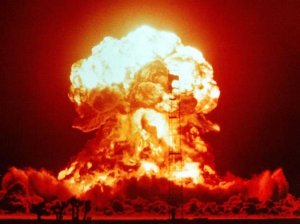
 Millennials need new movies about nuclear war, a ninth-grader says, Bulletin of the Atomic Scientists, 8 JANUARY 2018 Cassandra Williams Movies hold the power to teach and to persuade. Today, there is one subject that appears to be largely absent from popular movies: nuclear war. Nuclear war movies were huge in Hollywood from the 1960s to the 1980s. Today, however, they are rare.
Nuclear war is, and will be, a threat for as long as nuclear weapons exist. Everyone needs to understand this threat, especially millennials. They are the future, after all. But many millennials are too young to have seen the eye-opening movies of an earlier era, which revealed what would happen in the event of a nuclear war. These movies include On the Beach from 1959, Testament from 1983, and many more.
The movie that really had people talking was the 1983 film The Day After. This movie affected many people, including President Ronald Reagan. In his diary, he wrote about the sorrow the movie left him feeling. While the movie got mixed reviews, there is no denying that it made millions of people think more deeply about the possibility that nuclear war could occur. Because nuclear war movies are outdated, they don’t hold the attention of millennials today; we need new movies to warn of the nuclear war threat………
The movie [The Day After] left me completely stunned. (The 1984 British film Threads, which follows a similar narrative, is reportedly even more unsettling.) I had learned about the power of nuclear weapons, but never had I seen just how devastating nuclear war could be. You can read about it, and you can hear about it, but actually seeing it is a different story. To see thousands of people vaporized in less than a second, buildings toppling on people faster than they can react, and everyone slowly dying of cancer is as eye-opening as it gets.
The words that filled the screen at the end of the film made it even more disturbing: “The catastrophic events you have just witnessed are, in all likelihood, less severe than the destruction that would actually occur in the event of a full nuclear strike against the United States. It is hoped that the images of this film will inspire the nations of the earth, their peoples and leaders, to find the means to avert that fateful day.” Based on the tense relations in the world today, and the unpredictable behavior of North Korea and our current US president, I fear this fateful day may be closer than we think……
Modern movies. Why don’t Americans see these kinds of movies anymore? Nuclear weapons still exist. World relationships are still tense. President Donald Trump tends to make some questionable and reactionary decisions based on emotion, as does North Korean leader Kim Jong-un. Because these leaders are unpredictable, the public needs something to make us think about how devastating a nuclear war would be. We need something that will affect people as much as The Day After……… https://thebulletin.org/millennials-need-new-movies-about-nuclear-war-ninth-grader-says11416
January 10, 2018
Posted by Christina Macpherson |
2 WORLD, media |
Leave a comment
 Aiken Standard 7th Jan 2018, South Carolina’s $1million daily penalty tally against the Department of
Energy started over Jan. 1, and state leaders said they will pursue payment of the daily penalty as well as claims for penalties accrued in 2016 and 2017.
According to federal law, the DOE was required to finish the Mixed Oxide Fuel Fabrication Facility at the Savannah River Site in Aiken County by 2014, or remove at least one metric ton of plutonium from the state by Jan. 1, 2016. When the Energy Department failed to meet those deadlines, a $1 million daily penalty was instated. The penalties add up to a maximum of
$100 million annually for each of the first 100 days of the year. When the fees reach the maximum mark, state leaders said residents can expect to see a claim follow quickly thereafter.
https://www.aikenstandard.com/news/clock-resets-for-m-a-day-fine-against-doe-for/article_160b5366-f258-11e7-acdd-9b750ce012c1.html
January 10, 2018
Posted by Christina Macpherson |
Legal, USA, wastes |
Leave a comment
 The Nuclear Decommissioning Authority, https://www.nao.org.uk/work-in-progress/the-nuclear-decommissioning-authority/
| Scheduled |
Summer 2018 |
| Sector |
Energy, Environment |
| NAO Team |
Director: Michael Kell
Audit Manager: Zaina Steityeh |
| Media contact |
Steve Luxford
Direct line: 020 7798 7861 Mobile: 07985 260074 Email: pressoffice@nao.gsi.gov.uk
The Nuclear Decommissioning Authority (NDA) is a non-departmental public body sponsored by the Department for Business, Energy & Industrial Strategy. The NDA is responsible for the operation, decommissioning and clean-up of 17 nuclear reactor and research sites in the UK.
Of the 17 sites, Sellafield is the largest in terms of size and annual expenditure. It is also one of the most complex and hazardous nuclear sites in Europe. In 2015, the NDA announced that the management arrangements it had in place for the Sellafield site were ineffective; in April 2016, Sellafield Ltd became a wholly-owned subsidiary of the NDA. The NDA says these new arrangements will enable faster hazard and risk reduction at the site, and a more effective management of major projects. Alongside these changes, Sellafield is readying itself for the end of its reprocessing activities in 2020, meaning its operational focus will be on reducing high hazard reduction and decommissioning nuclear facilities. Sellafield has set out a transformation plan to support these changes.
This study will examine whether the new arrangements at Sellafield are effective in reducing high risk and hazard on the site, and whether the NDA is making progress with the performance of its major projects.
If you would like to provide evidence for our study please email the study team on enquiries@nao.gsi.gov.uk, putting the study title in the subject line.
The team will consider the evidence you provide; however, please note that due to the volume of information we receive we may not respond to you directly. If you need to raise a concern please use our contact form. |
January 10, 2018
Posted by Christina Macpherson |
UK, wastes |
Leave a comment
Pilgrim foes to demand plant’s closure, By Sean F. Driscoll, http://www.capecodtimes.com/news/20180107/pilgrim-foes-to-demand-plants-closureCape Cod Times, Jan 7, 2018 Opponents of the Pilgrim Nuclear Power Station will hold a “speakout” and deliver a letter to Gov. Charlie Baker at 2 p.m. today, calling for him to use his authority to demand the Nuclear Regulatory Commission revoke the plant’s operating license following an emergency shut down during the Jan. 4 snowstorm, according to a statement from the Cape Downwinders.
The shutdown, known as a “scram,” occurred because of loss of offsite power, according to Entergy Corp., the plant’s owner.
The Nuclear Regulatory Commission, the federal agency that oversees the nation’s 99 nuclear reactors, has reduced the number of resident inspectors at Pilgrim from three to two, despite the plant’s classification as one of the three worst performers in the country. Federal regulations require two resident inspectors from the Nuclear Regulatory Commission at every nuclear reactor; the NRC boosted the number at Pilgrim to three in 2015 due to its poor performance.
Pilgrim is set to permanently shut down May 31, 2019.
“The decision to close Pilgrim should be a public safety issue not a business decision,” Diane Turco, director of Cape Downwinders, said in the statement. “The recent scram highlights the continuing risk Entergy is willing to take at our expense. Pilgrim should be the poster child for public safety and closed now, not in 2019.”
For more information on the speakout, visit capedownwinders.info.
January 10, 2018
Posted by Christina Macpherson |
Uncategorized |
Leave a comment
HIROSHIMA — Chromosome abnormalities similar to those of A-bomb survivors have been found among two North Korean defectors who lived near the Punggye-ri Nuclear Test Site in Kilju County in North Korea’s North Hamgyong province, it has been learned.
The finding surfaced after experts in Hiroshima analyzed data collected by researchers in South Korea. The maximum accumulated radiation exposure faced by one of the defectors was estimated to be 394 millisieverts. It is thought that radiation from North Korea’s nuclear tests is to blame. The estimate is on par with the early-stage radiation exposure of A-bomb survivors in Hiroshima at a distance around 1.6 kilometers from the hypocenter when the city was bombed on Aug. 6, 1945. In recent years an increasing number of residents near the Punggye-ri Nuclear Test Site have complained of poor health apparently resulting from nuclear weapons testing, and calls have arisen for a probe into the extent of the damage.
In July and August 2016, and in September last year, the private Seoul-based South and North Development (SAND) research institute, which works with defectors from North Korea, questioned 21 people who had resided in Kilju County. It found that many of them were complaining of common symptoms such as headaches and nausea.
In 2016, SAND asked the Korea Institute of Radiological & Medical Sciences (KIRAMS) to test the defectors, and a radiation exposure survey was subsequently conducted. It found that a woman in her 40s who escaped from North Korea in 2011, after the North’s nuclear tests in 2006 and 2009, had a chromosome abnormality in the lymphocytes in her blood, similar to that resulting from exposure to radiation. The woman’s estimated accumulated radiation exposure was 320 millisieverts.
Receiving assistance from KIRAMS, South Korea’s Ministry of Unification conducted a separate test of 30 people from Kilju in November last year. This test found a chromosome abnormality in a man in his 40s who defected from North Korea in 2012, likewise after the nuclear tests in 2006 and 2009. The man was born and raised in an area about 20 kilometers away from the nuclear test site, and his estimated accumulated radiation exposure was 394 millisieverts. South Korean officials, however, said there was no information available to evaluate the effects of the living environment in North Korea, so it was not possible to conclusively say that the abnormalities were caused by nuclear testing.
Masaharu Hoshi, a professor emeritus at Hiroshima University and specialist in radiation biology and physics, who analyzed the data from South Korea, commented, “It’s possible that people were exposed to dust and gas containing radioactive substances. We also need to check data relating to internal contamination, such as cesium levels.”
Hoshi was involved in a survey around the Semipalatinsk Test Site in northeast Kazakhstan, where the Soviet Union conducted over 450 atmospheric and underground nuclear weapons tests between 1949 and 1989.
“The conditions are similar to those at Semipalatinsk, and I guess this is the first result thought to stem from North Korea’s nuclear testing,” he said. An accumulated radiation level of 400 millisieverts was detected in bricks in the village of Dolon, located about 110 kilometers from the Semipalatinsk nuclear testing site.
Since the possibility of radioactive substances being dispersed in the air is relatively lower for underground nuclear weapons tests compared with those conducted in the atmosphere, Hoshi commented, “There’s a possibility that radioactive materials are leaking from North Korea’s test site.”
Choi Kyung-hui, president of the SAND institute, underscored the need to grasp the extent of the damage.
“Nuclear development is seen as problematic, but no attention was paid to the possibility of radiation exposure. Even today, there may be many people around the testing site who were exposed to radiation and are suffering,” Choi said.
https://mainichi.jp/english/articles/20180109/p2a/00m/0na/013000c
January 10, 2018
Posted by arclight2011part2 |
Uncategorized |
Leave a comment
 China, France sign deal to enhance cooperation on nuclear energy Xinhua | 2018-01-10 07:17 GUANGZHOU
 — A Chinese nuclear power operator signed an agreement Tuesday with a French energy organization to deepen cooperation on nuclear power technology.
The deal, between China General Nuclear Power Corporation (CGN) and the French Alternative Energy and Atomic Energy Commission (CEA), focuses on areas such as nuclear reactor technology, advanced fuels and materials, and nuclear fuel cycles.
Under the agreement, CGN and CEA will deepen cooperation in the upstream and downstream nuclear power industry chain, including reactor life management and the concept design of the fourth-generation nuclear energy technology.
He Yu, chairman of CGN, said the new agreement will enhance bilateral exchanges in nuclear power technology and open new space for Sino-French nuclear power cooperation.
Founded in 1994, CGN is the largest nuclear power operator in China, with 39,000 employees worldwide. It focuses on the development of clean energies such as nuclear power, nuclear fuel, wind power and solar power.
The CEA is a key organization in research, development and innovation in France. Its main areas include defense and security, nuclear and renewable energy, and physical and life sciences.
http://www.chinadaily.com.cn/a/201801/10/WS5a554d97a3102e5b17371b35.html
January 9, 2018
Posted by arclight2011part2 |
China, France, marketing |
Leave a comment
09/01/2018 – 22:33:37

Ireland has been awarded a prestigious international peace prize.
The Irish disarmament delegation at the UN, along with six international partners, has been named as a winner of the Arms Control Person of the Year.
Diplomats from the disarmament delegations of Austria, Brazil, Ireland, Mexico, New Zealand, and South Africa, and Ambassador Elayne Whyte Gómez of Costa Rica won the poll ahead of eight other nominees.
It is for their leadership during the negotiations of the Treaty on the Prohibition of Nuclear Weapons.
The Tánaiste Simon Coveney welcomed the award, and said the situation in North Korea is a reminder of the risks and consequences of nuclear weapons.
Daryl Kimball, executive director of the Arms Control Association, said: “In a year marked by rising tensions between the world’s nuclear-armed states, the negotiation of the Treaty on the Prohibition of Nuclear Weapons stands out as a historic achievement.
“The strong affirmative vote for the disarmament teams from Austria, Brazil, Ireland, Mexico, New Zealand, and South Africa, and Ambassador Whyte Gómez, reflects their pivotal role in the negotiation of the treaty and the pursuit of a world without nuclear weapons.”
http://www.breakingnews.ie/ireland/irish-diplomats-share-international-prize-for-negotiating-nuclear-weapons-treaty-822020.html
January 9, 2018
Posted by arclight2011part2 |
Uncategorized |
Leave a comment
Stephen Stapczynski
9 January 2018
(Bloomberg) — Shattered by the enormity of the Fukushima nuclear disaster and bleeding customers to nimbler rivals, Tokyo’s lumbering, 66-year-old electric-power behemoth has a new strategy for long-term survival: reinventing itself as a cutting-edge innovator.
Tepco, known formally as Tokyo Electric Power Co. Holdings Inc., is scouring the periphery of the industry for the latest ideas and technologies — using blockchain to manage power flows is one possibility. The company is hunting both overseas and around Japan for startups and other investments with the potential to revolutionize the power sector.

“We must ensure our survival because we’re responsible for the Fukushima cleanup and revitalization,” Shinichiro Kengaku, who leads a Tepco task force that invests in foreign companies, said in an interview. “We realized we had to be more proactive in pushing innovation. We want to be the ones disrupting the industry, not the ones being disrupted.”
The long-term viability of Japan’s biggest utility has been in doubt as reforms and rapid technological advancements sparked by the worst nuclear disaster since Chernobyl upset the traditional order. After operating with almost no competition since the end of World War II, Tepco has lost nearly 3 million households and small-businesses since deregulation in April 2016 let customers switch power providers.
Compared with its rivals, Tepco’s situation is particularly dire. Its stock price is down 78 percent since the Fukushima meltdown left it on the hook for 16 trillion yen ($142 billion) in cleanup costs. Other utilities and regional power companies, which share 4 trillion yen in costs related to Fukushima, are down about 30 percent since the disaster. Tepco also lags behind utilities in other nations in weaving renewable energy into its supply chain, according an October report from the Institute for Energy Economics and Financial Analysis.

Besides searching for innovative technology to help shore up long-term prospects, Tepco hopes to boost its profit in the short-term by selling natural gas to households, restarting its remaining atomic facility in Niigata prefecture, investing in overseas power projects and partnering with rivals to reduce fuel-import costs.
“In the new electricity market that’s emerging in Japan, old utilities face being outmaneuvered by nimbler, more innovative companies using new technology,” said Simon Nicholas, an analyst at the Institute for Energy Economics and Financial Analysis. “For a company like Tepco, it would be hard to see how it could pay off its Fukushima costs if it remained wedded to the old model. Tepco and the others will have to innovate in order to thrive going forward.”
One such innovation might be virtual power plants, which aggregate small bits of electricity to send back into the grid or on to consumers. Tepco announced a partnership with Nissan Motor Co. last year to test a system that uses batteries in electric vehicles to create such a network.
But Tepco won’t have the field to itself. Japanese companies from trading houses to mobile-phone carriers are testing VPP systems, showing how quickly utilities could lose their grip on the market to new competition.
Tepco’s Kengaku distilled the challenge down to what he called the five D’s — de-centralization, deregulation, digitalization, de-carbonization and democratization, forces that he said will eventually disrupt the industry’s current structure. One result will be the emergence of “prosumers” who produce and consume their own electricity through distributed generation systems, increasing the number of ways customers can receive their power and disrupting the monopoly held by utilities, he said.
The path is similar to what happened in developed nations around the world, including the U.K. and Germany, where companies use distributed generation systems and employ energy-efficiency measures, reducing the need to buy electricity from traditional utilities.
Tepco’s task force, which started in April 2016, has invested in four overseas ventures, including a German company that uses blockchain technology to manage power flows and a U.K. venture that uses “smart home batteries” to create virtual power plants. The Tokyo-based company also co-created Free Electrons, an alliance of utilities around the world committed to supporting energy startups. And it’s the only Japanese utility in the Energy Impact Partners coalition, a private equity firm that invests in technology throughout the power supply chain.
Tepco said in March that it partnered with mapping company Zenrin to offer services that could lead to the creation of “drone highways” that ensure safe flights for small-scale autonomous aircraft, compiling a 3D database of potential obstructions such as transmission lines and poles.
The utility’s strategy mirrors attempts by rivals to adjust to deregulation. Tokyo Gas Co., which has taken more of Tepco’s lost customers than any other competitor, announced in December that it set up a fund based in California to invest in next-generation energy technology.
Chubu Electric began a program for startups to submit innovative energy ideas, and the winners will get funding or even be folded into Chubu Electric’s business operations. Kansai Electric Power Co. is sending some of its employees to startups to work for a short time, learn about the company and come back with new ideas.
“The utility business model used to be about getting infrastructure built at the lowest cost and taking advantage of economies of scale,” Sonia Aggarwal, vice president of Energy Innovation Policy & Technology LLC, said in a phone interview. Now “it’s more about taking the best advantage of the infrastructure that we’ve already built and trying to incorporate new technology.”
https://www.bloombergquint.com/technology/2018/01/09/blockchain-drones-are-strategies-for-survival-at-japan-s-tepco
January 9, 2018
Posted by arclight2011part2 |
Uncategorized |
Leave a comment
The first ballistic missile submarine of India is out of commission for almost ten months. The submarine INS Arihant was flooded with saltwater after the negligence of staff who did not close the hatch properly. The damages will be repaired in almost a year’s time. The submarine was designed to work as a floating arsenal of nuclear weapon and guaranteed a retaliatory strike in case of a surprise attack.
According to an Indian Navy source, a hatch left opened on the rear side of the ship that allowed saltwater to enter the propulsion area while the ship was at the harbor. The submarine, Arihant, was in repairs for ten months while the water was pumped out of it and pipes were replaced. Indian authorities also believe that the pipes that were exposed to the saltwater cannot be trusted to work efficiently. Particularly those pipes that carry pressurized water coolant to and from the ship’s 83-megawatt nuclear reactor. Failing pipes will not only endanger the ship’s crew but also the whole submarine and the nuclear weapons on it.

The Arihant was built after investing $2.9 billion on it as a result of a submarine technology program. Its construction began in 2009 and the ship was commissioned to Indian Navy in 2016. The modified version of Russian Akula-1 class nuclear attack submarine was able to accommodate twelve K-15 short-range nuclear missiles or four K-4 intermediate-range nuclear missiles. K-15 missiles, target Pakistan with their 434-mile range while K-4 missiles can reach all of Pakistan and even to other Indian rival’s capital, Beijing. A second missile submarine, INS Arihant was launched in December and another set of 3 submarines are also planned.
India has a “No First Use” policy regarding nuclear weapons and promises to use nuclear weapons only when attacked by them. It is the sixth nation in the world that has put ballistic weapons at sea. The strategy is called Continuous At Sea Deterrence and is employed by several countries including the USA. It requires only one nuclear-missile armed submarine at sea at all times to repel a surprise attack.
Keeping the hatches under strict check and not leaving them open because they can potentially sink a ship is basic common sense. Why did the propulsion section and nuclear reactor on the 364-foot long submarine was left unattended so the flooding went unnoticed? Only investigations will tell!
January 9, 2018
Posted by arclight2011part2 |
Uncategorized |
Leave a comment
Published time: 9 Jan, 2018
https://www.rt.com/politics/415369-korea-nuclear-russia-mediator/
Moscow may act as mediator in the denuclearization talks between the two Koreas, as the nuclear issue affects Russia’s national interests, Leonid Slutsky, head of the State Duma’s International Affairs Committee, said.
“It highly likely that efforts by international mediators will be required to promote the issue of denuclearization and the nuclear dossier” on the Korean peninsula, Slutsky said, as cited by TASS. “Considering the fact that this issue directly affects Russia’s interests, primarily because of the territorial proximity to our borders, Russia can play such a role,” he said.
Russian parliamentarians welcome “any kind of dialogue between Seoul and Pyongyang,” Slutsky said as he commented on the peace talks between South- and North Korea, which resumed this week after a two-year break. However, he pointed out that “it’s early to talk about specific results” of the intra-Korean negotiations.
Russia has constructive relations with both Seoul and Pyongyang and “remains a consistent supporter of the notion that all disputes on the Korean peninsula should be decided behind the negotiating table and that escalation of tensions may lead to unpredictable consequences for the international community,” the MP said.
Slutsky also addressed the Trump administration, which threatened to use force in order to make North Korea curb its nuclear and ballistic missile program, saying: “As for the US, which considers itself to be the center of the world, in my opinion, it should now curtail its anti-Pyongyang rhetoric, stop provoking North Korea and wait for the first results of the inter-Korean talks.”
Following talks between Seoul and Pyongyang on Tuesday, it was announced that the sides agreed to hold consultations between the military officials of the two countries in order to defuse tensions on the border, as well as to intensify exchanges in other areas.
January 9, 2018
Posted by arclight2011part2 |
Uncategorized |
Leave a comment
According to Kyodo News Agency, China and Japan recently held talks on whether to ease or lift the ban on food imports from 10 Japanese prefectures imposed after the 2011 Fukushima nuclear disaster, with the Chinese government offering to set up a working group on the issue. There has been no official confirmation from the Chinese side.
The earthquake, which rocked Japan in March, 2011, caused a radiation leak from the Fukushima Daiichi Nuclear Power Station after which the Chinese government immediately banned food from Japanese prefectures surrounding the facility. Neither Beijing nor Tokyo has released any statement on lifting the ban, yet the Kyodo News Agency report attracted wide attention.
Since Japanese Prime Minister Shinzo Abe returned to power in late 2012, rebuilding people’s confidence in affected areas both at home and abroad has become his major task. During the lower house election in 2014, Abe tasted grilled fish in Fukushima. When Britain’s Prince William visited Japan in 2015, Abe invited him to visit Fukushima and enjoy local food with ingredients from local producers. Japanese Foreign Minister Taro Kono brought Fukushima peach juice to British Foreign Secretary Boris Johnson during his visit to the UK in December 2017.
The Abe administration has been proactively promoting the safety of Fukushima food on public occasions, with little success. According to research revealed by the NHK Broadcasting Culture Research Institute in 2016, many people are feeling more anxious about radiation in Fukushima. According to Japan’s Ministry of Agriculture, Forestry and Fisheries, China, the US, Russia, South Korea, Singapore and other countries have kept their bans on importing food produced in some regions or sometimes from the whole country. This has been an awkward reality for Abe’s administration.
It remains to be seen whether the working group will be eventually established. But it is an indisputable fact that Abe’s administration has repeatedly requested the Chinese government to lift the ban on food imports over the past few years. For example, during the agricultural vice-ministerial meeting in Beijing in 2016, the Japanese side had hoped that China will remove food import restrictions. However, China did not give any specific reply. When Toshihiro Nikai, secretary general of Japan’s Liberal Democratic Party, visited Beijing in December last year, he also expressed his wish of easing the import ban to the head of China’s General Administration of Quality Supervision, Inspection and Quarantine.
It can be argued that China is Japan’s primary destination for food exports from affected areas including Fukushima. This is not only because China has a huge market, but also because any Chinese move will be likely followed by other Asian countries.
With recent improvements in Sino-Japanese ties, the possibility of setting up a special working group cannot be ruled out. However, even if the group is established, Beijing may not completely lift import restrictions on Japanese food. On the one hand, the key to lifting the ban lies in whether food products from Japan can meet Chinese standards. On the other, Chinese people’s doubts over the food in the affected areas also play a crucial role. Even if imported food from Japan’s disaster-affected region passed Chinese tests, it is not very likely to appear on Chinese dining tables given the distrust of the Chinese public.
China and Japan are lately cooperating in a number of fields including economy and politics. Import and export of agricultural products is a vital link in the cooperation trail. According to a Xinhua report in March, some food from Japan’s affected areas was flowing to China via e-commerce platforms, posing a severe safety risk to Chinese consumers. Therefore, when it comes to lifting the ban on food from disaster affected areas, China should exercise caution. Political interaction is important, but people’s well-being is above all.
By Chen Yang Source:Global Times Published
The author is a PhD candidate at the Graduate School of Sociology at Toyo University.
January 9, 2018
Posted by dunrenard |
Fukushima 2018 | China, Contaminated Foods, Fukushima Contamination, Japan Food Exports |
Leave a comment
TEHRAN – Iran’s nuclear chief Ali Akbar Salehi cautioned on Monday that Tehran might reconsider cooperation with the UN nuclear watchdog if the United States fails to respect its commitments under the nuclear agreement.
Talking to International Atomic Energy Agency (IAEA) director Yukiya Amano on the phone, Salehi said in case Washington falls short of its obligations, Iran will adopt measures that can affect its cooperation with the UN body, IRNA reported.
Iran, the five permanent members of the UN Security Council, Germany and the European Union signed the nuclear deal, also called the JCPOA, back in 2015.
MH/PA
Article source: http://www.tehrantimes.com/news/420146/Iran-threatens-to-reconsider-cooperation-with-IAEA
January 9, 2018
Posted by arclight2011part2 |
Uncategorized |
Leave a comment
Posted By: Mashal Khan Takkar January 9, 2018
Europe, Iran to discuss nuclear deal Thursday: EU
BRUSSELS: The EU has called Iranian Foreign Minister Mohammad Javad Zarif to talks in Brussels on Thursday with his French, British and German counterparts in efforts to preserve the hard-fought deal to curb Tehran´s nuclear ambitions.
The meeting between Zarif and the three European parties to the landmark 2015 agreement comes after Iran warned the world on Monday to prepare for the withdrawal of the United States.
Thursday´s meeting comes against a backdrop of high political tension in Iran following recent protests which claimed 21 lives, though Zarif has dismissed the idea the unrest would be on the agenda.
Iran signed the accord with six world powers, agreeing to curb its nuclear programme in exchange for the lifting of many international sanctions, but US President Donald Trump has condemned the deal and threatened to pull out.
“The EU High Representative Federica Mogherini will convene a meeting with ministers of foreign affairs of E3 countries — France, Jean-Yves Le Drian, Germany, Sigmar Gabriel, and the UK Boris Johnson — and Iranian Foreign Minister Javad Zarif on Thursday 11 January in Brussels,” the 28-member bloc said in a statement.
“The meeting will take place in the context of the ongoing work to ensure a full and continued implementation of the Joint Comprehensive Plan of Action,” the statement added, using the official name for the deal.
The EU, which played an important role in brokering the Iran nuclear deal, has been lobbying US lawmakers not to pull out and so far Trump has continued to waive nuclear-related sanctions at regular intervals as required under the agreement._ AFP
http://www.thevoicetimes.com/europe-iran-discuss-nuclear-deal-thursday-eu/
January 9, 2018
Posted by arclight2011part2 |
Uncategorized |
Leave a comment







 nuclear-news