December 5 Energy News

Opinion:
¶ “Senate Tax Bill Threatens Clean Energy & Public Health, Pays Fossil Fuel Industry To Wreak Environmental Havoc” • Senate Republicans passed their $1.5 trillion Tax Cuts and Jobs Act. It is a hastily written that will increase the country’s deficit by as much as $1 trillion. It also threatens the country’s renewable energy industry. [CleanTechnica]
 Creating environmental havoc
¶ “Three Reasons Why Renewable Energy Leaders Are Optimistic” • At Green Tech Media’s US Power and Renewables Summit, utility company executives, financiers, renewable energy developers, and regulators shared their research and different experiences of the rapidly evolving renewable energy industry. [Natural Resources Defense Council]
Science and Technology:
¶ Dr Joanne Chory, a biologist from the Salk Institute for Biological Studies and HHMI, created a type of plant infused with a compound called suberin that she says can cut CO2 in the atmosphere by 50% if…
View original post 805 more words
Radioactive Japan: Nasunagahara park Hot spot 6mcSv/h #Safecast

Measurement day December 1, 2017 Nasushiobara city, Tochigi prefecture Nasunagahara park Hot spot continuous measurement ⑨
GLOBAL Uranium companies to cut production to increase the value of uranium post FUKUSHIMA

Kazatomprom Announced Production Cuts to Address Uranium Oversupply
Dec 04, 2017
OTC Disclosure & News Service
–
TORONTO and NUCLA, Colo., Dec. 04, 2017 (GLOBE NEWSWIRE) — Western Uranium Corporation (CSE:WUC) (OTCQX:WSTRF) (“Western”) wishes to highlight the positive uranium news released out of Kazakhstan this morning. Subsequent to the 2008 Global Financial Crisis and 2011 Fukushima nuclear accident, global uranium demand has stagnated causing oversupply which has depressed market prices. Uranium production cuts have been anticipated and in this fourth quarter these have been put in place by a number of major uranium producers for 2018.
Today Kazatomprom, the world’s largest uranium producer announced its intention to reduce planned production by 20%. According to the Kazatomprom announcement, this action will remove over 8 million pounds from the market in 2018 and approximately 24 million pounds of uranium over a three year period. In making this announcement, Kazatomprom cited the goal of better aligning their production levels with market demand.
This follows the Honeywell announcement on November 20th that its ConverDyn conversion facility would be immediately idled. The diminished production of uranium hexafluoride (UF6) from this last operating conversion facility in the United States removes approximately 15 million pounds of uranium from the market. Honeywell put forth similar rationale noting that the current oversupply has caused a downward trend in uranium markets.
Furthermore, on November 8th in a Cameco announcement production was suspended at McArthur River Mine and the Key Lake Mill. It was stated that this would start January 2018 and remove approximately 1.2 million pounds per month of uranium production from the global uranium supply. Cameco, North America’s largest uranium producer, took these actions in response to uranium price weakness.
In total as a result of these major announcements, approximately 37 million pounds in aggregate can be calculated to be removed from 2018 uranium supply. Consequently, the aggregate effect of these production cuts, if implemented as announced, will eliminate a large portion of oversupply.
About Western Uranium Corporation
Western Uranium Corporation is a Colorado based uranium and vanadium conventional mining company focused on low cost near-term production of uranium and vanadium in the western United States and development and application of ablation mining technology.
The Japanese Government Is Lying to the International Community: the Radiological Situation in and around Fukushima is NOT Safe
“Perinatal mortality in not only Fukushima prefecture but also neighboring prefectures rose 15.6% just 10 months after the accidents. This clearly indicates the existence of some kind of human health damage from radiation.”
The Japanese Government Is Lying to the International Community: the Radiological Situation in and around Fukushima is NOT Safe
Appeal from a Japanese Anti-nuclear Activist
Etsuji Watanabe
Nov.29 2017 Revised (Oct.12 2017)
Source fro article; http://blog.torikaesu.net/?eid=69
〖Please download the following link.〗
The Japanese Government Is Lying to the International Community: the Radiological Situation in and around Fukushima is NOT Safe(pdf,15pages,2250KB)
Etsuji Watanabe: Member of the Japanese anti-radiation citizen-scientist group ACSIR (Association for Citizens and Scientists Concerned about Internal Radiation Exposures)
Special thanks to Mrs Yuko Kato, Mr Ruiwen Song, Ms Nozomi Ishizu, Mrs Kurly Burch, Ms Jennifer Alpern, and Mark Bennett
Yuko Kato: Evacuee from Fukushima, member of the Kansai plaintiff group for compensation against TEPCO and government
Ruiwen Song: Taiwanese freelance journalist
The Japanese government has created foreign language websites which provide the information about radiology in general and the radiological situation in Fukushima. Journalists around the world, our friends and acquaintances living abroad are continually asking us whether the information that these Japanese central and local government websites present to the international community is correct or not. The following is our answer.
[Question 1]
The stories uploaded on these websites give people the impression that worrying about radiation is unnecessary. As for this impression, has Fukushima now really become a safe place to live or visit?
[Answer]
First of all, Japanese anti-nuclear activists and evacuees from contaminated areas in Fukushima and Kanto, have been warning people all over the world NEVER to trust what the Japanese government is saying about both radiology in general and the specific radiological health effects caused by the Fukushima Dai-ichi nuclear power plant disaster (hereafter Fukushima accident) following the Great East Japan Earthquake and Tsunami on March 11th, 2011.
Prime-minister Shinzo Abe and the Japanese government as a whole including Fukushima prefectural government have repeatedly declared that “with regard to health-related problems (of the Fukushima accident), I (Abe) will state in the most emphatic and unequivocal terms that there have been no problems until now, nor are there any at present, nor will there be in the future.” (Abe’s statement at a news conference). See the Japanese government website below.
http://japan.kantei.go.jp/96_abe/statement/201309/07argentine_naigai_e.html
This claim is completely fabricated and false. In making these claims, the Japanese government is blatantly ignoring the vast number of studies in radiological sciences and epidemiology that have been accumulating historically. By engaging in this behavior, the Japanese government has been systematically deceiving the public, both nationally and internationally.
Just think of the amount of radioactivity released during the Fukushima accident. As you know, one of the standards used to assess the extent of radioactive releases and longtime human health effects is the levels of cesium 137 (Cs137) released into the environment. Based on the Japanese government data (which is an underestimate), the Fukushima accident released 168 times the Cs137 discharged by the atomic bomb dropped on Hiroshima. This amount is almost the equivalent to the total atmospheric nuclear explosions conducted by the United States on the Nevada test ground. The Nevada desert is not designated as a residential area, but the Japanese government has recommended evacuated residents return to live in areas with radiation levels of up to 20 mSv/year. By removing economic support for evacuees, the Japanese government has forced many people who had evacuated from these areas to return.
We estimate that in the Fukushima accident approximately 400-600 times the Cs137 were released into the atmosphere by the atomic bomb blast in Hiroshima. Roughly 20% of the Cs137, or 80-120 Hiroshima-equivalents, were deposited on Japan. Of this, the decontamination efforts have only been able to retrieve five Hiroshima-equivalents. The waste from decontamination efforts is typically stored all over Fukushima mostly in mountainous heaps of large plastic bags. This means that 75-115 Hiroshima-equivalents of Cs137 still remain in Fukushima, surrounding prefectures, and all over Japan.


In addition, the Japanese government is now planning to reuse the retrieved contaminated soil under 8000Bq/kg in public works projects all over Japan. This self-destructive program has now been partially started without any announcements as to where the contaminated soil are and will be reused, under the pretext of “avoiding damage caused by harmful rumors”. This project is tantamount to scattering lethal fallout of Cs137 equivalent to about 5 times that of Hiroshima bomb all over Japan. The Japanese government is literally behaving like a nuclear terrorist.
Do you really imagine that Fukushima prefecture and surrounding areas, contaminated as they are to levels similar to the Nevada test site, is really a safe place for people to permanently live, or for foreign tourists to visit and go sightseeing?
Regrettably, we must conclude that it is not, for either residents or tourists the situation in Fukushima is not safe.
[Question 2]
These websites also point out that the international annual dose limit for the public is at 1mSv, but this level is easily exceeded by only one CT-scan, insinuating that this 1mSv standard is set too low and thus not a useful indicator.
[Answer]
CT-Scans are often cited as if they had no radiation risks, But this is not true. A recent study clearly shows that every CT-scan (about 4.5mSv irradiation) increases the risk of cancers in children by 24%. See the website below.
http://www.bmj.com/content/346/bmj.f2360
In Fukushima the allowable level of radiation per year for residents is now 20mSv. Can you imagine having 4-5 CT-scans every year?
[Question 3]
One of the websites states: “In Fukushima, the indoor radiation doses are now so reduced that no radioactive cesium can be found in the air. Therefore, no radioactive particles can invade the human body during breathing.” What do you think of this statement?
[Answer]
The Japanese government also ignores the long term peril caused by “hot particles” ――micron-and- nano-sized radioactive particulates――which, if inhaled or absorbed into the human body, may lead to many kinds of cancers and other diseases including cardiac failure. We should consider internal irradiation to the cells near the radiation sources to be 500 times more dangerous than external irradiation because particles inside the body radiates very near or even inside cells, causing intensive damage to DNAs and other cell organs such as mitochondria.
[Question 4]
These websites explain that there exists not only artificial but also natural radioactivity, thus people are living in an environment surrounded by radiation all the time in everyday life.
[Answer]
One of the main tactics that the Japanese government often uses to propagate the “safety of low level irradiation” is to compare artificial radioactivity with natural radioactivity. But this logic is a methodological sleight of hand. It is crystal-clear that even exposure to natural radioactivity has its own health risks. Cancers sickened and killed people long before artificial radioactivity was used. For example, Seishu Hanaoka, one of the founders of Japan’s medicine, carried out 152 breast cancer surgeries from 1804 to 1836.
Both kinds of radioactivity have their own health risks. Risks caused by artificial radioactivity should not be compared but be added to the natural radioactivity risks as they both lead to the accumulation of exposure.
For example, potassium 40 (K40) is a typical natural radioactive nuclide. According to the Japanese government, the average internal exposure dose for adults from K40 is about 4,000Bq/year or 0.17mSv/year. See the website below (in Japanese).
http://www.kantei.go.jp/saigai/pdf/g31_siryou5.pdf
The ICRP risk model (2007) allows us to estimate the approximate risk posed by K40. The calculation shows that K40 is responsible for approximately 4,000 cancer cases and 1,000 deaths every year. If the same amount of radiation was added to that of K40 in the human body by artificial sources, the cancers and mortalities would be doubled to 8,000 and 2,000 a year, respectively. Based on the ECRR (2010) model, which criticizes the ICRP risk model as a severe underestimate, these figures should be multiplied by 40, reaching 320,000 and 80,000, respectively.
The extract you cite from the Fukushima government website is completely fake: “In Fukushima, the indoor radiation doses are now so reduced that no radioactive cesium can be found in the air. Therefore, no radioactive particles can invade the human body during respiration”. Reports from civic radiation measurement stations refute this claim. For example, dust collecting paper packs of vacuum cleaners used in Iwaki City, Fukushima prefecture, are radiologically measured and 4,800-53,900Bq/kg radioactive cesium was detected in Oct-Dec 2015. See the website below (in Japanese).
http://www.iwakisokuteishitu.com/pdf/tsushin011.pdf
[Question 5]
One of the websites says that the Fukushima prefecture has conducted whole-body counter screenings of the 170,000 local population so far but cesium was rarely detected.” Does this mean that we can safely consume food from Fukushima, and Fukushima residents are no longer being exposed internally to radiation?
[Answer]
This is a typical example of demagogy by the Japanese government: vague expressions lacking specific data, using the words “safe and secure” without clear explanation. In reality, the government has not publicized any data indicating serious irradiation of the population. For example, you mentioned the Fukushima prefectural government website saying that whole-body counter screenings of 170,000 members of the local population have found radioactive Cs only in very few cases. However, the fact that no specific number is given makes the statement suspicious.
These statistics, more than likely, exclude many firefighters or other municipal employees who, at the time of accident, helped local residents evacuate from a lot of contaminated areas surrounding the defunct Fukushima plant. These people were subjected to serious radiation doses.
Civic groups’ efforts for the disclosure of information has recently prompted city officials near the defunct plant to disclose the fact that it conducted whole-body counter check-ups on about 180 firefighters, nurses and municipal employees. According to Koichi Ohyama, a member of the municipal assembly of Minami Soma, the screening conducted in July, 2011, showed almost all of these people tested positive in Cs. The maximum Cs137 dose among the firefighters was as high as 140,000 Bq. This data reveals a part of the reality of irradiation but it is only a tiny part.
[Question 6]
The government websites suggest that no health effects from irradiation have been reported in Fukushima. Is this true? Or have any symptoms appeared that indicate an increase in radiation-induced diseases in Fukushima?
[Answer]
One example is the outbreak of child thyroid cancer, but the Japanese government has been denying the relationship with irradiation from radioactive iodine released from the Fukushima disaster.
Japan’s population statistics reflect the health effects from the Fukushima disaster radioactivity. The following data clearly show that diseases increasing in Fukushima are highly likely to have been radiation-induced.


[Question 7]
The Fukushima prefecture website says, “After the Fukushima accident, the Japanese government has introduced the provisional standards for radioactive iodine and cesium. The Fukushima prefectural government subsequently strictly regulated distribution and consumption of food with levels of radioactivity exceeding the provisional standards. Now we have had this new much stricter standard. The distribution and consumption of food exceeding this new standard has been continuously regulated; therefore any food on the market is safe to consume.” Is it true?
[Answer]
As for food contamination, the Japanese government has also tried to cover up the real picture. First, the current government standard for radioactivity in food, 100Bq/kg, is dangerously high for human health, especially for fetuses, infants, children and pregnant women. Even six and a half years after the accident, the Agriculture Ministry of Japan as well as many civic radioactivity measurement stations all over the country have reported many food contamination cases, although the frequency is evidently reduced. See the website below.
http://en.minnanods.net/
The Japanese government has underestimated the danger presented by internal irradiation. But, we must consider two important factors. (1) The wide range of difference in personal radio-sensitivity. According to Professor Tadashi Hongyo (Osaka University Medical Faculty), the maximum difference is as wide as 100 times in terms of biological half-life of Cs137. (2) Recent studies denying that the so-called biological half-life decrease curve actually exists. According to the new model, daily food contamination can cause concentrations to accumulate as time passes. Even a daily 1Bq internal radiation dose from food cannot be safe for human health (details below).
Our recommendation is to be cautious of food or produce from Fukushima and the surrounding areas, and, even if contamination levels are said to have now generally decreased, to avoid jumping to the conclusion that all the food is fit to eat.
[Question 8]
We would like to ask about the situations in prefectures surrounding Fukushima. A television program once reported, “As for the safety of Tochigi and Gunma prefectures, few people are raising concern about health effects of radiation.” Is it true that the prefectures somewhat distant from the Fukushima Daiichi plant are now safe with no human risk?
[Answer]
Regarding the radioactive contamination in prefectures surrounding Fukushima, you can refer to the following website.
http://www.gowest-comewest.net/statement/20170825english.html
This article examines the contamination in the Tokyo metropolitan area, but conditions are the same or more serious in Tochigi or other prefectures north of Tokyo, nearer to the defunct Fukushima Daiichi plant.
Another example is the statistics of stillbirth and neonatal mortality in Fukushima and the surrounding five prefectures (Tochigi, Gunma, Ibaragi, Miyagi, Iwate) shown below.
 https://www.ncbi.nlm.nih.gov/pmc/articles/PMC5044925/
Perinatal mortality in not only Fukushima prefecture but also neighboring prefectures rose 15.6% just 10 months after the accidents. This clearly indicates the existence of some kind of human health damage from radiation.
[Question 9]
We would like to ask about the decontamination efforts by famers living in Fukushima and neighboring prefectures. Should we think highly of the farmers measuring the amount of radiation deposited on the surface of soil to create radiation maps for farms, or washing the radiation from the surface of every single tree off the radiation with high-pressure washers? The farmers said that while these methods have been shown to be radiologically effective, their produce did not sell well, because consumers are still feeling anxious about health risks. Does the problem of radioactive food contamination in Japan just end up in whether each consumer personally believes it safe or not?
[Answer]
We must raise a question that, despite the government’s decontamination efforts, a huge amount of radioactive materials deposited in mountainous areas remain untouched. Now they are re-dispersing and re-depositing over wide areas of Fukushima and surrounding prefectures via winds, cars, trains, river water, pollen, spores, emissions from incinerators, in the form of radioactive dusts and particulates, among many others. For an example, see the following website.
http://www2.jpgu.org/meeting/2015/PDF2015/M-AG38_all_e.pdf
So I regret to say that, although these farmers’ endeavors you mentioned are very precious and respectable, they are not sufficient to completely eliminate the risk of radiation exposure from food. The problem exists objectively in the nuclear materials deposited on and in soil, algae, plants, houses, buildings, forests, animal and human bodies, not subjectively in the consumers’ sentiment or psychology.
[Question 10]
Japanese experts have recently pitched a cultivation method that can remove cesium by intensive use of potassium fertilizer. Is this method effective at all? Do you have any doubt about their claims?
[Answer]
They seem to be among those experts who have been criticizing the general public’s tendency to demand “zero irradiation risk” as an obstacle to Fukushima reconstruction.
As you know, cesium (Cs) has chemically similar characteristics to potassium (K). So it is true that higher levels of application of potassium fertilizer lowers the plant’s absorption, and therefore concentration, of radioactive Cs, decreasing Cs137/134 concentrations in produce, often to below the government standard of 100Bq/kg. But the following problems remain: (1) This procedure can prevent Cs transfer from the soil to produce only partly, not completely; (2) This process raises the potassium concentration in the produce and therefore heightens the burdens on certain human organs such as kidneys, the heart and the nervous system, causing new health risks; (3) Heightened concentration of potassium also leads to the heightened concentration of radioactive K40, so the reduced risk of radioactive Cs lead to an increased risk of internal irradiation by K40.
[Question 11]
Even if cesium concentration was reduced by applying more potassium fertilizer than usual, strontium contamination would remain. In Japanese government’s international press campaign as to the Fukushima accident, almost nothing has been said about strontium. If you have any information on strontium contamination, let us know.
[Answer]
We regret that the information about strontium that you are asking for is very limited and searching for it is also a challenge for us. The Japanese government and research institutes under the government have reported very limited data regarding strontium contamination. But it is important that the Japanese government admits the fact of strontium contamination within 80km from the defunct Fukushima plant. See the website below.
http://radioactivity.nsr.go.jp/ja/contents/6000/5048/24/5600_110930_rev130701.pdf
Did you know that the US Department of Energy data on the strontium contamination of soil in Japan and its visualization (in Japanese) can be seen on the websites below?
https://energy.gov/downloads/us-doennsa-response-2011-fukushima-incident-data-and-documentation
https://news.whitefood.co.jp/%E6%94%BE%E5%B0%84%E8%83%BD%E3%81%A8%E3%81%9F%E3%81%9F%E3%81%8B%E3%81%86%E3%83%96%E3%83%AD%E3%82%B0/1861/
[Question 12]
Some Japanese experts say, “the Japanese government has declared that no health effects from irradiation below 100mSv (or 100mSv/year) have been confirmed.” Some farmers have established a private food standard of 20Bq/kg, much lower than the Japanese government standard of 100Bq/kg. Do you think that doses under 100mSv or under 20Bq/kg are safe and secure?
[Answer]
As you mentioned, the Japanese government claims that no scientific studies verify that irradiation of 100mSv or less poses a threat to human health, suggesting that irradiation under 100mSv has no risk. This, however, is false. The government is fabricating this information. In fact, very many scientific studies have already confirmed and proven health effects induced by irradiation under 100mSv. For example, see the websites below.
https://ehp.niehs.nih.gov/1408548/
https://www.ncbi.nlm.nih.gov/pubmed/24198200
http://www.bmj.com/content/346/bmj.f2360
https://www.ncbi.nlm.nih.gov/pubmed/22766784
https://www.ncbi.nlm.nih.gov/pmc/articles/PMC3050947/
https://www.ncbi.nlm.nih.gov/pmc/articles/PMC2696975/
The Japanese government is using the term “100mSv” in a deliberately ambiguous and confusing manner. The expression 100mSv can have three meanings: (1) a one-time irradiation dose, (2) cumulative irradiation doses, or (3) annual irradiation doses. So 100mSv is not the same as, nor equal to the 100mSv/year that you mentioned in parenthesis. The latter amounts to a 1Sv in cumulative dose over 10 years (which is an up to 10% lethal dose), and 5Sv over 50 years (which is a 50% lethal dose). The present government standard for evacuees to return, 20mSv/year, means that living there for 5 years leads to a cumulative dose of 100mSv, at which the Japanese government admits clear health risks.
Regarding 20Bq/kg as some farmers’ private food standard, it is critical to pay serious attention to the extraction process of Cs from tissues. Japanese-Canadian non-organic biochemist Eiichiro Ochiai points out in his book “Hiroshima to Fukushima, Biohazards of Radiation” (2014) that, based on the Leggett model, the Cs concentration injected in tissues at one time diminishes relatively quickly for about 10 days in most tissues. After that, processes slow down, tending to become steady. He writes: the decrease of the overall Cs level in the body does not follow an exponential decay curve (p.83). This means that consecutive intake of Cs, even in very low levels, results in the accumulation of Cs in the body. (Incidentally, Ochiai’s book can be downloaded for free from the website below.)
https://archive.org/details/HiroshimaToFukushima
Regarding the Leggett model, see the website below.
https://www.ncbi.nlm.nih.gov/pubmed/14630424
Yuri Bandazhevsky considers over 10Bq/kg of radioactive Cs concentrations in the body to be unsafe because even this low level can possibly cause abnormal electrocardiographic pattern in babies, metabolic disorders, high blood pressure, cataracts, and so on.
Therefore, we can conclude unequivocally that neither the irradiation under 100mSv nor the privately set 20Bq/kg food standard are safe and secure.
- 論考
- 2017.11.29 Wednesday
- 11:29
- by torikaesu01
Tokyo 2020 to feed IOC food from disaster-hit regions

Fukushima dome roof takes shape, but radiation remains high


Vietnam’s ex-president admits Fukushima disaster played role in ditching foray into atomic power

Image shows extent of damage to reactor at Fukushima plant

Closer to the nuclear brink: American air drills begin over the Korean peninsula
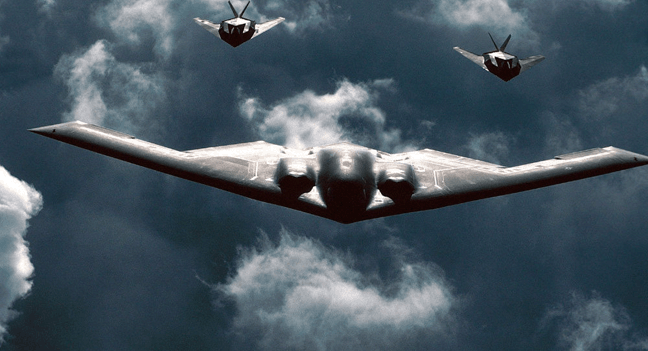
Air drills put region on ‘brink of nuclear war’, warns North Korea, 9 News, By Richard Wood
The human consequences of nuclear war: a new medical plea against war
 NUCLEAR WAR WITH N. KOREA: WE’RE NOT PREPARED FOR THE SCALE OF CASUALTIES http://www.newsweek.com/nuclear-war-n-korea-were-not-prepared-scale-casualties-729656 BY The global impact of nuclear war—in perception and reality—took a significant, unprecedented and highly negative turn in the summer of 2017 with North Korea’s acquisition of a thermonuclear weapon.
Those of us in the field of emergency preparedness shudder with the realization that a growing number of nations are joining the global thermonuclear arms race.
This reality is fraught with consequences that most people do not recognize, and frankly do not want to know.
In a nutshell, thermonuclear weapons, colloquially known as H-bombs, produce much larger yields of destructive power than the nuclear weapons that countries tested in the early days of nuclear weapon development.
For example, the nuclear bombs that the U.S. dropped on Japan in 1945 were in the 15 to 20 kiloton yield. This means that they had the destructive power of an equivalent of 15,000 to 20,000 tons of dynamite.
In addition to killing about 100,000 people, these weapons cause thousands of traumatic injuries, thousands of radiation injuries and hundreds of thermal burn victims.
Compare that to a thermonuclear weapon which is in the range of 75 to 49,000 kilotons of destructive power. Used on a densely populated urban center like New York City or Tokyo, just one weapon would kill millions of people and produce millions of casualties.
Those numbers are devastating enough, but the real nightmare is that the number of thermal burn casualties greatly multiply with a thermonuclear weapon relative to a simple nuclear weapon.
A typical serious thermal burn injury in a well staffed hospital takes three to four medical personnel per patient to provide adequate care. When we have hundreds of thousands of surviving burn patients due to an urban thermonuclear detonation, we are not going to be able to treat even a tiny fraction of them.
Until now, only wealthy and advanced nations – the United States, Russia, China, the United Kingdom, France and Israel – were able to produce these massively destructive thermonuclear weapons.
Now, with poor and unstable North Korea joining the thermonuclear club, other small nations may realize that this previously difficult threshold may be within their technical reach.
Even worse, nations around the world know that the Earth is getting to be a much more dangerous place when a nation like North Korea has such weapons, and many will perceive that their national safety now depends on procuring these terrible devices as well.
In academic journals and in the media, there is talk of India acquiring thermonuclear weapons on the fast track, which will pressure Pakistan to do the same. The sense of urgency is even touching nations that previously eschewed the development of nuclear weapons.
Even Japan – which by its constitution is significantly restricted in its armaments and has no nuclear weapons at all – could use its enormous stockpile of nuclear waste to rapidly develop an equally enormous stockpile of thermonuclear weapons.
Despite repeated headlines about the growing possibility of nuclear war, most people, curiously, avoid thinking or talking about it. In over a thousand lectures on nuclear war medical response, I find even medical audiences do not want to address the issue.
In fact, I recently published an assessment of U.S. and Asian emergency medical responders’ hypothetical response to a nuclear event which found a striking lack of knowledge about patients affected by radiation after nuclear war and a strong reluctance to treat them, even though it is far less dangerous than treating infectious disease patients.
This fear of radiation is just as pronounced in the general population. We had a very hard time getting the medical and public health community to adequately address this issue even when we were focused on the smaller, Hiroshima-sized weapons, where it is feasible to mount a credible response. Now, we have to discuss the grim prospect of responding to the global thermonuclear arms race that we are now in – and currently losing.
While nuclear nonproliferation remains a top priority, the preparation for responding to the actual use of these terrible weapons is now a regrettable necessity that we must confront.
Cham Dallas is the director of the Institute for Disaster Management at the University of Georgia.
USA air drills over Korean peninsula – North Korea warns of nuclear war danger
 Air drills put region on ‘brink of nuclear war’, warns North Korea, 9 News, By Richard Wood
Secret USA-Russia plan for nuclear marketing was backed by Michael Flynn
 Mideast nuclear plan backers bragged of support of top Trump aide Michael Flynn http://www.smh.com.au/world/mideast-nuclear-plan-backers-bragged-of-support-of-top-trump-aide-michael-flynn-20171201-gzxau2.html, Warren Strobel, Nathan Layne and Jonathan Landay, 3 Dec 17, Washington: Backers of a US-Russian plan to build nuclear reactors across the Middle East bragged after the US election they had backing from Donald Trump’s national security adviser Michael Flynn for a project that required lifting sanctions on Russia, documents reviewed by Reuters show.
The documents, which have not previously been made public, reveal new aspects of the plan, including the proposed involvement of a Russian company currently under US sanctions to manufacture nuclear equipment. That company, major engineering and construction firm OMZ OAO, declined to comment.
The documents do not show whether Flynn, a retired Army lieutenant general, took concrete steps to push the proposal with Trump and his aides. But they do show that Washington-based nuclear power consultancy ACU Strategic Partners believed that both Flynn, who had worked as an adviser to the firm as late as mid-2016, and Trump were firmly in its corner.
“Donald Trump’s election as president is a game changer because Trump’s highest foreign policy priority is to stabilise US relations with Russia which are now at a historical low-point,” ACU’s managing director, Alex Copson, wrote in a November 16, 2016 email to potential business partners, eight days after the election.
White House officials did not immediately respond to an email seeking comment. ACU declined comment and also declined to make Copson available for an interview. Previously they told a congressional committee that they had not had any dealings with Flynn since May 2016, before Trump became the Republican Party’s presidential candidate.
Flynn pleaded guilty on Friday to lying to the FBI about a discussion with the former Russian ambassador to Washington, Sergey Kislyak, in late December 2016 regarding sanctions.
The documents also show that ACU proposed ending Ukraine’s opposition to lifting sanctions on Russia by giving a Ukrainian company a $US45 billion contract to provide turbine generators for reactors to be built in Saudi Arabia and other Mideast nations.
The contract to state-owned Turboatom, and loans to Ukraine from Gulf Arab states, would “require Ukraine to support lifting US and EU sanctions on Russia,” Copson wrote in the November 16 email.
A Turboatom spokeswoman said she did not have an immediate comment on the matter.
The email was titled “TRUMP/PUTIN ME Marshall plan CONCEPT.” ME stands for Middle East. The title, evoking the post-World War Two plan to rebuild Western European economies, reflected the hopes of the plan’s backers that Trump and Russian President Vladimir Putin could cooperate on a project that would boost Middle East economies.
The email can be seen here: http://tmsnrt.rs/2ALdoCY
The ACU documents reviewed by Reuters include emails, business presentations and financial estimates and date from late autumn 2016.
As part of their investigation into the Trump election campaign’s ties to Russia, Special Counsel Robert Mueller and Democrats on the House of Representatives Oversight Committee are probing whether Flynn promoted the Middle East nuclear power project as national security adviser in Trump’s White House.
Flynn resigned after just 24 days as national security adviser after it became known he had lied to Vice President Mike Pence by telling him he had not discussed US sanctions on Russia with Kislyak in late December.
In response to questions about the emails and documents, ACU referred Reuters to letters written in June and September by ACU scientist Thomas Cochran to the House Oversight Committee.
In those letters, Cochran had laid out the project’s strategy, describing a “ready-to-go” consortium that included French, Russian, Israeli and Ukrainian interests, without naming specific companies.
The nuclear reactor plan aimed to provide Washington’s Middle East allies with nuclear power in a way that didn’t risk nuclear weapons proliferation and also helped counter Iranian influence, improve dismal US-Russian relations, and revive the moribund US nuclear industry, according to the documents seen by Reuters.
The Wall Street Journal and the Washington Post reported this week that Flynn pushed a version of the nuclear project within the White House by instructing his staff to rework a memo written by a former business associate into policy for Trump to sign.
Two US officials familiar with the issue told Reuters the policy document Flynn prepared for Trump’s approval proposed working with Russia on a nuclear reactor project but did not specifically mention ACU. The officials, who spoke on condition of anonymity, said they did not know if Trump had read the memo or acted upon it.
On November 18, 2016, 10 days after Trump won the presidential election, ACU’s Copson received an email from nuclear non-proliferation expert Reuben Sorensen saying that he had updated Flynn on the nuclear project’s status. Sorensen’s role in the project was not clear from the emails.
“Flynn is getting closer to (being named) National Security Advisor. Expect an announcement soon. This is a big win for the ACU project,” Sorensen wrote.
“Spoke with him via backchannels earlier this week. He has always believed in the vision of the ACU effort … We need to let him get settled into the new position, but update him shortly thereafter,” Sorensen added.
Reuters could not independently confirm a briefing took place. Sorensen did not reply to an email seeking comment.
Incident at Russia’s Mayak nuclear reprocessing plant may have caused radiation cloud over Europe
 Environmentalists point the finger of blame at Mayak, the plant to process Kola’s Cold War legacy, ByThomas Nilsen, – Barents Observer 30th Nov 2017
A mysterious cloud of radioactive ruthenium-106 blowing over Europe earlier
this autumn triggered many speculations about Russia trying to
‘cover-up’ a leak from the country’s largest nuclear waste treatment
facility.
Nadezhda Kutepova a local environmentalists from the closed city
of Ozyorsk near Mayak who was forced to flee Russia in 2015, now reveals
more inside information. Kutepova says Mayak was testing new equipment on
September 25 and 26 at the reprocessing plant and that something abnormal
may have happened.«Emission of ruthenium may come from the reprocessing
plant 235 or RT-1 in Mayak where the vitrification plant for very
high-level nuclear waste is located,» Kutepova tells.
She points to the new vitrification furnace which started operation last December and
experienced problems during construction and testing. «My idea is that the
furnace was built with a lot of problems that emerge in the operation and I
think this is the cause of the ruthenium-106 leak we saw in September,»
she explains.
Mayak has loads of high-level liquid radioactive waste that
needs to be stabilized and made safer and starting the new plant was,
according to Kutepova, rather urgent. She calls the equipment bought for
the electric furnace «low-quality» https://thebarentsobserver.com/en/node/3260
Plans for Terminal High Altitude Area Defense (THAAD) anti-ballistic missiles on America’s West Coast
 US seeking new missile defence sites on West Coast as North Korea nuclear attack fears grow, congressmen say Pressure grows on government to respond to increasing likelihood Kim Jong-Un regime has missiles that could hit mainland America, Independent Mike Stone 3 Dec 17 The US agency tasked with protecting the country from missile attacks is scouting the West Coast for places to deploy new anti-missile defences, two Congressmen said on Saturday, as North Korea’s missile tests raise concerns about how the United States would defend itself from an attack.
West Coast defences would likely include Terminal High Altitude Area Defense (THAAD) anti-ballistic missiles, similar to those deployed in South Korea to protect against a potential North Korean attack.
The accelerated pace of North Korea’s ballistic missile testing programme in 2017 and the likelihood the North Korean military could hit the US mainland with a nuclear payload in the next few years has raised the pressure on the United States government to build-up missile defences…….. http://www.independent.co.uk/news/world/americas/us-missile-defence-west-coast-north-korea-nuclear-pentagon-attack-trump-kim-jong-un-congressmen-a8089251.html
Nuclear propagandist Michael Shillenberger running for Governor of California
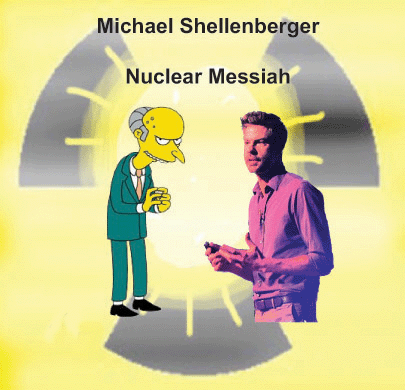 Pro-nuclear activist running for governor on pledge to reform utilities commission http://www.sandiegouniontribune.com/news/politics/sd-me-cpuc-candidate-20171201-story.html Jeff McDonaldContact Reporter
Michael Shellenberger, founder of the pro-nuclear group Environmental Progress, said Gov. Jerry Brown and the California Public Utilities Commission are responsible for creating some of the highest energy rates in the United States.
He also blames Brown and the utility regulators he appointed for the “corrupt” deal that assigned customers $3.3 billion in costs related to the premature shutdown of the San Onofre nuclear plant and said he wants to secure a cleaner energy future by promoting nuclear power.
Shellenberger listed eight key pledges he said would lower energy costs, reduce poverty, improve education and promote cleaner sources of power. His first pledge is: “Break up the corrupt California Public Utilities Commission (CPUC), release secret emails and prosecute the criminals.”
The commission was the subject of a criminal investigation by former Attorney General Kamala Harris, although it’s unclear where the probe stands under her successor, Xavier Becerra. The investigation centered on emails showing potentially improper communications between regulators and the utility companies they are supposed to oversee. San Diego consumer attorney Mike Aguirre has a number of lawsuits against the commission, including one demanding release of more emails.
A resident of Berkeley, Shellenberger is the founder and president of Environmental Progress, a nonprofit group that 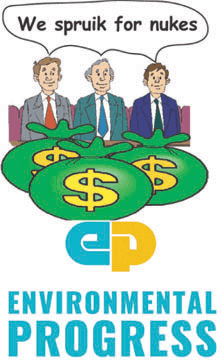 advocates for nuclear power across the country and world. The group is committed to preserving the Diablo Canyon nuclear plant on California’s central coast that has been scheduled for closure.
A resident of Berkeley, Shellenberger is the founder and president of Environmental Progress, a nonprofit group that advocates for nuclear power across the country and world. The group is committed to preserving the Diablo Canyon nuclear plant on California’s central coast that has been scheduled for closure.
Rick Perry to visit Saudi Arabia – a nation keen to have nuclear reactors AND to highly enrich uranium
 U.S. Firms Courting Saudi Arabia to Build Nuclear Reactors; Rick Perry to Visit
 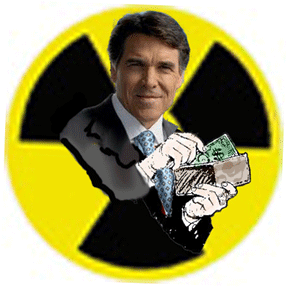 Riyadh, Haaretz, 3 Dec 17, One of the sources also said Riyadh had told Washington it does not want to forfeit the possibility of one day enriching uranium – a process that can have military uses.
1 This Month
Chernobyl: The Lost Tapes – A good documentary on Chernobyl on SBS available On Demand for the next 3 weeks– https://www.sbs.com.au/ondemand/tv-program/chernobyl-the-lost-tapes/2352741955560

of the week–London Campaign for Nuclear Disarmament

Tell the Ukrainian Government to Drop Prosecution of Peace Activist Yurii Sheliazhenko
To see nuclear-related stories in greater depth and intensity – go to https://nuclearinformation.wordpress.com
-
Archives
- April 2026 (189)
- March 2026 (251)
- February 2026 (268)
- January 2026 (308)
- December 2025 (358)
- November 2025 (359)
- October 2025 (376)
- September 2025 (257)
- August 2025 (319)
- July 2025 (230)
- June 2025 (348)
- May 2025 (261)
-
Categories
- 1
- 1 NUCLEAR ISSUES
- business and costs
- climate change
- culture and arts
- ENERGY
- environment
- health
- history
- indigenous issues
- Legal
- marketing of nuclear
- media
- opposition to nuclear
- PERSONAL STORIES
- politics
- politics international
- Religion and ethics
- safety
- secrets,lies and civil liberties
- spinbuster
- technology
- Uranium
- wastes
- weapons and war
- Women
- 2 WORLD
- ACTION
- AFRICA
- Atrocities
- AUSTRALIA
- Christina's notes
- Christina's themes
- culture and arts
- Events
- Fuk 2022
- Fuk 2023
- Fukushima 2017
- Fukushima 2018
- fukushima 2019
- Fukushima 2020
- Fukushima 2021
- general
- global warming
- Humour (God we need it)
- Nuclear
- RARE EARTHS
- Reference
- resources – print
- Resources -audiovicual
- Weekly Newsletter
- World
- World Nuclear
- YouTube
-
RSS
Entries RSS
Comments RSS
 nuclear-news