Ecowatch 27th Dec 2017, Germany has broken another renewable energy record, with clean power
providing a third of of the country’s electricity in 2017. Preliminary data
from the Association of Energy and Water Industries show that renewable
electricity generation grew to a record 33 percent this year, up from 29
percent in 2016. “The figures show impressively that there is already an
accelerated shift in power generation from CO2-intensive to low-carbon and
almost CO2-free energy sources,” Stefan Kapferer, the chairman of the
association, said. “The energy industry is clearly on course with regard
to energy and climate targets: our industry is able to reduce CO2 emissions
by 40 percent by 2020 compared to 1990.” Onshore and offshore wind power
has now surpassed natural gas, nuclear, and hard coal as the second largest
electricity source, with a 16 percent slice of Germany’s power mix.
https://www.ecowatch.com/renewable-energy-germany-2520322211.html
December 30, 2017
Posted by Christina Macpherson |
general |
Leave a comment
Politicians and decision-makers in South Korea are torn about a plan to
continue construction of two nuclear power plants, following a major
earthquake. The magnitude 5.4 earthquake in early November reignited public
concern about whether the country can still be considered a seismic safe
zone. Now a 500-strong panel of experts is due to report.
http://www.aljazeera.com/news/2017/12/south-korea-concerns-raised-safety-nuclear-plants-171226071506379.html
December 30, 2017
Posted by Christina Macpherson |
safety, South Korea |
Leave a comment
Ontario’s long-awaited new nuclear emergency plan falls short, Greenpeace says Ontario has updated its plan for dealing with nuclear emergencies for the first time since the 2011 Fukushima disaster, The Star.com, By ROB FERGUSON Queen’s Park Bureau, Dec. 28, 2017 Ontario has updated its plan for dealing with potentially deadly emergencies at nuclear power plants for the first time since the 2011 Fukushima disaster forced the evacuation of 70,000 people in Japan.
The 173-page effort follows criticisms from provincial auditor general Bonnie Lysyk earlier this month that the nuclear response blueprint has not been changed since 2009 to reflect lessons learned elsewhere.
“Ontario has three nuclear power facilities and 18 operating reactors, which makes it the largest nuclear jurisdiction in North America and one of the largest in the world,” she wrote in her annual report.
“Plans need to be regularly updated with current information and to reflect the best approach to respond to emergencies so they can be used as a step-by-step guide during a response,” Lysyk added.
The new plan takes into account radiation emergencies that could stem from reactor accidents, leaks during the transportation of radioactive material, explosions and even a satellite crashing on nuclear plants at Pickering and Darlington east of the heavily populated Greater Toronto Area or at the Bruce reactors near Kincardine on Lake Huron…….
The plan was released a week after the government put out a request for experts to conduct a technical study of it, making a mockery of the process, said the anti-nuclear group, Greenpeace.
“It’s ass backward and incompetent,” said Shawn-Patrick Stensil, senior energy analyst for Greenpeace, a vocal critic of the government’s nuclear energy program.
There is little in the updated nuclear response plan to prepare for a major disaster, he added, such as emergency zones that are too small given the potentially large scale of nuclear disasters.
“While other countries have strengthened public safety since Fukushima, it’s taken the Ontario government six years to maintain the status quo,” said Stensil.
“Other countries are preparing for bigger accidents.”……….
Toronto city council passed a motion in November calling on the province to prepare for more severe accidents and expand delivery of anti-radiation potassium iodide pills beyond the current 10-kilometre zone around nuclear power plants.
The city also requested a study on the potential impacts of a major nuclear accident on the Great Lakes, which are a source of drinking water for millions in Canada and the United States, awareness campaigns for Toronto residents on how to prepare for a nuclear accident at Pickering or Darlington, just east of Oshawa.https://www.thestar.com/news/queenspark/2017/12/22/ontarios-long-awaited-new-nuclear-emergency-plan-falls-short-greenpeace-says.html
December 30, 2017
Posted by Christina Macpherson |
Canada, safety |
Leave a comment
How Close Are We Really to Achieving Nuclear Fusion? Geek.com, 29 Dec 17 Nuclear fusion has been the practical Holy Grail for clean, sustainable power for decades. Based on the same process that powers the sun, a controlled, human made nuclear reactor could solve a lot of Earth’s biggest problems. One plant could power a significant percentage of the US, and a few more — each of which only need small pellets of cheap, plentiful fuel to operate — could run the planet. And all without any extra greenhouse gas emissions, or the risk of a catastrophic meltdown. So… what’s stopping us from putting these things everywhere? Well… unfortunately, the laws of physics.
That’s not to say that building a fusion reactor is impossible (though that may well be, at least for cheap power generation), just that it is very, very hard. Scientists have been working on this since the 50s and, at the time, they suspected the final breakthrough wasn’t too far off. But then, as now, the running joke is that fusion is still a staggering 50 years away. But is that even true? How could it be?
Because we aren’t working with stars, humans have some major hurdles in fusing atoms and creating the tremendous amounts of energy we see in the sun. Most of those come from the incredible heat involved. Hot gasses and plasmas expand, but to keep the reaction going, you need the atoms to keep smashing together. You can use magnets to force the material to stay contained, but that uses a lot of power. That’s the fundamental problem with fusion as it stands today.
Reactions can be started, but, thus far, they’ve all taken more energy to control than we get out of them. In fact, starting that initial fusion reaction is quite easy, but it can’t just be the spark. That spark has to stick and kick up a nuclear furnace that yields enough to operate what are, in essence, force fields to contain the reaction and send the excess to the mains.
December 30, 2017
Posted by Christina Macpherson |
general |
Leave a comment
The new edition of the best-selling Japanese dictionary “Kojien” to go on sale next month will be the first with nuclear power generation terms selected by a dedicated editor in its 62-year history, according to its publisher.
The dictionary covering some 240,000 words was first published in 1955 and is revised every 10 years or so. Its publisher, Iwanami Shoten, decided to have a particular editor for nuclear terms for the upcoming 7th edition as people have become more familiar with such terms since the March 2011 Fukushima nuclear disaster.
Some of the terms have been frequently used in the media and become quite common, but many of those already included in the dictionary’s current edition are defined using technical jargon.
Toru Kawahara, 46, at Iwanami Shoten proposed at a meeting just months after the Fukushima disaster that the publisher appoint an editor dedicated to reviewing and selecting nuclear terms.
He remembers telling the meeting, “Issues regarding nuclear plants are no longer restricted to experts in the field and people living near the plants.”
The proposal was accepted unanimously and Kawahara himself became the first to take the post.
He added about 20 new words to the upcoming edition including “hairo” meaning decommissioning of a reactor and “anzen-shinwa” (safety myth), describing the view once held by the government and power companies that nuclear power is undoubtedly safe.
One of the key factors behind his choice of new terms was “whether they will continue to be used” in years to come, he says.
Kawahara came up with 200 candidate words, including those he saw in print media and came across on the internet. He was surprised to learn that hairo had not been included.
He realized that people only paid attention to the building and operating of nuclear plants and cared far less about the fact that the work of scrapping aged reactors safely is an important part of nuclear power.
“Everyone, including myself, was so indifferent (about nuclear power),” he says.
While also adding “The Great East Japan Earthquake” in 2011 which triggered the Fukushima crisis, Kawahara revised descriptions for some of the already listed terms, such as radiation and breeder reactor, using words easier to understand.
He knew that some of the terms he chose to add are not widely used. Among such terms were “youso” (iodine) and “bento” (venting).
Iodine pills help to reduce radiation buildup in the thyroid in the event of a nuclear accident. “I think it is good to tell people how they work and how they should take them in an emergency,” he said.
Venting is one of the terms which became widely known after the Fukushima disaster. Tokyo Electric Power Company Holdings Inc., the operator of the disaster-hit Fukushima Daiichi complex, came under fire for its failed venting operation to deal with the pressure buildup at the reactors and causing hydrogen explosions which severely damaged the structures.
Since venting could cause radioactive materials to reach the environment, “I thought it is a term we must have as long as it concerns life-and-death situations people may encounter during evacuation,” Kawahara said.
He contemplated adding “difficult-to-return-to zone” near the Fukushima plant where radiation levels remain high. But he dropped it, concluding the term would no longer be used once the designation is lifted.
“I felt compelled to help people remember the reality of residents there who cannot return to their way of life before the disaster. It was not an easy decision.”
The new edition will go on sale Jan. 12.
http://english.kyodonews.net/news/2017/12/ade339c19145-best-selling-japanese-dictionary-updated-with-more-nuclear-terms.html
December 30, 2017
Posted by arclight2011part2 |
Uncategorized |
Leave a comment
Levels of iodine-129 in capital of Shaanxi province peaked two days after hydrogen bomb test 2,000km away
PUBLISHED : Saturday, 30 December, 2017, 8:30am
UPDATED : Saturday, 30 December, 2017, 8:42am
Radiation levels in a Chinese city nearly 2,000km from a North Korean nuclear test site spiked following Pyongyang’s latest and most powerful nuclear weapons test in September, Chinese scientists say.
However, they say the spike in iodine-129 levels Xian was probably not related to the detonation of a 100-kilotonne hydrogen bomb in a tunnel at the Punggye-ri nuclear test site on September 3 and was more likely to have originated in Europe.
The spike was recently declassified by the Chinese Academy of Sciences, prompting heated discussion among researchers about its possible cause, with some disputing the Europe theory.
From September 3 to 11, levels of iodine-129 in Xian, the capital of Shaanxi province in central China, jumped to at least 4.5 times above average, according to readings picked up by instruments at the academy’s Institute of Earth Environment, which is based in the city.
Iodine-129 is an isotope of the element iodine that rarely occurs in nature. It is mostly produced by man-made fission and is closely monitored around the world as evidence of nuclear weapons tests or nuclear accidents.
The levels in Xian, nearly 2,000km west of Punggye-ri, peaked between September 5 and 6, when they were nine times as high as the day before the test.
Zhang Luyuan, a physicist at the institute who is leading the investigation of the incident, said she had goosebumps when she first saw the spikes on the chart.
“We thought we’d nailed it. The timing was almost perfect,” she said on Wednesday. “It could have been the first time fallout was recorded outside North Korea.”
But the matter turned out to be much more complicated than the researchers thought.
Zhang and her colleagues checked the data collected by devices set up along the Chinese-Korean border due to concerns in Beijing that the Punggye-ri test site, under a mountain near the border, might collapse and release a large amount of radioactive pollutants.
While some stations reported an increase in overall radioactivity, they did not detect trace elements such as iodine-129.
Zhang said the researchers pondered whether the radioactive particles might have been blown towards Xian but discovered winds had been blowing towards the east for most of the time in question.
The team also calculated that in order to generate enough fallout to boost the amount of iodine-129 in Xian by so much, the bomb detonated in North Korea would have had to have been “many, many times” larger than reported estimates, Zhang said.
The team now suspectedthe fallout might have come from western Europe, because two
of the world’s largest spent nuclear fuel recycling plants, in France and Britain, had released more than six tonnes of iodine-129 into the environment since the 1960s, more than 100 times the amount produced by all the nuclear weapons tests conducted in the atmosphere.
But that suggestion came under fire from many people in the research community, who pointed out that Xian was more than 8,000km from France and Britain.
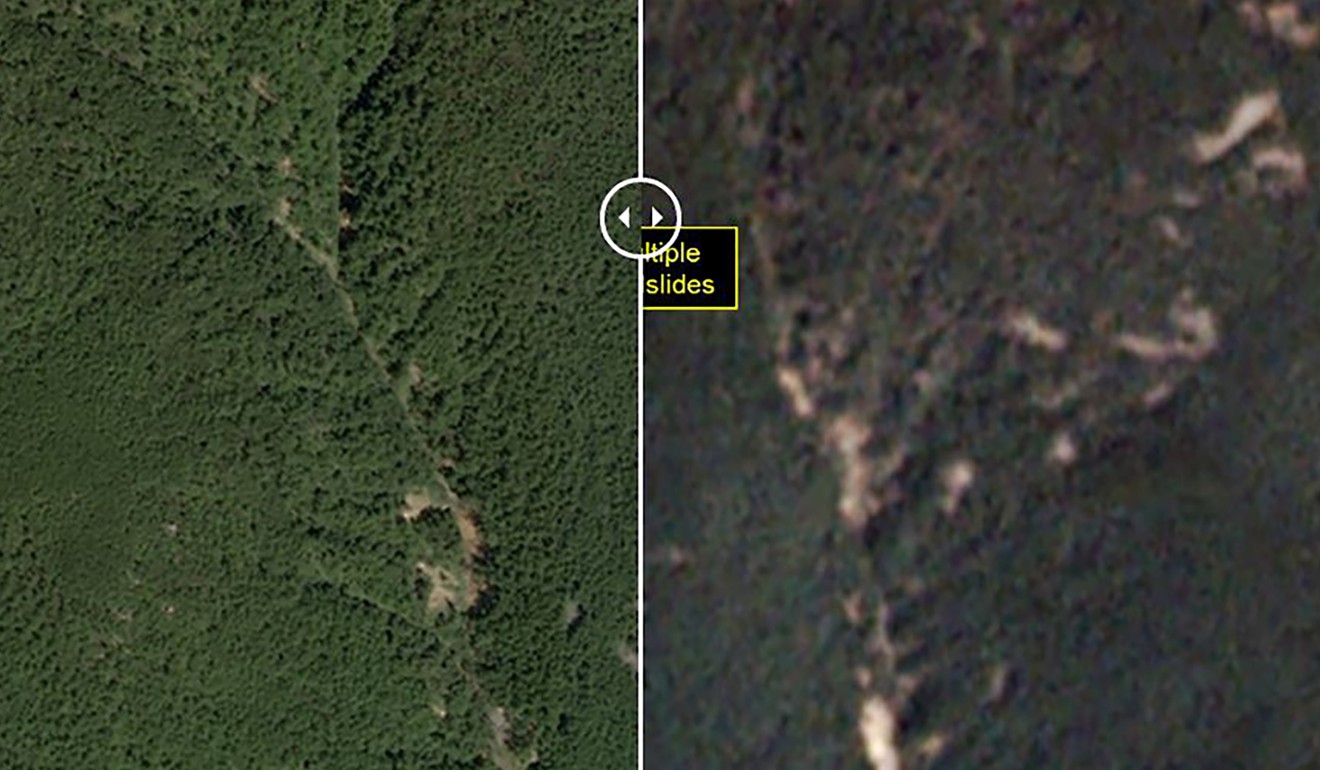
Professor Guo Qiuju, a nuclear physicist leading the research programme on nuclear hazard monitoring at Peking University, said that if Europe was to blame, there must have been a very large, very serious accident that had not been disclosed.
“Europe has established maybe the world’s best network to monitor radioactivity in the environment,” she said. “If there was a cloud coming from there, it must have triggered alerts all along the way.”
But Guo, also a member of an expert panel that advises the Chinese government on dealing with North Korea’s nuclear threat, said the incident was unlikely to have been caused by the bomb test either.
“If a leak has indeed occurred, the stations on the high mountains at the border should have recorded similar or stronger signs,” she said. “The data is transparent. There is no cover-up.”
A nuclear safety expert who requested anonymity said Xian was home to a major research centre for China’s nuclear weapon programme.
The Northwest Nuclear Technology Research Institute, run by the People’s Liberation Army’s Equipment Development Department, operated a wide range of radioactive equipment in the city including a pulse reactor and powerful accelerators, the researcher said, adding “the possibility of a local accident cannot be ruled out.”
Zhang admitted the need to avoid public panic was one reason the information had been kept from the public until the end of November.
“Our investigation was not completed then,” she said.
http://www.scmp.com/news/china/society/article/2125448/what-caused-radiation-spike-xian-north-korean-blast-european
December 30, 2017
Posted by arclight2011part2 |
Uncategorized |
1 Comment
This Sept. 30, 2017 aerial photo shows the reactors of No. 6, right, and No. 7, left, at Kashiwazaki-Kariwa nuclear power plant, Niigata prefecture.
TEPCO gets OK to restart nuclear reactors, to the displeasure of some
(Newser) – The biggest nuclear power plant in the world sits idle, as it has for nearly seven years. But that state is set to change, and not without public trepidation. The Guardian reports that Japan’s nuclear watchdog this week gave Tokyo Electric Power (TEPCO) the green light to restart two of the seven reactors at Kashiwazaki-kariwa, which fell victim to the country’s nuclear power moratorium in the wake of the March 2011 Fukushima disaster. That calamity occurred on TEPCO’s watch, and the utility says the money it will generate from Kashiwazaki-kariwa’s power is key to funding its continuing decommissioning efforts at Fukushima. It has poured more than $6 billion into Kashiwazaki-kariwa in an effort to make it immune to the series of disasters that befell Fukushima.
A 50-foot seawall provides tsunami protection, for instance, and 22,000 tons of water sit in a nearby reservoir, ready for the taking if reactors need sudden cooling. But locals aren’t convinced—the Japan Times reports some people shouted at the meeting where the restart approval was granted—and that matters: Though the restarts are penciled in to occur in spring 2019, the AFP reports local authorities need to give their OK, and that process could take years. The plant is located in Niigata prefecture, and locals there cite the active seismic faults in the area as a major concern; the Guardian notes “evidence that the ground on which Tepco’s seawall stands is prone to liquefaction in the event of a major earthquake.” A second is the fear that should an evacuation be necessary, it would be much less successful than that of Fukushima due to the bigger population.
December 29, 2017
Posted by dunrenard |
Japan | Kashiwazaki-Kariwa NPP |
Leave a comment
In the meantime, if the reactivation of the atomic power station is to be delayed, there is a possibility that the national government’s grants to the host municipalities will be reduced.
Niigata Gov. Ryuichi Yoneyama, left, talks with Masaya Kitta, second from right, head of TEPCO Niigata regional headquarters, at the Niigata Prefectural Government building on Dec. 27, 2017
NIIGATA — There are no prospects that two reactors at the Kashiwazaki-Kariwa Nuclear Power Plant, which have passed a safety review by the Nuclear Regulation Authority (NRA), will be restarted in the foreseeable future, as local bodies hosting the plant remain divided over the issue.
The mayors of the city of Kashiwazaki and the village of Kariwa, which jointly host the power station, are in favor of reactivating the No. 6 and No. 7 reactors at the plant owned by Tokyo Electric Power Company Holdings Inc. (TEPCO).
Niigata Gov. Ryuichi Yoneyama, on the other hand, remains cautious about the resumption of the units’ operations.
Gov. Yoneyama told Masaya Kitta, head of TEPCO’s Niigata regional headquarters who visited the governor on Dec. 27 that the prefectural government cannot agree on the early reactivation of the plant.
“I have no intention of objecting to the decision by the NRA, but our position is that we can’t start talks on reactivation unless our examination of three-point checks progresses,” Yoneyama told Kitta. The governor was referring to his policy of not sitting at the negotiation table over reactivation unless three points are examined by the prefectural government: the cause of the Fukushima nuclear disaster, potential effects on people’s livelihoods as well as health in case of an accident, and safe evacuation measures. He has stated that it would take two to three years to complete the checks of these points.
The governor also told Kitta, “Our examination will never be affected” by the NRA’s judgment that the plant meets the new safety standards. Moreover, the prefectural government is poised to independently examine the outcome of the NRA’s safety review of the Kashiwazaki-Kariwa power station.
Kashiwazaki Mayor Masahiro Sakurai and Kariwa Mayor Hiroo Shinada were separately briefed by plant manager Chikashi Shitara on the outcome of the NRA safety review of the facility.
Both mayors have expressed their appreciation for TEPCO’s response up to this point, and Sakurai urged the power company to “make efforts to reassure local residents (about the nuclear plant),” while Shinada urged the utility to “try to provide information in an appropriate manner.”
In the meantime, if the reactivation of the atomic power station is to be delayed, there is a possibility that the national government’s grants to the host municipalities will be reduced.
The Economy, Trade and Industry Ministry is continuing to provide such grants to local bodies hosting idled nuclear plants by deeming them to be running plants in some form. In April 2016, the national government revised its rules on grants to nuclear plant host municipalities and decided to reduce the amount of funding if the facilities are not restarted within nine months after the completion of the NRA’s safety review, which is necessary for reactivation.
The No. 6 and 7 reactors at the Kashiwazaki-Kariwa plant need to pass two more inspections within a year. If it takes several years to form a consensus among the local governments concerned, however, grants will be reduced in fiscal 2020 at the earliest. The amounts of reductions are estimated at some 400 million yen for Kariwa, about 100 million yen for Kashiwazaki and approximately 740 million yen for Niigata Prefecture.
December 29, 2017
Posted by dunrenard |
Japan | Kashiwazaki-Kariwa NPP, Niigata Prefecture |
Leave a comment
 Because my websites focus on nuclear news, many important climate stories were not covered there. A pity – now that the most accurate climate predictions are turning out to be the worst case scenarios. It is clear that climate change is a global emergency – NOW.
Some remarkable climate stories that we did cover: Rise of deadly heatwaves will continue. Food crops already affected. Lakes around the world are affected by heat from climate change. The importance of the Arctic – warm water being pushed to the surface, the disappearing ice, and its consequences, rapid spread of ocean acidification.
I’ve selected not the major news items, but nuclear stories that ought not to be forgotten.
The most impressive story of 2017:
brings together the climate and nuclear issues – Australian Mark Willacy’s text and visual coverage of the climate danger to the nuclear waste “dome” on Enewetak atoll.
Equally impressive
– USA’s Kate Brown and Ukraine’s Olha Martynyuk’s – investigation of the cherry-pickers of Ukraine “The Harvests of Chernobyl”.
Because many of these stories are long, and complicated, I’m providing here first the links to extracts on nuclear-news.net, which contain links to the originals.
NUCLEAR WEAPONS: Evidence that Britain’s nuclear power industry subsidises nuclear weapons. America’s nuclear bomb tests and their health toll on Americans.
USA NUCLEAR WEAPONS AND THE MONEY THEY COST:
Listing the financial institutions that provided 344 billion available to 27 nuclear weapon producing companies. How it happens that taxpayer $trillions are spent on nuclear weapons – Follow the money. $billions of Americans’ tax money squandered on weapons. How did the Pentagon lose $10 Trillion? America’s war profiteers
JAPAN and FUKUSHIMA. What It’s Like for Informal Labour Employed in Nuclear Power Stations in Japan. The Fukushima Daichi nuclear power complex is a continuing, permanent, catastrophe. Small head size and delayed body weight growth in wild Japanese monkey fetuses after the Fukushima Daiichi nuclear disaster Many articles by dunrenard.
RADIOACTIVE WASTE DANGER. Just Moms, St Louis and the continuing horror story of nuclear weapons’ waste. Problems at Los Alamos National Plutonium Facility-4 (PF-4) – dangerous plutonium pits. Nuclear catastrophe narrowly avoided at Los Alamos National Laboratory.
IONISING RADIATION and CHERNOBYL.
SOME OTHER TOP STORIES.
December 29, 2017
Posted by Christina Macpherson |
Christina's notes |
Leave a comment
The ‘Nuclear for Climate’ lobby group recently attended the United Nations’ COP23 climate conference armed with bananas, in order to make specious comparisons between radiation exposures from eating bananas and routine emissions from nuclear power plants.
One of the reasons the comparison is specious is that some exposures are voluntary, others aren’t. Australian academic Prof. Barry Brook said in the aftermath of the Fukushima disaster: “People don’t understand that they live in an environment that is awash with radiation and they make decisions every day which affect their radiation dose – they hop on an airplane or eat a banana or sit close to the TV.” True – but people choose to hop on an airplane or eat a banana or sit close to the TV, whereas radiation doses from nuclear plants and nuclear accidents are usually involuntary.
Another reason why the comparison made by ‘Nuclear for Climate’ is specious is that it ignores spikes in radioactive emissions during reactor refueling. Radiation biologist Dr Ian Fairlie notes that when nuclear reactors are refueled, a 12-hour spike in radioactive emissions exposes local people to levels of radioactivity up to 500 times greater than during normal operation. The spikes may explain infant leukemia increases near nuclear plants − but operators provide no warnings and take no measures to reduce exposures.
The comparison between bananas and nuclear power plants also ignores the spike in emissions and radiation doses following catastrophic accidents. So, what’s the Banana Equivalent Dose (yes, that’s a thing) of the Chernobyl and Fukushima disasters?
According to the International Atomic Energy Agency (IAEA), the collective effective dose from Chernobyl was 600,000 person-Sieverts. The UN Scientific Committee on the Effects of Atomic Radiation estimates radiation exposure from the Fukushima disaster at 48,000person-Sieverts.
Combined, exposure from Chernobyl and Fukushima is estimated at 648,000 person-Sieverts. Exposure from eating a banana is estimated at between 0.09-2.3 microSieverts. Let’s use a figure of 0.1 microSievert per banana. Thus, exposure from Chernobyl and Fukushima equates to 6,480,000,000,000 Banana Equivalent Doses – that’s 6.48 trillion bananas or, if you prefer, 6.48 terabananas or 6,480 gigabananas.
End-to-end, that many 15-cm (6-inch) bananas would stretch 972 million kilometres – far enough to reach the sun 6.5 times over, or the moon 2,529 times over.
Potassium cycle
Another reason the comparison made by ‘Nuclear for Climate’ is specious is explained by Dr Gordon Edwards from the Canadian Coalition for Nuclear Responsibility:
“[T]he body already has a lot of “natural” potassium including K-40 [which is unavoidable], and any new “natural” potassium ingested is balanced by eliminating a comparable amount of “natural” potassium to maintain the “homeostasis” of the body. In other words the body’s own mechanisms will not allow for a net increase in potassium levels – and therefore will not allow for an increase in K-40 content in the body.
“Here’s what the Oak Ridge Associated Universities has to say; (ORAU was founded in 1946 as the Oak Ridge Institute of Nuclear Studies.): ‘The human body maintains relatively tight homeostatic control over potassium levels. This means that the consumption of foods containing large amounts of potassium will not increase the body’s potassium content. As such, eating foods like bananas does not increase your annual radiation dose. If someone ingested potassium that had been enriched in K-40, that would be another story.’
“The same argument does not work for radioactive caesium, or for any of the radioactive pollutants given off by a nuclear power plant, because most of these materials do not exist in nature at all – and those that do exist in nature are not subject to the same homeostatic mechanism that the body uses to control potassium levels. Consequently any foodstuffs or beverages containing radioactive caesium or other man-made radioactive pollutants will cause an additional annual dose of ionizing radiation to the person so exposed.”
Likewise, Linda Gunter explained in a 16 November 2017 article:
“At the COP23 Climate Talks currently underway in Bonn, a group calling itself Nuclear for Climate, wants you to slip on their false banana propaganda and fall for their nonsensically unscientific notion that bananas are actually more dangerous than nuclear power plants! I am not making this up. Here is the picture.
“The oxymoronic Nuclear for Climate people are handing out bananas complete with a sticker that reads: “This normal, every-day banana is more radioactive than living near a nuclear power plant for one year.” …
“If you smell something rotten in this banana business, you are right. So let’s peel off the propaganda right now. In short, when you eat a banana, your body’s level of potassium-40 doesn’t increase. You just get rid of some excess potassium-40. The net dose of a banana is zero.
“To explain in more detail, the tiny radiation exposure due to eating a banana lasts only for a few hours after ingestion, namely the time it takes for the normal potassium content of the body to be regulated by the kidneys. Since our bodies are under homeostatic control, the body’s level of potassium-40 doesn’t increase after eating a banana. The body just gets rid of some excess potassium-40.
“The banana bashers don’t want you to know this and instead try to pretend that the potassium in bananas is the same as the genuinely dangerous man-made radionuclides ‒ such as cesium-137 and strontium-90 ‒ that are released into our environment from nuclear power facilities, from atomic bomb tests and from accidents like Fukushima and Chernobyl.
“These radioactive elements, unlike the potassium-40 in bananas, are mistaken by the human body for more familiar elements. For example, ingested radioactive strontium-90 replaces stable calcium, and ingested radioactive cesium-137 replaces stable potassium. These nuclides can lodge in bones and muscles and irradiate people from within. This is internal radiation and can lead to very serious, long-lasting and trans-generational health impacts.”
An unfortunate incident in Goiania, Brazil in September 1987 illustrates the hazards of cesium-137, a fission product. Two people stole a radiotherapy source from a disused medical clinic. A security guard did not show up to work that day; he went instead to the cinema to see ‘Herbie Goes Bananas‘. The radiotherapy source contained 93 grams of cesium-137. It was sold to a junkyard dealer. Many people were exposed to the radioactive cesium and they spread the contamination to other sites within and beyond the town. At least four people died from exposure to the radiation source and, according to the IAEA, “many others” suffered radiation injuries. Those injured included eight patients who required surgical debridments, amputation of the digital extremities and plastic skin grafts. The incident was rated Level 5 (‘Accident with Off Site Risk’) on the 7-point International Nuclear Event Scale.
Terrorists don’t arm themselves with bananas
There is a long history of nuclear power plants being used directly and indirectly in support of nuclear weapons programs. Bananas are of no interest to nuclear weapons proliferators. There’s no Treaty on the Non-Proliferation of Bananas, no Comprehensive Test Banana Treaty, no Anti-Banana Missile Treaty. Kim Jong-un and Donald Trump aren’t threatening each other with bananas; not yet, at least.
Nuclear historian Paul Langley notes that terrorists don’t arm themselves with bananas:
“The potassium cycle in humans is no excuse for nuclear authorities anywhere on the planet to claim any benefit or natural precedent for the marketing of nuclear industry emissions contaminated food.
“The fission products are not nutrients. Do not eat them. The nuclear industry promises to keep its radioactive sources sealed. When the industry invariably fails in this undertaking, it turns around and claims that the residue of its pollution is like a banana. Crap. The residue is like the residue of a rad weapon. Fact. It’s the same stuff. Terrorists do not attempt to arm themselves with bananas. They are not dangerous.
“Radio Strontium, Radio Iodine, Radio cesium have NO PLACE in food. Nuke is not clean, it is not green and it relies on lies it has concocted over decades. … The more the nuclear industry claims eating plutonium, strontium, cesium, iodine and other fuel and fission products is OK because bananas exist and because the potassium is a needed nutrient, the more I consider them to be blatant liars.”
http://www.dianuke.org/many-bananas-equal-chernobyl-fukushima-jim-green-nuclear-propagandists-radiation/
December 29, 2017
Posted by dunrenard |
Fukushima 2017 | Fukushima, Lies & Cover-up, Propaganda |
Leave a comment
Tokyo Electric Power employees check instruments in a mock-up of the plant’s central control room.
Consent given to turn reactors at the massive Kashiwazaki-kariwa plant back on, but Japanese worry over active fault lines and mismanagement
If a single structure can define a community, for the 90,000 residents of Kashiwazaki town and the neighbouring village of Kariwa, it is the sprawling nuclear power plant that has dominated the coastal landscape for more than 40 years.
When all seven of its reactors are in operation, Kashiwazaki-kariwa generates 8.2m kilowatts of electricity – enough to power 16m households. Occupying 4.2 sq km of land along the Japan Sea coast, it is the biggest nuclear power plant in the world.
But today, the reactors at Kashiwazaki-kariwa are idle. The plant in Niigata prefecture, about 140 miles (225km) north-west of the capital, is the nuclear industry’s highest-profile casualty of the nationwide atomic shutdown that followed the March 2011 triple meltdown at Fukushima Daiichi.
The company at the centre of the disaster has encountered anger over its failure to prevent the catastrophe, its treatment of tens of thousands of evacuated residents and its haphazard attempts to clean up its atomic mess.
Now, the same utility, Tokyo Electric Power [Tepco], is attempting to banish its Fukushima demons with a push to restart two reactors at Kashiwazaki-kariwa, one of its three nuclear plants. Only then, it says, can it generate the profits it needs to fund the decommissioning of Fukushima Daiichi and win back the public trust it lost in the wake of the meltdown.
This week, Japan’s nuclear regulation authority gave its formal approval for Tepco to restart the Kashiwazaki-kariwa’s No. 6 and 7 reactors – the same type of boiling-water reactors that suffered meltdowns at Fukushima Daiichi.
After a month of public hearings, the nuclear regulation authority concluded that Tepco was fit to run a nuclear power plant and said the two reactors met the stricter safety standards introduced after the 2011 disaster.
Just before that decision, Tepco gave the Guardian an exclusive tour of what it claims will be the safest nuclear plant in the world.
Now, as on the day of the triple disaster that brought widespread destruction to Japan’s northeast coast, Kashiwazaki-kariwa has the look of a working nuclear plant. Just over 1,000 Tepco staff and 5,000-6,000 contract workers provide the manpower behind a post-Fukushima safety retrofit that is projected to cost 680 billion yen ($6.1bn).
Kashiwazaki-kariwa nuclear power plant, with the Japan Sea in the distance.
They have built a 15-metre-high seawall that, according to Tepco, can withstand the biggest tsunami waves. In the event of a meltdown, special vents would keep 99.9% of released radioactive particles out of the atmosphere, and corium shields would block molten fuel from breaching the reactors’ primary containment vessels. Autocatalytic recombiners have been installed to prevent a repeat of the hydrogen explosions that rocked four of Fukushima Daiichi’s reactors.
Other parts of the sprawling complex are home to fleets of emergency vehicles, water cannon, back-up power generators, and a hilltop reservoir whose 20,000 tonnes of water will be drawn to cool reactors in the event of a catastrophic meltdown.
“As the operator responsible for the Fukushima accident, we’re committed to learning lessons, revisiting what went wrong and implementing what we learned here at Kashiwazaki-kariwa, says the plant’s chief, Chikashi Shitara. “We are always looking at ways to improve safety.
“Because of our experience at Fukushima, we’re committed to not making the same mistakes again – to make the safety regime even stronger. That’s what we have to explain to members of the public.”
‘This is no place for a nuclear power plant’
The public, however, is far from convinced. Last year, the people of Niigata prefecture registered their opposition to the utility’s plans by electing Ryuichi Yoneyama, an anti-nuclear candidate, as governor. Exit polls showed that 73% of voters opposed restarting the plant, with just 27% in favour.
Yoneyama has said that he won’t make a decision on the restarts, scheduled for spring 2019, until a newly formed committee has completed its report into the causes and consequences of the Fukushima disaster – a process that could take at least three years.
For many residents, the plant’s location renders expensive safety improvements irrelevant. “Geologically speaking, this is no place for a nuclear power plant,” says Kazuyuki Takemoto, a retired local councillor and a lifelong anti-nuclear activist.
Takemoto cites instability caused by the presence of underground oil and gas deposits in the area, and evidence that the ground on which Tepco’s seawall stands is prone to liquefaction in the event of a major earthquake.
Local critics have pointed to the chaos that could result from attempting to evacuate the 420,000 people who live within a 30km radius of Kashiwazaki-kariwa. “That’s more people than lived near Fukushima, plus we get very heavy snowfall here, which would make evacuating everyone impossible,” Takemoto adds. “The situation would be far worse than it was in Fukushima.”
Adding to their concerns are the presence of seismic faults in and around the site, which sustained minor damage during a magnitude-6.6 offshore earthquake in 2007. Two active faults – defined by nuclear regulators as one that has moved any time within the last 400,000 years – run beneath reactor No. 1.
But for Tepco, a return to nuclear power generation is a matter of financial necessity, with the utility standing to gain up to ¥200 billion in annual profits by restarting the two reactors at Kashiwazaki-Kariwa.
Workers at Kashiwazaki-kariwa nuclear power plant in Niigata Prefecture, Japan.
The bill for decommissioning Fukushima Daiichi, decontaminating neighbourhoods and compensating residents affected by the meltdown could reach 21.5tr yen [$191bn], according to government estimates. That is on top of the money the firm is spending on importing expensive fossil fuels to fill the vacuum left by the nuclear shutdown.
Earlier this year, the Japan Centre for Economic Research said the total cost of the four-decade Fukushima cleanup – including the disposal of radioactive waste from the plant’s three damaged reactors – could soar to between 50-70tr yen.
“As Tepco’s president and our general business plan have made clear, restarting the reactors here is very important to us as a company,” says Shitara.
Much is at stake, too, for Japan’s prime minister, Shinzo Abe, who has put an ambitious return to nuclear power generation at the centre of his energy policy. His government wants nuclear to provide about 20 percent Japan’s electricity by 2030 – a move that would require the restart of about 30 reactors.
Of the country’s 48 operable reactors, only four are currently online. Several others have passed stringent new safety tests introduced in the wake of Fukushima, but restarts have encountered strong local opposition.
As part of the restart process, people across Japan were recently invited to submit their opinions on the Kashiwazaki-kariwa restart and Tepco’s suitability as a nuclear operator.
Kiyoto Ishikawa, from the plant’s public relations department, insists Tepco has learned the lessons of Fukushima. “Before 3-11 we were arrogant and had stopped improving safety,” he said. “The earthquake was a wake-up call. We now know that improving safety is a continuous process.”
The firm’s assurances were dismissed by Yukiko Kondo, a Kariwa resident, who said the loss of state subsidies if the plant were to remain permanently idle was a sacrifice worth making if it meant giving local people peace of mind.
“Tepco caused the 2011 accident, so there is no way I would ever support restarting nuclear reactors here,” she said. “They kept telling us that Fukushima Daiichi was perfectly safe – and look what happened.”
December 29, 2017
Posted by dunrenard |
Japan | Kashiwazaki-Kariwa NPP, Tepco |
Leave a comment
The chief of the organization that won this year’s Nobel Peace Prize will visit Japan next month. She is seeking a meeting with Japanese Prime Minister Shinzo Abe.
Beatrice Fihn, the executive director of the International Campaign to Abolish Nuclear Weapons, also known as ICAN, will visit Japan for 7 days from January 12th.
She plans to give lectures in the atomic bombed cities of Hiroshima and Nagasaki.
ICAN is now requesting the Japanese government to allow the meeting. The group is also calling for a debate session with officials from political parties.
The UN Treaty on the Prohibition of Nuclear Weapons was adopted this year, and ICAN played a key role.
Japan objects to the treaty, arguing it is not effective for nuclear disarmament because the world’s nuclear powers did not join it.
Fihn plans to offer Abe and others various ways to study the positive and negative effects of Japan joining the treaty.
Akira Kawasaki, a key Japanese member of ICAN, said they are calling for concrete discussions with non-participating nations. He said the countries may be arguing against the treaty because they are guaranteed protection by a country with nuclear weapons.
December 29, 2017
Posted by dunrenard |
Japan | ICAN, PM Abe |
Leave a comment
 Military secrets of our nuclear power plants https://www.theguardian.com/uk-
 news/2017/dec/27/military-secrets-of-our-nuclear-power-plants
Disturbing links between Britain’s nuclear power stations and the military are highlighted by Dr David Lowry. In her excellent article on the Hinkley C nuclear plant financial fiasco (The long read, 21 December), Holly Watt mentions the innovative insight of Sussex University academics Prof Andy Stirling and Dr Phil Johnstone, who have identified the central importance of expansion of the skill base of the new nuclear build programme – headed by Hinkley C – for the Trident military nuclear renewal programme. Watt also mentions the first nuclear plant built on the same site, Hinkley A. What is barely acknowledged about this reactor is it was both built and operated to manufacture plutonium for British nuclear warheads, and probably some plutonium it created was sent to the US for use in its military stockpile too.
I have dug up considerable evidence that demonstrates this beyond any doubt. The first public hint came with an announcement on 17 June 1958 by the Ministry of Defence, on “the production of plutonium suitable for weapons in the new [nuclear] power stations programme as an insurance against future defence needs”.
The Conservative government’s paymaster general, Reginald Maudling,
told parliament a week later: “At the request of the government, the Central Electricity Generating Board has agreed to a small modification in the design of Hinkley Point … so as to enable plutonium suitable for military purposes to be extracted should the need arise. The government made this request in order to provide the country, at comparatively small cost, with a most valuable insurance against possible future defence requirements.”
And that is exactly what they did. The nuclear world has thus turned full circle, as the atomic conjoined twins that had been painfully separated for nearly 50 years are being rejoined in an insidious way by this new Conservative government.
Dr David Lowry
Senior research fellow, Institute for Resource and Security Studies
December 29, 2017
Posted by Christina Macpherson |
UK, weapons and war |
Leave a comment
 http://www.dw.com/en/2017-the-year-climate-change-hit/a-41944142
The devastating effects of climate change are becoming apparent — and the world has begun taking action. But the frequency of extreme weather events has shown we are starting to run out of time.
“Crazy” weather has been a hot topic for elevator conversations this year — and yes, extremes are starting to become the new normal.
No continent was spared in 2017 when it came to extreme weather. From droughts to hurricanes, from smog to forest fires, these events killed thousands of people — and have been directly linked to climate change.
Read more: Extreme weather on the rise in Europe
Southern Europe, Canada and the United States were among the areas worst hit by devastating wildfires. Both in California and Portugal, 2017 has been the deadliest year on record for wildfires. Even icy Greenland wasn’t spared. Climate change, along with the dangerous combination of a lack of sustainable forest management and careless — or malicious — human activity, has been to blame.
Read more: Climate change sets the world on fire
Hurricanes and high water
Major storms were also responsible for the year’s most catastrophic events. Hurricane Harvey in the US, Irma and Maria in the Caribbean and Katia in the Gulf of Mexico left destruction in their wake. While hurricanes aren’t unusual in tropical regions, the frequency and intensity of these most recent storms — fueled by warming oceans — were out of the ordinary. But they may be a sign of things to come, if the world doesn’t take action to limit climate change.
At the same time, global sea levels reached a new high in 2017, with the polar ice caps melting at an accelerating pace. Warmer ocean temperatures contributed to the breakaway of a 1 trillion ton iceberg from the Larsen C ice shelf in Antarctica in July, at 5,800 square kilometers (2,200 square miles) one of the largest icebergs ever recorded.
Flooding caused the death of hundreds of people in the Philippines, Greece, Germany and Vietnam, to name just a few countries. Meanwhile, drought is increasing the pressure on regions of Africa and Asia, such as Somalia, South Sudan and Pakistan, where armed conflicts are already making daily life a struggle for survival.
Often forgotten, the struggles of the world’s oceans also increased this year. Despite several initiatives protecting the Great Barrier Reef, coral bleaching has continued at an alarming rate. Ocean acidification, meanwhile, is on track to make the seas uninhabitable for many aquatic creatures, endangering entire ocean ecosystems.
Read more
— Great Barrier Reef coral bleaching even worse than expected
— Ocean acidification: climate change’s evil twin
Governments across the globe are taking action to address current and upcoming climate threats, and leaders like French President Emmanuel Macron, who took office in May and pledged to fund climate research, have been a source of hope for many.
Read more: Emmanuel Macron, Europe’s climate hero?
But 2017 will also, unfortunately, be remembered for the US withdrawal from the 2015 Paris climate accord, along with President Donald Trump’s other moves away from the fight against climate change.
Read more: Answering unresolved questions from Trump’s climate announcement
As despairing as all of this may sound, it’s actually another call to take action. Weather has always been out of our control — and will remain so. But we can still work to avoid making extremes the new normal.
December 29, 2017
Posted by Christina Macpherson |
2 WORLD, climate change |
Leave a comment





 nuclear-news