She evacuated from Tokyo to Kobe in west Japan to protect her daughter.
The contamination does not stop at the Fukushima department border. Tokyo is also contaminated.
Transcription (note 1):
I am standing here to tell you that the Fukushima nuclear catastrophe is not over.
I evacuated to Kansai (note2), three years after the Fukushima nuclear power plant accident.
Where do you think I evacuated from?
I evacuated from Tokyo!
Do you know that Tokyo has serious radioactive contamination?
Tens of millions of people in east Japan live with radioactive contamination now.
I have a daughter who was 5 years old at the time of the accident.
She became very sick one year after the accident.
In fact, my daughter became so sick that she could not live a normal life at all.
However, when she stayed in a place where there was no radioactive contamination, my daughter became so well. But when we returned to Tokyo, my daughter became sick again.
We did not have the option to stay in Tokyo, we just fled from Tokyo and came here.
Living in east Japan means living with many radioactive materials, and it is not a place where people can live healthily.
We are calling for evacuation to west Japan.
We are evacuees from eastern Japan.
Our existence will not be broadcasted on radio waves or published in newspapers. So, I am telling you about it now.
After the accident, we were told that radiation was not a problem, health damages would not occur.
But it was not true.
Many of us have evacuated from east to west due to various health problems.
Many people are getting sick today in east Japan.
People are dying without noticing that it is due to radiation.
Many Japanese can not face this nuclear catastrophe.
Please try to know what is going on in Japan now.
We are telling the world that the nuclear disaster is far from being over.
Note 1: We thank Ms Yoko Chase for her proofreading of the text prepared by Ms Yoko Shimozawa.
Note 2: The region in west Japan, including large cities such as Osaka, Kyoto and Kobe.
Although 34.5 billion yen ($309 million) in taxpayer money has funded an “ice wall” to keep out groundwater from the Fukushima No. 1 nuclear power plant site, the frozen barrier may not be meeting hopes and expectations.
In particular, the wall has been vulnerable to heavy rain brought by typhoons.
Reducing the volume of radiation-contaminated water is vital to proceeding with the removal of melted fuel from the reactors at the Fukushima No. 1 plant so it can be decommissioned.
But officials of Tokyo Electric Power Co., the operator of the plant, are still not completely sure if the ice wall is performing as designed.
Heavy rain appears to pose a major problem because the ice wall has so far proved incapable of stopping groundwater when typhoons have passed near the plant.
In theory, the ice wall should serve as a dam to prevent groundwater from the mountainside of the plant from flowing into the reactor buildings.
The total length of the wall is about 1,500 meters, and the wall surrounds the reactor and turbine buildings of four reactors at the No. 1 plant. Pipes have been buried about 30 meters deep at one-meter intervals.
Liquid at temperatures of minus 30 degrees have been poured into the pipes to freeze the surrounding ground. Freezing of the final section of the wall began on Aug. 22, but TEPCO officials on Nov. 22 still stopped short of offering an assessment of whether the ice wall was actually working as planned.
Utility officials have said that after about two months, ground temperatures where the freezing had begun have fallen below 0 degrees.
The estimated volume of groundwater that has leaked into the reactor and other buildings was 190 tons a day at the start of 2016, but it had decreased to 110 tons a day by early October.
However, the situation changed dramatically when two typhoons passed by in late October.
The groundwater level rose rapidly and the average daily flow of groundwater into the building basements for October was estimated to be 310 tons. That was close to the 400 tons that was flowing into the building basements before any measures were implemented to deal with the contaminated water.
There was no realistic expectation of building a ice wall that would keep out all groundwater because the pipes had to be buried in a way that would avoid underground piping from the reactors that were already in place. That meant there were underground portions that could not be frozen.
Masashi Kamon, a professor emeritus at Kyoto University who specializes in environmental geotechnics, said TEPCO should have considered a number of measures to stem the flow of groundwater from the long-term perspective of eventually removing the melted fuel from the reactors.
Another measure that is receiving more attention of late is pumping up groundwater from the 42 wells located around the reactor buildings and releasing it into the ocean. TEPCO plans to double the number of pumps and processing capacity of decontamination facilities by early 2018.
But other measures will likely have to be considered before work can begin to remove melted fuel from the reactor cores. The first step would be to remove as much as possible the highly radioactive water that remains in the reactor building basements. Such water poses a huge risk to the workers who will have to enter the buildings to remove the fuel.
Toyoshi Fuketa, chairman of the Nuclear Regulation Authority, said the ice wall was a measure implemented when the situation was much more serious, but that now is the time for calmer consideration about whether that investment of time and money was the proper one.
A Tepco official wearing radioactive protective gear stands in front of Advanced Liquid Processing Systems during a media tour at the Fukushima No. 1 nuclear power plant in November 2014.
ONAHAMA, FUKUSHIMA PREF. – More than six years after a tsunami overwhelmed the Fukushima No. 1 nuclear power plant, Japan has yet to reach consensus on what to do with a million tons of radioactive water, stored on site in around 900 large and densely packed tanks that could spill should another major earthquake or tsunami strike.
The stalemate is rooted in a fundamental conflict between science and human nature.
Experts advising the government have urged a gradual release to the Pacific Ocean. Treatment has removed all the radioactive elements except tritium, which they say is safe in small amounts. Conversely, if the tanks break, their contents could slosh out in an uncontrolled way.
Local fishermen are balking. The water, no matter how clean, has a dirty image for consumers, they say. Despite repeated tests showing most types of fish caught off Fukushima are safe to eat, diners remain hesitant. The fishermen fear any release would sound the death knell for their nascent and still fragile recovery.
“People would shun Fukushima fish again as soon as the water is released,” said Fumio Haga, a drag-net fisherman from Iwaki, a city about 50 kilometers (30 miles) down the coast from the nuclear plant.
And so the tanks remain.
Fall is high season for saury and flounder, among Fukushima’s signature fish. It was once a busy time of year when coastal fishermen were out every morning.
Then came March 11, 2011. A magnitude 9 offshore earthquake triggered a tsunami that killed more than 18,000 people along the coast. The quake and massive flooding knocked out power for the cooling systems at the Fukushima nuclear plant. Three of the six reactors had partial meltdowns. Radiation spewed into the air, and highly contaminated water ran into the Pacific.
Today, only about half of the region’s 1,000 fishermen go out, and just twice a week because of reduced demand. They participate in a fish testing program.
Lab technicians mince fish samples at Onahama port in Iwaki, pack them in a cup for inspection and record details such as who caught the fish and where. Packaged fish sold at supermarkets carry official “safe” stickers.
Only three kinds of fish passed the test when the experiment began in mid-2012, 15 months after the tsunami. Over time, that number has increased to about 100.
The fish meet what is believed to be the world’s most stringent requirement: less than half the radioactive cesium level allowed under Japan’s national standard and one-twelfth of the U.S. or EU limit, said Yoshiharu Nemoto, a senior researcher at the Onahama testing station.
That message isn’t reaching consumers. A survey by the Consumer Affairs Agency in October found that nearly half of Japanese weren’t aware of the tests, and that consumers are more likely to focus on alarming information about possible health impacts in extreme cases, rather than facts about radiation and safety standards.
Fewer Japanese consumers shun fish and other foods from Fukushima than before, but 1 in 5 still do, according to the survey. The coastal catch of 2,000 tons last year was 8 percent of pre-disaster levels. The deep-sea catch was half of what it used to be, though scientists say there is no contamination risk that far out.
Naoya Sekiya, a University of Tokyo expert on disaster information and social psychology, said that the water from the nuclear plant shouldn’t be released until people are well-informed about the basic facts and psychologically ready.
“A release only based on scientific safety, without addressing the public’s concerns, cannot be tolerated in a democratic society,” he said. “A release when people are unprepared would only make things worse.”
He and consumer advocacy group representative Kikuko Tatsumi sit on a government expert panel that has been wrestling with the social impact of a release and what to do with the water for more than a year, with no sign of resolution.
Tatsumi said the stalemate may be further fueling public misconception: Many people believe the water is stored because it’s not safe to release, and they think Fukushima fish is not available because it’s not safe to eat.
The amount of radioactive water at Fukushima is still growing, by 150 tons a day.
The reactors are damaged beyond repair, but cooling water must be constantly pumped in to keep them from overheating. That water picks up radioactivity before leaking out of the damaged containment chambers and collecting in the basements.
There, the volume of contaminated water grows, because it mixes with groundwater that has seeped in through cracks in the reactor buildings. After treatment, 210 tons is reused as cooling water, and the remaining 150 tons is sent to tank storage. During heavy rains, the groundwater inflow increases significantly, adding to the volume.
The water is a costly headache for Tokyo Electric Power Company Holdings Inc., the utility that owns the plant. To reduce the flow, it has dug dozens of wells to pump out groundwater before it reaches the reactor buildings and built an underground “ice wall” of questionable effectiveness by partially freezing the ground around the reactors.
Another government panel recommended last year that the utility, known as Tepco, dilute the water up to about 50 times and release about 400 tons daily to the sea — a process that would take almost a decade to complete. Experts note that the release of tritiated water is allowed at other nuclear plants.
Tritiated water from the 1979 Three Mile Island accident in the United States was evaporated, but the amount was much smaller, and still required 10 years of preparation and three more years to complete.
A new chairman at Tepco, Takashi Kawamura, caused an uproar in the fishing community in April when he expressed support for moving ahead with the release of the water.
The company quickly backpedaled, and now says it has no plans for an immediate release and can keep storing water through 2020. Tepco says the decision should be made by the government, because the public doesn’t trust the utility.
“Our recovery effort up until now would immediately collapse to zero if the water is released,” Iwaki abalone farmer Yuichi Manome said.
Some experts have proposed moving the tanks to an intermediate storage area, or delaying the release until at least 2023, when half the tritium that was present at the time of the disaster will have disappeared naturally.
Adam Broinowski, visiting research fellow at The Australian National University, 2017
Faced with the post-3.11 reality of government (and corporate) policy that protects economic and security interests over public health and well-being, the majority of the 2 million inhabitants of Fukushima Prefecture are either unconscious of or have been encouraged to accept living with radioactive contamination…
As Fukushima city resident Shiina Chieko observed, the majority of people seem to have adopted denial as a way to excise the present danger from their consciousness. Her sister-in-law, for example, ignored her son’s ‘continuous nosebleeds’, while her mother had decided that the community must endure by pretending that things were no different from pre-3.11 conditions. [Source: Shiina Chieko, interview with the author]…
Some, such as Yokota Asami (40 years old), a small business owner and mother from Kōriyama (60 km from FDNPS), demonstrated initiative in voluntarily evacuating her family. She decided to return (wearing goggles and a mask, she joked) in September 2011 when her son’s regular and continuous nosebleeds (in 30-minute spells) subsided. The Yokotas found themselves the victims of bullying when they called attention to radiation dangers… Her son was the only one to put up his hand when he was asked along with 300 fellow junior high school students if he objected to eating locally produced school lunches. He also chose not to participate in outdoor exercise classes and to go on respite trips instead. When it came time to take the high school entrance exam, he was told by the school principal that those who took breaks could not pass. He took the exam and failed. When he asked to see his results he found that he had, in fact, enough points to pass (the cut-off was 156 while he received 198 out of 250 points). [Source: Yokota Asami, interview with the author]…
Asami reported that doctors undertook paediatric thyroid operations while denying any correlation (inga kankei) with radiation exposures. They also urged their patients to keep their thyroid cancer a secret… Yokota also indicated she knew of students having sudden heart attacks and developing leukaemia and other illnesses. [Source: Yokota Asami, interview with the author]
This seems to be supported by Mr Ōkoshi, a Fukushima city resident, whose two daughters experienced stillbirths after 3.11. While Ōkoshi found that doctors have regularly advised women in the area to abort after 3.11, presumably to avoid miscarriages and defects, they do not discuss direct causes. He also observed regular illnesses experienced by many of his friends, and some sudden deaths. After a friend (62 years old) started saying strange things, he was diagnosed with brain dysfunction. He died quickly. Another friend (53 years old) was advised by a doctor to monitor a polyp in her breast. When she sought second opinions, she discovered she had accumulated an internal dose of 22 mSv and had a rapidly developing liver cancer. She also died quickly. [Source: Mr Ōkoshi, interview with the author]
There are many more such stories that are being actively ignored by the authorities. As Shiina put it, ‘we’re getting leukaemia and cataracts and we die suddenly. The TEPCO registrar has been inundated with complaints’. [Source: Shiina Chieko, interview with the author]
Fukushima-derived radiocesium fallout in Hawaiian soils… This study estimated the magnitude of cesium deposition in soil, collected in 2015-2016, resulting from atmospheric fallout… Detectable, Fukushima-derived 134Cs inventories ranged from 30 to 630 Bq m-2 and 137Cs inventories ranged from 20 to 2200 Bq m-2… This research confirmed and quantified the presence of Fukushima-derived fallout in the state of Hawai’i in amounts higher than predicted by models and observed in the United States mainland…
The Hawaiian Islands were expected to get minimal, below 10 Bq m-2 or lower, of Fukushima-derived fallout…
Fukushima-derived soil radiocesium concentrations, were greater than anticipated based on model-predicted Pacific atmospheric dispersion rates…
Maximum estimated values of 134Cs fallout on the islands of Hawaii and O’ahu constrained by precipitation and data from sites with less than 70% canopy cover were obtained by linear interpolation of all measured soil cesium concentrations, resulting in 134Cs fallout ranging from < 60 to 1000 Bq m-2 [According to this study, “The Fukushima-derived fallout… 134Cs to 137Cs ratio was 1:1” — therefore 137Cs fallout from Fukushima was also 60 to 1000 Bq m-2, making the total radiocesium 120 to 2000 Bq m-2. Compare this to the study’s previous statement that “The Hawaiian Islands were expected to get minimal, below 10 Bq m-2 or lower, of Fukushima-derived fallout”]…
Using the conservative values and integrating over the whole area with rainfall above 200 mm, we estimate that the island of Hawaii received 1.50 x 10^12 Bq [1.5 Trillion Bq] of 134Cs and 137Cs, each isotope contributing 50%, between March 19 and April 4, 2011…
Atmospheric dispersion models predicted the majority of the plume to travel a more northern route over the Aleutian Islands… however, suggesting that the Fukushima-derived aerosol plume may have taken an alternative southern path. Our radiocesium fallout inventories are comparatively higher than those estimated and measured in North America. Previous research that used whole-water wet deposition to predict ‘its fallout in North America estimated up to 180 Bq m -2 in Alaska, 46 Bq m -2 in California, and 29 Bq m -2 in Washington State…
This is the first study to our knowledge studying Fukushima-derived fallout in the Pacific Islands…
Fukushima-derived radiocesium fallout in Hawaiian soils
The molten fuel from the Fukushima Daiichi Nuclear Power Plant is unprecedented in the world and is not considered as usual radioactive waste.
26/11/2017 【Nikkei Newspaper】 The government has decided in the process chart that the “decommissioning furnace” of TEPCO Fukushima Daiichi Nuclear Power Plant will be completed in 30 to 40 years. However, even after six and a half years from the accident, it is uncertain evidence that they discussed the method and place of final disposal of molten fuel melted from the nuclear reactor. It is on the way to develop technologies to reliably process up to 880 tons just by emphasizing that it will take out molten fuel from 2021.
TEPCO is planning to collect molten fuel and store it on the ground first. Besides strong radiation, one of the risks is recriticality where uranium of molten fuel and others starts fission reaction again. Fear of new exposure (hibaku) comes out.
It is said that re-criticality occurs when the conditions of nuclear fission reactions are satisfied according to the positional relationship of nuclear fuels. For this reason, at Toshiba’s nuclear technology research institute, researches on storage methods using containers called “storage cans” have begun.
The storage can is a stainless steel container like a bucket whose surface shines in silver. The diameter is about 20 centimeters. Director Naoaki Okuzu, director of the International Decommissioning Research and Development Organization (IRID) Development Planning Division responsible for decommissioning technology, explains, “If it is this size the amount to enter the container will be limited, to avoid a criticality.”
It is not the end when you pack it in a storage can. If moisture remains in the molten fuel, hydrogen is generated by radiation, and the can may rupture. Devices for degassing are required. In addition to the difficulty of technological development, selection of temporary a storage place is expected to be difficult.
What is further worrying in the way of final disposal. Radioactive waste generated from nuclear power plants etc is determined for each pollution degree depth to be buried in the basement. The wastewater (nuclear waste) which has been reprocessed and spent nuclear fuel with the highest pollution level can be confined deeper underground 300 than 300 meters.
The molten fuel from the Fukushima Daiichi Nuclear Power Plant is unprecedented in the world and is not considered as usual radioactive waste.
The government and TEPCO are to consider how to dispose of it, but we have not sufficiently started the research on how to do the final disposal while preventing radiation. “Director has not appeared” including the final disposal site (person in charge of the Nuclear Regulatory Authority).
The government can not choose to think even of the final disposal site of the nuclear waste. It shows a region that can become a candidate site, and it is only beginning to be discussed by society on a nationwide basis.
In fact, it will be necessary to look for the disposal sites separately from nuclear waste for molten fuel.
Roughly translated from Japanese. Link to original source;
And for further information on how Japan is dodging the issues of nuclear waste disposal read this exclusive report by nuclear-news.net [Arclight2011]
Japans dodgy deep geological nuclear waste disposal hopes and fears 2016
The issue of definition
,,,,,,,,It would appear that the Japanese Government is trying to play down the adverse comments from the OECD/NEA report from May 2016. Awkwardly enough, The NUMO report came out in March 2016 and seemed to rely on earlier findings in an older OECD/NEA report.
Well, moving on, The main issue found was with the definition and clarity of the Japanese experts terminology in making points within the report. This issue was brought up in the earlier OECD/NEA report and the March 2016 NUMO report said that it had tackled the problem. This was not true as the May 2016 OECD/NEA report still mentions issues of clarity in definition.,,,,,,,,,
Blogpost by Jan Haverkamp, Andrey Allakhverdov – 27 November, 2017 at 0:49 3 comments
A week ago, the Russian meteorological service, Roshydromet, reacted to a month-long standing request for information from Greenpeace. It triggered extraordinary interest among journalists world-wide in a rather unknown bit of nuclear physics: the radioactive substance ruthenium-106.
For weeks, two Russian state-run bodies, Rosatom and Roshydromet, made statements negating or misinterpreting each other’s information and the data coming from French and German sources. The International Atomic Energy Agency – the UN body in which all nuclear states are supposed to cooperate – did not give any clarity, and only a Russian energy propaganda site leaked what looks like the IAEA’s measurement data. The Russian disinformation services were working overtime over social and even official media, making denial statements and sometimes pointing the finger to France and the Ukraine. In other words, there is no reliable information on where the cloud of this rare man-made radioactive substance came from.
The only thing that is clear, is that at its source there must have been a lot of it – sufficient, according to the French nuclear research institute IRSN, to activate precautionary measures for some kilometres around. The scary thing is that we still don’t know what caused it. Speculation abounds: medical waste burned in an incinerator? Or an incident in the recently started new vitrification plant in the nuclear reprocessing facility, Mayak, or like in 2001 in a similar installation in France? We know it was no satellite and no nuclear power plant.
The Russian nuclear giant Rosatom has a legacy of denying accidents at nuclear facilities and radiation pollution: The explosion at Mayak (also known as the Kyshtym disaster) in 1957 and continuous contamination of the area in the South Urals; the Chernobyl catastrophe that was denied in the first days, and the effects of which last until today; the 1993 explosion at the Siberian Chemical Combine where, among other isotopes, the same ruthenium-106 was released into the atmosphere and about 2000 people were contaminated. The emergency situation in 2007 at Mayak resulted in the radioactive contamination of water; and many other incidents. In these cases, the event was immediately denied, then later reluctantly admitted after denial had become impossible.
Radioactive sampling from the Techa river near the Mayak complex, from July 2017.
Rosatom is building, or is planning to build, nuclear power plants in Europe, Asia, Africa and Latin America. It boasts a portfolio worth some $133 billion. We need a high level of safety culture: full transparency, immediate cooperation with regulatory authorities, the IAEA, international partners and competitors, whistleblower protection, and attention and care for the potential victims.
Rosatom has done nothing to demonstrate it is a responsible actor. No early and constructive publication of measurement data, no constructive analysis of what the source could be. Only denial, diversion of attention, and shooting at the messenger. In order to get more clarity, Greenpeace saw no other possibility than to request an investigation from the public prosecutor. The fact that the source of this ruthenium-106 emission remains a mystery is a reason for concern in itself. But the fact that Rosatom, one of the largest nuclear operators in the world, reacts as it did makes it really scary.
Jan Haverkamp is nuclear expert consultant at Greenpeace Central and Eastern Europe.
Andrey Allakhverdov is press secretary of the Greenpeace CEE nuclear project.
Discovered on September 27-29 by French and German experts, the release of ruthenium-106, which occurred, apparently, in the south of the Urals in late September 2017, became the property of the Russian public only at the end of November. And, as usual, we learned about this through publications in the Western media, based on monitoring data from local radiation monitoring services. The scandal that broke out was smoldering since the beginning of October and has flared up just now.
At the end of September in Europe, the level of pollution varied from several microbequerels (μBq) to 5 millibecquerels (MBq) per cubic meter. meter. French experts suggested on the basis of modeling that a radioactive release occurred somewhere on the territory of Russia between the Volga and the Urals, and the amount of ruthenium-106 at the release point was from 100 to 300 terabecquerels (TBq) [1]. German experts believe that the outburst occurred somewhere in the Southern Urals, stipulating, however, that this could happen and somewhere else in the south of Russia [2].
In its turn, Roshydromet, which is subordinate to the Ministry of Natural Resources of the Russian Federation, claims that it timely reported the detection of Ru-106 radioisotope in its weekly monitoring of environmental pollution. For example, in the October 6-13 issue [3], he reported an increase in the level of ruthenium-106 at his posts in the Southern Urals since September 25 (according to the data of the Typhoon of Roshydromet, the contamination was 5.2-7.5.10-2 Bq / m3 [8] ).
According to the same Roshydromet data, on 26-27 September, the Ru-106 decay products were fixed in Tatarstan, on September 27-28 a cloud of pollution moved to Volgograd and Rostov-on-Don. Since September 29, it has already recorded all the countries of Europe (n.10-3 Bq / m3). On October 2-6, Ru-106 was detected in aerosol samples in St. Petersburg, and at that time the concentration of Ru-106 in Europe decreased to n.10-4 Bq / m3.
Such a rapid spread of the polluted cloud from the South Urals Roshydromet explains the meteorological situation (the link of the two anticyclones), “thanks to which conditions for the active eastward transfer of air masses and pollutants from the territory of the South Urals and South Siberia to the Mediterranean region and then to the north of Europe.”
Now the administration of Roshydromet regrets that it published data on ruthenium-106 without specifying maximum permissible concentration (MPC), which, they say, caused an incorrect and sometimes deliberately unfair interpretation of their data by some media and public organizations. According to the head of Roshydromet Maxim Yakovenko, the concentration of ruthenium-106 never exceeded the MPC [4].
It is worth noting that on October 11 Rossiyskaya Gazeta published a report from Rosatom, according to which there was no ruthenium-106 outflow in Russia, radioactivity at Rosatom’s facilities is within the norm and corresponds to a natural radiation background. Moreover, the newspaper, referring to experts from Rosatom, suggested that the traces of ruthenium-106 do not lead to the south of Russia, but to one of the countries in the east of the European Union, but we will not point a finger at this country. The experts based their conclusions on the fact that aerosol samples showed the presence of ruthenium-106 in Russia only in St. Petersburg, while “the concentration of Ru-106 in the air above Romania was 145 000 μBq / m3, over Italy – 54 300, Ukraine – 40,000, Slovenia – 37,000, Poland – 9,930 μBq / m3 “[5].
It turns out that the information of Rosatom and Roshydromet contradict each other. The head of Roshydromet asserts that as early as October 20, the administration of the Chelyabinsk region administration held a special briefing for the media, which confirmed the presence of ruthenium-106 in samples taken by the Ural Department of the Hydrometeorological Service. Immediately, journalists were told that the concentrations of Ru-106 “are hundreds to thousands of times lower than the permissible average annual volumetric activity and do not pose a threat to the population.” They also stated about some “transit” origin of ruthenium [6].
Preface prepared by Natalia Demina Where could ruthenium-106 come from?
Boris Zhuikov
Boris Zhuikov. Photo by Ignat Nightingale.
What could have happened in reality? By his analysis of the data with the release of ruthenium-106 with TrB-Nauka, he shared his Doct. chem. Sciences, Head. Laboratory of the Institute for Nuclear Research of the Russian Academy of Sciences Boris Zhuikov.
In recent months, Europe and Russia have been agitated by reports of an impending radioactive cloud of ruthenium-106. People ask themselves: what’s the matter, what happened?
The usual story. As there is something related to radioactivity, specialists working in this field are silent, and people who have heard something about radioactive isotopes comment on something, but do not really understand.
At one time I had to work with radioactive isotopes of ruthenium, to study their volatility. In general, it’s understandable. 1. How do they get ruthenium-106?
This radionuclide (a half-life of 374 days) is a product of uranium fission and is produced by the operation of nuclear reactors. On cyclotrons it does not get at all, talking about it is stupid.
The yield of ruthenium-106 in fission products is 0.4%, and the other shorter-lived ruthenium radioisotope is ruthenium-103 (half-life 39 days) – 3%. The chemical behavior of both radionuclides is the same, and if the second isotope is not visible (as in this case), this means that ruthenium-106 was separated from the old products of the nuclear reactor, a year and a half or even several years after operating. 2. How could the release of pure ruthenium-106 be obtained?
Pure ruthenium-106 is obtained in small amounts for the manufacture of applicators for the treatment of certain eye diseases. But to explain the appearance of a huge ruthenium cloud by some processing of these medical products is impossible. According to the Institute of Nuclear and Radiation Safety of France (IRSN) [1], the release was 100-300 terabecquerels. This is a huge activity, no applicators are enough. And why recycle them?
Another “duck”: ruthenium appeared as a result of the destruction of the satellite. This is refuted by a member of the Russian Academy of Cosmonautics, former adviser to the head of the RSC Energia AB. Zheleznyakov [7]: on satellites, ruthenium-106 is not used.
So what’s the deal? Why not see other products of uranium fission?
The fact is that ruthenium has a chemical property that is quite rare for metals – it forms an easily volatile compound – ruthenium tetroxide. So when heating nuclear waste in air to a certain temperature, only ruthenium will fly. There are other volatile fission products of uranium, for example iodine-131, but it has already disintegrated (half-life of 8 days); the other isotope iodine-iodine-129 has a very long half-life (16 million years), so its activity is extremely small and against this background is not visible.
Thus, if an aqueous solution of old radioactive waste is evaporated in air or heated in a vitrification furnace, only ruthenium-106 will fly as a tetraoxide. Such long-lived radionuclides, like strontium-90, cesium-137, are not volatile under these conditions and therefore do not stand out when heated. They appear in the air either in the explosion and ejection of solid or liquid matter, or when heated to a much higher temperature – when a nuclear reactor is operating. Existing technologies for processing radioactive waste, of course, provide for the capture of the departed ruthenium with special filters, but apparently in this case the filters did not work. 3. How is ruthenium-106 distributed?
Once in the atmosphere, ruthenium will be deposited on the dust particles already in the form of low-volatile dioxide. Distribution can be quite wide, and the cloud can spread far in accordance with weather conditions. Particle deposition of particles leads to an increased concentration of radioisotope on the surface at individual points. Naturally, more such points will be close to the place where the emission occurred, but the ruthenium precipitation can happen quite far from the accident site. Ruthenium-106 itself emits only beta particles, but its spread is easily traced by the gamma activity of the daughter short-lived decay product – rhodium-106.
The map, with the supposed site of ruthenium-106 emission
Fig. 2. The movement of radioactive particles, assumed on the basis of published measurement data. Source: http://www.openrussia.org [9]
4. Where can this happen?
The published maps show (see Figures 1 and 2) that the cloud began its spread from the Ural region. Of the large nuclear facilities there is the production association “Mayak”, the enterprise of the state corporation Rosatom in Ozersk (Chelyabinsk region). Not so far, next to Yekaterinburg, operates the Beloyarsk nuclear power plant – also the enterprise of Rosatom. Most commentators suspect in the incident “Mayak”, because it is there that are engaged in the processing of nuclear waste.
The points with the greatest ruthenium-106 contamination, according to the published bulletin of the Federal Service for Hydrometeorology and Environmental Monitoring of Russia (Rosgidromet) [8], the settlements of Metlino, Argayash, Khudaiberdinsk, and Novogorny are located just in these places, in the Chelyabinsk region. “Mayak” denies involvement in the accident and emissions. This enterprise is a closed, unauthorized access to any of its facilities is strictly prohibited, so it is difficult to verify them. 5. How dangerous is this for the population?
Authorities and experts say that the concentrations of ruthenium-106 found are not dangerous. Many people, remembering the Chernobyl history, they do not believe. Let’s look at it in detail.
Journalists and some environmentalists like to compare the level of pollution with the background value (as they say – the usual meaning). This is completely unjustified. If the background value of someone of a rare substance is close to zero, then a thousand-fold excess of background means little.
It is not at all for the sake of radioactivity, but in the level of radioactivity. It is completely wrong to think that any radioactivity is harmful. Some kind of radioactivity is everywhere and always. At low doses (and only at low doses!), The number of diseases is not at all proportional to the dose of radiation, rather, on the contrary (radiation hormesis). The human body needs this kind of immunity, otherwise it can die, for example, after flashes on the Sun.
There are norms [10], they are rather rigid and made with a large margin. According to these standards, for professionals working with radioactivity and under constant control (persons of category A), the norm of the maximum annual intake of ruthenium-106 is up to 1,100,000 becquerels, in the workplace in the air it can have no more than 440 becquerels per cubic meter .
For people of category B – the whole population – the norms are more stringent – no more than 36 000 becquerels inside the body and 4.4 becquerels per cubic meter on average per year. Radiotoxicity of ruthenium-106 is higher than that of cesium-137, but lower than that of strontium-90.
According to the published data of Roshydromet [8], which has no reason to distrust, the maximum recorded content of ruthenium-106 in air was 0,086 becquerels per cubic meter in Argayash. That is, to get a dose that is the maximum for the population, a person should breathe at least about a million cubic meters of such air, in a professional – 100 million m3. A person inhales usually about a few thousand cubic meters per year … Or you need to carefully ruthenium ruthenium from the most active surface (Metlino) on an area of about 50 m2.
But even a temporary excess of the maximum allowable concentration is not so terrible. After all, otherwise the entire center of Moscow, not to mention Chelyabinsk and Norilsk, has long been needed to be evacuated, since there is regularly a multiple excess of the maximum permissible concentrations of harmful chemicals. And from my point of view this is a much more important problem. But the radioactivity of the people is special – radioactivity can not be seen, sniffed and touched, so it is so scary.
Does this mean that there is absolutely nothing to worry about? Not certainly in that way. Of course, there is no need to talk about any evacuation, even from the dirtiest places. But the loss of radioactivity can be very uneven, and careful monitoring in the contaminated areas is necessary. And, of course, we need to find the reasons for what happened and exclude it in the future.
Нормы радиационной безопасности (НРБ-99/2009). Санитарные правила и нормативы (СанПиН 2.6.1.2523-09). Государственное санитарно-эпидемиологическое нормирование Российской Федерации. Москва, 2009.
Если вы нашли ошибку, пожалуйста, выделите фрагмент текста и нажмите Ctrl+Enter.
China has invested heavily in scientific development in recent years, as it seeks to overtake the United States and Europe as a global scientific powerhouse.
The academy’s selection of foreign members is part of this effort to strengthen China’s presence and influence in engineering, science, and technology, the organisation said on its website.
The academy also pledged to continue studying and implementing the “spirit” of the 19th Party Congress, a phrase trotted out frequently by state media after the event in October, which saw Xi consolidate his grip on power.
Apart from Gates, the other 17 newly inducted foreign scholars included mechanical engineering professor Shixin Jack Hu from the University of Michigan; Stephen P Boyd, an electrical engineering professor from Stanford in Connecticut; and Zhengzhou University’s Nicholas Robert Lemoine, dean of the academy of medical sciences. Forty nine new Chinese members were also selected.
There were already 76 foreigners in the academy, including Nobel laureates such as Robert H Grubbs, from the California Institute of Technology, and Paul Nurse, from the Francis Crick Institute.
British scientist Joseph Needham, known for his historical chronicling of Chinese science and technology, was also a member until his death in 1995.
Membership of the body is a badge of honour for Chinese scientists. Its members are asked to be cautious about accepting public titles and urged to turn down “offers with excessively high or inappropriate material benefits”.
“Our recovery effort up until now would immediately collapse to zero if the water is released,” Iwaki abalone farmer Yuichi Manome said.
Some experts have proposed moving the tanks to an intermediate storage area, or delaying the release until at least 2023, when half the tritium that was present at the time of the disaster will have disappeared naturally.
More than six years after a tsunami overwhelmed the Fukushima nuclear power plant, Japan has yet to reach consensus on what to do with a million tons of radioactive water, stored on site in around 900 large and densely packed tanks that could spill should another major earthquake or tsunami strike.
The stalemate is rooted in a fundamental conflict between science and human nature.
Experts advising the government have urged a gradual release to the nearby Pacific Ocean. Treatment has removed all the radioactive elements except tritium, which they say is safe in small amounts. Conversely, if the tanks break, their contents could slosh out in an uncontrolled way.
Local fishermen are balking. The water, no matter how clean, has a dirty image for consumers, they say. Despite repeated tests showing most types of fish caught off Fukushima are safe to eat, diners remain hesitant. The fishermen fear any release would sound the death knell for their nascent and still fragile recovery.
“People would shun Fukushima fish again as soon as the water is released,” said Fumio Haga, a drag-net fisherman from Iwaki, a city about 50 kilometers (30 miles) down the coast from the nuclear plant.
And so the tanks remain.
Fall is high season for saury and flounder, among Fukushima’s signature fish. It was once a busy time of year when coastal fishermen were out every morning.
Then came March 11, 2011. A 9 magnitude offshore earthquake triggered a tsunami that killed more than 18,000 people along Japan’s northeast coast. The quake and massive flooding knocked out power for the cooling systems at the Fukushima nuclear plant. Three of the six reactors had partial meltdowns. Radiation spewed into the air, and highly contaminated water ran into the Pacific.
Today, only about half of the region’s 1,000 fishermen go out, and just twice a week because of reduced demand. They participate in a fish testing program.
Lab technicians mince fish samples at Onahama port in Iwaki, pack them in a cup for inspection and record details such as who caught the fish and where. Packaged fish sold at supermarkets carry official “safe” stickers.
Only three kinds of fish passed the test when the experiment began in mid-2012, 15 months after the tsunami. Over time, that number has increased to about 100.
The fish meet what is believed to be the world’s most stringent requirement: less than half the radioactive cesium level allowed under Japan’s national standard and one-twelfth of the U.S. or EU limit, said Yoshiharu Nemoto, a senior researcher at the Onahama testing station.
That message isn’t reaching consumers. A survey by Japan’s Consumer Agency in October found that nearly half of Japanese weren’t aware of the tests, and that consumers are more likely to focus on alarming information about possible health impacts in extreme cases, rather than facts about radiation and safety standards.
Fewer Japanese consumers shun fish and other foods from Fukushima than before, but one in five still do, according to the survey. The coastal catch of 2,000 tons last year was 8 percent of pre-disaster levels. The deep-sea catch was half of what it used to be, though scientists say there is no contamination risk that far out.
Naoya Sekiya, a University of Tokyo expert on disaster information and social psychology, said that the water from the nuclear plant shouldn’t be released until people are well-informed about the basic facts and psychologically ready.
“A release only based on scientific safety, without addressing the public’s concerns, cannot be tolerated in a democratic society,” he said. “A release when people are unprepared would only make things worse.”
He and consumer advocacy group representative Kikuko Tatsumi sit on a government expert panel that has been wrestling with the social impact of a release and what to do with the water for more than a year, with no sign of resolution.
Tatsumi said the stalemate may be further fueling public misconception: Many people believe the water is stored because it’s not safe to release, and they think Fukushima fish is not available because it’s not safe to eat.
___
The amount of radioactive water at Fukushima is still growing, by 150 tons a day.
The reactors are damaged beyond repair, but cooling water must be constantly pumped in to keep them from overheating. That water picks up radioactivity before leaking out of the damaged containment chambers and collecting in the basements.
There, the volume of contaminated water grows, because it mixes with groundwater that has seeped in through cracks in the reactor buildings. After treatment, 210 tons is reused as cooling water, and the remaining 150 tons is sent to tank storage. During heavy rains, the groundwater inflow increases significantly, adding to the volume.
The water is a costly headache for Tokyo Electric Power Co., the utility that owns the plant. To reduce the flow, it has dug dozens of wells to pump out groundwater before it reaches the reactor buildings and built an underground “ice wall” of questionable effectiveness by partially freezing the ground around the reactors.
Another government panel recommended last year that the utility, known as TEPCO, dilute the water up to about 50 times and release about 400 tons daily to the sea — a process that would take almost a decade to complete. Experts note that the release of radioactive tritium water is allowed at other nuclear plants.
Tritium water from the 1979 Three Mile Island accident in the United States was evaporated, but the amount was much smaller, and still required 10 years of preparation and three more years to complete.
A new chairman at TEPCO, Takashi Kawamura, caused an uproar in the fishing community in April when he expressed support for moving ahead with the release of the water.
The company quickly backpedaled, and now says it has no plans for an immediate release and can keep storing water through 2020. TEPCO says the decision should be made by the government, because the public doesn’t trust the utility.
“Our recovery effort up until now would immediately collapse to zero if the water is released,” Iwaki abalone farmer Yuichi Manome said.
Some experts have proposed moving the tanks to an intermediate storage area, or delaying the release until at least 2023, when half the tritium that was present at the time of the disaster will have disappeared naturally.
TOKYO – Overconfidence in technology and arrogance associated with it lies behind a series of misconduct that recently came to light at major Japanese manufacturers, an academic who was formerly in the country’s manufacturing sector says.
“I think there was an attitude (at the companies) that made them believe it’s okay to slack off a little because the quality of Japanese products are high,” said Atsushi Osanai, a professor in the business school at Waseda University in Tokyo and a former Sony Corp employee.
His remarks follow revelations that Mitsubishi Materials Corp subsidiaries falsified data for products supplied to over 200 firms for use in automobiles and aircraft in a scandal similar to that at Japan’s third-largest steelmaker Kobe Steel Ltd. Automakers Nissan Motor Co and Subaru Corp have also admitted that product inspections were carried out by uncertified staff.
Osanai said business models at Japanese automakers and electronics firms have “yet to be converted to match the changes of the times” such as a rise in Chinese firms, and it worked as another factor leading to irregularities at the firms.
“The Japanese automakers and electronics firms used to be able to increase profits just on the strength of their technologies, but they can no longer win in competition with Chinese and other foreign firms only with technology,” said Osanai, who spent 10 years working at Sony prior to becoming an academic.
“As a result, the Japanese companies were pressured to reduce employees and implement excessive cost-cutting measures, and it probably led to the misconduct,” he said.
Tsutomu Yamada, a market analyst at kabu.com Securities Co., echoes the view that cost cuts were behind the scandals.
“(These scandals) resulted from the companies overcutting fixed expenditures during the 20-year-long deflation in Japan,” Yamada said.
Some critics say the data falsification at the Mitsubishi Materials units could offset the favorable reputation the parent company earned last year when it concluded a settlement agreement with Chinese groups that had been negotiating compensation with the Japanese company over its use of forced labor during World War II.
The document covers 3,765 Chinese, the largest number of people subject to a Japanese company’s postwar compensation.
As the scandals have surfaced one after another over the recent months, members of the public have voiced concerns whether the misconduct is rampant in the country’s manufacturing industry.
Industry minister Hiroshige Seko said Friday in a press conference, “It’s important for the whole of the manufacturing industry to share the (recently revealed) problems.”
We call it the tomb,” says Christina Aningi, the head teacher of Enewetak’s only school.
“The children understand that we have a poison in our island.” It’s “Manit Day” on Enewetak Atoll, a celebration of Marshall Islands culture when the Pacific nation’s troubled past seems a distant memory. Schoolchildren sit cross-legged on the coral sands as they sing of the islands and atolls, the sunshine and the breeze; “flowers and moonlight, swaying palm trees”.
They were born decades after the last nuclear explosion ripped through the warm Pacific air with a thunderous roar. But it’s hard to escape the long echo of the bombs.
“Gone are the days when we live in fear, fear of the bombs, guns and nuclear,” they sing.
“This is the time … this is my country, this is my land.”
But those old fears, thought to be long buried, are threatening to reawaken in their island paradise.
In the late 1970s, Runit Island, on the remote Enewetak Atoll, was the scene of the largest nuclear clean-up in United States history. Highly contaminated debris left over from dozens of atomic weapons tests was dumped into a 100-metre wide bomb crater on the tip of the uninhabited island. US Army engineers sealed it up with a half-metre thick concrete cap almost the size of an Australian football ground, then left the island.
Now with sea levels rising, water has begun to penetrate the dome.
A report commissioned by the US Department of Energy in 2013 found that radioactive materials were leeching out, threatening the already tenuous existence of Enewetak locals.
“That dome is the connection between the nuclear age and the climate change age,” says Marshall Islands climate change activist Alson Kelen.
“It’ll be a very devastating event if it really leaks. We’re not just talking the Marshall Islands, we’re talking the whole Pacific.”
The United States detonated 43 atomic bombs around the island chain in the 1940s and 50s.
Four of Enewetak’s 40 islands were completely vaporised by the tests, with one thermonuclear blast leaving a two-kilometre-wide crater where an island had been just moments before.
Enewetak’s population had been re-located to another island in the Marshalls ahead of the tests. Residents would only be allowed to return home more than three decades later — some on the island today can still recall returning to Enewetak as children.
As part of the clean-up process, Washington set aside funds to build the dome as a temporary storage facility, and initial plans included lining the porous bottom of its crater with concrete.
But in the end, that was deemed too expensive.
“The bottom of the dome is just what was left behind by the nuclear weapons explosion,” says Michael Gerrard, the chair of Columbia University’s Earth Institute in New York.
“It’s permeable soil. There was no effort to line it. And therefore, the seawater is inside the dome.” ocals rarely set foot on Runit Island. They’re fearful of the lingering radiation from the dome and because it’s been ruled off-limits.
To this day, only three islands along Enewetak Atoll’s slender rim are considered safe enough for human habitation. “[The other islands were] too hot, too radioactive to worry about,” says Giff Johnson, publisher of the Marshall Islands Journal, the country’s only newspaper.
“There was no point [cleaning them up].”
After the fall-out from the atomic testing, life for the people of Enewetak went from a traditional existence of fishing and subsistence living to one where the waters that once supported their livelihoods were now polluted.
On the main island, where most of the atoll’s few hundred people now live, concerns about the radioactive contamination of the food chain has seen a shift away from a traditional diet of fish and coconut.
The US Department of Energy has even banned exports of fish and copra from Enewetak because of the ongoing contamination.
The vast bulk of foodstuffs are now brought into the island by barge, and that means islanders are reliant on imported canned and processed goods like Spam that have triggered health problems such as diabetes. The shelves of Enewetak’s only store are largely filled with American brand chocolate bars, lollies and potato chips.
Locals sometimes visit Runit to scavenge from scrap copper left behind by the Americans, selling it for a few dollars to a Chinese merchant.
For 30 years, Jack Niedenthal has helped the people of neighbouring Bikini Atoll fight for compensation for the 23 atomic tests conducted there. “To me, it’s like this big monument to America’s giant f–k up,” says Niedenthal. “This could cause some really big problems for the rest of mankind if all that goes underwater, because it’s plutonium and cement.”
Some of the debris buried beneath the dome includes plutonium-239, a fissile isotope used in nuclear warheads which is one of the most toxic substances on earth.
It has a radioactive half-life of 24,100 years.
Cracks are visible in the dome’s surface and brackish liquid pools around its rim.“Already the sea sometimes washes over [the dome] in a large storm,” says Columbia University’s Michael Gerrard. “The United States Government has acknowledged that a major typhoon could break it apart and cause all of the radiation in it to disperse.”
While Professor Gerrard would like the US to reinforce the dome, a 2014 US Government report says a catastrophic failure of the structure would not necessarily lead to a change in the contamination levels in the waters surrounding it.
“I’m persuaded that the radiation outside the dome is as bad as the radiation inside the dome,” says Professor Gerrard.“And therefore, it is a tragic irony that the US Government may be right, that if this material were to be released that the already bad state of the environment around there wouldn’t get that much worse.”
But that is cold comfort to the people of Enewetak, who fear they may have to be relocated once again if the dome collapses or crumbles.
“If it does [crack] open most of the people here will be no more,” says Ms Aningi.
“This is like a graveyard for us, waiting for it to happen.”
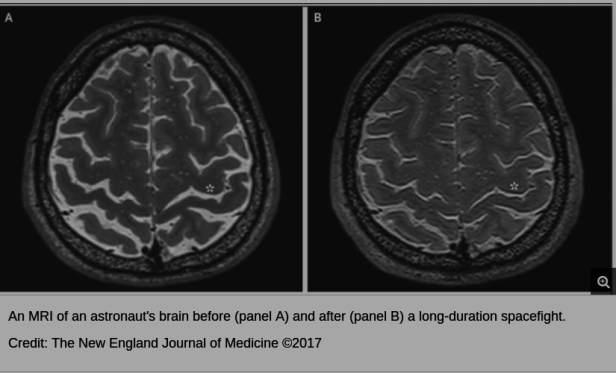
IF astronauts do succeed in the long trek to Mars, will they by then have enough intelligence left to actually operate the nuclear reactor, given that scientists have found that space travel damages astronauts’ brains?
What is NASA’s plan if the rocket taking the plutonium -fulled reactor crashes on an Earth city?
NASA, DEPARTMENT OF ENERGY TESTING ‘KILOPOWER’ SPACE NUCLEAR REACTOR, Space Flight Insider COLLIN SKOCIK, 26 Nov 17 In preparing for possible missions to the Red Planet in the near future, NASA’s Space Technology Mission Directorate (STMD) has been given the go-ahead to test a small nuclear reactor that could one day run equipment on the Martian surface.
The Kilopower project is working to advance a design for a compact, low-cost, and scalable nuclear fission power system for missions that require lots of power, such as a human mission to Mars. The technology uses a fission reactor with a uranium-235 reactor core to generate heat, which is then transferred via passive sodium heat pipes to Stirling engines. Those engines use that heat to create pressure, which moves a piston – much as old coal-powered ships used steam pressure to run their pistons. When coupled to an alternator, the Stirling engine produces electricity.
“What we are striving to do is give space missions an option beyond RTGs [radioisotope thermoelectric generators], which generally provide a couple hundred watts or so,” Lee Mason, STMD’s principal technologist for Power and Energy Storage at NASA Headquarters in Washington, D.C., said in a NASA news release. “The big difference between all the great things we’ve done on Mars, and what we would need to do for a human mission to that planet, is power.”
Mason said the new technology could provide kilowatts of power and even be upgraded to provide hundreds of kilowatts or even megawatts of power.
“We call it the Kilopower project because it gives us a near-term option to provide kilowatts for missions that previously were constrained to use less,” Mason said. “But first things first, and our test program is the way to get started.”
THE TEST PROGRAM
The next step for Kilopower project hardware is to be subjected to a full-power test for some 28 hours.
“The upcoming Nevada testing will answer a lot of technical questions to prove out the feasibility of this technology, with the goal of moving it to a Technology Readiness Level of 5,” said lead researcher Marc Gibson, “It’s a breadboard test in a vacuum environment, operating the equipment at the relevant conditions.”
Mason acknowledges the contributions of the Department of Energy and the National Nuclear Security Administration’s infrastructure, as well as the Los Alamos National Laboratory in New Mexico.
Academic paper: “Increases in perinatal mortality in prefectures contaminated by the Fukushima nuclear power plant accident in Japan” Source Institute: 医療問題研究会
Authors and copyright: Hagen Heinrich Scherb, Dr rer nat Dipl-Matha,∗, Kuniyoshi Mori, MDb, Keiji Hayashi, MDcEditor: Roman Leischik.
Abstract:
Descriptive observational studies showed upward jumps in secular European perinatal mortality trends after Chernobyl.
The question arises whether the Fukushima nuclear power plant accident entailed similar phenomena in Japan. For 47 prefectures representing 15.2 million births from 2001 to 2014, the Japanese government provides monthly statistics on 69,171 cases of perinatal death of the fetus or the newborn after 22 weeks of pregnancy to 7 days after birth.
Employing change-point methodology for detecting alterations in longitudinal data, we analyzed time trends in perinatal mortality in the Japanese prefectures stratified by exposure to estimate and test potential increases in perinatal death proportions after Fukushima possibly associated with the earthquake, the tsunami, or the estimated radiation exposure.
Areas with moderate to high levels of radiation were compared with less exposed and unaffected areas, as were highly contaminated areas hit versus untroubled by the earthquake and the tsunami. Ten months after the earthquake and tsunami and the subsequent nuclear accident, perinatal mortality in 6 severely contaminated prefectures jumped up from January 2012 onward: jump odds ratio 1.156; 95% confidence interval (1.061, 1.259), P-value 0.0009.
There were slight increases in areas with moderate levels of contamination and no increases in the rest of Japan.
In severely contaminated areas, the increases of perinatal mortality 10 months after Fukushima were essentially independent of the numbers of dead and missing due to the earthquake and the tsunami. Perinatal mortality in areas contaminated with radioactive substances started to increase 10 months after the nuclear accident relative to the prevailing and stable secular downward trend. These results are consistent with findings in Europe after Chernobyl.
Counterpunch 24th Nov 2017,Linda Pentz Gunter: September 29 marked the 60th anniversary of the
world’s third most deadly— and least known — nuclear accident. It
took place at the Mayak plutonium production facility, in a closed Soviet
city in the Urals. The huge explosion was kept secret for decades.
Itspread hot particles over an area of more than 20,000 square miles,
exposing a population of at least 270,000 and indefinitely contaminating
land and rivers. Entire villages had to be bulldozed. Residents there have
lived for decades with high rates of radiologically induced illnesses and
birth defects.
Now, evidence is emerging of a potentially new nuclear
accident and indications point once again to Mayak as one of the likely
culprits. Ironically, if there was indeed an accident there, it happened on
or around the precise anniversary of the 1957 disaster. The Research
Institute of Atomic Reactors in Dimitrovgrad in the region is another
possible suspect. https://www.counterpunch.org/2017/11/24/a-radioactive-plume-thats-clouded-in-secrecy/








 nuclear-news