Study projects huge increase in hurricane damage

Warming oceans will lead to bigger, stronger storms
 Hurricane Sandy bearing down on the East Coast in 2012. Satellite image courtesy NOAA.
Staff Report
As if to underscore a new report from the U.S. Government Accountability Office on the costs of global warming, researchers at the University of Vermont this week released a study showing that financial losses from hurricanes could increase more than 70 percent by 2100.
View original post 475 more words
Fire Danger Again Rises Across California; Number of Structures Lost in Northern Blazes Increases to 8,400

A California still reeling from the devastating impact of wildfires worsened by human-caused climate change just can’t get a break.
An army of 5,000 firefighters presently remain engaged in attempting to contain the large wildfires that are now unarguably the most destructive in California history. As with the recently very extreme hurricanes, we are still tallying the damage estimates. And the results are pretty stark. 100,000 of our fellow Americans have been displaced. The loss of souls has risen to 42. In total, 8,400 structures including thousands of homes, have been burned to the ground.
Already, this disaster is yet another in the billion-dollar-class of climate incidents. Now numbering 4 in just the past three months with total estimated losses from the fires ranging from 1 to 3 billion dollars. Unfortunately, this devastating toll is likely to climb as further tallies come in.
View original post 520 more words
Global Tree Cover Loss Rose 51 Percent in 2016 — GarryRogers Nature Conservation

Global tree cover loss reached a record 29.7 million hectares (73.4 million acres) in 2016, according to new data from the University of Maryland released today on Global Forest Watch. The loss is 51 percent higher than the previous year, totaling an area about the size of New Zealand.
via Global Tree Cover Loss Rose 51 Percent in 2016 — GarryRogers Nature Conservation
October 23 Energy News

Opinion:
¶ “How to Keep the Lights On After a Hurricane” • More than a month after Hurricane Maria devastated Puerto Rico, nearly 80% of the island remains without power, and food and water can be tough to find. As we rally to help the survivors and look to rebuild, we owe it to the victims to build more resilient infrastructure. [New York Times]
 A resident of Toa Baja, Puerto Rico, trying to repair his
electrical lines. (Credit: Ramon Espinosa | Associated Press)
How can I help the people of Puerto Rico? One way is
to donate at [Sunnyside Solar’s crowdfunding website].
¶ “UN Officials Urge the World to Ignore Trump on Climate” • In a deliberate denial of mainstream science, Donald Trump’s administration has issued a strategic four-year plan for the US EPA that does not once mention “greenhouse gas emissions”, “carbon dioxide” or “climate change” in its 48 pages…
View original post 826 more words
Changing ocean alters food web
Study documents shifts caused by warming seas, other stressors
 A chemical analysis of dolphin skin cells helped scientists track changes in the ocean food chain. @bberwyn photo.
Staff Report
Big fish eat little fish is the conventional wisdom of the sea, but it’s not always quite so simple. When Global warming and El Niño combined in 2015 and 2016 to warm the Pacific Ocean to new record-high temperatures, it shifted the food chain significantly, according to scientists with NOAA, the Moss Landing Marine Laboratories and the Scripps Institution of Oceanography.
According to their new study, published in the journal Science Advances, the food web “changed in response to various natural and anthropogenic related stressors,” said lead author Rocio I. Ruiz-Cooley, formerly of NOAA Fisheries’ Southwest Fisheries Science Center and now at Moss Landing Marine Laboratories. “This tells us that the food web is very dynamic, and reveals changes with…
View original post 373 more words
Narragansett Bay is Being Impacted by Climate Change; Scott Pruitt’s EPA Says Scientists Can’t Talk About it
Scott Pruitt, a climate change denier who was tapped to head the EPA by a similarly myopic Trump Administration now appears to be wielding the powers of that government agency to suppress the voices of climate scientists.
A report out of the New York Times yesterday found that three scientists scheduled to discuss the impacts of human-caused climate change on the sensitive environment of Narragansett Bay were barred from speaking in a panel discussion today. The scientists are employees of the EPA and contributors to a 400 page report on the health of Narragansett Bay. The study found numerous climate change related impacts to the Bay region — which is a vital economic resource and home to more than 2 million people.

“Climate change is affecting air and water temperatures, precipitation, sea level, and fish in the Narragansett Bay region.”
The EPA, presently…
View original post 320 more words
Tesla Under Fire as Renewables Rise: China, Consumer Reports, and the Ailing ICE Industry
With major renewable energy and automotive media now obsessed with the success or failure of Tesla’s zero emissions Model 3, it’s helpful to understand the larger context in which a monumental conflict between an old, mostly dirty industry and new clean energy players is occurring. To this particular point, we should take the opportunity to step back for a moment from the day-to-day minutiae of business activities and related media campaigns to ask this single essential question:
In the present day’s ever-worsening and warming climate, what does a wise, forward-looking national energy policy look like?
Such a question may seem out of context until one considers the fact that the object of so much media and industry drama — Tesla — operates in what can best be described as a conflicted policy environment. In the U.S., Tesla enjoys a dwindling subsidy in the form of tax breaks going to purchasers…
View original post 2,620 more words
Are the Pentland Firth waters the ‘Saudi Arabia of marine power?’


These are the words of Alex Salmond. An analogy of this sort has already been made in an Energy Voice headline and reported on here at:
‘Scotland ‘Saudi of wind’ or ‘Gagging on Wind Power’
A new report from Energy Voice today uses figures from Associate Professor Thomas Adcock of Oxford University to illustrate the enormous power available to Scotland in only one, admittedly the most powerful one, tidal channel. You can see a fuller and impressive account of the wave power potential around Scotland’s more than 16 000 miles of mostly turbulent coastline in this:
http://www.sciencedirect.com/science/article/pii/S0960148117302082
Here are Addison’s figures on the Pentland Firth:
- Tidal surge speeds of more than 16ft per second! Imagine that if you can.
- Potentially 1.9 gigawatts-hours (GWh) – Torness and Sizewell B do at best around 1.2 gigawatts. The other nuclear plants do far less. A gigawatt is a billion watts or a million electric…
View original post 181 more words
More of Joban line reopens in Fukushima


What a difference a word makes: Japan weakens its annual anti-nuclear resolution!

 “The omission of the word ‘any’ implies there could be a case of nuclear weapon use that would not cause inhumane consequences and therefore this type of use might be permitted”
“The Japanese draft resolution looks like one proposed by the United States or any other nuclear weapon states”
Japan waters down text of annual anti-nuclear resolution to imply acceptable use of nukes https://www.japantimes.co.jp/news/2017/10/21/national/politics-diplomacy/u-s-pressure-japan-waters-text-anti-nuclear-resolution/#.We0KUo-CzGg, BY MASAKATSU OTA KYODO Japan’s annual diplomatic effort to demonstrate its anti-nuclear credentials and create momentum for disarmament has run into a major obstacle in the form of its most important ally, as well as an atmosphere of division between states possessing atomic weapons and those without them.
A draft resolution recently proposed by the Abe government to the United Nations General Assembly was dramatically watered down under diplomatic pressure from the United States, government sources have revealed.
Last year, its proposed resolution was adopted at the assembly’s plenary session with support from 167 nations, including the United States, while China, North Korea, Russia and Syria opposed and 16 other nations abstained.
In the middle of October, Japan submitted a resolution titled “United action with renewed determination toward the total elimination of nuclear weapons.”
Close examination of the text has found a few major changes from past resolutions.
Since 2010, Japan has drafted annual resolutions that include the same common sentence, which emphasizes “deep concern at the catastrophic humanitarian consequences of any use of nuclear weapons.”
The phrase, “the catastrophic humanitarian consequences of any use of nuclear weapons,” has been a keyword used by international movements pursuing a denuclearized world in recent years.
In July, this anti-nuclear campaign culminated in the adoption of the Treaty on the Prohibition of Nuclear Weapons at the United Nations — the first international law that prohibits state parties from developing, testing, possessing and using nuclear weapons in any manner, including “threat of use.”
In the most recently proposed resolution, the government deleted the word “any” from the frequently used phrase, rendering it as “deep concern at the catastrophic humanitarian consequences of nuclear weapons use.”
It seems a minor rhetorical change, but the deletion of “any” has raised concerns and sparked severe criticism from nuclear disarmament specialists in Japan.
“The omission of the word ‘any’ implies there could be a case of nuclear weapon use that would not cause inhumane consequences and therefore this type of use might be permitted,” professor Tatsujiro Suzuki, director of the Research Center for Nuclear Weapons Abolition at Nagasaki University, pointed out.
“It can’t be helped if Japan will be regarded (by the international community) as an unfit advocate for the abolition of nuclear weapons,” Suzuki said.
“The Japanese draft resolution looks like one proposed by the United States or any other nuclear weapon states,” said Akira Kawasaki, an International Steering Group member of ICAN, or the International Campaign to Abolish Nuclear Weapons.
ICAN will receive the Nobel Peace Prize at the end of this year in Oslo for its worldwide grass-roots campaign for the adoption of the Treaty on the Prohibition of Nuclear Weapons.
During a recent interview, Kawasaki said “the deletion of ‘any’ is so problematic” that several nations which have supported Japan’s annual resolutions in the past may not become a cosponsor of the resolution this year.
That wold pose a serious setback for Japan, which has taken a leading position in the international disarmament based on its strong credentials.
Governmental sources suggested that the administration of U.S. President Donald Trump opposes including the word “any” in the draft resolution, and that Japan made the concession to get Washington’s support for the document.
Trump has indicated a desire to accelerate the modernization of the U.S. nuclear arsenal in light of North Korea’s nuclear and missile provocations. Prime Minister Shinzo Abe has been deepening security cooperation with the United States and repeatedly requested more U.S. security assurances for Japan, including the “nuclear umbrella.”
Another conspicuous change in the latest Japanese resolution is that it urges only North Korea to sign and ratify the Comprehensive Nuclear Test Ban Treaty without delay, rather than the eight nations it named for the previous resolutions.
Japan is a key advocate of accelerating the CTBT, which requires ratification by eight nations including North Korea, China and the United States. The U.S. Republican Party is widely known as a strong opponent of CTBT.
“Our new draft resolution is the result of policy considerations for creating a common ground between nuclear weapon states and nonnuclear weapons states for furthering a practical approach (toward nuclear abolition),” said one official of the Ministry of Foreign Affairs without specifically explaining why they decided to make the notable changes in the draft resolution.
AS UN Climate Change Conference draws near, Christian leaders demand implementation of Paris Agreement
The Paris Climate Change Agreement Explained
Christian leaders demand implementation of Paris Agreement ahead of climate change conference http://www.christiandaily.com/article/christian-leaders-demand-implementation-of-paris-agreement-ahead-of-climate-change-conference/61336.htm Lorraine Caballero Christian leaders from various countries have signed a letter demanding action on the Parish Agreement in 2015 as the next phase of the United Nations Climate Change Conference (COP23) in Bonn, Germany, draws nearer.
Renew Our World, a partnership of several Christian groups, coordinated the letter signed by five Anglican archbishops and several other Christian leaders which called on governments to make good on the promises they released during the Paris Climate Change talks. The partnership said world leaders need to take action on the issue during the COP23 next month or else it will be too late, the Anglican News detailed.
The letter read in part: “As Christians across the globe we are calling for action on climate change. The changing climate is causing great damage to people and planet right now, and we are particularly concerned about hunger and poverty hitting the most vulnerable communities, who did least to cause it.”
The five archbishops who signed the letter were Philip Freier of Australia; Francisco De Assis Da Silva of Brazil; Thabo Makgoba of South Africa; Albert Chama of Central Africa; and Winston Halapua of Aotearoa, New Zealand and Polynesia. Bishop Jwan Zhumbes of Bukuru in Nigeria and Bishop Robert Innes from the Church of England’s Diocese in Europe also signed the document. There were also 580 other Christian leaders who signed the said document.
Meanwhile, Fiji’s Prime Minister Frank Bainimarama announced on Oct. 18 that their country will issue the first sovereign green bond from a developing country. The country wants to raise 100 million Fiji dollars (roughly $50 million) to be used in the fight for climate change and its transition to 100 percent renewable energy, Climate Home News reported.
Bainimarama explained that people in the Pacific were the first ones to be affected by climate change, and the changes in the sea level and weather patterns were becoming detrimental to their security and development. Ahead of their presidency of the COP23, Fiji wants to set an example to other countries that are vulnerable to the effects of the climate change.
Stresses on North Korea’s nuclear test mountain – becoming unstable?
After six tests, the mountain hosting North Korea’s nuclear blasts may be exhausted, SMH, Anna Fifield, 21 Oct 17 Tokyo: Have North Korea’s nuclear tests become so big that they’ve altered the geological structure of the land?
Some analysts now see signs that Mount Mantap, the 2200-metre-high peak under which North Korea detonates its nuclear bombs, is suffering from “tired mountain syndrome”.

The mountain visibly shifted during the last nuclear test, an enormous detonation that was recorded as a 6.3-magnitude earthquake in North Korea’s northeast. Since then, the area, which is not known for natural seismic activity, has had three more quakes.
“What we are seeing from North Korea looks like some kind of stress in the ground,” said Paul G Richards, a seismologist at Columbia University’s Lamont-Doherty Earth Observatory.
“In that part of the world, there were stresses in the ground but the explosions have shaken them up.”
Chinese scientists have already warned that further nuclear tests could cause the mountain to collapse and release the radiation from the blast.
North Korea has conducted six nuclear tests since 2006, all of them in tunnels burrowed deep under Mount Mantap at a site known as the Punggye-ri Nuclear Test Facility. Intelligence analysts and experts alike use satellite imagery to keep close track on movement at the three entrances to the tunnels for signals that a test might be coming.
After the latest nuclear test, on September 3, Kim Jong Un’s regime claimed that it had set off a hydrogen bomb and that it had been a “perfect success”.
After the latest nuclear test, on September 3, Kim Jong Un’s regime claimed that it had set off a hydrogen bomb and that it had been a “perfect success”.
Images captured by Airbus, a space technology company that makes earth observation satellites, showed the mountain literally moving during the test. An 85-acre area on the peak of Mount Mantap visibly subsided during the explosion, an indication of both the size of the blast and the weakness of the mountain.
Since that day, there have been three much smaller quakes at the site, in the 2 to 3 magnitude range, each of them setting fears that North Korea had conducted another nuclear test that had perhaps gone wrong. But they all turned out to be natural.
If the mountain collapses and the hole is exposed, it will let out many bad things.
Wang Naiyan, former chairman of the China Nuclear Society
That has analysts Frank V. Pabian and Jack Liu wondering if Mount Mantap is suffering from “tired mountain syndrome”, a diagnosis previously applied to the Soviet Union’s atomic test sites.
“The underground detonation of nuclear explosions considerably alters the properties of the rock mass,” Vitaly V. Adushkin and William Leith wrote in a report on the Soviet tests for the United States Geological Survey in 2001. This leads to fracturing and rocks breaking, and changes along tectonic faults.
Earthquakes also occurred at the US’ nuclear test site in Nevada after detonations there.
“The experience we had from the Nevada test site and decades of monitoring the Soviet Union’s major test sites in Kazakhstan showed that after a very large nuclear explosion, several other significant things can happen,” Richards said. This included cavities collapsing hours or even months later, he said.
Pabian and Liu said the North Korean test site also seemed to be suffering.
“Based on the severity of the initial blast, the post-test tremors, and the extent of observable surface disturbances, we have to assume that there must have been substantial damage to the existing tunnel network under Mount Mantap,” they wrote in a report for the specialist North Korea website 38 North.
But the degradation of the mountain does not necessarily mean that it would be abandoned as a test site – just as the United States did not abandon the Nevada test site after earthquakes there, they said. Instead, the US kept using the site until a nuclear test moratorium took effect in 1992.
For that reason, analysts will continue to keep a close eye on the Punggye-ri test site to see if North Korea starts excavating there again – a sign of possible preparations for another test.
The previous tests took place through the north portal to the underground tunnels, but even if those tunnels had collapsed, North Korea’s nuclear scientists might still use tunnel complexes linked to the south and west portals, Pabian and Liu said.
Chinese scientists have warned that another test under the mountain could lead to an environmental disaster. If the whole mountain caved in on itself, radiation could escape and drift across the region, said Wang Naiyan, the former chairman of the China Nuclear Society and senior researcher on China’s nuclear weapons programme.
“We call it ‘taking the roof off’. If the mountain collapses and the hole is exposed, it will let out many bad things,” Wang told the South China Morning Post last month……http://www.smh.com.au/world/after-six-tests-the-mountain-hosting-north-koreas-nuclear-blasts-may-be-exhausted-20171021-gz5ixm.html
America’s Environmental Protection Agency gagging its own scientists on climate change

 E.P.A. Cancels Talk on Climate Change by Agency Scientists https://www.nytimes.com/2017/10/22/climate/epa-scientists.html WASHINGTON — The Environmental Protection Agency has canceled the speaking appearance of three agency scientists who were scheduled to discuss climate change at a conference on Monday in Rhode Island, according to the agency and several people involved.
President Trump’s Nuclear Posture Review (NPR) should focus on safety and security, not deterrence
The Hill 20th Oct 2017, President Trump’s Nuclear Posture Review (NPR) is likely to be released
in January 2018. Given the President’s reported remarks about increasing
the U.S. nuclear arsenal tenfold, the focal point of the review will
undoubtedly be on deterrence, not nuclear security.
Regardless of decisionsrelated to the size of the U.S. nuclear stockpile, preventing nuclear
terrorism — an integral part of nuclear security — should still be a
top priority. After all, terrorists, by their very nature, cannot be
deterred in the same way that states can. Nuclear, fissile and radioactive
materials — ingredients for a nuclear weapon, crude weapon or dirty bomb
— are quite literally all around us.
They are stored in thousands of universities, hospitals and laboratories across the world because of their
applications in medicine and research. Preventing these materials from
ending up in the wrong hands keeps the world safe from a nuclear attack.
The dangers are not as distant as you might think. Security breaches have
already happened. In 2012, an unarmed 82-year-old nun broke into the Y-12
maximum security nuclear facility in Tennessee, the “Fort Knox of
uranium,” to protest.
It is not hard to imagine that criminals bent onacquiring nuclear material could have similar success.
The consequences of a nuclear terrorist event in any U.S. city are terrifying. Even a small
nuclear detonation could cause immediate casualties from the blast, as well
as panic, economic disruption, long-term evacuations, exorbitant
decontamination costs, casualties from cancer and overwhelming
psychological damage. Regardless of views on broader nuclear policy
choices, the reason to maintain focus on nuclear security is clear.
http://thehill.com/opinion/national-security/356439-preventing-nuclear-terrorism-should-remain-a-top-us-priority
Sellafield authorities play down the seriousness on chemical emergency at nuclear reprocessing site

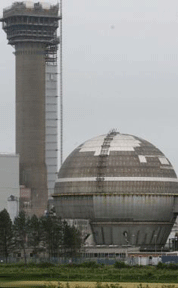 Times 22nd Oct 2017, The emergency removal of unstable chemicals from Sellafield yesterday hasraised fresh concerns over safety at the nuclear site.
Army bomb disposal specialists were called to the nuclear fuel reprocessing plant in Cumbria
after a routine audit found canisters of potentially explosive solventsdating back to the early 1990s.
Officials sought to reassure the public that it was “not a radiological event” and that the solvents had been
safely destroyed in two controlled explosions. However, one expert who
spoke on condition of anonymity claimed that although the solvents were not
radioactive they had been kept in the main laboratory near far more
dangerous materials. “This substance was in a dangerous oxidised state and
if it had exploded in that location it had the potential to distribute
radioactive material over the site and beyond,” the engineer said.
“Sellafield appears to be downplaying the severity of it to the public.”
The chemicals are understood to include tetrahydrofuran, an organic solvent
that can become unstable when exposed to air. Sellafield Ltd, part of the
government’s Nuclear Decommissioning Authority, said that after the
disposal the site was “working as it would be on any other Saturday“.
https://www.thetimes.co.uk/edition/news/sellafield-chemicals-scare-defused-by-army-98pkzxcln
1 This Month
Chernobyl: The Lost Tapes – A good documentary on Chernobyl on SBS available On Demand for the next 3 weeks– https://www.sbs.com.au/ondemand/tv-program/chernobyl-the-lost-tapes/2352741955560

of the week–London Campaign for Nuclear Disarmament

Tell the Ukrainian Government to Drop Prosecution of Peace Activist Yurii Sheliazhenko
To see nuclear-related stories in greater depth and intensity – go to https://nuclearinformation.wordpress.com
-
Archives
- April 2026 (126)
- March 2026 (251)
- February 2026 (268)
- January 2026 (308)
- December 2025 (358)
- November 2025 (359)
- October 2025 (376)
- September 2025 (257)
- August 2025 (319)
- July 2025 (230)
- June 2025 (348)
- May 2025 (261)
-
Categories
- 1
- 1 NUCLEAR ISSUES
- business and costs
- climate change
- culture and arts
- ENERGY
- environment
- health
- history
- indigenous issues
- Legal
- marketing of nuclear
- media
- opposition to nuclear
- PERSONAL STORIES
- politics
- politics international
- Religion and ethics
- safety
- secrets,lies and civil liberties
- spinbuster
- technology
- Uranium
- wastes
- weapons and war
- Women
- 2 WORLD
- ACTION
- AFRICA
- Atrocities
- AUSTRALIA
- Christina's notes
- Christina's themes
- culture and arts
- Events
- Fuk 2022
- Fuk 2023
- Fukushima 2017
- Fukushima 2018
- fukushima 2019
- Fukushima 2020
- Fukushima 2021
- general
- global warming
- Humour (God we need it)
- Nuclear
- RARE EARTHS
- Reference
- resources – print
- Resources -audiovicual
- Weekly Newsletter
- World
- World Nuclear
- YouTube
-
RSS
Entries RSS
Comments RSS
 nuclear-news