TOMIOKA, Fukushima (Jiji Press) — Train operations were resumed Saturday on a Joban Line section in Fukushima Prefecture after a suspension following the March 2011 earthquake and tsunami and the subsequent nuclear accident at the Tokyo Electric Power Company Holdings Inc.’s Fukushima No. 1 nuclear power plant.
East Japan Railway Co., or JR East, restarted services on the 6.9-kilometer section between Tomioka Station in the town of Tomioka and Tatsuta Station in the town of Naraha.
JR East hopes to reopen the last remaining section by the end of March 2020. The section runs through the towns of Okuma and Futaba, the host municipalities for the power plant, and most of it is inside the heavily contaminated no-entry zone around the plant.
“The omission of the word ‘any’ implies there could be a case of nuclear weapon use that would not cause inhumane consequences and therefore this type of use might be permitted”
“The Japanese draft resolution looks like one proposed by the United States or any other nuclear weapon states”
A draft resolution recently proposed by the Abe government to the United Nations General Assembly was dramatically watered down under diplomatic pressure from the United States, government sources have revealed.
Japan, the only nation to have been attacked with atomic weapons, saw the U.S. destroy Hiroshima and Nagasaki with two atomic bombs 72 years ago. it has proposed a series of draft resolutions on nuclear disarmament to the General Assembly since 1994.
Last year, its proposed resolution was adopted at the assembly’s plenary session with support from 167 nations, including the United States, while China, North Korea, Russia and Syria opposed and 16 other nations abstained.
In the middle of October, Japan submitted a resolution titled “United action with renewed determination toward the total elimination of nuclear weapons.”
Close examination of the text has found a few major changes from past resolutions.
Since 2010, Japan has drafted annual resolutions that include the same common sentence, which emphasizes “deep concern at the catastrophic humanitarian consequences of any use of nuclear weapons.”
The phrase, “the catastrophic humanitarian consequences of any use of nuclear weapons,” has been a keyword used by international movements pursuing a denuclearized world in recent years.
In July, this anti-nuclear campaign culminated in the adoption of the Treaty on the Prohibition of Nuclear Weapons at the United Nations — the first international law that prohibits state parties from developing, testing, possessing and using nuclear weapons in any manner, including “threat of use.”
In the most recently proposed resolution, the government deleted the word “any” from the frequently used phrase, rendering it as “deep concern at the catastrophic humanitarian consequences of nuclear weapons use.”
It seems a minor rhetorical change, but the deletion of “any” has raised concerns and sparked severe criticism from nuclear disarmament specialists in Japan.
“The omission of the word ‘any’ implies there could be a case of nuclear weapon use that would not cause inhumane consequences and therefore this type of use might be permitted,” professor Tatsujiro Suzuki, director of the Research Center for Nuclear Weapons Abolition at Nagasaki University, pointed out.
“It can’t be helped if Japan will be regarded (by the international community) as an unfit advocate for the abolition of nuclear weapons,” Suzuki said.
“The Japanese draft resolution looks like one proposed by the United States or any other nuclear weapon states,” said Akira Kawasaki, an International Steering Group member of ICAN, or the International Campaign to Abolish Nuclear Weapons.
ICAN will receive the Nobel Peace Prize at the end of this year in Oslo for its worldwide grass-roots campaign for the adoption of the Treaty on the Prohibition of Nuclear Weapons.
During a recent interview, Kawasaki said “the deletion of ‘any’ is so problematic” that several nations which have supported Japan’s annual resolutions in the past may not become a cosponsor of the resolution this year.
That wold pose a serious setback for Japan, which has taken a leading position in the international disarmament based on its strong credentials.
Governmental sources suggested that the administration of U.S. President Donald Trump opposes including the word “any” in the draft resolution, and that Japan made the concession to get Washington’s support for the document.
Trump has indicated a desire to accelerate the modernization of the U.S. nuclear arsenal in light of North Korea’s nuclear and missile provocations. Prime Minister Shinzo Abe has been deepening security cooperation with the United States and repeatedly requested more U.S. security assurances for Japan, including the “nuclear umbrella.”
Another conspicuous change in the latest Japanese resolution is that it urges only North Korea to sign and ratify the Comprehensive Nuclear Test Ban Treaty without delay, rather than the eight nations it named for the previous resolutions.
Japan is a key advocate of accelerating the CTBT, which requires ratification by eight nations including North Korea, China and the United States. The U.S. Republican Party is widely known as a strong opponent of CTBT.
“Our new draft resolution is the result of policy considerations for creating a common ground between nuclear weapon states and nonnuclear weapons states for furthering a practical approach (toward nuclear abolition),” said one official of the Ministry of Foreign Affairs without specifically explaining why they decided to make the notable changes in the draft resolution.
Renew Our World, a partnership of several Christian groups, coordinated the letter signed by five Anglican archbishops and several other Christian leaders which called on governments to make good on the promises they released during the Paris Climate Change talks. The partnership said world leaders need to take action on the issue during the COP23 next month or else it will be too late, the Anglican News detailed.
The letter read in part: “As Christians across the globe we are calling for action on climate change. The changing climate is causing great damage to people and planet right now, and we are particularly concerned about hunger and poverty hitting the most vulnerable communities, who did least to cause it.”
The five archbishops who signed the letter were Philip Freier of Australia; Francisco De Assis Da Silva of Brazil; Thabo Makgoba of South Africa; Albert Chama of Central Africa; and Winston Halapua of Aotearoa, New Zealand and Polynesia. Bishop Jwan Zhumbes of Bukuru in Nigeria and Bishop Robert Innes from the Church of England’s Diocese in Europe also signed the document. There were also 580 other Christian leaders who signed the said document.
Meanwhile, Fiji’s Prime Minister Frank Bainimarama announced on Oct. 18 that their country will issue the first sovereign green bond from a developing country. The country wants to raise 100 million Fiji dollars (roughly $50 million) to be used in the fight for climate change and its transition to 100 percent renewable energy, Climate Home News reported.
Bainimarama explained that people in the Pacific were the first ones to be affected by climate change, and the changes in the sea level and weather patterns were becoming detrimental to their security and development. Ahead of their presidency of the COP23, Fiji wants to set an example to other countries that are vulnerable to the effects of the climate change.
After six tests, the mountain hosting North Korea’s nuclear blasts may be exhausted, SMH, Anna Fifield, 21 Oct 17 Tokyo: Have North Korea’s nuclear tests become so big that they’ve altered the geological structure of the land?
Some analysts now see signs that Mount Mantap, the 2200-metre-high peak under which North Korea detonates its nuclear bombs, is suffering from “tired mountain syndrome”.
The mountain visibly shifted during the last nuclear test, an enormous detonation that was recorded as a 6.3-magnitude earthquake in North Korea’s northeast. Since then, the area, which is not known for natural seismic activity, has had three more quakes.
“What we are seeing from North Korea looks like some kind of stress in the ground,” said Paul G Richards, a seismologist at Columbia University’s Lamont-Doherty Earth Observatory.
“In that part of the world, there were stresses in the ground but the explosions have shaken them up.”
North Korea has conducted six nuclear tests since 2006, all of them in tunnels burrowed deep under Mount Mantap at a site known as the Punggye-ri Nuclear Test Facility. Intelligence analysts and experts alike use satellite imagery to keep close track on movement at the three entrances to the tunnels for signals that a test might be coming.
After the latest nuclear test, on September 3, Kim Jong Un’s regime claimed that it had set off a hydrogen bomb and that it had been a “perfect success”.
After the latest nuclear test, on September 3, Kim Jong Un’s regime claimed that it had set off a hydrogen bomb and that it had been a “perfect success”.
Images captured by Airbus, a space technology company that makes earth observation satellites, showed the mountain literally moving during the test. An 85-acre area on the peak of Mount Mantap visibly subsided during the explosion, an indication of both the size of the blast and the weakness of the mountain.
Since that day, there have been three much smaller quakes at the site, in the 2 to 3 magnitude range, each of them setting fears that North Korea had conducted another nuclear test that had perhaps gone wrong. But they all turned out to be natural.
If the mountain collapses and the hole is exposed, it will let out many bad things.
Wang Naiyan, former chairman of the China Nuclear Society
That has analysts Frank V. Pabian and Jack Liu wondering if Mount Mantap is suffering from “tired mountain syndrome”, a diagnosis previously applied to the Soviet Union’s atomic test sites.
“The underground detonation of nuclear explosions considerably alters the properties of the rock mass,” Vitaly V. Adushkin and William Leith wrote in a report on the Soviet tests for the United States Geological Survey in 2001. This leads to fracturing and rocks breaking, and changes along tectonic faults.
Earthquakes also occurred at the US’ nuclear test site in Nevada after detonations there.
“The experience we had from the Nevada test site and decades of monitoring the Soviet Union’s major test sites in Kazakhstan showed that after a very large nuclear explosion, several other significant things can happen,” Richards said. This included cavities collapsing hours or even months later, he said.
Pabian and Liu said the North Korean test site also seemed to be suffering.
“Based on the severity of the initial blast, the post-test tremors, and the extent of observable surface disturbances, we have to assume that there must have been substantial damage to the existing tunnel network under Mount Mantap,” they wrote in a report for the specialist North Korea website 38 North.
But the degradation of the mountain does not necessarily mean that it would be abandoned as a test site – just as the United States did not abandon the Nevada test site after earthquakes there, they said. Instead, the US kept using the site until a nuclear test moratorium took effect in 1992.
For that reason, analysts will continue to keep a close eye on the Punggye-ri test site to see if North Korea starts excavating there again – a sign of possible preparations for another test.
The previous tests took place through the north portal to the underground tunnels, but even if those tunnels had collapsed, North Korea’s nuclear scientists might still use tunnel complexes linked to the south and west portals, Pabian and Liu said.
Chinese scientists have warned that another test under the mountain could lead to an environmental disaster. If the whole mountain caved in on itself, radiation could escape and drift across the region, said Wang Naiyan, the former chairman of the China Nuclear Society and senior researcher on China’s nuclear weapons programme.
E.P.A. Cancels Talk on Climate Change by Agency Scientists https://www.nytimes.com/2017/10/22/climate/epa-scientists.html By LISA FRIEDMANWASHINGTON— The Environmental Protection Agency has canceled the speaking appearance of three agency scientists who were scheduled to discuss climate change at a conference on Monday in Rhode Island, according to the agency and several people involved.
The Hill 20th Oct 2017, President Trump’s Nuclear Posture Review (NPR) is likely to be released
in January 2018. Given the President’s reported remarks about increasing
the U.S. nuclear arsenal tenfold, the focal point of the review will
undoubtedly be on deterrence, not nuclear security.
Regardless of decisionsrelated to the size of the U.S. nuclear stockpile, preventing nuclear
terrorism — an integral part of nuclear security — should still be a
top priority. After all, terrorists, by their very nature, cannot be
deterred in the same way that states can. Nuclear, fissile and radioactive
materials — ingredients for a nuclear weapon, crude weapon or dirty bomb
— are quite literally all around us.
They are stored in thousands of universities, hospitals and laboratories across the world because of their
applications in medicine and research. Preventing these materials from
ending up in the wrong hands keeps the world safe from a nuclear attack.
The dangers are not as distant as you might think. Security breaches have
already happened. In 2012, an unarmed 82-year-old nun broke into the Y-12
maximum security nuclear facility in Tennessee, the “Fort Knox of
uranium,” to protest.
It is not hard to imagine that criminals bent onacquiring nuclear material could have similar success.
The consequences of a nuclear terrorist event in any U.S. city are terrifying. Even a small
nuclear detonation could cause immediate casualties from the blast, as well
as panic, economic disruption, long-term evacuations, exorbitant
decontamination costs, casualties from cancer and overwhelming
psychological damage. Regardless of views on broader nuclear policy
choices, the reason to maintain focus on nuclear security is clear. http://thehill.com/opinion/national-security/356439-preventing-nuclear-terrorism-should-remain-a-top-us-priority
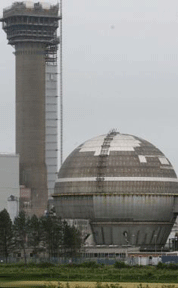
Times 22nd Oct 2017,The emergency removal of unstable chemicals from Sellafield yesterday hasraised fresh concerns over safety at the nuclear site.
Army bomb disposal specialists were called to the nuclear fuel reprocessing plant in Cumbria
after a routine audit found canisters of potentially explosive solventsdating back to the early 1990s.
Officials sought to reassure the public that it was “not a radiological event” and that the solvents had been
safely destroyed in two controlled explosions. However, one expert who
spoke on condition of anonymity claimed that although the solvents were not
radioactive they had been kept in the main laboratory near far more
dangerous materials. “This substance was in a dangerous oxidised state and
if it had exploded in that location it had the potential to distribute
radioactive material over the site and beyond,” the engineer said.
“Sellafield appears to be downplaying the severity of it to the public.”
The chemicals are understood to include tetrahydrofuran, an organic solvent
that can become unstable when exposed to air. Sellafield Ltd, part of the
government’s Nuclear Decommissioning Authority, said that after the
disposal the site was “working as it would be on any other Saturday“. https://www.thetimes.co.uk/edition/news/sellafield-chemicals-scare-defused-by-army-98pkzxcln
So-called “golden parachutes,” written into the contracts of those executives in case of a sale or takeover, could trigger payments estimated at $28 million for Chief Executive Kevin Marsh and roughly $12 million each for two other SCANA leaders, according to The State newspaper’s review of the company’s federal filings.
As the power bills rose, so did SCANA’s executive pay.
Total compensation for SCANA’s company’s executive team rose to $14 million in 2016 from $8.5 million in 2007, the year S.C. legislators passed a law that green lighted the nuclear project.
“That’s just absolute insanity,” state Rep. Kirkman Finlay, R-Richland, said Thursday. “How do you pay a bonus on a plant that is a year from being bankrupt?”……
HOW MUCH COULD EACH GET?
Golden parachutes written into the contracts of SCANA’s top executives ensure each could be paid millions of dollars if the Cayce-based company is sold. According to the utility, here is how much each would have been owed if those provisions were triggered in December 2016:
▪ Chief executive Kevin Marsh: $28 million
▪ Chief nuclear officer Stephen Byrne: $12.8 million
▪ Chief financial officer Jimmy Addison: $11.8 million
▪ Senior vice president Keller Kissam: $5 million
▪ Former SCANA general counsel Ronald Lindsay: $8.8 million (1)
(1) Subsequently, retired and no longer eligible for a payout
U.S. says cyberattacks have targeted nuclear, energy, aviation, water and critical manufacturing industries, Japan Times, 21 Oct 17 REUTERS TORONTO/HOUSTON– The U.S. government issued a rare public warning that sophisticated hackers are targeting energy and industrial firms, the latest sign that cyberattacks present an increasing threat to the power industry and other public infrastructure.
The Department of Homeland Security and Federal Bureau of Investigation warned in a report distributed by email late on Friday that the nuclear, energy, aviation, water and critical manufacturing industries have been targeted along with government entities in attacks dating back to at least May.
The agencies warned that hackers had succeeded in compromising some targeted networks, but did not identify specific victims or describe any cases of sabotage.
The objective of the attackers is to compromise organizational networks with malicious emails and tainted websites to obtain credentials for accessing computer networks of their targets, the report said.
U.S. authorities have been monitoring the activity for months, which they initially detailed in a confidential June report first reported by Reuters. That document, which was privately distributed to firms at risk of attacks, described a narrower set of activity focusing on the nuclear, energy and critical manufacturing sectors……..
NATO’s Hidden Agenda: What’s Behind Drills With US Nuclear Weapons in Germany https://sputniknews.com/analysis/201710221058446313-germany-drills-us-nuclear-weapons/NATO is holding an American nuclear weapons safety procedure exercise at a base in Büchel, Germany and in the Belgian town of Kleine-Brogel. The legitimacy of such actions and the deployment of nuclear weapons in non-nuclear countries raises several questions. The drills have also been criticized by Russia.
Drills in Europe
The airbase in Büchel still houses up to 20 American nuclear bombs and is the only facility in Germany where nuclear weapons are deployed. Currently, Bundeswehr pilots and personnel from other NATO countries are practicing nuclear weapons handling procedures.
“This exercise is nicknamed ‘Steadfast Noon’ within the alliance and is held annually at military bases across Europe,” Otfried Nassauer, a researcher with the Berlin Information Center for Security (BITS), told Sputnik Germany.
He explained that during the drills which are supervised by the US military personnel, practice safety regulations while mounting a nuclear bomb on an aircraft and they are observed until the plane takes off. However, no real nuclear weapons are used in the drills.
Legal Dilemma Since the 1960s, NATO’s nuclear participation has provided for the possible use of American nuclear weapons by four non-nuclear European nations in the event of war. According to NATO officials, nuclear participation complies with the nuclear non-proliferation treaty, which is often disputed by critics.
“Their argument is that as a result of this situation a new group of countries emerges in between the nuclear and non-nuclear parties of the treaty. This is a group of pseudo-nuclear states, which are not mentioned by the treaty,” Nassauer pointed out.
German forces are not allowed to use nuclear weapons, in accordance with international law. However, during the current drills German personnel receive orders not from the defense ministry, but from NATO’s command.
“This creates an embarrassing situation. The law prohibits the use of nuclear weapons by German troops, but they receive such orders from NATO. They may try to disobey such orders at their own risk, because according to German laws a soldier must not obey an illegal order,” the analyst said.
Signal to Russia
Retired Bundeswehr colonel Ulrich Scholz, who was involved in NATO’s air force planning, described the drills a “questionable affair” and said they are likely to be a political argument against Russia.
Scholz expressed serious concerns about Germany’s national security. If we’re abandoning nuclear energy due to safety concerns but stockpiling nukes on our soil and taking part in these drills, I’ve got one question: is anybody out there concerned about Germany’s security?” he said.
The former officer also noted that Washington’s “geo-strategic interests” are now again focused on Russia, as it was during the Cold War.
According to Nassauer, the US is interested in keep all of its allies bound together. For the first time, Poland, Greece and the Czech Republic have been involved in the exercise this year. Moreover, the exercise has been held at different military facilities.
“In light of the continuing tensions between Russia and the West, all of the above looks like a political signal from NATO to Moscow,” he said.
On Friday, Russian Foreign Minister Sergei Lavrov called for the removal of US nuclear weapons from Europe.
“We gradually stand for the withdrawal of US nuclear weapons from Europe and their return to the US,” Lavrov said a nuclear weapons non-proliferation conference in Moscow.
The minister called on NATO to stop nuclear weapons drills in its non-nuclear members.
‘Worse than nuclear bombs!’ Putin reveals terrifying sci-fi weapon amid World War fears
VLADIMIR PUTIN has said that the development of genetically-modified soldiers is the next phase of military combat – and one worse than nuclear bombs. By OLI SMITHExpress. UK, Oct 22, 2017
Vladimir Putin warned a crowd of young students that scientists in Russia will soon break the genetic code and create something “worse than a nuclear bomb”.
In a shocking speech yesterday, the Russian leader suggested that his world could soon seen sci-fi super-human soldiers who cannot feel pain or fear.
President Putin said that science is moving at such a fast pace that the world is running out of the time to develop regulation around these eerie advances.
This comes amid escalation on the Korean penisula and mounting fears for the outbreak of nuclear war between North Korea and the US.
Threat of court action if Govt steps out of line with nuclear plans, fin 24, Oct 22 2017 Cape Town – Should the details of any progress on trying to push through a costly and deemed unnecessary nuclear build programme not be open to the public, the DA will not hesitate to go to court to interdict it.
DA MP Gordon Mackay said in a statement on Sunday that allegations in the media regarding a high-level Russian delegation which met with President Jacob Zuma shortly before the second Cabinet reshuffle earlier this week are “startling to say the least”.
The reshuffle saw David Mahlobo appointed as new energy minister, raising concerns that this step was ostensibly to push through the nuclear deal in favour of the Russians.
Zuma reshuffled his Cabinet allegedly just hours after a meeting with a group of Russian officials in efforts to implement a R1tn new nuclear build project deal, reported the Sunday Times.
Mackay pointed out that the previous minister of energy, Mmamoloko Kubayi, committed on record to abide by the Western Cape High Court’s nuclear ruling in April this year. He added that Mahlobo is bound by the court judgment as well and any deviation will be illegal.
In order for the nuclear deal to be approved, five key pieces of legislation or regulations would need to be updated and amended by Parliament, according to Mackay.
These include the Integrated Resource Plan; the electricity pricing path; procurement regulations; the framework agreements; and changes to the energy act to allow for a different funding/ownership model.
“In addition, the court ruling made clear the need for a substantial public participation process,” emphasised Mackay.
“The fact is that we cannot afford nor do we need the nuclear deal. In any event, it is doubtful that we need nuclear in the energy mix bearing in mind that by the time reactors come online, green energy will be able to fill the gap sufficiently.”
Global Research, October 21, 2017 Recent discussions about the safety or otherwise of having the US military flying in and out of Shannon Airport gave us reason to recall an incident in March 2008 in which a Murray Air aircraft was involved in an emergency landing at Shannon. This was after it was seen flying over Askeaton, which is across the River Shannon estuary from the airport, with flames coming from one of its engines. Residents of the County Limerick town described their windows rattling and houses shaking as the cargo plane flew low over a housing estate in the town.
At the time there was a discussion about the incident on the RTE Radio’s Joe Duffy Show. During the discussion Tracey Bell, Director of Administration for Murray Air, admitted that explosives had been brought through Shannon by the airline on previous occasions. She was asked about this by the presenter Joe Duffy:
Joe Duffy – Murray Air could carry explosives through Shannon?
Tracey Bell – I can confirm that, yes sir.
Joe Duffy – Have you carried explosives through Shannon?
Tracey Bell – I believe so, yes sir.
Joe Duffy – … for the American Army?
Tracey Bell – Yes sir.
Edward Horgan of Shannonwatch who contacted the programme and spoke on air asked if Murray Air had carried depleted uranium (DU) through Shannon. Ms Bell said she didn’t know, but when pressed confirmed that their license allowed for them to carry this lethal radioactive substance.
The consequence of it not being declared to the Irish authorities, or of the Department of Transport, Tourism and Sport giving permission for it to be taken through Shannon are frightening. What if a plane carrying DU was involved in an accident at Shannon, or as it was taking off?
The consequence of using DU munitions are even more devastating in war zones. We know that the US used them in the Gulf and Iraq Wars. A 2006 report by Dr. Souad N. Al-Azzawi on Harvard University’s website confirms this:
“Depleted Uranium (DU) weaponry has been used against Iraq for the first time in the history of recent wars. The magnitude of the complications and damage related to the use of such radioactive and toxic weapons on the environment and the human population mostly results from the intended concealment, denial and misleading information released by the Pentagon about the quantities, characteristics and the area’s in Iraq, in which these weapons have been used.”
In an interview with Al Jazeera reporter Dahr Jamail, Democracy Now! reported that the US invasion has left behind a legacy of cancer and birth defects suspected of being caused by their extensive use of depleted uranium and white phosphorus. This is not surprising, given that they fired hundreds of thousands of rounds of DU munitions there. Democracy Now! wrote:
“Noting the birth defects in the Iraqi city of Fallujah, Jamail says: ‘They’re extremely hard to bear witness to. But it’s something that we all need to pay attention to … What this has generated is, from 2004 up to this day, we are seeing a rate of congenital malformations in the city of Fallujah that has surpassed even that in the wake of the Japanese cities of Hiroshima and Nagasaki that nuclear bombs were dropped on at the end of World War II.’”
The US has also used DU in Syria, for example in two high-profile raids on oil trucks in late 2015. These air assaults were the first confirmed use of this armament since the 2003 Iraq invasion.
Because of its high density, DU can also be used in tank armor, sandwiched between sheets of steel armor plate.
Murray Air’s Tracey Bell confirmed that the airline had a license to transport DU. They and other carriers may well have taken it through Shannon with or without the knowledge of the Irish governnment or the authorities. The people charged with ensuring the safety and security of Shannon refuse to search US military and military contracted planes likely to be carrying DU. Instead they follow orders from a government that relies on worthless diplomatic assurances from the US authorities. These “assurances” state that they not taking hazardous and lethal material like DU through Shannon. And the Irish government take them at face value.
Its unlikely that the US authorities would tell the Irish government if they were taking DU through Shannon. If they are lying, it presents a very grave rish to people in places like Askeaton that the military and military contracted planes pass over as they are taking off and landing. And it makes Shannon Airport a very dangerous place to work in or travel through.
The safest thing to do – and the right thing to do – is to stop all US military and military contracted planes from landing at Shannon. The risk is too great.
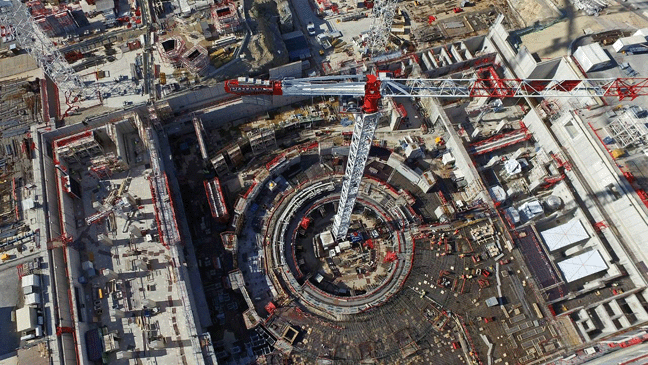
Washington Post 20th Oct 2017,The world’s biggest scientific experiment is on course to become the most expensive source of surplus power. Components of the 20 billion-euro ($24 billion) project are already starting to pile up at a construction site in the south of France, where about 800 scientists plan to test whether they can harness the power that makes stars shine.
Assembly of the machine will start in May. Unlike traditional nuclear plants that split atoms, the
so-called ITER reactor will fuse them together at temperatures 10-times hotter than the Sun — 150 million degrees Celsius (270 million Fahrenheit). Its startling complexity, with more than a million pieces and sponsors in 35 countries, mean questions remain about over whether the reactor will work or if it can deliver electricity at anything like the cost of more traditional forms of clean energy.
With wind-farm developers starting to promise subsidy-free power by 2025 and electricity demand
stagnating, even the project’s supporters are asking whether ITER will ever make sense. “I’m dubious,” said Chris Llewellyn Smith, director of energy research at Oxford University who has spoken in favor of the research project. “The cost of wind and solar has come down so rapidly, so the competition has become harder to beat than you could have conceivably imagined a decade ago.” http://washpost.bloomberg.com/Story?docId=1376-OY3SHX6S972801-2RKS837QMLNSJG9Q1LHCUFO248
Evacuations after emergency at UK nuclear plant, explosives experts rush to scene, BOMB disposal specialist have been called to the Sellafield nuclear plant to deal with a chemical incident. Sunday Express, By SIMON OSBORNE, Oct 21, 2017 “…….Initial reports suggest the incident involved five bottles containing a number of non-nuclear chemicals. …..”An operational decision will be taken in due course on how best to dispose of the material.”
Sellafield reprocesses and stores nearly all of Britain’s nuclear waste.
There have been safety concerns at the plant after a tip-off from a whistleblower, including allegations of inadequate staffing levels and poor maintenance.
The programme discovered that liquid containing plutonium and uranium has been kept in thousands of plastic bottles for years. The bottles were only intended for temporary storage and some of them are degrading.
Researchers were was also told that parts of the facility are dangerously rundown.
Sellafield insisted the site in Cumbria is safe and has been improved with significant investment in recent years. http://www.express.co. uk/news/uk/869238/sellafield- nuclear-reprocessing-plant- chemical-alert-bomb-disposal- experts














 nuclear-news