Scisco Media 23rd Sept 2017, The domestic supply of fresh water from Ennerdale to West Cumbrians is to
cease by 2022. This is (so the official narrative goes) to safeguard water levels on the River Ehen flowing from Ennerdale Water that provides a “delicate habitat” for one of the last populations of endangered fresh water pearl mussels.
The enormous sums of money and effort to save the pearl mussels are meaningless while the integrity of the River Ehen is
being trashed by the nuclear industry. The volumes of fresh water abstraction from the River Ehen by the Nuclear Decommissioning Authority for Sellafield’s cooling and processing is staggering (remember they take
four million gallons daily from Wastwater as well as other sources too). https://sciscomedia.co.uk/nuclear-contamination-drinking-water/
Both incidents were detailed in a recent report by the Defense Nuclear Facilities Safety Board.
In the first incident, according to the report, workers mishandled plutonium metals. The second incident occurred just 11 days later, when nearly a dozen workers were exposed to particles that caused radioactive contamination to at least one worker.
Safety has become a serious concern at the labs in recent months. In June KOB reported that a watchdog group said key safety inspectors had quit out of frustration
¶ “Wind, other renewable energy sources are the answer to climate change” • America’s wind energy industry feels the pain inflicted by Hurricane Harvey. Wind companies have pledged $1 million to Habitat for Humanity to help Texas communities recover from the disaster. But wind power helps in other ways that are important. [Houston Chronicle]
West Texas wind farm (Photo: Spencer Platt | Getty Images)
¶ “They Voted For Trump. Obama’s Solar Panels Saved Them From Irma’s Wrath.” • Hurricane Irma knocked out the power while residents Titusville, Florida, sheltered in the Apollo Elementary School. But Classroom 408 had electricity, thanks to an economic stimulus program set in motion by President Barack Obama. [Daily Beast]
Science and Technology:
¶ The world’s periglacial zones, home to nearly all of the world’s permafrost, will “almost completely disappear” by the year 2100 even in the most optimistic of scenarios about…
¶ “US Solar Industry Could Be Devastated By Today’s Tariffs Ruling – May Lead To Crushing Tariffs” • The US International Trade Commission granted a petition for relief from cheaper imported solar panels by two bankrupt US manufacturers. But the remedy will likely mean tariffs that are job-crushing for solar installers. [CleanTechnica]
Solar array
¶ “Are Hurricanes Winds of Change for Insurers’ Climate Risk?” • The insurance industry faces a long-term challenge as climate change makes natural disasters more severe. The Trump administration’s push to ax some of the tools insurers need to prepare for disasters could force companies to take a more public position on climate change. [Bloomberg BNA]
¶ “Taking back full control of your home energy needs” • Eaton, a maker of power management solutions, recently partnered with Manchester City Football Club on a research project. They found that 10% of football…
GR: It’s not all of humankind that is responsible for the great danger we face, It’s particular members of the species. The fossil fuel companies in America and Europe fooled most of us into thinking that unlimited coal and oil burning was safe. Are we just as guilty as Rex Tillerson and the other energy industry leaders who lied to us, or does our ignorance and gullibility make our behavior excusable? Perhaps. However, continuing to believe Rex Tillerson’s Exxon-Mobil deceit with so many scientists and independent voices calling out the warning is criminal negligence.
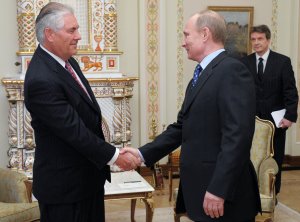
Russian Prime Minister Vladimir Putin, right, shakes hands with Rex W. Tillerson, chairman and chief executive officer of Exxon Mobil Corporation at their meeting in the Novo-Ogaryovo residence outside Moscow, Monday, April 16, 2012. Exxon is teaming up with Russian oil giant Rosneft to develop oil and natural gas fields in Russia and North America.The companies…
Lawyers for the plaintiffs in a lawsuit seeking damages from the government and TEPCO for residents who evacuated to Chiba Prefecture following the 2011 Fukushima nuclear disaster hold up banners reading “Government not liable,” left, and “TEPCO must pay portion of compensation,” right, in front of the Chiba District Court on Sept. 22, 2017.
When on Sept. 22 the Chiba District Court ordered Tokyo Electric Power Co. (TEPCO) to pay some 376 million yen in damages to a group of Fukushima nuclear disaster evacuees, it gave concrete recognition to the evacuees’ loss — of hometowns, jobs and personal relationships — for the first time.
Six and a half years after the disaster, even in areas where evacuation orders have been lifted, the reconstruction of the communities that once thrived there is still a distant prospect. However, though it absolved the government of legal liability, this court ruling — the second in a slew of class action suits filed against TEPCO and the government — can be said to be a breakthrough far exceeding previous compensation levels.
“The Maebashi District Court (in March) recognized the responsibility of both the government and TEPCO, but this ended up feeling like a victory in name only, with no ‘reward.’ But it can be said that the Chiba (District Court) decision finally reaped ‘rewards,”’ commented lawyer Katsuyoshi Suzuki, lead counsel of the plaintiffs’ legal team in the Maebashi court case, who was at a gathering in Chiba awaiting the Sept. 22 ruling.
The Maebashi District Court awarded a total of some 460 million yen in damages. However, based on “interim guidelines” set for TEPCO by the Ministry of Education, Culture, Sports, Science and Technology’s Dispute Reconciliation Committee for Nuclear Damage Compensation in August 2011 to ensure swift payouts, it was decided that TEPCO had already paid about 420 million yen. As such, a total of only 38.55 million yen was awarded to 62 of the 137 plaintiffs. Complaints followed that voices of the evacuees decrying their psychological pain had not been heard.
However, in the Chiba case, TEPCO was ordered to pay 42 out of the 45 plaintiffs a total of roughly 376 million yen, even after some 650 million yen was judged as already having been paid by the company under the “interim guidelines.” It was pointed out that the guidelines only set a minimum baseline for compensation, and upon considering the individual cases, the court granted the large damages award.
What stood out was that the court explicitly recognized the payout as compensation for the loss of hometowns, jobs and personal relationships suffered by the nuclear disaster evacuees. The majority of the plaintiffs in the Chiba case were residents of designated evacuation zones, and claimed they lost their livelihoods, relationships and local customs to the nuclear disaster, and were stripped of their right to live a peaceful life. They had sought 20 million yen in compensation each, saying that the interim guidelines did not accurately reflect the pain of losing their hometowns.
Concerning communities where the evacuation orders had been lifted by this spring, including the village of Iitate, Fukushima Prefecture, TEPCO cited falling radiation levels and infrastructure restoration as evidence that the plaintiffs’ claim that they lost their hometowns permanently was false. As such, TEPCO argued that their current compensation standards were sufficient.
However, even in areas where evacuation orders have been lifted, only roughly 10 percent of former residents have returned. The court decision stated, “(The plaintiffs) have lost their close connections to their local communities over a substantial period of time. Simply lifting evacuation orders will not immediately relieve this suffering,” awarding 36 of the plaintiffs an average of some 3 million yen each. Nevertheless, some of the plaintiffs are not satisfied by the results.
“Our lives were disrupted,” said Michiko Saito, 56, who evacuated from the Odaka district of Minamisoma, Fukushima Prefecture, to Yachimata, Chiba Prefecture. “Even if the money is returned to us, we will never get our hometowns back.”
Over 30μSv/h was read along side the recently-reopened Route 114 in Fukushima, September 20, 2017. It is insane for the government to give its green light for people to use that road.
6.5 years mean nothing here. Nothing at all.
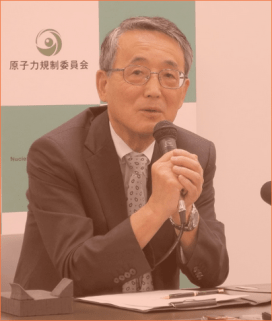
Nuclear Regulation Authority (NRA) Chairman Shunichi Tanaka held his final press conference in Tokyo’s Minato Ward on Sept. 20 before officially stepping down from his role.
Reflecting on his five-year term in office, Tanaka said, “I tried to maintain independence and transparency,” adding that, “I have absolutely no doubt that I’ve made judgments from a scientific and impartial standpoint, and taken actions based on (the NRA’s) philosophies. This is something that I am proud of.”
However, he also stated that, “The distrust of the public who experienced the Fukushima nuclear disaster in 2011 is an issue that cannot be easily rectified.”
Tanaka became the first chairman of the NRA at the same time the organization was established in September 2012, having previously served as the deputy director general of the Japan Atomic Energy Research Institute and acting chairman of the Japan Atomic Energy Commission.
During his time as NRA chairman, he led efforts to draw up new regulatory standards based on the lessons learned from the Tokyo Electric Power Co.’s Fukushima No. 1 Nuclear Power Plant disaster, and carried out nuclear power plant screening.
Originally hailing from Fukushima Prefecture, Tanaka says he is planning to live in the prefectural village of Iitate after stepping down as NRA head. “It would be great if I could contribute to the recovery of Fukushima (using my experience at the NRA),” Tanaka said.
The head of Tepco Electric Power company Holdings Inc. promised Wednesday to institute a safety pledge as requested by nuclear regulator, as the company seeks clearance to reactivate undamaged, idle reactors located far from its plant crippled by natural disaster in 2011.
has been calling for the company to make such a pledge part of its legally binding reactor safety program because it operates the Fukushima Daiichi nuclear power plant, the site of a major nuclear disaster in the aftermath of the massive earthquake and tsunami.
President Tomoaki Kobayakawa told the regulator on Wednesday that will stipulate a pledge to build “safety culture” in its program developed for ensuring safe operation of the Nos. 6 and 7 reactors at the company’s power station in Niigata Prefecture on the Sea of coast.
promise will pave the way for the regulator’s safety clearance for the two units — boiling-water reactors that are the same type as the ones that experienced meltdowns in the disaster.
The regulator will soon compile a draft document for the two units that will serve as certification that the utility has satisfied new stricter safety requirements implemented since the nuclear disaster.
It will then consult the economy, trade and industry minister, who oversees the nuclear industry, to confirm that is fit to be an operator. It will also solicit comments from the public before formally giving safety clearance.
Even if the reactors clear the safety checks, local governments in the area on which the Kashiwazaki-Kariwa plant sits remain cautious about their resumption.
Niigata Gov. Ryuichi Yoneyama, for example, has said it will take “around three to four years” for the utility to win the required local consent for a restart.
said last week was “qualified” as a nuclear plant operator, but that it wanted the utility to express its resolve to ensure safety in a legal document, not just in words.
Safety programs drawn up for reactors need to be approved by the regulator and if it finds a grave violation, it can demand a halt to nuclear power operations from the utility.
“We intend to tackle the unending mission of improving the safety of nuclear power and to complete the decommissioning and compensation of the Fukushima Daiichi complex,” Kobayakawa said at the regulator’s meeting on Wednesday. “We will also make efforts to maintain qualification” as operator of nuclear reactors, he said.
The Nos. 6 and 7 units at the Kashiwazaki-Kariwa plant are the newest among the seven units at the plant. The complex is one of the world’s largest nuclear power plants with a combined output capacity of 8.2 million kilowatts.
For a reactor to be restarted, it first needs to clear the safety requirements introduced in the wake of the Fukushima nuclear crisis. filed for safety assessments of the two units in .
, which is facing massive compensation payments and other costs in the aftermath of one of the world’s worst nuclear crises, has been desperate to resume operation of its idled reactors so it can reduce spending on costly fossil fuel imports for non-nuclear thermal power generation.
While some reactors run by other utilities have resumed operations in by satisfying the new safety regulations, has been under close scrutiny by regulators on whether it is qualified to once again operate a nuclear power plant.
As nations sign up at present, at United Nations, to the Treaty on the Prohibition of Nuclear Weapons, the Treaty is due to come into force later, when 50 signed members have ratified it. 122 countries out of the 193 UN member nations approved the draft treaty in July.
The nuclear weapons nations and their associates oppose the treaty, giving various important strategic sounding reasons. But when this UN treaty comes into force, joining the previous treaties that make other forms of mass destruction illegal, the governments with nuclear weapons will no longer be able to claim the moral high ground. Their stand will sound hollow, against the growing global consensus that the possessing, threatening, using of nuclear weapons is inhumane and immoral.
Amid deepening anxiety over the risk of war between the United States and North Korea, much of the international community is embracing the new Treaty on the Prohibition of Nuclear Weapons. This historic global agreement formally opened for signature at UN headquarters on Wednesday.
Presidents, prime ministers, foreign ministers and ambassadors from 50 nations lined up to ink the accord, affirming their commitment to disarmament and categorically rejecting, for all time, the most destructive weapons ever created. More leaders are expected to sign in the coming days and weeks.
The signatories hope that, over time, the treaty will establish a powerful global norm against the use and possession of nuclear weapons by any state. Their ultimate objective: to convince all the world’s nations to sign and comply with the treaty, eliminating the nuclear-weapon threat completely.
At the signing ceremony, UN Secretary-General António Guterres declared the treaty open for signature. “There remain some fifteen thousand nuclear weapons in existence,” he reminded those gathered. “We cannot allow these doomsday weapons to endanger our world and our children’s future.”
Peter Maurer, the president of the International Committee of the Red Cross, also participated in the ceremony. “Humanity simply cannot live under the dark shadow of nuclear warfare,” he said, describing the new treaty as a light “illuminating a pathway towards a world without nuclear weapons.”
Of the 50 nations that signed the treaty on Wednesday, three—Guyana, the Holy See, and Thailand—also deposited their instruments of ratification, thereby formally consenting to be bound to the treaty. Once 50 such instruments have been deposited, the treaty will enter into legal force.
The large number of signatures on the opening day is a remarkable show of support for a treaty that fundamentally challenges the status quo in nuclear diplomacy—one that goes beyond traditional arms control and non-proliferation approaches and embraces an abolitionist agenda.
In the weeks leading up to the ceremony, the United States worked energetically to dissuade nations from signing, perhaps with the aim of preventing it from entering into legal force. But its behind-the-scenes lobbying appears to have been largely unsuccessful.
If ever there were a moment for leaders to declare their total opposition to nuclear weapons, it is now. The dire international security environment is precisely why this treaty is such a vital initiative.
Are Hurricanes Creating Climate Refugees In The Caribbean? Forbes, Marshall Shepherd , 21 Sept 17“………Prime Minister Roosevelt Skerrit declared that 95% of the country of Dominica was destroyed by Hurricane Maria. I suspect that many of the 73,000 residents left the country and with that level of destruction, when can (or will) they go back? Other countries like Cuba, Puerto Rico and the British/U.S. Virgin Islands took massive hits from Irma and Maria as well.Some reports estimate that Puerto Rico may be without power for 4 to 6 months. Places like St. Bart, Anguilla, St. Maarten, Barbuda and Dominica are much smaller, and I am already noticing that they do not get mentioned very much in the social and broader media discussions.
It is for these reasons that I wonder if some of the residents will ever return. Maria Cristina Garcia is the author of the book, Climate Refugees: The Environmental Origins of Refugee Migrations. In a Cornell University media release, Garcia stated
People have been displaced by climate for millennia…but we are now at a particular historical moment, facing a new type of environmentally driven migration that will be more fast and furious. It will require incredible adaptability and political will to keep up with the changes that are forecasted to happen…..
Garcia is also concerned because climate refugees (displaced due to sea level rise, loss of agricultural productivity, storm-related destruction) would not fall under the current legal designations for refugees. U.S. law bases refugee status on persecution related to religion, race, political viewpoint, or nationality. Other international laws are similar and provide no protection.
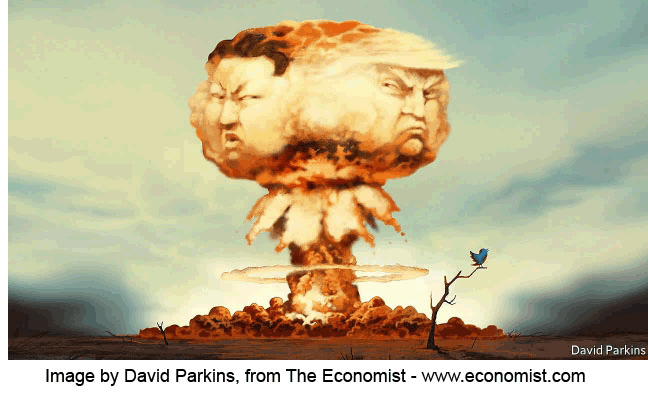
How We Got to North Korea’s Pacific Nuclear Test Threat and What Comes Next It would be the first above-ground detonation in decades and would send tensions into uncharted territory. The Drive BY JOSEPH TREVITHICK, SEPTEMBER 22, 2017 In ever escalating war of words between the United States and Kim Jong-un’s totalitarian regime in North Korea has reached an entirely new level since President Donald Trump threatened to “totally destroy” the Hermit Kingdom in a speech to the United Nations General Assembly. It seems all but guaranteed that the rhetoric will lead to new North Korean provocations, but what’s unprecedented and potentially game-changing is that they could potentially include a full demonstration of a nuclear-armed ballistic missile, or at least an above-ground nuclear weapon test, either which in turn would similarly demand some form of American response.
This latest escalation in tensions between the U.S. government and North Korean officials began on Sept. 19, 2017, when Trump addressed the United Nations General Assembly for the first time with fiery remarks, lashing out at not only North Korea, but also Iran, Cuba, Venezuela, and other critics of American foreign policy more broadly. He vowed to put the United States interests first in all matters and encouraged the other assembled leaders to do the same. But he reserved some of the most incendiary comments for Kim, who he has now nicknamed “Rocket Man,” and his regime.
“The United States has great strength and patience, but if it is forced to defend itself or its allies, we will have no choice but to totally destroy North Korea,” he declared. “Rocket Man is on a suicide mission for himself and for his regime. The United States is ready, willing and able, but hopefully this will not be necessary.”
This particular statement drew “audible gasps” from some of the world leaders in attendance, according to The Associated Press. The North Korean delegation had already walked out in protest before Trump even began speaking……..
The string of threats, especially Nikki Haley’s comments, suggest the United states and its allies could easily handle the increasingly worrisome situation with military force if it runs out of other options. This of course is entirely untrue and major conflict with North Korea would be devastating for all the involved parties.
Not surprisingly, this has not prompted a change in the behavior of the North Korean regime or Premier Kim. As we at The War Zone have noted for months, these statements feed into the country’s existing paranoid and propaganda that the United States and its allies are actively looking to destroy it and forcefully eliminate its government.
It has only appeared to give North Korea more of a reason to continue to develop advanced ballistic missiles and nuclear weapons to achieve some relative parity with the United States in order, if nothing else, to preserve the regime’s very existence. Kim said as much himself in a televised rebuttal on Sept. 21, 2017……
Trump continued the cycle on Sept. 22, 2017, as part of a series of Tweets on various topics. “Kim Jong Un of North Korea, who is obviously a madman who doesn’t mind starving or killing his people, will be tested like never before!” he posted on the social media site.
If his remarks in front of the United Nations seemed likely to generate a North Korean response, the Tweet sounded closer to a direct challenge. Given Kim’s immediate response to Trump’s threat of total destruction, it seems he will have little room but to make a provocative move in response to this new “test.”
After Kim’s own televised address, North Korean Foreign Minister Ri Yong Ho had already said the North Korean response could include detonating a hydrogen bomb in or over the Pacific Ocean. Earlier in September 2017, North Korea tested what experts believe to be a working thermonuclear device…….
In the future, North Korea may simply need to conduct nuclear weapons tests outside of its own borders since the Punggye-ri underground test site may simply not be able to survive the strain of more powerful thermonuclear designs. The nuclear test earlier in September 2017 appeared to cause the tunnel containing the device to collapse, highlighting the limits of underground testing.
Even if the atmospheric test went as intended, it could be difficult to be entirely sure there would be no inadvertent casualties and the resulting fallout could easily fall on civilian mariners or populated areas……..
despite Nikki Haley’s and H.R. McMaster’s insistence that there are available military options to respond to these growing provocations, as well as Trump’s vague threats, any direct action would be fraught with its own dangers. One of the most likely courses of action, shooting down the missile, carries significant risks as the impact of the interceptor could trigger the device or the radioactive debris could fall over populated areas.
Perhaps more importantly to the viability of America’s still largely unproven ballistic missile defense shield, if the intercepting weapon misses or otherwise fails to achieve the desired effect, it would expose a serious vulnerability to not just North Korea, but the rest of the world…..
In particular, systems that engage the missile as it comes falling back down to earth, such as the Terminal High Altitude Air Defense (THAAD) system, have a very narrow window to achieve a “kill.” Furthermore, this means that personnel manning the interceptors would likely be in the direct path the incoming weapon, and if it was fully armed, a nuclear test.
There is very little room for failure in any of these scenarios. Even if the shoot down were to go smoothly, it is possible that it could trigger a larger and immensely destructive conflict on the Korean Peninsula or throughout East Asia. The War Zone’s Tyler Rogoway has highlighted these various issues previously in a deep dive into the United States’ available options in responding to North Korea’s continued provocations……..
All of these options still come with their own risks, though, and there’s still no indication that they would convince Kim to change course. If the North Korean regime’s primary goal is its own survival, it is perfectly rational for them to continue to demonstrate their resolve to respond in kind to American threats.
And despite his comments, Trump’s first step, on Sept. 21, 2017, was to sign a new executive order penalizing any individual or business doing business with North Korea. This follows a trend of steady sanctions against actors and firms outside of North Korea that the United States accuses of enabling the reclusive country’s government.
Trump and other members of his administration repeatedly question Kim’s mental stability, but as we at The War Zone have noted before, he clearly has a coherent plan. We’re still not sure that U.S. government has developed a thought-out strategy to dissuade him from his chosen path.
North Korea ‘threatens Pacific nuclear test’ Sky News, , 22 September 2017 North Korean Foreign Minister Ri Yong Ho says he believes the North could consider a hydrogen bomb test on the Pacific Ocean of an unprecedented scale, South Korea’s Yonhap news agency reports.
Mr Ri was speaking to reporters in New York when he was asked what North Korean leader Kim Jong-un had meant when he threatened in an earlier statement the ‘highest level of hard-line countermeasure in history’ against the United States.
North Korea could consider a hydrogen bomb test, Mr Ri said, although he did not know his leader’s exact thoughts, Yonhap reported.
In an earlier statement Mr Kim said Mr Trump was ‘mentally deranged’ and his comments were ‘the most ferocious declaration of a war in history,’ Mr Kim said the US president’s UN speech on Tuesday confirmed Pyongyang’s nuclear program has been ‘the correct path’.
‘His remarks … have convinced me, rather than frightening or stopping me, that the path I chose is correct and that it is the one I have to follow to the last,’ Mr Kim said in the statement carried by the North’s official KCNA news agency, promising to make Trump ‘pay dearly for his speech’.
Mr Trump had warned the North Korean leader in his UN address on Tuesday that the United States, if threatened, would ‘totally destroy’ the country of 26 million people and mocked Kim as a ‘rocket man’ on a suicide mission………
He offered more vitriol for Mr Trump, saying he was ‘unfit to hold the prerogative of supreme command of a country, and he is surely a rogue and a gangster fond of playing with fire, rather than a politician.’
After the Chernobyl nuclear reactor melted down on April 26, 1986, some dogs and cats left behind survived and began to breed. More than 400 animals were spayed and neutered in the first year of the clinic’s operation at the former reactor, which ended earlier this month.
The laws governing the exclusion zone around Chernobyl strongly advise people to avoid feeding or touching the dogs, due to the risk of contamination. Not only is the dogs’ fur potentially loaded with radioactive particles, but their food and water is contaminated. The radioactive molecules they ingest may also linger in their bodies.
“We could find areas in their bones where radioisotopes had accumulated. We could survey the bones and we could see the radioactivity in them,” a Clean Futures Fund co-founder, Lucas Hixson, told Newsweek. The program funds medical treatment for locals in addition to running the spay and neuter program at the power plant and in the neighboring city.
“These dogs run through [contaminated areas] and it gets stuck on their coat and on the end of their noses and their feet.”
There are nearly 1,000 dogs in the area around the power plant. Only a few dozen cats live in the highly contaminated areas that the dogs frequent.
Hixson has been traveling to Chernobyl for about five years, initially as a radiation specialist. “I go over there expecting to do my work, and I step off the train at the power plant and there’s a dog in my face. Honestly, it was one of the last things I expected to see at Chernobyl,” he said.
To keep the veterinary hospital as free from radioactive contamination as possible, dogs that come to the facility are examined and washed down until their levels of radioactivity are deemed safe.
Despite the potential risk, Hixson said he’s continued to interact with the dogs. “There is a fair amount of handling that happens. This is a natural reaction between humans and dogs,” he said. “You can’t help yourself.”
“They’re not hazardous to your immediate health and wellbeing. But anytime you go pet the dogs, go wash your hands afterwards before you eat.”
Clean Futures Fund got approval from the Ukranian government for its operations. Other partners include SPCA International, Dogs Trust and two U.S. universities, including Worchester Polytechnic Institute and the University of South Carolina.
Hixson also noted the local workers have welcomed the team. “I remember there was a lot of skepticism when we showed up,” he said. “But after about two or three days of us catching dogs, processing them, releasing them, the attitude immediately changed,” he said. “I can’t thank them enough for everything they did.”
Even if every dog and cat in Chernobyl is sterilized and vaccinated, the wider stray dog issue in Ukraine means that more dogs could move into the contaminated area and Clean Futures Fund’s efforts could be somewhat for naught. Ultimately, Hixson would like to work with the Ukranian government on a wider rescue program to get the dogs out of the area and into homes.
He will be returning in November to measure the impact of the program, which is expected to run for five years. The next spay and neuter clinic will happen next summer.











 nuclear-news