¶ India’s solar generating capacity saw a multi-fold surge, as it crossed the 10,000 MW mark on March 10, 2017. It stood at 2,650 MW in mid 2014. Crossing the 10-GW milestone is a stepping stone to a goal of 100 GW solar power capacity by 2022. India is to bring its overall renewable energy generating capacity to 175 GW by 2022. [The Dollar Business]
Tracking solar system
¶ Tesla’s Elon Musk may have put large scale battery storage on the national agenda with his offer to solve South Australia’s power crisis for free if he did not deliver a large system with 100 days of signing a contract. Both the Prime Minister and South Australia’s Premier are looking for more details on the offer. [The Sydney Morning Herald]
¶ A meeting this month will look at whether Guelph, Ontario, should join 1,000 communities worldwide…
Excellent 2 minute video by Radiation Free Lakeland
Marianne Birkby of Radiation Free Lakeland explains that Springfields near Preston, UK, makes nuclear fuel for the entire UK, as well as Japan, Finland, and the USA. It does uranium conversion (to uranium hexafluoride, i.e., hex, as well.) She points out that John Gofman, who worked with the Manhattan Project, called nuclear power licensed, premeditated, murder, and wonders how many more Fukushimas will it take until people say enough! She also discusses the dangers of MOX.
¶ The rate of ocean warming has nearly doubled since 1992 compared with the previous three decades. And the warming has reached deeper waters, scientists reported Friday. The findings are important because the world’s oceans provide one of the best records of the excess energy trapped on Earth by increased greenhouse gases. [InsideClimate News]
¶ Climate change may be increasing the footprint of Lyme disease. Higher temperatures encourage the reproduction of mice, which are both natural reservoirs for the bacteria that cause Lyme disease and carriers of the ticks that spread the infection to humans. People also spend more time out doors, increasing exposure risks. [Huffington Post]
World:
¶ A unanimous vote of the Ottawa city council approved a proposal to build a new cross-town rapid transit corridor. The system will…
So we keep hearing this phrase in the sciences — faster than we thought. In the context of global warming, it’s not a phrase we want to hear. And when the world’s largest heat sink — the oceans — are warming up faster than we thought, that’s kind of a big deal.
GR: Like Trump’s Russia connection, the global warming story is building strength. Here’s one of the best climate news sources on the web.
(Climate Central is a private nonprofit organization funded by public and private donations. Its staff and board are among the most respected leaders in climate science.)
“Addressing climate change using sound science is crucial not just for the U.S., but for the world. Unfortunately, that appears unlikely over the next four years under the Trump administration, which has shown signs of being apathetic if not outright hostile to climate science and science-based policies to rein in carbon pollution.
“Trump has promised to rid the country of Obama’s climate policies while simultaneously propping up coal and oil, the two biggest energy sources of carbon pollution. That’s despite the fact that climate science indicates now is the time when more urgent action is needed to address climate change.
“…“The example given by Norway strongly reinforces the importance and the value of establishing and applying IAEA Nuclear Security Guidance that contributes to the continuous improvement of physical protection and nuclear security,” said Muhammed Khaliq, Head of the IAEA’s Nuclear Security of Materials and Facilities Section.
The IPPAS team, led by Kristóf Horváth, Deputy Director General of the Hungarian Atomic Energy Authority (HAEA), comprised eight experts from seven nations, including the IAEA representative, Mr Khaliq….” Oct 2015 Oslo
This report has been translated from the Norwegian in order to clarify the situation concerning confusion from some of the Pro nuclear lobby and anti nuclear movement highlighted on social media these past weeks. I have tried to get more information from sources to answer the issue as to why there was deleted data from EURDEP radiation mapping in Sweden and Norway just after this report was completed but to no avail, thus far.
The IFE were contacted by Peter for their comment on this incident. The initial impression Peter was given was that the Bellona report was inaccurate and claims by the IFE seems to show a concerted effort to minimise the risks that this reactor poses to the public. If a large plume had come from the Halden reactor on the 17th February into Sweden then the ESPOO treaty concerning cross border contamination on radiation may have been broken. This plume went on for some days and seems to have also hit most of southern Norway (east and west) as the wind changed direction.
However, there have been many claims that the Halden reactor was responsible for all iodine releases in Europe these past months and this is not true. Using EURDEP, I have tracked, as best as i could, the probable sources. There are two main sources of Iodine from Hungary (January 2017)and Norway (Oct 2016 and Feb 2017) and some smaller sources of gamma energy from Spain, Germany, France and possibly from the Italian area. This seems to have ruled out Halden as the only source of Iodine and all the reports of USA military planes checking out the Russian involvement in this scenario are false (this was also claimed by some main stream press also).
The IAEA has been efficient at removing most of the spikes and leaving no data. These spikes are removed as a matter of course in some countries because they claim it is normal Radon from the environment (NORM) but this is mostly not the case.
As to why Sweden might not want to highlight any plumes concerning issues on the ESPOO Treaty from Halden into their country, we only have to see the recent statement by the Swedish Radiation Safety Agency (SRSA) concerning the Nordic Nuclear Safety Research group (NKS) from the 9 March 2017;
“Above all, these evaluations have demonstrated that our approach is correct: We should continue to take part in these research fora,” says Eva Simic, director of research at the Swedish Radiation Safety Authority. “An additional perspective is that the fora underline the beneficial impact of NKS and Halden on our work, and highlight a number of areas we need to work on in order to benefit further from the collaboration. In other words, they provide valuable decision-making input when we discuss future research initiatives.”
It would seem that the Halden management of IFE has many friends that support anything they say but Bellona and the NRPA are holding IFE to task, though it is not widely reported by the main stream media. Bellona represent one of the few organisations that are trying to provide truly independent Science Media Journalism and even the Norwegian Governments own department the NRPA is trying to hold the IFE accountable and promote transparency in a technology that is renowned for secrecy and risk taking. Anyway, here is the full report by the NRPA on the Halden reactor and there should be another due in the near future to assess how IFE are dealing with the issues outlined in this report.. This link shows the original article and links posted on nuclear-news. Thanks to NIls Bohmer and the NRPA for allowing me to publish this report in full. Shaun McGee aka arclight 12th March 2017
1 Introduction
Monday 24 October 2016 at. 1:45 p.m. there was an incident in the treatment of the damaged reactor fuel at the Institute for Energy Technology (IFE) in its facility in Halden. As a result, there was an urgent release of radioactive substances into the reactor hall and into the surroundings. The reactor hall was evacuated and closed off. The IFE notified The Norwegian Radiation Protection Authority (NRPA) Tuesday morning (October 25) and the ventilation system of the reactor hall was stopped. The discharge into the environment then stopped. The IFE informed the NRPA that the situation was under control on Tuesday night.
The day after the notification, Wednesday 26 October, TheNRPA chose to conduct unannounced inspection at the IFE at their headquarters in Kjeller in connection with the late notification and the handling of the incident. During this inspection it was revealed that the situation was still unresolved and that there was still a discharge to the reactor hall. Because of this, the NRPA decided to create an enhanced inspection orderfor the IFE to follow up the late notification, the missing information, and the handling of the consequences of the incident, including the efforts to gain further control on the discharge from the damaged fuel.
As part of the enhancedinspection, atighter communictaion regime between IFE and the NRPAwas created for the future handling of the situation. IFE reported daily progress of the work, the size of the emissions in the reactor hall and into the surrounding environment, and planned future work. Personnel from the NRPA were present with IFE Halden during all operations in the reactor hall during theinspection period. As a part of the enhanced inspection, theNRPA conducted several interviews with personnel from IFE that were involved in handling of the incident. Most interviews were conducted on 10 and 25 November 2016. In addition, the NRPA had several video conferences with IFE personnel and their management. The NRPA also obtained copies of the relevant logs.
Their was a major inspection meeting between IFE and the NRPA in Halden, 25 November 2016. Present at the meeting were the following representatives from the NRPA and the IFE:
IFE: Atle Valseth – research director NSF
Geir Mjønes – department manager HBWR
Tord Walderhaug – safety chief / Radiation Protection Supervisor (Halden)
Kari Lyumer Moum – section head chemistry
Pål Thowsen – senior reactor engineering
Lise Moen – senior reactor physicist
Wolfgang Wiesenack – Research Director
NRPA: Per Strand – Department director
Kristin Frogg – technical director
Øyvind Gjølme Selnæs – senior adviser
Tonje Sekse – senior adviser
2. Current regulations The enhanced inspection authority was notified on 25 October 2016 under the unannounced inspection on the same day. The Inspection was authorisedby the Atomic Energy Act § 13 on inspection, and in the Pollution Control Act § 48 also on inspection.
3. Background, scope and implementation
The inspection was decided on and initiated in conjunction with the unannounced inspection on the 26 October 2016. As a part of the enhanced inspectionthe NRPA had ongoing dialogue with IFE in supervision period and has conducted several interviews with personnel at IFE that were involved in handling of the incident. The focus of the interviews was the individual’s role in the process of handling the damaged fuel, but also with the situation with the reactor. NRPA received copies of relevant logs in connection with thisinspection.
The enhanced inspection was completed on December 2.
4. General impression Previously the NRPA, as part of the unannounced inspectionon the 26 October 2016, had reported errors for missing information and the late notification of the incident, ref. Inspection report 13/2016 . The enhanced inspection involves communication from IFE to NRPA, and the further handling of the incident.
The NRPA conducted interviews and obtained logs as part of the inspection. During the inspection meeting on 25 November 2016 IFE were handed the Emergency log, logs from the reactor engineer (of the control room), and log of the water chemistry for the relevant period. In addition the IFE subsequently forwarded logs of plant control, “the night round,” daily instructions and construction announcements, and print from Procsee showing signals / trends.
The primary cooling circuit is an important part of the safety system of the reactor. Valves which regulate the circulation of cooling water in the primary cooling circuit is dependent on the process air to be open. When the ventilation system of the reactor hall was stopped and the valves closed on Wednesday, the 26 October, one of the consequences was that the process air had to be closed off. Circulation in the primary cooling circuit was therefore suspended. The reactor was shut down when the incident with the damaged fuel occurred on the 24 October. IFE had informed that earlier that they had stoppages in circulation in the primary cooling circuit for longer periods of time in connection with maintenance and other work while the reactor was out of service.
From Thursday 27 October the safety of the reactor was a daily recurring theme between NRPA and IFE, where the NRPA repeatedly questioned theopinions about reactor safety and the closure of the primary cooling circuit. The IFE reported back that the situation was not unusual and that the reactor could stay in that condition for several weeks to come. The NRPA wanted greater transparency and traceability in the safety assessments that were made and demanded in a video meeting on Tuesday 1 November at. 2:00 pm, better documentation with declarations with signatures from the responsible operations and safety managers. A few hours later the same evening received the NRPA a concerning message from IFE that the reactor was “in a very special condition.” Continue reading →
Dying robots and failing hope: Fukushima clean-up falters six years after tsunami
Exploration work inside the nuclear plant’s failed reactors has barely begun, with the scale of the task described as ‘almost beyond comprehension’, Guardian, Justin McCurry at Fukushima Daiichi nuclear power plant, 9 Mar 17. B
Barely a fifth of the way into their mission, the engineers monitoring the Scorpion’s progress conceded defeat. With a remote-controlled snip of its cable, the latest robot sent into the bowels of one of Fukushima Daiichi’s damaged reactors was cut loose, its progress stalled by lumps of fuel that overheated when the nuclear plant suffered a triple meltdown six years ago this week.
As the 60cm-long Toshiba robot, equipped with a pair of cameras and sensors to gauge radiation levels was left to its fate last month, the plant’s operator, Tokyo Electric Power (Tepco), attempted to play down the failure of yet another reconnaissance mission to determine the exact location and condition of the melted fuel.
Even though its mission had been aborted, the utility said, “valuable information was obtained which will help us determine the methods to eventually remove fuel debris”.
The Scorpion mishap, two hours into an exploration that was supposed to last 10 hours, underlined the scale and difficulty of decommissioning Fukushima Daiichi – an unprecedented undertaking one expert has described as “almost beyond comprehension”.
Cleaning up the plant, scene of the world’s worst nuclear disaster since Chernobyl after it was struck by a magnitude-9 earthquake and tsunami on the afternoon of 11 March 2011, is expected to take 30 to 40 years, at a cost Japan’s trade and industry ministry recently estimated at 21.5tr yen ($189bn).
The figure, which includes compensating tens of thousands of evacuees, is nearly double an estimate released three years ago……
Developing robots capable of penetrating the most dangerous parts of Fukushima Daiichi’s reactors – and spending enough time there to obtain crucial data – is proving a near-impossible challenge for Tepco. The Scorpion – so called because of its camera-mounted folding tail – “died” after stalling along a rail beneath the reactor pressure vessel, its path blocked by lumps of fuel and other debris.
The device, along with other robots, may also have been damaged by an unseen enemy: radiation. Before it was abandoned, its dosimeter indicated that radiation levels inside the No 2 containment vessel were at 250 sieverts an hour. In an earlier probe using a remote-controlled camera, radiation at about the same spot was as high as 650 sieverts an hour – enough to kill a human within a minute.
Shunji Uchida, the Fukushima Daiichi plant manager, concedes that Tepco acquired “limited” knowledge about the state of the melted fuel. …
Robotic mishaps aside, exploration work in the two other reactors, where radiation levels are even higher than in reactor No 2, has barely begun. There are plans to send a tiny waterproof robot into reactor No 1 in the next few weeks, but no date has been set for the more seriously damaged reactor No 3………
‘The situation is not under control’
On the surface, much has changed since the Guardian’s first visit to Fukushima Daiichi five years ago. Then, the site was still strewn with tsunami wreckage. Hoses, pipes and building materials covered the ground, as thousands of workers braved high radiation levels to bring a semblance of order to the scene of a nuclear disaster.
Six years later, damaged reactor buildings have been reinforced, and more than 1,300 spent fuel assemblies have been safely removed from a storage pool in reactor No 4. The ground has been covered with a special coating to prevent rainwater from adding to Tepco’s water-management woes.
Workers who once had to change into protective gear before they approached Fukushima Daiichi now wear light clothing and simple surgical masks in most areas of the plant. The 6,000 workers, including thousands of contract staff, can now eat hot meals and take breaks at a “rest house” that opened in 2015.
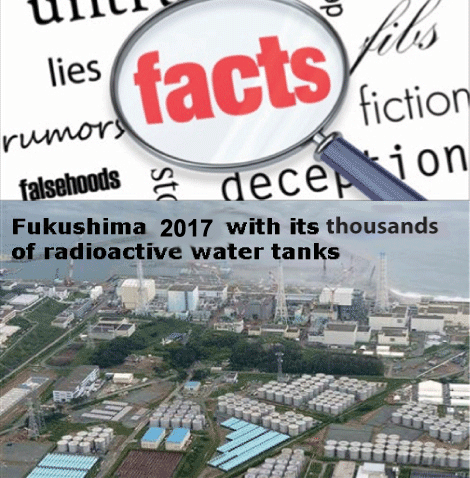
But further up the hill from the coastline, row upon row of steel tanks are a reminder of the decommissioning effort’s other great nemesis: contaminated water. The tanks now hold about 900,000 tons of water, with the quantity soon expected to reach 1m tons.
Tepco’s once-vaunted underground ice wall, built at a cost of 24.5bn yen, has so far failed to completely prevent groundwater from leaking into the reactor basements and mixing with radioactive coolant water.
The structure, which freezes the soil to a depth of 30 metres, is still allowing 150 tonnes of groundwater to seep into the reactor basements every day, said Yuichi Okamura, a Tepco spokesman. Five sections have been kept open deliberately to prevent water inside the reactor basements from rising and flowing out more rapidly. “We have to close the wall gradually,” Okamura said. “By April we want to keep the influx of groundwater to about 100 tonnes a day, and to eliminate all contaminated water on the site by 2020.”
Critics of the clean-up note that 2020 is the year Tokyo is due to host the Olympics, having been awarded the Games after Abe assured the International Olympic Committee that Fukushima was “under control”.
Mitsuhiko Tanaka, a former Babcock-Hitachi nuclear engineer, accuses Abe and other government officials of playing down the severity of the decommissioning challenge in an attempt to win public support for the restart of nuclear reactors across the country.
“Abe said Fukushima was under control when he went overseas to promote the Tokyo Olympics, but he never said anything like that in Japan,” says Tanaka. “Anyone here could see that the situation was not under control.
Terminal decline? Fukushima anniversary marks nuclear industry’s deepening crisis, Ecologist, Nuclear Monitor 10th March 2017 With the sixth anniversary of the Fukushima disaster falling on 11 March , nuclear lobbyists are arguing over solutions to the existential crisis facing nuclear power,writes Jim Green. Some favour a multinational consolidation of large conventional reactor designs, while others back technological innovation and ‘small modular reactors’. But in truth, both approaches are doomed to failure
Saturday March 11 marks the sixth anniversary of the triple-disaster in north-east Japan – the earthquake, tsunami and the Fukushima nuclear disaster.
And the news is not good. Scientists are wondering how on earth to stabilise and decontaminate the failed reactors awash with molten nuclear fuel, which are fast turning into graveyards for the radiation-hardened robots sent in to investigate them.
The Japanese government’s estimate of Fukushima compensation and clean-up costs has doubled and doubled again and now stands at ¥21.5 trillion (US$187bn; €177bn).
Indirect costs – such as fuel import costs, and losses to agricultural, fishing and tourism industries – will likely exceed that figure.
Kendra Ulrich from Greenpeace Japan notes in a new report that “for those who were impacted by the worst nuclear disaster in a generation, the crisis is far from over. And it is women and children that have borne the brunt of human rights violations resulting from it, both in the immediate aftermath and as a result of the Japan government’s nuclear resettlement policy.”
Radiation biologist Ian Fairlie summarises the health impacts from the Fukushima disaster: “In sum, the health toll from the Fukushima nuclear disaster is horrendous. At the minimum:
Over 160,000 people were evacuated most of them permanently.
Many cases of post-trauma stress disorder (PTSD), depression, and anxiety disorders arising from the evacuations.
About 12,000 workers exposed to high levels of radiation, some up to 250 mSv
An estimated 5,000 fatal cancers from radiation exposures in future.
Plus similar (unquantified) numbers of radiogenic strokes, CVS diseases and hereditary diseases.
Between 2011 and 2015, about 2,000 deaths from radiation-related evacuations due to ill-health and suicides.
An, as yet, unquantified number of thyroid cancers.
An increased infant mortality rate in 2012 and a decreased number of live births in December 2011.”
Dr Fairlie’s report was written in August 2015 but it remains accurate. More than half of the 164,000 evacuees from the nuclear disaster remain dislocated. Efforts to restore community life in numerous towns are failing. Local authorities said in January that only 13% of the evacuees in five municipalities in Fukushima Prefecture have returned home after evacuation orders were lifted.
Wind maps for 17th 18th and 20th Feb 2017 Oslo and missing data points from EURDEP in Sweden, Norway and one reading from Denmark showing the radiation was OK on the 20th .
Winds did come from the north at times and also from the southeast as well during these dates, early If a release was done in the early hours/morning of the 17th Feb 2017, the plume would have moved into Sweden and then later been sent west.
The data on the Denmark monitor was largely missing but did actually have the 20th Feb 2017 data showing normal radiation levels
I added some radiation monitoring data from the east coast of Norway and heading north (including one monitor in the mountains) from there to show that a lesser plume made this distance but the data removed was for a shorter time frame. The wind maps show that the direction of the wind did also, at times, head east to account for this Plume.
I also checked the Finnish monitoring system but the data was generally intact but for a small brief rise on one east coast of Finland monitor showing the plume was likely dissipated or broken up over the Baltic sea.
Note; The Halden reactor monitor for October 2016 (the original release) was for only a few hours and the data is missing to show that. Over a few months some small rises and missing data points are evident but the largest period of missing data in February 2017 is the same as the Oslo data maps below, over a few days.
Locked-Out Media Watch While Trump Administration Retreats Into Secrecy MEDIA MATTERS, Blog ››› March 9, 2017 ERIC BOEHLERT, “We want to ensure at all times, if confirmed, that the secretary of state and the State Department is fully transparent with the public.” – Secretary of State Rex Tillerson at his January 11, 2017, confirmation hearing.
On Tuesday, bureau chiefs for major news organizations held a conference call to discuss the fact that Secretary of State Rex Tillerson is not going to allow the press to travel with him on his plane during an upcoming trip to Asia. According to Poynter.org, which reported on the call, not allowing reporters on Tillerson’s government plane would be would be “very unusual, if not unprecedented, certainly in recent annals, with substantial access given by recent Secretaries of State, including John Kerry, Hillary Clinton and Condoleezza Rice.”
As Poynter explained, “[T]he logistics of keeping up with [Tillerson] by assembling stringers or hopscotching about on commercials flights makes coverage exceedingly difficult, if not impossible.” According to CNN, a senior official “told reporters Tuesday Tillerson prefers to travel on a smaller plane and ‘carries a much smaller footprint.'” Tillerson’s plan to exclude the press from traveling with him overseas represents a stunning State Department policy reversal, while further cementing his image as a secretive cabinet figure who has had virtually no contact with journalists since being sworn in. “The secretary of state has given only a handful of prepared statements to the press and has not taken any questions,” CNN noted.
That veil of secrecy has quickly emerged as the hallmark for this shadowy administration.
It’s important to note that while President Trump’s ongoing war on the press has received most of the attention this year as he threatens journalists and restricts their access, there are plenty of indications that the rampant secrecy and disdain for transparency is widespread. “The retreat from the press has taken place administration-wide,” Politiconoted.
There seems to be a collective closing of the gates now underway in terms of the federal government separating itself from journalists.
Just look at what unfolded on Monday:
Tillerson, along with Secretary of Homeland Security John Kelly and Attorney General Jeff Sessions, held an event with journalists to announce the administration’s latest attempt to restrict travel to the U.S. from six Muslim-majority countries. But none of the men responded to press questions about the controversial initiative.
Unlike how the administration treated the original travel ban signing, Trump signed the revised travel ban executive order without photographers or reporters present to record the event.
When the White House held a background conference call with reporters to discuss the updated travel ban it did not identify officials on the call, which prompted a New York Times reporter to tweet:
Been on dozens of background conference calls: DOJ/DOS/DHS call was first time I’ve been on 1 where officials didn’t give their names.
The next day, NBC reporter Andrea Mitchell was escorted from a photo-op with Tillerson and Ukrainian Foreign Minister Pavlo Klimkin after trying to ask several questions. The questions were “met with silence.”
All of that constitutes an historic effort by the Trump administration to lock out the press from the government’s official duties and business.
This, of course, comes after the White House’s radical move to banish several major news outlets from a press “gaggle,” likely because the administration was unhappy with what the organizations were reporting. What followed was a highly unusual, weeklong blackout in terms of televised press briefings from White House press secretary Sean Spicer.
That drawing of the curtain is part of a larger administration effort to march back transparency. For instance, in recent weeks there’s been a paucity of senior administration officials available for on-the-record interviews. Traditionally, senior officials, including cabinet members, have been made available for in-depth interviews, especially on the Sunday morning shows. But not the Trump team.
Thousands expected to march to protest nuclear power today http://www.taipeitimes.com/News/taiwan/archives/2017/03/11/2003666562 By Abraham Gerber / Staff reporter The nation’s annual march against nuclear power plants is to be held today, with activists on Thursday calling for more openness and civic participation in crafting a nuclear waste disposal plan.
“We have to keep the pressure on the government, otherwise it will stall — our hope is that there should be a result by the conclusion of the Democratic Progressive Party’s [DPP] four years in power,” Green Citizens’ Action Alliance secretary-general Tsuei Su-hsin (崔愫欣) said while leading more than a dozen people in a protest outside the Legislative Yuan in Taipei.
People plan to congregate on Ketagalan Boulevard this afternoon for the march, a major annual environmental demonstration.
“This will be our first march since the DPP took full control [of the government] and there are a lot of issues — from retiring nuclear reactors to transitioning to different forms of energy — where we feel there is a need for society to rigorously inspect whether the government has sufficient political resolve,” Tsuei said.
Tsuei added that nuclear waste disposal and energy taxes were key issues.
“Nuclear waste disposal cannot be something where Taiwan Power Co just makes a decision for itself,” Mom Loves Taiwan secretary-general Yang Shun-mei (楊順美) said, calling for open discussion of how waste is to be addressed, included the geology of proposed disposal sites.
“Statements the government has made about future energy prices have been extremely conservative and vague,” Green Citizens’ Action Alliance deputy secretary-general Hung Shen-han (洪申翰) said, calling for the government to stop avoiding demands for an energy tax.
“The government should definitely be taking action and I trust that now is the time for the DPP to realize the promises it made before the election,” said DPP Legislator Chuang Ruei-hsiung (莊瑞雄), who represented the party’s legislative caucus in talks with the protesters.
He said the party is considering establishing a cross-party legislative committee to draft plans for the disposal of nuclear waste.
Now US military chiefs are reportedly planning to fly in B-1 and B-52 bombers – built to carry nuclear bombs – to show America has had enough.
South Korea and the US have also started their annual Foal Eagle military exercise sending a strong warning to North Korea over its actions.
A military official said 300,000 South Korean troops and 15,000 US personnel are taking part in the operation.
Secretary of Defence James Mattis said the US “remains steadfast in its commitment” to the defence of the South, according to Pentagon spokesman Navy Capt Jeff Davis.
Capt David said: “He further emphasised that any attack on the United States or its allies will be defeated and any use of nuclear weapons will be met with a response that is effective and overwhelming.”
Washington is also expected to deploy a series of strategic assets from the US as well as from military bases in Guam and Japan, reports the Korea Times
The USS Carl Vinson, a Nimitz-class supercarrier, will join the Foal Eagle exercise after departing from San Diego.
The nuke-powered aircraft carrier will carry dozens of fighter jets, early warning aircraft and anti-sub craft.
It will be accompanied by the guided-missile cruiser USS Lake Champlain (CG-57) and two Arleigh Burke-class guided-missile destroyers.
From the US Marine Corps in Japan, F-35B stealth fighters will be deployed to the peninsula for the first time.
“An F-35B is capable of evading anti-aircraft radar and making preemptive strikes,” a military official said.
North Korea repeatedly protests that both Foal Eagle and Key Resolve are rehearsals for invasion.
Pyongyang’s Korea Central News Agency reported that North Korean leader Kim Jong-un has stressed “a need for preparation for a fight”.
He listed guidelines to strike South Korea and the US “mercilessly”.
Terminal decline? Fukushima anniversary marks nuclear industry’s deepening crisis, Ecologist, Jim Green / Nuclear Monitor10th March 2017
“……..Small is beautiful? The four Third Way / Breakthrough Institute authors argue that nuclear power must become substantially cheaper – thus ruling out large conventional reactors “operated at high atmospheric pressures, requiring enormous containment structures, multiply redundant back-up cooling systems, and water cooling towers and ponds, which account for much of the cost associated with building light-water reactors.”
Substantial cost reductions will not be possible “so long as nuclear reactors must be constructed on site one gigawatt at a time. … At 10 MW or 100 MW, by contrast, there is ample opportunity for learning by doing and economies of multiples for several reactor classes and designs, even in the absence of rapid demand growth or geopolitical imperatives.”
Other than their promotion of small reactors and their rejection of large ones, the four authors are non-specific about their preferred reactor types. Any number of small-reactor concepts have been proposed.
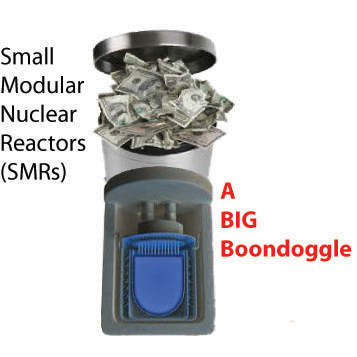
Small modular reactors (SMRs) have been the subject of much discussion and even more hype. The bottom line is that there isn’t the slightest chance that they will fulfil the ambition of making nuclear power “substantially cheaper” unless and until a manufacturing supply chain is established at vast expense.
And even then, it’s doubtful whether the power would be cheaper and highly unlikely that it would be substantially cheaper. After all, economics has driven the long-term drift towards larger reactors.
As things stand, no country, company or utility has any intention of betting billions on building an SMR supply chain. The prevailing scepticism is evident in a February 2017 Lloyd’s Register report based on “insights and opinions of leaders across the sector” and the views of almost 600 professionals and experts from utilities, distributors, operators and equipment manufacturers.
The Lloyd’s Register report states that the potential contribution of SMRs “is unclear at this stage, although its impact will most likely apply to smaller grids and isolated markets.” Respondents predicted that SMRs have a “low likelihood of eventual take-up, and will have a minimal impact when they do arrive”.
The Third Way / Breakthrough Institute authors are promoting small reactors because of the spectacular failure of a number of large reactor projects, but that’s hardly a recipe for success. An analysis of SMRs in the Bulletin of the Atomic Scientists sums up the problems:
Without a clear-cut case for their advantages, it seems that small nuclear modular reactors are a solution looking for a problem. Of course in the world of digital innovation, this kind of upside-down relationship between solution and problem is pretty normal. Smart phones, Twitter, and high-definition television all began as solutions looking for problems.
“In the realm of nuclear technology, however, the enormous expense required to launch a new model as well as the built-in dangers of nuclear fission require a more straightforward relationship between problem and solution. Small modular nuclear reactors may be attractive, but they will not, in themselves, offer satisfactory solutions to the most pressing problems of nuclear energy: high cost, safety, and weapons proliferation.”
Toshiba’s troubled nuclear business Westinghouse is bringing in bankruptcy lawyers, City AM, Courtney Goldsmith, 9 Mar 17, Toshiba’s US nuclear business, Westinghouse, has hired bankruptcy attorneys, signalling to investors it is serious about the potential of a Chapter 11 filing.
The Japanese conglomerate brought in law firm Weil Gotshal & Manges to explore the option, but it had not yet taken a decision on a bankruptcy filing, sources told Reuters.
Toshiba’s shares closed down 7.2 per cent today.
The firm unexpectedly delayed its financial update last month as it announced it needed more time to probe its US nuclear business after revealing a multi-billion pound hole. It’s due to report earnings Tuesday, but a source has told Reuters the likelihood of Toshiba meeting this deadline was “fifty-fifty”.
If the firm fails to meet that deadline, it has until 27 March to file or could be delisted.
Although the troubled firm said it’s not aware of any intention for Westinghouse to file for Chapter 11 bankruptcy, sources have said it is one of several options being considered. The nuclear business faces cost overruns at two projects.
Toshiba has also hired a Japanese law firm to help estimate the how a US bankruptcy will impact the broader group, sources said…..
one issue may be financing guarantees given by the US government to help fund the construction of reactors at the Vogtle plant in Georgia, one of the two projects at the core of Westinghouse’s woes.
A 2014 statement on the US department of energy’s website says the loan guarantees totaled $8.3bn (£6.8bn)















 nuclear-news