 In Asia, on his first major trip overseas as secretary of state, Mr. Tillerson has been heavily scripted in his few public comments, and he has gone out of his way to make sure he is not subject to questions beyond highly controlled news conferences, at which his staff chooses the questioners. In a breach of past practice, he traveled without the usual State Department press corps, which has flown on the secretary’s plane for roughly half a century.
 Rex Tillerson Rejects Talks With North Korea on Nuclear Program, NYT, By DAVID E. SANGER MARCH 17, 2017 SEOUL, South Korea — Secretary of State Rex W. Tillerson ruled out on Friday opening any negotiation with North Korea to freeze its nuclear and missile programs and said for the first time that the Trump administration might be forced to take pre-emptive action “if they elevate the threat of their weapons program” to an unacceptable level.
March 18, 2017
Posted by Christina Macpherson |
media, politics international, USA |
Leave a comment
 Fukushima Daiichi is still the world’s largest bleeding sore http://rabble.ca/blogs/bloggers/2017-03-17t000000/fukushima-daiichi-still-worlds-largest-bleeding-sore, Penney Kome March 17, 2017 Six years after the March 2011 earthquake and tsunami ruined four nuclear reactors at Fukushima Daiichi, urgently needed clean up is still stalled.
Despite the $188 billion cost (and counting), engineers haven’t even been able to build a robot that can survive radiation inside the plant long enough to send back images of the inferno. Apparently nothing that moves can operate in such a hot and radioactive environment — much less a human, who would be dead seconds.
We do know that fuel in at least two out of three of the reactors melted right through the reactor floors. Time Magazine reported in 2011, “that means that…the fuel itself lies in a clump — either at the bottom of the pressure vessel, or in the basement below or possibly even outside the containment building. Engineers don’t know for sure…” Fuel rods won’t explode, but they can burn if exposed to air, producing massive clouds of radioactive smoke.
On February 13, 2017, muon tomography images offered a slightly clearer picture, but not much more hopeful. TEPCO learned that radiation levels at reactor number two were actually emitting about 530 sieverts, not 73 sieverts, as they had expected. Administered to a human, a one sievert dose causes acute radiation poisoning, and a 10 sievert dose is fatal.
Although the disaster is local, the toxins travel. Unlike other environmental disaster areas (e.g. Love Canal) Fukushima Daiichi sheds toxins daily — widely — because every day TEPCO pours 400 tons of water over the fuel rods to keep them from overheating.
More than 962,000 tons of contaminated water are now stored on site. Last fall, TEPCO poured 300 million tons of it into the Pacific Ocean, into currents that reach the North American West Coast. After the 2011 earthquake, the tsunami wave and the wind spread contamination broadly across the Fukushima prefecture.
Unlike Russia, Japan doesn’t have enough land to be able to sequester the damaged plants and leave them alone for centuries — the half-life of some radioactive isotopes — even if reactor number two was stabilized, which it is not.
Instead, the Japanese government evacuated people and conducted massive decontamination programs, scraping and replacing the top two inches of soil, leaving 9,000,000 bags of contaminated soil all around the area. Now it is urging 100,000 displaced citizens to return to their cleaned up villages. Not everybody is convinced that the land is safe.
Greenpeace Japan noted on March 11, “this year will be the first time that some of the more heavily contaminated areas...are being opened up for resettlement….despite radiation still far exceeding long-term targets in places where decontamination work has been done.
“Levels in nearby forests are comparable to the current levels within Chernobyl’s 30 kilometre exclusion zone, which, more than 30 years after the accident, remains formally closed to habitation…”
Greenpeace measured radiation across the village of Iitate (population 6,000) which is 75 per cent forest, and found high levels of contamination even in areas that had been officially decontaminated. Packs of radioactive wild boars are patrolling the empty village.
Fukushima has become one of the largest of the global nuclear sacrifice zones, such as Three Mile Island and Chernobyl, which have afflicted the world since 1930. That’s when uranium refining started in Hanford, Montana, which eventually provided fuel for the first atomic weapons.
These days, the whole town of Hanford is a toxic waste supersite, containing some 55 million gallons of some of the world’s most dangerous radioactive wastes. The entire congressional delegation for the area has petitioned President Trump to give top priority to Hanford clean-up funding, despite the staggering $2 billion cost annually for 30 or 40 years.
Nuclear power plants have an operating life of about 30 to 50 years. Most existing plants were built in the 1970s, before anybody actually had plans for how to de-commission them. However, Reuters reported in 2011, that along with its 104 operating commercial nuclear power plants, the US also had 23 plants in the process of being de-commissioned, at a cost of $500 million to $1 billion each, including 10 that had been “completely cleaned up.”
Seven of the remaining 13 reactors are in SAFSTOR — shut down, under guard, but still holding nuclear materials. In Canada, Quebec’s Gentilly-2 nuclear power plant and units 2 and 3 of the Pickering Nuclear Generating Station, Pickering, Ontario, are already in safe storage — essentially no-human-zones although not permanently sacrificed.
However, Fukushima Daiichi is different from other sacrifice zones because of the ongoing seething nuclear reaction in reactor number two, and because (unlike other zones where habitation is forbidden) Prime Minister Abe’s government wants people to live there.
PM Abe’s government and some media reports downplay radiation’s potentially horrifying effects on humans and babies not yet born. Public relations campaigns label former residents (mostly women, mostly mothers) who resist returning to the ostensibly decontaminated land as neurotically “radiophobic,” even though 174 children in Fukushima prefecture have been diagnosed with — or are suspected of having — thyroid cancer since the nuclear meltdown.
Meanwhile, as evidence emerges that TEPCO has lied about how serious the crisis is, radiation leaks into the Pacific Ocean and the world’s airshed, and one melted-down plant at Fukushima Daiichi threatens to burst into a catastrophic nuclear fire.
“For the global nuclear industry, the Fukushima disaster is an historic — if not fatal — setback,” said Worldwatch President Christopher Flavin. He introduced a draft copy of Worldwatch’s 2011 World Nuclear Industry Status Report.
Among other points, the report noted that every single nuclear power plant under construction in the world was chosen by central planners. Not one faced any competition from local markets or alternatives. And even during the nuclear binge building years, only 41 per cent of the approved power plants ever achieved operating status. Major delays and massive cost overruns were the rule.
In the foreword, Amory Lovins wrote that “long before Fukushima, nuclear power was dying of an incurable attack of market forces.” Wind and solar devices now offer more flexibility at half the price or less.
Indeed, Lovins said, “just as computing no longer needs mainframes, electricity no longer needs giant power plants.” Instead, the Pentagon prefers to rely on a variety of mass-produced generators networked in microgrids,” for resilience. So could the public.
More troubling, though, Lovins noted that the accident “vaporized” TEPCO’s balance sheet. “A 2007 earthquake had cost the company perhaps $20 billion; this one could cost it $100 plus billion. TEPCO is now broke and is becoming, in whatever form, a ward of the state.”
If the company is “a ward of the state,” that means its liabilities are too. Yet Japan’s government seems determined to repopulate Fukushima prefecture even as the doomed reactors overheat in the distance. Volunteer organizations like Greenpeace have to provide radioactivity monitoring for local air, water, soil and food.
On the other hand, what affects one nation affects us all. There has to be some point where the public stands up and says, “no more sacrifice zones!” The ongoing Fukushima Daiichi tragedy cries out for the United Nations to step in, take charge, and direct all the world’s best minds and resources to containing the disaster and rescuing the people who live there.
March 18, 2017
Posted by Christina Macpherson |
Fukushima continuing |
1 Comment
 Military action against North Korea ‘an option’, warns Rex Tillerson
US secretary of state says policy of strategic patience has ended due to threat posed by Pyongyang’s nuclear weapons programme, Guardian, Justin McCurry , 17 Mar 17 , A pre-emptive US military strike against North Korea may be necessary if the threat posed by its nuclear weapons programme reaches a level that “requires action”, the US secretary of state, Rex Tillerson, has warned.
Speaking in Seoul on the second day of a visit to the Asia-Pacific region, Tillerson said Washington’s policy of “strategic patience” towards the regime in Pyongyang had ended.
In his strongest comments yet on concerns that North Korea is moving closer towards developing a nuclear strike capability that could threaten the US mainland, Tillerson said “all options are on the table”.
“Certainly we do not want to, for things to get to military conflict,” he said at a joint press conference with South Korea’s foreign minister, Yun Byung-se.
“If they elevate the threat of their weapons programme to a level that we believe requires action, then that option’s on the table. “Let me be very clear: the policy of strategic patience has ended. We are exploring a new range of security and diplomatic measures.”
Those words hint at a departure from the North Korea policy pursued by the Obama administration, which sought to use multilateral sanctions to pressure the North Korean leader, Kim Jong-un, into agreeing to denuclearisation in exchange for aid and investment…….
Aside from repeating that Washington’s policy options remain open, Tillerson has not offered details of how the Trump administrationplans to address the rising threat from North Korean nuclear weapons and ballistic missiles…….
Tillerson faces potentially the most difficult leg of his three-country visit when he arrives in Beijing on Saturday…..https://www.theguardian.com/us-news/2017/mar/17/military-action-against-north-korea-an-option-warns-rex-tillerson
March 18, 2017
Posted by Christina Macpherson |
politics international, USA, weapons and war |
Leave a comment
 Trump White House is ‘a pretty hostile environment to work in,’ and staff are getting paranoid, Daily Kos, By Laura Clawson Mar 16, 2017 As the head of a private business, Donald Trump is known for keeping his employees divided and suspicious of one another, and his White House is not turning out any different. Add an ongoing beef with the intelligence community and the mere existence of civil servants throughout government who aren’t Trump loyalists, and Trump’s people are descending to full-on paranoia. A senior administration aide told Politico that “People are scared” in a White House that’s “a pretty hostile environment to work in.” But there’s more:
In an interview, one White House aide described the elaborate steps he was taking to shield himself. Once he gets home in the evening, he turns off his work phone and stores it in a drawer because, he said, he believes it could be used to listen to him even when it’s off. If he makes a call during off-hours, he uses a separate, personal phone in an adjoining room, where the stowed work device wouldn’t be able to pick up his voice as clearly……..
Spending your time away from work to sift through your coworkers’ social media accounts to see who disagrees with you politically is both impressively paranoid and a reason civil service employees should be looking over their own shoulders constantly and refusing to call it paranoia—because the Trump people really are out to get them.
In addition to being afraid that the intelligence community and civil servants are out to get them, Trump’s staff are also engaged in constant infighting and suspicion of one another as they jockey for position. But that suspicion is probably justified, because all the evidence suggests that Trump’s White House is a snake pit stocked with every kind of venomous serpent. http://www.dailykos.com/story/2017/3/15/1643609/-Trump-White-House-is-a-pretty-hostile-environment-to-work-in-and-staff-are-getting-paranoid
March 18, 2017
Posted by Christina Macpherson |
psychology - mental health, USA |
Leave a comment
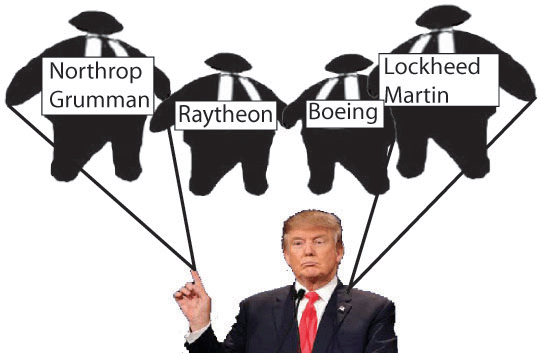
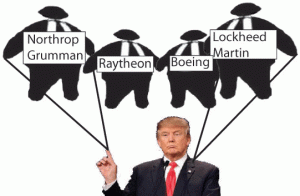 Trump budget: An extra billion dollars for nuclear weapons, Salon.com, 17 Mar 17 His draft 2018 budget would boost the budget for nuclear weapons production by 11 percent PATRICK MALONE AND R. JEFFERY SMITH, THE CENTER FOR PUBLIC INTEGRITY President Donald Trump has proposed to boost federal spending on the production of nuclear weapons by more than $1 billion in 2018 while slashing or eliminating spending on many federal programs related to diplomacy, foreign aid, and social needs, in a budget proposal that reflects the first tangible expression of his defense priorities.
The $1.4 billion budget increase for the National Nuclear Security Administration amounts to just a small fraction of the overall $54 billion boost he requested over the military’s roughly $639 billion 2017 budget, but it is a proportionally higher increase (11 percent) than the Defense Department itself would get (8 percent), signaling that he and his advisers feel the U.S. nuclear weapons program deserves special treatment.
The 64-page budget document released by the White House on March 16 — and entitled “America First: A Budget Blueprint to Make America Great Again” — contained only a few sentences about the proposal, which would give the NNSA a total of $14.3 billion in fiscal year 2018. But the blueprint said the new spending would support “the goals of moving toward a responsive nuclear infrastructure and advancing the existing program of record for warhead life extension programs.”
That language refers to an existing effort to modernize three types of warheads, so they can be deployed with bombers, submarine-launched missiles, and land-based missiles, some of which will themselves be modernized in years to come. That warhead work is well under way, although the budget document suggested it had been slowed by Obama-era defense spending caps. Some independent experts have cautioned, however, that the speed of the work is limited mostly by its sheer complexity, rather than by fund shortages, and expressed doubt that it could be accelerated.
Trump’s budget proposal also says the additional NNSA funds would address its “critical infrastructure maintenance” needs — which is Washington-speak for everything from laboratories and test tracks to office buildings — which NNSA director Frank Klotz has pegged in public statements at roughly $3.7 billion. That tally includes both nuclear weapons-related work and nonnuclear work related to the cleanup of wastes from past weapons production activities……..
Many in Washington say that Congress is unlikely to approve Trump’s budget. Nonetheless, the special status Trump has assigned to nuclear weapons work is exemplified by the fact that even as the NNSA’s budget would expand under his proposal, the rest of the Energy Department’s budget would decline by around 20 percent, or $1.7 billion.
Gone would be the department’s weatherization, gas mileage, and clean energy programs. The Office of Science, which supports research into new technologies and basic physics as well as climate change, would be cut by nearly twenty percent. Elsewhere in the government, the State Department would get a 28 percent budget cut, funds for U.N. peacekeeping would be scaled back, humanitarian aid would be focused on fewer nations, and all federal spending for the U.S. Institute of Peace would disappear.
The current U.S. nuclear weapons modernization program, which was initiated and strongly supported by former President Barack Obama, was already estimated to cost $1 trillion or more over the next three decades. But Trump, in a Dec. 22 tweet, said “the United States must greatly strengthen and expand its nuclear capability” — implying that this should be beyond what Obama had set in motion.
As if to hammer that point home, Trump on March 16 also announced the appointment to the position of Pentagon policy chief of a defense analyst who helped write a new U.S. nuclear policy in 2001 that supported research on new types of nuclear warheads. The policy, overseen in part by Trump nominee David J. Trachtenberg, a former Pentagon deputy assistant secretary under President George W. Bush, also downplayed the significance of arms control, and supported an expansion of U.S. ballistic missile defense programs……..http://www.salon.com/2017/03/17/trump-budget-an-extra-billion-dollars-for-nuclear-weapons_partner/
March 18, 2017
Posted by Christina Macpherson |
USA, weapons and war |
Leave a comment

Officers from the Beijing Food and Drug Administration check imported food at a supermarket on Thursday.
Report finds many e-commerce sites selling potentially unsafe products
The Chinese Foreign Ministry has urged the Japanese government to take more effective measures to handle the environmental aftermath of the Fukushima nuclear disaster and disclose information to ensure marine environmental safety and the safety of people in other countries.
Hua Chunying, spokeswoman for the Ministry of Foreign Affairs, made the comment on Thursday following exposure by China’s State television station that food products from areas affected by the nuclear disaster in Japan are being sold in China.
China’s top food regulator promised on Thursday to punish such irregularities involving food safety exposed in China Central Television’s annual World Consumer Rights Day program on Wednesday.
“We have demanded local food and drug supervision authorities investigate the irregularities and transfer criminal suspects to public security authorities,” the China Food and Drug Administration said.
Food and drug authorities must strengthen supervision over food safety and severely punish culprits, it said.
Food from areas affected by the 2011 Fukushima nuclear disaster have been sold on many e-commerce platforms in China and in some brick-and-mortar shops, including dairy, cereal, rice and wine, CCTV reported.
Although some of the products had labeling in Japanese that specified manufacturing locations such as Tokyo and Tochigi, they were covered by Chinese labels that only stated the manufacturing location as Japan, the report said.
China has banned the importation of food and animal feed from Tokyo and 11 prefectures, including Fukushima, Niigata-ken and Tochigi, since April 2011 to guard against risks, according to the General Administration of Quality Supervision, Inspection and Quarantine.
Major supermarkets and e-commerce platforms in Beijing started to inspect imported food products following the CCTV report and found no product from any of the 12 areas, Ji Ye, an official at Beijing Food and Drug Administration, said.
The administration is also conducting inspections of food enterprises in Beijing, including MUJI and 7-Eleven, and will recall any product that is imported from the affected areas, he said.
More than 13,000 online shops in China were suspected of selling food from these banned areas, according to the Shenzhen Market and Quality Supervision Commission, CCTV reported.
Law enforcement officers from the commission found nearly 20,000 packages of “Calbee” brand oatmeal, which is from Tochigi, at a company in Shenzhen, the report said.
Some supermarkets, including Japanese brand MUJI, are also suspected of violations, CCTV said.
MUJI said on Thursday that the two kinds of products, a cereal beverage and a muffin, are made in Fukui-ken and Osaka, which are not on the list of imports banned by China’s quality supervision authorities.
http://www.ecns.cn/2017/03-17/249602.shtml
http://www.pressreader.com/china/china-daily/20170317/281694024591810
March 17, 2017
Posted by dunrenard |
Fukushima 2017 | China, Contaminated Foods, Fukushima Contamination, Japan Food Exports |
Leave a comment

People pray for victims of the March 11, 2011 earthquake and tsunami near Tokyo Electric Power Co’s (TEPCO) tsunami-crippled Fukushima Daiichi nuclear power plant
Japan govt & Tokyo power firm liable for ‘preventable’ Fukushima meltdown – court
Negligence by the government and Tokyo Electric Power (TEPCO) contributed to the Fukushima nuclear disaster in March 2011, a court in Japan has ruled, saying the catastrophe could have been avoided, and marking the first time the state has been held liable.
The district court in Maebashi, north of Tokyo, said the government and plant operator were to blame for failing to prepare anti-tsunami measures.
The judge awarded a total of 38.55 million yen (US$340,000) in damages to some 62 plaintiffs who evacuated to Gunma Prefecture after the disaster began to loom large at the Fukushima No. 1 nuclear power plant in March 2011, the Asahi Shimbun newspaper reported.
A group of 137 plaintiffs had argued the authorities and TEPCO failed to prevent the triple meltdown at the plant, and demanded 11 million yen ($97,108) each in compensation, the newspaper said, adding that the court accepted most of the arguments about the dramatic lack of anti-tsunami measures.
The plaintiffs highlighted the fact that in May 2008, three years before the disaster, plant operator TEPCO received an estimate of a tsunami as high as 15.7 meters that could hit the Fukushima No. 1 nuclear plant, Asahi Shimbun reported. That apocalyptic forecast came true, with a wave around that height hitting the nuclear power plant in 2011, triggering the reactor meltdowns. A huge tsunami knocked out the Fukushima Daiichi nuclear plant, spewing radiation and forcing 160,000 people to flee their homes.
If the utility had installed emergency diesel electric generators on higher ground, the measure could have prevented the nuclear disaster, the court ruled on Friday.
Citing a government estimate released in July 2002, the court said that “TEPCO was capable of foreseeing several months after (the estimate) that a large tsunami posed a risk to the facility and could possibly flood its premises and damage safety equipment, such as the backup power generators,” the Japan Times reported.
Meanwhile, in its long-term estimate, unveiled in 2002, the government said that the probability of an earthquake striking in the Japan Trench off the coast of northeastern Japan, including the sea area off the Fukushima No. 1 plant, was “about 20 percent within 30 years,” the Asahi Shimbun paper said.
The lawyers for the plaintiffs welcomed the Friday court ruling, saying “It was extremely significant that (a court) has acknowledged the responsibility of the state,” Kyodo news agency reported.
Around 30 similar suits have been filed in at least 20 district courts across Japan, lawyers said.
However, Takehiro Matsuta, one of the plaintiffs who evacuated from the city of Koriyama in central Fukushima Prefecture, called the damages “disappointing.” His child, who was three years old at the time of the nuclear disaster, received no compensation whatsoever.
“My wife and I are struggling every day, but it’s my child who suffers the most,” the 38-year-old father said, as cited by the Japan Times.
“The ruling was one big step for my family, for those who evacuated from Fukushima to Gunma, and for tens of thousands of earthquake victims nationwide,” he said.
Both the government and TEPCO argued that the long-term estimate and the May 2008 tsunami study were not credible enough, continuing to insist that the massive tsunami was unexpected.
Chief Cabinet Secretary Yoshihide Suga, the government’s top spokesman, told a press conference on Friday that the officials “will consider how to respond after carefully examining the ruling.”
The Fukushima Daiichi nuclear power plant suffered a blackout and subsequent failure of its cooling systems in March 2011, when it was hit by an earthquake and a killer tsunami that knocked out the Fukushima Daiichi nuclear plant, spewing radiation and forcing 160,000 people to flee their homes. Three of the plant’s six reactors were hit by meltdowns, making the Fukushima nuclear disaster the worst since the Chernobyl catastrophe in 1986.
https://www.rt.com/news/381154-tepco-government-liable-fukushima/

Supporters of plaintiffs seeking compensation for Fukushima evacuees unfurl banners in front of the Maebashi District Court in Gunma Prefecture announcing the court’s decision Friday.
In first, government and Tepco found liable for Fukushima disaster
Maebashi, Gunma Pref. – A court in Japan has ruled for the first time that the government and the operator of the crippled Fukushima No. 1 nuclear power plant were responsible for failing to take preventive measures against the March 11, 2011, quake-triggered tsunami that killed scores and forced tens of thousands from their homes.
Friday’s stunning ruling by the Maebashi District Court was the first to recognize negligence by the state and Tokyo Electric Power Co. Holdings Inc. It called the massive tsunami predictable and said the major nuclear disaster could have been avoided.
The district court ordered the two to pay damages totaling ¥38.55 million to 62 of 137 plaintiffs from 45 households located near the plant, which suffered a triple meltdown caused by the tsunami, awarding ¥70,000 to ¥3.5 million in compensation to each plaintiff.
The plaintiffs had demanded the state and Tepco pay compensation of ¥11 million each — a total of about ¥1.5 billion — over the loss of local infrastructure and psychological stress they were subjected to after being forced to relocate to unfamiliar surroundings.
Citing a government estimate released in July 2002, the court said in the ruling that “Tepco was capable of foreseeing several months after (the estimate) that a large tsunami posed a risk to the facility and could possibly flood its premises and damage safety equipment, such as the backup power generators.”
It pointed out that the state should have ordered Tepco to take bolstered preventive measures, and criticized the utility for prioritizing costs over safety.
Of the plaintiffs, 76 who lived in evacuation zones were forced to move, while another 61 evacuated voluntarily even though their houses were located outside evacuation zones. The ruling was the first of 30 similar class-action suits filed nationwide involving more than 10,000 plaintiffs.
About 80,000 citizens who had lived in Fukushima reportedly left the prefecture after the March 2011 disaster.
“I believe that the ruling saying both the government and Tepco were equally responsible is an important judgment,” Katsuyoshi Suzuki, the lead lawyer for the defense said at a news conference following the ruling. “But thinking about the psychological distress (the plaintiffs faced) after being forced to evacuate from their homes, I think the amount is not enough.”
Takehiro Matsuta, 38, one of the plaintiffs who evacuated from the city of Koriyama, hailed the ruling, but called the damages “disappointing.”
“The ruling was one big step for my family, for those who evacuated from Fukushima to Gunma, and for tens of thousands of earthquake victims nationwide,” he said.
But called the payout “disappointing,” as his child, who was 3 years old at the time of the nuclear disaster, was not granted compensation. “My wife and I are struggling everyday, but it’s my child who suffers the most.”
The group of lawyers for the plaintiffs, which have had suits filed since September 2011, claimed that the Fukushima disaster resulted in serious human rights violations by forcing victims to relocate after the crisis caused widespread environmental damage.
The plaintiffs argued that Tepco could have prevented the damage if it had implemented measures, including the building of breakwaters, based on its 2008 tsunami trial calculation that showed waves of over 10 meters could hit the Fukushima No. 1 plant.
Those calculations took into account the 2002 estimate by the government’s Headquarters for Earthquake Research Promotion, which concluded that there was a 20 percent chance of a magnitude-8 earthquake rocking areas off Fukushima within 30 years.
However, the government and Tepco have argued that the massive tsunami was unexpected, claiming that there were different opinions among scholars over the long-term evaluation. Both attacked the credibility of the study, calling it unscientific.
The government also objected to the ruling, saying that because it had no authority to force Tepco to take such preventive measures as argued by the plaintiffs, it bore no responsibility.
According to the defense, a number of other class suits are inching closer to rulings, with one in the city of Chiba scheduled for Sept. 22 and another in the city of Fukushima involving 4,000 plaintiffs expected by the year’s end.
http://www.japantimes.co.jp/news/2017/03/17/national/crime-legal/first-government-tepco-found-liable-fukushima-disaster/#.WMwqEqKmnIV
March 17, 2017
Posted by dunrenard |
Fukushima 2017 | Court Decision, Fukushima Evacuees, Fukushima Suit, Japanese Government, Liability, Tepco |
Leave a comment

An abandoned home in Futaba, Japan, one of the towns around the Fukushima plant. Nearly 160,000 people evacuated the area after the disaster in 2011.
TOKYO — The Japanese government and the electric utility that operated the Fukushima Daiichi nuclear power plant were negligent in not preventing the meltdowns in 2011 that forced thousands of people to flee the area, a district court in eastern Japan ruled on Friday.
It was the first time that a court determined that both the Tokyo Electric Power Company, or Tepco, and the government bore responsibility for the nuclear disaster that followed a devastating earthquake and tsunami in March 2011. The decision could influence dozens of similar lawsuits filed by close to 12,000 evacuated residents now living across the country.
According to Japanese news reports of the ruling by the Maebashi District Court in Gunma Prefecture, the court said that the disaster, considered the worst nuclear calamity since Chernobyl in 1986, was “predictable” and that it was “possible to prevent the accident.”
The court ordered the government and Tepco to pay damages totaling 38 million yen, or about $335,000, to 62 residents who were evacuated from the towns around the Fukushima plant and who relocated to Gunma. Each was awarded a different amount, but the total worked out to an average of $5,400 a person.
In their lawsuit, 137 former residents had sued for damages of ¥11 million, about $97,000, per person, and the court awarded damages to half the plaintiffs. About half of them had left on government evacuation orders while the other half had decided to leave on their own. Each case was evaluated individually.
The court weighed whether Tepco and the government had paid adequate damages to the nearly 160,000 people who evacuated from the towns around Fukushima. About 90,000 people have returned or settled in other places, and Tepco has already paid about ¥7 trillion in compensation.
In the lawsuit, the plaintiffs said that the central government and Tepco should have foreseen the possibility of a tsunami of the magnitude that hit the plant and that they should have done more to protect the plant.
The March 11, 2011, meltdowns at Fukushima Daiichi, which is on the eastern coast of Japan, occurred when 32-foot waves breached the power station’s protective sea walls, flooding buildings and destroying diesel-powered electricity generators that were designed to keep critical systems functioning in a blackout.
Tepco did not deny responsibility in a statement on Friday.
“We again apologize from the bottom of our hearts for giving great troubles and concerns to the residents of Fukushima and other people in society by causing the accident of the nuclear power station of our company,” Isao Ito, a spokesman, said. “Regarding today’s judgment given at the Maebashi local court today, we would like to consider how to respond to this after examining the content of the judgment.”
Yoshihide Suga, the chief cabinet minister to Prime Minister Shinzo Abe, told reporters that the government had yet to see the details of the ruling.
“The concerned ministries and agencies are going to thoroughly examine the content of the judgment and discuss how we will respond to it,” Mr. Suga said.
Analysts said the case appeared to set an important precedent.
“Tepco’s argument all along has basically been that everything it did before the accident had been approved by the government, while the government has claimed that Tepco failed to follow guidance,” said Azby Brown, director of the Future Design Institute at the Kanazawa Institute of Technology and a volunteer researcher with Safecast, an independent radiation-monitoring group.
“This suit seems to have concluded that the evidence shows they share culpability,” he said. “I expect the government and Tepco to appeal, and for this to drag on for years.”
Izutaro Managi, a lawyer representing another class-action lawsuit against the government and Tepco, said that the government had failed in its oversight responsibilities. He said the damages were “not big enough.”
Representatives of groups that have sued the government and Tepco for negligence said they were more interested in the principle of the case than the amount of compensation awarded.
“The money is not a problem,” said Koichi Muramatsu, 66, a former resident of Soma City in Fukushima and the secretary of a victims group representing 4,200 plaintiffs in the suit being handled by Mr. Managi. “Even if it’s ¥1,000 or ¥2,000, it’s fine. We just want the government to admit their responsibility. Our ultimate goal is to make the government admit their responsibility and remind them not to repeat the same accident.”
In a statement, Katsumasa Suzuki, the chief lawyer for the plaintiffs, called the ruling significant because it “legally reconfirmed that government regulation was inappropriate.”
But he said he was disappointed by the low total of the damages.
“It is largely questionable whether the mental distress the plaintiffs faced was adequately evaluated,” he said.
https://mobile.nytimes.com/2017/03/17/world/asia/japan-fukushima-nuclear-disaster-tepco-ruling.html?smprod=nytcore-iphone&smid=nytcore-iphone-share&_r=0&referer=https%3A%2F%2Ft.co%2FTFE8zlaSpi
March 17, 2017
Posted by dunrenard |
Fukushima 2017 | Compensation, Court Decision, Fukushima Evacuees, Fukushima Suit, Government Negligence, Tepco Negligence |
Leave a comment

Court: State and TEPCO must compensate
A court in Japan has ordered the government and Tokyo Electric Power Company to pay damages to evacuees of the 2011 nuclear accident.
The ruling is the first among similar suits filed across the country to order compensation.
137 evacuees mainly living in Gunma Prefecture northwest of Tokyo, filed the suit. They were seeking damages for emotional distress suffered after losing their livelihoods.
https://www3.nhk.or.jp/nhkworld/en/news/20170317_23/
Court decision expected in Fukushima damages suit
A district court in eastern Japan will announce its decision Friday on a damages lawsuit filed by evacuees of the 2011 Fukushima nuclear accident against the state and Tokyo Electric Power Company.
137 people, mainly evacuees living in Gunma Prefecture, filed the suit with the Maebashi District Court, seeking compensation worth about 13 million dollars. The ruling will be the first damages suit of its kind in Japan.
The plaintiffs include those who fled evacuation zones and other parts of Fukushima Prefecture after the accident at the Fukushima Daiichi nuclear plant. They say they suffered emotional distress after losing their livelihoods. They are seeking about 97,000 dollars each.
The points of contention include whether the Japanese government and plant operator TEPCO could have foreseen the major tsunami and prevented the damage, as well as whether the compensation TEPCO is paying evacuees is appropriate.
The plaintiffs claim the tsunami was predictable, citing a 2002 prediction of a massive earthquake by the government’s Headquarters for Earthquake Research Promotion.
But the government and TEPCO say many researchers voiced differing views, and an installation of tide embankments based on the prediction would not have prevented the damage.
The plaintiffs say the compensation they received is insufficient. The government and TEPCO say it is appropriate.
More than 12,000 people have filed similar suits in 18 prefectures.
https://www3.nhk.or.jp/nhkworld/en/news/20170317_10/
March 17, 2017
Posted by dunrenard |
- Fukushima 2011 | Compensation, Court Decision, Fukushima Evacuees, Fukushima Suit, State, Tepco |
Leave a comment

Tokyo Electric Power : Tepco denies it plans to scrap reactor at plant close to crippled Fukushima site
TOKYO (Reuters) – Tokyo Electric Power Co Holdings on Friday denied a media report that it was set to decommission a nuclear reactor that suffered only minor damage compared with the nearby Fukushima Daiichi plant that was wrecked after a massive quake in 2011.
The Mainichi newspaper reported earlier that Tepco was likely to decommission the No.1 reactor at the Fukushima Daini power plant as it was the worst-hit of the facility’s four reactors after the quake and tsunami, temporarily losing cooling functions.
Local governments have been calling for the decommission of all four reactors at Fukushima Daini. The government and the ruling Liberal Democratic Party have also pressed Tepco to make a decision on decommissioning the No.1 reactor.
Dozens of reactors elsewhere in Japan are still going through a relicensing process by a new regulator set up after the Fukushima disaster in 2011, the world’s worst since Chernobyl 25 years previously, highlighted regulatory and operational failings by the country’s nuclear utilities.
http://m.4-traders.com/TOKYO-ELECTRIC-POWER-COMP-6491247/news/Tokyo-Electric-Power-Tepco-denies-it-plans-to-scrap-reactor-at-plant-close-to-crippled-Fukushima-s-24058746/
March 17, 2017
Posted by dunrenard |
Fukushima 2017 | Fukushima Daini, Reactor 1, Scrapping |
Leave a comment
NUCLEAR TURKEY? Imam close to Erdogan calls for weapons NOW amid tensions with EU, Express UK, 17 Mar 17 TURKEY should ignore rules set by ‘the West’ and build its own NUCLEAR WEAPONS – an Imam close to president Recep Tayyip Erdogan has advised – as the fallout between Brussels and Ankara deepens. By ZOIE O’BRIEN, Mar 16, 2017 The worrying advice has been called weeks ahead of a Turkish referendum aimed at giving more power to President Erdogan – and in the midst of a keeping fallout between Ankara and EU leaders.
Hayrettin Karaman, the Turkish AK Party’s go-to religious leader, attacked ‘the West’ in a letter which insisted Erdogan should immediately invest in weapons of mass destruction.
In the online post the imam accused Christian countries in the West of egotism and racism – stating the bad attitude towards Turkey has been “accelerated”.
President Erdogan is in the midst of a deep fall out with European nations including Germany and the Netherlands after both countries banned rallies and kicked out his ministers who had sworn to campaign for his referendum. Mr Erdogan retaliated by comparing them to Nazis and protests were held outside the Dutch embassy in Ankara.
The fallout threatens the £5billion one-for-one migrant deal.
But, if Mr Erdogan listens to his favourite religious leader, the tensions could be ramped up even further……..http://www.express.co.uk/news/world/780240/TURKEY-Imam-Erdogan-nuclear-weapons-NOW-EU-tension-Germany-Netherlands
March 17, 2017
Posted by Christina Macpherson |
Turkey, weapons and war |
Leave a comment

After years of banning Japan’s fish and agriculture, many countries might be willing to give the nation a second chance and import its goods. The Fukushima Daiichi nuclear disaster in 2011 and the resulting radiation in the region caused 54 countries and regions to implement restrictions on certain Japanese goods.
That number has shrunken to 33, with more nations likely to follow suit and lift the ban, the Japan Times reported Wednesday.
“We are looking forward to the lifting of the South Korean import ban,” Masao Atsumi, a sea-squirt farmer in Miyagi prefecture, told the Japan Times.
South Korea, which received about 70 percent of Japan’s sea squirt exports, imposed a ban on fish imports from eight prefectures in Japan in 2013.
The European Union began easing its own restrictions on Japanese imports in 2016. China, Taiwan, Hong Kong, Macao, Singapore and Russia all continued to ban products from certain regions.
Lifting such restrictions could be a sign that Japan, still heavily burdened by the disaster six years later, was on the road to recovery. The nuclear meltdown left a zone of more than 300 miles surrounding the plant uninhabitable, causing the evacuation of 160,000 residents. Many of those residents were set to begin returning in the coming days.
Despite progress, serious problems have continued to pervade the region. Due to melted fuel debris, radiation in the nuclear plant recently reached the highest levels ever recorded inside, with experts calling it “unimaginable.” Radiation reached such elevated levels that the robots tasked with cleaning the reactor could not survive. Tokyo Electric Power Company, the group responsible for the cleanup, was still struggling to complete the $188 billion recovery process to decommission the plant, a project estimated to take decades.
The barren region left behind by the disaster also has a wild boar problem. Hundreds of the animals began invading towns surrounding the defunct plant after residents fled, scavenging for food and virtually taking over.
http://www.ibtimes.com/fukushima-japan-ban-fish-exports-over-after-nuclear-radiation-disaster-countries-2508805
March 17, 2017
Posted by dunrenard |
Fukushima 2017 | Contaminated Foods, Fukushima, Import Ban, Japan Food Exports |
Leave a comment
 geoharvey
Science and Technology:
 (Wikimedia Commons)
¶ About 10 years ago, researchers noticed a close correspondence between the fluctuations in CO2 levels and in temperature over the last million years. When Earth is at its coldest, the amount of CO2 in the atmosphere is also at its lowest. Now, a study of deep-sea corals reveals why atmospheric carbon was reduced during colder time periods, providing new insights into climate change. [Science Daily]
World:
¶ France’s anti-fraud and consumer protection agency, DGCCRF, has released a new report that alleges that Renault has been (may have been?) falsifying vehicle emissions test data for the last 25 years. The report, very notably, claims that all of the company’s top executives, including CEO Carlos Ghosn, have most likely known of this. [CleanTechnica]
¶ Italy reached its 17.5% carbon emission target by the end of 2015, Eurostat said. Italy is…
View original post 777 more words
March 17, 2017
Posted by Christina Macpherson |
Uncategorized |
Leave a comment
Fukushima to host Tokyo Olympics events to help recovery from nuclear disaster

Some baseball and softball events will be held about 70km from nuclear power plant that suffered triple meltdown in 2011, Guardian, Justin McCurry , 17 Mar 17, Fukushima has been chosen to host baseball and softball matches at the 2020 Tokyo Olympics, organisers said on Friday, a move they hope will boost the region’s recovery from the March 2011 nuclear disaster.
Azuma baseball stadium, about 70km north-west of the ruined Fukushima Daiichi nuclear power plant, will host at least one baseball game – possibly the opening match – and one or more softball fixtures, according to Yoshiro Mori, the 2020 organising committee president.
“By hosting Olympic baseball and softball events, Fukushima will have a great platform to show the world the extent of its recovery in the 10 years since the disaster,” Mori said in a statement……
Mori said the “fantastic idea” to hold baseball and softball matches in the affected area had originated in a meeting between the president of the International Olympic Committee (IOC), Thomas Bach, and Japan’s prime minister, Shinzo Abe, in October last year.
Two months later, however, the IOC initially declined to add Azuma to the main baseball venue in Yokohama.
Riccardo Fraccari, the president of the World Baseball Softball Confederation, welcomed the IOC’s change of heart, describing it as a “great step” that would to “inspire hope and highlight the regeneration in Fukushima”…..
The Fukushima prefectural government has offered to cover the costs of the refurbishment and renovation work needed to bring the 30,000-seat stadium up to Olympic standards, according to organisers……
No evacuation order has ever been in place in the part of Fukushima prefecture where the baseball stadium is located. The Azuma sports park complex served as an evacuation centre for people fleeing radiation caused by the triple meltdown triggered by a magnitude-9 earthquake and tsunami on 11 March 2011.
Nuclear power officials in Japan insist the 40-year effort to decommission Fukushima Daiichi, including the storage of nuclear waste, will not affect people visiting the region to attend Olympics events………https://www.theguardian.com/world/2017/mar/17/fukushima-to-host-tokyo-olympics-events-to-help-recovery-from-nuclear-disaster
March 17, 2017
Posted by Christina Macpherson |
Fukushima continuing, Japan |
Leave a comment







 nuclear-news
