Fukushima decontamination near-complete in evacuated areas, so they claim
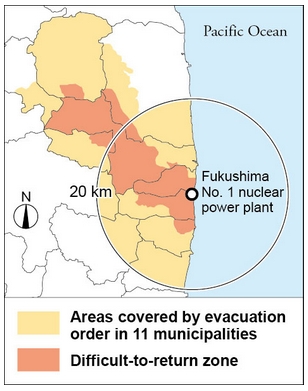
SIX YEARS AFTER: Fukushima decontamination near-complete in evacuated areas
Decontamination work in areas covered by the evacuation order from the 2011 Fukushima nuclear disaster is expected to conclude this month, paving the way for evacuees from the affected communities to return home.
With the project’s completion, the government’s focus will shift to the cleanup of heavily contaminated areas near the crippled Fukushima No. 1 nuclear power plant and infrastructure building.
The areas covered in the Environment Ministry’s decontamination project constitute those in 11 municipalities, including Okuma and Futaba, the two towns co-hosting the nuclear complex.
The decontamination project got under way there in fiscal 2012 to remove soil, fallen leaves and other materials contaminated by radioactive substances primarily in residential areas, roads, and rice paddies and fields.
But the areas collectively known as the difficult-to-return zone where annual radiation doses were estimated to exceed 50 millisieverts as of the end of 2011 and still estimated at more than 20 millisieverts five years after the disaster were excluded from the decontamination work in those 11 local governments.
The cleanup in nine municipalities has already been completed, while the project in the remaining two is expected to finish this month, according to the government.
The completion of the project comes after the Cabinet approved a policy to finish decontamination by the end of March 2017 at a meeting in March 2016.
The evacuation order for Okuma and Futaba will remain in place even though the cleanup project will soon be over.
But the government expects to lift the order for people from the remaining nine municipalities, except for residents from the difficult-to-return zone, by April 1.
That will make the total area remaining under the evacuation order 30 percent of the size six years ago.
According to the ministry, decontamination operations have been carried out in 99 local governments in and outside of Fukushima Prefecture, costing about 2.6 trillion yen ($23.56 billion) over the past five years.
Although the government initially covers the costs of decontamination, it sends the bill to Tokyo Electric Power Co., the plant’s operator.
Despite the cleanup project, many evacuees will likely remain anxious about radiation exposure when they return because forests and woods except for those close to residential areas have not been decontaminated.
The government envisages setting up hubs for rebuilding the difficult-to-return zone by carrying out an intensive cleanup to make the areas habitable by 2022.
No comments yet.
1 This Month

of the week – Shut Down Drone Warfare!


Tell the Ukrainian Government to Drop Prosecution of Peace Activist Yurii Sheliazhenko

Petition to revoke the licensing of the Near Surface Nuclear Disposal Facility (NSDF) at Chalk River. https://www.ourcommons.ca/petitions/en/Petition/Details?Petition=e-7247
To see nuclear-related stories in greater depth and intensity – go to https://nuclearinformation.wordpress.com
-
Archives
- April 2026 (68)
- March 2026 (251)
- February 2026 (268)
- January 2026 (308)
- December 2025 (358)
- November 2025 (359)
- October 2025 (376)
- September 2025 (257)
- August 2025 (319)
- July 2025 (230)
- June 2025 (348)
- May 2025 (261)
-
Categories
- 1
- 1 NUCLEAR ISSUES
- business and costs
- climate change
- culture and arts
- ENERGY
- environment
- health
- history
- indigenous issues
- Legal
- marketing of nuclear
- media
- opposition to nuclear
- PERSONAL STORIES
- politics
- politics international
- Religion and ethics
- safety
- secrets,lies and civil liberties
- spinbuster
- technology
- Uranium
- wastes
- weapons and war
- Women
- 2 WORLD
- ACTION
- AFRICA
- Atrocities
- AUSTRALIA
- Christina's notes
- Christina's themes
- culture and arts
- Events
- Fuk 2022
- Fuk 2023
- Fukushima 2017
- Fukushima 2018
- fukushima 2019
- Fukushima 2020
- Fukushima 2021
- general
- global warming
- Humour (God we need it)
- Nuclear
- RARE EARTHS
- Reference
- resources – print
- Resources -audiovicual
- Weekly Newsletter
- World
- World Nuclear
- YouTube
-
RSS
Entries RSS
Comments RSS
 nuclear-news
Leave a comment