In early November 1983, after President Ronald Reagan denounced the Soviet Union as the “evil empire” and unveiled his so-called Star Wars missile defense strategy, Kremlin leaders were growing convinced that war games planned by the United States and NATO in Western Europe were, in fact, a disguised prelude to a nuclear first strike on Russia.
Their fear was almost palpable. On Sept. 27, a Soviet early warning station had received signals that five incoming Minuteman intercontinental missiles had been launched from American bases. The duty officer, Col. Stanislav Petrov, made a split-second gut decision that proved correct: He concluded that a satellite glitch had triggered a false alarm.
Six weeks later, as the war games began with realistic precision, fully armed Soviet fighters were placed on alert at Polish and East German bases for the first and only time in the Cold War. Soviet helicopters began ferrying nuclear weapons from storage sites to launching pads. Civilian aircraft in Warsaw Pact nations were grounded while the Soviets launched three dozen spy-plane flights over Western Europe to assess whether the mobilization presaged a sneak attack.
At Ramstein Air Base in West Germany, where the United States Air Force had its European headquarters, Lt. Gen. Leonard H. Perroots, the deputy chief of staff for intelligence there, faced, like Colonel Petrov, a quandary — one with profound potential consequences.
The war games had already made Moscow jumpy. NATO planes visibly armed with what turned out to be dummy nuclear warheads were seen leaving their hangars. A further tit-for-tat escalation could have provoked war.
But General Perroots, making his own quick judgment call, defused the situation. He saw the signs of an elevated Soviet military alert but decided not to respond.
Conflict was averted, but more than 30 years would pass before his pivotal role in the episode was disclosed. A top-secret presidential advisory board analysis released in 2015 concluded that he had made a “fortuitous, if ill-informed” decision during the training exercise, designated Able Archer 83.
General Perroots died on Jan. 29 in Lake Ridge, Va. He was 83.
“Had Perroots mirrored the Soviets and escalated the situation, the War Scare could conceivably have become a war,” Nate Jones wrote last year in “Able Archer 83: The Secret History of the NATO Exercise That Almost Triggered Nuclear War.”
He added, “Fortunately, Perroots trusted his gut, and Able Archer 83 ended without nuclear incident.”
Mr. Jones is director of the Freedom of Information Project of the National Security Archive at George Washington University, a nongovernment group that focuses on transparency. The organization had sought the declassification of the report, written in 1990.
General Perroots went on to direct the Defense Intelligence Agency from 1985 to 1988 under President Reagan. He also oversaw efforts to find American military veterans still missing in action in Southeast Asia more than a decade after the Vietnam War ended.
Leonard Harry Perroots Sr. was born on April 24, 1933, in Morgantown, W. Va., the son of Phillip Perroots, an Italian-born stone mason, and the former Alma Perrini….
In the wake of President Trump’s comments that NATO is “obsolete”, and European ‘leaders’ renewed calls for a European army, Angela Merkel has been forced to deny Germany is interested in acquiring nuclear weapons amid calls for it to lead a European “nuclear superpower.”
As we noted previously, calls for an EU Army pre-exist current trends among Europeans and Americans to reject international institutionalism for a more nationalistic, sovereign state oriented model of governance. The Guardian was reporting in 2015 that European Commission President Jean-Claude Juncker was calling for an EU Army to show Russia that the bloc was “serious about defending its values.” The shock result of Brexit merely accelerated plans within the EU that were already in progress.
But with Trump’s NATO comments, chatter picked up further in recent weeks of the need for the European Union to invest in its own nuclear deterrent.
Jaroslaw Kaczynski, the head of Poland’s ruling party, told a German newspaper this week he would “welcome an EU nuclear superpower”.
A senior MP from Mrs Merkel’s Christian Democrat party (CDU) has called for Germany to press for a European nuclear deterrent.
Spiegel magazine has questioned whether it is time for Germany to acquire its own nuclear weapons.
And the Financial Times has called for Germany to “think the unthinkable” on the issue.
As The Guardian reports, the German Government has moved quickly to stymie those rumors…
“There are no plans for nuclear armament in Europe involving the federal government,” a spokesman for Angela Merkel said.
Leading voices in Germany have warned that the country acquiring its own nuclear weapons is not the solution.
“We would open Pandora’s box and start an arms race,” General Hans-Lothar Domröse, a former Nato commander, said. “It would make it even more difficult to prevent other countries like Iran from getting the bomb.”
The Canadian Nuclear Safety Commission (CNSC) is offering participant funding to assist members of the public, Indigenous groups and other stakeholders in reviewing its Regulatory Oversight Report for Canadian Nuclear Power Plants: 2016 (2016 NPP Report) and in submitting comments to the Commission. This report provides CNSC staff’s assessment of the Canadian nuclear power industry’s safety performance during 2016 and details the progress of regulatory issues and initiatives up to April 30, 2017.
The CNSC will hold a public meeting on August 16 or 17, 2017 in Ottawa, where CNSC staff will present the 2016 NPP Report to the Commission. The report assesses how well plant operators are meeting regulatory requirements and program expectations in areas such as human performance, radiation and environmental protection, and emergency management and fire protection.
Participant funding of up to $35,000 is being offered for the provision of new, distinctive and valuable information, through informed and topic-specific written submissions to the Commission.
The CNSC regulates the use of nuclear energy and materials to protect health, safety, security and the environment; to implement Canada’s international commitments on the peaceful use of nuclear energy; and to disseminate objective scientific, technical and regulatory information to the public.
The CNSC publishes a report on the safety performance of Canada’s nuclear power plants each year.
The report highlights emerging regulatory issues pertaining to the industry at large and to each licensed station.
The CNSC evaluates how well licensees meet regulatory requirements and its expectations for the performance of programs in 14 safety and control areas.
As announced, TEPCO has inserted a cleaner robot onto the gangway in the Reactor 2 containment enclosure. It is equipped with a snowplow at the front, two cameras and a jet of pressurized water.
The robot was able to clean only one meter instead of the 5 expected. According to the Japanese document put online by TEPCO, in some places deposits were more adherent than expected, which slowed down the robot’s progress.
There are areas where the robot could not move forward. There are up to 2 cm of deposits that can be insulation and paint that have melted before sticking to the bridge. On a first attempt, the water pump did not work.
After two hours of activity, the cameras became obscured and the robot was quickly removed. TEPCO believes this is due to extremely high radiation levels.
The camera can only withstand a cumulative dose of about 1000 Sv. The analysis of the images gives an approximate dose rate of 650 Sv / h. This is even more than the recorded dose few days ago (530 Sv / h).
The company is reluctant to send the scorpion measuring robot because it could only take data for two hours.
It is not under the reactor vessel that the dose rates are the highest and TEPCO does not understand why.
TEPCo has released a new series of photos and a video. The video shows the magnitude and the difficulty of the task expected for this small robot.
The daily Asahi has posted a video report on the Fukushima dai-ichi plant. This is in Japanese.
One sees first the reactor n ° 1 where there are 150 microsieverts per hour in the vicinity and then the reactor n ° 3 where the dose rate in the vicinity rises to 335 microsievert per hour.
Then we see the Reactor No. 2 and the recent images taken by TEPCO on the inside of the confinement enclosure.
Then the tanks with contaminated water, followed by archive images without the tanks. It is explained that the water stock is increasing by 200 m3 per day currently. There are nearly a thousand tanks now.
At the end of the report, we see that the working and living conditions on the site have improved and that there is no need to wear a full face mask anywhere.
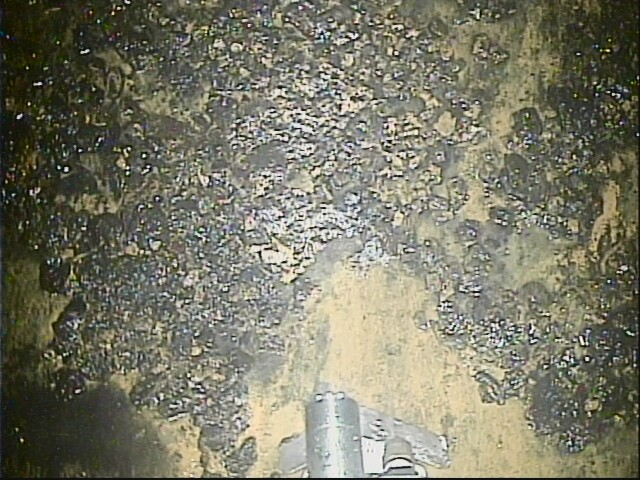
A pressure washer-equipped robot clears the path inside the containment vessel of Fukushima No. 1 nuclear power plant’s No. 2 reactor on Feb. 9. The black lumps are believed to be melted fuel. (Provided by Tokyo Electric Power Co.)
The road to decommissioning Fukushima No. 1 nuclear power plant’s No. 2 reactor could be rockier than expected, as radiation levels on Feb. 9 were even deadlier than those recorded in late January.
Tokyo Electric Power Co. announced that day that radiation levels inside the reactor were estimated at up to 650 sieverts per hour, much higher than the record 530 sieverts per hour marked by the previous survey.
A camera attached to the robot deployed inside Fukushima No. 1 nuclear power plant’s No. 2 reactor shows how it clears its path covered with debris and deposits using a pressure washer. (Captured from video provided by Tokyo Electric Power Co.)
A camera made its way inside the reactor’s containment vessel for the first time on Jan. 30 and spotted fuel rods that had melted into black lumps in the nuclear accident in the aftermath of the 2011 Great East Japan Earthquake and tsunami disaster.
The plant operator made the latest estimate from the amount of camera noise experienced by the robot that ventured into the lion’s den that morning.
Equipped with a pressure washer, the machine was deployed to pave the way for the Sasori (scorpion) robot that is set to survey the reactor’s interior in greater detail.
The robot’s task was to hose down melted fuel and other substances as it traveled along a rail measuring 7 meters long and 0.6 meter wide connecting the outer wall of the containment vessel with the reactor’s core. It started operating from a point located 2 meters from the exit of the tunnel bored into the side of the vessel.
But about two hours into its journey, in which it had progressed about a meter, the camera footage started getting dark, TEPCO said. The amount of radiation emitted by the melted fuel may have taken a toll on the camera’s well-being.
As the robot could be left stranded inside the vessel if the camera broke down completely, the utility called off the operation seven hours earlier than scheduled and retrieved the device.
TEPCO analyzed the footage and concluded that the doses amounted to about 650 sieverts per hour, which is deadly enough to kill a human in less than a minute.
As the robot’s camera was designed to withstand a cumulative dosage of 1,000 sieverts per hour, the utility commented that “it’s consistent with how the camera started to break down after two hours.”
The plant operator plans to deploy the Sasori surveyor robot before the end of February.
“We will be assessing the amount of deposits and debris to decide how far Sasori can advance,” a TEPCO official said.
We read with interest the paper by Ohira et al. of thyroid ultrasound examinations in Fukushima, which examines the relation between external radiation dose and thyroid cancer prevalence among Fukushima children.1 However, we point out that their classification of 59 municipalities in Fukushima prefecture into 3 areas is inappropriate. The “lowest dose area” was constituted of Aizu area with least thyroid dose and a distant Iwaki city with the highest thyroid dose, which led to a wrong conclusion that the external radiation dose was not associated with thyroid cancer prevalence among Fukushima children.
Ohira et al. of Fukushima Medical University examined the association between the prevalence of thyroid cancer and radiation dose among Fukushima residents.1 They used external radiation dose estimated by Fukushima Health Management Survey (FHMS) based on individual external doses from behavior data of 26.4% residents who responded the questionnaire.2 They classified municipalities based on fraction of respondents: “highest dose area” (≥1% received external radiation exposure of ≥5 mSv), “lowest dose area” (≤1% received ≥1 mSv), and the other “middle dose area”. Mainly because the prevalence of thyroid cancer was found not to decrease in this order of decreasing external dose, they concluded that external dose due to nuclear accident is not associated with thyroid cancer prevalence. However, their classification of municipalities based on fraction of residents (1%) whose exposure exceeds 5mSv and 1mSv does not represent the average exposure dose in each municipality. Moreover, they seem to have made a serious mistake in their classification as follows.
Internal exposure to I-131 is known to be closely associated with the incidence of thyroid cancer among children. The UNSCEAR report on absorbed dose in thyroid 3a,b shows that the Ohira et al.’s “lowest external dose area” is composed of the Aizu area with least thyroid dose and a distant Iwaki city with the highest thyroid dose in Fikushima prefecture except evacuation zone. In a recent estimation of internal thyroid dose using a combination of thyroid measurement data, whole-body counter measurement data and atmospheric transport dispersion simulations, the residents of three municipalities including Iwaki city were shown to have the highest thyroid equivalent dose in Fukushima prefecture. 4 The “lowest external dose area” is found to be composed of the lowest dose Aizu area and the highest thyroid dose Iwaki city. Incidence rates of thyroid cancer for the highest, middle and lowest external dose areas in ref. 1 and those for Aizu and Iwaki districts constituting the “lowest dose area” are listed in Table 1. The average total effective dose to 10-year-old children estimated by UNSCEAR3b,c shows that the effective dose of Iwaki city is the 18th highest in 59 municipalities. If Iwaki city is classified as “middle external dose area” instead of “the lowest external dose area”, dose response of thyroid cancer prevalence may be recovered.
The conclusion of ref. 1 that external radiation dose due to nuclear accident is not associated with thyroid cancer prevalence among Fukushima children is found to come from the wrong constitution of the “lowest dose area” as a sum of Aizu with lowest thyroid dose and Iwaki city with the highest thyroid dose. External radiation dose estimation may possibly reveal the dose dependence of thyroid cancer, if it is used carefully with referring to various estimations of external dose and absorbed dose in thyroid.
1. Ohira, T, Takahashi H, Yasumura S, et al. Comparison of childhood thyroid cancer prevalence among 3 areas based on external radiation dose after the Fukushima Daiichi nuclear power plant accident: The Fukushima health management survey. Medicine. 2016; 95(35): p e4472 doi: 10.1097/MD.0000000000004472
2. Fukushima Health Management Survey, Basic Survey Appendix: Estimated external radiation dose, Web site. http://fmu-global.jp/?wpdmdl=1872 Published Sep. 15, 2016, Accessed January 11, 2017.
3. UNSCEAR 2013 Report Vol. I Sources, Effects and Risks of Ionizing Radiation. Published 2014 March, Accessed January 11, 2017.
4. Internal thyroid doses to Fukushima residents—estimation and issues remaining. Kim E, Kurihara O, Kunishima N, Momose T, Ishikawa T, Akashi M. J Radiat Res. 2016 Aug; 57(Suppl 1): i118–i126.
I don’t know which is the worst news this week – climate or nuclear. But I am going away for a week on a boat, WITH NO ACCESS TO ANYTHING DIGITAL. I can’t wait. I’m taking one of those old things we all used to use – A BOOK.
Fortunately, there is a bit of good news in his heap of radioactivity. Last November, asettlement was reachedbetween the US Department of Justice, Bechtel Corp. and AECOM (formerly URS) for a whopping $125 million. The civil lawsuit alleged taxpayer funds were mismanaged and that both companies performed shoddy work. The lawsuit also claimed that government funds were illegally used to lobby members of Congress. Brought on by whistleblowers Gary Brunson, Donna Busche, and Walter Tamosaitis (Busche and Tamosaitis’s sagas were highlighted intwo Investigative Fund reportsI authored for Seattle Weekly in 2011 and 2012), the settlement was one of the largest in DoE history.
No doubt it was a substantial victory for whistleblowers and government accountability, despite the fact that the defendants did not admit guilt. Now, Washington State legislators are pushing HB 1723, a bill that would protect and treat Hanford workers for certain health problems that are a result of the work they’ve done at the facility, such as respiratory problems, heart issues, certain cancers like bone, breast, lung and thyroid, as well as neurological issues.
Good News and Bad News at Hanford, America’s Most Polluted Site http://www.counterpunch.org/2017/02/09/good-news-and-bad-news-at-hanford-americas-most-polluted-site/FEBRUARY 9, 2017“The people running Hanford need to have a moral compass that directs them in the right way, as human beings, to do the right thing to protect these people,” retired Hanford employee Mike Geffre, who worked at Hanford for 26 years,told KING 5. “They’re trying to save money and save face. They’re standing behind their old position that there’s no problem. That’s absurd. They need to accept the fact that they made mistakes and get over it.”
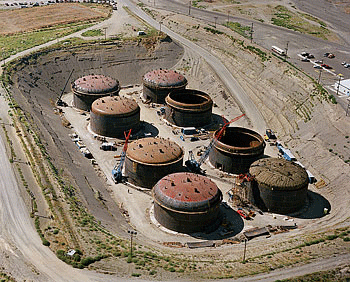
byJOSHUA FRANKIt’s a new year and new administration, but the strong radioactive stench is the same out at Hanford in eastern Washington, home of the world’s costliest environmental cleanup. In January, a dozen workers reported smelling a toxic odor outside the site’s tank farms, where nuclear waste is stored underground. From April to December 2016, 70 people were exposed to chemical vapors emanating from the facility — and 2017 is off to the similar start.
Toxic odors at an old nuclear depot? This would be startling news anywhere else. But this is Hanford after all, where taxpayer money freely flows to contractors despite the snail-paced half-life of their work.Twenty years and $19 billion later, Hanford is still a nightmare — likely the most toxic site in the Western Hemisphere. Not one ounce of nuclear waste has ever been treated, and there are no indications Hanford will be nuke free anytime soon. To date, at least1 million gallonsof radioactive waste has leaked and is making its way to the Columbia River. It’s an environmental disaster of epic proportions — a disaster created by our government’s atomic obsession during the Cold War era.
No doubt, Hanford is a wreck in search of a remedy, yet the costs covered by American taxpayers appears to be growing exponentially. At the tail end of 2016, the estimated cost of turning the radioactive gunk into glass rodsbumped up a cool $4.5 billion(adding to the ultimate price tag for the remaining Hanford cleanup, which had already reached a whopping $107.7 billion). These sorts of increases are so common they hardly make news anymore.
Donald Trump’s pick for Department of Energy Secretary, Rick Perry, who infamously stated he’d like to do away with the DoE altogether, now admits that Hanford’s one of themost dangerous facilities in the nation. But his commitment to cleaning up the fiscal and nuclear boondoggle remains to be seen. The plant that is to turn the waste into glass rods is set to open in 2023, but it’s a safe bet that won’t be happening. It’s already two decades behind schedule.
Meanwhile, workers on the front lines of the cleanup are often put in situations that are poorly monitored and exceedingly unsafe. Over the past three years KING 5 News in Seattle has tracked dozens of employeeswho were exposed to chemical vaporsat Hanford and found their illnesses to include “toxic encephalopathy (dementia), reactive airway disease, COPD, and painful nerve damage.”
“The people running Hanford need to have a moral compass that directs them in the right way, as human beings, to do the right thing to protect these people,” retired Hanford employee Mike Geffre, who worked at Hanford for 26 years,told KING 5. “They’re trying to save money and save face. They’re standing behind their old position that there’s no problem. That’s absurd. They need to accept the fact that they made mistakes and get over it.”
Fortunately, there is a bit of good news in his heap of radioactivity. Last November, asettlement was reachedbetween the US Department of Justice, Bechtel Corp. and AECOM (formerly URS) for a whopping $125 million. The civil lawsuit alleged taxpayer funds were mismanaged and that both companies performed shoddy work. The lawsuit also claimed that government funds were illegally used to lobby members of Congress. Brought on by whistleblowers Gary Brunson, Donna Busche, and Walter Tamosaitis (Busche and Tamosaitis’s sagas were highlighted intwo Investigative Fund reportsI authored for Seattle Weekly in 2011 and 2012), the settlement was one of the largest in DoE history.
No doubt it was a substantial victory for whistleblowers and government accountability, despite the fact that the defendants did not admit guilt. Now, Washington State legislators are pushing HB 1723, a bill that would protect and treat Hanford workers for certain health problems that are a result of the work they’ve done at the facility, such as respiratory problems, heart issues, certain cancers like bone, breast, lung and thyroid, as well as neurological issues.
“Currently, many Hanford workers are not receiving necessary medical care because they are put in the impossible situation of being unable to specify the chemicals to which they have been exposed, and in what concentrations, making it difficult for their doctors to connect their disease with their exposures,” Randy Walli, Business Manager for the pipefitters union, Local 598,told King 5.
Compensation for whistleblowers and employees whose health is impacted by their work are steps in the right direction. But Hanford’s contractors and the DoE that oversees them still have much to do to make the increasingly expensive nuclear cleanup at Hanford, safe, effective and transparent.
Radiation levels inside Fukushima too high for robot http://www.cbc.ca/news/technology/fukushima-nuclear-robot-radiation-1.3973908 , The robot was to inspect and clean a passage before another robot does a fuller examination The Associated Press Feb 09, 2017A remote-controlled cleaning robot sent into a damaged reactor at Japan’s Fukushima nuclear plant had to be removed Thursday before it completed its work because of camera problems most likely caused by high radiation levels.
It was the first time a robot has entered the chamber inside the Unit 2 reactor since a March 2011 earthquake and tsunami critically damaged the Fukushima Da-ichi nuclear plant.
Tokyo Electric Power Co. (TEPCO) said it was trying to inspect and clean a passage before another robot does a fuller examination to assess damage to the structure and its fuel. The second robot, known as the “scorpion,” will also measure radiation and temperatures.
Thursday’s problem underscores the challenges in decommissioning the wrecked nuclear plant. Inadequate cleaning, high radiation and structural damage could limit subsequent probes, and may require more radiation-resistant cameras and other equipment, TEPCO spokesman Takahiro Kimoto said.
“We will further study (Thursday’s) outcome before deciding on the deployment of the scorpion,” he said.
TEPCO needs to know the melted fuel’s exact location and condition and other structural damage in each of the three wrecked reactors to figure out the best and safest ways to remove the fuel. It is part of the decommissioning work, which is expected to take decades.
During Thursday’s cleaning mission, the robot went only part way into a space under the core that TEPCO wants to inspect closely. It crawled down the passage while peeling debris with a scraper and using water spray to blow some debris away. The dark brown deposits grew thicker and harder to remove as the robot went further.
More obstacles for second mission
After about two hours, the two cameras on the robot suddenly developed a lot of noise and their images quickly darkened — a sign of a problem caused by high radiation. Operators of the robot pulled it out of the chamber before completely losing control of it.
The outcome means the second robot will encounter more obstacles and have less time than expected for examination on its mission, currently planned for later this month, though Thursday’s results may cause a delay.
Both of the robots are designed to withstand up to 1,000 Sieverts of radiation. The cleaner’s two-hour endurance roughly matches an estimated radiation of 650 Sieverts per hour based on noise analysis of the images transmitted by the robot-mounted cameras. That’s less than one-tenth of the radiation levels inside a running reactor, but still would kill a person almost instantly.
Kimoto said the noise-based radiation analysis of the Unit 2’s condition showed a spike in radioactivity along a connecting bridge used to slide control rods in and out, a sign of a nearby source of high radioactivity, while levels were much lower in areas underneath the core, the opposite of what would normally be the case. He said the results are puzzling and require further analysis.
TEPCO officials said that despite the dangerously high figures, radiation is not leaking outside of the reactor.
Images recently captured from inside the chamber showed damage and structures coated with molten material, possibly mixed with melted nuclear fuel, and part of a disc platform hanging below the core that had been melted through.
A bad START: Trump tells Putin U.S.-Russia treaty to limit nuclear weapons was a “bad deal”, Salon.com , FEB 10, 2017
The president reportedly didn’t know what the New START treaty was but wanted to get rid of it MATTHEW ROZSA , President Donald Trump has had another embarrassing phone call with a foreign leader — and this time there’s potentially dangerous consequences.
Trump described the New Strategic Arms Reduction Treaty, or START, signed by former president Barack Obama in 2010, as a bad deal for the United States, according to a Reuters report. The treaty requires America and Russia to cap their deployed strategic nuclear warheads at 1,550 by February 2018, as well as limit their deployed land- and submarine-based missiles and nuclear-capable bombers.
According to the sources who spoke with Reuters, however, Trump seemed unfamiliar with the details of New START when it was brought up by Russian leader Vladimir Putin. After Putin suggested extending New START beyond its original time frame, Trump referred to the treaty as one of many bad deals that Obama had negotiated.
If New START is not mutually extended, neither America nor Russia would be limited in their nuclear production, which could trigger a nuclear arms race.
The sources also say that Trump then turned the conversation toward the subject of his own supposed popularity within the United States. The official White House account of Trump’s Jan. 28 conversation with Putin did not mention a discussion about New START.
China’s nuclear missile policy put under strain by US plan CNBC, 10 Feb 17 David Reid | @cnbcdavy A decision by the United States to pursue a new breed of nuclear weapons could push China to reconsider its decades-long atomic policy, according to experts.
The U.S. Defense Department recently recommended the government develop tactical nuclear weapons with “low yield” results that can be deployed within smaller battlefield areas.
Tong Zhao, an associate in the Carnegie Endowment’s Nuclear Policy Program based in Beijing, told CNBC Wednesday that this more flexible form of weapon would lower the threshold of nuclear use.
“This will be seen by China as evidence of U.S. contemplating first use of nuclear weapons in a future crisis and will encourage China to consider pursuing similar capabilities that may undermine the no-first-use policy,” he said in an email.
China’s “no-first-use policy” means Beijing only demands the capability to ensure the launch of a nuclear missile, after being hit first by an enemy nuclear strike.
U.S. President Donald Trump signed an executive order on January 27, requiring Defense Secretary James Mattis to review America’s nuclear prowess.
Zhao said U.S. plans to pursue a global missile network, initiated by the Obama administration, may be viewed by China as a threat to its own small deterrent and could mean a switch to a “launch-on-warning” policy, whereby China would retaliate before enemy missiles hit land.
“The new U.S. administration seems very much devoted to developing and deploying a massive global and layered missile defense network that protects not only U.S. homeland, U.S. allies, and friends, but also U.S. bases and troops wherever they are located or deployed.
“To make sure that there would be enough Chinese nuclear weapons to survive a U.S. first strike and not be neutralized by U.S. missile defense, China may have an increasing incentive to adopt the launch-on-warning posture,” he said.
It is extraordinary that some French wine producers are accompanying the Australian and French nuclear promoters spruiking the benefits of nuclear waste dumping to the community in the Barndioota region of South Australia. Not only are many vital questions unanswered as ENuFF SA (Everyone for a Nuclear Free Future SA) has shown, but this propaganda campaign completely ignores both the opposition to nuclear waste dumping, in France and the radioactive danger to France’s Champagne vineyards
“The Champagne producers are facing two nuclear timebombs – one already leaking at Soulaine, and one planned at Bure. The wine producers in the Rhone region stood up to the nuclear state in France and won. The Champagne region needs to act fast before it’s too late,” said Fred Marillier of Greenpeace France. “The French Government must stop this madness. The new facility must not accept any more waste, and an immediate investigation launched into how to stop further contamination of ground water.”
Radioactive waste leaking into Champagne Water Supply, Levels set to rise warns Greenpeace, Greenpeace 30 May, 2006 Greenpeace today revealed that France’s iconic sparkling wine, Champagne, is threatened by radioactive contamination leaking from a nuclear waste dumpsite in the region. Low levels of radioactivity have already been found in underground water less than 10 km from the famous Champagne vineyards.
Problems at the dumpsite, including water migration leading to fissures in the storage cells have been reported to French nuclear safety agency in recent weeks (1). Greenpeace has written to the Comita des Producteur de Champagne to warn them that their production risks contamination, as experienced by dairy farmers in la Hague, Normandy.
The waste dump, Centre Stockage l’Aube (CSA) in Soulaine eastern France, contains mostly waste from Electricite de France (EdF) and AREVA, but also includes foreign nuclear waste disposed of illegally under French law (2). Every week nuclear waste is trucked across France to the Champagne site. Once full, the dumpsite will be one of the world’s largest with over 1 million cubic meters of waste, including plutonium and other radionuclides.
ANDRA, the national nuclear waste agency operating the site, stated that it would not release any radioactivity into the environment when given permission for the dumpsite in the late 1980’s. Greenpeace research released last week showed levels of radioactivity leaking from another dumpsite run by ANDRA in Normandy were up to 90 times above European safety limits in underground water used by farmers, and that the contamination was spreading into the countryside (3). The Champagne site will receive a total of 4 thousand terabequerels of tritium; more than three times the amount of tritium waste as the dumpsite in Normandy.
“We have been told for decades that nuclear dumpsites will not leak and that the best standards are being applied. In reality the dumpsite in Normandy is a disaster, and radioactivity is already leaking from the dumpsite in Champagne,” said Shaun Burnie nuclear campaigner at Greenpeace International. “The authorities know they have a problem in Champagne already, with mistakes in the design. This is only the beginning of the problem, the bigger picture is that France has a nuclear waste crisis out of control that is threatening not only the environment and public health but also the economy of the Champagne region.”
In addition to the problems with the waste stores at the site, Greenpeace has learnt recently that French nuclear safety agency DGSNR has written to AREVA seeking clarification of the type of waste being disposed of at the Champagne site (4).
In addition to the low and intermediate waste site, a new high-level waste dumpsite is being planned in Bure also in the Champagne region, in which the most radioactive material in France would be deposited. Plans to build a high level waste facility in the Rhone Valley were scrapped a few years ago after strong opposition by the wine producers due to the threat to their vines and wine production.
“The Champagne producers are facing two nuclear timebombs – one already leaking at Soulaine, and one planned at Bure. The wine producers in the Rhone region stood up to the nuclear state in France and won. The Champagne region needs to act fast before it’s too late,” said Fred Marillier of Greenpeace France. “The French Government must stop this madness. The new facility must not accept any more waste, and an immediate investigation launched into how to stop further contamination of ground water.”……http://www.greenpeace.org/international/en/press/releases/radioactive-waste-leaking-into/
In this new political era, climate scientists and their science are under attack. The attack is from multiple fronts, from threats to pull funding of the important instruments they use to measure climate change, to slashing their salaries and jobs. But there is a real fear of renewed personal attacks, and it appears those fears are now being realized. What the attackers do is identify and isolate scientists – a process termed the “Serengeti Strategy” by well-known and respected scientist Michael Mann who suffered these types of attacks for years.
The author of the recent attack piece, David Rose in the UK, has a history of denying the well-established science of climate change. He has a long history of making incorrectclimatechangestatements. In the attack, Mr. Rose claims that scientists used misleading data in a recent (2015) paper that studied the rate of temperature change across the globe. He reportedly obtained information from someone who works at NOAA to imply that internal review procedures were not followed as the paper was prepared for publication. What Mr. Rose omitted however, is incredibly telling and he does a disservice to his readers.
The second thing Rose neglects to mention is that his story’s source was never involved any part of the work. According to a colleague of the authors Peter Thorne, this source:
never participated in any of the numerous technical meetings on the land or marine data I have participated in at NOAA NCEI either in person or remotely. This shows in his reputed (I am taking the journalist at their word that these are directly attributable quotes) misrepresentation of the processes that actually occurred. In some cases these misrepresentations are publically verifiable.
Mr. Rose further neglects to mention that Dr. Karl was not involved in the development of the critical sea surface temperature data that was used in the study. That information was already published before the Karl paper appeared.
The attack piece also claims that the scientists discarded high-quality temperature measurements in favor of low quality data. This claim is demonstrably false, as described here and here.
The lengths to which Mr. Rose goes in his attack are disheartening and dishonest. He includes a graph that appears to show two temperature results that disagree. When they are replotted correctly, as temperature anomalies with correct baselines, the discrepancy disappears. This finding shows that the NOAA results from 2015 actually agree extremely well with data from other institutions.
Calls to scrap nuclear deal during #SONA2017,SONA / 9 February 2017, SAMKELO MTSHALI, Durban – Civil society organisations and other critics of government’s proposed multibillion-rand nuclear plan called on President Jacob Zuma to scrap it during his State of the Nation address tonight.
The South Durban Community Environmental Alliance (SDCEA) picketed outside City Hall on Wednesday and handed over a memorandum to the eThekwini Municipality, detailing their opposition to the nuclear plan.
Today in Cape Town the Right2Know Campaign is expected to add its voice to growing criticism of plans to build nuclear power stations in South Africa. Desmond D’Sa, SDCEA chairperson, said the deal had been shrouded in secrecy and accused the government of not consulting with communities.
“Ultimately it’s the poor and working class of this country who will have added pressure to pay for these nuclear power stations that cost so much money. “This money should instead be used for better access to healthcare facilities, education and other basic necessities,” D’Sa said.
He pointed out that a single nuclear powered plant would take close to a decade to build. With government planning on building six to eight, it would take about 30 to 40 years before all were completed. “If you take half the money of the nuclear deal, R500billion, and invest it in setting up companies in renewable energy projects , you could create over a million jobs ,” said D’Sa.
He said setting up these companies in townships such as uMlazi, KwaMashu, Soweto, Alexandra, Gugulethu and Langa would go a long way in addressing the high rate of unemployment, which stands at 26.6%.
He said this was the route countries like India, the US and China had followed.
“Nuclear energy is harmful……..
Carina Conradie, of the Right2Know Campaign, said they were concerned about the affordability of the nuclear deal because nuclear energy was one of the most expensive forms of energy. “Wind and solar energy are much better and cost-effective alternatives to nuclear energy,” she said.
Questioning the legitimacy of the deal, Conradie said: “There have been reports of secret deals with Russia and even the procurement process was not above board; it was shrouded in secrecy.”
She said they had strategically planned their demonstrations around Sona 2017 because it was important the issue remained at the forefront of the public’s thoughts and on the tip of their tongues.











 nuclear-news