Tokyo Electric Power Co. said Jan. 30 it may have finally pinpointed the location of melted fuel at the Fukushima No. 1 nuclear plant, nearly six years after the triple meltdown unfolded there.
If confirmation is made, it would represent a breakthrough in the daunting task of decommissioning the stricken nuclear plant.
A remote-controlled camera fitted on a long pipe detected black lumps on grating in the lower part of the containment vessel of the No. 2 reactor at the plant early on Jan. 30, TEPCO said.
The wire-mesh grating is located below the pressure vessel of the reactor. The lumps were not there before the Great East Japan Earthquake and tsunami on March 11, 2011, caused the nuclear disaster, according to TEPCO.
The utility plans to determine whether the lump is melted fuel based on images and radiation levels taken by an investigative robot and other data. The robot, called “Sasori” (scorpion) and fitted with two cameras, a dosimeter and a temperature gauge, will be sent into the No. 2 reactor containment vessel next month.
High radiation levels have hampered efforts at the nuclear plant to determine the condition and location of melted nuclear fuel.
TEPCO tried–and failed–three times to locate melted fuel using an industrial endoscope at the No. 2 reactor.
The latest investigation inside the No. 2 reactor began on Jan. 26 to locate the melted fuel.
The company is preparing to devise a method to retrieve the melted fuel in fiscal 2018 as part of the decommissioning work.
The image shows what is believed to be the remains of melted nuclear fuel that seeped through the grating below the pressure vessel of the No. 2 reactor at the Fukushima No. 1 nuclear power plant. (Provided by Tokyo Electric Power Co.)
On Tuesday, the Doomsday Clock was moved 30 seconds closer to midnight by “Scientists” says the web Telegraph, with video and scary musical accompaniment.
The Bulletin of the Atomic Scientists Doomsday Clock first appeared in 1947. Everyone was reeling from the photographs of the vaporization of Hiroshima. It was thought that atomic war would wipe out everyone on earth. This almost happened in the 1962 Cuban Missile Crisis, which the top page of Google informs us was a “direct and dangerous confrontation between the United States and the Soviet Union during the Cold War.”
I didn’t need to go to Google to find this out. It was a defining moment in my life. Women were refusing to have children because they didn’t want them to live in a world of fear and probable atomization. We moved to the Welsh mountains in a pathetic attempt to do something, anything, and stocked up on food. In America, there was a brisk trade in fallout shelters. It was my friend, the late Ernest Sternglass, who stopped the atmospheric testing by getting to President Kennedy with the calculation that several million children had died from exposure to fallout Strontium-90 building up in the milk and their bones – seeds planted for the global cancer epidemic that began 20 years later.
The Doomsday clock signaling nuclear annihilation at midnight is a simple illustration of the fact that, although life on Earth has been around for billions of years, Clever Old Man has developed a system that could switch it off with an hour-long fireworks extravaganza. Now it has been extended to global warming, virus pandemics, and more or less anything that the media has decided makes a good scare story. The clock has now been advanced to two and a half minutes to midnight. By Scientists.
This is the way the World ends—not with a bang, but a whimper. – T.S. Eliot; The Hollow Men, 1925
Let’s think about this a bit. What scientists? The clock is not a scientific concept. It is an emotional cry for help. What are these scientists using as data for their decision? In the last ten years, for all sorts of reasons relating to the destabilization of the world through various obviously organized operations (Twin Towers, Al-Qaeda, Iraq, Afghanistan, Libya, Egypt, Syria etc.), a kind of continuous bombing operation on poor countries has contributed to the profits of arms manufacturers. Added to all this is the US abandonment of the arms limitation agreements and the re-investment in missile development. We see NATO creeping closer to Russia, and the absurd attempts by the US to bring Ukraine into the operation. Is this why the clock has been moved?
No. It is apparently Donald Trump.
In the post-truth era, belief is created by the media: Google (again) reports that the Guardian, Telegraph, and “Science” blame the movement of the clock’s hands on the election of Mr. Trump. ABC10 seems to think it is global warming. But global warming, even in worst case scenarios, won’t wipe out life on Earth. And a virus pandemic would always have some survivors. A total nuclear exchange would not: so that is what we are dealing with. It is still a real possibility. But not because of Donald Trump. The election of Trump, and Brexit also, is a spontaneous creation of civil society in countries that have seen their lives ruined by globalization and what has been called “the New World Order.”
What I see in Mr. Trump is an independent flamboyant showman along the lines of an earlier US President, Andrew Jackson – a man who also tried to destroy the US establishment. Trump clearly thinks outside the system of smoke and mirrors that passes for Western media news, the constructions on the web and TV and newspapers that are increasingly spun and slanted with nonsense and demonstrable lies about the state of the world. Like the Doomsday clock story.
If I were running the Doomsday clock, the election of Trump would make me put the clock back rather than forward. He doesn’t trust the US security services. He disassociates his Presidency from the collection of dodgy characters previously running the show. This was a revolution against the fat-cat control of America and its continuous war against the people on the planet, fought as if the world was a battleground. This machine that emerged in the post-war period is well known to readers of spy novels. It was fueled by paranoia about Communism and the immense amounts of power and wealth associated with developing and manufacturing weapons. When the Soviet Union broke up and the US could no longer justify the huge military budget (presently about 600 billion dollars), other enemies had to be found. Bombs had to be dropped on someone, in order to order new ones. Hence the continuous and endless wars about “democracy” and “freedom.”
Let’s look at some scenarios. How big an exchange would represent apocalypse? A baseline is the atmospheric testing that peaked in megaton yield and radioactive fallout in 1959-63. This did not wipe out humanity, although there was a mini nuclear winter in the 60s. The European Committee on Radiation Risk estimated some 60 million extra cancers together with a few million dead babies (about 0.2% of births) as the consequence.
Nuclear exchanges between India and Pakistan, or Israel and Iran, would not do the trick. The number of warheads involved would result in some mega-Hiroshimas and global fallout contamination would jump, but there would be no end of the world. The combined yield of the approximately 100+100 warheads (say 200 kilotons each) would be just about equal the yield of the 1962 Tsar Bomba 50-megaton test on its own. And Iran has no nuclear weapons, but even if it had, an Israel-Iran exchange would be even feebler than India-Pakistan. North Korea? The same. As for China, it has no real enemies, and the Chinese have always been traders rather than invaders. China is doing alright and doesn’t need to attack anyone.
So, what is the real Doomsday threat? It is the US government’s obsession with Russia, the tail of the Cold War guard dog of the spy novels. It is the encroachment of NATO (let’s be clear, of the US war machine) on the borders of Russia. It is the deployment of sophisticated (and enormously expensive) antimissile systems in countries like Rumania and Poland. It is the crazy world view of NATO and US generals who want to (and have) put troops and materiel into the Baltic States (where I live), on the basis that the “expansionist Russians” are intent on marching over the borders of Latvia and taking back their lost empire.
Since I moved to Riga in 2010, I have seen the NATO infestation of the country. New (US) tanks with the Latvian Flag rumble though the villages, and helicopters thud overhead disturbing the badgers and deer in the forest. Russia has no need to invade Latvia; it can get what it wants or needs. But the media whip up a frenzy of fear that there will be a Russian invasion. There is even a book about this insanity written by a general, retired Deputy NATO commander Sir Richard Shirreff.
Like most things in politics, this is about money. The Media demonizes Trump because he won’t follow the master plan to globalize the planet, driving down unit costs by moving manufacturing around to the lowest wage countries. And the plan to control access through fake democracy wars to diminishing resources (oil) whilst making huge amounts of money for the arms manufacturers that are supplying the global battlefield – Raytheon, Boeing, McDonnell Douglas et al. Trump has said he will increase military spending in the USA, but stop importing weapons, a kind of Keynesian approach to “Making America Great Again,” but as I see it this will not necessarily affect the NATO/ Russia tinderbox. It may rather cause European countries to require NATO to buy weapons in Europe, or even to abandon NATO and set up a European version.
I myself still have an iron in this fire. Inspired by the Perdana Peace Foundation’s campaign to criminalize war, Ditta Rietuma, general secretary of NationalState.INFO, and I have addressed these issues and their solution for some years in conferences in three languages from Latvia and Sweden, for example, recently at the Latvian Academy of Sciences in Riga.
The real Doomsday clock passed midnight long ago. The mad race to extinction fueled by the market-forces laissez faire Western system has created a monster: a system that is not really controlled by anyone, but drives itself with only one imperative – to become richer and more powerful, so as to become richer and more powerful.
This monster has no soul; it was not constructed to look after life on the planet. Following the nuclear fallout, and nuclear energy accidents, the depleted Uranium, and now the fracking, background radioactivity is continuously increasing. The fertility rate is falling. IVF is advancing. Cancer is an epidemic in real terms. This is the way the world ends. Not with a bang, but a whimper.
New York readies for nuclear energy from aging power plants, Herald Net, Jan 29th, 2017 By David Klepper Associated Press OSWEGO, N.Y. — When the Nine Mile Point reactor first went online, Richard Nixon was president, the Beatles were still a band and Three Mile Island, Chernobyl and Fukushima weren’t yet bywords for the hazards of nuclear power.
Almost 50 years later, New York state is betting big on the future of Nine Mile Point, one of the nation’s two oldest nuclear plants.
The state is putting up $7.6 billion in subsidies to ensure that the plant and two other upstate nuclear plants stay open, part of New York’s strategy to lean on nuclear energy as it ramps up renewable sources such as wind, solar and hydroelectric.
But even as Democratic Gov. Andrew Cuomo’s administration embraces nuclear power upstate, it’s moving to shutter the Indian Point nuclear plant some 30 miles north of New York City.
To critics, Cuomo is making a political calculation that favors jobs and energy upstate, and safety and the environment downstate.
“These things have an expiration date, and they’re really pushing it,” said Sue Matthews, who worked for contractors building Nine Mile Point’s second reactor in the 1980s. She said her opposition to the plant makes her the “most hated” woman in town. “Everyone here depends on that place — the jobs, the property taxes. They can’t afford to close it.”
Nuclear plants around the nation are at a similar crossroads, with more closures likely as owners become reluctant to spend increasingly large sums operating aging plants.
Located on the shores of Lake Ontario, Nile Mile Point is a wonder of Cold War-era engineering, with miles of colored pipes and wires snaking through long corridors to a cathedral-sized turbine room. Anyone getting close to the reactor is fitted with a small dosimeter to monitor exposure, and must step inside a phone-booth sized radiation scanner before and after.
The plant’s first reactor went online in 1969, sharing the nation’s-oldest honor with the Oyster Creek plant in New Jersey.
Immediately adjacent to Nine Mile Point is a second, 42-year-old nuclear plant, FitzPatrick, which was slated to close before Cuomo’s nuclear bailout package was approved. A third, the 47-year-old Ginna nuclear power plant, is located just east of Rochester……….
Environmental groups critical of nuclear power don’t like Cuomo’s approach.
We investigated the relationship between epidemics and soil radiation through an exploratory study using sentinel surveillance data (individuals aged <20 years) during the last three epidemic seasons of influenza and norovirus in Japan. We used a spatial analysis method of a geographical information system (GIS). We mapped the epidemic spreading patterns from sentinel incidence rates. We calculated the average soil radiation [dm (μGy/h)] for each sentinel site using data on uranium, thorium, and potassium oxide in the soil and examined the incidence rate in units of 0·01 μGy/h. The correlations between the incidence rate and the average soil radiation were assessed. Epidemic clusters of influenza and norovirus infections were observed in areas with relatively high radiation exposure. A positive correlation was detected between the average incidence rate and radiation dose, at r = 0·61–0·84 (P < 0·01) for influenza infections and r = 0·61–0·72 (P < 0·01) for norovirus infections. An increase in the incidence rate was found between areas with radiation exposure of 0 < dm < 0·01 and 0·15 ⩽ dm < 0·16, at 1·80 [95% confidence interval (CI) 1·47–2·12] times higher for influenza infection and 2·07 (95% CI 1·53–2·61) times higher for norovirus infection. Our results suggest a potential association between decreased immunity and irradiation because of soil radiation. Further studies on immunity in these epidemic-prone areas are desirable.
Satsuki Goto responded to this article thus; “Put it simply, Westminster is the obstacle to green energy transition in Scotland, Northern Ireland and Wales. ”
…..Scotland’s relative success in facilitating rapid expansion of on-shore wind is attributed to a more enduring and cohesive policy community around renewable energy growth than in Northern Ireland and Wales, but this success has been adversely affected by fragmenting policy networks around renewables at national (UK) level. ….. http://www.sciencedirect.com/science/article/pii/S2214629616302419
THE Ayrshire mining community of Cumnock is poised to get become Scotland’s fully ‘Green Town’.
The plan is to make Cumnock carbon neutral town, creating a blueprint that can be rolled out across the rest of Scotland.
The plans include proposals for the community to run its own hi-tech renewable energy system – based on sun, wind and water power – and make use of cutting edge digital and smart technologies.
The regeneration proposals which have been put forward by the Scotland’s Towns Partnership, and received backing from the Scottish Government and the local council. Energy and communications suppliers including Scottish Power to BT are also supporting the plans.
The town, which is the birthplace of Keir Hardie – the first Labour MP – and has a population of about 1300 is considered to be of perfect size to test cutting edge renewable technologies on a mass scale, as well as smart metres and devices, high speed communications networks, ‘passive buildings’ – which are carbon neutral – and the widespread use of electric vehicles and cycle networks.
Phil Prentice, head of Scotland’s Towns Partnership, said that Cumnock, which lies in a sleepy East Ayrshire backwater with poor transport links, could be transformed as the most technologically advanced town in the country, addressing issues such as fuel poverty and employment opportunities.
“The vision for Cumnock is to create Scotland’s first truly sustainable energy town, a town which is carbon neutral and highly functioning but which respects the environment,” he said.”Why not have Cumnock as the first town that owns and manages it’s own renewable energy supply, where education and business opportunities are improved through digital deployment and where smart meters, passive buildings, recovered brown space, cycling and pedestrianisation become the norm?”
He claimed that once systems had been put in place to make Cumnock carbon neutral, lessons could be learned elsewhere helping the Scottish Government meet its renewable targets, which have so far been largely met by shutting coal-fuelled power station Longannet.
“There are a hundred Cumnocks, small towns across Scotland,” he said. “These are the places that once were useful but then the industry left. Cumnock provided Scotland with the coal to power houses and businesses for generations. Now we are going to lead the way to show how energy can transform our future generations.”
Last Thursday partners met for the first time to commit to the proposals with more detailed delivery and action plans being put together in collaboration with local community groups in the next six months. Prentice said that though it would be a long-term project we hoped many of its ambitious targets would be achieved in the first five years, with carbon neutral status reached within a decade.
Graham Campbell, district general manager for Scottish Power Energy Networks, claimed the town was ideally placed to embrace renewable energy with rivers and burns running through it that could be harnessed for hydro power and plenty of great sites to make use of wind energy. He pointed to opportunities for anaerobic digestion to create even more energy – using waste materials such as local grass cuttings – and said solar panels could also be added to houses across the town, with adaptations made to create passive – or energy neutral – buildings.
“It’s very exciting,” he said of the proposal. “The energy network is changing and we are now seeing a bigger uptake of low carbon technologies but that has been at a very local level. This is an opportunity to put Cumnock back on the map.”
A community run energy network could not only supply energy for the whole town’s needs but sell back additional energy to the grid, he claimed.
He added: “The reality is that this type of development is going to happen anyway. If we don’t take the initiative and do it then the private sector will leap in and reap the benefits. The community will be shut out. The revolution is already under way.”
Councillor Douglas Reid, Leader of East Ayrshire Council, said: “This is a hugely positive idea that could provide massive benefits for Cumnock and indeed the whole of Scotland.
“Although the idea is still at a very early stage, many different agencies including the Scottish Government and Scotland’s Towns Partnership have met with Cumnock Action Plan steering group to discuss what they could do to help Cumnock become Scotland’s greenest town.” All are committed to working together to bring the plans to reality, he added.
“Becoming a fully green town would obviously be a long-term project, but the opportunities it would present in terms of taking people out of fuel poverty, increasing jobs and boosting tourism are exciting ones.”
A Scottish Government spokesperson confirmed it had discussed plans with the Scottish Towns Partnership last week and said it would continue to work with them to “support regeneration, develop a sustainable economy, improve energy efficiency, tackle fuel poverty and consider how we can take this forward in other communities across in Scotland”
Summary of Press Conference Comments Made by Satoru Katsuno, FEPC Chairman, on January 20, 2017
Happy New Year. I am Satoru Katsuno, Chairman of the FEPC. Today, I would like to talk about the “issues and resolution for 2017”.
Looking back at 2016, there were significant events in the world such as Donald Trump winning the U.S. Presidency, and Britain voting to leave the European Union. Meanwhile in Japan, the economy recovered steadily, and there were indications to end deflation and have an economic reform.
The electricity industry faced the “full liberalization of retail electricity”, a transitional period at an unprecedented scale to which the utilities responded by developing various initiatives. At the same time, 2016 was a “year that started laying the groundwork for truly realizing the effects of electricity systems reform”, exemplified by the deliberation and preparation of new frameworks in order to solve “public benefit issues” which need to be tackled simultaneously under a competitive environment.
It was also a year that saw steady progress in responding to the inspection for checking conformity as can be seen from events such as the restart of Takahama Unit 3 and Ikata Unit 3, and the determination of design basis ground motion at several plants.
Next, I would like to talk about the “issues and resolution for 2017”.
The full liberalization of retail gas will begin in April 1 this year, marking the dawn of a new age in energy where competition will transcend the conventional sectors.
We will continue to do our best for the customers to make decisions based on the overall energy situation, not limiting themselves to electricity.
Around the end of last year, certain directions were indicated in the “Policy Subcommittee for Completing the Electricity Systems Reform” regarding solving public benefit issues under liberalization and stimulating competition. 2017 will see specific deliberations about creating new markets such as the capacity market and baseload power market.
We would like to continue taking an active role as practitioners so that the market will be organized to secure stable supply in Japan as a whole, integrating currently implemented market transactions to accomplish true benefits for the customers.
As for the details of designing the regulation in the future, we would like to see the deliberation started swiftly, giving careful consideration to the balance and consistency among each regulations and the administrative schedule.
We also need to keep an eye on international affairs that affect energy such as the change in energy policy by the inauguration of the new U.S. President, and crude oil production cuts by both OPEC members and non-members.
Under such circumstances, Japan is virtually devoid of natural resources as can be seen from the low energy self-sufficiency ratio at 6%. Nuclear energy, a semi-domestic energy, must be utilized as an important power source, and the nuclear fuel cycle
is also extremely important in terms of effectively utilizing the uranium resources and waste volume reduction.
On the 18th of this month, Genkai Nuclear Power Station Units 3 and 4 have received approval of a revised review of reactor upgrade plans. We would like to continue sincerely dealing with the inspection for checking conformity to the New Regulatory Requirements, and also collaborate with external organizations such as the NRRC and JANSI to confront nuclear risks
head-on and transcend the regulation’s boundaries to achieve safety at a higher level.
Furthermore, we will continue to improve the emergency response capabilities that transcend the frameworks of utilities through measures such as the Mihama Nuclear Emergency Support Center that started full operation at the end of last year and mutual cooperation between the electric utilities.
Currently, a new inspection system is being deliberated. We would like to continue improvements and enrich the operators’ safety activities in order to further improve the safety at nuclear facilities.
Going forward, we would like to strive for the earliest possible restart of nuclear power stations by carefully explaining the initiatives to the wide public including the site communities.
As for the reprocessing businesses, the Nuclear Reprocessing Organization was established last year. We will cooperate and proceed with the Organization and Japan Nuclear Fuel Limited, gaining understanding from Aomori Prefecture and Rokkasho-mura, where the Organization is situated, and the wider public.
There were quality management issues at JNFL and they were given orders to submit reports by the Nuclear Regulation Authority based on the Law for the Regulations of Nuclear Reactors. Currently, JNFL is identifying the cause of the incident and deliberating amendments, and will promptly report the NRA as soon as they get settled. We would like to provide the necessary support.
Last November, the “Paris Agreement”, an international framework that consists of all the major greenhouse gas emitting countries, was implemented. It is a major progress for global warming countermeasures that discussions commenced in order to decide on specific rule making.
In Japan, the “Electric Power Council for a Low Carbon Society” has already been established with the mission to promote effective countermeasures as the electric power industry as a whole. Each member utilities already take responsibility based on their plans, but it is my understanding that the Council will amalgamate each company’s initiatives, and promote the PDCA cycle as the whole of the Council.
We will aim to achieve our goal set forth by the committee and contribute to the reduction of greenhouse gases on a global scale by pursuing for an optimum energy mix from the viewpoint of “S+3E”
I have mentioned several topics so far, but the whole energy industry is entering a transitional period marked by the start of full liberalization of retail electricity in last April.
Under such circumstances, we would like to provide new values such as products and services that help the customers’ living and businesses by having a broad perspective and accurately capturing the expectations and needs of the society without being
constrained to conventional ideas.
To stably provide inexpensive and high quality electricity remains the foundation for the people’s lives and economic activities. The electric utilities shall continue to have a strong sense of mission and responsibility that they are contributing to the society, and as
The electric utilities shall continue to achieve “cooperation and competition” simultaneously by having a strong sense of mission and responsibility. Ordinary transmission operators shall cooperate with each other to secure stable supply, while operation and retail companies shall compete for best performance.
This will conclude my segment of the press conference today. Thank you very much.
The release early last week of thousands of files related to New Zealand by the US Central Intelligence Agency (CIA) further demolishes the myth of the now-deceased Labour Party Prime Minister David Lange (in office from 1984 to 1989) as a crusader against nuclear weapons.
The database was put online after legal action by the US-based MuckRock group, set up to help people file Freedom of Information Act requests. Among 13 million pages of records are almost 4,000 CIA documents referencing New Zealand, dating from 1948.
Outgoing US Ambassador to New Zealand Mark Gilbert told the New Zealand Herald the documents came from “note-taking in diplomatic meetings” and that the US “does not spy on New Zealand.”
Such claims are manifestly false. There is material in the CIA documents, which are heavily redacted, that could only have been collected by clandestine means. This includes a 12-page report from 1949 on the Stalinist Communist Party of NZ, discussing the extent of its influence within the Labour Party and trade unions. The Herald noted that coding on some of the sensitive documents indicates that their circulation was limited to high levels of the US government.
Many documents deal with the Lange government, which barred US warships from entering New Zealand. Washington was concerned about widespread opposition to nuclear weapons testing and the potential for Moscow to take advantage to increase its influence in the Pacific, which the US has always regarded as its back yard.
Under the Nuclear Free Zone, Disarmament and Arms Control Act, passed by the Labour government in 1987, the country’s territorial sea, land and airspace became nuclear-free zones. After the law was passed, Washington suspended the tripartite ANZUS defence treaty, which included Australia.
While NZ-US defence ties have been fully restored and strengthened, particularly since 2001, the anti-nuclear policy has remained in place and is frequently trumpeted as the basis of the country’s “independent foreign policy.” In a July 2016 speech, Labour leader Andrew Little praised it as a “core part of New Zealand’s international identity,” now supported by “all sides of the political divide.”
The CIA documents show that Labour’s pacifist posturing was always a cynical charade. The party represents the interests of the New Zealand ruling class that, since World War II, has maintained a close alliance with the US in order to advance its own neo-colonial interests in the South Pacific.
According to the Herald, Lange’s newly-elected government in 1984 immediately tried to find a loophole in the policy to allow continued visits by US warships and “save the NZ and US relationship.”
Lange told US officials he believed nuclear propulsion was safe, leading the CIA to conclude that Lange had backed himself into a corner by campaigning on the anti-nuclear issue. The proposed visit by the USS Buchanan in 1985 was eventually denied on the basis that Washington refused to “confirm or deny” if it was nuclear armed.
A CIA report from 1985 stated that Labour MP Mike Moore, briefly prime minister in 1990 and later New Zealand ambassador to Washington (2010–15), told US embassy officials in 1984 “the United States should ‘finesse’ the nuclear power issue by asking to send a conventionally powered ship.” Moore said it “should ‘tell David [Lange] privately’ that no nuclear weapons would be on board the ship requesting access.”
Gerald Hensley, then head of the prime minister’s department, told the Herald Lange had secretly worked on a similar plan with the US Embassy. Chief of Defence Ewan Jamieson was to be sent to Hawaii to choose a ship obviously unable to carry nuclear weapons or sail under nuclear propulsion. The USS Buchanan was the vessel NZ selected to break the deadlock.
News of the proposal leaked while Lange was overseas. Acting Prime Minister Geoffrey Palmer refused the USS Buchanan entry after Labour MP Jim Anderton said he would publicly protest the visit. A CIA report suggested Anderton would have had majority support in Labour’s parliamentary caucus.
Another former cabinet minister, Richard Prebble, said shortly after this “came the invitation to debate the issue at the Oxford Union and Lange’s evolution into a nuclear-free warrior.” Lange went to Oxford and argued before an international television audience that “nuclear weapons are morally indefensible.” According to Prebble, “the public reaction to little New Zealand standing up to America was euphoric.”
Behind the scenes, however, Labour worked assiduously to maintain ties with Washington. This included granting certain exemptions to the anti-nuclear legislation for visiting US military aircraft. More significantly, Labour vastly expanded the spy agencies, and in 1987 sought to appease the US by constructing the Waihopai spy base and boosting New Zealand’s contribution to the US-led Five Eyes spy alliance.
The Labour governments of the 1970s and 1980s were not concerned about “peacemaking.” Their opposition to nuclear weapons tests in the Pacific was bound up with the determination of both Australia and New Zealand to continue to hold sway over the region, particularly in opposition to France, which was conducting nuclear tests in the South Pacific.
The anti-nuclear posturing served a fundamental purpose for the New Zealand ruling class. It provided a “left wing” veneer for Labour as it launched far-reaching pro-market “reforms,” imposing the same policies as Thatcher in Britain and Reagan in the US on behalf of big business and the financial elite, with devastating consequences for the working class.
Hensley told the Herald there was a “rumoured” trade-off between the different factions of the Labour caucus: there would be “no opposition” to the right-wing economic agenda so long as Lange made New Zealand nuclear-free.
Regardless of whether there was such a deal, as the anti-nuclear policy gained wider support, especially among the middle class, Labour proceeded to deregulate the financial sector, privatise government-owned corporations, slash taxes for the rich and introduce the regressive Goods and Services Tax. The result was soaring social inequality. Tens of thousands of workers abandoned the Labour Party in disgust.
In 1989 Anderton quit the Labour Party to set up NewLabour as a vehicle to contain the deepening hostility. NewLabour subsequently joined with three other capitalist parties to form the Alliance. In 2001 the Alliance, with Anderton as deputy prime minister in the Helen Clark-led Labour government, voted to send SAS troops to join the US invasion of Afghanistan. After its participation in this brutal and criminal war, the Alliance’s support collapsed and the party disintegrated.
Today, the anti-nuclear policy has effectively been brushed aside. Last November, for the first time in three decades, the National Party government, supported by the Labour and Green parties, welcomed the visit by a US naval destroyer to New Zealand. The protest group Greenpeace also cheered the visit, despite the continued refusal of the US to say whether its vessels are nuclear-armed. The entire political establishment wants a closer alliance with US militarism, precisely at the point where Washington’s encirclement and threats against China have raised the risk of war between nuclear-armed countries.
After getting a firm commitment of Rs 3,000 crore allocation over the next two decades for atomic power projects in the last Union Budget, the nuclear power sector is not expecting anything new in the upcoming 2017-18 budget, said the Atomic Energy Commission chief.
Indian nuclear industry reaches the end of the road?
Chennai:
“Unlike other industries, we do not have any new expectations from the Union Budget. Yes, it is true last year Finance Minister Arun Jaitley announced annual additional allocation of Rs 3,000 crore to expand nuclear power capacity,” Atomic Energy Commission (AEC) Chairman Sekhar Basu, who is also the Secretary of the Department of Atomic Energy (DAE), said.
“Our focus now is on setting up 10 more 700 MW pressurised heavy water reactors (PHWR). The PHWRs are our own technology. Apart from expanding the power generation capacity, this would give steady stream of orders for the domestic industry involved in the nuclear field,” Basu said.
Presenting the Budget for 2016-17, Jaitley said: “In the power sector, we need to diversify the sources of power generation for long-term stability. Government is drawing up a comprehensive plan, spanning next 15 to 20 years, to augment the investment in nuclear power generation.”
Echoing Basu was SK Sharma, Chairman and Managing Director of Nuclear Power Corporation of India Ltd. He said: “When a project is designed, the funding part is finalised after discussions with the government.” Sharma said new sites to house reactors – indigenous as well as foreign – are being explored.
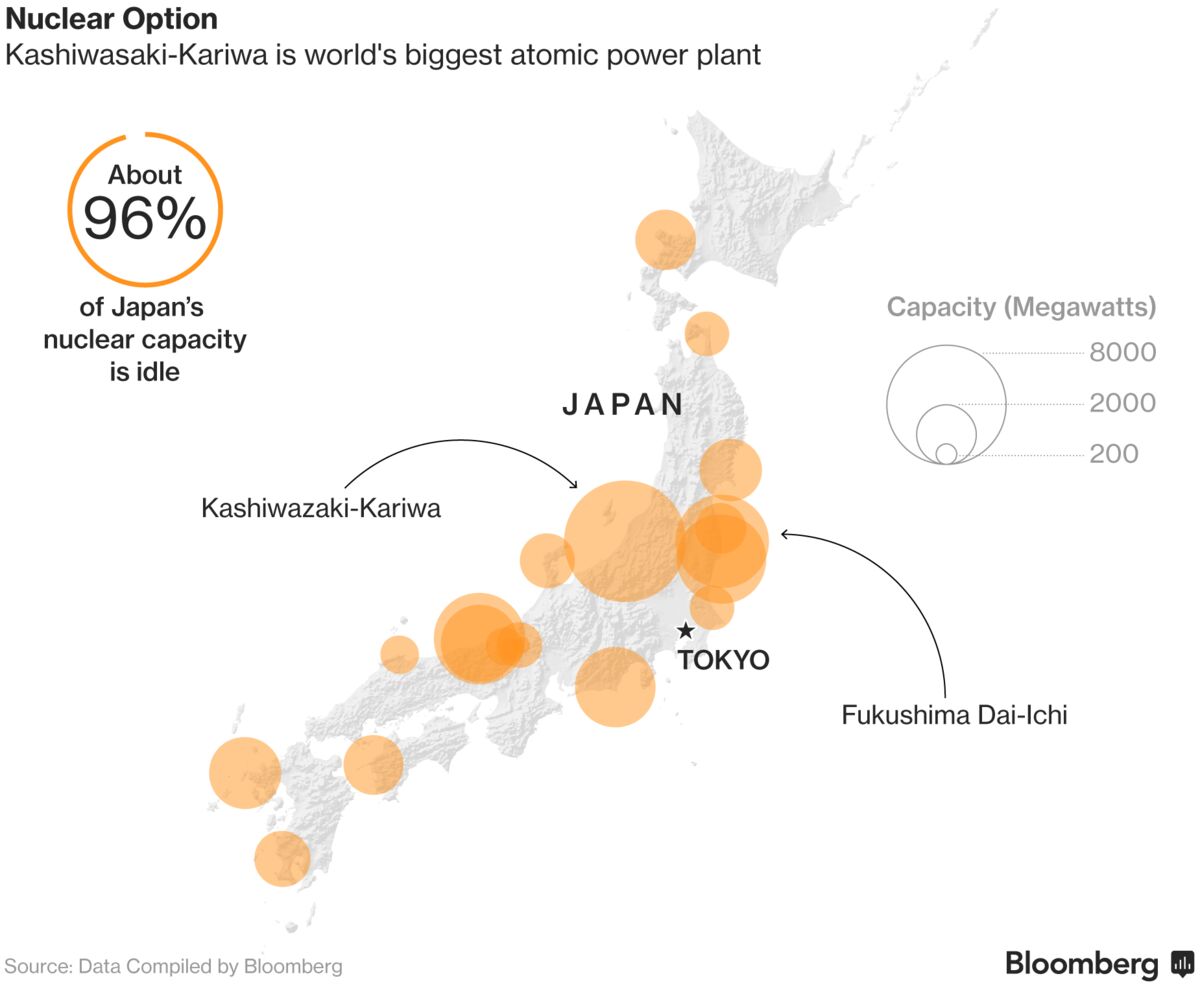
(Bloomberg) — The man blocking the world’s largest nuclear plant says he grew opposed to atomic energy the same way some people fall in love.
Previously an advocate for nuclear power in Japan, Ryuichi Yoneyama campaigned against the restart of the facility as part of his successful gubernatorial race last year in Niigata. He attributes his political U-turn to the “unresolved” 2011 Fukushima Dai-Ichi disaster and the lack of preparedness at the larger facility in his own prefecture, both owned by Tokyo Electric Power Co. Holdings Inc.
“Changing my opinion wasn’t an instant realization,” Yoneyama said in an interview. “It was gradual. As people say, you don’t know the exact moment you’ve fallen in love.”
Yoneyama won’t support the restart of the Kashiwazaki-Kariwa plant in Niigata until an investigation is complete into the chain of events that resulted in the triple meltdown at Fukushima, which he plans to visit Wednesday. While utilities don’t need approval of local authorities to restart plants, Japanese power companies are tradition-bound not to move ahead until they get their consent.
Local Opposition
Yoneyama, a 49-year-old doctor and native of Niigata, is one of the highest-profile local opponents pitted against a political establishment led by Prime Minister Shinzo Abe, which sees nuclear power as crucial for the country’s long-term energy security and environmental goals. Regulations and public opinion are keeping nearly all of Japan’s atomic stations shut almost six years after the accident at Fukushima, where the search has barely begun for fuel that burned through to the bottom of the reactors.
“If the local governor remains firmly opposed to the restart, it will be very difficult for the reactors to come back online,” said James Taverner, an analyst at IHS Markit Ltd. “In addition to the local government, building the support and trust of local residents is key.”
A Kyodo News poll on the day of Yoneyama’s October election showed about 64 percent of Niigata voters opposed the restart of Kashiwazaki-Kariwa, known popularly as KK.
Switching Sides
In last year’s gubernatorial race for the southern prefecture of Kagoshima, where Kyushu Electric Power Co. operates the Sendai nuclear plant, a three-term incumbent was defeated by an opponent campaigning to temporarily close the reactors. A district court last year barred Kansai Electric Power Co. from running two reactors at its Takahama station in western Japan only weeks after they’d been turned back on.
Yoneyama supported bringing back online Japan’s reactors during his unsuccessful bid in 2012 for a seat in Japan’s lower house. The country was being forced to spend more on fossil fuel imports after the disaster, so restarting the plants was needed to help the economy recover, he said at the time.
Though Yoneyama’s position switch helped secure his first electoral victory after four failed campaigns for the country’s legislature, nuclear opponents see him driven by more than political opportunism.
“I had my reservations about Yoneyama,” said Takehiko Igarashi, an official at the Niigata division of the anti-nuclear group Nakusou Genpatsu. “But after he was vetted and endorsed by the Japanese Communist Party and other smaller parties that have an anti-nuclear slant, I knew that I could trust him.”
Tokyo Electric and Abe’s government see restarting KK as one way for Japan’s biggest utility to boost profits and help manage its nearly 16 trillion yen ($139 billion) share of the Fukushima cleanup. Resuming reactors No. 6 and No. 7 will boost annual profits by as much as 240 billion, the utility has said.
Abe, a strong backer of atomic power, leads a government aiming for nuclear to account for as much as 22 percent of Japan’s energy mix by 2030, compared with a little more than 1 percent now.
While restart opponents like Yoneyama demand the government guarantee the safety of the reactors, they’ve also criticized evacuation and emergency response plans as inadequate.
In his first meeting with Tokyo Electric executives since taking office, Yoneyama earlier this month told Chairman Fumio Sudo and President Naomi Hirose that he won’t support KK’s restart until a new evacuation plan is drawn up using the results of a Fukushima investigation. Tepco will fully cooperate with the probe and stay in communication with the governor, the company said in response to a request for comment.
“Once I realized that the Fukushima disaster couldn’t be easily resolved, of course my opinion changed,” Yoneyama said. “If another accident occurs, overseas tourism will become a distant dream. Even Japanese may flee the country.”
TOKYO, Jan 30 (Reuters) – Mitsubishi UFJ Trust and Banking Corp is preparing to sue Toshiba Corp for 1 billion yen ($8.7 million) in damages after its share price tanked due to a $1.3 billion accounting scandal two years ago.
The trust bank is seeking compensation on behalf of its client pension funds, a spokesman said on Monday.
The development is an extra headache for the conglomerate which has plunged into crisis again.
It said on Friday it will sell a minority stake in its memory chip business as it urgently seeks funds to offset an imminent multi-billion dollar writedown, adding that its overseas nuclear division – the cause of its woes – was now under review.
The laptops-to-nuclear conglomerate said in October last year that it had been sued by 15 groups and individuals since it first admitted to reporting inflated profits going back to 2008. ($1 = 114.5400 yen) (Reporting by Makiko Yamazaki; Editing by Edwina Gibbs)
PRAGUE (Sputnik) — On Saturday, Komarov said that Rosatom was ready to participate in the construction of the new blocs of the two Czech nuclear power plants as it did with the Paks NPP in Hungary. In return, Rosatom will be the main supplier of the reactor technologies.Komarov proposed to supply the Czech Republic with the nuclear reactor of the III+ generation, the Novinky news outlet reported on Sunday.
Rosatom is the only company in the world, which had constructed the reactor of the III+ generation and put it into operation at the Novovoronezh NPP, the media outlet added citing the official.
Rosatom is among six companies interested in the Czech project concerning the construction of the new nuclear plant units, which was announced in 2015. The project is aimed at the development of Dukovany and Temelin plants built with the assistance of specialists from the Soviet Union in 1980s.
“If you tell a lie big enough and keep repeating it, people will eventually come to believe it. The lie can be maintained only for such time as the State can shield the people from the political, economic and/or military consequences of the lie. It thus becomes vitally important for the State to use all of its powers to repress dissent, for the truth is the mortal enemy of the lie, and thus by extension, the truth is the greatest enemy of the State.” Paul Joseph Goebbels (29 October1897 – 1 May1945) was Adolf Hitler‘s Propaganda Minister in Nazi Germany.
The town of Koriyama in Fukushima Prefecture was one of the towns most severely hit by the Fukushima Daiichi March 2011 plume. Though not evacuated as it is located outside of the 30km radius evacuation zone decided by the Japanese government, it remains quite contaminated and has many radioactive hotspots.
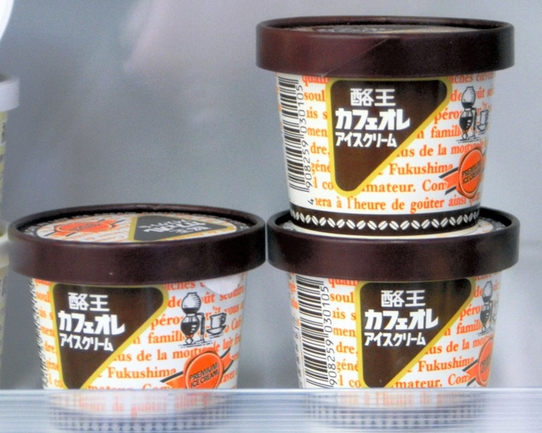
Winter sales have been strong for Rakuou Cafe au Lait Ice Cream produced in Fukushima Prefecture.
KORIYAMA, Fukushima Prefecture–A dairy company here that has withstood fears and rumors about radiation has produced a hot-selling item in the middle of winter.
Within two weeks in November, the initial 6,000 cups of Rakuou Cafe au Lait Ice Cream, produced by Rakuounyugyou Co. in Koriyama, were nearly sold out.
The company, founded in 1975, shipped out an additional lot of around 18,000 cups in December, but this supply has also run short.
Rakuounyugyou shipped 25,000 more cups, mostly to outlets in Fukushima Prefecture, in mid-January, and plans to ship an additional 24,000 within this month.
“Perhaps our ice cream is being seen as more of a premium product,” a sales official at the company said.
Rakuounyugyou’s Rakuou Cafe au Lait, a mild-flavored lactic drink containing at least 50 percent raw milk from Fukushima Prefecture, has an entrenched fan base both in and outside the prefecture.
The company maintained its sales levels in the aftermath of the 2011 Fukushima nuclear disaster, while its competitors suffered losses due to radiation fears and rumors among the public.
Rakuounyugyou developed the ice cream product to commemorate the 40th anniversary of the release of Rakuou Cafe au Lait. The ice cream contains at least 10 percent Rakuou Cafe au Lait and at least 10 percent milk.
“We exercised trial and error because we absolutely didn’t want to disappoint fans of our Cafe au Lait,” the sales official said.
The ice cream was initially sold mainly at sightseeing facilities and expressway service areas in Fukushima Prefecture. Demand was high even though the company did little in the way of a sales campaign.
The spreading popularity of the product can be attributed to Twitter.
Tweets about the ice cream can sound like a hunt for a rare Pokemon on the “Pokemon Go” game app.
“Where could I get one?” one post said. “I got one!” said another.
It is not the first time the social networking service has helped the dairy company; tweets of encouragement spread in the aftermath of the nuclear disaster.
“Be what may, the Rakuou Cafe au Lait tastes so good,” said one particularly popular tweet at that time.
Cafe au Lait is being shipped to a growing number of retailers, most of them in the greater Tokyo area. Sales of the product are up 10 percent from pre-disaster levels.
“Word of our ice cream has also been spread by our fans,” the sales official said. “We are so grateful that we are reduced to tears.”
¶ Rising temperatures could boost mercury levels in fish by up to seven times what they currently are, Swedish researchers say. A study suggests that climate change could be driving up levels of methylmercury, through a mechanism that has not previously been recognized. The study was published in the journal, Science Advances. [BBC]
Recovering sediment cores for study (Erik Lundberg)
¶ A study indicates that tiny floating particles can grow semi-solid around pollutants, allowing them to last longer and travel much farther than what previous global climate models said. Polycyclic aromatic hydrocarbons, or PAHs, from fossil fuel burning, forest fires, and biofuel consumption can travel across the Pacific Ocean. [CCTV]
¶ For the past few years, the winter season in Bangladesh has been getting shorter, and experts suspect this is because of climate-related changes. A meteorologist for the Bangladesh Meteorological Department said…
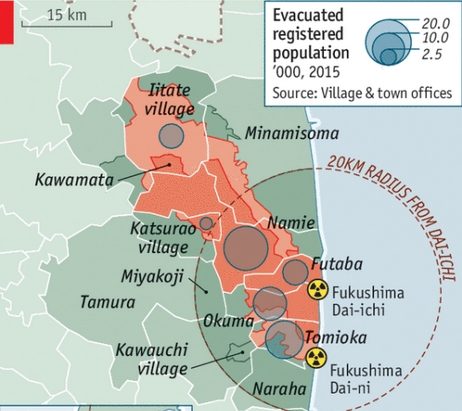
FUKUSHIMA (Kyodo) — Only 13 percent of the evacuees from the 2011 Fukushima nuclear disaster in five municipalities in Fukushima Prefecture have returned home after evacuation orders were lifted, local authorities said Saturday.
Some residents who used to live in the cities of Tamura and Minamisoma, villages of Kawauchi and Katsurao, and the town of Naraha may be reluctant to return to their homes due to fear of exposing children to radiation, the authorities said.
The evacuation orders to residents in those municipalities were lifted partly or entirely from April 2014 through July 2016. As of January, about 2,500 people out of a combined population of around 19,460 registered as residents of those areas were living there.
Evacuation orders for four more towns and villages in Fukushima Prefecture are scheduled to be lifted this spring, but it is uncertain how many residents will return to those areas as well.
In the prefecture, eight municipalities are still subject to evacuation orders around the Fukushima Daiichi nuclear power plant due to high radiation levels. Three nuclear reactors at the plant melted down and the structures housing them were severely damaged by hydrogen gas explosions days after a massive earthquake and ensuing tsunami on March 11, 2011 knocked out electric power needed to run critical reactor cooling equipment.
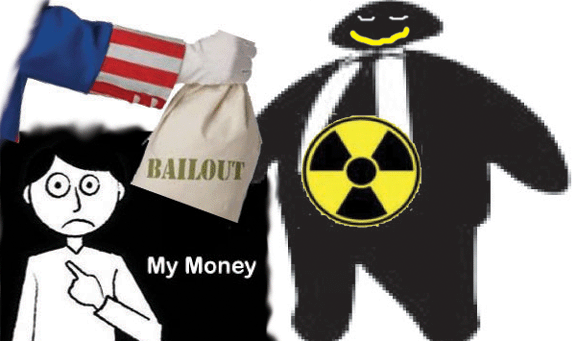
Toshiba Corporation (aka Westinghouse) is withdrawing from the nuclear power construction business… Captains of Toshiba and Westinghouse are abandoning their nuclear Titanic sunk on economic iceberg!!!!!
Toshiba Corp. will cease taking orders related to the building of nuclear power stations, sources said Saturday, in a move that would effectively mark its withdrawal from the nuclear plant construction business.
The news comes amid reports Toshiba’s chairman may resign over the massive write-down that has doomed the company’s U.S. nuclear business.
The multinational conglomerate said Friday it will review its nuclear operations and spin off its chip business to raise funds in a bid to cover an expected asset impairment loss of up to ¥700 billion ($6.08 billion).
After Toshiba ceases taking new orders, it will focus on maintenance and decommissioning operations, according to the sources.
The company will continue work on four nuclear plants under construction in the United States that are expected to be completed by 2020.
The Japanese industrial conglomerate may announce company chairman Shigenori Shiga’s resignation as soon as Feb. 14, when it reports its April-December financial results, the sources also said.
Shiga once served as president of the U.S. nuclear unit, Westinghouse Electric Co., which Toshiba has said could face a multibillion-dollar loss due to cost overruns from delays in plant projects.
The post of Toshiba chairman is expected to remain vacant after Shiga’s resignation.
Westinghouse Chairman Danny Roderick is also set to step down, the sources said, but Toshiba President Satoshi Tsunakawa is likely to stay on.
Shiga, Roderick and Tsunakawa took their current posts last June as Toshiba reshuffled its management following an accounting scandal that surfaced in 2015.
Shiga was the vice president in charge of the power systems business when Westinghouse acquired CB&I Stone & Webster in late 2015. CB&I Stone & Webster is the U.S. nuclear plant construction firm at the heart of Toshiba’s massive write-down problem.
Toshiba to sell part of chip business, puts overseas nuclear ops under review
Toshiba Corp (6502.T) said it will sell a minority stake in its memory chip business as it urgently seeks funds to offset an imminent multi-billion dollar writedown, adding that its overseas nuclear division – the cause of its woes – was now under review.
The drastic measures are set to be just some of the tough choices the Japanese conglomerate will have to take as proceeds from the sale are likely to only cover part of a charge that domestic media has put at $6 billion.
Still battered by a 2015 accounting scandal, Toshiba was plunged back into crisis when it emerged late last year that it had to account for huge cost overruns at a U.S. power plant construction business recently acquired by its Westinghouse division.
Describing the nuclear division as no longer a central business focus for the firm, Chief Executive Satoshi Tsunakawa said Toshiba will review Westinghouse’s role in new projects and whether it will embark on new power plant construction. The division will also now fall under direct CEO supervision.
Tsunakawa added Toshiba was looking to sell less than 20 percent of its memory chip business – the world’s biggest NAND flash memory producer after Samsung Electronics (005930.KS) – which comprises the bulk of the conglomerate’s operating profit.
The firm is rushing to complete the sale by the end of the financial year in March as failure to do so will likely mean that shareholder equity – just $3 billion in the wake of the accounting scandal – would be wiped out by the charge.
Sources have said Toshiba aims to raise more than 200 billion yen ($1.7 billion) from the sale and potential investors include private equity firms, business partner Western Digital Corp (WDC.O) and the government-backed Development Bank of Japan.
It is also selling other assets although it ruled out the sales of any of its infrastructure businesses – which include water treatment, railway and elevator firms.
“We’ve been raising funds through sales of stock holdings, real estate and other assets,” Tsunakawa told a news conference without disclosing the amount, adding that various measures were being considered to boost the firm’s capital base by March.
Toshiba also said it may eventually list the memory chip business.











 nuclear-news