Here’s a correction on last week’s Kyodo News report on Fukushima seafood contamination.
Kyodo said that 95% of the more than 8,000 fish tested had contamination levels that were “hardly detectible”. Japan’s Atomic Industrial Forum reports, “…radioactive cesium was not detected (i.e., less than the detection limit value) in 8,080 specimens, or some 95.0 percent of the total.”
Not detected is considerably different from hardly detectible. JAIF adds that the specimens were taken from the Pacific Ocean within a 20 kilometer radius of F. Daiichi.
(Comment – With severe “radiophobia” infecting millions of Japanese, it is imperative that popular news outlets report accurately. Kyodo News ought to post a correction.)

All Fukushima Seafood Tested in 2016 Falls Below Cesium Standard Value
After the March 2011 accident at the Fukushima Daiichi Nuclear Power Plants, Fukushima Prefecture has been conducting tests on fish and shellfish in coastal waters. It was revealed recently that the concentration of radioactive cesium in all the fish and shellfish collected during tests in 2016 fell below the national standard value of 100Bq/kg. It was the first time since the nuclear accident that all such seafood from Fukushima fell below the standard value in a single calendar year.
According to the prefectural Fisheries Experiment Station, the number of specimens tested in 2016 was 8,502. Among those, radioactive cesium was not detected (i.e., less than the detection limit value) in 8,080 specimens, or some 95.0 percent of the total. The last time that the reference value had been exceeded was in March 2015, after which no instances have been registered.
The inspections, which started in April 2011, include fish and shellfish taken from the sea within a 20-km radius from the Fukushima Daiichi site. The proportion of fish and shellfish exceeding the reference value has been decreasing year by year, as follows: 39.8 percent in 2011, 16.5 percent in 2012, 3.7 percent in 2013, 0.9 percent in 2014, and 0.05 percent in 2015.
Test operations are continuing in limited sea areas in the coastal waters off Fukushima, including fish species in which it is difficult to incorporate radioactive substances.
http://www.jaif.or.jp/en/all-fukushima-seafood-tested-in-2016-falls-below-cesium-standard-value/
January 20, 2017
Posted by dunrenard |
Fukushima 2017 | Contamination, Fukushima, Seafood, Spin & Propaganda |
Leave a comment
Long-distance transport of radioactive plume by nocturnal local winds
Abstract
Radioactive plumes can spread far and wide depending on wind conditions. The plumes often frequently reached the Tokyo metropolitan area, which is approximately 200 km away from the Fukushima Daiichi nuclear power plant, under spatially heterogeneous wind fields in March 2011. To reduce exposure to radioactive plumes, the behaviour of the plumes must be known. However, the transport mechanism of radioactive plumes is not fully understood. Using a regional climate model, we show that multiple diurnal cycle processes play a key role in the frequent transport of radioactive plumes to the Tokyo metropolitan area. The observed data and hindcast results indicate that the radioactive plume moves along the local winds, which comprise the northeasterly local wind (NELW) associated with the meso-scale low-pressure system (meso-low) and the northerly sea wind (NSW) during the night. The long-term analysis and sensitivity simulations also show the nocturnal processes that the NELW caused by the meso-low and the NSW are formed east of the Tokyo metropolitan area and from Fukushima offshore east of the Tokyo metropolitan area, respectively, when neither winter monsoons nor extra-tropical cyclones are predominant. These findings indicate that the radioactive plumes could reach faraway places frequently via nocturnal local processes.
Introduction
Radioactive plumes can scatter widely under the strong influence of the weather1,2,3,4,5,6,7,8. After the accident at the Fukushima Daiichi nuclear power plant in March 2011, the Japanese government evacuated the area within a 20-km radius of the power plant and advised residents within a 20-km to 30-km radius of the power plant to stay inside their homes9. However, high air doses were observed in faraway places outside the 30-km radius (Fig. 1a,b). In such situations, exposure should be minimized because the released radioactive material (131I) is assumed to have the potential to cause thyroid cancer10. Therefore, when and where radioactive plumes will travel should be known in advance.
Figure 1: A common feature of the atmospheric fields when a high air dose was observed in the Tokyo metropolitan area.

(a) The locations of Fukushima, Tokai-mura, and the Tokyo metropolitan area. (b) Time variations of the observed air doses at the observation sites in Tokai-mura. Cases 1, 2, 3, and 4 correspond to the spikes in the air dose. (c) The wind field and geo-potential height of MSM-GPV (975 hPa) at midnight before each of the four cases. Dark areas indicate low pressure. The maps were created by using GrADS 2.0.1 (http://cola.gmu.edu/grads/) (a,c) and Microsoft Excel for Mac 2011 (b).
The movement of a radioactive plume is not only influenced by large-scale events, such as monsoons and extra-tropical cyclones, but also by local-scale events4,5. For example, local-scale events, including land/sea breezes, are predominant under calm weather conditions11,12. A land/sea breeze can cause severe atmospheric pollution even in areas that are distant from the emission source13,14,15. A contamination could occur in a specific area because of the local circulation if large amounts of radioactive materials are emitted over a long period.
A large quantity of radioactive 131I, estimated to be between 1.8 × 10¹² and 8.9 × 10¹⁵ Bq h−1, was released from the Fukushima Daiichi nuclear power plant by the end of March 201116,17,18. To represent the transport and deposition distribution of radioactive materials in Japan, several numerical simulations have been performed using the estimated emission data3,4,5,6,7,8,16,17,18. However, simulating the distributions is difficult because many uncertainties affect numerical simulations. One such uncertainty is the chaotic behaviour of the atmosphere19,20, which amplifies prediction errors resulting from imperfections in the model formulation or the sensitive dependence on the initial conditions. Indeed, if chaotic behaviour were predominant, the movement of the radioactive plume would be difficult to predict accurately.
In contrast, predicting the movement of a radioactive plume would be relatively simple if large-scale events, such as monsoons and extra-cyclones, were predominant because the wind field would be expected to be temporally constant and spatially homogeneous. However, radioactive plumes often reached the Tokyo metropolitan area, even under spatially heterogeneous wind fields5. The types of atmospheric events that might have affected the wind field and the mechanisms by which the radioactive plumes travelled over long distances remain poorly understood. The chaotic behaviour of the atmosphere might be associated with the movement of the radioactive plume. Here, we investigate the mechanism of radioactive plume transport from Fukushima to the Tokyo metropolitan area using a regional climate model.
Results
High air doses, indicated by the spike in Fig. 1b, were often observed at Tokai-mura in the eastern coastal region of the Tokyo metropolitan area in the morning. At approximately the same time, the NSW and the NELW commonly occurred near the coastal area of the northeastern region of the Tokyo metropolitan area at 975 hPa (see Supplementary Fig. S1), whereas these winds were not detected at 850 hPa (see Supplementary Fig. S2). Another common feature, the nocturnal meso-low, formed in the Tokyo metropolitan area before the high dose rates were observed east of the Tokyo metropolitan area in the morning (Fig. 1c). We conducted a hindcast (HC run) to confirm the relationship between the observed high air radiation doses and the radioactive plume simulated using a regional climate model21 (see Methods). The simulated radioactive plume occurred from Fukushima to the northeastern part of the Tokyo metropolitan area in all cases (see Supplementary Fig. S3).
We assumed that the NSW, NELW, and nocturnal meso-low strongly influenced the radioactive plume transport when neither winter monsoons nor extra-cyclones were predominant. Some diurnal cycle processes could have formed the NSW, NELW, and nocturnal meso-low if the diurnal variations of those atmospheric fields were confirmed in the long-term composite data during calm weather. To verify this hypothesis, we defined a typical day when diurnal wind was observed as a calm day using station data for the central part of the Tokyo metropolitan area. The four cases shown in Fig. 1 were included in the calm day. The diurnal variations were investigated by using the operational meteorological analysis dataset for March from 2008 to 2014 (see Supplementary Fig. S4 and Methods). Seven-year composite would be sufficient to detect the signal of diurnal cycle significantly.
The results demonstrated that the NSW, NELW, and meso-low were clearly evident in the composite of the calm day (Fig. 2b,c) at 975 hPa at night, whereas these atmospheric fields were unclear at 850 hPa (Fig. 2g–i). The meso-low could strongly influence the formation of the NELW. Additionally, the NSW and NELW could be formed as gravity currents induced by the meridional temperature gradient because no predominant forcing exists except for the temperature gradient at night under calm conditions. In contrast, the onshore wind, which is intensified by the heat-low at the mountains of central Japan14, is clearly evident in the daytime (Fig. 2a,d). Almost 30% of the days in March from 2008 to 2014 were calm days (see Supplementary Fig. S5). Thus, diurnal cycle processes are not rare events but are important contributors to the regional climate in March.
Figure 2: Diurnal variation of the wind fields under calm conditions.

Diurnal variation of the composite data of wind fields, geo-potential height, and temperature at 975 hPa and 850 hPa on calm days from 2008 to 2014 according to the MSM-GPV data. The dark areas indicate areas of low geo-potential height (low pressure). The maps were created by using GrADS 2.0.1 (http://cola.gmu.edu/grads/).
The nocturnal meso-low forms in various areas worldwide22,23,24,25,26. The topographical heat-low in the daytime could be a trigger of the meso-low23. However, the nocturnal meso-low has been observed to persist until the morning (Fig. 2c). If the convergence caused by the NSW sustains the meso-low, the topographic effect and meridional temperature gradient could be important in the formation of the meso-low.
To elucidate the formation mechanisms of the NSW, NELW, and meso-low, we conducted simple sensitivity tests (see Methods). The effect of the meridional temperature gradient was investigated by adapting a monthly averaged global zonal mean field in March 2011 as the initial and boundary conditions (Ex. 1); the effect of geography, including the land/sea contrast, was investigated by adapting the area-averaged atmospheric field around east Japan (Ex. 2) (see Supplementary Fig. S6). The result shows that Ex. 1 simulates the NSW, NELW, and meso-low but Ex. 2 does not (Fig. 3). This finding indicates that the meridional temperature gradient is essential in the formation of the diurnal cycle of the atmospheric field.
Figure 3: Sensitivity test.

The wind fields, geo-potential heights, and temperatures at 975 hPa in the morning (6 JST) of Ex. 1 and Ex. 2. The atmospheric fields of the global zonal mean and area-averaged values in March 2011 were applied as the lateral boundary conditions of Ex. 1 and Ex. 2, respectively. The maps were created by using GrADS 2.0.1 (http://cola.gmu.edu/grads/).
Discussion
A schematic of the transport of radioactive materials is presented in Fig. 4. The radioactive materials are transported to an area offshore of Fukushima by the land breeze, and then, the plume moves to the south via the NSW (Fig. 4a). In the morning, the radioactive plume flows into the Tokyo metropolitan area via the NELW, which is formed by the nocturnal meso-low (Fig. 4b). In the afternoon, the plume moves to the mountain area located to the northeast of the Tokyo metropolitan area because of the intensified sea breeze induced by the heat-low over the mountains in central Japan (Fig. 4c).
Figure 4: Long-distance transport of the radioactive plume via multiple diurnal processes.

The 3D image of the mixing ratio of 131I in Case 1. The maps were created by using Volume Data Visualizer for Google Earth (VDVGE) 1.1.7 ESC JAMSTEC (https://www.jamstec.go.jp/esc/research/Perception/vdvge.ja.html) and Adobe Illustrator CS5
The northeasterly wind accompanied by rain is often observed around the Tokyo metropolitan area during winter mornings27,28,29. The developed nocturnal meso-low is responsible for this precipitation. Consequently, it was reassuring that no rainfall was detected on 15 March 2011, when the highest air doses were observed (case 1 in Fig. 1). If rainfall had occurred, the serious contamination would have also caused in the Tokyo metropolitan area.
In the seven-year simulation with the constant emission of radioactive materials (CE run), a high deposition of 131I was simulated from Fukushima to the Tokyo metropolitan area in the morning, with increased deposition occurring the mountains located east of the Tokyo metropolitan area in the evening (see Supplementary Fig. S7 and Methods). The diurnal variation of the deposition could be explained by the movement of the radioactive plume corresponding to the diurnal wind field shown in Fig. 4. Thus, diurnal processes strongly influence the deposition distribution.
The amounts of radioactive materials deposited, especially 137Cs, depend strongly on the precipitation30. Generally, precipitation is difficult to simulate using a numerical model quantitatively with high accuracy because of the non-linearity of the precipitation process. Therefore, accurately estimating the deposition at a specific point without observations would be difficult. Therefore, using only the simulated deposition (exposure by groundshine), determining whether immediate evacuation should be enforced is problematic. Our new findings will be useful for determining the time to take shelter to avoid exposure to the radioactive plume (by cloudshine and/or intake) when a large-scale event is not predominant. Additionally, by applying the transport mechanism clarified here, we could potentially reduce the uncertainties relating to the deposition of radioactive materials. Therefore, we should continue improving existing numerical models to more accurately represent the local circulation caused by diurnal cycle processes. This finding could also useful to improve the local depositions simulated by a global circulation model31.
Generally, local circulation is not simple because various factors, such as land use, geographical features, and synoptic wind, strongly influence the local wind field12. The findings of this study indicate that when a severe nuclear power plant accident occurs, radioactive plumes could reach faraway places via multiple diurnal cycle processes. Therefore, establishing a detailed mechanism of local circulation in every area is necessary to make any progress in reducing the uncertainties related to exposure.
Yoshikane, T. et al. Long-distance transport of radioactive plume by nocturnal local winds. Sci. Rep. 6, 36584; doi: 10.1038/srep36584 (2016).
http://www.nature.com/articles/srep36584
January 20, 2017
Posted by dunrenard |
Fukushima 2017 | 311, Fukushima Daiichi, Radioactive Plume, Tokyo |
Leave a comment
6.4 million Americans now work in the traditional energy and the energy efficiency sector, which added more than 300,000 net new jobs in 2016, or 14 percent of the nation’s job growth.
“This report verifies the dynamic role that our energy technologies and infrastructure play in a 21st century economy,” said DOE Senior Advisor on Industrial and Economic Policy David Foster. “Whether producing natural gas or solar power at increasingly lower prices or reducing our consumption of energy through smart grids and fuel efficient vehicles, energy innovation is proving itself as the important driver of economic growth in America, producing 14 percent of the new jobs in 2016.”
The solar industry is particularly shining bright.
“Proportionally, solar employment accounts for the largest share of workers in the Electric Power Generation sector,” the report, released on Jan. 13, states. “This is largely due to the construction related to the significant buildout of new solar generation capacity.” Overall, the U.S. solar workforce increased 25 percent in 2016.
According to the report, solar—both photovoltaic and concentrated—employed almost 374,000 workers in 2016, or 43 percent of the Electric Power Generation workforce. This is followed by fossil fuels, which accounts for 22 percent of total Electric Power Generation employment, or 187,117 workers across coal, oil and natural gas generation technologies.
Wind generation is seeing growth in employment with a 32 percent increase since 2015. The wind industry provides the third largest share of Electric Power Generation employment with 102,000 workers at wind firms across the nation.
The reason behind this growth in the solar sector is due to the high capacity additions in both distributed and utility-scale photovoltaic solar, the report said. In fact, construction and installation projects represented the largest share of solar jobs, with almost four in ten workers doing this kind of work, followed by workers in solar wholesale trade, manufacturing and professional services.
In a sign of promise for the booming industry, solar employers reported that they expect to increase employment by 7 percent this year.
Solar is becoming the cheapest form of electricity production in the world, according to statistics from Bloomberg New Energy Finance. Last year was the first time that the renewable energy technology out-performed fossil fuels on a large scale.
January 20, 2017
Posted by Christina Macpherson |
employment, renewable, USA |
Leave a comment
 Global warning: ominous signs for climate in Trump administration – live https://www.theguardian.com/environment/live/2017/jan/19/global-warning-live-from-the-climate-change-frontline-as-trump-becomes-president With climate change deniers moving into the White House, the Guardian is spending 24 hours focusing on the issue. Right now we’re focusing on how warming temperatures will affect the Asia-Pacific region
- Our partner, Univision News, is hosting a parallel event in Spanish today. Follow it here
- The Tumblr community is joining us with personal posts about climate change. See them here
Mark Rice-Oxley in London, Oliver Milman and Alan Yuhas in New York (earlier), and Michael Slezak in Sydney (now) Friday 20 January 2017
- Here in Australia, there’s been a toxic debate about renewable energy. The fossil fuel industry, conservative media and the coalition government have been trying to link blackouts in South Australia, which have been caused by extreme weather, to the high proportion of renewables in that state.
They’ve also been arguing that rising power bills around the country are a result of increases in renewable energy in the grid.
But today, just as another extreme storm causes a large blackout in South Australia, we have polling from GetUp showing Australians have not been swayed by these arguments.
Just over 17% of voters said they thought renewable energy was to blame for rising power prices.
-
…..
First up, we’re starting in the low-lying island of Kiribati. My colleague Eleanor Ainge Royhas filed this from New Zealand:………
January 20, 2017
Posted by Christina Macpherson |
general |
Leave a comment
Donald Trump’s very confusing thoughts on nuclear weapons, explained
Vox, by Zack Beauchamp@zackbeauchampzack@vox.com Jan 18, 2017 Just days before his inauguration, Donald Trump made headlines by trashing America’s European allies in an interview with two of Europe’s biggest newspapers. The hubbub over Trump’s attack on Europe obscured one of the stranger comments in the interview — that he hoped to work with Russian strongman Vladimir Putin to reduce both countries’ nuclear arsenals.
“Let’s see if we can make some good deals with Russia,” Trump said. “For one thing, I think nuclear weapons should be way down and reduced very substantially.”
To say this is a flip-flop is an understatement. Less than a month ago, Trump tweeted that the US “must greatly strengthen and expand its nuclear capability until such time as the world comes to its senses regarding nukes.” When MSNBC’s Mika Brzezinski asked him about the possibility of this policy setting off an arms race with Russia (which is also talking about expanding/modernizing its nuclear arsenal), Trump’s answer was simple.
“Let it be an arms race.”
Nuclear arms control is a hugely important issue — especially in a world where tensions between the US and two other nuclear powers, Russia and China, are heating up. So where does Trump stand: with his comments from December, or with his comments from January?
The truth is that nobody knows — leaving us in the dark on one of the very few policy issues with the potential to transform the future of human civilization.
“It’s difficult to discern what Trump’s policy will be and whether he has given more than a few minutes’ thought to these issues,”
Kingston Reif, the director for disarmament and threat reduction policy at the Arms Control Association, tells me.
Questions about nuclear policy have dogged Trump for more than a year now. In a December 2015 Republican debate, moderator Hugh Hewitt asked Trump about the “nuclear triad” — America’s three-part system for delivering nuclear weapons (bombers, submarines, and intercontinental ballistic missiles). Trump’s answer was confusing:
We have to be extremely vigilant and extremely careful when it comes to nuclear. Nuclear changes the whole ballgame. … The biggest problem we have is nuclear — nuclear proliferation and having some maniac, having some madman go out and get a nuclear weapon. That’s in my opinion, that is the single biggest problem that our country faces right now.
There are two interesting things about this. First, Trump suggests, as he later did in his January interview, that he sees large global nuclear stockpiles as a problem. Second, he doesn’t appear to know any of the major policy questions surrounding the nuclear triad, or even what the nuclear triad is.
That became especially clear when Hewitt followed up, pressing Trump to answer the actual question about the triad. Trump’s response? “I think — I think, for me, nuclear is just the power, the devastation is very important to me.”
This pattern — an abstract abhorrence of nuclear weapons but seemingly confused views on actual nuclear policy — continued throughout the campaign. . In a March 2016 town hall, for example, host Chris Matthews pressed Trump on whether he’d use nuclear weapons. He seemed to say both no and yes at the same time, saying he’d be “the last one to use nuclear weapons,” but also that he would be very willing to nuke ISIS territory in response to a terrorist attack:………… http://www.vox.com/world/2017/1/18/14310168/trump-nuclear-policy-inauguration-explained
January 20, 2017
Posted by Christina Macpherson |
politics, USA, weapons and war |
Leave a comment
 China’s Xi calls for a world without nuclear weapons, SCMP, 19 Jan 17, Chinese President Xi Jinping called for a world without nuclear weapons at the UN on Wednesday and urged a multilateral system based on equality among nations large and small.
His speech at the United Nations in Geneva came at the end of a diplomatic tour that included a landmark address at the World Economic Forum in Davos, just days before Donald Trump is sworn in as the 45th president of the United States.
Some experts have seen Xi’s Swiss tour as a bid to capture the mantle of global leadership at a time when Washington is clouded by uncertainty with an unpredictable political novice about to take charge.
“Nuclear weapons should be completely prohibited and destroyed over time to make the world free of nuclear weapons,” Xi said, according to an official translation.
China has been a nuclear power since 1964.
In an address that stretched beyond 45 minutes, Xi also sought to make the case for a global governance system that strives for a level playing field among countries where interventionist tendencies are resisted……..
While he made no mention of the incoming Republican administration, Xi’s message on nuclear weapons stood apart from Trump’s at times contradictory remarks on American nuclear power……http://www.scmp.com/news/china/diplomacy-defence/article/2063383/chinas-xi-calls-world-without-nuclear-weapons
January 20, 2017
Posted by Christina Macpherson |
China, weapons and war |
1 Comment
 Saudi Arabia to focus on solar, wind in $US50bn clean energy plan REneweconomy By Ilias Tsagas on 18 January 2017 PV Magazine Speaking yesterday at an Abu Dhabi’s Sustainability Week (ADSW) event, Saudi Arabia’s energy, industry and mineral resources minister Khalid Al-Falih announced a new grand energy plan for the country. The new program is set to commence in a few weeks’ time, when Saudi Arabia’s government will launch the first round of bidding for a new renewable energy tender, energy minister Al-Falih announced at the World Future Energy Summit 2017 (WFES) in Abu Dhabi.
The energy minister did not, however, provide any details regarding the capacity that will be auctioned in the tender.
He did inform the attendants that Saudi Arabia’s new master program for the energy sector will require between USD 30 to 50 billion investment, which will need to come via the private sector.
Solar and wind power will be the preferred technologies in the auctions, but geothermal and waste projects will also be considered, just with a smaller role to play.
Saudi Arabia, OPEC’s biggest oil producer, is aiming for renewable energy installations, primarily of solar and wind, of 9.5 GW by 2023, but this is just the starting point, the country’s energy minister told the ADSW.
By 2030, the country will generate 70 percent of its electricity from natural gas and 30 percent from renewables and other sources, promised Al-Falih.
“Other resources” include nuclear power plants, of which plans for two nuclear reactors totaling 2.8 GW are currently in the early stages of consideration and planning…….. http://reneweconomy.com.au/saudi-arabia-to-focus-on-solar-wind-in-us50bn-clean-energy-plan-35690/
January 20, 2017
Posted by Christina Macpherson |
renewable, Saudi Arabia |
Leave a comment
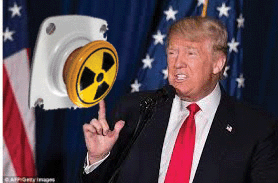 Donald Trump and the ‘nuclear football’: What’s stopping President-elect launching lethal weapon strike http://www.independent.co.uk/news/world/americas/donald-trump-nuclar-football-codes-what-stops-president-elect-push-button-launch-nuclear-weapon-a7534926.html ‘In theory the president has full discretion over authorisation of nuclear use’ Peter Walker @petejohn_walker , 19 Jan 17 Donald Trump will be simultaneously handed power to launch nuclear weapons as he is inaugurated tomorrow.
Here we explain how the “thin-skinned” and “impulsively tempered” President-elect can wield the power of the ‘nuclear football’ and what’s stopping him from using it.
January 20, 2017
Posted by Christina Macpherson |
politics, USA, weapons and war |
Leave a comment
 Toshiba shares crash as nuclear writedown crisis deepens Shares in Toshiba have dived 16% on reports that the embattled Japanese conglomerate faces bigger losses at its US nuclear power business. BBC News 19 Jan 17
It is feared Toshiba may have to write down the value of the unit by a larger-than-expected 700bn yen ($6.1bn; £5bn).
There are unconfirmed reports Toshiba is seeking aid from the government-backed Development Bank of Japan (DBJ).
Toshiba said the exact writedown figure was not finalised, and declined to comment on any DBJ approach.
The laptops-to-hydro power giant was plunged into crisis late last year when it emerged it faced huge cost overruns on projects handled by a newly-bought company that builds US nuclear power plants. ……. on 27 December Toshiba admitted that it faced writedowns of “several billion dollars”. The company later indicated that the size of the writedowns would be between $1bn and $4.5bn.
Toshiba’s nuclear services business brings in about one-third of the industrial giant’s revenue.
The share price, down 26% at one stage on Thursday, is now 50% lower than when the writedown revelations emerged amid fears that the company still has no firm grip on the final costs………http://www.bbc.com/news/business-38674697
January 20, 2017
Posted by Christina Macpherson |
business and costs, Japan |
Leave a comment
 Corroded holes found inside nuclear plant in Shimane http://mainichi.jp/english/articles/20170119/p2a/00m/0na/002000c January 19, 2017 (Mainichi Japan) Japanese versionMATSUE — Nineteen corroded holes have been discovered in air ducts inside the No. 2 reactor at the Shimane nuclear power plant, the Mainichi Shimbun has learned. As a consequence of this discovery, the Nuclear Regulation Authority decided on Jan. 18 to order all electric power companies to carry out checks on ducts inside all of their nuclear power plants.
The corroded holes were discovered when insulating material — that had been wrapped around the ducts — was removed during a check in December 2016 at the No. 2 reactor at the Shimane plant, which is operated by Chugoku Electric Power Co. The largest hole of the 19 was found to be approximately 30 centimeters by 100 centimeters in size.
Corroded holes in ducts present a threat as there is a chance that radioactive material could flow into the central control room via the holes during an accident — thereby exposing power plant staff to radiation.
January 20, 2017
Posted by Christina Macpherson |
Japan, safety |
Leave a comment

 FPL Wins Battle to Store Radioactive Waste Under Miami’s Drinking Water Aquifer, Miami New Times, BY JERRY IANNELLI JANUARY 16, 2017 Environmental activists have started a petition urging Florida lawmakers to prevent FPL from storing waste underground. South Florida sits atop two gigantic underground stores of water: the Biscayne and Floridan Aquifers. Miamians get most of their drinking water from the upper Biscayne Aquifer, while the government has used the lower portion of the Floridian to dump waste and untreated sewage — despite the fact that multiple studies have warned that waste could one day seep into the drinking water.
According to NRC documents, CASE’s petition was dismissed for being filed “inexcusably late” in FPL’s application process.
“This was thrown out on procedural grounds,” says CASE’s president, Barry J. White. “The science is still there.”
CASE had filed a petition with the U.S. Nuclear Regulatory Commission, but the NRC on Friday threw out CASE’s complaint, saying the environmental group had filed too late in FPL’s approval process.
The fight stems from the energy company’s plan to build two nuclear reactors at the controversial Turkey Point Nuclear Generating Station south of Miami by roughly 2030. The towers might not be operational for a decade or two, but that doesn’t mean the public should stop paying attention to them. FPL is submitting numerous proposals about the project to the government.
As part of that package, FPL told the U.S. Nuclear Regulatory Commission that it plans to store contaminated water used to clean the reactors, as well as radioactive waste (“radwaste”) in the Boulder Zone. In October, the NRC issued a report, stating FPL’s plan would pose “no environmental impacts” to the South Florida environment.
Roughly a month later, on November 28, CASE filed a legal petition demanding that the NRC hold a hearing on FPL’s radioactive waste plan. CASE alleges the government failed to address a host of concerns about the power company’s plan.
“Everything will be put into a supposedly ‘hermetically sealed’ Boulder Zone,” White told New Times in December. “But anybody who lives in South Florida knows nothing below us is hermetically sealed.” Environmentalists say the plan could leak carcinogens such as cesium, strontium 90, and tritium right into the drinking-water aquifers…….. http://www.miaminewtimes.com/news/fpl-wins-battle-to-store-radioactive-waste-under-miamis-drinking-water-aquifer-9059210
January 20, 2017
Posted by Christina Macpherson |
Legal, USA, water |
Leave a comment
|
Groups sue to end ratepayer subsidies of aged nuclear power plants http://www.midhudsonnews.com/News/2017/January/19/nuke_plant_subsidy_suit.html BEACON – Hudson River Sloop Clearwater and a number of co-petitioners filed in Supreme Court a challenge to the recently enacted mandatory 12-year nuclear subsidy that is expected to cost New York ratepayers between $7 billion and $10 billion.The surcharge was ordered by the state Public Service Commission as part of its Clean Energy Standard.
The petitioners argue that the $7.6 billion nuclear subsidy imposed on the state’s electricity consumers was unjustified and that the PSC did not follow the law when it enacted them.
The subsidies will be paid by ratepayers on their monthly energy bills based on usages. That cost will “most seriously impact low-income ratepayers and businesses operating on a thin profit margin,” the groups said.
“New Yorkers who are currently using and who are committed to renewable energy and who are paying additionally for Renewable Energy Credits for 100 percent of their electrical needs should not also be billed for this $7.6 billion nuclear plant subsidy,” said North Salem Town Supervisor Warren Lucas.
“This action has brought to challenge the PSC’s nearly $8 billion bailout of the unsustainable and polluting nuclear industry, based on the mistaken premise that nuclear energy production is emission-free,” said attorney Susan Shapiro, owner of petitioner Goshen Green Farms. “Nuclear energy is not, nor has it ever been emission-free, as it routinely emits radiation, heat and greenhouse gases, which are all climate change catalysts.”
Clearwater Environmental Director Manna Jo Greene noted at Diablo Canyon in California, they are phasing out their last nuclear plant by committing to 100 percent renewable replacement energy, while protecting plant workers by retaining those with critical institutional memory and highly technical knowledge. She said they are also retraining those who are not needed for safe decommissioning, and placing them in jobs in the renewable energy economy.
“New York needs to create a just transition plan, not a prolonged nuclear bailout,” Greene said.
|
|
|
January 20, 2017
Posted by Christina Macpherson |
Legal, USA |
Leave a comment
Neighbouring countries concerned about the risk of a Belgian Nuclear meltdown http://www.theecologist.org/News/news_analysis/2988553/neighbouring_countries_concerned_about_the_risk_of_a_belgian_nuclear_meltdown.html 19th January, 2017
On 10 January 2017 a new emergency plan was presented in a commission in Belgium’s Parliament. The evacuation perimeter was conveniently halved to 10km to avoid an evacuation of Belgium’s second and third cities in case of a meltdown. The plan has been called totally inadequate. NICK MEYNEN reports
It’s not the metaphorical political meltdown of Belgium that neighbouring governments fret about, but a nuclear meltdown. The Netherlands, Luxemburg and Germany have all asked Belgium’s government to close its most risky reactors with immediate effect. The city of Aachen and 30 other major cities and districts are also suing Belgium for not closing them. The German government no longer trusts the Belgian Nuclear Safety Agency and wants permission for its own agency to do safety checks. So far, foreign pressure is falling on deaf ears.
Belgians have even more reasons to worry. On 10 January 2017 a new emergency plan was presented in a commission in Belgium’s Parliament. The evacuation perimeter was conveniently halved to 10km to avoid an evacuation of Belgium’s second and third cities in case of a meltdown. Nuclear Transparency Watch, a European organisation created by Members of the European Parliament of all political colours, called Belgium’s plans totally inadequate and incoherent.inad
So rather than signing agreements with Belgium about sharing information, where are the economic sanctions for Belgium? There are both EU and UN regulations that could shut the reactors down, as more than a million people requested a year ago. Belgium’s neighbours have reasons to get tough.
Belgium is your backyard
Belgium’s recent nuclear history reads like a mirror of Germany’s, where the highest court decided that Merkel’s decision to speed up the nuclear phase-out after the Fukushima incident was justified. Belgium did just the opposite. The Belgian government reversed a nuclear phase-out law from 2003 only a year after the Japanese reactors exploded, pushing retirement back from 2015 to 2025. The last bill to postpone retirement with 10 years was approved at the end of 2016. The Government can ‘take comfort’ at the fact that 2017 started better than 2016: unlike last year when only a week incidents after which the first incident (in which one person got severely injured) took place with an unexpected shutdown as result.
Yes, the protesting former president of the European Parliament Martin Schulz was born and raised close to Belgium’s border and yes, I was born and raised 15 km from four nuclear reactors in Doel, in the city of Antwerp (half a million people). But before you call us NIMBY (Not In My Back Yard) activists: our backyard contains six to seven million people that in the event of a nuclear meltdown would never be able to go home again. Depending on the wind direction on the day of a meltdown, a radioactive cloud will poison and kill many additional people in London, Paris, Amsterdam or Berlin as well. The possibility of that scenario has increased in recent years.
Cracks, extortion and sabotage
In 2012 it became known that the mantle around the old Tihange 2 reactor shows signs of erosion. Further research in 2015 concluded that there are thousands of cracks of up to 15 cm. Later that year, 10 security incidents were recorded in Tihange in just six weeks, leading Belgium’s nuclear safety agency to suspend four members of staff and raise serious questions about the safety culture. In 2015, Belgian’s nuclear plants spent longer in shutdown or “maintenance” than in being operational.
Who said nuclear energy was a reliable source of energy?
But it is the Doel plant that reads like the script of an apocalyptic Hollywood blockbuster, part one. The plant was sabotaged in 2014. The sabotage was found before things spiralled out of control, but the culprit(s) remain unknown. A year later, police found hidden cameras that followed the movements of a nuclear researcher, raising alarming questions about criminals extorting staff. Research also revealed a staggering number of cracks in the mantle that is supposed to keep the Doel 3 reactor in check: 13,047. The cracks are on average 1 to 2 cm wide, but the largest ones are up to 18cm. And with 35 years of operational history, the researched Doel 3 is the second “youngest” of Doel’s four reactors. Belgium’s nuclear safety agency concluded after the tests in Tihange and Doel that the erosion of the mantle was due to normal reactor activity. They can thus be expected to be present in all plants in the world of similar age and to keep multiply through normal reactor use.
The economic and terrorist threats
In terms of potential economic impacts, Doel is by far number 1 in Europe. The major Fukushima disaster knocked 2 to 10% from Japan’s GDP, but when Doel goes into meltdown, the cost is estimated to be 200% of the GDP of Belgium. In such a scenario, GDP won’t really mean much. Most of Flanders and the capital of Europe will become inhabitable zones, sending millions of refugees to France, The Netherlands, Germany and the UK. Will they open their borders for a flood of immigrants from Belgium?
And then there’s terrorism. For the last two years, Belgian authorities have claimed we are living under emergency level 3, just one notch below the State of Emergency that France is living under. This means a terrorist threat is “serious” and an attack “probable”. France has already experienced a series of undeclared drone flights over various nuclear power stations. The Bulletin of the Atomic Scientists later explained that the danger of that is not about drones carrying small explosives and crashing on the plant because in theory a nuclear plant can cope with a jumbo jet crash (although this has never been tested). But drones can easily carry AK47s and drop them inside the territory of the plant, even at night.
In another scenario laid out by the atomic scientists, drones can attack the power lines and then the diesel generator back-up system. It requires a bit more organisation than driving a truck into a crowd, but less than teaching a terrorist team how to fly a jumbo jet, hijack several at the same time and fly them into the two WTC towers and the Pentagon. As we have learned the hard way in recent years, Belgium also happens to be a favourite hide-out for terrorists. Belgium’s authorities want us to believe that the terrorist risk has never been so high, but they don’t want you to connect that with our nuclear plants and with unexplained drone flights over nuclear plants.
Corrupted centralised power plants
All this raises the question: is it still smart to count on a few vulnerable centralised power plants? And what about the waste of state money that seems to come hand-in-hand with nuclear power? Bulgaria wasted 1,221 billion euro on a plant that never materialized. Bulgaria is also still spending money to deal with the legacy of uranium mining, even though the last mine closed in 1992. When I visited the surroundings of the now closed Buhovo mine, stones of a size that would fit a child’s hand showed radiation 100s of times above normal. They were ready to be picked up and played with at a popular local picnic place.
Conflicts against nuclear power plants and the formulation of constructive alternatives are popping up outside Europe as well: from India to Japan. So are the conflicts and externalised costs around the uranium that now feeds most of our reactors, from Niger to Namibia. Although there’s one other country that has become the EU’s main supplier: Russia. But as environmental justice, geopolitical weakening or financial debacles don’t seem to stop the nuclear addiction: will it have to take another meltdown? Policymakers seem to have forgotten that our countries signed up to the precautionary principle, which the EU still has in its Treaty. Maybe it’s time that the Germans, who are kicking nuclear out of their country, march once more on Belgium. As a Belgian citizen I do kindly request to come in peace and only armed with the renewable energy solutions that swept your country.
This Author
Nick Meynen was the organiser of a 72km long anti-nuclear energy march from Doel to Brussels. He works for the ENVJUSTICE project and writes articles and books on environmental issues.
January 20, 2017
Posted by Christina Macpherson |
EUROPE, safety |
Leave a comment
U.S. sees indications of possible North Korea missile test-launch Yahoo News, By James Pearson and Phil Stewart January 20, 2017 SEOUL/WASHINGTON (Reuters) – North Korea may be preparing for a new missile test-launch, U.S. officials told Reuters on Thursday, after South Korean media reported movement of what could be components of an upgraded prototype of an intercontinental ballistic missile.
The U.S. officials, who spoke on condition of anonymity, said the United States was seeing activity in North Korea indicating a possible ballistic missile test, including positioning of two mobile missile launchers.
Still, the timing of the test and precise type of missile remained unclear, the officials said.
In his New Year’s speech, leader Kim Jong Un said North Korea was close to test launching an ICBM, and state media has said a launch could come at any time. Experts on the isolated and nuclear capable country’s missile program believe the claims to be credible.
The Pentagon declined comment on its intelligence about the North Korea threat, but spokesman Peter Cook assured reporters that Washington’s readiness would be not be diminished during the U.S. presidential transition, due to take place on Friday.
“I can’t get into intelligence matters. I can’t confirm what’s been reported there,” Cook told a news briefing.
“We would once again encourage North Korea not to engage in provocative actions that do nothing but destabilize the region.”
South Korean media said a test could potentially coincide with the inauguration of U.S. President-elect Donald Trump on Friday, South Korean media said.
Trump on Jan. 2 tweeted, “It won’t happen!” about North Korean ICBMs, although his precise meaning was unclear. The Pentagon has said it would not necessarily strike a test-launched ICBM if it did not pose a threat.
NEW TYPE OF MISSILE?
South Korean intelligence agencies reported on Wednesday that they had recently spotted missile parts being transported, believed to be the lower-half of an ICBM, raising fears that a test-launch may be imminent, the Chosun Ilbo newspaper said, citing unidentified military sources…….https://www.yahoo.com/news/u-sees-north-korea-activity-signaling-possible-missile-160137245.html
January 20, 2017
Posted by Christina Macpherson |
North Korea, weapons and war |
Leave a comment
Ft.com 19 Jan 17 Threat follows confirmation of Delhi’s military assault plans in times of crisis by: Kiran Stacey in New Delhi and Farhan Bokhari in Islamabad Pakistani officials have threatened to use nuclear weapons should India invade, after India’s new army chief admitted to secret military plans for attacking its neighbour in the event of a crisis…….https://www.ft.com/content/889ebb80-dc9b-11e6-9d7c-be108f1c1dce
January 20, 2017
Posted by Christina Macpherson |
general |
Leave a comment







 nuclear-news