Industry ministry unveils plan to split nuclear power division from TEPCO

The Economy, Trade and Industry Ministry is planning to spin off Tokyo Electric Power Co. (TEPCO) Holdings Inc.’s nuclear power generation division and aim for an alliance between the new subsidiary and another power company.
The ministry unveiled the plan at an Oct. 25 meeting of an expert panel on reform of TEPCO and issues related to the tsunami-hit Fukushima No. 1 nuclear plant. The possibility has emerged that realignment of the major utilities’ nuclear power divisions will be led by the government as the planned reactivation of idled nuclear reactors has stalled.
As part of TEPCO reforms this past April, the company’s thermal power, power retail and power transmission and distribution divisions were transformed into subsidiaries and placed under the umbrella of the newly established TEPCO Holdings.
However, TEPCO Holdings has retained its nuclear power division because the company needs to decommission the crippled Fukushima nuclear complex and pay compensation to victims of the nuclear disaster, which broke out in March 2011.
Under the ministry’s plan, a subsidiary would be set up to take over TEPCO’s nuclear power business, excluding the Fukushima No. 1 plant, with an eye to forming an alliance between the new firm and another major utility.
The costs of decommissioning the crippled power station’s reactors are likely to far surpass the initial estimate. The ministry released a revised projection at the Oct. 25 expert panel meeting stating that the annual decommissioning bill will likely balloon from the current 80 billion yen into the hundreds of billions, due to work to remove melted nuclear fuel from the reactors and other factors.
The panel discussed TEPCO reforms to raise funds to cover the massive expense of dealing with the accident, such as compensation payments and decontamination of areas tainted with radioactive substances emanating from the nuclear disaster, plus decommissioning.
The committee is aiming to increase TEPCO’s profitability by promoting the realignment of the firm’s nuclear power division and other cost-cutting efforts.
TEPCO set up a joint venture, JERA Co., with Chubu Electric Power Co. in April 2015 to gradually integrate their thermal power station fuel procurement and overseas power generation divisions. TEPCO has also formed a business tie-up with SoftBank Group Corp. to bundle electricity and communications device contracts.
The industry ministry furthermore proposed that TEPCO’s power transmission and distribution subsidiary, which is highly profitable thanks to a large number of customers in the Tokyo metropolitan area, strengthen its alliances with other utilities.
The expert committee is poised to work out the details of a plan to spin off TEPCO’s nuclear power division and how the subsidiary should join hands with other companies. The panel will draw up a draft of its proposals possibly by the end of this year, and incorporate the recommendations in TEPCO’s corporate rehabilitation plan to be released next year.
http://mainichi.jp/english/articles/20161026/p2a/00m/0na/004000c
Ionizing radiation May Contribute to Development of Alzheimer’s

University of Southern Denmark
More humans than ever are exposed to higher levels of ionizing radiation from medical equipment, airplanes, etc. A new study suggests that this kind of radiation may be a confounding factor in the neurodegenerative disease Alzheimer´s.
Alzheimer’s disease is the leading cause for dementia in the elderly, and its global prevalence is supposed to increase dramatically in the following decade – up to 80 million patients by 2040.
– It is crucial that we investigate the potential factors behind this disease, says postdoc Stefan J. Kempf, University of Southern Denmark. His research focuses on possible connections between radiation and cognitive impairments.
In a new study, he and an international consortia involving colleagues from Italy, Japan, Germany and Denmark show that low doses of ionising radiation induce molecular changes in the brain that resemble the pathologies of Alzheimer’s.
The study has been published in Oncotarget. Co-authors are from Institute of Radiation Biology/Institute of Pathology, Helmholtz Zentrum München, German Research Center for Environmental Health and Institute for Environmental Sciences in Japan.
Large numbers of people of all age groups are increasingly exposed to ionizing radiation from various sources. Many receive chronic occupational exposure from nuclear technologies or airline travel. The use of medical diagnostics and therapeutic radiology has increased rapidly – for example more than 62 million CT scans per year are currently carried out in USA.
Approximately one third of all diagnostic CT examinations are scans of the head region.
– All these kinds of exposures are low dose and as long as we talk about one or a few exposures in a lifetime I do not see cause for concern. What concerns me is that modern people may be exposed several times in their lifetime and that we don’t know enough about the consequences of accumulated doses, says Stefan J. Kempf.
Recent data suggest that even relatively low radiation doses, similar to those received from a few CT scans, could trigger molecular changes associated with cognitive dysfunction.
In their new study, the researchers have elucidated molecular alterations in the hippocampus of mice. The hippocampus is an important brain region responsible for learning and memory formation and it is known to be negatively affected in Alzheimer´s.
The authors induced changes in the hippocampus by two kinds of chronic low-dose-rate ionizing radiation treatments. The mice were exposed to cumulative doses of 0.3 Gy or 6.0 Gy given at low dose rates of 1 mGy over 24 hours or 20 mGy over 24 hours for 300 days.
– Both dose rates are capable of inducing molecular features that are reminiscent of those found in the Alzheimer’s disease neuropathology, says Stefan J. Kempf.
When a patient gets a head scan, the doses varies between 20 and 100 mGy and lasts for around one minute. When a person flies, he or she gets exposure to ionising radiation coming from space but the rates are by far smaller than a CT scan.
– When you compare these figures you will find that we exposed the mice to a more than 1000 times smaller cumulative dose than what a patient gets from a single CT scan in the same time interval. And even then we could see changes in the synapses within the hippocampus that resemble Alzheimer´s pathology.
According to Stefan J. Kempf, the data indicate that chronic low-dose-rate radiation targets the integration of newborn neurons in existing synaptic wires.
###
Paper: Chronic low-dose-rate ionising radiation affects the hippocampal phosphoproteome in the ApoE?/? Alzheimer mouse model. Forfattere: Stefan Kempf, Dirk Janik, Zarko Barjaktarovic, Ignacia Braga-Tanaka III, Satoshi Tanaka, Frauke Neff, Anna Saran, Martin Røssel Larsen, Soile Tapio. OncoTarget, 20. september 2016.
https://www.eurekalert.org/pub_releases/2016-10/uosd-ctr102716.php
Fukushima museum receives pro-nuclear signs for safekeeping
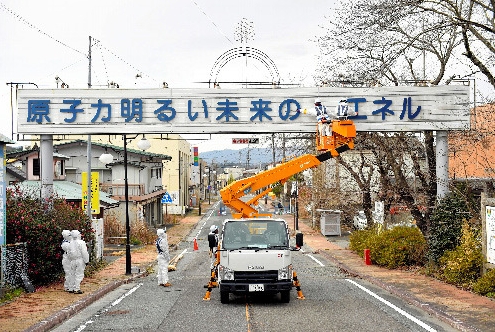
Workers in protective gear remove the banner lauding nuclear energy in Futaba, Fukushima Prefecture, in December.
AIZUWAKAMATSU, Fukushima Prefecture—Pro-nuclear propaganda signs that became the ironic symbol of a town evacuated in the 2011 Fukushima nuclear disaster have been moved to a museum’s storage ahead of their possible public display as a warning from history.
The Fukushima Museum in this city took over care of the signs this month on behalf of the town government of Futaba, which co-hosts the crippled Fukushima No. 1 nuclear power plant.
The most well-known of the banners, which residents campaigned to save, reads: “Genshiryoku–Akarui Mirai no Energy” (Nuclear power is the energy of a bright future).
Yuji Onuma, a 40-year-old former resident of Futaba who now lives in Kogawa, Ibaraki Prefecture, came up with the slogan as a sixth grader at a Futaba school. The town hall adopted it to promote nuclear energy.
Onuma, who fled the town amid the triple meltdown, said the move to the museum is welcome in terms of keeping them in good condition.
“But I am hoping that they will be shown to the public as soon as possible,” he said.
The signboards were removed between December and March along with other panels of slogans promoting nuclear energy in the town. The town government cited the danger of the tall steel structures collapsing because of old age.
They had been kept in a barn wrapped in blankets until the prefectural museum came forward with the offer of storage space early this month.
“The signboards will be kept from deteriorating at the museum where the temperature and humidity can be easily adjusted,” a Futaba official said of the transfer to the museum.
The town hall had initially sought to remove and dispose of the prominent signs, saying they were nearly 25 years old and may fall off at any time.
But after the town announced the decision to do so in March 2015, Onuma and other like-minded people scrambled to start a petition to call for their preservation as historically important items.
“The signs should be stored and exhibited as a ‘negative legacy’,” said Onuma, who recalled that he had once been proud of co-hosting a nuclear power station as he believed it would lead the town to a promising future.
But after the disaster, he decided he was wrong and switched to the solar power generation business in Kogawa.
In the end, the town government agreed to preserve them after they were removed from the original site.
A Futaba official said the signs could be featured at a facility to pass down the records of and lessons learned from the powerful quake, tsunami and the nuclear disaster which the prefectural government is planning to construct.
UN Oks Nuclear Arms Ban Resolution, Japan in Complete Denial of Hiroshima and Nagasaki Bombings Opposed it
Finally, 71 years after the dropping of atomic bombs that destroyed Hiroshima and Nagasaki, the international community is ready to start negotiations on a new treaty banning nuclear weapons. Although this is a historical moment, it was very sad that Japan and the US opposed the UN resolution.
UN committee OKs nuclear arms ban resolution
A UN General Assembly committee has approved a resolution calling for a treaty to ban nuclear weapons.
Japan, the only country that has suffered atomic bombings, was among the countries that opposed it, along with nuclear powers including the United States.
The resolution was adopted on Thursday by a majority vote at the General Assembly’s First Committee on Disarmament.
The resolution submitted by about 50 non-nuclear weapons states calls for starting negotiations on a legally binding treaty in New York in March.
123 countries voted in favor, while 38 voted against. 16 countries abstained.
Among the nuclear powers, the United States and Russia opposed it. China and India abstained.
Japan voted against it. The country has been calling for the abolition of nuclear weapons, while under the US nuclear umbrella. But it said disarmament should be done in stages with the cooperation of nuclear and non-nuclear states.
Austrian disarmament ambassador Franz Josef Kuglitsch called the resolution the fruit of years of huge effort and conscience-building by many countries and civil society. Austria is one of the proponents of the resolution.
If adopted at a General Assembly session in December, treaty negotiations will start in March.
http://www3.nhk.or.jp/nhkworld/en/news/20161028_12/
U.S., Japan oppose and China abstains as U.N. votes to launch talks on nuclear arms ban
UNITED NATIONS – A U.N. General Assembly committee on Thursday voted to launch negotiations on a new treaty banning nuclear weapons despite fierce opposition from the world’s nuclear powers.
A resolution presented by Austria, Ireland, Mexico, Nigeria, South Africa and Brazil was adopted by a vote of 123 to 38, with 16 abstentions, following weeks of lobbying by the nuclear powers for “no” votes.
The nonbinding resolution provides for negotiations to begin in March on the new treaty, citing deep concern over the “catastrophic humanitarian consequences of any use of nuclear weapons.”
Four of the five U.N. Security Council nuclear powers — Britain, France, Russia and the United States — voted against the resolution, while China abstained, as did India and Pakistan.
Japan, which has long campaigned against the use of nuclear weapons, voted against it, as did South Korea, which is facing a nuclear threat from North Korea.
Opponents argued that nuclear disarmament should be addressed within negotiations on the Nuclear Non-Proliferation Treaty.
Beatrice Fihn, executive director of the International Campaign to Abolish Nuclear Weapons, described the vote as a “historic moment” in the decades-long drive for a nuclear-free world.
“This treaty won’t eliminate nuclear weapons overnight. But it will establish a powerful, new international legal standard, stigmatizing nuclear weapons and compelling nations to take urgent action on disarmament.”
The measure is expected to go to the full General Assembly for a vote in late November or early December.
Although Japan voted against the resolution due to pressure exerted by the U.S., Foreign Minister Fumio Kishida said Friday that Japan intends to join U.N. negotiations to outlaw nuclear weapons.
“At present, I hope to proactively join in the negotiations and firmly present our stance,” which stresses cooperation between nuclear and nonnuclear powers, Kishida told reporters, adding that the government as a whole will make the final decision.
Kishida said Japan opposed the draft resolution as it did not match the country’s stance to pursue a world free of nuclear weapons by “concrete and pragmatic measures” amid the growing threat posed by North Korea’s nuclear and missile development and the need for nuclear deterrence.
“The resolution further deepens the rift and encourages opposition” between countries possessing nuclear weapons and those that do not, Kishida said.
Japan also took note of the votes by other key countries in making the decision, Kishida said. All of the countries possessing nuclear weapons, including the United States, opposed the draft resolution, while North Korea voted in favor.
The resolution calls for talks to be held twice next year — the first round from March 27 to 31 and the second from June 15 through July 7 in New York — to negotiate a treaty to prohibit nuclear weapons.
Despite the U.S. and other nuclear powers’ objection to the motion, Robert Zuber, director of Global Action to Prevent War, a nongovernmental organization, is upbeat about its prospects.
“We believe that a ban treaty could help contribute to a robust international framework to which the nuclear weapon states could eventually accede,” he said.
But the decision by Japan, the only country to have ever suffered a nuclear attack, to vote against the draft disappointed some anti-nuclear campaigners.
The government is “still captured by a very old-fashioned idea on security. They still believe nuclear weapons are necessary for their own security. However, it is already clear that it is nuclear weapons that are posing a threat to global security and survival of human kind, as testified by many survivors of Hiroshima and Nagasaki,” said Akira Kawasaki, director of Peace Boat Hibakusha Project.
UN votes to start negotiating treaty to ban nuclear weapons
Australia votes with major nuclear powers against the resolution – including US, Russia and Israel – but 123 nations vote in favour
United Nations member states have voted overwhelmingly to start negotiations on a treaty to ban nuclear weapons, despite strong opposition from nuclear-armed nations and their allies.
In the vote in the UN disarmament and international security committee on Thursday, 123 nations were in favour of the resolution, 38 opposed and 16 abstained.
Nuclear powers the United States, Russia, Israel, France and the United Kingdom were among those that opposed the measure.
Australia, as forecast last week, and as a long-time dependant on the US’s extended nuclear deterrence, also voted no.
The resolution now goes to a full general assembly vote some time in December.
The resolution aims to hold a conference in March 2017 to negotiate a “legally binding instrument to prohibit nuclear weapons, leading towards their total elimination”.
Support for a ban treaty has been growing steadily over months of negotiations, but it has no support from the nine known nuclear states – the US, China, France, Britain, Russia, India, Pakistan, Israel and North Korea – which includes the veto-wielding permanent five members of the security council.
But Australia has been the most outspoken of the non-nuclear states.
During months of negotiations, Australia has lobbied other countries, pressing the case for what it describes as a “building blocks” approach of engaging with nuclear powers to reduce the global stockpile of 15,000 weapons.
Australia has consistently maintained that as long as nuclear weapons exist, it must rely on the protection of the deterrent effect of the US’s nuclear arsenal, the second largest in the world.
When he appeared before Senate estimates last week, the Department of Foreign Affairs and Trade’s assistant secretary, Richard Sadleir, forecast Australia’s rejection of the vote: “Consistent with the position to that we took to the open-ended working group (into nuclear disarmament) report, we will be voting no with respect to that resolution.”
Sadleir said Australia’s position on nuclear disarmament was “consistent and clear”.
“We do not support a ban treaty,” he said. “A ban treaty that does not include the nuclear weapons states, those states which possess nuclear weapons, and is disconnected from the rest of the security environment, would be counterproductive and not lead to reductions in nuclear arsenals.”
Professor Tilman Ruff, founding chair of the International Campaign to Abolish Nuclear Weapons and co-president of the International Physicians for the Prevention of Nuclear War, said the vote was a “historic step” for the world that “heralds an end to two decades of paralysis in multilateral nuclear disarmament”.
“The numbers are especially encouraging given the ferocious pressure on countries to vote no by the nuclear-armed states, who see that this will fundamentally challenge their continued possession of nuclear weapons,” he said.
“The treaty will fill the legal gap by which the most destructive of all weapons – nuclear weapons – are the only weapon of mass destruction to not yet be outlawed by international treaty.”
Ruff said Australia should reverse its opposition “and get on the right side of humanity”.
“Australia is doing dirty work for Washington, and is willing for US nuclear weapons to be used on its behalf, and potentially with its assistance,” he said.
“It is inconceivable that Australia would not eventually sign up to a treaty prohibiting the last to be banned and worst [weapons of mass destruction]. We’ve signed every other treaty banning an unacceptable weapon, and on some, like chemical weapons, we were a leader.”
Ruff said that given there were no nuclear disarmament negotiations under way or planned, a ban treaty was the only feasible path towards ridding the world of nuclear weapons available now.
The efficacy of a ban treaty is a matter of fierce debate.
Without the participation of the states that actually possess nuclear weapons, critics argue it cannot succeed. But proponents say a nuclear weapons ban will create moral suasion – in the vein of the cluster and landmine conventions – for nuclear weapons states to disarm, and establish an international norm prohibiting nuclear weapons’ development, possession and use.
Non-nuclear states have expressed increasing frustration with the current nuclear regime and the sclerotic movement towards disarmament.
With nuclear weapons states modernising and in some cases increasing their arsenals, instead of discarding them, more states are becoming disenchanted with the nuclear non-proliferation treaty and lending their support for an outright ban.
Call for negotiations on a new treaty outlawing nuclear weapons – UN resolution
 UN Resolution Calls for Ban on Nuclear Weapons http://www.voanews.com/a/un-resolution-calls-for-a-ban-on-nuclear-weapons/3569764.html U.N. member states have voted overwhelmingly on a measure that could lead to a ban on nuclear weapons.
On Thursday, the U.N. Disarmament and International Security Committee voted to approve a resolution that calls for negotiations on a new treaty outlawing nuclear weapons, despite opposition from nuclear-armed nations.
“This treaty won’t eliminate nuclear weapons overnight. But it will establish a powerful, new international legal standard, stigmatizing nuclear weapons and compelling nations to take urgent action on disarmament,” Beatriz Fihn, executive director of the International Campaign to Abolish Nuclear Weapons, said.
Fihn said the vote was a “historic moment” even though convincing countries to eliminate their nuclear weapons will be very difficult.
The non-binding resolution, presented by Austria, Brazil, Ireland, Nigeria, Mexico and South Africa was approved by a vote of 123 to 38, with 16 abstentions. Nuclear powers had lobbied for “no” votes.
Who voted against it The United States, Israel, France, Russia and Britain were among the nations voting against the measure. China, India and Pakistan abstained.
U.N. members will meet in December to vote on the resolution during a full general assembly.
The resolution also aims to set up a conference next March to negotiate a “legally binding instrument to prohibit nuclear weapons, leading toward their total elimination.”
Humanitarian consequences Countries in favor of the resolution cited deep concerns about the “catastrophic humanitarian consequences of any use of nuclear weapons.”
Nations against the measure say nuclear disarmament should be discussed during negotiations on the Nuclear Non-Proliferation Treaty.
This resolution came after three international conferences that took place in 2013 and discussions by a working group on nuclear disarmament in 2016 that recognized the humanitarian effects of nuclear weapons.
By 2100 Southern Spain headed to become a desert, with climate change
 Climate change rate to turn southern Spain to desert by 2100, report warns, Guardian, Adam Vaughan, 28 Oct 16
Mediterranean ecosystems will change to a state unprecedented in the past 10,000 years unless temperature rises are held to within 1.5C, say scientists. Southern Spain will be reduced to desert by the end of the century if the current rate of greenhouse gas emissions continue unchecked, researchers have warned.
Anything less than extremely ambitious and politically unlikely carbon emissions cuts will see ecosystems in the Mediterranean change to a state unprecedented in the past 10 millennia, they said.
The study, published in the journal Science, modelled what would happen to vegetation in the Mediterranean basin under four different paths of future carbon emissions, from a business-as-usual scenario at the worst end to keeping temperature rises below the Paris climate deal target of 1.5C at the other.
Temperatures would rise nearly 5C globally under the worst case scenario by 2100, causing deserts to expand northwards across southern Spain and Sicily, and Mediterranean vegetation to replace deciduous forests.
Even if emissions are held to the level of pledges put forward ahead of the Paris deal, southern Europe would experience a “substantial” expansion of deserts. The level of change would be beyond anything the region’s ecosystems had experienced during the holocene, the geological epoch that started more than 10,000 years ago.
“The Med is very sensitive to climatic change, maybe much more than any other region in the world,” said lead author Joel Guiot of Aix-Marseille University. “A lot of people are living at the level of the sea, it also has a lot of troubles coming from migration. If we add additional problems due to climate change, it will be worse in the future.”
He said that while his study did not simulate what would happen to production of Mediterranean food staples such as olives, other research showed it was clear the changes would harm their production. Climate change has already warmed the region by more than the global average – 1.3C compared to 1C – since the industrial revolution.
The real impact on Mediterranean ecosystems, which are considered a hotspot of biodiversity, could be worse because the study did not look at other human impacts, such as forests being turned over to grow food……. https://www.theguardian.com/environment/2016/oct/27/climate-change-rate-to-turn-southern-spain-to-desert-by-2100-report-warns
Nuclear and Climate News to October 28

Christina Macpherson’s websites & blogs
NUCLEAR UN votes to start negotiating treaty to ban nuclear weapons Australia votes with major nuclear powers against the resolution – including US, Russia and Israel – but 123 nations vote in favour.
CLIMATE. Carbon dioxide at record levels, UN warns. The hottest year on record? It will be 2016. Climate change and ocean deoxygenation on the way to suffocating the oceans. Climate change could spark the world’s next financial crisis. Climate change brings skin diseases to new regions. Half a Kilometer of Ice Gone in Just 7 Years — West Antarctica’s Smith Glacier Points To Nightmare Melt Scenario
Causal connection between nuclear radiation and Alzheimers’ Disease – European research.
A “nonsense” paper accepted for International Conference on Atomic and Nuclear Physics.
AFRICA. “We Have Nowhere to Go” — Sea Level Rise is Devouring the Coast of West Africa
USA
- Political journalism in America – dying, with the tawdry election “debate”
- The danger of war between USA and Russia now greater than in the cold war.
- USA and North Korea are talking, unofficially.
- Republicans’ foreign policy approach more moderate than that of Democrats.
- America DID use depleted uranium weapons in Syria.
- Transport of nuclear waste – as big a problem as storage. https://www.youtube.com/watch?v=oANCQyWluOk
- USA’s Energy Secretary Moniz promoting nuclear industry for all he’s worth. National and Texas groups unite against nuclear waste “interim” storage scheme.
- Investment firm Carlyle Group LP foresees end of nuclear power in USA, unless saved by tax-payers Closure of Fort Calhoun nuclear station will save $millions. Wind and solar power set to take over as Fort Calhoun nuclear plant closes.
- TVA Watts Bar Nuclear Workers Frightened of Raising Safety Concerns: US NRC Meets with TVA Officials on Nov. 3rd.
SOUTH KOREA. South Korea’s anxiety: talk of pre-emptive strikes on North Korean missile and nuclear facilities.
FRANCE. Japanese Flawed steel Components at the Center of French Nuclear Crisis – Major Questions & Implications for Japanese Reactors Safety.
JAPAN. Massive underestimation of Cost to scrap Fukushima nuclear plant Japanese officials admit. Outside power temporarily cut to Okayama uranium processing facility after quake.
TAIWAN to End Nuclear Power Generation in 2025
UK. Scottish power plant forced offline for a week by swarm of jellyfish.
Nuclear power ‘dangerous and dirty’ – People Against Wylfa B
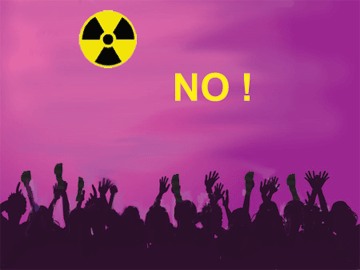
 Wylfa Newydd protesters brand nuclear power ‘dangerous and dirty’, Daily Post, 28 Oct 16
People Against Wylfa B say it’s ‘ironic’ the Japanese company behind the new plant are not building in their own country. Nuclear is an “old fashioned, dangerous and dirty technology” according to a group opposed to a new plant being built on Anglesey.
Pawb (People Against Wylfa B) have responded to Horizon Nuclear Power’s latest consultation by questioning the Japanese firm’s commitment to construct the £12bn power station in view of no new nuclear plants being planned in Japan……..
Last year, the Prime Minister of Japan at the time of the disaster, Naoto Kan, visited Anglesey and urged residents to oppose the Wylfa plant.
Dylan Morgan, a founding member of Pawb, said Hitachi, who own Horizon, are being “totally irresponsible” in persisting with its nuclear “obsession”. He added: “The technology is old fashioned, dirty, dangerous and very expensive.
“It’s ironic that a Japanese company are so adamant that a reactor is built here in Wales, when they can’t do so in their own country.
“Due to the high levels of heat and radioactivity, the waste will have to be stored on site for decades.”…..http://www.dailypost.co.uk/news/north-wales-news/wylfa-newydd-protesters-brand-nuclear-12093470
EDF: fears that Hinkley nuclear will go the disastrous way of Olkiluoto and Flamanville reactors
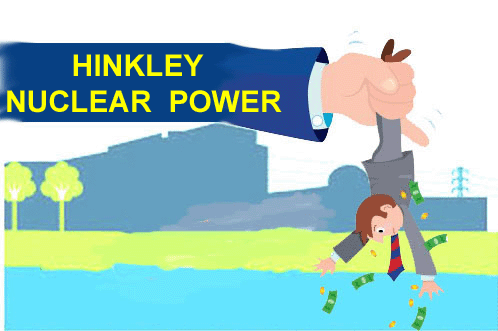 Britain hopes to showcase nuclear skills at Hinkley Point, Ft.com , 28 Oct 16 “………some in the industry have warned that setting up supply chains may not be straightforward. In France and Finland, new reactors are years late and billions over budget, in part because of problems with suppliers.
When the Finnish Olkiluoto 3 reactor and French Flamanville reactors were started, neither country had built a nuclear plant for decades, leading to years of teething problems and criticism of components that were not up to standard.
In 2008, the French nuclear safety authority asked EDF to suspend part of the project “as a result of the numerous deviations observed in the reinforcement or concreting of the foundation rafts”. It said this “highlighted a lack of rigour” and “problems with supervision”, singling out the oversight of a key Italian supplier.
“EDF had not built a nuclear plant in a long time [when it started on Flamanville],” said Denis Florin, founder of consultancy Lavoisier Conseil. “Its control mechanisms were weakened and had to be reactivated.”
The company says it has learnt from Flamanville. But some within EDF fear that Hinkley could have the same problems. “I want to believe we will not face similar issues, but I am afraid it will be the same story all over again,” said one executive at EDF who has been suspicious about the project from the start….”
Russia now trying to sell nuclear reactors to Myanmar
Russia, Myanmar launch working body for nuclear tech cooperation, Myanmar Times, By Aung Shin | Friday, 28 October
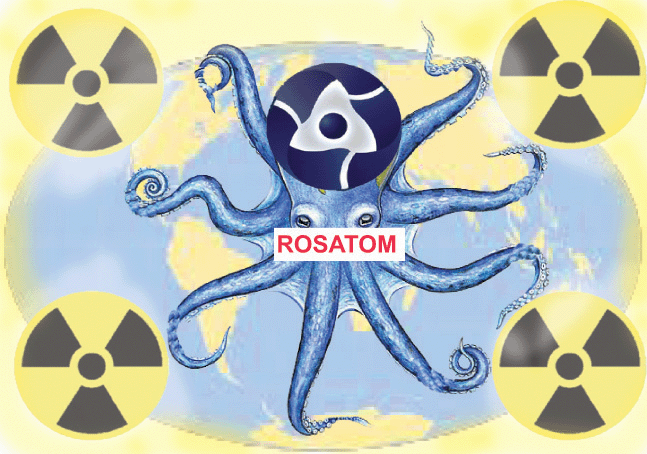
Russia and Myanmar this week established a working body for nuclear technology cooperation, according to officials.
Little is known about the bilateral taskforce, including who is involved or even how many members are included. The two countries signed a memorandum of understanding (MoU) to cooperate in nuclear technology for peaceful purposes in June last year.
According to a Ministry of Education official, the working body is another step in developing nuclear technology with the help of Russia.
Russian government officials are now in Nay Pyi Taw to discuss further steps for the MoU, said U Khin Maung Latt, director general of the Department of Technology Promotion and Coordination (DTPC) under the Ministry of Education.
“We have a roadmap of further steps for the MoU … We have discussed and agreed for further cooperation,” he said……..
Since 2007 Russia and Myanmar have had an inter-governmental agreement regarding nuclear technology and building a nuclear research centre, according to Rosatom.
Russia has trained more than 700 Myanmar students in nuclear and nuclear-related technologies in the past 10 years.
The Russian state firm is seeking potential investment opportunities in the Southeast Asian region, and is offering comprehensive nuclear technology and experience, said Rosatom officials. The company is building two nuclear power units in Vietnam, and has also won a tender for the preliminary design of a 10-megawatt reactor in Indonesia (see map).
Rosatom has two operating nuclear reactors in India and China, with two more in each country under construction. The Russian state-owned company has also won a project to construct a nuclear power plant in Bangladesh…….http://www.mmtimes.com/index.php/national-news/nay-pyi-taw/23368-russia-myanmar-launch-working-body-for-nuclear-tech-cooperation.html
Japanese energy utilities say they’re not uniting, to reduce nuclear costs
Japan’s Kansai, 3 others deny report of nuclear tie-up http://www.reuters.com/article/japan-nuclear-idUSL4N1CY1G0 Oct 28 Kansai Electric Power Co and three other energy utilities based in western Japan on Friday denied a report in the Nikkei newspaper that they are considering a tie-up in their nuclear businesses, which are struggling after the Fukushima disaster.
The Nikkei reported that Kansai Electric, Shikoku Electric Power, Chugoku Electric Power and Kyushu Electric Power were in talks to jointly rebuild old nuclear plants and run them together to cut costs. It did not cite sources.
The Nikkei added the moves could lead to a full merger of the companies’ nuclear operations as part of a realignment of Japan’s atomic power sector, which is all but shutdown nearly six years after the meltdowns at the Fukushima Daiichi plant, located in eastern Japan and run by Tokyo Electric Power .
“There is no truth to the report,” Kansai Electric said in a statement. Chugoku Electric and Shikoku Electric issued similar statements, while a Kyushu Electric spokesman also denied the report.
Japan’s industry ministry this week proposed spinning off the nuclear business of Tokyo Electric Power, as part of a possible reorganisation of the nuclear industry in the country.
Ten companies operate nuclear reactors in Japan but only two of 42 operable units are up and running, amid strong public scepticism towards nuclear power after Fukushima. Courts have also intervened to stop plants operating.
Over the years since Fukushima, the regional utilities have been hit by higher fuel costs, massive investments in upgrades to strengthen atomic plants and, since April, the opening of the retail electricity business to new competitors. (Reporting by Osamu Tsukimori; Editing by Aaron Sheldrick and Joseph Radford)
France’s coming election helps govt to avoid nuclear plant closure decision
France avoids nuclear plant closure decision as election looms http://www.reuters.com/article/us-france-energy-nuclearpower-idUSKCN12S2DG
France has delayed a decision on promised nuclear reactor decommissioning, effectively putting on hold a process that could ultimately be overturned with a change of government next year.
A government investment roadmap published on Friday stopped short of identifying reactors for closure under 2015 legislation that commits France to reducing atomic energy to 50 percent of its electrical power mix, from more than 75 percent currently.
Instead, the Energy Ministry plans leaves it to state utility EDF to issue a strategic review of plants and energy requirements around April of next year.
However, the final decision on whether the reactors are scrapped is a political one.
France goes to the polls in the first round of presidential voting in April, followed by legislative elections in June – meaning the issue looks unlikely to be resolved before a new president and assembly has been elected.
Former Prime Minister Alain Juppe, the conservative candidate currently leading the race, has called Socialist President Francois Hollande’s 50 percent target absurd and vowed to scrap it, in common with several other right-wing candidates.
Lawmaker Herve Mariton, a Juppe ally and prominent energy specialist among the conservative Les Republicains, has also rejected Hollande’s plan to close EDF’s ageing Fessenheim plant after a new reactor opens at Flamanville in 2018.
Opinion polls show conservative candidates easily defeating any potential Socialist rivals in the presidential election, which takes place in two rounds, the second due in May.
Environmental group Greenpeace said the French government was failing to implement the 2015 energy law and had betrayed last year’s Paris Climate Agreement to curb climate-warming emissions by not doing enough to support renewable energy alternatives.
In order to meet the 2015 commitment, France would have had to decide on the shutdown of 22 reactors by now, it said.
According to the energy investment plan published on Friday, a decision to close Fessenheim, France’s oldest nuclear plant, will be taken by the end of the year. The plan also pledged to almost double renewable power output to 150-167 terawatt hours (TWh) by 2030. The plan also seeks to cut nuclear power output by 10 to 65 TWh by 2023.
The financial risks of climate change
A veteran of Britain’s central bank, Paul Fisher says climate change will have a massive impact on the global financial sector. He talks about managing the risks.
MS It seems to me that the insurance industry, because it has a long-time horizon and takes a very actuarial approach, would be well ahead of the game on this. Is that an accurate reading?
PF In the UK that’s certainly true. The UK is one of the world’s largest insurance markets. Lloyd’s of London writes a lot of catastrophe, risk insurance, so they’ve been on this case for some time. They are experts and certainly helped the Bank of England in doing its work. The other insurers and pension funds, and savings managers generally, are also picking up on it. You are starting to see more of the bigger firms announcing investment policies to reflect climate risk. Banking, I would say, is a bit further behind, but coming along. In some countries now – China for example – if you lend to a polluting company, then you as the lender can be held to account, not just the polluter. China is one of the major forces in the world trying to get this on the agenda, which is relevant to Australia, of course, as a big exporter. Here you have big superannuation companies looking at long-term asset issues……..
Climate change is … becoming a material risk for more and more firms. If you could have taken it into account and you didn’t and the risks crystallise, you will be held to account for failing in your duties. This is the way the interpretation is going. The law is never static on this sort of thing and it will be interpreted by the courts as time goes on and more evidence mounts that if you didn’t take climate risk into account and it crystallises, you can’t expect the courts to be very sympathetic……..
MS However, Australia’s economy is particularly tied to the fossil fuel industry.
PF This isn’t about stopping the economy from growing. It’s about how we get the maximum sustainable growth rate. It’s about making people more fuel efficient. It’s about making sure energy prices properly reflect the costs that are imposed on society, not just whatever the market price would otherwise be. This isn’t anti-Australia or anti-Australian industry, it’s about what you have to do to get Australian business working on a sustainable basis … given what’s happening to the planet. A lot of people are working behind the scenes quietly with firms to try to get the right position.
MS Nonetheless, we will see a lot of stranded assets here, won’t we?
PF Possibly, but the longer it’s left and the less is done, the more of those stranded assets you get……
MS How did a scientific and economic issue become an ideological one?
PF Once it moves to the financial sector, as it has now, ideology’s out the window. This is a financial risk if you’ve got a long-term asset portfolio. Forget the ideology, do the risk analysis, otherwise you’re not meeting your responsibilities. We need to sweep the politics to one side and say this is just a commercial business risk, like any other, that we need to take into account. It’s coming, and ignoring it or pretending it isn’t there is not going to help. https://www.thesaturdaypaper.com.au/news/economy/2016/10/29/veteran-uk-banker-paul-fisher-climate-change-and-the-financial-sector
Political era of #climate #refugees #auspol

By Robert Hunziker
Global warming/climate change is one of the most potent agents of political and economic change in history. Its impact is like Atilla the Hun in modern times, who back in the day struck terror into the hearts of the Roman Empire.
As of recent, Europe has been inundated with refugees from Middle Eastern wars as well as refugees from ecosystem collapse all across the southern Mediterranean region. The refugee impact is felt far and wide, including Brexit and a concomitant rise of xenophobia throughout the West whilst altering politics towards antagonism, hatred, and malevolence. The world is turning mad, and madness turns to madman leaders, like Attila the Hun. In point of fact, world history is filled with examples of madmen leading countries, ultimately to demise. They prey upon foreign threats of change to lifestyle and work to motivate people. Climate change is providing plenty of material…
View original post 1,216 more words
October 28 Energy News

Opinion:
¶ “Guess Which Big EU Country Might Have Blackouts This Winter?” • At present, 21 of France’s 58 nuclear reactors are offline. The country’s power prices have skyrocketed, as have imports. Power from fossil fuel is increasing, and the country has now postponed its plans to implement a floor price on carbon. [RenewEconomy]
 The Blayais nuclear power plant in France
(photo by Pierre-Alan Dorange, edited, CC BY-SA 3.0)
Science and Technology:
¶ Southern Spain will be reduced to desert by the end of the century if the current rate of greenhouse gas emissions continue unchecked, researchers have warned. With anything less than extremely ambitious and politically unlikely carbon emissions cuts, ecosystems in the Mediterranean will change dramatically. [malaysiandigest.com]
World:
¶ French utility Engie announced it is now offering contracts for renewable electricity at no additional cost to new residential and small business customers. Engie aims…
View original post 765 more words
1 This Month

of the week – Shut Down Drone Warfare!


Tell the Ukrainian Government to Drop Prosecution of Peace Activist Yurii Sheliazhenko

Petition to revoke the licensing of the Near Surface Nuclear Disposal Facility (NSDF) at Chalk River. https://www.ourcommons.ca/petitions/en/Petition/Details?Petition=e-7247
To see nuclear-related stories in greater depth and intensity – go to https://nuclearinformation.wordpress.com
-
Archives
- April 2026 (103)
- March 2026 (251)
- February 2026 (268)
- January 2026 (308)
- December 2025 (358)
- November 2025 (359)
- October 2025 (376)
- September 2025 (257)
- August 2025 (319)
- July 2025 (230)
- June 2025 (348)
- May 2025 (261)
-
Categories
- 1
- 1 NUCLEAR ISSUES
- business and costs
- climate change
- culture and arts
- ENERGY
- environment
- health
- history
- indigenous issues
- Legal
- marketing of nuclear
- media
- opposition to nuclear
- PERSONAL STORIES
- politics
- politics international
- Religion and ethics
- safety
- secrets,lies and civil liberties
- spinbuster
- technology
- Uranium
- wastes
- weapons and war
- Women
- 2 WORLD
- ACTION
- AFRICA
- Atrocities
- AUSTRALIA
- Christina's notes
- Christina's themes
- culture and arts
- Events
- Fuk 2022
- Fuk 2023
- Fukushima 2017
- Fukushima 2018
- fukushima 2019
- Fukushima 2020
- Fukushima 2021
- general
- global warming
- Humour (God we need it)
- Nuclear
- RARE EARTHS
- Reference
- resources – print
- Resources -audiovicual
- Weekly Newsletter
- World
- World Nuclear
- YouTube
-
RSS
Entries RSS
Comments RSS
 nuclear-news