The “flawed and woefully incomplete” public data from the nuclear industry is leading to an over-confident attitude to risk, the researchers warned.
The study, which put fresh pressure on the nuclear industry to be more transparent with data on incidents, also called for a fundamental rethink of how accidents are rated, arguing that the current method (the discrete seven-point International Nuclear Event Scale or INES) is highly imprecise, poorly defined, and often inconsistent.
For example, the Fukushima accident and the Chernobyl accident are rated 7 — the maximum severity level — on the INES scale.
However, Fukushima alone would need a score of between 10 and 11 to represent the true magnitude of consequences, the researchers said.
Catastrophic nuclear accidents like Chernobyl disaster in the US that took place in 1986 and the more recent Japan’s Fukushima disasters in 2011 may not be relics of the past. But the risk of such disasters are still more likely to occur once or twice per century, a study has warned.
The study found that while nuclear accidents have substantially decreased in frequency, this has been accomplished by the suppression of moderate-to-large events.
The researchers estimated that Fukushima and Chernobyl-scale disasters are still more likely than not once or twice per century, and that accidents like 1979 meltdown at Three Mile Island in the US are more likely than not to occur every 10-20 years.
For the study, a team of international risk experts analysed more than 200 nuclear accidents — the biggest-ever analysis of nuclear accidents — which provided a grim assessment of the risk estimated by the nuclear industry.
The “flawed and woefully incomplete” public data from the nuclear industry is leading to an over-confident attitude to risk, the researchers warned.
“We have found that the risk level for nuclear power is extremely high,” said lead author Spencer Wheatley, Professor at ETH Zurich in Switzerland.
“The next nuclear accident may be much sooner or more severe than the public realises,” added Benjamin Sovacool, Professor at the University of Sussex in Britain.
Further, the standard methodology used by the International Atomic Energy Agency to predict accidents and incidents — particularly when focusing on consequences of extreme events — is also problematic, the researchers said.
The study, which put fresh pressure on the nuclear industry to be more transparent with data on incidents, also called for a fundamental rethink of how accidents are rated, arguing that the current method (the discrete seven-point International Nuclear Event Scale or INES) is highly imprecise, poorly defined, and often inconsistent.
For example, the Fukushima accident and the Chernobyl accident are rated 7 — the maximum severity level — on the INES scale. However, Fukushima alone would need a score of between 10 and 11 to represent the true magnitude of consequences, the researchers said.
To remove a possibility of such disasters would likely require enormous changes to the current fleet of reactors, which is predominantly second-generation technology, Wheatley noted.
But, “even if we introduce new nuclear technology, as long as older facilities remain operational — likely, given recent trends to extend permits and relicense existing reactors — their risks, and the aggregate risk of operating the global nuclear fleet, remain,” Sovacool said.
The results were published in the journals Energy Research & Social Scienceand Risk Analysis
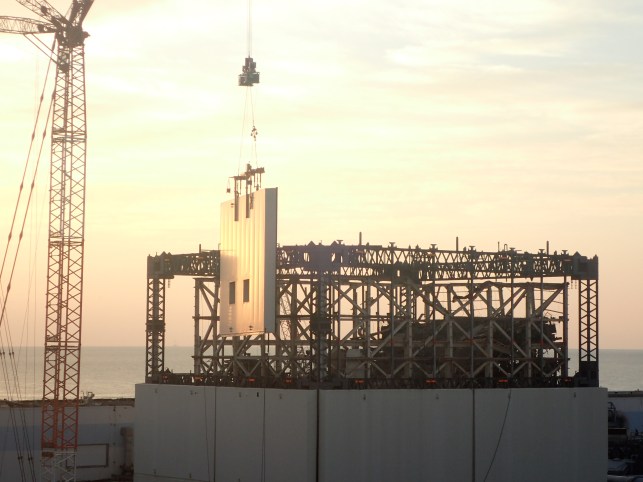
The Shika nuclear plant in Ishikawa Prefecture operated by Hokuriku Electric Power Co.
The Nuclear Regulation Authority has instructed Hokuriku Electric Power Co. to further investigate and prevent a recurrence of flooding that short-circuited the emergency lighting system at its Shika nuclear plant in Ishikawa Prefecture.
The 6.6 tons of rainwater that entered the No. 2 reactor building at the Shika plant in late September also came close to drenching power batteries prepared for emergency use.
“It was never imagined that such a volume of rain would flood the building,” NRA Chairman Shunichi Tanaka said Oct. 19. “There was the possibility of losing an important safety function.”
The Shika plant is currently offline, but the flooding incident could prompt the NRA to review the screening process required before the nuclear reactor is cleared to resume operations.
Hokuriku Electric President Yutaka Kanai apologized for the incident at a special meeting with the NRA on Oct. 19 and acknowledged that the downpour caught the company off-guard.
“Measures to stop flooding were an afterthought because the altitude of the plant site is comparatively high,” Kanai said. “There was a delay in dealing with the warning signals because of a weak sense of crisis among those on duty at the time.”
According to the utility’s report submitted to the NRA, a drainage ditch next to the reactor building was partially covered for road construction work. The rainfall on Sept. 28 flooded the road, and some of the water entered cable piping leading to the reactor building because a lid had been partially moved to allow for passage of a temporary cable.
The rainwater eventually reached the first floor of the reactor building, and power sources for emergency lighting short-circuited. Some of the rainwater leaked through cracks in the floor and fell as far as the second floor basement, according to the report.
The water reached the floor just above the room on the first floor basement where power batteries are kept. Those batteries are a crucial power source for the plant’s operations in the event electricity is cut off in an earthquake.
According to the Japan Meteorological Agency, as much as 26 millimeters of rain fell per hour on that day.
The 2011 disaster at the Fukushima No. 1 nuclear power plant was caused in part by the loss of emergency power sources in the tsunami that swamped the plant.
That accident led to the creation of stricter safety standards on measures to prevent flooding of reactor buildings, including erecting levees against tsunami and installing watertight doors.
However, not much attention was focused on the possibility of flooding through piping.
Anti-flooding measures were not high on the priority list at the Shika plant because there are no nearby rivers. Piping into the reactor building was also not required to be sealed off.
The NRA will ask Hokuriku Electric for new safety measures when it screens the No. 2 reactor at the Shika plant under the utility’s application to resume operations.
The NRA is also expected to wait until Hokuriku Electric presents a more detailed report before looking into whether the incident was unique to the Shika plant or whether there is a need to expand the safety measures to other nuclear plants when conducting screenings before operations can resume.
Here is another propaganda article on Forbes from James Conca, the highest paid pro-nuke shill, wanting us to believe that Fukushima Apples are dynamite in cocktails.
They are certainly not dynamite, but surely hot!
Fukushima Apples Are Dynamite In Cocktails
The 42nd World Cocktail Championships, which kicked off in Tokyo this week, is an unusual event to discuss a nuclear disaster. But that is exactly what Yoshikazu Suda, a bartender in Tokyo’s Ginza district who hails from Fukushima, is doing.
And his demonstration of solidarity with farmers and the people of Fukushima is in the form of some very cool drinks.
Bartenders and mixologists from over from 53 countries will gather in Tokyo to take part in the drink-creating championships. But the International Bartenders Association is no ordinary group. Founded in 1951, the IBA represents the National Bartender Guilds in 64 countries around the world. Over 500 bartenders and mixologists will gather at the event, which is being held in Japan for the first time in 20 years.
The International Bartenders Association is committed to responsible drinking and dispelling myths about alcohol. But this World Cocktail Championship will dispel a completely different type of myth – that Fukushima food is contaminated by radiation. It certainly is not.
During the contest at Tokyo’s Imperial Hotel, several varieties of fruit will be used, but only Fukushima-grown apples will be used in the fruit-cutting event, specifically apples grown by Fukushima farmer Chusaku Anzai.
Five years ago, a magnitude 9 earthquake on the Tohoku Fault off the east coast of Japan sent a 50-foot tsunami crashing into the coast with almost no warning, flooding over 500 square miles of land, killing almost 20,000 people and destroying a million homes and businesses.
– Anti-nuclear candidates win in Niigata, Kagoshima prefectures
– Three gubernatorial races next year in regions facing restarts
Japan Prime Minister Shinzo Abe’s ambition to restart the country’s fleet of nuclear reactors may face further challenges from local elections.
The victory of an anti-nuclear gubernatorial candidate in the central prefecture of Niigata on Sunday, following a similar win in the southern Kagoshima region earlier this year, is complicating efforts by the country’s ruling party to revive Japan’s nuclear fleet. There will be at least three such elections next year in areas where utilities are vying to restart reactors.
“Even as the Abe administration remains committed to including nuclear power as part of Japan’s energy mix, implementing this vision will require overcoming ever-more-dogged resistance from local communities and their representatives,” Tobias Harris, a vice president with Teneo Intelligence in Washington D.C., said in a note Monday. “The restart process will continue to proceed unevenly at best.”
Almost all the country’s reactors remain shut because of new safety regulations and public opposition following the 2011 Fukushima disaster. Only 2 of Japan’s 42 operable reactors are producing power commercially as of Oct. 6, when Kyushu Electric Power Co. shut its Sendai No. 1 unit for maintenance.
Local Approval
Sendai’s return to service may be delayed due to the recently elected Kagoshima governor’s strong opposition to its operation. Local government approval — including endorsement from the governor — is traditionally sought by Japanese utilities before returning plants to service.
Tokyo Electric Power Co. Holdings Inc. fell the most in almost four months on Monday after Ryuichi Yoneyama was elected governor of Niigata over the weekend. Yoneyama won’t support restarting the prefecture’s Kashiwazaki Kariwa plant without a deeper review of the Fukushima meltdown and Niigata’s current evacuation measures.
Elections will be watched closely as support from local governments are crucial to get more nuclear reactors back online, according to Syusaku Nishikawa, an analyst at Daiwa Securities Co. About 57 percent of the Japanese public oppose restarts, according to an Asahi newspaper poll earlier this month. Lawsuits have also threatened reactor operations.
Public opposition and the slow pace of returning reactors will be a challenge to Abe’s goal of having nuclear power provide at least 20 percent of Japan’s electricity by 2030, Harris said.
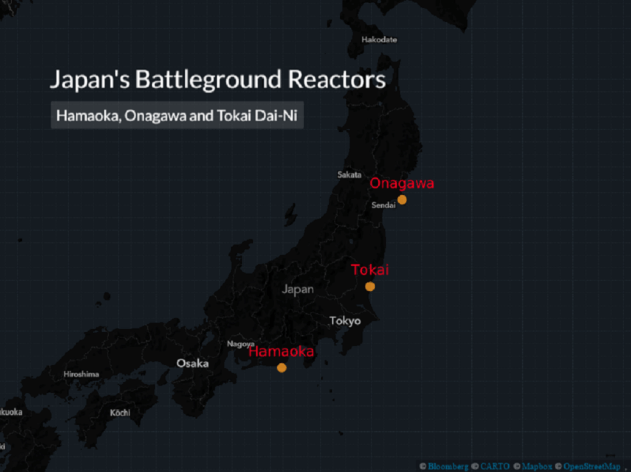
Gubernatorial races are held within about 30 days of when the current term ends, which will happen in 2017 in the following prefectures, according to the local-government websites and data compiled by Bloomberg:
Shizuoka
Chubu Electric Power Co.’s only nuclear power plant is in Shizuoka prefecture, where two of the Hamaoka facility’s units are under review by the nation’s regulator. The current governor, Heita Kawakatsu, said Monday the issue of nuclear restarts should be thoroughly debated during the election, according to Chunichi newspaper. He said in May the prefecture should hold a public referendum on whether the reactors restart, the Mainichi newspaper reported.
While an exact date for the election hasn’t been decided, it will likely occur as early as June, according to the prefecture’s administrative office. Chubu Electric declined to comment on next year’s gubernatorial race and the current governor’s stance. The governor’s office wasn’t immediately available to comment.
Miyagi
Tohoku Electric Power Co. asked the national nuclear regulator to review the safety of the No. 2 reactor at its Onagawa nuclear plant in 2013. Yoshihiro Murai, governor of Miyagi prefecture since 2005 and not affiliated with any party, will not take a position on the restart until after the review, according to an official from the prefecture’s nuclear safety policy division. Tohoku Electric declined to comment.
Ibaraki
Ibaraki prefecture is in a similar position as Miyagi.
Japan Atomic Power Co. asked for a federal safety review in 2014 of its Tokai Dai-Ni plant. Politically-independent Masaru Hashimoto, governor since 1993, said in an NHK interview earlier this year he’ll make a decision on the restart after the review is complete. Japan Atomic declined to comment. The governor’s office wasn’t immediately available to comment.
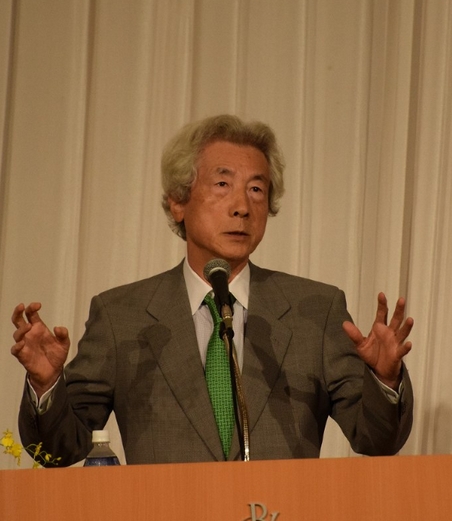
Former Prime Minister Junichiro Koizumi gestures as he speaks at a hotel in Matsumoto, Nagano Prefecture, on Oct. 18, 2016
MATSUMOTO, Nagano — Former Prime Minister Junichiro Koizumi on Oct. 18 commented on the victory of an anti-nuclear newcomer in the Oct. 16 Niigata gubernatorial election, asking why the government isn’t giving up nuclear power when it can.
The newly elected governor, Ryuichi Yoneyama, has expressed a cautious view on the restart of the Kashiwazaki-Kariwa nuclear power plant in Niigata Prefecture.
“He beat a candidate backed by the Liberal Democratic Party (LDP), Komeito and the Japanese Trade Union Confederation, and it was an unexpected upset. I guess that the public has come to understand that nuclear power plants are dangerous, not safe,” Koizumi said during an address in the Nagano Prefecture city of Matsumoto.
He underscored the impact of the election, saying that if the opposition parties jointly field candidates in the next House of Representatives election and make the elimination of nuclear power plants the main focal point, “There’s no telling how the LDP will end up.”
Koizumi said that while he was in power, he believed the opinions of experts and thought that nuclear power plants were necessary. But his view on nuclear power changed in the wake of the Fukushima nuclear disaster.
“With the Fukushima nuclear disaster, I realized that the descriptions of (atomic power) as safe, clean and low-cost were all lies.”
The former prime minister said he started efforts to eliminate all nuclear power plants in Japan after realizing the mistake and wanting to correct it and make amends. At times during his address, Koizumi raised his voice in earnest like he did when he was prime minister.
“They (the government) can eliminate nuclear power, so why don’t they?” he asked. “It’s time to turn a predicament into a chance.”
France’s Nuclear Safety Authority has ordered the country’s EDF utility to conduct checkups at five nuclear reactors ahead of their scheduled maintenance tests, citing potential weakness in critical parts manufactured by a Japanese company, French media reported Tuesday.
All five nuclear reactors are using parts made by Kitakyushu-based Japan Casting & Forging Corp. (JCFC), which is now under scrutiny by Japan’s Nuclear Regulation Authority.
The NRA discussed the matter at its regular meeting on Wednesday as it has also found the company manufactured reactor pressure vessels in 13 Japanese nuclear reactors including the Sendai Nos. 1 and 2 reactors operated by Kyushu Electric Power Co. in Kagoshima Prefecture.
The Sendai No. 1 reactor is undergoing a regular checkup while the No. 2 reactor is in operation.
In addition, the NRA said JCFC had been manufacturing important components at the No. 2 unit at Kansai Electric Power Co.’s Mihama plant in Fukui Prefecture and No. 1 unit at Kyushu Electric Power Co.’s Genkai nuclear plant in Saga Prefecture, which have already been decommissioned.
The French nuclear watchdog ASN said earlier in June that parts manufactured by JCFC using a method called “forging,” in which metals are hammered and extended, contained a high carbon concentration that could lead to lower-than-expected mechanical strength.
In the documents submitted to the NRA meeting, JCFC admitted there is a possibility that the parts used in nuclear power plants in France contain carbon higher than the regulated limits, but parts used in Japan are manufactured after removing high-carbon concentration from steel.
According to the media reports, safety tests have already been carried out at seven of a total of 12 reactors in France that used parts manufactured by JCFC. Parts at four of the seven reactors are believed to contain a higher carbon concentration than permitted by standards.
Following these findings, ASN told EDF to test the remaining five reactors within three months.
France has 58 commercial nuclear reactors. At the No. 3 reactor at Flamanville nuclear plant, which is under construction, parts made in 2014 by Creusot Forge, a subsidiary of France’s Areva SA, were found to be lacking in strength. ASN later discovered that the parts manufactured by JCFC also had problems.
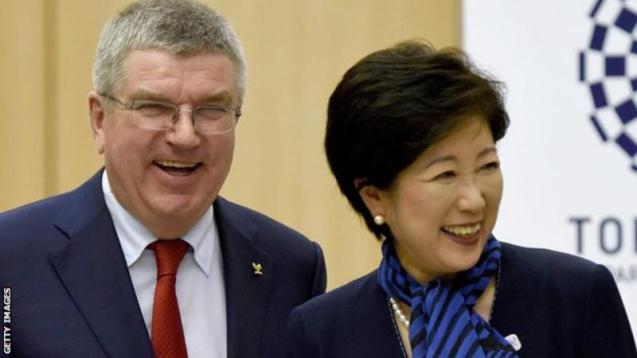
IOC president Thomas Bach is holding talks with Tokyo Governor Yuriko Koike in the city
Tokyo 2020: Japan earthquake and nuclear disaster site could host Olympic events
Tokyo 2020 Olympic events could be held in part of Japan hit by the 2011 Fukushima earthquake, tsunami and nuclear disaster in a bid to cut costs.
Rowing canoe/kayak sprint events and baseball/softball are among sports that could be moved 400km north of Tokyo.
The International Olympic Committee is holding talks with organisers after a review showed costs could exceed £23bn ($28bn) – four times the estimate.
But IOC president Thomas Bach said “we have to respect” athletes.
“The athletes are the heart and soul of the Olympic Games,” Bach emphasised.
The IOC began four-party discussions with the city government, Tokyo organisers and Japan’s central government on Tuesday in a bid to reduce spending on the Games.
The proposal to move some sports to the north-eastern area of Japan devastated by the earthquake was made in a review of expenses commissioned by Tokyo Governor Yuriko Koike.
The review recommends moving some sports from planned new venues to existing ones.
Several events have already been moved outside of Tokyo, with cycling now due to take place 200km from the village in the Shizuoka district.
Bach said he was confident cost reductions could be made, but suggested Tokyo should try to stay close to its original bid proposal of keeping the majority of venues within 8km of the athlete’s village in the city’s downtown.
He said moving events to the earthquake-hit area was one of several cost-cutting options being discussed, and that it could “contribute to the regeneration” of the region.
The most expensive Games to date are the London Games at £12bn and the Sochi 2014 Winter Games in Russia which cost £17.7bn.
The Rio Olympic Games cost £9.7bn, coming in 51% over budget despite cuts to ceremonies, venues and staff.
According to a recent study, no Games since 1960 has come in under budget.
The head of the International Olympic Committee has suggested holding some events of the 2020 Tokyo Games in areas of northeastern Japan that were devastated by the earthquake and tsunami of 2011.
IOC President Thomas Bach, now visiting Japan, met Prime Minister Shinzo Abe in Tokyo on Wednesday.
Bach told Abe the IOC is thinking of holding some Olympic events in the disaster zone to contribute to revival efforts. He said this could show the world how the areas have recovered. Abe welcomed the idea.
Abe also promised the government’s participation in talks to cut costs for the games.
Bach had proposed 4-way talks by the Tokyo Metropolitan Government, the IOC, Tokyo 2020 organizers and Japan’s government.
Reporters later asked Bach if baseball and softball will be held in Fukushima City. Bach said it’s an option under consideration. He added that since the sports are very popular in Japan, having the country’s team play in the disaster zone would send a strong message.
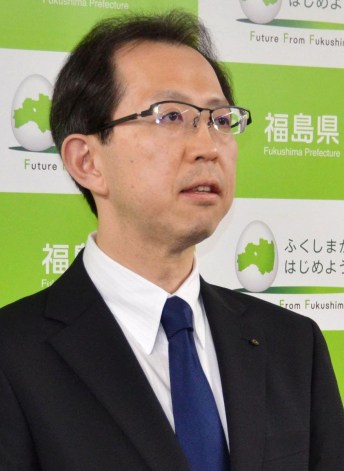
Washington, Oct. 18 (Jiji Press)–Visiting Fukushima Governor Masao Uchibori said Tuesday that he will pitch in the United States specialties and attractions of the northeastern Japan prefecture, such as sake and hot springs.
At a press conference, Uchibori said he wants many people to visit the prefecture from the United States and take first-hand looks at the current situation there.
If such visitors disseminate information about the prefecture in their own words, that will be a significant step toward reconstruction, he added.
Fukushima was hit hard by the March 2011 nuclear reactor meltdown at the Fukushima No. 1 power plant of Tokyo Electric Power Company Holdings Inc. following a massive earthquake and subsequent tsunami.
The evacuation area due to radioactive contamination caused by the nuclear disaster now accounts for only 5 pct of the prefecture’s land area and people live normal lives in the remaining 95 pct, Uchibori explained.
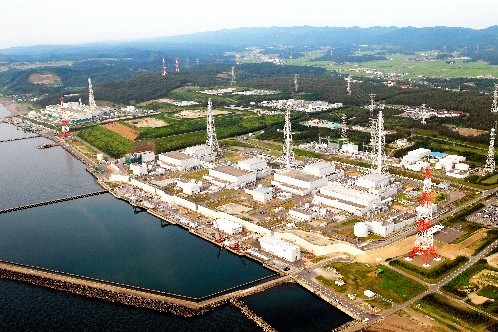
The Kashiwazaki-Kariwa nuclear power plant in Niigata Prefecture
In an upset, Ryuichi Yoneyama, a rookie candidate backed by the opposition Japanese Communist Party, the Social Democratic Party and the Liberal Party, was elected governor of Niigata Prefecture on Oct. 16.
Yoneyama presented a tough stance toward the proposed restart of Tokyo Electric Power Co.’s Kashiwazaki-Kariwa nuclear power plant in the prefecture, which was the main election issue.
He emerged victorious in a virtual one-on-one contest against Tamio Mori, a former mayor of Nagaoka in the prefecture, who was backed by the ruling Liberal Democratic Party and its junior coalition partner, Komeito.
The outcome could be called a manifestation of the public will that wants to halt the headlong way the administration of Prime Minister Shinzo Abe is seeking to have Japan’s idled nuclear reactors brought back online.
The election highlighted the strong anxiety that Niigata Prefecture residents have concerning nuclear power.
Yoneyama said in his campaign pledge that he would not discuss the restart of the Kashiwazaki-Kariwa plant unless the causes of the 2011 disaster at TEPCO’s Fukushima No. 1 nuclear power plant, its impact and the challenges it highlighted are scrutinized.
He has the responsibility to follow through on his promise and confront the central government and TEPCO, which are seeking to have the Kashiwazaki-Kariwa’s nuclear reactors brought back online, with a resolute attitude.
Hirohiko Izumida, the incumbent governor who has consistently taken a cautious stance toward a nuclear restart, did not seek re-election.
Attention was focused during the gubernatorial race on whether Izumida’s policy line would be succeeded. It was initially thought that Mori, a former head of the Japan Association of City Mayors who emphasized the connections he has with the central government, had an overwhelming advantage.
But Yoneyama, who announced his candidacy immediately before official campaigning started and asserted he would follow Izumida’s stance over the nuclear restart issue, turned out to have more pull.
An Asahi Shimbun survey of eligible voters in Niigata Prefecture found that, while only about 20 percent of the respondents said they approved the restart of the Kashiwazaki-Kariwa nuclear plant, more than 60 percent opposed it. Yoneyama was elected by that public opinion.
Kashiwazaki-Kariwa, where seven nuclear reactors are concentrated, is one of the world’s largest nuclear plants. A serious cover-up of technical problems there came to light in 2002. The Niigata Chuetsu-oki Earthquake of 2007 resulted in a fire and the leakage of a small amount of radioactive substances there. It stands to reason that many feel anxious about plant operations.
Izumida told the central government that plans for evacuating local residents in the event of a nuclear plant disaster are not covered by the screenings by the Nuclear Regulation Authority, and called for the central government’s Nuclear Emergency Response Guideline to be improved. He also used an expert panel of the prefectural government to pursue an independent investigation into the Fukushima nuclear disaster.
The governor also questioned TEPCO’s delay in announcing that core meltdowns had occurred at the Fukushima No. 1 nuclear plant. That led to TEPCO’s acknowledgment this year of a cover-up.
One can say that Izumida has demonstrated that a prefectural governor can play various roles without leaving the safety of a nuclear plant up to the central government. The election results have shown that many residents of Niigata Prefecture want their governor to continue that stance.
The Abe administration, which defines nuclear energy as an important mainstay power source, is hoping to restart nuclear reactors that have passed NRA screenings. It also defines the restart of the Kashiwazaki-Kariwa nuclear plant as an indispensable step for rehabilitating the embattled TEPCO, which has virtually become a government-owned entity.
The administration, however, should sincerely face up to the public will in Niigata Prefecture.
In Kagoshima Prefecture as well, the winner in a gubernatorial election this summer was a candidate who called for a nuclear plant in the southern prefecture to be taken temporarily offline.
It is the duty of top officials responsible for national politics to listen to the voices of the public.
TOKYO — The election of an anti-nuclear candidate as governor of Japan’s Niigata Prefecture could hit the finances of not only Tokyo Electric Power Co. Holdings but the public as well, as the utility is relying on a reactor restart in Niigata to cover Fukushima cleanup costs.
The central government reached an arrangement in 2014 to extend up to 9 trillion yen ($86.6 billion currently) in interest-free loans to pay for dealing with the fallout of the 2011 Fukushima Daiichi nuclear plant disaster. Of this, 5.4 trillion yen is to go toward compensating those affected, with Tepco and other power companies, including Kansai Electric Power and Chubu Electric Power, to repay the loans. Another 2.5 trillion yen is earmarked for decontamination work, with the costs to be recouped through the sale of Tepco shares held by the government.
But more than 6 trillion yen in compensation has been paid out so far, and cost overruns on decontamination are seen as all but certain. Decommissioning work at Tepco’s Fukushima plant, such as extracting fuel, falls outside the 9 trillion yen framework.
The 2 trillion yen Tepco had aimed to secure on its own to pay for scrapping the plant will be nowhere near enough. The utility and Japan’s industry ministry had counted on bringing the Kashiwazaki-Kariwa nuclear plant in Niigata Prefecture back online, which would improve Tepco’s earnings by 240 billion yen a year. But Gov.-elect Ryuichi Yoneyama has indicated that he is not amenable to a quick restart.
An expert panel set up by the ministry started discussing how to handle the additional costs this month. It laid out a scenario in which improved profit margins at Tepco via restructuring, along with profits from the Kashiwazaki-Kariwa facility, would be used to minimize the amount shouldered by taxpayers.
The longer it takes to restart the plant in Niigata, the larger the hit will be to Tepco’s available funding for Fukushima costs. Though the utility will squeeze out some money via internal reforms, Tepco may use rate hikes to pass on to the public what it cannot cover itself. Tepco and other utilities already have raised rates to recoup part of the compensation costs. A top industry ministry official indicated that rate increases will also be on the table to pay for decommissioning.
Power companies besides Tepco could be affected as well. Since many nuclear plants in eastern Japan use boiling-water reactors like those at the Kashiwazaki-Kariwa plant, further delays could hold up other reactor restarts in the region.
“…..I would like to bring to the attention of the kind reader some issues that we often take for granted. The real industrial profit for the military industrial complex, working hand in glove with Wall Street and London, stems from the preparation for war: spending on research, development, manufacture, stretching costs, inflating them and extorting as much money as possible from the government and the American taxpayers. This is the basic guideline for American military spending doctrine. Do you think that Raytheon and Boeing would derive higher profits from a nuclear exchange with tens of millions of deaths? Unlikely, least of all because those who finance them (common citizens paying taxes) would themselves be reduced to ashes.
If a nuclear exchange is not convenient for anyone, and if MAD cannot be altered willy-nilly, then why does NATO continue to fan the flames, raising the scenario of thermonuclear conflict?
Three main reasons:
1. To intimidate Russia with the ridiculous hope that Moscow will step back from the global arena in which it has been playing the leading role in the last months and years.
2. The constant state of pre-alert as a harbinger of war for billion-dollar contracts for the US arms industry.
3. Placing troops and weapons in distant countries is a way to project power and at the same time make those nations feel important within the Atlantic alliance (with the added benefit that these governments will provide lucrative contracts for the US defense industry)
The second point is the essence of this analysis and continues in the wake of the previous questions. How does Moscow perceive NATO’s attitude, and what is a possible answer to this continuous aggression?
The answer for Russia is simple: tilt the table and take advantage from the deterioration of international relations. Sanctions are imposed? Implement countermeasures that, while painful, are necessary and in the long term will be positive and decisive. Import and export products looking towards the east. Encourage local production with reduced imports. And, especially, decrease the importing and exporting of goods using the US dollar.
A military doctrine does not differ much from the following basic principle: develop weapons and tactics to counter the existential dangers effectively. It is obvious that when Putin recently pointed out the danger that Romania will face, having decided to accept elements of the missile shield in their country, he was addressing the issue pointed out above in (a), which carries a lot of historical weight and significance.
There are of course two other issues to be addressed:
Many analysts note how the West has a really hard time understanding the Russian mindset in a scenario of existential crisis. They are not wrong to say so, but the conclusion they reach is excessive in my view, especially when they claim that a Russian preemptive strike on the European missile shield is possible in order to prevent (what seems to them) an inevitable US nuclear first strike.
The problem with this thesis is that according to the information at our disposal, there simply are not enough elements to this scenario to make it probable or even possible, especially in relation to a Russian preemptive strike. We observe Russia’s behavior in Libya, Ukraine and now Syria and are left in little doubt that Moscow’s involvement in international affairs has increased exponentially in recent years. But it is always carried out in a proportionate way, accompanied by unceasing diplomatic overtures to Europe and the United States. The carrot and stick always feature prominently in Putin’s global vision of the foreign affairs for the Russian Federation.
Realistically, Moscow is well aware that the military build-up on its borders is not a significant threat and nor is the missile shield. Does this mean that Moscow, or even Beijing, are happy to be surrounded by the Atlantic Alliance’s bases? Of course not. But this does not automatically mean that the time has come for a final showdown of nuclear Armageddon.
Major analysts of Russians think-tanks have reached the same conclusions as set out above, namely, nuclear war is not convenient for anybody, especially NATO. The negative effects of such a conflict would not be limited to Russia. We must remember that the best deterrent, along with MAD, is a nuclear arsenal that is intact, functional, and is ready and deadly. This is exactly the thinking that the Russians have employed over the last 10 years concerning their nuclear stockpile, thanks in large part to NATO’s aggressiveness.
In short, the beating of the war drums by the neo conservative and neoliberals in relation to Russia is only another way to increase military spending and fatten their own pockets……” More on link
byPAUL STREETI have more than once heard fellow U.S. leftists describe the choice between dismal Democrats and rancid Republicans as like a choice of how one would like to be executed: firing squad or hanging; electric chair or gas chamber; guillotine or liquid injection. With the official range of selection narrowed to Donald Trump or Hillary Clinton for U.S. President, we might extend the metaphor to all of humanity (and to the other species homo sapiens hasn’t already eradicated) and ask: which is your preferred near-term path of extinction, accelerated anthropogenic (really capitalogenic) global warming (AGW) or thermonuclear world war?
If one wants to work with the dichotomy of “greater” and “lesser” evil, Trump is quite probably the “greater evil” on climate change, whose existence he denies. If president, he says, he would “deregulate [American] energy.” He would help the nation’s fossil fuel firms and their customers extract, sell, and burn as much coal. gas, and oil as they could (and the executive branch can do quite a bit in that regard). Noam Chomsky is right that this could signal “almost a death knell for the species.” We are speeding to ecosystem collapse with AGW in the lead of numerous interrelated “ecological rifts.” A stepped-up carbon orgy under a Trump administration could well seal the tipping-point deal.
But Hillary Clinton is the greater evil when it comes to World War III. She is showing signs that she would view a landslide victory against Trump as what the left analyst Glen Ford calls “a mandate for war with [nuclear] Russia.” The nuclear “dice on humanity’s future” (Ford) are already being shaken by the Obama administration. Consistent with Obama’s long-time commitment (shared the Clintons, Madeline Albright, and the rest of the Council on Foreign Relations crowd) to the Zbigniew Brzezinski project of humiliating Russia, Washington has helped install a vicious right wing and pro-Western government in Ukraine, a key state on Russia’s western border (one that past European invaders have marched through on a path to Moscow). Last May, Washington announced the installation of a so-called European missile defense system in Romania – a deployment that Russia naturally interpreted as an attack on its nuclear deterrence capacity. The White House disingenuously claimed that the system was meant to protect Europe from Iran, something that Moscow immediately and reasonably denounced as a lie. Russia suggested that it might retaliate by placing nuclear missiles in Crimea and Kaliningrad, its exclave on the Baltic Sea, between Poland and Lithuania.
The key hotspot in the U.S. and Western-led “new Cold War” now is of course Russia- and Iran-backed Syria, where U.S. and other Western airplanes “mistakenly” killed 62 Syrian troops one month ago. The attack effectively blew up a Syrian “ceasefire” Washington had arranged with the Syrian government’s key ally Russia just a week before. Now, Pepe Escobar reports, “the Pentagon – supported by the Joint Chiefs of Staff – …is peddling ‘potential strikes’ on Syria’s air force to ‘punish the regime’ for what the Pentagon actually did; blow up the ceasefire.” Washington disingenuously claims to have deep humanitarian concerns for the 250,000 or so civilians who are trapped on the eastern side of the city of Aleppo, a rebel/al Qaeda-controlled territory under siege by the Syrian army and Shia paramilitary forces from Iran, Iraq, and Lebanon. This follows a provocative Washington Post story leaking reports that the Obama administration is thinking about undertaking a direct U.S. covert war on the ground against the Syrian state.
All of this has quite naturally elicited a stern response from Moscow. The Russian Ministry of Defense telling Washington to “weigh the consequences” of its schemes. Maj. Gen. Igor Konashenkov informed the world that it was ready and willing to use its state-of-the-art air defense systems to shoot down U.S. war planes attacking Syrian troops or Russian military installations. If and when that happens, Konashenkov added, things will be moving too fast for the Russians to use the “hotline” to give Washington the “exact flight program” of its air defense missiles in Syria.
This is all bad enough, but Hillary seems to want to up the ante. Listen to her language in her second “presidential” “debate” with Trump. “The situation in Syria is catastrophic,” Mrs. Clinton said. “And every day that goes by, we see the results of the regime by Assad in partnership with Iranians on the ground, the Russians in the air…when I was Secretary of State, I advocated and I advocate today a no-fly zone and a safe zone.” Continue reading →
Donald J. Trump the Hawk, Counter Punch bySHELDON RICHMAN, OCTOBER 14, 2016 Donald Trump is no peacenik. Leave aside Trump’s proclamation that he “love[s] war” and unpredictability, and that he is more “militaristic” than anyone. Forget that he wants to enlarge the military and that he refuses to forswear first use of nuclear weapons. Ignore his bellicosity toward Iran and China or his promise to support Israel unconditionally. Pay no attention to Trump’s 2002 endorsement of the invasion of Iraq and his imploring Obama to invade Libya and overthrow Muammar Gaddafi.
All we have to do to see the real Trump is examine his allegedly dovish statements.
Trump takes heat every time he expresses a wish to get along with Russia. This in itself would be good: the United States and Russia could destroy the world with their nuclear weapons. But the ruling elite disagrees. Since the collapse of the Soviet Union and its Warsaw Pact alliance, U.S. rulers have provoked Russia by incorporating its former allies and republics into NATO and enabling a coup against an elected Russia-friendly president of Ukraine, jeopardizing Russia’s naval base in Crimea.
But would Trump really pursue peaceful relations with Russia? It’s not so clear. When asked about his views on Russia at the recent joint appearance with Hillary Clinton, he noted that Russia is “fighting ISIS,” which he implied puts the United States on the same side. “I believe we have to get ISIS,” he said. “We have to worry about ISIS before we can get too much more involved.”
Note the words before we can get too much more involved. Trump’s statement indicates that working with Russia is merely a matter of priorities. First ISIS, then … what? More intervention, presumably against Syria’s ruler, Bashar al-Assad.
After all, Assad is an ally of Iran, which Trump demonizes daily. We have no reason to think that if he presided over the defeat of ISIS, Trump would continue to cooperate on Syria with Russia, which like Iran would still have influence in the Middle East. Thin-skinned nationalist Trump is unlikely to suffer what he regards as impertinences from these nations, which resent having an American president define their places in the world…….
Trump wants to “bomb the shit” out of ISIS. He wants to torture suspected terrorists. He wants to kill the relatives of those suspects. That would only inspire more terrorism. Trump has obviously learned nothing from the wars he once supported and now falsely claims to have opposed…….. http://www.counterpunch.org/2016/10/14/donald-j-trump-the-hawk/
Japanese and North Korean students forge bonds in rare meeting but remain apart over nuclear weapons, Japan Times, BY NATSUME WATANABE. 18 Oct 16 KYODO PYONGYANG – A group of Japanese college students made a rare visit to Pyongyang in late August — just before North Korea conducted its fifth nuclear test on Sept. 9 — for talks on war and peace with local students.
But three days of social exchanges and intense discussions left the groups at odds on issues such as how best to achieve world peace and whether nuclear disarmament is feasible……..
The student-to-student program was initiated in 2012 by a group of Japanese nongovernmental organizations. Among them was Tokyo-based Relief Campaign Committee for Children, Japan, which conducts cultural exchanges.
Participants in the annual program have gradually become able to take up political issues over the years, organizers said, despite the isolated communist regime’s strict controls on speech.
Jinguji was one of eight Japanese students who took part in this year’s program. The 11 North Koreans were all in their early 20s and majoring in Japanese language at the Pyongyang University of Foreign Studies……..
On the morning when the Japanese students were to return home, tears could be seen in the eyes of some of the North Korean students.










 nuclear-news