The Fukushima Decontamination, Waste Storage, Processing and Recycling Utopia
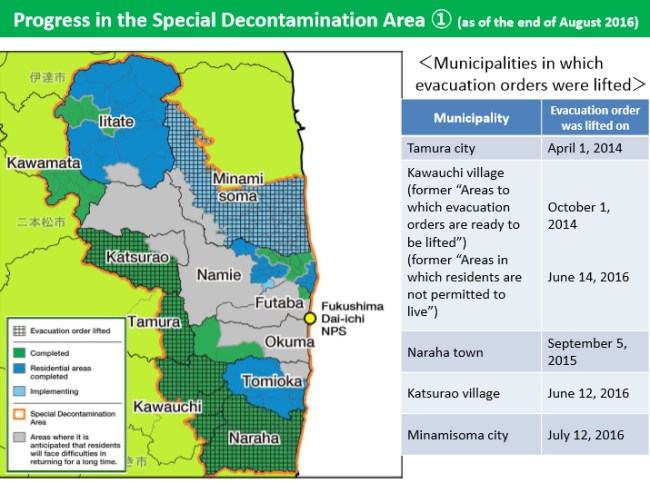
In Fukushima Prefecture, large quantities of contaminated soil and waste have been generated from decontamination activities. Currently, it is difficult to clarify methods of final disposal of such soil and waste. Until final disposal becomes available, it is necessary to establish an Interim Storage Facility (ISF) in order to manage and store soil and waste safely.
The only solution proposed is a storage facility of 16 km2 around the Fukushima plant for a period of 30 years. After that, time will tell, because the problems are endless.
The following materials generated in Fukushima Prefecture will be stored in the ISF.
1. Soil and waste (such as fallen leaves and branches) generated from decontamination activities, which have been stored at the Temporary Storage Sites.
2. Incineration ash with radioactive concentration more than 100,000 Bq/kg.
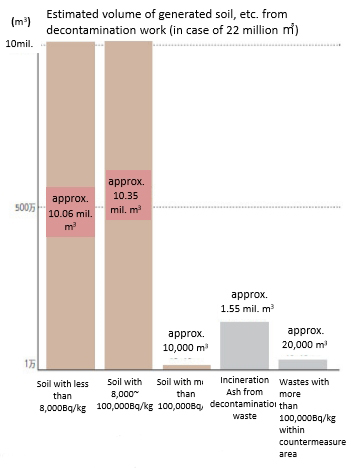
It is estimated that generated soil from decontamination will be approx. 16 ~22 mil. m3 after the volume reduction incineration, estimated value based on the decontamination implementation plan of July 2013. (Ref: approximately 13~18 times as much as the volume of Tokyo Dome (1.24 mil. m3) .
Transportation to Stock Yards
In order to confirm safe and secure delivery towards the transportation of a large amount of decontamination soil, MOE implemented the transportation approx. 1,000m3 each from 43 municipalities in Fukushima Prefecture from 2015-2016.
Actual achievement in 2016 as of July 30, 2016
Stored volume: 13,384m3 (58,766m3 in total)
Stock yards in Okuma: 4,883m3; stock yards in Futaba: 8,501m3
* Calculated on the assumption that the volume of a large bag is 1m3
Total number of trucks used: 2,279 (9,808 in total)
Stock yards in Okuma: 815 trucks; stock yards in Futaba:1,464 trucks
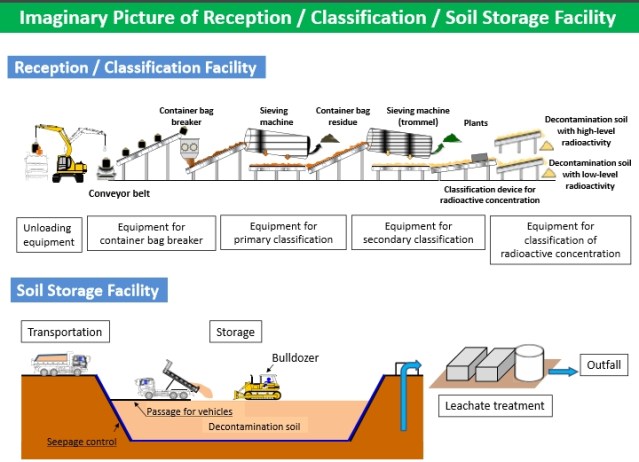
To construct facilities, it will need comprehensive area and 2/3 will be assumed to be used for facilitation. The possible volume for installation is to be 10,000m3/ha and 140,000m3/5ha for a storage facility, and will be installed from TSS to ISF sequentially.
Approximate period from contract with operators to ISF operation: 3months for TSS, 6months for delivery & classification, 12months for storage, 18months for incineration.
On the premise that infrastructure construction on roads for Okuma and Futaba IC would proceed as planned, the maximum volume of possible transportation is estimated: 2millions m3 /y before the operation of both IC, 4millions m3/y after Okuma IC & before Futaba IC, 6 millions m3/y after the both ICs operation.
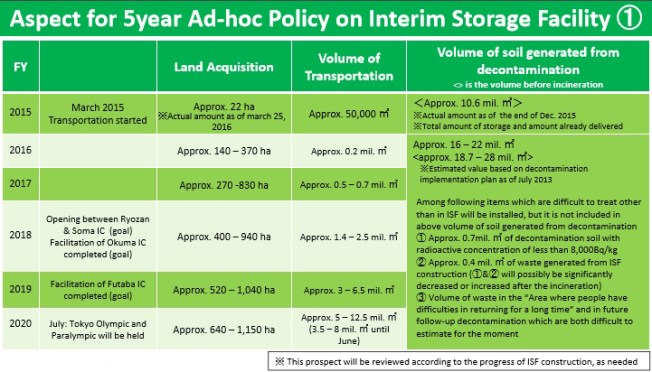
Landowners are still reluctant to sell their land to put the waste. In late September 2016, according to the official data of the Ministry of Environment, only 379 owners out of 2360 had signed a contract. This represents an area of 144 ha, or about 9% of the total project.
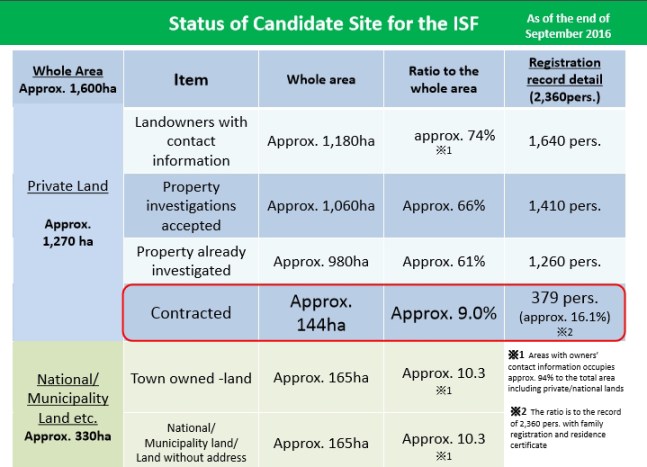
The town of Okuma, is almost entirely classified as “difficult to return”zone, therefore it intends to offer all its municipal land to put the waste. This represents 95 hectares, or about 10% of land considered in the town. This includes schools, the Fureai Park with some sports grounds … The town has not yet decided whether it would sell or would lease its land.
Meanwhile, it is an abandoned village:
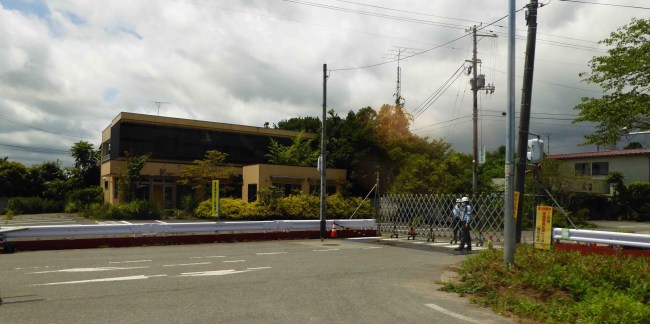
The Joban railway line was partially destroyed by the tsunami, as here in Tomioka:
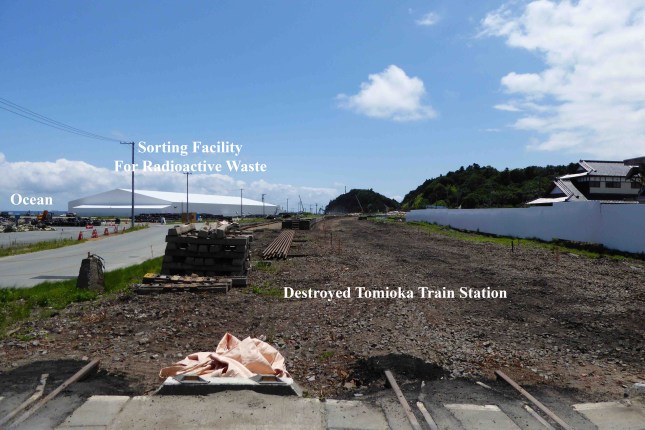
Destroyed Tomioka train station and sorting facility for radioactive waste
Some parts have reopened, but not in the most contaminated areas; between Tatsuta and Namie. Japan Railway wants to fully reopen the railway before 2020, avoiding the coast. Decontamination should produce 300,000 m3 of radioactive waste. The radioactive waste bags are along the railway, but they will need to be take them away. The Environment Ministry is negotiating with landowners owning the land beside the railway, but this is not enough because few responded favorably. So it’s a game of musical chairs that is planned: use the lands where some waste is right now after they’ll freed by the transfer of the waste to the storage center located around the Fukushima Dai-ichi.
Meanwhile, the waste is piling up everywhere:
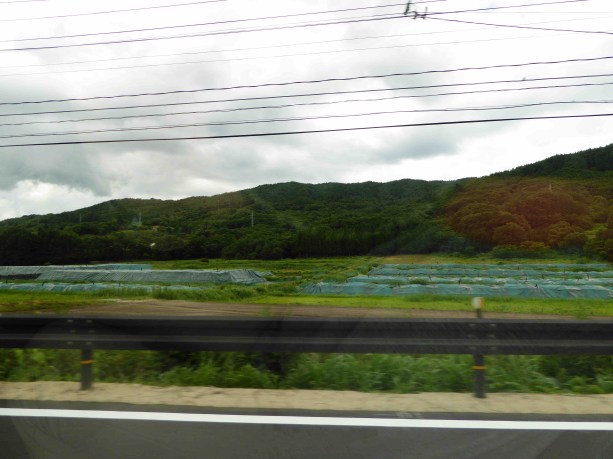
Radioactive waste in Iitate
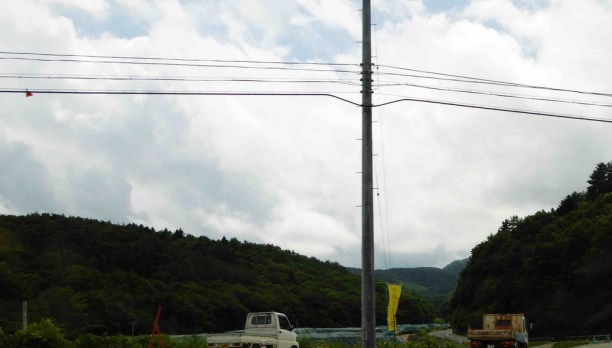
Valley of radioactive waste in Iitate mura
This storage was not expected to last as long, which is not without causing problems because the bags do not hold. Here in Tomioka, weeds grow back:
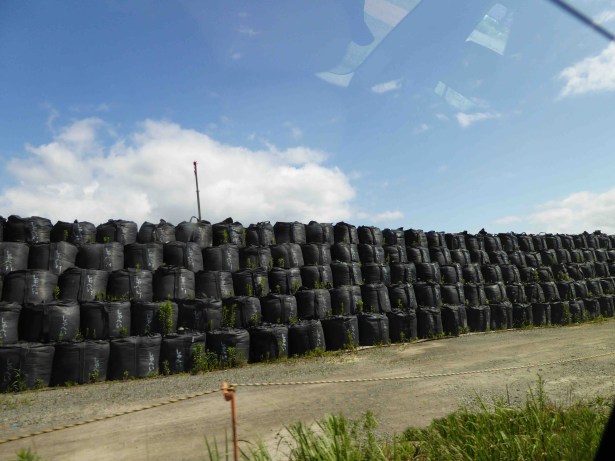
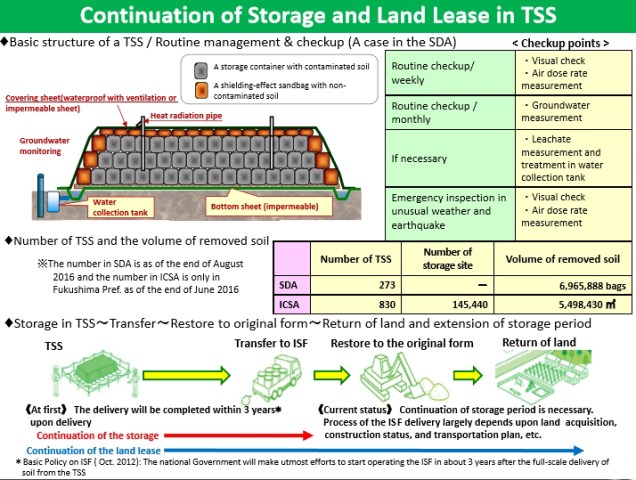
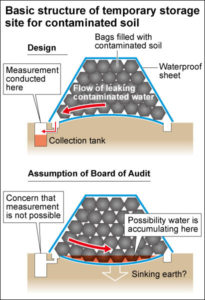
The equivalent of the Court of Accounts of Japan went to inspect some of these sites and found other problems, according to the Asahi. Those who receive contaminated soil, are elevated in the center so that the water flows over the edges where it can be harvested and controlled because the bags are not waterproof. There are up to 5 levels. With time and the weight of waste, a hollow that may appear in the center, and contaminated water accumulates there. Monitoring is difficult or impossible. See diagram of Asahi:
It is not normal that the Nuclear Regulatory Authority, the NRA does not control these storage sites for radioactive waste.
Regarding the waste from the decommissioning of nuclear power plants, the NRA wants to bury the most contaminated within 70 meters for 100 000 years. This is essentially reactor control rods. Utilities would bear responsibility for 300 to 400 years. They have not yet found where to have the sites … Read Asahi for more. http://www.asahi.com/ajw/articles/AJ201609020034.html
The government relies on the radioactive decay for these wastes to pass below the 8000 Bq / kg to be downgraded and utilized …
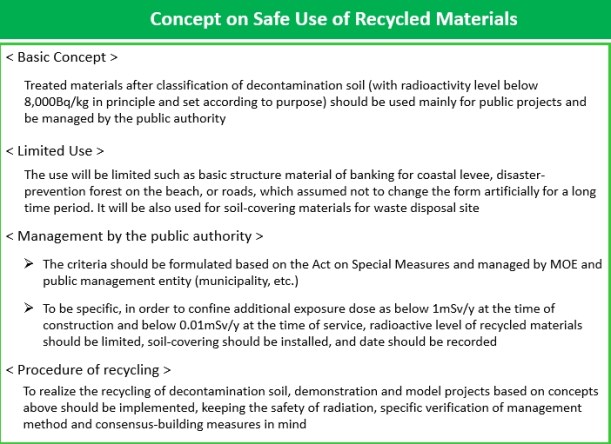
http://josen.env.go.jp/en/pdf/progressseet_progress_on_cleanup_efforts.pdf
No comments yet.
1 This Month

of the week – Shut Down Drone Warfare!


Tell the Ukrainian Government to Drop Prosecution of Peace Activist Yurii Sheliazhenko

Petition to revoke the licensing of the Near Surface Nuclear Disposal Facility (NSDF) at Chalk River. https://www.ourcommons.ca/petitions/en/Petition/Details?Petition=e-7247
To see nuclear-related stories in greater depth and intensity – go to https://nuclearinformation.wordpress.com
-
Archives
- March 2026 (251)
- February 2026 (268)
- January 2026 (308)
- December 2025 (358)
- November 2025 (359)
- October 2025 (376)
- September 2025 (257)
- August 2025 (319)
- July 2025 (230)
- June 2025 (348)
- May 2025 (261)
- April 2025 (305)
-
Categories
- 1
- 1 NUCLEAR ISSUES
- business and costs
- climate change
- culture and arts
- ENERGY
- environment
- health
- history
- indigenous issues
- Legal
- marketing of nuclear
- media
- opposition to nuclear
- PERSONAL STORIES
- politics
- politics international
- Religion and ethics
- safety
- secrets,lies and civil liberties
- spinbuster
- technology
- Uranium
- wastes
- weapons and war
- Women
- 2 WORLD
- ACTION
- AFRICA
- Atrocities
- AUSTRALIA
- Christina's notes
- Christina's themes
- culture and arts
- Events
- Fuk 2022
- Fuk 2023
- Fukushima 2017
- Fukushima 2018
- fukushima 2019
- Fukushima 2020
- Fukushima 2021
- general
- global warming
- Humour (God we need it)
- Nuclear
- RARE EARTHS
- Reference
- resources – print
- Resources -audiovicual
- Weekly Newsletter
- World
- World Nuclear
- YouTube
-
RSS
Entries RSS
Comments RSS
 nuclear-news
Leave a comment