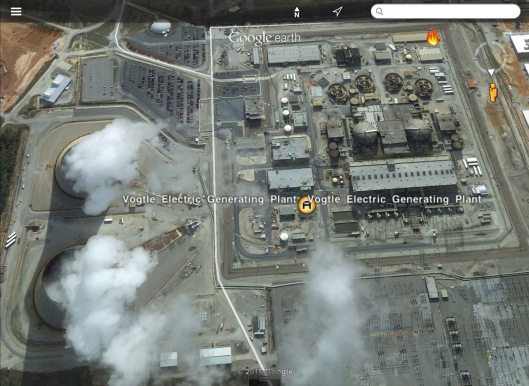
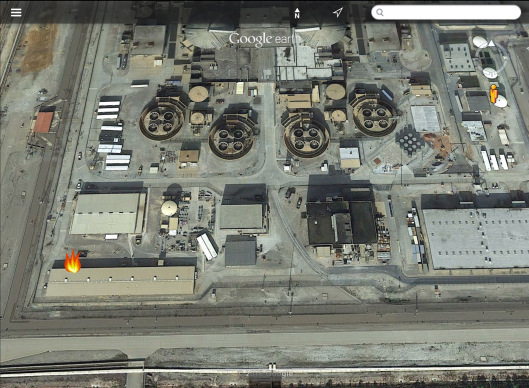
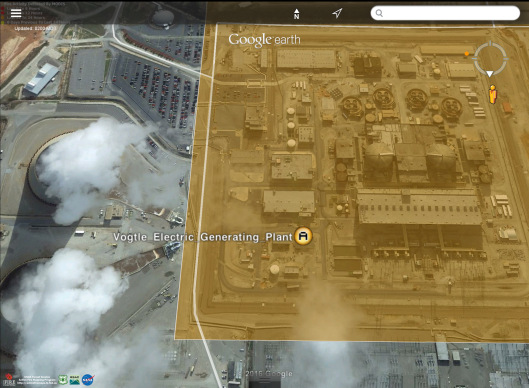
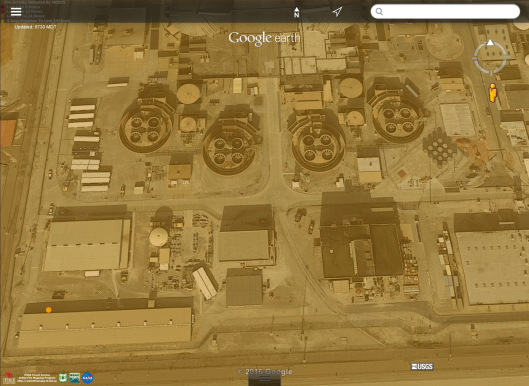
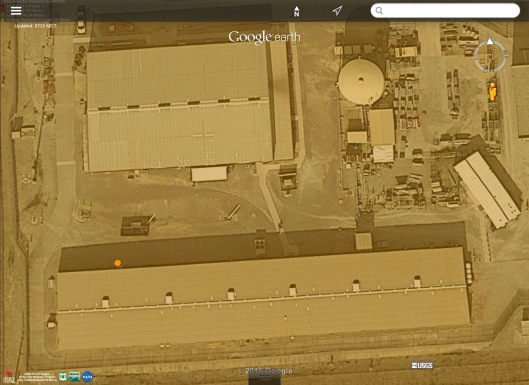
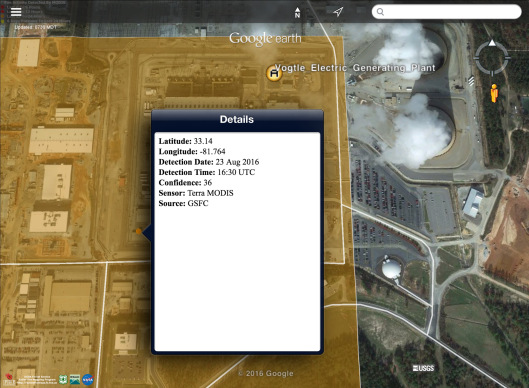
Though a fire at Vogtle Nuclear Power Station remains unconfirmed, and fire locations may not be exact, it looks logical. One might speculate a spent nuclear fuel fire? Will we ever know? It is not listed yet as a US NRC “event”.
USDA Forest Service: http://activefiremaps.fs.fed.us/index.php
¶ “Holding Clean Energy Hostage” • Nuclear power got a much-needed lifeline in New York, at an estimated eventual cost to electricity customers of over $7 billion. Coal plants are uncompetitive. Clean energy is cheap, but electric utilities, invested in old technology, stand squarely in the way of such an energy future. [Jacobin magazine]
A coal-fired power plant in Flint Hills, Kansas. Patrick Emerson / Flickr.
World:
¶ Kuwait’s Ministry of Electricity and Water has reportedly scrapped plans to build a nuclear power plant citing cost concerns. The country had planned to obtain a licence for the project from the United Nations. The ministry said alternative energy sources like wind and solar power were more cost-effective. [Gulf Business News]
¶ A study of the UK’s offshore wind energy potential has suggested that the total amount of economically feasible installed capacity offshore might be up to…
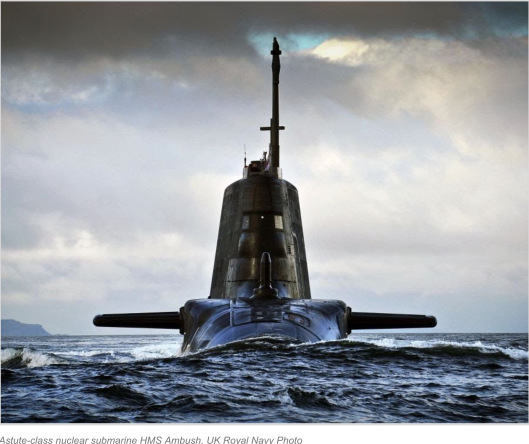
“UK Nuclear Submarine HMS Ambush Collides With Merchant Vessel
By: Sam LaGrone, July 20, 2016 4:37 PM • Updated: July 20, 2016 7:52 PM
A U.K. Astute-class nuclear attack submarine struck a merchant vessel near Gibraltar on Wednesday at about 1:30 P.M. local time, the Royal Navy said in a statement.
HMS Ambush was submerged when it, “was involved in a glancing collision with a merchant vessel off the coast of Gibraltar,” read the statement. “We are in contact with the merchant vessel and initial indications are that it has not sustained damage.”
Ambush suffered external damage but the boats nuclear plant was not affected and no sailors were injured. The 7,400-ton attack boat returned to a British base in Gibraltar for additional examination and an investigation is underway.
From pictures published with the Gibraltar Chronicle, the front of Ambush sail had been crumpled near the top from when the…
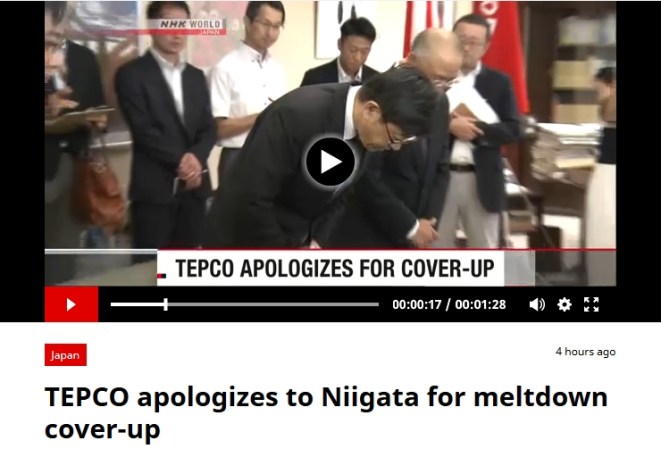
A top official of the operator of the Fukushima Daiichi nuclear power plant has apologized to the Niigata Prefecture governor for having concealed the 2011 reactor meltdowns for more than two months.
Takafumi Anegawa, Managing Executive Officer of the Tokyo Electric Power Company, met Niigata Governor Hirohiko Izumida on Thursday.
In February this year, TEPCO admitted the utility could have ascertained there was a meltdown three days after its occurrence if utility workers had followed an in-house manual. It was also later found that TEPCO’s then-president had instructed officials not to use the words “core meltdown.”
The prefecture, which hosts another TEPCO nuclear power plant on the Japan Sea coast, has put together a panel of experts to study the utility’s handling of the Fukushima accident.
Anegawa told the governor that TEPCO apologizes for not having presented a report based on an adequate investigation.
Izumida said information on meltdowns is critical for residents living near nuclear power plants to decide whether to flee or not. He said the prefecture expresses regret that TEPCO has not admitted its meltdown cover-up for five years.
Later this month, a joint panel set up by Niigata Prefecture and TEPCO plans to begin a detailed investigation.
Governor Izumida said additional probes are necessary to find out what in-house problems TEPCO had.
The governor said it is too soon to discuss resuming operations at the nuclear plant in his prefecture without a complete review of the Fukushima accident.
Rising temperatures could accelerate radiation induced DNA effects in marine mussels
Increased sea temperatures could dramatically enhance and accelerate radiation-induced DNA effects in marine invertebrates, a new study suggests.
Led by Plymouth University, in conjunction with the Centre for Environment, Fisheries and Aquaculture Science (Cefas), the research for the first time explored the impact of rising temperatures coupled with the presence of tritium, an environmentally relevant radionuclide, on marine mussels (Mytilus galloprovincialis).
Studies carried out under laboratory conditions demonstrated that at radiation dose rates considerably below the recommended international guidelines, induced DNA strand breaks appeared earlier at higher temperature compared to lower temperature. At 15ºC, DNA damage was only significantly elevated after seven days in contrast to 25°C where a similar response was observed after three days.
Scientists involved say this suggests an acceleration of radiation-induced DNA damage and potentially compromising defence mechanisms as indicated by changes in expression profiles of genes involved in heat-shock protection, cell cycle progression and repair of DNA breaks.
Temperature is an abiotic factor of particular concern for assessing the potential impacts of radionuclides, many of them having very long half-lives, on marine species, and with sea surface temperatures forecast to rise 0.5-3.5?C in the next 30-100 years, determining the interaction of radiological exposure has never been more important.
Awadhesh Jha, Professor of Genetic Toxicology & Ecotoxicology, led the study and said: “Ionising radiations are known to induce genetic damage, and radiation-induced genetic damage could be modified by many environmental factors, including temperature. Compared to other radionuclides, large amounts of tritium are discharged, mostly as water, in the marine environment by nuclear power plants (NPPs) and nuclear fuel reprocessing plants (NFRPs). In addition, cooling water from nuclear installations is one of the major sources of tritium in the aquatic environment. As thermal discharges from nuclear facilities is an important environmental issue, second only to the release of radionuclides which could extend for a long distance from the discharge point, such studies are important in determining the hazard and risk to the natural biota and therefore environmental sustainability.”
Brett Lyons, from the Environment and Animal Heath group based in Cefas’ Weymouth laboratory, co-supervised the study and said: “These results are important as they allow us to better understand the risks a warming ocean poses to marine life. We already know climate change is impacting things such as fish physiology, reproduction and migration, but this research is part of a growing body of evidence that is suggesting rises in sea water temperature may increase the risk posed by certain chemical and physical pollutants.”
For the study, published in the Journal of Environmental Radioactivity, the mussels were exposed to tritiated water (HTO) with differing temperatures of 15°C and 25°C, and DNA damage and gene expressions were determined along with accumulation of tritium in different tissues of the mussels over a period of seven days.
In their conclusion, the authors say: “This study is the first to investigate temperature effects on radiation-induced genotoxicity in an ecologically representative marine invertebrate. It represents an important step forward in radioecology in general, and our study suggests that mussels (or similar marine species) exposed to increased temperature and HTO may have a compromised ability to defend against genotoxic insult at the molecular level. This is particularly pertinent in the context of rising sea temperatures and thermal pollution. The study suggests there is still a pressing need to investigate the interactive effects of temperature and other abiotic factors in conjunction with radiation exposure on aquatic organisms.”
Journal Reference:
Lorna J. Dallas, Tim P. Bean, Andrew Turner, Brett P. Lyons, Awadhesh N. Jha. Exposure to tritiated water at an elevated temperature: Genotoxic and transcriptomic effects in marine mussels (M. galloprovincialis). Journal of Environmental Radioactivity, 2016; 164: 325 DOI: 10.1016/j.jenvrad.2016.07.034
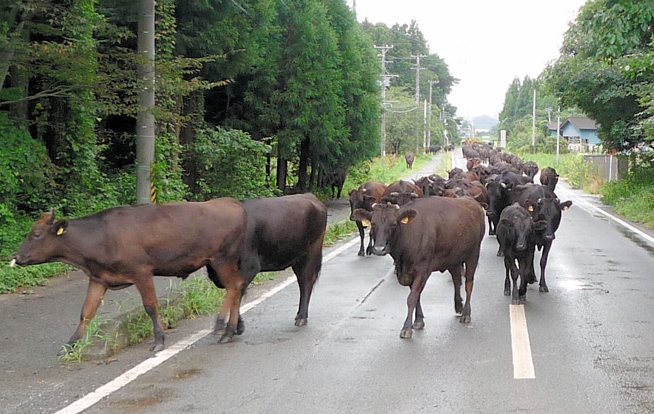
In a scene from “Hibaku-ushi to Ikiru” (Living with irradiated cattle), stray cattle head down a road in the 20-kilometer no-entry zone around the crippled Fukushima No. 1 nuclear power plant in August 2011.
OSAKA–For some cattle farmers in Fukushima Prefecture, the thought of destroying their herds is too painful to bear even if they are contaminated with radioactive fallout.
A new documentary to be shown here this week records the plight of these farmers, who continue to look after their beef cattle in defiance of a government request to euthanize the animals.
“I took on this project because I wanted to capture what is driving farmers to keep their cattle. For all the trouble it is worth, the animals are now worthless,” said Tamotsu Matsubara, a visual director who shot the documentary.
Four years in the making, “Hibaku-ushi to Ikiru” (Living with irradiated cattle) is set for its first screening on Aug. 26 at a local community center in the city.
Matsubara’s interactions with the cattle farmers date to the summer of 2011, a few months after the nuclear crisis unfolded at the Fukushima No. 1 nuclear power plant following the Great East Japan Earthquake and tsunami on March 11 that year. His assignment was to cover a traditional festival in Minami-Soma, which is located near the stricken nuclear plant.
Matsubara, 57, became acquainted with a farmer caring for more than 300 cattle on his land in the 20-kilometer no-entry zone set by the government. Residents in the zone were ordered to evacuate, but the farmer stayed on to look after his animals.
At that time, the government was seeking to destroy the cattle within the no-entry zone by obtaining their owners’ consent, saying animals that were heavily contaminated with radiation from the nuclear accident could not be sold at market.
But some farmers did not want to put their livestock down.
However, keeping them alive costs 200,000 yen ($2,000) a year in feed per head.
Matsubara became curious why the farmers continued to look after cattle that cannot be sold or bred, despite the heavy economic burden.
He soon began making weekly trips from Osaka to Fukushima to film the lives of the farmers, their cattle and the people around them.
After finishing his regular job in promotional events on Fridays, Matsubara would drive 11 hours to Fukushima and spend the weekend documenting the plight of the farmers before returning to Osaka by Monday morning.
He had 5 million yen saved for the documentary, his first feature film. When the money ran out, Matsubara held a crowdfunding campaign to complete it. Shooting wrapped up at the end of December.
About 350 hours of footage was edited into the 104-minute “Hibaku-ushi to Ikiru.”
The film documents the farmers and their supporters who are struggling to keep the cattle alive.
One couple in the film returns to their land in Okuma, a town that co-hosts the Fukushima plant, to care for their herd. They affectionately named each animal and said it would be unbearable to kill them. Their trips are financed using a bulk of the compensation they received for the nuclear accident.
A former assemblyman of Namie, a town near the plant, tends to his animals while asking himself why he used to support nuclear power.
The documentary also sheds light on scientists who are helping the farmers. The researchers believe that keeping track of the contaminated cattle will provide clues in unraveling how low-level radiation exposure impacts large mammals like humans.
Matsubara said the documentary tells the real story of what is going on with victims of the nuclear disaster.
“Not all the farmers featured in the documentary share the same opinion or stance,” Matsubara said. “I would like audiences to see the reality of people who cannot openly raise their voices to be heard.”
Takeshi Shiba, a documentary filmmaker who served as producer of this project, hopes the film will reach a wide audience.
“Matsubara broke his back in making this movie,” he said. “I hope that many people will learn what Fukushima people are thinking.”
More than five years ago on Friday, March 11, 2011, the Great East Japan Earthquake with a magnitude of 9.0 set off a large tsunami sending a 50-foot wall of water over three Fukushima Daiichi reactors. Three of the nuclear cores melted down in the next three days.
About 1,600 miles away on the next day, Saturday, March 12, 2011, the Center for Food Safety (CFS) in Hong Kong began stepped up surveillance of fresh foods including milk, vegetables and fruits, imported from Japan for radiation testing.
Eleven days later, on Wednesday, March 23, 2011, CFS discovered three samples imported from Japan with radioactivity levels exceeding those considered to be safe by international Codex Alimentarius Commission.
CFS is a unit of the Food and Environmental Hygiene Department of Hong Kong’s City government, which is part of China. The CFS continues to test those Japanese imports but hasn’t found any additional shipments with unsafe radiation levels.
And its not for lack of looking. Since one week before CFS found those hot white radishes, turnips and spinach samples, Hong Kong has tested 344,881 samples.
It breaks down this way: 19,420 vegetable samples; 19,338 fruit samples; 2,189 milk and milk beverage samples; 900 milk powder samples; 594 frozen confection samples; 54,468 aquatic product samples; 9,487 meat product smples; 31,744 drink samples, and 206,741 other samples including cereals and snacks.
The totals are through Aug. 22. CFS continues to test samples from Japanese imports, conducting testing around the clock five days a week.
Hong Kong’s continued surveillance for radioactivity is just one sign of how cautious Asia remains about the Fukushima meltdown. Japan has excluded people and crop production in a 310-square-mile zone around the nuclear plants. No deaths or cases of radiation sickness are attributed to the nuclear accident. And, perhaps due to the large exclusion zone, future cancers and deaths from potential exposures are projected to be low.
The U.S. Food and Drug Administration treats Fukushima with a periodically updated Import Alert that permits certain Japanese food imports to be detained without inspection.
“Districts may detain, without physical examination, the specified products from firms in the Fukushima, Aomori, Chiba, Gumna, Ibaraki, Iwate, Miyagi, Nagano, Niigata, Saitama Shizuoka, Tochigig, Yamagata and Yamanashi prefectures,” the July 18 Import Alert from FDA says.
Japanese imports from those areas that can still be detained at the U.S. border include:
Rice, Cultivated, Whole Grain;
Milk/Butter/Dried Milk Products;
Filled Milk/Imitation Milk Products;
Fish, N.E.C.;
Venus Clams;
Sea Urchin/Uni;
Certain Meat, Meat Products and Poultry, specifically(beef, boar, bear, deer, duck, hare and pheasant products;
At Security Council, Ban calls for eradicating weapons of mass destruction ‘once and for all’, UN News Centre, 23 August 2016 – Recalling that eliminating weapons of mass destruction was one of the founding principles of the United Nations and was in fact the subject of the first resolution adopted by the UN General Assembly, Secretary-General Ban Ki-moon today stressed the need to seriously refocus attention on nuclear disarmament.
“I call on all States to focus on one overriding truth: the only sure way to prevent the human, environmental and existential destruction these weapons can cause, is by eradicating [these weapons] once and for all,” said Mr. Ban in his remarks at the Security Council open debate on ‘non-proliferation of weapons of mass destruction.’
“We – the international community – must ensure the disarmament and non-proliferation framework is universally and completely implemented, and is resilient and versatile enough to grapple with the changing environment,” he added.
In his remarks, Mr. Ban said the success in preventing the spread of weapons of mass destruction offers some comfort and that multilateral treaties, including the Nuclear Non-Proliferation Treaty (NPT), the Chemical Weapons Convention, the Biological Weapons Convention, and instruments, including Security Council resolution 1540, are “robust and tested.”
Adopted in 2004, resolution 1540 affirms that the proliferation of nuclear, chemical and biological weapons and their means of delivery constitutes a threat to international peace and security.
But the Secretary-General also pointed out that the challenges to the disarmament and non-proliferation architecture are growing. He noted that technological advances have made means of production and methods of delivery of these weapons easier and more accessible.
“Vicious non-State actors that target civilians for carnage are actively seeking chemical, biological and nuclear weapons,” he stressed.
He said that it is particularly disappointing that progress on eliminating nuclear weapons has descended into fractious deadlock, underscoring that arguments justifying nuclear weapons, such as those used during the Cold War, “were morally, politically and practically wrong thirty years ago, and they are wrong now”.
Recalling the Security Council’s convening of the historic summit on non-proliferation and adoption of resolution 1887 (2009) in which it emphasized its primary responsibility to address nuclear threats and its willingness to take action, Mr. Ban said the global community now expects the Council to demonstrate the same leadership on the subject, to build on resolution 1887 and to develop further initiatives to bring about a world free of weapons of mass destruction.
While noting that more needs to be done to “bridge the divide” within the international community, the UN chief said that it was encouraging that all UN Member States agree that the collective efforts must complement and strengthen the nuclear disarmament and non-proliferation regime, including the NPT, which is the only treaty-based commitment to nuclear disarmament and has been a strong barrier against nuclear proliferation for nearly 50 years……..http://www.un.org/apps/news/story.asp?NewsID=54738#.V70yNVt97Gh
Those who grew up in the era of the “Doomsday Clock” and “duck and cover” might assume that the days of mutual assured destruction andlaunch under attack were swept away with the Soviet Union. They would be wrong. America’s nuclear weapons remain on hair-trigger alert, and the commander in chief has not ruled out being the first to use them.
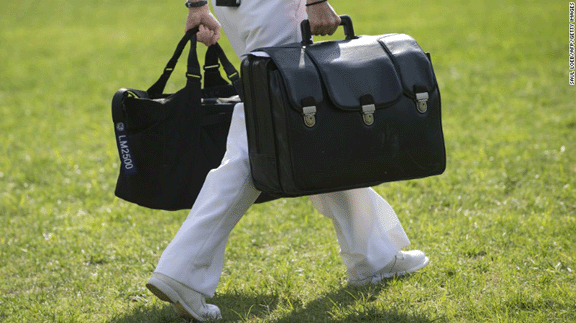
For all his talk about a “nuclear free world,” President Obama has proposed a $1 trillionmodernization of the nuclear arsenal. Republicans, having engineered the demise of the Anti-Ballistic Missile Treaty, are intent on ramping up U.S. nuclear defenses. The nuclear “football” still follows the president everywhere, enabling a cataclysmic strike to be launched on a moment’s notice.
Twenty-five years after the end of the Cold War, U.S. policy remains stuck on the same horrifying premise: that U.S. national security depends on its willingness to use nuclear weapons.
The problem is, who but a madman would ever do so?
First, the danger of escalation is simply too great. Whether the United States used nuclear weapons preemptively, or simply responded in kind, could it count on a nuclear power such as Russia or China to stand down and give in? There is no scenario more unimaginable than the United States taking the chance of setting off a chain reaction that ends in total annihilation.
Second, the humanitarian and environmental risks are unacceptable. Seventy-one years after the United States dropped atomic bombs on Hiroshima and Nagasaki, Japan,, residents are still developing cancerous tumors that can be linked to radiation exposure. New evidence suggests that a nuclear exchange would produce far more serious harm to public health than previously imagined. The United States has made drones its “weapon of choice” in the war on terror in large part because of its obligation under international law to take “all feasible precautions” to avoid and minimize incidental loss of civilian life, injury to civilians and damage to civilian infrastructure.
Third, the world is in a different place than it was when U.S. nuclear doctrine was conceived. Globalization — for better or worse — has interlocked America’s economic fate with that of its former adversaries. Over the past quarter-century, ideological differences have receded, U.S. trade relations with Russia and China have become normalized, and profound cultural, educational, scientific and human ties have been forged. Climate change, mass migration and pandemic disease have brought wide recognition of the interdependence of the planet. And disastrous U.S. interventions in Afghanistan, Iraq and Libya have plainly demonstrated the limits of what can be achieved with military power, no matter how shocking or awesome it may be.
Envisioning Donald Trump’s finger on the nuclear button helps us to understand how poorly the country is served by its absurd nuclear procedures, which allow a single individual, acting alone and instantaneously, without the benefit of full information or consultation, to order a nuclear attack that could end life as we know it. President Obama has a moral obligation to his country, and the world, to dismantle the “use it or lose it” system designed for a bygone era, and to declare that the United States will never be the first to use nuclear weapons. Ohlbaum is an independent consultant and a board member of the Center for International Policy.
The ‘nuclear football’ – the deadly briefcase that never leaves the president’s side
Donald Trump’s views on nukes may be the scariest thing about his candidacy. But how does Potus launch an attack at a moment’s notice? And what happens when you send the codes to the dry cleaners by mistake…Guardian, Stuart Jeffries , 22 Aug 16 “……..As for the nuclear football, it comes into active service when the president leaves the White House. It is the nickname for a large leather, aluminium-framed briefcase weighing 20kg which is hefted by a military aide who shadows the US commander in chief.
It is, as former Washington Post reporter Michael Dobbs calls it, “the ultimate power accessory, a doomsday machine that could destroy the entire world”. The late Bill Gulley, a former director of the White House Military Office, described what’s inside the nuclear football in his 1980 memoir Breaking Cover. “There are four things in the football. The Black Book containing the retaliatory options, a book listing classified site locations, a manila folder with eight or 10 pages stapled together giving a description of procedures for the Emergency Broadcast System, and a three-by-five inch card with authentication codes.”
The nuclear football has an antenna protruding from it, likely indicating that inside there is a communication system with which the president can maintain contact the Pentagon’s National Military Command Centre which monitors worldwide nuclear threats and can order an instant nuclear response. “The football,” says Dobbs, “also provides the commander-in-chief with a simplified menu of nuclear strike options – allowing him to decide, for example, whether to destroy all of America’s enemies in one fell swoop or to limit himself to obliterating only Moscow or Pyongyang or Beijing.”…….
Why is the briefcase nicknamed the nuclear football? According to former US secretary of defence Robert McNamara, it was so-named because it was part of an early nuclear war plan code-named Operation Drop Kick.
In Stanley Kubrick’s 1964 nuclear black comedy Dr Strangelove, there is also an Operation Drop Kick. It denoted a nuclear exercise that goes wrong when the unhinged US general played by Sterling Hayden orders a first strike on the Soviet Union. All the president’s men strive to recall the bombers to prevent nuclear politics……..
Aides who carry the nuclear football have extensive psychological evaluations to assess whether they’re up to the task. Metzger discloses that he underwent extensive vetting by the Defense Department, the secret service and the FBI before he was given the job. The incoming president, whether it is Trump or Clinton, will undergo no such checks as to their mental stability. There is, though, one consoling thought. Even if Trump did nuke Europe, he’d probably spare part of Aberdeenshire – he wouldn’t want to destroy his golf resort. https://www.theguardian.com/world/2016/aug/22/nuclear-football-donald-trump
North Korea threatens to turn Washington and Seoul into a ‘heap of ash’ AUGUST 24, 2016 Gavin Fernando news.com.au@GavinDFernando NORTH Korea has issued a fresh warning to Seoul and Washington, threatening a huge nuclear attack if provoked.
The North’s military warned it will turn the cities into “a heap of ash through a Korean-style pre-emptive nuclear strike” if they show any signs of aggression towards their territory, a spokesman for North Korea’s military was quoted as saying by the country’s state media.
This comes as South Korea and the US begin their annual military drills, which South Korea has described as defensive in nature. The allied countries have repeatedly stated they have no intention of invading or taking aggressive action against North Korea capital Pyongyang.
South Korea President Park Geun-Hye responded to the threats saying: “The North Korean regime has been continuously suppressing its people by its reign of terror while ignoring the livelihood of its people.”
She also said the South would “prepare” for any potential attacks by North Korea, adding that the communist country’s nuclear and missile threats are “direct and realistic”.
Relations between the countries are tenser than usual now, following the defection of a senior North Korean diplomat and a US plan to place a hi-tech missile defence system in South Korea.
Earlier this month, it was reported South Korea intends to arm itself with nuclear weapons.The state will develop a nuclear self-defence strategy in defiance of a treaty that has been in place for almost 50 years. “It will become a domino effect and even South Korea will become concerned and develop nuclear weapons, and maybe Japan as well,” a senior official in the Seoul government told Fairfax.
Meanwhile, over the weekend, Australia surprised the world by being the only country to attempt to block an international ban on nuclear weapons.
Yucca Mountain Documents Now Publicly Available – In a New Online Library, USA Nuclear Regulatory Commission August 19, 2016 David McIntyre Public Affairs Officer
The NRC is flipping the switch today on its new LSN Library — making nearly 3.7 million documents related to the adjudicatory hearing on the proposed Yucca Mountain repository available to the public…….The library is significant for three reasons. First, it meets federal records requirements. Second, the library again provides public access to the previously-disclosed discovery materials should the Yucca Mountain adjudicatory hearing resume. Third, should the Yucca Mountain hearing not resume, the library will provide an important source of technical information for any future high-level waste repository licensing proceeding. https://public-blog.nrc-gateway.gov/2016/08/19/yucca-mountain-documents-now-publicly-available-in-a-new-online-library/
“There is no question the Energy Department has downplayed the significance of the accident,” said Don Hancock, who monitors the dump for the watchdog group Southwest Research and Information Center.
a federal investigation found more than two dozen safety lapses at the dump.
Nuclear Accident In New Mexico Is Still Being Censored, $2 Billion Cleanup
Nuclear accident in New Mexico ranks among the costliest in U.S. history, http://www.latimes.com/nation/la-na-new-mexico-nuclear-dump-20160819-snap-story.htmlRalph Vartabedian, 23 Aug 16 When a drum containing radioactive waste blew up in an underground nuclear dump in New Mexico two years ago, the Energy Department rushed to quell concerns in the Carlsbad desert community and quickly reported progress on resuming operations.
The early federal statements gave no hint that the blast had caused massive long-term damage to the dump, a facility crucial to the nuclear weapons cleanup program that spans the nation, or that it would jeopardize the Energy Department’s credibility in dealing with the tricky problem of radioactive waste.
But the explosion ranks among the costliest nuclear accidents in U.S. history, according to a Times analysis. The long-term cost of the mishap could top $2 billion, an amount roughly in the range of the cleanup after the 1979 partial meltdown at the Three Mile Island nuclear power plant in Pennsylvania.
The Feb. 14, 2014, accident is also complicating cleanup programs at about a dozen current and former nuclear weapons sites across the U.S. Thousands of tons of radioactive waste that were headed for the dump are backed up in Idaho, Washington, New Mexico and elsewhere, state officials said in interviews.
Washington state officials were recently forced to accept delays in moving the equivalent of 24,000 drums of nuclear waste from Hanford site to the New Mexico dump. The deal has further antagonized the relationship between the state and federal regulators.
“The federal government has an obligation to clean up the nuclear waste at Hanford,” Democratic Gov. Jay Inslee said in a statement. “I will continue to press them to honor their commitments to protect Washingtonians’ public health and our natural resources.”
Other states are no less insistent. The Energy Department has agreed to move the equivalent of nearly 200,000 drums from Idaho National Laboratory by 2018.
“Our expectation is that they will continue to meet the settlement agreement,” said Susan Burke, an oversight coordinator at the state’s Department of Environmental Quality.
The dump, officially known as the Waste Isolation Pilot Plant, was designed to place waste from nuclear weapons production since World War II into ancient salt beds, which engineers say will collapse around the waste and permanently seal it. The equivalent of 277,000 drums of radioactive waste is headed to the dump, according to federal documents.
The dump was dug much like a conventional mine, with vertical shafts and a maze of horizontal drifts. It had operated problem-free for 15 years and was touted by the Energy Department as a major success until the explosion, which involved a drum of of plutonium and americium waste that had been packaged at the Los Alamos National Laboratory.
The problem was traced to material — actual kitty litter — used to blot up liquids in sealed drums. Lab officials had decided to substitute an organic material for a mineral one. But the new material caused a complex chemical reaction that blew the lid off a drum, sending mounds of white, radioactive foam into the air and contaminating 35% of the underground area.
“There is no question the Energy Department has downplayed the significance of the accident,” said Don Hancock, who monitors the dump for the watchdog group Southwest Research and Information Center.
Though the error at the Los Alamos lab caused the accident, a federal investigation found more than two dozen safety lapses at the dump. The dump’s filtration system was supposed to prevent any radioactive releases, but it malfunctioned.
Twenty-one workers on the surface received low doses of radiation that federal officials said were well within safety limits. No workers were in the mine when the drum blew.
Energy Department officials declined to be interviewed about the incident but agreed to respond to written questions. The dump is operated by Nuclear Waste Partnership, which is led by the Los Angeles-based engineering firm AECOM. The company declined to comment.
Federal officials have set an ambitious goal to reopen the site for at least limited waste processing by the end of this year, but full operations can not resume until a new ventilation system is completed in about 2021.
The direct cost of the cleanup is now $640 million, based on a contract modification made last month with Nuclear Waste Partnership that increased the cost from $1.3 billion to nearly $2 billion. The cost-plus contract leaves open the possibility of even higher costs as repairs continue. And it does not include the complete replacement of the contaminated ventilation system or any future costs of operating the mine longer than originally planned.
An Energy Department spokesperson declined to address the cost issue but acknowledged that the dump would either have to stay open longer or find a way to handle more waste each year to make up for the shutdown. She said the contract modification gave the government the option to cut short the agreement with Nuclear Waste Partnership.
It costs about $200 million a year to operate the dump, so keeping it open an additional seven years could cost $1.4 billion. A top scientific expert on the dump concurred with that assessment.
In addition, the federal government faces expenses — known as “hotel costs” — to temporarily store the waste before it is shipped to New Mexico, said Ellis Eberlein of Washington’s Department of Ecology.
The Hanford site stores the equivalent of 24,000 drums of waste that must be inspected every week. “You have to make sure nothing leaks,” he said.
The cleanup of the Three Mile Island plant took 12 years and was estimated to cost $1 billion by 1993, or $1.7 billion adjusted for inflation today. The estimate did not include the cost of replacing the power the shut-down plant was no longer generating.
Other radioactive contamination at nuclear weapons sites is costing tens of billions of dollars to clean up, but it is generally the result of deliberate practices such as dumping radioactive waste into the ground.
For now, workers entering contaminated areas must wear protective gear, including respirators, the Energy Department spokesperson said. She noted that the size of the restricted area had been significantly reduced earlier this year.
Hancock suggested that the dump might never resume full operations.
“The facility was never designed to operate in a contaminated state,” he said. “It was supposed to open clean and stay clean, but now it will have to operate dirty. Nobody at the Energy Department wants to consider the potential that it isn’t fixable.”
Giving up on the New Mexico dump would have huge environmental, legal and political ramifications. This year the Energy Department decided to dilute 6 metric tons of surplus plutonium in South Carolina and send it to the dump, potentially setting a precedent for disposing of bomb-grade materials. The U.S. has agreements with Russia on mutual reductions of plutonium.
The decision means operations at the dump must resume, said Edwin Lyman, a physicist and nuclear expert at the Union of Concerned Scientists.
“They have no choice,” he said. “No matter what it costs.”
A View from Allison Macfarlane, Nuclear’s Glacial Pace There’s a reason it takes so long to approve a new reactor design.MIT Technology Review ,August 23, 2016 “……. a number of startups are promising cheap, safe, proliferation-resistant nuclear energy in the next decade … Can these startups fulfill their promises? Outside of China, nuclear power is expanding nowhere. China has 21 new reactors under construction; Russia has nine, India six. The U.S. is bringing five new plants online, but since 2012, five other reactors have been retired, with seven more to be shuttered by 2019. California’s Diablo Canyon plant recently announced it will close by 2025. With other plants closing in Japan, Germany, and the U.K., more reactors may be decommissioned than built in the near future.
So why is this happening? Because it’s expensive and time-consuming to design and build a new nuclear plant, and there are cheaper, easier alternatives.
The U.S. Nuclear Regulatory Commission has been waiting since 2014 for applications for design certification licenses for small modular reactors—smaller versions of the large and extra-large operating light-water reactors, with additional safety features. …….. Other designs are on the horizon, including molten-salt reactors, which are promising but won’t be ready for decades.
In 2015, the General Accountability Office reported that it takes 20 to 25 years to develop a new reactor in the United States—10 years for the design phase, 3.5 years for a design certification license from the NRC, four years for a combined operating license, and another four years for construction. And that’s only in an ideal world where no unexpected problems occur.
The GAO also found that it’s not cheap to bring a design to fruition: just to reach the design certification point costs somewhere between $1 billion and $2 billion, and only about $75 million of that is NRC fees. There’s a reason it takes so long and costs so much: manufacturers need to confirm that the design is safe and secure.
Some people blame the regulators for holding up the plants. Yet the NRC hasn’t been presented with any applications for new reactors and probably won’t be for years. Data from prototype plants would be helpful, but then many of the “new” designs are not so new at all. Sodium-cooled fast reactors have been built by countries including the U.S., Japan, Russia, Germany, France, and India since the 1950s, but no country has been able to make a plant cheap and reliable enough to even come close to being a viable energy source…….Allison Macfarlane was the chairman of the Nuclear Regulatory Commission from 2012 to 2014. https://www.technologyreview.com/s/602155/nuclears-glacial-pace/
The agency announced on Aug. 1 that the B61-12 – the nation’s first guided, or “smart,” nuclear bomb – had completed a four-year development and testing phase and is now in production engineering, the final phase before full-scale production slated for 2020.
This announcement comes in the face of repeated warnings from civilian experts and some former high-ranking military officers that the bomb, which will be carried by fighter jets, could tempt use during a conflict because of its precision. The bomb pairs high accuracy with explosive force that can be regulated.
President Barack Obama has consistently pledged to reduce nuclear weapons and forgo weapons with new military capabilities. Yet the B61-12 program has thrived on the political and economic clout of defense contractors such as Lockheed Martin Corp., as documented in a Reveal investigation last year.
The B61-12 – at $11 billion for about 400 bombs the most expensive U.S. nuclear bomb ever – illustrates the extraordinary power of the atomic wing of what President Dwight D. Eisenhower called the “military industrial complex,” which has now rebranded itself the“nuclear enterprise.” The bomb lies at the heart of an ongoing modernization of America’s nuclear arms, projected to cost $1 trillion over the next 30 years.
Virtually everyone agrees that as long as nuclear weapons exist, some modernization of U.S. forces is needed to deter other countries from escalating to nuclear weapons during a conflict. But critics challenge the extravagance and scope of current modernization plans.
In late July, 10 senators wrote Obama a letter urging that he use his remaining months in office to “restrain U.S. nuclear weapons spending and reduce the risk of nuclear war” by, among other things, “scaling back excessive nuclear modernization plans.” They specifically urged the president to cancel a new nuclear air-launched cruise missile, for which the Air Force is now soliciting proposals from defense contractors.
While some new weapons programs are farther down the road, the B61-12 bomb is particularly imminent and worrisome given recent events such as the attempted coup in Turkey. That’s because this guided nuclear bomb is likely to replace 180 older B61 bombs stockpiled in five European countries, including Turkey, which has an estimated 50 B61s stored at Incirlik Air Base. The potential vulnerability of the site has raised questions about U.S. policy regarding storing nuclear weapons abroad.
But more questions focus on the increased accuracy of the B61-12. Unlike the free-fall gravity bombs it will replace, the B61-12 will be a guided nuclear bomb. Its new Boeing Co. tail kit assembly enables the bomb to hit targets precisely. Using dial-a-yield technology, the bomb’s explosive force can be adjusted before flight from an estimated high of 50,000 tons of TNT equivalent force to a low of 300 tons. The bomb can be carried on stealth fighter jets.
“If the Russians put out a guided nuclear bomb on a stealthy fighter that could sneak through air defenses, would that add to the perception here that they were lowering the threshold for the use of nuclear weapons? Absolutely,” Hans Kristensen of the Federation of American Scientists said in the earlier Reveal coverage.
And General James Cartwright, the retired commander of the U.S. Strategic Command told PBS NewsHour last November that the new capabilities of the B61-12 could tempt its use.
“If I can drive down the yield, drive down, therefore, the likelihood of fallout, etc., does that make it more usable in the eyes of some – some president or national security decision-making process? And the answer is, it likely could be more usable.”
__
Ackland can be reached at lenackland@gmail.com. He wrote this story for Reveal, from the Center for Investigative Reporting.












 nuclear-news