
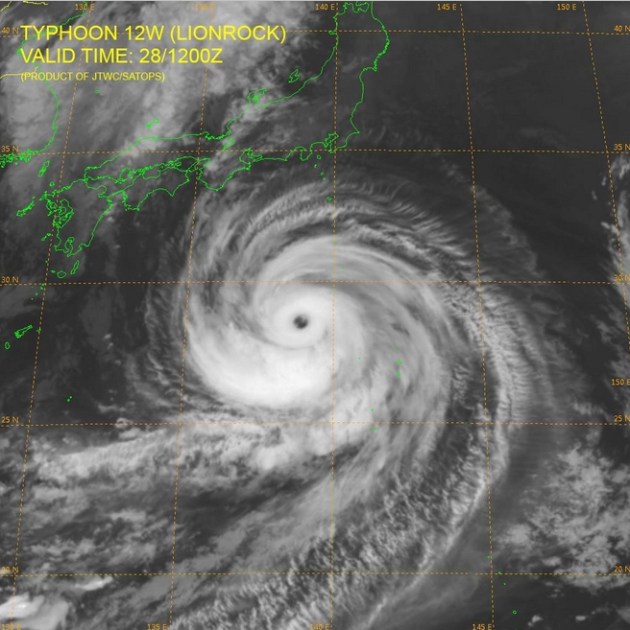
It might land in north east Japan for the first time since the beginning of meteorological records. We are very very worried about the Fukushima Daiichi NPP and the local population.
Typhoon Lionrock has strengthened and changed course. Current predictions as of today shows it hitting the Tohoku coast as a category 1 typhoon. The center of the predicted path is around Sendai, Miyagi Prefecture. Fukushima Prefecture and Fukushima Daiichi are within the predicted path zone.
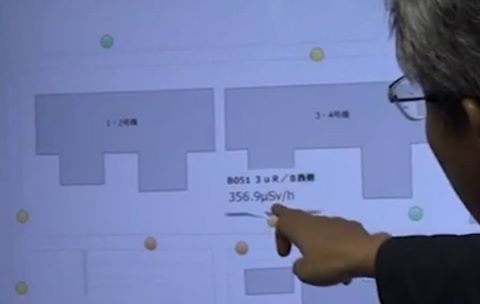
Even if it doesn’t directly hit Fukushima Daiichi, outer bands could still cause significant problems. High winds could damage contaminated water tanks in the process of being disassembled or assembled on site. These tanks are highly radioactive and some may still contain highly radioactive water or sludge. Cranes and other outdoor structures that could be damaged by high winds are a concern.
The “K” drainage system connected to the roofs of the reactor buildings before the disaster. Post disaster we still see spikes in contamination in this drainage system. There are multiple other locations where this system could be fed contaminated run off. This drainage system has been redirected to the port but the port still exchanges water with the sea, so it isn’t a reliable solution. There is a pumping system to pump contaminated groundwater out of the area near the reactor buildings then to contaminated water storage.
It is not clear if it can keep up with both the ongoing groundwater intrusion and influx from a typhoon.
August 28, 2016
Posted by dunrenard |
Fukushima 2016 | Fukushima continuing, Fukushima Daiichi, Typhoon |
Leave a comment
Just one in five Japanese is optimistic about the country’s future and less than half the population believes that Japan is a functioning democracy, according to a survey that canvassed views on these issues in India and Indonesia as well.
The figure of 20 percent of Japanese who are optimistic about the future contrasted with more than 60 percent in India and Indonesia who felt the same.
The survey was carried out by private institutions in the three countries and the results were released Aug. 19.
Many respondents in Japan cited an aging population and a sluggish economy as reasons for being pessimistic. The survey results also highlighted a general distrust of the current state of party politics.
Genron NPO of Japan, the Center for Strategic and International Studies of Indonesia and the Observer Research Foundation of India contacted 1,000 people each in the three respective countries in June or later for the survey.
Only 20.7 percent of the respondents in Japan said they were either “optimistic” or “slightly optimistic” about the future of their country, whereas the corresponding ratios stood at 65.3 percent in Indonesia and 75.9 percent in India.
Among the various reasons for being pessimistic about the future, the commonest in Japan, cited by 84.7 percent of the respondents, was a lack of effective measures being presented to cope with the rapidly aging and shrinking population.
In Japan, 46.7 percent of the respondents answered in the affirmative when they were asked if they believe democracy is functioning. The corresponding figures for Indonesia and India were 47.1 percent and 65 percent, respectively.
When asked their reasons for believing that democracy is dysfunctional, the largest portion of the respondents who said so in Japan, at 60.2 percent, said that politicians are not confronting the challenges facing society because they are more intent on winning elections.
Only 15.5 percent of the Japanese respondents answered in the affirmative when they were asked if they had positive expectations for political parties, a figure that indicated a deep distrust of party politics.
http://www.asahi.com/ajw/articles/AJ201608270008.html
August 28, 2016
Posted by dunrenard |
Japan | Democracy, Public Survey |
Leave a comment
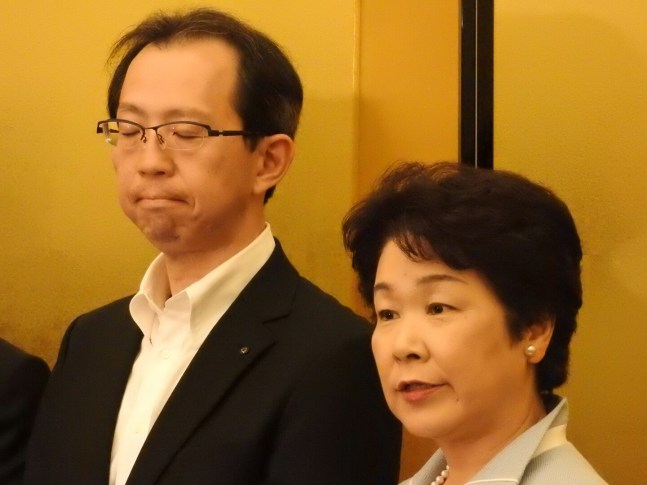
Yamagata and Niigata prefectural governors strongly request that FUKUSHIMA prefecture should extend the housing support for Nuclear disaster voluntary evacuees.But Fukushima governor, Uchibori Masao did not answer anything to their request. Why?
Yamagata Prefecture governor Mieko Yoshimura has requested an extension of the house support provided asking for the “special consideration“.
Niigata Prefecture governor Hirohiko Izumida also pointed out that “further burden in the problems of housing is increasing“, which the Fukushima Governor Uchibori Masao should well consider.
The Fukushima Prefecture governor to enforce central government order to terminate free housing support for evacuees by March 2017.
IfYoshimura and Izumida were Fukushima Prefecture governor, their treatment of “voluntary evacuees“ might have been quite different.
http://taminokoeshimbun.blog.fc2.com/blog-entry-38.html
August 28, 2016
Posted by dunrenard |
Fukushima 2016 | Evacuees, Free Housing Suspension, Fukushima continuing |
Leave a comment
 NUCLEAR. Articles on weapons and disarmament dominate the nuclear news this week.On Monday 29 August, an international conference entitled ‘Building a Nuclear Weapons Free World’ will take place in Astana, the capital of Kazakhstan. That day will also be the 25th anniversary of of the closure of the Semipalatinsk Nuclear Test Site – largest in the world, where 456 weapons tests happened, leaving a terrible legacy for the people.
UN Secretary-General Ban Ki-moon calls for eradication of nuclear weapons. The nuclear working group at the UN concluded its work in Geneva, and the majority of governments voted to recommended that the UN General Assembly set up a conference in 2017 to negotiate a new treaty prohibiting nuclear weapons, despite the Australian government’s best efforts to sabotage this. This is one of those times when I am ashamed to be Australian.
CLIMATE. A new study declares that human-caused climate change began at around 1830. (I’ve always thought that it was 1801, because of the 1801 painting Coalbrookdale by Night – attached). Research indicates that the difference between 1.5 C and 2C rise in global temperatures will be significant, and in only 20 years’ time. Huge volume of Greenland Ice Sheet lost each year, due to global warming. Again this year, Indonesia’s blanket of smoke is back. India floods: Over 300 dead, millions affected Louisiana National Guard Rescues 19,000 in Flood-Affected Areas.
UN Security Council warned on danger of nuclear drone terror attacks.
Global nuclear industry ponders ways to get taxpayers to pay up for Small Modular Nuclear Reactors (SMRs)
USA
UK. New report shows that Britain’s Hinkley Point C nuclear station is not essential. UK figuring out how to get out of the Hinkley nuclear power deal. Britain’s nuclear industry in turmoil over botched contracts. UK Nuclear Submarine HMS Ambush: Smashing Collision With Merchant Vessel.
JAPAN.
NORTH KOREA ‘s submarine – launched missile. North Korea’s ‘Military First’ celebration enhanced by nuclear missile test.
SOUTH KOREA ‘s nuclear weapons advocates are now more vocal since North Korea’s missile test
CHINA. Public opposition threatens China’s grandiose nuclear power plans. China really part of the global nuclear marketing conglomerate.
TAIWAN‘s First Nuclear Decommissioning Project
SOUTH AFRICA nuclear electricity company non compliant with govt rules on advertising. Nuclear is not the cheapest source of electricity for South Africa. African countries are the least compliant in implementing global nuclear security safeguards.
FRANCE to launch 6 tenders for solar energy projects
GERMANY ‘s green power going strong, with more renewable energy than it ever had nuclear
BULGARIA Bulgaria seeks solution for costly blowout for Belene nuclear power plant
UKRAINE . Westinghouse puts on hold plans to build nuclear fuel plant in Ukraine
August 27, 2016
Posted by Christina Macpherson |
Christina's notes |
Leave a comment
 Building a #NuclearWeapons free world. EU Reporter, Colin
  Stevens | August 26, 2016 The international community, including the EU, is being urged to step up its contribution to create a nuclear-free world, writes Colin Stevens.
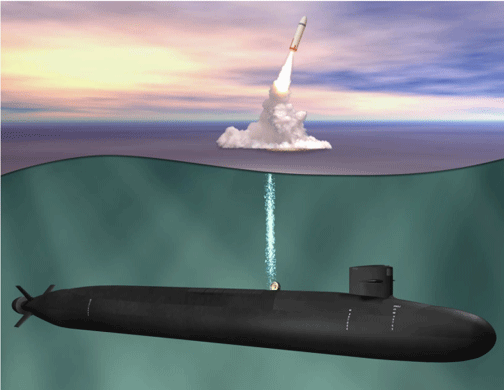
The issue was thrust back into the spotlight most recently when North Korea test–fired a submarine-based ballistic missile from its east coast on 25 August.
The exercise drew international condemnation and Daniel A. Pinkston, a professor at Troy University, said the fact that the rocket travelled as far as it did suggests the North Koreans are “making quite rapid progress, and probably more rapid progress than anyone had predicted”.
The call to remove such threats by seriously scaling down nuclear programmes comes as Kazakhstan marks the 25th anniversary of the closure of the Semipalatinsk Nuclear Test Site on 29 August.
On Monday in Astana, the capital of Kazakhstan, an international conference entitled ‘Building a Nuclear Weapons Free World’ will take place.
It will be attended by political and religious leaders, experts in the field of disarmament, as well as representatives of civil society, international and regional organisations. Those present will include nations that possess nuclear weapons, as well as non-nuclear-weapon states.
The date, 29 August, is the anniversary of Kazakhstan President Nazarbayev’s decision to shut down Semipalatinsk and the date which has since been designated the UN International Day against Nuclear Weapons.
Kazakhstan suffered 450 Soviet nuclear weapons tests at the Semipalatinsk site between August 29, 1949 and 1991 when Nazarbayev finally gave the order to shut down the site.
The 42 years of testing, however, inflicted great suffering on both the Kazakh people and its environment. Tests negatively affected the health of more than 1.5 million Kazakh citizens including many who, to this day, in the first and the second generations, suffer early death, lifelong debilitating illness and horrific birth defects……..
Also on Monday, a special ceremony will take place in Ypres, Belgium to mark the landmark.
The Flemish city is known for the death and destruction it witnessed in World War I. The ceremony will take place in the town’s Cloth Hall close to a memorial which is dedicated to the many tens of thousands who fell in the Great War.
Almas Khamzayev, the ambassador of Kazakhstan’s embassy in Belgium, will join Jan Durnez, the Mayor of Ypres and vice president of Mayors for Peace, an organization that seeks to raise global awareness of the need to abolish nuclear weapons. The leaders will observe a minute’s silence in honour of victims of weapons of mass destruction and open a photographic exhibition to showcase Kazakhstan’s efforts in non-proliferation.
In 2012 the country launched The ATOM Project, a global initiative to help bring into force the Comprehensive Nuclear Test Ban Treaty (CTBT) and show world leaders that the public worldwide is united in its desire to eliminate the nuclear weapons threat.
It specifically seeks to help bring into force the Comprehensive Nuclear Test Ban Treaty (CTBT) and is an example of how Kazakhstan has led the way for the rest of the world on this issue.
The project puts a human face on this global issue by telling the stories of the survivors of nuclear testing. To this day, children are born with severe deformities, illnesses and a lifetime of health challenges as a result of exposure generations ago to nuclear weapons tests.
More than 260,000 people from over 100 countries have, so far, signed the petition. It is hoped to reach 300,000 signatures by the end of this month.
Ridding the world of nuclear weapons is also an effort supported by UN Secretary General Ban Ki-moon who has noted that the world has “witnessed a substantial growth of interest in better understanding the catastrophic humanitarian effects of nuclear weapons”.
He said: “Achieving global nuclear disarmament is one of the oldest goals of the United Nations. It was the subject of the General Assembly’s first resolution in 1946. It has been on the General Assembly’s agenda along with general and complete disarmament ever since 1959.
“It has been a prominent theme of review conferences held at the UN since 1975 of States parties to the Nuclear Non-Proliferation Treaty. It was identified a priority goal of the General Assembly’s first Special Session on disarmament in 1978, which attached a special priority to nuclear disarmament. And it has been supported by every United Nations Secretary-General.”……….
Kazakhstan’s recent history shows that nations do not necessarily need a nuclear arsenal to feel safe. Its policy of eliminating nuclear weapons and strengthening the regime of non-proliferation of weapons of mass destruction has earned the recognition of the international community.
Despite this, the uncertainty about the intentions of states such as North Korea and terrorist groups such as Islamic State suggests there should be no let-up in efforts to rid the world of the nuclear threat once and for all. https://www.eureporter.co/energy/2016/08/26/building-a-nuclearweapons-free-world/
August 27, 2016
Posted by Christina Macpherson |
general |
Leave a comment
It is time to turn nuclear common sense into national policy. A declaration that the United States would never use nuclear weapons when conventional weapons could destroy the target could reduce the number of nuclear weapons we need for legitimate deterrence purposes.

 The common-sense fix that American nuclear policy needs, WP, By Jeffrey G.
Lewis and Scott D. Sagan August 24
Jeffrey G. Lewis is director of the East Asian Nonproliferation Program at the Middlebury Institute of International Studies at Monterey. Scott D. Sagan is the Caroline S.G. Munro professor of political science and senior fellow at the Center for International Security and Cooperation at Stanford University. This op-ed was adapted from an article that will appear in the fall issue of Daedalus.
President Obama, in his final months in office, is considering major nuclear policy changes to move toward his oft-stated goal of a world without nuclear weapons. One option reportedly under consideration is a “no first use” pledge, a declaration that the United States would not be the first state to use nuclear weapons in any conflict. While we think that such a pledge would ultimately strengthen U.S. security, we believe it should be adopted only after detailed military planning and after close consultation with key allies, tasks that will fall to the next administration.
There is, however, a simpler change that Obama could make now that could have as important, or even greater, benefits for U.S. security. The president could declare, as a matter of law and policy, that the United States will not use nuclear weapons against any target that could be reliably destroyed by conventional means.
This might seem like common sense, but current U.S. doctrine allows the use of nuclear weapons against any “object” deemed to be a legitimate military target. In 2013, the Obama administration did issue a guidance directing the U.S. military to “apply the principles of distinction and proportionality and seek to minimize collateral damage to civilian populations and civilian objects” and pledged that “the United States will not intentionally target civilian populations or civilian objects.”
This was a good step forward. But Obama’s guidance omitted an important legal concept derived from just-war doctrine — the “principle of necessity,” which suggests that war planners must use only the minimum amount of military force necessary to destroy a target. Ignoring the necessity principle leaves a loophole large enough to fly a nuclear-armed bomber through. To give one egregious example, although the U.S. military does not target civilian populations directly, following the principle of noncombatant immunity, it insists that it can legally target civilian airports in an adversary’s cities because they could be converted to military airports during a war — and there is no restriction in place against using nuclear weapons against such a civilian airport………
It is time to turn nuclear common sense into national policy. A declaration that the United States would never use nuclear weapons when conventional weapons could destroy the target could reduce the number of nuclear weapons we need for legitimate deterrence purposes. Placing conventional weapons at the center of debates about the future of deterrence would also help focus the policy discussion on plausible scenarios with realistic plans for the use of U.S. military power. And it would more faithfully honor the just-war principles of distinction, necessity and proportionality, by placing them at the heart of our deterrence and security policies, where our highest ideals belong. https://www.washingtonpost.com/opinions/the-common-sense-fix-that-american-nuclear-policy-needs/2016/08/24/b9692dd0-6596-11e6-96c0-37533479f3f5_story.html?utm_term=.a6cc17bf50cf
August 27, 2016
Posted by Christina Macpherson |
politics international, Reference, USA, weapons and war |
Leave a comment
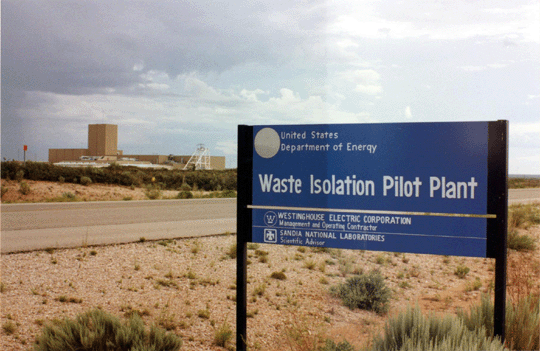
A typo and a bag of kitty litter might cost US taxpayers billions in nuclear waste cleanup, Business Insider, DAVE MOSHER AUG 27, 2016, A typo and a bag of organic kitty litter may end up costing United States taxpayers more than $2 billion in nuclear waste cleanup, according to a new report by Ralph Vartabedian at the Los Angeles Times.
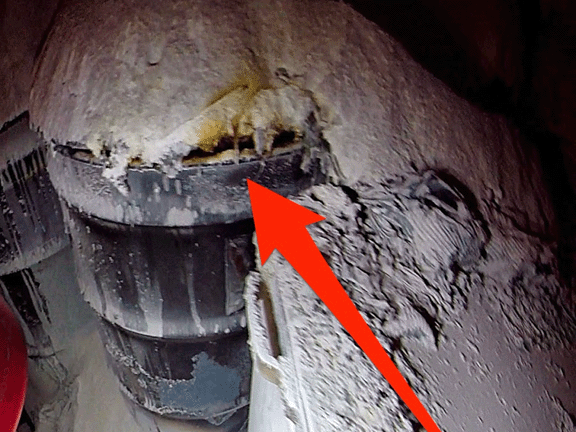
Back in February 2014, a drum of nuclear waste burst open inside the cavernous Waste Isolation Pilot Project (WIPP),  which is drilled out of a salt deposit nearly half a mile below the deserts of Carlsbad, New Mexico.
The US Department of Energy (DOE), which funds the company that runs the nuclear waste dump, quickly suspended operations and launched an investigation to figure out the cause.
In their 277-page report, investigators determined the blast vaporized nearly 7.5 lbs of the material inside a single barrel, labelled “Drum 68660.” That material included some radioactive isotopes of americium, plutonium, and uranium — byproducts of Cold War-era nuclear weapons production.
Although no one was inside WIPP when the drum burst, the facility’s air ventilation system spread some of the gases outside, exposing 21 workers to low doses of radiation.
Investigators also discovered the trigger of the “thermal runaway event,” also known as an “explosion”: a dangerous combination of nitric acid and salts, triethanolamine, and“sWheat Scoop” organic kitty litter. (The DOE mentions the brand almost 400 times in its report.)
The cleanup itself will cost hundreds of millions, but that’s not where the mishap’s ledger ends.
The “organic” part of the kitty litter in question is crucial.
That’s because wheat, which makes up the pee-absorbing bulk of organic kitty litter, contains plant cellulose that can burn. Standard kitty litter, meanwhile, is inorganic, since it’s primarily made of clay.
So when drum-packing workers at Los Alamos National Laboratory (LANL) followed instructions to add an organic variety to soak up radioactive fluids, they were unknowingly packing up what Sarah Zhang at Gizmodo called “the ingredients of a bomb.”………
Whatever the case, WIPP isn’t entombing any nuclear waste while cleanup work continues — which means the US government’s grand scheme to seal it all up has a major wrench in its gears.
The Times reports the facility may need 7 years of additional operation to handle the backup of waste. At $200 million per year, according to the Times’ analysis, that could add up to $1.4 billion in extra costs triggered by the mishap……
In the meantime, the DOE might also have to pay temporary storage and inspection costs for all of the waste that WIPP can’t entomb until the cleanup work is finished. The DOE couldn’t confirm or deny this, nor the cost.
“The Waste Isolation Pilot Plant (WIPP) is critical to the Department of Energy’s mission to cleanup nuclear waste generated by atomic energy activities,” a DOE spokesperson told Business Insider in an email. “WIPP is the nation’s only repository for the disposal of nuclear waste known as transuranic (TRU) waste. The Department is committed to the recovery, and resumption of TRU disposal operations at WIPP when it is safe to do so.”…..http://www.businessinsider.com.au/kitty-litter-nuclear-waste-accident-2016-8?r=US&IR=T
August 27, 2016
Posted by Christina Macpherson |
USA, wastes |
Leave a comment
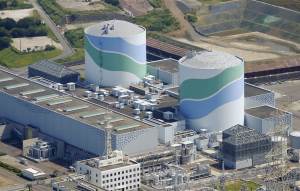 Governor asks utility to halt nuclear reactors in Kagoshima THE ASAHI SHIMBUN August 26, 2016 KAGOSHIMA–New Kagoshima Governor Satoshi Mitazono on Aug. 26 asked Kyushu Electric Power Co. to immediately shut down its Sendai nuclear power plant for a fresh safety inspection following the earthquakes that rocked neighboring Kumamoto Prefecture.
“We will consider your request and discuss it with many people,” Michiaki Uryu, president of Kyushu Electric, told Mitazono at the Kagoshima prefectural government building.
The utility plans to make an official response by early next month, but it is set to reject the governor’s request, sources said.
The two reactors at the Sendai plant in Satsuma-Sendai, Kagoshima Prefecture, on the southern main island of Kyushu, are the only ones online in Japan.
A governor does not have the legal authority to order a shutdown of a nuclear power plant. But under safety agreements, a prefectural government can call for measures deemed necessary to ensure the safety of the plant based on an inspection of the site…….http://www.asahi.com/ajw/articles/photo/AS20160826003329.html
August 27, 2016
Posted by Christina Macpherson |
Japan, safety |
Leave a comment
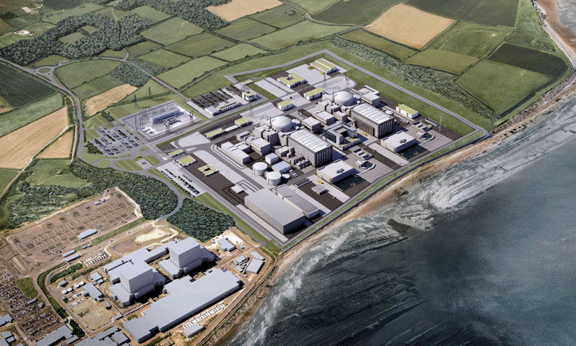
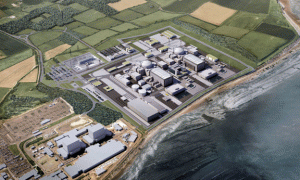 Hinkley Point C nuclear plant not essential – think tank, BBC News 26 Aug 16, The Hinkley Point C nuclear power plant is “not essential” for the UK to meet its energy and climate change targets, according to a think tank.
The Energy and Climate Intelligence Unit (ECIU) also said opting for “established” approaches instead would save bill payers £1bn a year in total.
EDF Energy, which has agreed to back Hinkley, said the ECIU report did not offer “credible alternatives”.
The government is due to make a final decision on Hinkley in the autumn………
One of the report’s authors, former Npower chief executive, Paul Massara – who now runs North Star Solar – said: “You are looking at a deal which is two and half times the current price, it goes on for 35 years and effectively this report today shows we can transition to a low carbon, affordable secure option without Hinkley and that’s what we should be doing.”
Mr Massara said a more “flexible” cost saving approach was needed that “includes things like demand-side management, which means people can turn down their electricity demand and manage their demand, with smart meters and batteries which are going to come in the next five to six years”…….
In its report, the not-for-profit ECIU made the assumption that “the total annual cost of Hinkley will probably be about £2.5bn”.
It then calculated the cost of a basket of alternative measures to meet the country’s energy and climate change targets, and concluded that bill payers, both domestic and business, would end up paying a total of £1bn less per year for their energy if they were adopted than if Hinkley C were built.
‘Not essential’
The think tank’s alternative proposals include building more wind farms and gas-fired power stations than are currently planned and laying more cables connecting the UK grid with other countries.
“Our conclusion is that [Hinkley Point’s] not essential,” said ECIU director, Richard Black.
“Using tried and tested technologies, with nothing unproven or futuristic, Britain can meet all its targets and do so at lower cost,” he added……..http://www.bbc.com/news/business-37191222
August 27, 2016
Posted by Christina Macpherson |
ENERGY, UK |
Leave a comment
studies have detected among area residents heightened levels of leukemia and cancer of the breast, colon, esophagus, liver, lung and thyroid. They have also revealed higher levels of cardiovascular and blood diseases, chromosomal aberrations and congenital anomalies.
Kazakhstan: Living with Semipalatinsk’s Nuclear Fallout, EurasiaNet August 26, 2016 – by Joanna Lillis In the village of Znamenka in northeastern Kazakhstan, adults have vivid memories of nuclear explosions rocking the steppe.
“We saw mushroom clouds — big and terrifying ones,” recalled Galina Tornoshenko, 67, shaking her head at the traumatic memory and gesturing upward at the clear blue sky. “I was small at the time, but I remember it well.”…….Over the next 40 years, 456 blasts were detonated there, releasing energy 2,500 times that of the first atomic weapon dropped on Hiroshima in 1945. The tests turned swaths of Kazakhstan into a toxic wasteland and ravaged the health of locals, who were, in effect, human guinea pigs……..
The site was mothballed in 1991, the year of the Soviet Union’s collapse. But for the people still suffering from the fallout, the atomic legacy is living on. Now renamed Semey, Semipalatinsk lies 120 kilometers east of the former ground zero, which is marked by a poignant monument in a city park depicting a woman nursing a child under an exploding mushroom cloud.In a small apartment on the outskirts of Semey, Mayra Zhumageldina is massaging her daughter’s twisted limbs. “If you don’t do massage, they freeze up,” Zhumageldina told EurasiaNet.org, smiling down fondly at her disabled daughter. “I took a special massage course to do this.”
Zhannur Zhumageldina, 25, was born in the village of Olzhabay, 200 kilometers from the polygon, the year after it closed and three years after it conducted its last explosion.
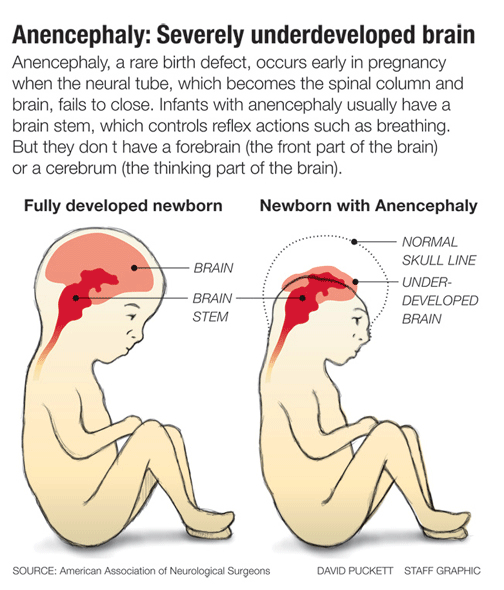
At 15 months old, she was diagnosed with microcephaly, a rare neurological condition in which the head is abnormally small, impeding brain development, and scoliosis, curvature of the spine. Both conditions were caused by radiation exposure.
Her diagnosis came as a bolt from the blue to her mother, pregnant at the time with her second child, a son who was born healthy.
“I didn’t even know the polygon existed until Zhannur was 15 months old,” said Zhumageldina, a single mother who cares full-time for her severely disabled daughter, who cannot walk or talk. “I was in shock.”
Across the city, in a cramped apartment in another drab suburb, Berik Syzdykov whiles away his days listening to music videos and strumming on his dombra, a traditional stringed instrument. Syzdykov, 37, was born blind and with severe facial deformities in Znamenka, the village where adults remember mushroom clouds exploding on the horizon.
“Once, there was a big explosion,” said his 73-year-old mother Zina Syzdykova, leaning back and closing her eyes. “It was the winter of 1979 and I was pregnant. Two months later, Berik was born like this.”
“Polygon,” she said with a shrug. “We didn’t know anything about it… When Berik was born, I cried and cried, but how would I know what was wrong with him?”
………Over four decades, nuclear tests at Semipalatinsk affected 1.5 million Kazakhstanis in some form, Nazarbayev has asserted. Due to poor record-keeping and Soviet official secrecy, it is still not known precisely how many people received dangerous doses of radiation, Togzhan Kassenova of the Carnegie Endowment for International Peace’s Nuclear Policy Program told EurasiaNet.org. Data cited in one Kazakh-Japanese study suggests a quarter of a million people may have received elevated doses.
Dr. Zhaxybay Zhumadilov, a scientist from Astana’s Nazarbayev University who has researched the impact of the tests with experts from Hiroshima University, says studies have detected among area residents heightened levels of leukemia and cancer of the breast, colon, esophagus, liver, lung and thyroid. They have also revealed higher levels of cardiovascular and blood diseases, chromosomal aberrations and congenital anomalies.
Determining exposure and drawing meaningful conclusions is complicated, because “for years, what happened at the Semipalatinsk test site, [and] its effects on human health and the environment, were treated as classified information,” Zhumadilov told EurasiaNet.org. There is no international analogy for such “repeated acute external and long-term internal chronic exposure.”………
the Semipalatinsk victims
grapple with the consequences of the tests a quarter of a century on. Lump sum compensation paid out in the 1990s, mostly amounting to a few hundred dollars, is long since spent. Many sufferers now must make due on social welfare payments.Showing files of records of her dogged – mostly futile – approaches to officialdom and charities for assistance, Zhumageldina counts herself lucky to have state-subsidized housing costing just $8 for her one-room apartment, from the $150 in monthly welfare that the family lives on. She notes that it took her 19 years of lobbying before she was granted the subsidy benefit.
The state provides free medical care for the test victims: Zhumageldina’s daughter has recently undergone treatment in Astana to alleviate her condition, for which there is no cure. Still, Zhumageldina strikes an upbeat note. “Zhannur means everything to me,” she said with a gentle smile, flicking through an album showing photos of her disabled daughter growing up. “Everyone said I should abandon her – the doctors, my husband, my mother-in-law. … I said no. I’m going to look after her.”
Syzdykov received financial support from the government and an Irish charity for multiple operations in Kazakhstan and Europe, but still this man robbed of his sight by the Semipalatinsk tests dreams of seeing what the world looks like.
“If I could see, it would be good,” he said. “If not, there’s no need for any more surgery.” http://www.eurasianet.org/node/80311
August 27, 2016
Posted by Christina Macpherson |
children, health, Kazakhstan |
Leave a comment

 Protests threaten China’s nuclear energy plans, Global Risk Insights, 26 Aug 16 NIMBYism is on the rise in China, and without better dialogue between stakeholders, threatens to undermine Beijing’s nuclear plans and efforts to meet its COP21 goals.
Over the past two weeks, thousands of residents of Lianyungang, a town in Jiangsu province, have gathered, halting preparations for a proposed nuclear waste reprocessing plant. Lianyungang is one of six sites under consideration for the project, but the two companies developing the plant, China National Nuclear Co. (CNNC) and France’s Areva, have not yet decided on a final location.
China’s ambitious nuclear plans The proposed fuel reprocessing center would recycle spent fuel to create new fissile material. This process also reduces the final volume of nuclear waste that needs to be stored. Currently, spent fuel is stored onsite at the power plant, usually first in cooling pools and then in dry casks. Long term storage facilities, such as the controversial Yucca mountain repository in Nevada, have been unsuccessful in gaining regulatory approval. However, on-site waste storage is not viable in the long term, and fuel reprocessing centers, like the proposed $15 billion CNNC-Areva project, will be critical to the viability of nuclear energy in China.………
Chinese state media has attributed the movement in Lianyungang to “nimbyism.” The NIMBY (Not In My Backyard) mentality has led to the suspension or cancellation of other industrial projects in China, such as praxylene or waste incinerator plants.
Lack of public input fuels opposition There is growing advocacy in China for an expanded role for public input in planning these projects – currently decisions at the planning stages are made with little input from residents: “for many local residents, there is no absolute guarantee that those projects, if built in their neighborhood, can be 100 percent safe. If there is some harm, they will bear the brunt of the costs and risks…..” http://globalriskinsights.com/2016/08/nimbyism-threatens-china-nuclear-plans/
August 27, 2016
Posted by Christina Macpherson |
China, opposition to nuclear |
Leave a comment

 UK nuclear industry hit by fresh turmoil, Ft.com Gill Plimmer August 26, 2016 Britain’s nuclear industry has been hit by fresh turmoil after the government said it was planning to appeal against a ruling that it had botched a £7bn contest to clean up toxic power plants, while another company threatened to bring legal action.
A High Court judge ruled on July 29 that the Nuclear Decommissioning Authority had acted unlawfully in the way it awarded a contract to dismantle and make safe 12 of the UK’s first-generation nuclear power stations. The decision leaves the government agency exposed to multimillion pound claims for damages.
The initial court challenge was brought by Energy Solutions, the US-based company that lost the contract after managing the nuclear sites for 14 years, but on Friday another US contractor, Bechtel , said it would also take legal action. Other losing companies or consortiums, such as Ch2MHill and Serco, are expected to follow.
Bechtel is understood to be seeking compensation for the loss of future earnings but others may just seek to recoup bid costs, which are estimated at £15m per consortium……….
The fiasco raises fresh questions over the way government entities hand out
multibillion-pound contracts as well as casting further doubt on the UK’s nuclear industry at a time when the government is reviewing the £18bn
Hinkley Point project.It has also prompted concerns over the future of the Nuclear Decommissioning Authority, which was already under scrutiny after the government scrapped the outsourced management contract to run Britain’s biggest nuclear waste site — Sellafield in Cumbria.
John Clarke, chief executive of the NDA, announced this month his intention to retire next year………http://www.ft.com/cms/s/0/0c4e74e4-6b80-11e6-a0b1-d87a9fea034f.html#axzz4ITV1TlFn
August 27, 2016
Posted by Christina Macpherson |
Legal, UK |
Leave a comment
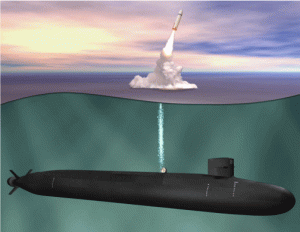 North Korea puts ‘another piece in puzzle’ towards nuclear capability, CNBC, David Reid | @cnbcdavy
26 Aug 16
North Korea puts ‘another piece in puzzle’ towards nuclear capability, CNBC, David Reid | @cnbcdavy
26 Aug 16 North Korea’s latest missile test has security analysts admitting that the military-led country is closer than ever to possessing a nuclear missile system capable of attacking another country.
On Wednesday, a North Korean submarine-launched missile flew about 500 kilometers east, landing for the first time in Japan’s Air Defense Identification Zone (ADIZ).
Pyongyang’s official KCNA news agency reported that regime leader Kim Jong Un supervised the test and described it as “the greatest success and victory”.
Research Analyst in Proliferation and Nuclear Policy at RUSI, Emil Dall, said to CNBC that Wednesday’s launch appears to be North Korea’s most successful missile test.
“It demonstrates Pyongyang’s continued determination to develop a fully-workable nuclear weapon capability, and this is another piece in that puzzle.
Dall said Thursday it was also probable the rogue state now has a nuclear bomb that can fit on the missile.
“Whether North Korea has been able to construct a nuclear warhead small enough to fit on to an intermediate-range missile is uncertain, but should be assumed at this point,” he said via email…….http://www.cnbc.com/2016/08/26/north-korea-will-soon-be-able-to-launch-nuclear-weapons.html
August 27, 2016
Posted by Christina Macpherson |
North Korea, weapons and war |
Leave a comment














 nuclear-news
