Fukushima nuclear meltdown was covered up, plant operator admits
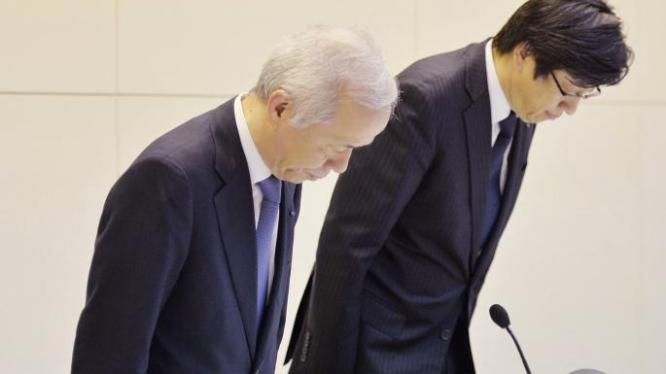
Naomi Hirose, left, TEPCO president, and Takafumi Anegawa, a director, apologise at press conference in Tokyo today
The company responsible for the Fukushima Dai-ichi nuclear power plant has admitted lying about the meltdown of its reactors five years ago, in a deliberate cover-up of the world’s second worst nuclear disaster.
It took two months for the Tokyo Electric Power Company (Tepco) to own up to the meltdown of three reactors after an earthquake and tsunami. A report commissioned by the company says that its president at the time ordered employees to speak of “damage” to the reactors and avoid the world, “meltdown”.
The company’s current president, Naomi Hirose, said: “It is extremely regrettable People are justified in…
No accountability in nuclear industry
Following the June 16 quake in Hakodate, Hokkaido, nuclear plant operators in the area reported no damage, but even if there were problems, because of Prime Minister Shinzo Abe’s new anti-democratic secrecy law, they would not necessarily report them, nor would they feel any compunction to do so. The Nuclear Village Idiots can cover their backsides very nicely with this new secrecy law.
Public safety is hardly a concern of politicians or the nuclear power plant owners. Japan’s very much a totalitarian state once again. It simply uses democratic-sounding titles to cover up the true authoritarian nature of the government and senior industrial officials. It’s Tojo’s Japan with velvet gloves. Let’s hope the gloves never come off.
ROBERT MCKINNEY
OTARU, HOKKAIDO
http://www.japantimes.co.jp/opinion/2016/06/25/reader-mail/no-accountability-nuclear-industry/
Japan Could Go Nuclear ‘Virtually Overnight’ Joe Biden Tells Chinese President

This undated picture released from North Korea’s official Korean Central News Agency (KCNA) on June 23, 2016 shows a test launch of the surface-to-surface medium long-range strategic ballistic missile Hwasong-10 at an undisclosed location in North Korea.The Musudan — also known as the Hwasong-10 — has a theoretical range of anywhere between 2,500 and 4,000 kilometres (1,550 to 2,500 miles).
U.S. Vice President Joe Biden, never one for a loss of words, told Chinese President Xi Jinping that Japan has the capacity to acquire nuclear weapons “virtually overnight.”
Biden made his disclosure while giving a speech at a Public Broadcasting Service program aired on Monday. Biden said he had urged Xi to exert influence on North Korea so it will abandon its missile and nuclear weapons developments.
Referring to North Korea’s recent nuclear test and missile launches in violation of U.N. Security Council resolutions, Biden said that if China and the U.S. fail to take effective action against North Korea, “What happens if Japan, who could go nuclear tomorrow? They have the capacity to do it virtually overnight.” Biden did not say when his conversation with Xi took place.
Biden said that China had the single greatest ability to influence North Korea, adding that North Korea is building nuclear weapons that can strike as far away the U.S. mainland.
“And I say, so we’re going to move up our defense system,” the vice president added, referring to the U.S. plan to deploy THADD (Terminal High Altitude Area Defense), an advanced missile interception system, in South Korea.
Biden quoted Xi as saying, “Wait a minute, my military thinks you’re going to try to circle us.” Earlier this month China said that deploying THADD infringes on China’s strategic interests.
The fact that Japan can easily develop nuclear weapons, however, isn’t the issue but the fact that Biden chose to tell Xi this is worthy of note, both in the context of North Korea’s nuclear ambitions and given Biden’s history of frequently making gaffes.
Tepco’s “sincere”apology!!!
With Tepco it is always the same song, they apologize for a long ago previous lie and tell the whole world how very very sorry, repenting they are, while they daily continue lying and covering-up the true happenings at Fukushima Daiichi.
FUCK TEPCO!
Press Release (Jun 21,2016)TEPCO APOLOGIZES FOR PREVIOUS LEADERSHIP’S FAILURE TO ACKNOWLEDGE MELTDOWN DURING FUKUSHIMA ACCIDENT
Responding to recent report of an investigating committee, TEPCO restates its commitment to provide comprehensive, accurate and understandable information, while making safety the utmost priority to ensure a safe and secure society
TOKYO, June 21, 2016 In its first response to the June 16 report of the committee investigating the belated acknowledgment that a meltdown had taken place at Fukushima Daiichi NPS in March 2011, TEPCO said it is clear from the report that its previous leadership gave instructions not to use the word “meltdown” in public statements.
“We deeply regret that our previous leadership failed to live up to the standards of transparency and thoroughness that we strive to meet today,” said TEPCO President Naomi Hirose (who was not the company’s leader at the time of the accident). “We sincerely apologize for it,” he said.
In more recent years, through the creation of the Nuclear Reform Monitoring Committee and many other changes, TEPCO has worked to improve the timeliness, thoroughness, and clarity of its communication with the public, both inside Japan and internationally. President Hirose stressed that TEPCO has been learning this lesson and breaking from its past, as it works to build trust with the public and with government through the implantation of its Nuclear Safety Reform Plan. Improvements in communication represent an important element of that Plan, which is overseen both by the company’s Nuclear Safety Oversight Office and by an independent Nuclear Reform Monitoring Committee chaired by the former head of the U.S. Nuclear Regulatory Commission.
“We deeply regret the shortcomings of the past,” President Hirose said, “but it is important to recognize that they do not represent the TEPCO of today while making safety the utmost priority to ensure a safe and secure society.”
http://www.tepco.co.jp/en/press/corp-com/release/2016/1300509_7763.html
To carry better the Fukushima radioactive water into the ocean

New Drainage Channels Start Operations at Fukushima Daiichi Nuclear Power Station
More Drainage “Improvements” at Fukushima Daiichi: In advance of typhoon season, rainwater drainage has been further improved by the construction of a new drainage channel. The channel runs between Units 5-6 and the cluster of Units 1-4. It carries water into two drainages, both of which empty into the protected port area and not the open ocean. The new channel helps manage the increased runoff that results from extensive hard-surfacing that has been done to reduce radiation, prevent rainwater from seeping into the ground, and in turn “improve the environment”.
http://www.tepco.co.jp/en/news/library/archive-e.html?video_uuid=tq4l2aqa&catid=69631
Living with radiation in Fukushima

In Iwaki city, Fukushima, the Tarachine “screening center” is a fully independent citizen laboratory, well equipped and employing qualified technicians to help the Fukushima population with anything involving radiation measuring or contamination testing.

For a minor fee people can come to the Tarachine screening clinic to have their foods tested, but also their house lot soil tested, or even the vacuumed dust of their house tested.

The Tarachine screening center fulfill a very important role for the Fukushima families, as families do not have the means to acquire all the necessary expensive equipment nor the technical qualifications.

As the Japanese government does not provide such vital service nor could be trusted with radiation measure numbers, some citizens organized themselves to set up such laboratories. There are at present about 100 such laboratories which have spread up, but Tarachine is certainly the most efficient and fully equipped for various types of radiation measures.
For example, since in a lot of places very young children cannot anymore play outside safely, but are kept to play indoors, it is therefore vital for the mothers to constantly control the level of contamination inside their house, thus they bring to the Tarachine center their vacuumed dust to be measured.

As an example this mother having brought her house vacuumed dust to be analyzed learned that it is contaminated by 4400 Bq/kg of Cesium 137, 718 Bq/kg of Cesium 134 and 1950 Bq/kg of Potassium 40, thus a total contamination of 5158 Bq/kg. The levels of Cesium 137 and Cesium 134 have too high, 4 times higher than the advised contaminated threshold and could therefore be harmful to the persons living in that house, especially for children.
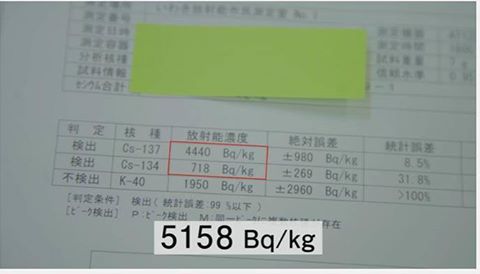
As a comparison, you may see vaccumed dust from 3 different locations, one in Iwaki, Fukushima, one in Chiba, nearby Tokyo, and one in Vancouver, British Columbia,Canada:
Vacuum House Dust in Fukushima (Iwaki)
Cs 137 4440 Bq/kg
Cs 134 718 Bq/kg
Vacuum House dust in Chiba (Makuhari)
Cs 137 137Bq/kg(± 2%)
Cs 134 27Bq/kg(± 5%)
Vacuum House dust in Vancouver, BC
Cs 137 <1.08Bq/kg
Cs 134 <0.86bq/kg
The Japanese government during the past 5 years has constantly lied to the Fukushima population about the harmful radiation risks, condemning the people to stay and live with radiation. Consequently citizens have learned to rely only on their own for radiation measuring and protection.
https://www.actbeyondtrust.org/campaign/pledge/tarachine/jp/
Contact adress: Tarachine Screening center
Onahama hanabatake-cho 11-3, Iwaki city, Fukushima Prefecture, Japan
Tel: 0246‐92‐2526
Japanese utility begins loading fuel at reactor for late July restart

MATSUYAMA, EHIME PREF. – Shikoku Electric Power Co. started loading nuclear fuel Friday into a reactor at its Ikata power plant, paving the way for a scheduled restart next month.
The utility plans to reactivate the No. 3 unit at the plant in Ehime Prefecture on July 26. The company envisions beginning electricity generation three days later and resuming commercial operation in mid-August.
The pressurized-water reactor using uranium-plutonium mixed oxide, or MOX, fuel, will be the fifth unit to be reactivated under tougher regulations introduced in the wake of the 2011 Fukushima nuclear disaster.
Ehime Gov. Tokihiro Nakamura said he hopes the reactor operator will make safety a high priority. Safety concerns remain, however, as the plant on the island of Shikoku is situated near a fault zone.
A group of local residents filed a suit in May seeking an injunction to halt the restart, arguing that strong earthquakes that have hit central parts of Kyushu may affect the fault and trigger further temblors. The plant is about 170 km (105 miles) east of Kumamoto Prefecture, the epicenter of the recent quakes.
The reactor, whose operation began in 1994, was suspended in April 2011 for a regular inspection after the March 2011 earthquake-tsunami and nuclear disasters.
The Nuclear Regulation Authority last July approved Shikoku Electric’s enhanced safety measures against possible earthquake and tsunami hazards as well as other major accidents prior to the restart.
The company started on-site preoperational checks of the unit in April, the last procedure toward reactivation.
On Friday, about 20 local residents shouted, “No to restart” near the power plant, saying the reactors should be decommissioned.
“I can’t believe the reactor is restarted even though the Fukushima No. 1 nuclear power plant of Tepco has not been contained,” said Takashi Hasebe, 62, who is a member of a citizens’ group opposed to Ikata’s restart. “We can’t stop natural disasters but we can stop nuclear power plants.”
But local businesses want them to be restarted in hopes of boosting the local economy.
“If the reactors won’t be restarted, our town would be depopulated even more,” said Tomokatsu Shinozawa, 55, who runs a Japanese inn in the town of Ikata. “I want it to be restarted as soon as possible.”
Another male farmer, 64, pointed out that spent nuclear fuel would be stored whether or not they are restarted.
“It’s dangerous one way or the other,” he said. “If that’s the case, it’s better to restart it making sure that it’s safe.”
June 24 Energy News

Opinion:
¶ “We’re all going solar, rooftop panels or not” • Solar power has gone beyond a rooftop revolution. Thanks to rapid cost reductions that even surprised experts, solar is on the verge of transforming Australia’s energy mix, whatever the outcome of the July 2 election. [The Australian Financial Review]
 Solar power is set to capture almost all the investment in new generation. Justin McManus
¶ “EDF should delay Hinkley Point decision following Brexit: union” • EDF’s unions have argued for months that the state-owned firm should delay its investment decision on the Hinkley Point. Now, the UK has voted to leave the EU, and UK politics have taken uncertainty to a new level. [The Fiscal Times]
Science and Technology:
¶ BMW announced battery packs from its i3 model can power your home, integrating seamlessly with solar panels to store energy for use at night, to…
View original post 662 more words
Exit from the European Union could make it easier for Britain to develop nuclear power
 A British vote to leave the European Union would force broad changes to the bloc’s energy policy, weakening its climate policy and removing a crucial Central European energy ally — but it could also give London far more freedom to pursue nuclear projects.
The U.K. is often an energy outlier in the EU, advocating nuclear power and shale gas sources shunned by others. And it tends to build alliances broadly aimed at keeping interference from Brussels to a minimum.
But both sides have a lot to lose.
A Brexit could undercut long-term climate policies in Brussels and London, and the EU would lose the U.K.’s pro-free market voice, which has historically helped tone down some more statist schemes coming from European capitals.
Here are the five ways that a Brexit would impact Europe’s energy and climate forecast:…….
 4. The freedom to subsidize — maybe
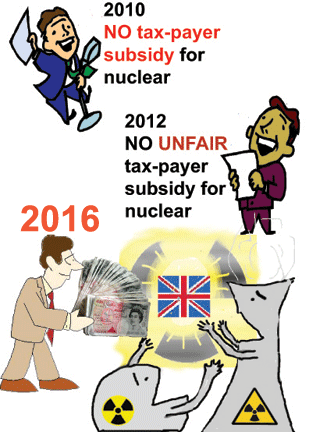
One area the European Commission tries to avoid is state aid, particularly for energy projects.
But even when the Commission gives a green light, there’s the danger that another EU country might try to interfere. That’s what happened with Hinkley Point. Brussels approved a state aid plan in 2014, but Austria, backed by Luxembourg,challenged the decision in the European Court of Justice eight months later…….
Environmental advocates worry it would give the U.K. room to continue rolling back support for renewables in favor of other fuels.
“One of the reasons why the government has had to have a more sensible policy on these issues is because state aid disciplines have stopped it from throwing money at gas-powered stations and fracking and nuclear,” said Nick Mabey, chief executive of the environmental analysis group E3G……..http://www.politico.eu/article/uk-brexit-renewable-energy-hinkley-nuclear-interconnectors-gas-climate-emissions-paris/
Every State can go Nuclear Free: California shows the way with a blue-green alliance
 California Is Going Nuclear-Free, Which Means Everyone Else Can, Too, Fast Coexist.com MICHAEL SHANK 06.21.16
A historic deal to replace the Diablo Canyon nuclear plant with renewable energy could be a model for the rest of the country. “……, a new historic agreement between a major American power company and environmental groups shows that another way is possible. America can, in fact, transition off nuclear in the short-term and replace it with renewable energy, efficiency and energy storage resources. It’s totally feasible. Take a look at the groundbreaking agreement:
First, the 100-plus year-old California-based power giant, Pacific Gas and Electric (PG&E), just agreed to shut down its two 30 year-old nuclear reactors in Diablo Canyon, letting the licenses expire in 2024 and 2025, respectively. This is a big deal, and it’ll make California, the world’s sixth largest economy, nuclear free.
This is no small thing. These two PG&E nuclear reactors, which spurred the start of the environmental organization Friends of the Earth, comprise roughly 20% of the annual electricity production in the company’s service territory and 10% of California’s annual production.
That’s a lot of power. And yet the transition off these kinds of plants is entirely doable and illustrative of switches that should happen across the U.S., including much older plants with long-expired licenses. Entergy’s Indian Point nuclear reactors north of New York City, for example, could be closed even sooner than Diablo Canyon and replaced with a portfolio of renewables, efficiency, and storage. Taking a cue from California, we should be replicating this everywhere.
Second, this agreement indicates that California is outpacing other states in how its utilities are redefining their future, as PG&E didn’t stop with the Diablo Canyon closure. They committed to ramping up their renewable energy portfolio over the next 15 years so that renewables will comprise the majority of their total retail power, at 55%, voluntarily exceeding California’s standards for 2030.
That’s also a big deal and heralds a new tide of utility leadership. PG&E sees the markets moving and wants to make the switch early. Utilities across the U.S., many of which are notoriously conservative in thinking and practice, are seeing the writing on the wall. And in the coming years, we’ll only see more of this switching as the economics are rapidly driving the conversion.
Senior EDF managers want Hinkley nuclear project to be postponed
 EDF Managers Tell UK MPs That Hinkley Point C Should Be Postponed http://www.nucnet.org/all-the-news/2016/06/20/edf-managers-tell-uk-mps-that-hinkley-point-c-should-be-postponed
Plans & Construction 20 Jun (NucNet): Senior managers at EDF have told British MPs that a final investment decision (FID) on the planned Hinkley Point C nuclear project should be delayed until problems including the reactor design and “multi-billion litigation” over the Olkiluoto-3 project in Finland have been resolved.
The letter from EDF managers to the UK parliament’s energy and climate change committee is a setback for the proposed £18bn (€23bn, $26bn) nuclear station in Somerset, England. The station is a flagship of the government’s energy policy and is intended to provide seven percent of Britain’s electricity from about 2025.
In April, the state-controlled French company said it was delaying the FID until September while it consulted with trade unions.
A letter dated 13 June and addressed to Angus MacNeil, the chairman of the committee, from the Fédération Nationale des Cadres Supérieurs de l’Énergie (FNCS) union, “advises to delay the FID until better upfront industrial visibility is evidenced”.
Outstanding problems highlighted by in the letter include:
– Areva NP, the designer of the European pressurised water reactor (EPR) planned for Hinkley Point, “is currently facing a difficult situation”.
– The French nuclear safety authority (ASN) may not approve operation of the Flamanville-3 EPR under construction in northwest France due to various anomalies with the reactor vessel bottom and the reactor vessel head.
– There may be “identical flaws” in an Areva EPR being built at Taishan-1 in China.
– Litigation between Areva and the Finnish energy group TVO over delays to the Olkiluoto-3 EPR remain unsettled.
– An EDF offer to purchase Areva expired on 31 March, leaving “governance uncertainties upon the implementation of the Hinkley Point C project”.
The letter says that on 25 May, ASN declared at an annual hearing in the French parliament that financial and economic challenges that both EDF and Areva are facing would be “time consuming”. The necessary reorganisations “would need long delays before a proper recovery happens” and ASN would prioritise regulatory oversight of the existing fleet rather than any new project.
According to the letter, ASN is concerned that while EDF is dedicating its efforts to new nuclear projects, the financing of safety improvements for the normal operation of the French nuclear fleet could be delayed or even given up.
The letter says “heavy evidence” still needs to be brought prior to further commitments, in order to make those commitments “gain robustness and reliability”.
On 7 June, three French workers unions sent a letter to energy minister Ségolène Royale asking for clarification about the “orientation” of the French nuclear industry.
Vincent de Rivaz, the chief executive officer of EDF’s UK subsidiary EDF Energy told MPs last month that he could not give a definite time for when the company will make the FID.
Mr de Rivaz was called to reappear before the committee after indicating at an appearance in March that the FID could be taken by early May. The committee asked him to explain why that had not happened.
The letter is online: http://bit.ly/1Uc8N0F
A model for nuclear plant closure: Diablo Canyon co-operative plan
 Diablo Canyon Nuclear Closure Plan: An Important Model, Natural Resources Defense Council, June 22, 2016 Matthew McKinzie Fourteen U.S. nuclear reactors have now been shut down or their owners have announced their closures since 2010, either because they were uneconomic in today’s electricity markets or had operational or environmental problems. The Joint Proposal announced yesterday for the two reactors at California’s Diablo Canyon Power Plant is historic, because it is the first time any utility owner has committed to a plan to replace retiring nuclear generation with 100 percent, zero-emissions, clean electricity-generating resources that are also lower cost. This shows that with careful planning, there is no need to substitute polluting fossil fuels for retiring nuclear generation –-an important model for the rest of the world.
The Diablo Joint Proposal signed by Pacific Gas & Electric (PG&E), Friends of the Earth, NRDC, labor and other environmental groups is further proof that our energy system is changing, and renewable energy and other resources can fill the gaps left from shuttering nuclear plants.
Energy efficiency, wind, and solar address climate change without nuclear energy’s burdens of highly radioactive waste, the need for physical and cyber security to guard against terrorist nuclear threats, the risk of radiation release in a major accident, and the nuclear weapons proliferation problem.
To see just how monumental the Joint Proposal for Diablo is, it’s important to take a look at what’s happening today in the nuclear industry. Since 2010, across Vermont, Massachusetts, New York, New Jersey, Florida, Illinois, Wisconsin, Nebraska and California, 14 nuclear reactors at 11 power plants totaling 11.9 gigawatts of electric capacity have either closed, or their owners have announced they will close.
Information on these closed or closing nuclear reactors is summarized in this table, and patterns are evident. Three of the reactors closed for primarily mechanical/safety reasons, whereas 11 reactors closed or will close primarily for market reasons. In other words, in today’s wholesale electricity markets (which largely do not reflect external costs imposed by carbon pollution), these reactors were unable to compete with other forms of electricity generation, including natural gas and wind, when utilities are procuring energy sources to help meet their customers’ needs……….
A carbon-free, renewable futureFortunately, both the United States and the world are making great strides forward on carbon-free energy efficiency and renewable energy, as well as technologies like demand response and battery storage. An October 2015 NRDC report “Tectonic Shift” describes how economic growth is now decoupled from energy usage, and that in fact energy usage is flat. California has adopted a requirement that half of its electricity come from renewable energy resources by 2030, and New York is about to adopt the same requirement. In 2015,in data compiled by AWEA, more than 30 percent of Iowa’s electricity came from wind power alone and three other states generated more than 20 percent of their electricity from wind power alone.
And the National Renewable Energy Laboratory has concluded that “renewable electricity generation from technologies that are commercially available today, in combination with a more flexible electric system, is more than adequate to supply 80 percent of total U.S. electricity generation in 2050 while meeting electricity demand on an hourly basis in every region of the country.”……
the Diablo Canyon proposal shows that given sufficient time to prepare, retiring nuclear capacity can transition smoothly to a mix of energy efficiency measures; clean, renewable resources; and energy storage without any role for fossil fuels – an outcome that can be optimal for the environment, the market, and the reliability of the electric grid.The Joint Proposal governing the shutdown of Diablo Canyon within nine years is exactly that – full replacement of retiring nuclear generating capacity with lower cost, zero-carbon resources. The proposal is a robust model of planned, orderly transition that takes into account sound energy policy, the values of jobs and community, the threat of climate change, and nuclear safety concerns. https://www.nrdc.org/experts/matthew-mckinzie/diablo-canyon-nuclear-closure-plan-important-model
Russia’s massive nuclear-powered icebreaker to seek oil reserves in Arctic
Arktika is just one icebreaker in a class known as Project 22220. The other two — Sibir, which was laid down in May 2015, and Ural — are also planned. If completed, Sibir will reportedly have the propulsion power of 110 MW, almost twice as powerful as Arktika. Both ships are part of a $1.2 billion contract that Baltic Shipyards signed in 2014 with Rosatom State Nuclear Energy Corp.
Why would Russia need nuclear-powered icebreakers in the first place? Obviously, for defense. Icebreakers can clear a path for military ships, allowing for increased mobility and range for the Russian naval fleet.
USA’s Department of Energy seeks “consent-based” #nuclear waste sites
 Nuclear waste, anyone? Feds look to willing states, The Orange County Register, June 22, 2016 By TERI SFORZA / STAFF WRITER Federal officials unleashed bubbles of hope in San Juan Capistrano on Wednesday – we’re developing a plan that can remove deadly nuclear waste from San Onofre earlier than we thought! – while others worked feverishly to pop them.
Speaking to a raucous audience at the San Juan Capistrano Community Center, John Kotek, the U.S. Department of Energy’s acting assistant secretary for nuclear energy, detailed the federal government’s new push for temporary nuclear waste storage in regions allegedly eager for the business.
Several such “consent-based” sites – currently envisioned in West Texas and New Mexico – could be up and running while the prickly question of finding a permanent home for the waste is hashed out……..
Some in Texas and New Mexico say they’ll never consent to importing our deadly castoffs, and they’re ready to do battle.
“Please be aware that many people in Texas and New Mexico are solidly opposed to having high-level radioactive waste stored in our region,” said Karen Hadden of the Sustainable Energy & Economic Development Coalition, a Texas-based nonprofit focusing on clean energy and public health, in a letter to San Onofre officials.
The DOE scheduled eight meetings about consent around the country, but none in Texas or New Mexico, the targeted region. … Dumping this dangerous waste on communities that are largely Hispanic and lack the resources to fight back, people who never had a say in the nuclear reactors to begin with or benefited from any electricity from them, would be an extreme example of environmental injustice.”
The Texas Democratic Party has gone on record opposing the import of nuclear waste, conjuring the stalemate at Yucca Mountain. The federal government spent $10 billion to put a permanent repository there, despite the opposition of Nevada residents. That effort is essentially dead……
 Former Nuclear Regulatory Commission Chairwoman Allison Macfarlane explained the tortured landscape: a Congress that only sees two, four and six years into the future, and is satisfied that the waste is safe where it is today, at 75 different sites across the nation; utilities that want to reduce costs, and thus aren’t eager to make changes; a Department of Energy that doesn’t have the legal authority to solve the problem entirely; and a Department of Justice that is paying billions to utilities from a judgment fund of taxpayer money, because the federal government promised the utilities it would permanently dispose of that waste in exchange for payments, but has failed utterly to do so……
It’s our ethical responsibility to not stick this problem to future generations, Macfarlane said to applause from the audience.
“I’m not hopeful new physics will be discovered to magic this stuff away. We have to grapple with it. It’s there.” http://www.ocregister.com/articles/waste-720291-nuclear-new.html
USA promotes a nuclear arms race in Asia, by Supporting India’s entry to Nuclear Suppliers Group
 Promoting a nuclear race?, Business Recorder June 23, 2016 IKRAM SEHGAL India clandestinely diverted nuclear fuel from the Canadian supplied civilian nuclear reactor in Tarapur for conducting its nuclear test in 1974. Created in 1974 as a direct result of the Indian subterfuge, the Nuclear Suppliers Group (NSG) was meant to prevent in future what India had done, being tasked with regulating nuclear commerce for civilian uses and preventing proliferation of nuclear weapons.
On the back of the US-India nuclear deal in 2008, the Bush Administration applied immense political pressure to exempt India from the NSG’s rules on civilian nuclear trade when it was under US sanctions for proliferation activities. This double standards waiver was engineered when Pakistani’s letter vehemently objecting to it was suddenly and surprisingly withdrawn in Vienna during NSG deliberations at the last minute on the express telephonic instructions from President Asif Zardari. This unparalleled “personal” initiative appeased the US and India but it destroyed the original concept of the NSG and cost Pakistan dearly. It “officially” allowed India to expand its arsenal massively by using imported fuel for civilian nuclear reactors and replenish stocks for weapon production. “Harvard’s Belfer Center” and US think tank “Arms Control Today” confirmed that this defeated the very purpose why the NSG was created in the first place.
What about nuclear balance in South Asia? In an article published by the International Committee of the Fourth International (ICFI), in September 2008 the writers correctly assessed that, “The action the NSG has been goaded into taking by the US has immense and incendiary strategic implications for South Asia, tilling the balance of power between India and its historic rival Pakistan sharply in India’s favour. It also rubbishes the basic principle of the nuclear regulatory regime the US championed earlier that States which pursue nuclear weapons will be “punished” by an embargo on all nuclear trade and those that adhere to the NPT will, in return, be assisted in developing civilian nuclear energy. And, as was foreshadowed in the events at the NSG meeting itself, it will intensify and complicate the ongoing and ever more explosive rivalry amongst the big powers for markets, raw materials, and geo-strategic advantage.”
A Senate hearing on 24 May saw US Senator Markey saying something extremely relevant, “Since 2008 when (we) also gave them an exemption, India has continued to produce fissile material for its nuclear weapons programme virtually un-checked. At that time Pakistan warned us that the deal would increase the chances of the nuclear arms race in South Asia”. Some countries, led by China and Turkey, are resisting this pressure on principle, arguing that if any exception to the rules is made, it should apply equally to both India and Pakistan. Since all 48 member NSG decisions are made by consensus, even one member can block a decision.
India has not honoured its limited commitments under the international non-proliferation regime that earned it the 2008 waiver, adhering to limited IAEA Additional Protocol as well as US laws (Hyde Act) for transparency in use of imported fissile material, agreeing to a moratorium on fissile material production for weapons use; signing and ratifying the CTBT and putting a cap on its nuclear weapons production. In the face of these obvious deficiencies, allowing India NSG membership will intensify the nuclear/strategic arms race in South Asia, undermine NSG’s credibility and will give India the legitimacy of a nuclear weapon state. Bent on using India as a counterweight to China, the US must realise the dangerous confrontation that will erupt in South Asia………http://www.brecorder.com/articles-a-letters/187/59532/
1 This Month

of the week – Shut Down Drone Warfare!


Tell the Ukrainian Government to Drop Prosecution of Peace Activist Yurii Sheliazhenko

Petition to revoke the licensing of the Near Surface Nuclear Disposal Facility (NSDF) at Chalk River. https://www.ourcommons.ca/petitions/en/Petition/Details?Petition=e-7247
To see nuclear-related stories in greater depth and intensity – go to https://nuclearinformation.wordpress.com
-
Archives
- April 2026 (103)
- March 2026 (251)
- February 2026 (268)
- January 2026 (308)
- December 2025 (358)
- November 2025 (359)
- October 2025 (376)
- September 2025 (257)
- August 2025 (319)
- July 2025 (230)
- June 2025 (348)
- May 2025 (261)
-
Categories
- 1
- 1 NUCLEAR ISSUES
- business and costs
- climate change
- culture and arts
- ENERGY
- environment
- health
- history
- indigenous issues
- Legal
- marketing of nuclear
- media
- opposition to nuclear
- PERSONAL STORIES
- politics
- politics international
- Religion and ethics
- safety
- secrets,lies and civil liberties
- spinbuster
- technology
- Uranium
- wastes
- weapons and war
- Women
- 2 WORLD
- ACTION
- AFRICA
- Atrocities
- AUSTRALIA
- Christina's notes
- Christina's themes
- culture and arts
- Events
- Fuk 2022
- Fuk 2023
- Fukushima 2017
- Fukushima 2018
- fukushima 2019
- Fukushima 2020
- Fukushima 2021
- general
- global warming
- Humour (God we need it)
- Nuclear
- RARE EARTHS
- Reference
- resources – print
- Resources -audiovicual
- Weekly Newsletter
- World
- World Nuclear
- YouTube
-
RSS
Entries RSS
Comments RSS
 nuclear-news