China’s plans for floating nuclear power plants- major risks, good terrorism targets
While floating power plants may seem to present exciting economic opportunities–both for sites lacking affordable power and for the entities selling the plants—they also come with major risks.
“naval bombardment” is a growing risk in the South China Sea. A floating nuclear power plant might make a tempting target.
 Floating nuclear power plants: China is far from first, Bulletin of the Atomic Scientists Dawn Stover , 2 June 16 On April 22, the state-owned Chinese newspaper Global Times reported that China plans to build as many as 20 floating nuclear power plants, the first of which could be producing power in just a few years. The story made a splash because the power from the floating reactors would most likely be used to accelerate construction of oil rigs and artificial islands in the South China Sea—already a source of border disputes and escalating tension between China and its neighbors.
Portable power stations may sound futuristic, but the idea is far from new. The United States launched the first floating nuclear power plant five decades ago, and Russia started its own construction project in 2000. Where the United States has seen a proprietary technology, though, China sees a marketing opportunity.
China floats an idea. Earlier this year, as part of its latest five-year plan, China’s National Development and Reform Commission approved the development of two nuclear reactors for marine platforms, one each from the country’s two big nuclear companies: The China General Nuclear Power Group will develop the ACPR50S, a small modular reactor with a generating capacity of 200 megawatts. Meanwhile, the China National Nuclear Corporation plans to work on the AC100S reactor, a marine version of its ACP100, which would generate 100 megawatts.
China General Nuclear has signed an agreement with China National Offshore Oil Corporation, which would presumably use floating nuclear power plants to provide power for offshore oil and gas exploration. China Shipbuilding Industry Corporation, the country’s largest shipbuilder, is building a barge-like platform for China General Nuclear’s pilot plant. An illustration of the platform looks very similar to Russian designs, which is not surprising. Only a few years ago, the Chinese were planning to build floating nuclear power plants in China using Russian technology; now the Chinese are floating their own designs………
Potential risks and rewards. Russia’s nuclear-powered icebreakers use highly enriched uranium, but the modified reactors for the Akademik Lomonosov will run on low-enriched uranium. That helps to alleviate concerns about proliferation, but environmental and safety concerns remain. A floating nuclear power plant would probably be safe from earthquakes, but storms could be a threat, and accident response would be slow in remote Arctic areas.
In the event of a nuclear accident, an offshore plant would have plenty of cooling water readily available. But a floating nuclear power plant might not have access to off-site backup power, and it would be more difficult to contain any radioactive releases than when an accident occurs at a land-based plant. A failed reactor might end up being abandoned at sea, as has happened to seven Soviet or Russian nuclear submarines.
Those risks aren’t preventing the Russians and Chinese from moving ahead with plans for floating nuclear power plants. Russia hopes to lease floating plants to other countries, and China sees an opportunity to capitalize on technologies originally developed by the United States and Russia…….
While floating power plants may seem to present exciting economic opportunities–both for sites lacking affordable power and for the entities selling the plants—they also come with major risks. As Bennett Ramberg, author of the book Nuclear Power Plants as Weapons for the Enemy: An Unrecognized Military Peril, noted in the Bulletin’s March 1986 issue: “[F]acilities can be placed on large lakes, inland seas, or oceans—on floating platforms surrounded by breakwaters, on floating vessels anchored to the marine floor, on artificial islands, or even undersea. However, there would be higher transmission costs for reactors, unique construction costs, and exposure to such dangers as ship collisions, accidental explosions, and naval bombardment.”
Thirty years later, “naval bombardment” is a growing risk in the South China Sea. A floating nuclear power plant might make a tempting target.
Editor’s note: The Bulletin’s archives from 1945 to 1998, complete with the original covers and artwork, can be found here. Anything after 1998 can be found via the search engine on the Bulletin’s home page. http://thebulletin.org/floating-nuclear-power-plants-china-far-first9522
Exelon gets employees to lobby for nuclear subsidies
 Exelon to Close 2 Nuclear Sites; Still Pushing for Subsidies http://abcnews.go.com/Politics/wireStory/exelon-close-illinois-nuclear-plants-39555124 By JOHN O’CONNOR, AP POLITICAL WRITER SPRINGFIELD, Ill. — Jun 2, 2016 Exelon Corp. says it will shut two Illinois nuclear plants because of legislative inaction on state financial support, but the company is still lobbying for the plan.
An email obtained by The Associated Press that Exelon President and CEO Chris Crane sent to employees about Thursday’s decision also urged them to call a telephone number and record a message in favor of the legislators to be played for lawmakers and Gov. Bruce Rauner.
Exelon announced earlier Thursday it would close unprofitable plants in Clinton and the Quad Cities by 2018 after lawmakers adjourned without approving a plan for Exelon to share in state subsidies for carbon-free electric generation.
The telephone number’s greeting encourages employees to say immediate legislative action could save the plants.
Exelon spokesman Paul Adams confirmed the closure decision is not irreversible.
Exelon’s 2 nuclear plants nearly dead, but not quite
 Exelon nuclear plant bill called dead, but some still pushing it, Herald Review LEE NEWS SERVICE Jun 1, 2016 SPRINGFIELD — A bill aimed at helping Exelon’s money-losing nuclear plants near Clinton and the Quad-Cities likely won’t make it out of the spring legislative session, but the company hasn’t yet confirmed it will close the two plants.
“The general consensus is that it’s dead for this session,” said Henry Marquard, director of government relations for the Quad-Cities Chamber of Commerce. He said he had spoken with an aide to the bill’s main sponsor, state Sen. Donne Trotter, D-Chicago, as well as others at the Capitol.
The News-Gazette of Champaign also reported that Trotter has pulled the plug on the bill proposing what Exelon calls the “Next Generation Power Plan,” saying time had run out with the scheduled end of the spring legislative session on Tuesday.
“We have not received any official word yet from Exelon,” said Clinton Chamber of Commerce Executive Director Marian Brisard in a statement Tuesday. “We would also urge our government officials to realize the seriousness of this issue and address it accordingly.”
Brisard said the Chamber will continue “supporting the efforts to keep the Clinton Power Station open.” ……. The bill also would establish a surcharge on utility customers that would help the nuclear plants, which Exelon said have lost more than $800 million over the past seven years, and change how some consumer rates are calculated.
Consumer groups and others have objected to the legislation, calling it a bailout for a profitable company. http://herald-review.com/news/state-and-regional/exelon-nuclear-plant-bill-called-dead-but-some-still-pushing/article_95462389-1769-5f47-8577-a48592e76025.html
Clinton Power Station and Quad Cities Generating Station – nuclear plants to close
Exelon to close 2 nuclear plants, news.com.au 3 June 16 Exelon Corp will shut two Illinois nuclear power plants after the state Legislature declined to act on the company’s request for financial support.
The Clinton Power Station in Clinton will close June 1, 2017, and the Quad Cities Generating Station in Cordova will close June 1, 2018, the Chicago-based power provider said in a news release on Thursday.
Exelon said it made the decision because the future is unclear for legislation which would extend state subsidies to nuclear power plants……
Exelon said it would continue to work to pass the legislation, known as the Next Generation Energy Plan.
The company said it would brief the Illinois governor’s office, state officials and community leaders……
The Clinton and Quad Cities locations are Exelon’s best-performing plants, but they’ve lost $US800 million ($A1.10 billion) over the last seven years, the company said…….http://www.news.com.au/finance/business/breaking-news/exelon-to-close-2-nuclear-plants/news-story/514a301601c870e58cf59c9b5f36ae46
Three Mile Island – another example of the dim future for nuclear power
 ‘The future is dim’: Three Mile Island fails to sell future energy production, again, Penn Live, By Christian Alexandersen | calexandersen@pennlive.com “…….Eric Epstein, chairman of Three Mile Island Alert, said the marketplace has decided there are better energy options than nuclear power. Major investments have been made in solar and wind power, but not in nuclear.
Nuclear power, Epstein said, is just not economically competitive.
“There’s no private equity chasing nuclear power,” Epstein said. “When it comes to new construction, nuclear power plants are always over budget and behind schedule.”
DeSantis said Three Mile Island’s inability to sell its future energy production is significant. But, if it can’t sell its energy in the future, it will have to sell it on the daily energy market.
That’s where the prices have been historically low. The bottom barrel prices are due to the abundance of natural gas and flat demand for electricity.
“If you’re not getting capacity payments, then you’re only relying on the one revenue stream,” DeSantis said. “And prices are really low now.”
Epstein said he doesn’t believe Three Mile Island is in any immediate threat of closing down. However, nuclear power will be phased out by better energy alternatives over time, Epstein said.
Nuclear energy — like coal — will become a bridge fuel.
“I don’t know what the future holds, but the future is dim,” he said.http://www.pennlive.com/news/2016/06/the_future_is_dim_three_mile_i.html
Chile producing too much solar energy
Chile Has So Much Solar Energy It’s Giving It Away for Free , Bloomberg, 2 June 16
-
Spot prices reached zero for 113 days this year through April
-
Solar power on Chile’s central grid quadrupled since 2013
-
Chile’s solar industry has expanded so quickly that it’s giving electricity away for free.
Spot prices reached zero in parts of the country on 113 days through April, a number that’s on track to beat last year’s total of 192 days, according to Chile’s central grid operator. While that may be good for consumers, it’s bad news for companies that own power plants struggling to generate revenue and developers seeking financing for new facilities.
Chile’s increasing energy demand, pushed by booming mining production and economic growth, has helped spur development of 29 solar farms supplying the central grid, with another 15 planned. Further north, in the heart of the mining district, even more have been built. Now, economic growth is slowing as copper output stagnates amid a global glut, energy prices are slumping and those power plants are oversupplying regions that lack transmission lines to distribute the electricity elsewhere………
-
Inadequate Infrastructure
The government is working to address this issue, with plans to build a 3,000-kilometer(1,865-mile) transmission line to link the the two grids by 2017. It’s also developing a 753-kilometer line to address congestion on the northern parts of the central grid, the region where power surpluses are driving prices to zero…….
- When power companies aren’t giving away electricity, it’s cheap. At the Diego de Almagro substation in the Atacama region, for example, prices didn’t exceed $60 a megawatt-hour for most of March. That’s less than the $70 minimum price for companies that won long-term contracts to sell solar power in Chile’s energy auctions in October and March……..http://www.bloomberg.com/news/articles/2016-06-01/chile-has-so-much-solar-energy-it-s-giving-it-away-for-free
Ontario Power Generation wants a whopping 69 per cent increase in price it gets for nuclear power
 OPG applies for rate increases to fund nuclear station refurbishing Hamilton Spectator By Keith Leslie TORONTO, 2 June 16 — Ontario Power Generation has applied for a whopping 69 per cent increase in the amount it is paid for nuclear power over the next five years.
OPG says it needs the increase to help pay for the $12.8-billion refurbishment of the Darlington nuclear station, which the government announced in January to extend the life of the reactors by another 30 years.
The government-owned utility is also asking for a small increase — less than the rate of inflation — in the rate it’s paid for hydroelectric power……
The Ontario Clean Air Alliance says OPG’s application shows it wants nine cents a kilowatt hour for the power produced from Darlington, which is more expensive than the 8.6 cents a kWh it pays for wind power.
“Our electricity rates are already too high, and we shouldn’t increase them even further when we can actually lower our bills by choosing a cleaner and safer option,” said Alliance chair Jack Gibbons.
“Why are we putting our children at risk of a nuclear accident when there are lower-cost options?”
Gibbons said Ontario should also consider signing long-term contracts to import more clean, renewable electricity from Quebec to offset the nuclear generation……
In addition to the Darlington refurbishment, which is supposed to extend its life until 2050, OPG is also undertaking work to squeeze about four more years of life out of reactors at the Pickering nuclear generating station.
And Bruce Power is spending $13 billion to refurbish six reactors at the nuclear generating station it operates under contract to the government near Kincardine……
Strikes spread to all nuclear plants in France
France’s union workers plan to begin rolling strikes in the power sector, including at all nuclear plants as part of nationwide protests against contentious labor reforms.
Members of the General Confederation of Labor (CGT) union voted to down tools at all 19 nuclear power plants on Thursday.
“All power production sites voted to strike from Thursday. All 19 nuclear plants voted for the strike. We will start cutting power output tonight from 1900 GMT,” said CGT union official Laurent Langlard……..http://www.presstv.ir/Detail/2016/06/02/468549/France-CGT-EDF-nuclear-strike
Malfunction shuts down Pennsylvania nuclear power reactor
Pennsylvania nuclear power reactor shut down after malfunction By Kurt Bresswein | For lehighvalleylive.com 2 June 16 A malfunction in the coolant system at a nuclear reactor about 30 miles south of Allentown led to its temporary shutdown Wednesday, its owner reported. Operators at Exelon Corp.’s Limerick Generating Station removed Unit 2 from service about 9 a.m. after an electrical component malfunctioned in the reactor’s recirculating water pumps.
The pumps circulate water to regulate temperatures in Unit 2, one of two twin 1,200-megawatt reactors at Limerick. They are not required for safe shutdown, Exelon said in a news release Wednesday afternoon.
The malfunction and shutdown did not rise to any of the levels of emergency classification under the U.S. Nuclear Regulatory Commission, said Diane Screnci, spokeswoman for the agency. As is the case at all 100 nuclear power plants in the United States, the NRC has resident inspectors at Limerick…….
The shutdown comes amid a stretch of warm weather that has air-conditioners buzzing throughout the region. PJM Interconnection, based like Limerick in Pennsylvania’s Montgomery County, says Wednesday’s shutdown is not expected to cause any power shortages……http://www.lehighvalleylive.com/news/index.ssf/2016/06/pennsylvania_nuclear_power_rea.html
Taiwan Reports 7.2 M Offshore Earthquake; An Exceptionally Bad Location for Nuclear Power Stations Due to Earthquake-Tsunami Hazard

Like Japan, Taiwan is located on the Pacific Ring of Fire and is an exceptionally bad location for nuclear power stations. About 90% of the world’s earthquakes and 81% of the world’s largest earthquakes occur along the Ring of Fire. https://en.wikipedia.org/wiki/Ring_of_Fire “The ‘Ring of Fire’, also called the Circum-Pacific belt, is the zone of earthquakes surrounding the Pacific Ocean- about 90% of the world’s earthquakes occur there. The next most seismic region (5-6% of earthquakes) is the Alpide belt (extends from Mediterranean region, eastward through Turkey, Iran, and northern India.” (“This dynamic earth: the story of plate tectonics” 1996, Kious, W. Jacquelyne; Tilling, Robert I., USGS Unnumbered Series General Interest Publication) http://pubs.er.usgs.gov/publication/7000097
Tuesday afternoon local time, Taiwan reported an offshore 7.2 M earthquake. The USGS calls it a 6.4 M. It was offshore from two of Taiwan’s nuclear power stations. Two of the four nuclear reactors…
View original post 507 more words
June 2 Energy News

Science and Technology:
¶ One potential power source covers 71% of the Earth. Startup Columbia Power is the latest company to dream of harnessing the ocean for electricity. It’s building a wave generator called StingRAY that will float on the ocean’s surface, turning each passing wave to usable power. [CNN]
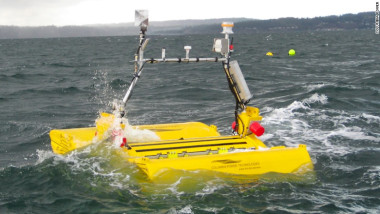 Columbia wave power.
World:
¶ The latest news from VW is that the company is now considering investing $11 billion into the development of a dedicated battery factory in Salzgitter – which would presumably support the production of the company’s previously hinted at future electric vehicle offerings. [CleanTechnica]
¶ Rongke Power, an affiliate of UniEnergy Technologies, will deploy the world’s largest battery, rated at 800 MWh. The vanadium flow battery will provide peak-shaving and enhance grid stabilization in northern China. More large batteries will no doubt be installed to support renewables. [PennEnergy]
 UniEnergy Technologies…
View original post 618 more words
June 1 Energy News
Science and Technology:
¶ If you thought the upper limit of solar cell efficiency was 32%, think again. MIT News reported on a research team that showed how a silicon solar cell could top the theoretical limit of 32%. See you later, Shockley-Queisser Limit, and don’t let the door hit you on the way out. [CleanTechnica]
 Photo via MIT News, courtesy of the researchers.
World:
¶ Solar, wind and hydropower sources were added in 2015 at the fastest rate the world has yet seen, according to the Renewables Global Status Report. Investments in renewables during the year were more than double the amount spent on new coal and gas-fired power plants. [BBC]
¶ Australia installed almost 1 GW of new solar capacity last year but that was easily eclipsed by rather cloudy nations such as the United Kingdom, which installed about four times as much, according…
View original post 620 more words
Keswick says No to New Nuclear Build 20 miles away as the crow flies

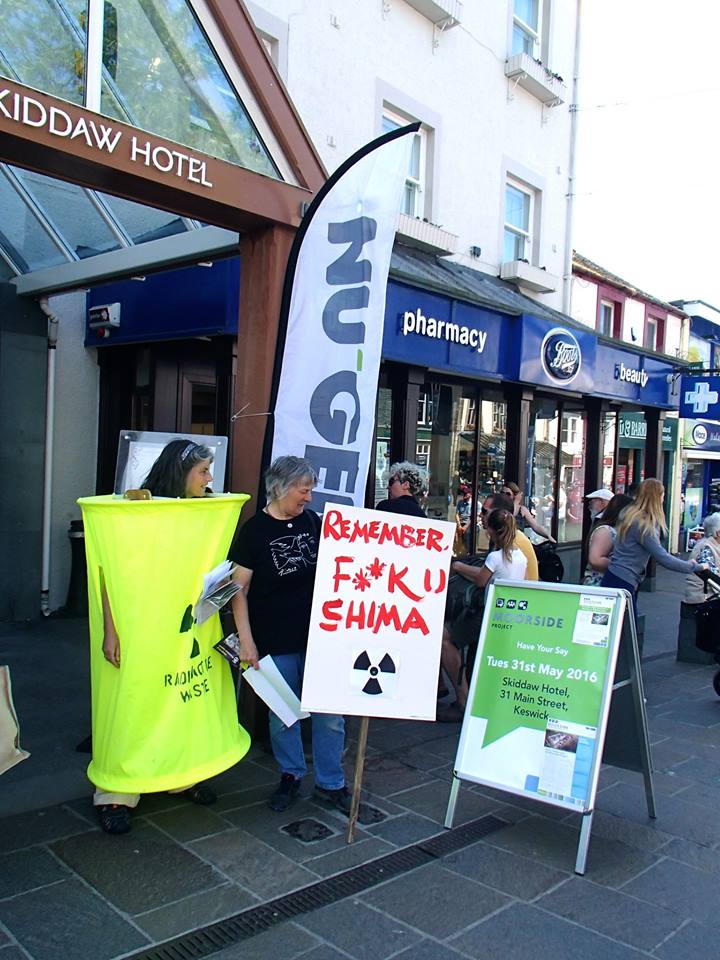
Today in Keswick 90% of the people we spoke to were opposed to new nuclear build in Cumbria. This does not tally with what NuGen are saying which is that “Cumbria wants new nuclear build.” A recent poll in the Evening Mail indicated that 85% of those voting do not want new nuclear build in Cumbria. Tourists said they would think twice about coming to Cumbria if dangerous new nuclear reactors were built here.
Dressed in nuclear waste barrels we handed out leaflets to tourists and locals outside the industry’s CONsultation day at the Skiddaw Hotel.
The only people going in to the CONsultation appeared to be the ones we had directed to it. Last year, in the very same hotel on the fourth anniversary of Fukushima (11.03.015) former US nuclear regulator Arnie Gundersen described Moorside as “Chernobyl on Steroids” Cumbria needs that like it needs a hole in…
View original post 60 more words
Why don’t you have a video-showing event of “NUCLEAR JAPAN” in your country?
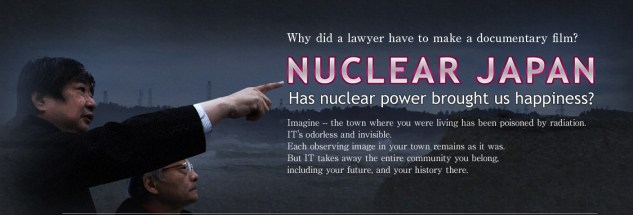
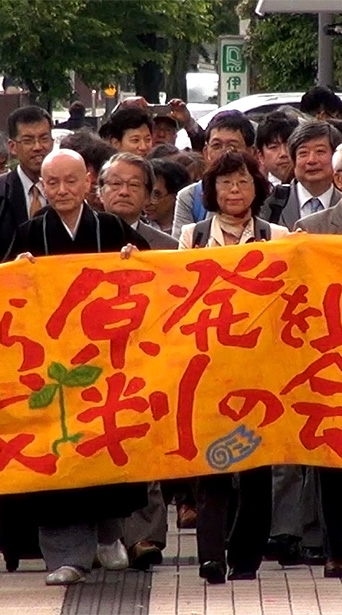
Almost in one year, this film has been shown to more than 70,000 people, and there have been held more than a thousand voluntary movie-showing events since “NUCLEAR JAPAN” was released in November 2014. It has been also presented at many courtrooms as evidence to get a bird’s-eye view of all the issues of nuclear power in order to halt nuclear power plants whole Japan.
If you are planning to have a video-showing event of “Nuclear Japan” (2h 15m), please send an application form to eiga@nihontogenpatsu.com.
It may take time for international shipping, please apply well in advance. Thank you!
SYNOPSIS
This movie strives to provide
a complete picture of nuclear power in Japan.
NUCLEAR JAPAN is a documentary film directed by a 70-year-old lawyer with remarkable record of winning very high-profile cases who elucidates the controversial issue of nuclear power industry in Japan.
On March 11th, 2011, a massive earthquake hit East Japan, which caused a catastrophic accident in Tokyo Electric Fukushima No.1 nuclear power plant. Radioactive materials were released from its four nuclear reactors, and they have contaminated the people’s land as well as ocean. Today, the effort to clean up the radioactive materials is still ongoing, only too little effect.
The film takes you back to a few hours after the earthquake on March 11th, to the shore of Namie Township, 7 kilometers north of Fukushima No.1 nuclear power plant. The local fire brigade in Namie is desperately searching for missing persons swept away by the disastrous tsunami. However, the next morning on the 12th, the question starts to rise for the possible dissemination of radioactive material. The Japanese government consequently declares the area within 10 kilometers from the Fukushima nuclear power plant as an evacuation zone. As a result, the fire brigade in Namie Township is forced to give up the search…
A month after the earthquake, the search for missing persons resumed. During the search, more than 180 bodies were found along the shore of Namie Township.
If it weren’t for the nuclear accident, most of those lives could have been saved.
There was one lawyer who had been actively voicing the absurdity and danger of Japanese nuclear power – Hiroyuki Kawai. Kawai has been fighting in many legal battles to halt nuclear power plants in Japan for over 20 years. Ever since the crisis at Fukushima No.1 power plant, his fight has been fueled by even more drive and dedication.
Then, Kawai had a thought. What if he makes a movie about this issue? If he wants the public to understand the complicated issues of nuclear power, literature has its limits. Also, all the coverage by Japanese media has been biased. Only by providing the visual and giving the objective view, he can communicate the true absurdity and inhumanity of the nuclear power in Japan.
With the help of another lawyer Yuichi Kaido, Kawai’s old ally who also has been fighting in nuclear power plant lawsuits, Kawai completed this documentary film, NUCLEAR JAPAN.
The film not only features the interviews of many experts, a number of facts and evidences, but it also brings to light the immense pain of the people have been suffering from the nuclear crisis. NUCLEAR JAPAN is now being presented as evidence in many lawsuits to halt nuclear power plants all over Japan.
This film is the ultimate nuclear power documentary that takes you on a journey to grasp all the issues of nuclear power in a factual, objective way, and eventually, a journey to find a hope.
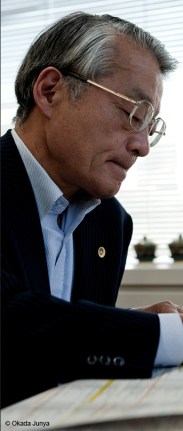
DIRECTOR
Protecting the environment of the planet
as an advocate for future generations;
especially from nuclear disasters
is Kawai’s very purpose.
Profile
Hiroyuki Kawai, a lawyer and a filmmaker, was born in Northeast China, Manchuria, in 1944. Kawai graduated from the University of Tokyo, Faculty of Law in 1968, and has been practicing law since 1970. In 2014, he made a directorial debut with a documentary film NUCLEAR JAPAN.
Today he holds various titles including; President of Sakura Kyoudo Law Offices, Chairman of The Support Group for Japanese War Orphans Left in China Obtaining Japanese Nationality, Head Director of Philippine Nikkei-jin Legal Support Center, and Representative Auditor of Institute of Sustainable Energy Policies.
Kawai is also a representative of National Federation of Lawyers Against Nuclear Power as well as The Complainants for Fukushima Nuclear Disaster Criminal Prosecution legal team. He is the lead lawyer of the legal team for Hamaoka Nuclear Power Plant Suspension Lawsuit and Tokyo Electric Executives Criminal Responsibility Lawsuit. He is also a part of Ohi, Takahama, Sendai Nuclear Power Plants Provisional Suspension Lawsuit legal team.
His motto is–
If you give 100%, you can achieve almost anything.
If you give 100%, you will find anything enjoyable.
If you give 100%, somebody will offer you their hand.
DIRECTOR’S
STATEMENT
“To share the idea of nuclear zero nationwide,
we need a movie.”
Kawai became involved with lawsuits against nuclear power plants from 1994.
The first suit concerned use of MOX fuel in the Fukushima No.1 Reactor 3 plant that exploded in March 2011.
This suit failed, as have many more since that time.
Ever a shrewd lawyer, Kawai was losing his passion to continue such lawsuits just before the Fukushima accident.
The Great East Japan Earthquake rekindled this passion and Kawai has said “I will never give it up. I will continue lawsuits against nuclear plants until nuclear power is eradicated from Japan”.
As part of this process, Kawai decided to make a movie.
Explaining this, he said “in a democracy, a fair legal process is obviously important to protect our rights, especially for minority issues.
Lawsuits in a democracy functions as safety valves.
Justice is justice. I shall stand up to protect life and Japan in courts, even if I would be alone.
But to share the idea of nuclear zero nationwide, we need a movie”.
Nuclear accidents strike at the very foundation of our lives.
Economics, culture, art, education, justice, welfare,
frugal and fancy living alike – everything is turned on its head.
Ignorance of nuclear power’s dangers renders every
enterprise meaningless, even irresponsible.
We have come to realize this.
What matters now is what we will do about it.
Hiroyuki Kawai
Woman gives up electricity and goes ‘off grid’ for 4 years

Chikako Fujii says she uses a human-powered dynamo remodeled from a bike-type training machine to generate power in emergencies
Chikako Fujii used to leave the TV on all the time, but since the Fukushima nuclear disaster inspired her to go “off grid” nearly four years ago, she has consumed literally no energy supplied from her regional power company.
Fujii, 55, a textile dyeing artist, uses a tiny amount of electricity generated primarily by solar panels set up on her veranda that measure a total of just 1.6 square meters.
The lifestyle choice means that Fujii cannot power an air conditioner, a refrigerator or a TV with such a small quantity of energy, but those things don’t concern her.
“I enjoy working out how to lead a life without using electricity,” she said.
A resident of Kunitachi, western Tokyo, Fujii terminated her contract with Tokyo Electric Power Co. in September 2012, after rolling blackouts were implemented in the wake of the March 2011 Great East Japan Earthquake and tsunami, which triggered a triple meltdown at the Fukushima No. 1 nuclear power plant.
Fujii said that before the disaster struck, she habitually left the TV on so that she could check the time whenever she wanted.
But when she stopped using her home appliances one by one, she found her electricity bill could be reduced.
While she paid more than 4,000 yen ($36) per month for electricity before the disaster, the figure gradually dropped to around 2,000 yen. When she finally unplugged the refrigerator, which requires much power, the bill reached 800 yen.
“I thought I might be able to live without relying on the power company, and decided to start an off-grid life for the fun of it,” Fujii said.
The solar panels installed on the veranda have a power production capacity of 260 watts and can generate more than 1 kilowatt-hour of power on a typical sunny day–enough to operate a washing machine for three hours to dye fabrics with plant-derived materials.
However, when cloudy weather continues for a week during the June rainy season or due to a typhoon, the electricity stored in the battery dries up. When that happens, Fujii uses a pedal-operated sewing machine and an old charcoal-powered iron for her work instead of electric ones.
One night, Fujii was asked by a business partner to send a document by e-mail on short notice.
She pedaled hard a human-powered dynamo remodeled from a bike-type training machine to generate electricity to use her computer.
As Fujii cannot use an air conditioner, she made small holes in a plastic bag containing water and hung it above the veranda to sprinkle water automatically to cool the surrounding air.
In lieu of an electric kettle, she painted plastic bottles black and exposed them to sunlight to heat the water inside.
In December last year, Fujii also introduced a handmade heater made out of a used tempura oil-based lamp and a flowerpot put over the lamp upside down. According to Fujii, 20 milliliters of oil can keep the flowerpot hot for three to four hours.
She said she daily consumes only 500 to 800 watt-hours of power at home, about one-12th that for an ordinary household.
“I always live while being conscious of the weather,” Fujii said. “For example, when I wake up to find it is sunny, I think I should use the washer today. Thinking this way is fun for me.”

The water heater made of glass tubes can increase the water temperature to 85 degrees in two hours even during winter if it is exposed to sufficient sunlight.

A handmade evaporation heat-based cooler designed to remove heat from flowerpots when water evaporates
http://www.asahi.com/ajw/articles/AJ201606010003.html
1 This Month

Chernobyl: The Lost Tapes – A good documentary on Chernobyl on SBS available On Demand for the next 3 weeks– https://www.sbs.com.au/ondemand/tv-program/chernobyl-the-lost-tapes/2352741955560

of the week–London Campaign for Nuclear Disarmament

Tell the Ukrainian Government to Drop Prosecution of Peace Activist Yurii Sheliazhenko
To see nuclear-related stories in greater depth and intensity – go to https://nuclearinformation.wordpress.com
-
Archives
- April 2026 (189)
- March 2026 (251)
- February 2026 (268)
- January 2026 (308)
- December 2025 (358)
- November 2025 (359)
- October 2025 (376)
- September 2025 (257)
- August 2025 (319)
- July 2025 (230)
- June 2025 (348)
- May 2025 (261)
-
Categories
- 1
- 1 NUCLEAR ISSUES
- business and costs
- climate change
- culture and arts
- ENERGY
- environment
- health
- history
- indigenous issues
- Legal
- marketing of nuclear
- media
- opposition to nuclear
- PERSONAL STORIES
- politics
- politics international
- Religion and ethics
- safety
- secrets,lies and civil liberties
- spinbuster
- technology
- Uranium
- wastes
- weapons and war
- Women
- 2 WORLD
- ACTION
- AFRICA
- Atrocities
- AUSTRALIA
- Christina's notes
- Christina's themes
- culture and arts
- Events
- Fuk 2022
- Fuk 2023
- Fukushima 2017
- Fukushima 2018
- fukushima 2019
- Fukushima 2020
- Fukushima 2021
- general
- global warming
- Humour (God we need it)
- Nuclear
- RARE EARTHS
- Reference
- resources – print
- Resources -audiovicual
- Weekly Newsletter
- World
- World Nuclear
- YouTube
-
RSS
Entries RSS
Comments RSS
 nuclear-news