Japan’s Nuclear Holy Grail Slips Away With Operator Elusive
Japan is missing its own deadline to find a new operator for a prototype nuclear power program that’s failed to succeed in the two decades since it was built, threatening the resource-poor country’s support of a technology other nations have abandoned.
The country’s nuclear regulator demanded in November a replacement for the government-backed Japan Atomic Energy Agency be found within six months for the Monju fast-breeder reactor. Monju, which has functioned for less than a year since its completion more than 20 years ago, now faces the possibility of being scrapped.
The so-called fast-breeder reactor — a cornerstone of its atomic energy strategy dating back to the 1950s — uses spent nuclear fuel from other plants and is designed to produce more atomic fuel that it consumes. The reactor, named after the Buddhist deity of wisdom, has cost the nation more than 1 trillion yen ($9 billion) and has barely operated since it first generated electricity in 1995.
“The potential closure of Monju would be a major blow not just to the fast-breeder community in Japan, but also those supporting reprocessing of spent fuel,” M. V. Ramana, a professor at Princeton University’s Nuclear Futures Laboratory, said by e-mail. “I wonder if the government will allow Monju to be shut down? I would expect that they will simply create a new agency to oversee Monju.”
1950s Strategy
Monju is currently operated by the JAEA, a quasi-government organization that is under the Ministry of Education, Culture, Sports, Science and Technology. JAEA declined to comment. The nation’s nuclear watchdog, the Nuclear Regulation Authority, didn’t respond to e-mailed questions regarding the status of Monju.
“We don’t have plans to decommission the reactor,” said Hiroki Takaya, director of the ministry’s International Nuclear and Fusion Energy Affairs Division, which oversees Monju. “We are exploring many different options for who will operate the reactor — either a new entity or an existing company.”
The NRA said in November the science ministry must find a new operator or consider closure. The ministry drafted a set of criteria for a new operator, but have yet to name a replacement, it said on May 27. The ministry hopes to find an operator as soon as possible, but hasn’t set a concrete deadline.
“These turn out to be very expensive technologies to build,” Allison MacFarlane, a former chairman of the U.S. Nuclear Regulatory Commission, said by e-mail. “Many countries have tried over and over. What is truly impressive is that these many governments continue to fund a demonstrably failed technology.”
While Japan’s science ministry seeks a new operator of Monju, no power utility has stepped forward.
“Monju’s reactor design is quite different from a normal reactor, and utilities don’t have the expertise to handle it,” Makoto Yagi, chairman of the Federation of Electric Power Companies of Japan, told reporters in May. “Monju is currently in a research and development phase by the government, it isn’t the matter for a private company.”
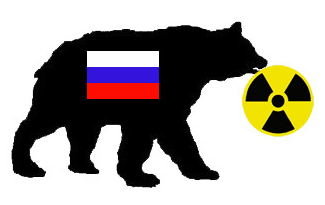
Russia, China, marketing nuclear power to – well, just about everybody

 Ghana explores nuclear power opportunities Business News ,
  30 May 2016 Source: Tv3network.com Ghana is among these emerging nuclear energy countries, as the country strives to meet the increasing demand of energy for domestic and industrial use. State-owned nuclear companies in Russia and China have taken the lead in offering nuclear power plants to emerging countries, usually with finance and fuel services.
Russia’s State Atomic Energy Corporation (ROSATOM) hosts the annual ATOMEXPO International Forum as a major exhibition and business platform for conducting meetings and negotiations between the worldwide leaders of the nuclear power industry.
The 2016 edition, holding in Moscow from May 30–June 2, provides leaders of nuclear power industry and nuclear power engineering with an opportunity to publically define the place and role of nuclear generation in the 21st century energy balance.
The Forum also promotes international cooperation between the Russian Federation and the countries of Latin America, Pacific Asia, Africa, Central and Eastern Europe in the field of nuclear power, and to discuss Russia’s proposal on developing national energy programs…….
Nuclear energy is growing globally with nearly 10 GW of new nuclear capacity supplying electricity in 2015 – more than double the average capacity connected each year in the previous decade.
Though there are long term prospects for nuclear, experts say the emerging nuclear energy countries are not expected to contribute very much to the expansion of nuclear capacity in the foreseeable future. http://www.ghanaweb.com/GhanaHomePage/business/Ghana-explores-nuclear-power-opportunities-443245
Russia marketing nuclear fuel to USA !!
Will The Russians Become Fuel Supplier To U.S. Nuclear Power Plants? http://www.forbes.com/sites/kenrapoza/2016/05/31/will-the-russians-become-fuel-supplier-to-u-s-nuclear-power-plants/#413acf8f2638 Kenneth Rapoza , 31 May 16,
It’s not unprecedented. While the U.S. does not currently use Russian technology at any of its nuclear power stations, a deal between Global Nuclear Fuel Americas and TVEL would be the first to make it happen. Global Nuclear Fuel-Americas is a GE-led joint venture that includes its main nuclear power plant partner Hitachi and rival Toshiba, which owns Westinghouse.
Under the agreement proposed May 24, GE partners and TVEL will “work together toward the licensing, marketing and fabrication of fuel” for U.S. pressurized water reactors (PWRs). Global Nuclear Fuel and TVEL would create a strategic alliance with the purpose of introducing the Russian fuel rods into the U.S. market.
“We believe strongly in the TVEL technology,” said Jonathan Allen, a spokesman for GE Hitachi.
TVEL’s latest nuclear fuel assembly technology is for use in Westinghouse-designed reactors. There are currently 35 of these reactors operating in the U.S., but none of them are allowed to use TVEL’s technology because it has not yet been approved U.S. nuclear industry regulators. The assembly rod, known as the TVS-K design, has been used for many years in Rusatom’s VVER-1000 nuclear power plants at 78 nuclear power reactors in 15 countries, most of them in the former Soviet bloc.
“This (deal gives) additional diversification of fuel supplies to U.S. reactors,” said Oleg Grigoryev, Vice President of Commerce and International Cooperation at TVEL.
Russia’s entrance into the U.S. market comes at a time when its partner in the deal, Toshiba, is also trying to capture some of TVEL’s market share in Finland, Czech Republic, Bulgaria and Ukraine. Washington has actually lent support to Westinghouse in sales pitches to governments looking to move out of Russia’s energy orbit. A move to bring Russian technology to the U.S. could also be seen as a fig leaf to Moscow, which has been locked in an energy security battle for Europe over the last year.
Opening the U.S. market to Russian tech would be the same as the traditional Russian markets, including Ukraine, opening up to Westinghouse.
Fuel assembly rods are essentially the batteries of nuclear power plants. They hold the uranium that goes into the reactor that generates electricity. Westinghouse is TVEL’s biggest competitor. But Chinese developers, working close with Westinghouse and Toshiba in China in a tech sharing deal, are also moving up market and could become rival suppliers at some point in the future.
TVEL has a roughly 17% global market share of fuel assemblies, with Westinghouse and Areva competing for first place with close to 30%.
USA trying to beat Russia in selling nukes to India
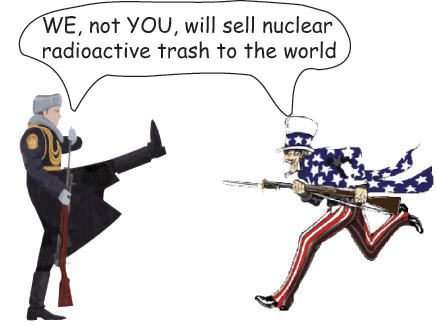 Westinghouse to get new site for Indian nuclear plant – officials, Reuters NEW DELHI | BY DOUGLAS BUSVINE AND RUPAM JAIN , 31 May 16 Toshiba Corp’s (6502.T) Westinghouse Electric will relocate a planned project to build six nuclear reactors in India, said officials, bringing the first deal stemming from a U.S.-India civil nuclear accord struck over a decade ago closer to reality.
The six AP-1000 reactors would be built in the southern state of Andhra Pradesh, after the original site proposed for the multi-billion-dollar project, in Prime Minister Narendra Modi’s home state of Gujarat, faced local opposition.
The breakthrough comes ahead of a June 7-8 visit by Modi to Washington, where he will be hosted by President Barack Obama for a final summit before the U.S. presidential election in November, and will address both houses of Congress.
U.S. lawmakers ratified the civil nuclear accord three years after it was struck in 2005, as part of an attempt to deepen the strategic relationship with India, but have expressed growing dismay over its failure to yield follow-on deals for U.S.-based reactor makers like Westinghouse…….
Analysts say resolving the land issue is a crucial step, but complex issues remain, including project financing and reaching a civil nuclear pact with Japan, where Westinghouse parent Toshiba is based…..
Russia’s Rosatom operates two reactors at Kudankulam, in Tamil Nadu, while France’s EDF (EDF.PA) signed a preliminary deal with the state-owned Nuclear Power Corporation of India (NPCIL) [NPCIL.UL] in January to build six reactors at Jaitapur, Maharashtra…..
Two sources, requesting anonymity due to the sensitivity of the matter, confirmed that the site was being acquired for Westinghouse, which plans to build six AP-1000 pressurized water reactors, each with a design capacity of around 1,100 megawatts.
Westinghouse did not respond to requests for comment, while senior executives at NPCIL were not available ………http://www.reuters.com/article/us-india-westinghouse-idUSKCN0YM0L2
Russia flogging nuclear to Africa
More African countries interested in nuclear energy: Russia, SABC News,31 May 2016 Amina Accram, Moscow “…….8th annual ATOM EXPO and conference currently underway in Moscow Russia…….. The Nigerian government aims to electrify at least eighty percent of its population by the year 2035. It is now investing in nuclear energy to meet this target. …General Director Atomic Energy Commission in Nigeria Frannklin Osaisai says Nigeria is seeking to diversify its economy by increasing agriculture output. It will use nuclear technology to advance this. …….
Russia flogging nuclear to Nigeria
Rosatom to prepare agreement on nuclear power plant project in Nigeria http://tass.ru/en/economy/879335 May 31, MOSCOW, Russian state nuclear corporation Rosatom will prepare an agreement on construction of a nuclear power plant in Nigeria, first deputy head of Russian state owned nuclear corporation Rosatom Kirill Komarov said at the Atomexpo 2016 forum.
“We established a joint coordination committee. We have already held the first meeting of the committee and plan to hold a second meeting this summer,” he said, adding that he hopes the sides will prepare an agreement on the development of the project, he said.
According to him, this document will determine further steps on implementation of the project on construction of nuclear power plants in Nigeria.
Russia flogging nukes to Bolivia
Agreement on Bolivia’s nuclear research center may be signed at SPIEF MOSCOW, May 31. /TASS/. An agreement on construction of a nuclear research center in Bolivia may be signed at the Petersburg International Economic Forum due to be held in June 2016, Kirill Komarov, the first deputy CEO of Russia’s state nuclear corporation Rosatom, said on Tuesday.
“We are set for very serious work. Soon, we plan to sign an agreement on the project implementation, to sign an agreement on the site examination,” he said. “It is not ruled out that some of our documents will be signed in a span of two weeks, at the Petersburg Economic Forum.”…….
Russia and Bolivia signed intergovernmental agreements on cooperation in the area of peaceful use of nuclear energy and on cooperation in the construction of a nuclear research and technology center on March 6…….http://tass.ru/en/economy/879346
Endless nuclear power – America’s foolish dream
America’s long fever dream of boundless nuclear power: What’s a country to do? Environmental Leader, 31 May 16, America’s relationship with civilian nuclear power is curious: it’s like the story of the aging playboy who can’t let go of his alluring but high-maintenance showgirl. The two love each other, dreaming of what might have been and what might be. They can’t quite make the relationship work, but can’t let go either……..
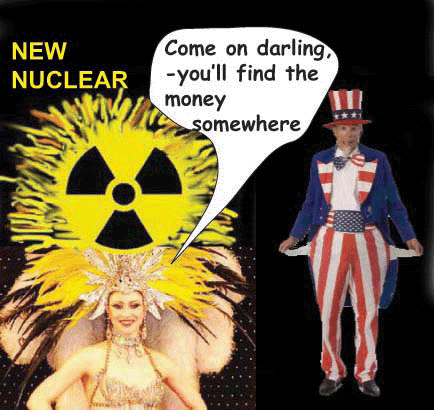
Next generation nuclear power might take many forms. Those behind the technologies they are working on – the small, modular, passively safe nuclear reactor; the traveling wave rector Bill Gates and others are backing, and other advanced concepts, which a Senate Energy and Natural Resources Committee hearing learned about from experts last week – seem aware they may never see the fruit of their labors in their lifetime. They talk of initial developments by 2030 or 2035 and beyond.
They talk of public-private partnerships aimed at solving supply chain problems, of resolving technical and licensing challenges, and addressing technical and economic questions at the demonstration phase. After 60-some years of commercial nuclear power, we’re still trying to profit from what we’ve learned and determine what yet we need to do. It’s conceptual, patient work. It seems we’re willing to keep the industry alive, but just barely. DOE’s Gateway for Accelerated Innovation in Nuclear (GAIN) initiative will be funded at a modest $80 million over several years……
Ontario pouring good money after bad in its failing nuclear dream
 Ontario’s misguided love affair with nuclear power, The Star, 31 May 16 Instead of seeing principled leadership in Ontario, we are seeing the opposite – a stealthy effort to keep an old and uneconomic nuclear dinosaur on life support. By JACK GIBBONS
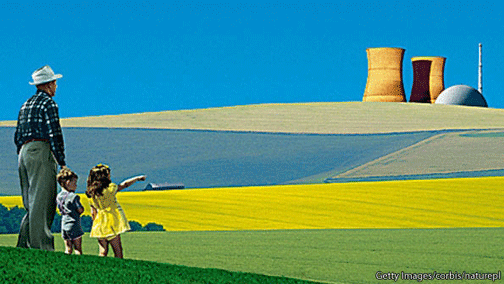
Construction on Pickering began in the 1960s and its first reactors were powered up in 1971 – the same year Led Zepplin released Stairway to Heaven. Despite 45 years of operation, its owner, Ontario Power Generation (OPG), only recently decided to see if the millions of people living around the plant are aware of its plans for what they should do in the event of an emergency at the plant. It quickly found out that a) local residents had no clue what they were supposed to do; and b) they weren’t buying OPG’s plan to “shelter in place” (stay put) during a high-level emergency.
No other nuclear plant in North America even comes close to having as many people on its doorstep as the Pickering Nuclear Generating Station. …….
Pickering is already sucking up $900 million per year in out-of-market subsidies for its power. As one of the highest-cost nuclear plants on the continent, keeping Pickering running means higher electricity rates.
And it’s not like we need its power: In 2015, Ontario exported more power than Pickering produced – and lost money doing it.
So why after promising to close Pickering by 2020 at the latest are the Liberals now working to keep it limping along? It could be like your Buick: You bit the bullet on that costly new transmission and just can’t admit it was a big mistake. Repairs to Pickering’s reactors in the late 1990s went massively over budget and were years late in being completed.
The truth is, however, that “fixing” Pickering is like fixing your aging Buick – it is an ongoing and costly battle. One reactor has recently been offline for months for repairs and breakdowns and “incidents” are regular occurrences at North America’s fourth oldest nuclear station. Pickering was the site of the worst loss of coolant accident at a Canadian reactor, during which workers had to siphon heavy water off the floor of the containment building and back into the reactor in 1984.
Designed in the 1950s and ‘60s, Pickering is an unusual nuclear facility: It has multiple reactors sharing a single containment building and has no secondary fast shutdown system. Separate containment for individual reactors and redundant fast shutdown systems have been standard issue for most nuclear plants for years.
The real reason the government wants to keep Pickering going is that our energy planners remain some of the last people on the planet who still believe that nuclear energy is the best way to meet our need for a brightly lit home or a cold drink. Only France outranks us for dependence on nuclear energy……
The problem is, we are all going to pay the price for their love affair with this outdated technology. https://www.thestar.com/opinion/commentary/2016/05/30/ontarios-misguided-love-affair-with-nuclear-power.html
Monju: the failing nuclear reprocessing dream
Nuclear Holy Grail Slips Away From Japan With Operator Elusive http://www.bloomberg.com/news/articles/2016-05-31/nuclear-holy-grail-slips-away-from-japan-with-operator-elusive Stephen Stapczynski sstapczynski Emi Urabe
-
Japan to pick a new operator for Monju fast-breeder reactor
-
The prototype plant has cost more than $9 billion amid delays
Japan is missing its own deadline to find a new operator for a prototype nuclear power program that’s failed to succeed in the two decades since it was built, threatening the resource-poor country’s support of a technology other nations have abandoned.
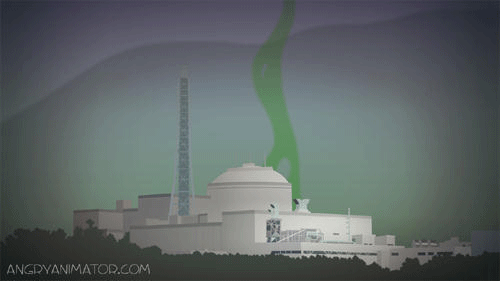
The country’s nuclear regulator demanded in November a replacement for the government-backed Japan Atomic Energy Agency be found within six months for the Monju fast-breeder reactor. Monju, which has functioned for less than a year since its completion more than 20 years ago, now faces the possibility of being scrapped.
The so-called fast-breeder reactor — a cornerstone of its atomic energy strategy dating back to the 1950s — uses spent nuclear fuel from other plants and is designed to produce more atomic fuel that it consumes. The reactor, named after the Buddhist deity of wisdom, has cost the nation more than 1 trillion yen ($9 billion) and has barely operated since it first generated electricity in 1995.
1950s Strategy
Monju is currently operated by the JAEA, a quasi-government organization that is under the Ministry of Education, Culture, Sports, Science and Technology. JAEA declined to comment. The nation’s nuclear watchdog, the Nuclear Regulation Authority, didn’t respond to e-mailed questions regarding the status of Monju.
“We don’t have plans to decommission the reactor,” said Hiroki Takaya, director of the ministry’s International Nuclear and Fusion Energy Affairs Division, which oversees Monju. “We are exploring many different options for who will operate the reactor — either a new entity or an existing company.”
The NRA said in November the science ministry must find a new operator or consider closure. The ministry drafted a set of criteria for a new operator, but have yet to name a replacement, it said on May 27. The ministry hopes to find an operator as soon as possible, but hasn’t set a concrete deadline.
You think the oil industry’s in trouble? Try nuclear!
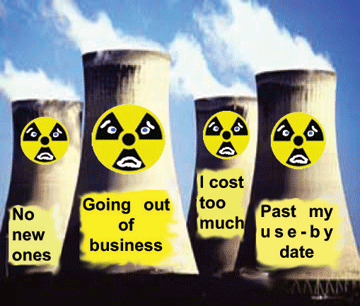 Nuclear power in more trouble than oil Utilities shutting down plants earlier than expected Houston Chronicle , By Chris Tomlinson , 31 May 16 If you think folks in the oil and gas business have it tough, talk to someone in the nuclear power industry where 20 percent of the reactors operating today may shut down early.
The last time the United States opened a new nuclear reactor was 30 years ago, when state commissions set the price for electricity and a generator could rely on steady, reliable profits for the lifetime of the plant. But since then, states have deregulated electricity markets and have forced generators to compete to sell the cheapest electricity by the 15 minute interval.
That’s a problem a nuclear power plant, which requires a huge investment to build and a huge amount of cash to decommission. The electricity may be marginally cheap, but what experts call the levelized cost of electricity that includes all the expenses is actually quite high.
That’s why the Nuclear Energy Institute reports that 15 to 20 of the nation’s 99 commercial reactors are at risk of premature closure in the coming years. If they have to compete solely on the spot-market price for electricity, keeping them going doesn’t make economic sense…….http://www.houstonchronicle.com/business/outside-the-boardroom/article/Nuclear-power-in-more-trouble-than-oil-7943174.php?t=2d6e26d409&cmpid=twitter-premium
Nuclear stations more at risk than Regulators say

 Undercovered: New Report Says Nuclear Power Plants More Vulnerable Than Regulators Said, Mediaite, by Sam Reisman May 31st, 2016
Welcome to Undercovered: our new daily feature bringing attention to excellent reporting and stories we feel deserve a larger audience.
Nuclear power plants in the United States are more vulnerable to the threats of natural disaster or terrorism than federal regulators have said, according to study released May 20 by the National Academies of Sciences, Engineering, and Medicine.
The Academies’ study is something of a rebuke to a 2014 study by the Nuclear Regulatory Commission, a government agency that oversees the nuclear power industry. According to the chair of Academies board, the NRC’s study neglected to adequately evaluate the risks posed by terrorism or sabotage to nuclear power plants, specifically to the aboveground pools that hold the spent nuclear fuel. There are 96 such pools in the U.S. spread out across 30 states………http://www.mediaite.com/online/undercovered-new-report-says-nuclear-power-plants-more-vulnerable-than-regulators-said/
Ukraine Cuts Russia Out Of Plans To Build Nuclear Reactors,
 Daily Caller 31 May 16 ANDREW FOLLETT The president of Ukraine’s state-controlled nuclear power company announced Monday that the country is terminating an agreement with Russia to complete the construction of two nuclear reactors.
The president told the satellite television channel Ukraine Today that the company was looking for new technical and economic advice from other countries to help finish the reactors. The reactors are currently 75 and 28 percent complete, and the company believes both will be completed by 2020.
The project was been delayed several times by both Russia and Ukraine due to political concerns and Ukraine’s parliament voted to terminate the agreement with Russia last September. The country’s Ministry of Energy held off of an outright cancellation as Russia was providing the financing for the reactors. The reactors will likely be finished by American companies such as Westinghouse, which previously bid on a contract to finish the reactor……..
hackers linked to Russia attacked the country’s power grid last December, according to a February statement by Ukraine’s energy ministry. The massive hacking was the first known cyber-attack to take down an electric grid and one of relatively few attacks which damaged physical infrastructure. It left approximately 700,000 homes without power for several hours last December, mostly in the Ivano-Frankivsk region of Ukraine.
The attack was probably caused by a well-engineered malware called BlackEnergy that disconnected electrical substations from the main power grid. A similar malware was used against Ukrainian media organizations during the 2015 local elections. The American Department of Homeland Security twice warned American utilities about the type of malware in December 2014 and again in June 2015. http://dailycaller.com/2016/05/31/ukraine-cuts-russia-out-of-plans-to-build-nuclear-reactors/
Probability of a big nuclear accident within the next 10 years
The Chances of Another Chernobyl Before 2050? 50%, Say Safety Specialists
And there’s a 50:50 chance of a Three Mile Island-scale disaster in the next 10 years, according to the largest statistical analysis of nuclear accidents ever undertaken. MIT Technology Review April 17, 2015 Given that most countries with nuclear power intend to keep their reactors running and that many new reactors are planned, an important goal is to better understand the nature of risk in the nuclear industry. What, for example, is the likelihood of another Chernobyl in the next few years?
Today, we get an answer thanks to the work of Spencer Wheatley and Didier Sornette at ETH Zurich in Switzerland and Benjamin Sovacool at Aarhus University in Denmark. These guys have compiled the most comprehensive list of nuclear accidents ever created and used it to calculate the likelihood of other accidents in future.
Their worrying conclusion is that the chances are 50:50 that a major nuclear disaster will occur somewhere in the world before 2050. “There is a 50 per cent chance that a Chernobyl event (or larger) occurs in the next 27 years,” they conclude.

The nuclear industry has long been criticised for its over-confident attitude to risk. But truly independent analyses are few and far between, partly because much of the data on accidents is compiled by the nuclear industry itself, which is reluctant to share it.
The International Atomic Energy Agency rates accidents using a system called the International Nuclear Event Scale, which is related to the amount of radiation released. However, the Agency does not publish a historical database of these accidents, probably because it has a dual role of both regulating the nuclear industry and promoting it.
So it has fallen to others to compile lists of accidents, the most comprehensive of which contains details of 102 events. (By comparison there are 72 events that have a rating on the International Nuclear Event Scale.)
Wheatley and co have significantly increased this number. They refrain from using the data from the International Atomic Energy Agency and compile their own list instead……..
The resulting list ranks 174 accidents between 1946 and 2014 and includes their date, location, the monetary cost in U.S. dollars, and the rating where available on the International Nuclear Event Scale and on another well-known scale called the Nuclear Accident Magnitude Scale.
The top five accidents ranked by monetary cost are the Fukushima accident in March 2011, the Chernobyl explosion in April 1986, a fire at the Tsuruga nuclear plant in December 1995, a fire at Rocky Flats nuclear weapons plant in September 1957 and an incident in March 1955 at Sellafield, then known as Windscale, two years before the infamous fire at the facility. Indeed, Sellafield appears five times in the list of the top 15 of most expensive nuclear accidents.
The new database contains 75 percent more entries than the most comprehensive list up until now. And this extra data significantly improves the kind of statistical analysis that can be done.
Wheatley and co take full advantage of this. They say for a start that the new database reveals just how poor the International Nuclear Event Scale actually is. For that to be consistent, the Fukushima disaster would need to be rated at 10 or 11, rather than at the current maximum level of 7, they say…….
These kinds of large unexpected events are known as dragon king events and particularly difficult to analyse because they follow this different distribution, have unforeseen causes, and are few in number.
Nevertheless, Wheatley and co say their data suggests that the nuclear industry remains vulnerable dragon king events. “There is a 50% chance that a Fukushima event (or larger) occurs in the next 50 years,” they say……
The team calculate that a Chernobyl-scale event, the most severe in terms of radiation release, is as likely as not in the next 27 years. And they say a Three Mile Island event in the next 10 years has a probability of 50 percent……
Wheatley and co’s work suggests that a Chernobyl-scale accident is worryingly likely to occur within the working lifetime of the reactors now being built. And when that happens, a once obscure place will enter the lexicon as a synonym for catastrophe, just like Chernobyl, Windscale and Fukushima.
These risks will have to be carefully weighed against the advantages. The question for engineers, policy makers and the general public alike is whether that risk is worth taking, given what’s at stake.
Ref: arxiv.org/abs/1504.02380 : Of Disasters and Dragon Kings: A Statistical Analysis of Nuclear Power Incidents & Accidents https://www.technologyreview.com/s/536886/the-chances-of-another-chernobyl-before-2050-50-say-safety-specialists/
Once more with fervour – nuclear marketing: theme for June 2016
The nuclear lobby is playing a high stakes gamble – marketing nuclear power with renewed fervour. It’s a gamble, because they’ve gotta sell it off fast, before the next radioactive catastrophe.
INTERNAL Nuclear Marketing is going on like crazy, especially in the USA, They’re still toting nuclear as a climate change action – a patently false story. They push that for Big Nuclear, and then they push a new set of lies for New Little Nuclear
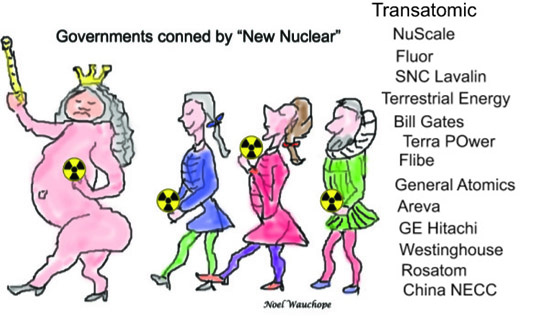
EXTERNAL Nuclear marketing. Any country that already has this unsafe, uneconomic, trash-producing technology is mad keen to salvage the drastic financial nuclear situation – by flogging their nuclear technology off to other countries.

1 This Month

Chernobyl: The Lost Tapes – A good documentary on Chernobyl on SBS available On Demand for the next 3 weeks– https://www.sbs.com.au/ondemand/tv-program/chernobyl-the-lost-tapes/2352741955560

of the week–London Campaign for Nuclear Disarmament

Tell the Ukrainian Government to Drop Prosecution of Peace Activist Yurii Sheliazhenko
To see nuclear-related stories in greater depth and intensity – go to https://nuclearinformation.wordpress.com
-
Archives
- April 2026 (189)
- March 2026 (251)
- February 2026 (268)
- January 2026 (308)
- December 2025 (358)
- November 2025 (359)
- October 2025 (376)
- September 2025 (257)
- August 2025 (319)
- July 2025 (230)
- June 2025 (348)
- May 2025 (261)
-
Categories
- 1
- 1 NUCLEAR ISSUES
- business and costs
- climate change
- culture and arts
- ENERGY
- environment
- health
- history
- indigenous issues
- Legal
- marketing of nuclear
- media
- opposition to nuclear
- PERSONAL STORIES
- politics
- politics international
- Religion and ethics
- safety
- secrets,lies and civil liberties
- spinbuster
- technology
- Uranium
- wastes
- weapons and war
- Women
- 2 WORLD
- ACTION
- AFRICA
- Atrocities
- AUSTRALIA
- Christina's notes
- Christina's themes
- culture and arts
- Events
- Fuk 2022
- Fuk 2023
- Fukushima 2017
- Fukushima 2018
- fukushima 2019
- Fukushima 2020
- Fukushima 2021
- general
- global warming
- Humour (God we need it)
- Nuclear
- RARE EARTHS
- Reference
- resources – print
- Resources -audiovicual
- Weekly Newsletter
- World
- World Nuclear
- YouTube
-
RSS
Entries RSS
Comments RSS
 nuclear-news