1MDB Unit Bought by China Nuclear Firm Was Distressed, Auditor Says
1MDB Unit Bought by China Nuclear Firm Was Distressed, Auditor Says China General Nuclear Power bought Edra Global Energy from debt-laden 1MDB last year, WSJ, By YANTOULTRA NGUI May 26, 2016
KUALA LUMPUR, Malaysia—An audit of a key energy group sold by troubled state investment fund 1Malaysia Development Bhd. to a Chinese state-owned nuclear-power company flagged deep uncertainty over the company’s viability.
Notes from auditor Deloitte in the 140-page financial accounts of Edra Global Energy Bhd. for the year ended March 31, 2015, said the audit found “an existence of a material uncertainty which may cast significant doubt about the group’s and company’s ability to continue as a going concern.”
The auditor’s notes, reviewed by The Wall Street Journal, are part of the most detailed account of Edra’s finances at the time that China General Nuclear Power Corp.purchased the firm for 9.83 billion ringgit ($2.4 billion) last November as the fund, known as 1MDB, was struggling to meet its debt obligations……..http://www.wsj.com/articles/1mdb-unit-bought-by-china-nuclear-firm-was-distressed-auditor-says-1464251503
Tottering Totten and the Coming Multi-Meter Sea Level Rise

A new scientific study has found that the Totten Glacier is fundamentally unstable and could significantly contribute to a possible multi-meter sea level rise this Century under mid-range and worst case warming scenarios.
*****
408 Parts per million CO2. 490 parts per million CO2e. This is the amount of heat-trapping CO2 and total CO2 equivalent for all heat-trapping gasses now in the Earth’s atmosphere. Two measures representing numerous grave potential consequences.
We’re Locking in 120-190 Feet of Sea Level Rise Long Term
Looking at the first number — 408 parts per million CO2 — we find that the last time global levels of this potent heat-trapping gas were so high was during the Middle Miocene Climate Optimum of 15-17 million years ago. During this time, the Greenland Ice Sheet did not exist. East Antarctic glacial ice was similarly scarce. And the towering glaciers of West Antarctica were greatly reduced…
View original post 1,609 more words
Workers Vote to Strike At All 19 Nuclear Power Stations in France


Workers at All of France’s 19 Nuclear Power Stations Vote to Strike
First, workers at Nogent-sur-Seine nuclear power station voted on Tuesday night, 24 May, to power down the still operating nuclear reactor starting on Wednesday night for a 24 hour period as a protest against major modifications in the work legal code. It will take several days for the reactor to power back up. The other reactor at the site is already down due to a technical problem.
On Wednesday night, 25 May, workers at the other 18 nuclear power stations also voted to strike. This means that all 19 nuclear power stations in France will be on strike from early Thursday morning. While Nogent-sur-Seine said that they intend to power the reactor down to 0% output, to join the 0% output of the other reactor, the exact program followed by the other striking power stations was to be…
View original post 1,950 more words
New Tar Sands Impact on Climate, Air Quality Found | Climate Central

 Scientists have found that tar sands are one of North America’s largest sources of organic aerosols, which affect climate and health.
Source: New Tar Sands Impact on Climate, Air Quality Found | Climate Central
May 25 Energy News

Science and Technology:
¶ Dosing farm animals with antibiotics increases greenhouse gas emissions from cow dung, new research suggests. Scientists say the drugs boost methane production in cowpats, apparently by favoring antibiotic-resistant, methane-producing organisms found in the gut. [BBC]
 Methane from cattle burps is a major contributor to carbon emissions. Science Photo Library.
¶ A PricewaterhouseCoopers report, Electricity beyond the grid: accelerating access to sustainable power for all, says rural electrification is best done by renewable off-grid technologies. It said current trends will leave two-thirds of the world’s population without electricity in 2030. [CPI Financial]
¶ The gulf between laboratory tests and real world air pollution from cars is hampering efforts to cut the toxic air that kills millions of people a year worldwide, an expert at the UN warned. The World Health Organisation said harmful airborne particulates had risen by 8% in cities. [
View original post 622 more words
German Activists Protest Transport of German Nuclear Waste Across Germany and to America, while Americans Sleep
While German activists protest the possible transport of German nuclear waste across Germany and to America for processing and probable burial, what are most Americans doing?
Wake up America! Wake up!
Last Saturday, some Germans protested the potential movement of nuclear waste from Juelich to Ahaus and possibly on to America. However, the larger amount of German nuclear waste, which may get sent to America, is already at Ahaus.
It’s truly absurd that most Americans are depending on Germans to protect America from German nuclear waste. As Bernie Sanders’ clear lack of qualms about sending Vermont radioactive waste to be buried in Texas shows, most people are happy to get shot of the waste from their area. And, don’t care what happens to it afterwards. Even Bernie is too foolish to see that waste buried out west may land on top of Vermont, after it blows up. Willingness to shut…
View original post 3,046 more words
10% of TEPCO’s frozen soil wall at Fukushima site not working

The solid frozen soil wall that Tokyo Electric Power Co. is trying to create at its stricken Fukushima No. 1 nuclear power plant is falling short of expectations.
TEPCO said May 25 its attempt to freeze the soil around the crippled reactors to decrease contaminated groundwater has hit an unexpected glitch.
The utility said it has been unable to freeze the soil at about 10 percent of points it surveyed even though more than one-and-a-half months have passed since the program started.
This is due to the fact that soil temperatures have failed to drop sufficiently. In places where the temperature remains especially high, there is a possibility the soil will never freeze.
TEPCO reported the situation to the Nuclear Regulation Authority, the nation’s nuclear watchdog, saying it plans to implement additional work, such as injecting cement or other materials into the soil.
The project involved the construction of a 1,500-meter-long circular frozen soil wall around the No. 1 to No. 4 reactor buildings. The utility inserted 1,568 pipes to a depth of 30 meters and 1 meter apart. The idea was that each pipe would then freeze the soil around it once liquid of minus 30 degrees circulated inside the cylinders.
The project is aimed to stop flow of groundwater into reactor buildings, where melted nuclear fuel has accumulated in the basements, and, as a result, reduce the volume of highly contaminated water.
To date, around 34.5 billion yen ($315 million) has been spent on the project.
TEPCO started to freeze the soil in late March, with the goal of first creating an 820-meter-long portion, mainly along the side of the plant facing the sea.
According to TEPCO, the temperature of soil around pipes was lower than zero in only 88 percent of 5,800 or so sites it surveyed as of May 17. In the remaining 12 percent, temperatures were as high as 10 degrees in places.
In spots where temperatures fell short, the soil wall was riddled with holes. TEPCO plans to fill them in by injecting cement or other agents.
On the site of the plant facing a mountain, the utility has been freezing the soil in phases. Although it had planned to double the number of frozen soil sites as early as mid-May, that has not materialized.
“If the effects of the frozen soil wall fall short of what we have expected, we will hold talks with TECPO about additional steps,” said an NRA official in charge of the issue.
A-bomb survivors’ leader says Japan shares blame, too

Terumi Tanaka, secretary general of Japan Confederation of A-and H-bomb Sufferers Organizations, speaks during an interview in Tokyo on May 11.
The debate over whether U.S. President Barack Obama should apologize to Japanese survivors of America’s atomic bombings in World War II made Terumi Tanaka think: What about his own government?
Tanaka, secretary-general of Japan Confederation of A-and H-bomb Sufferers Organizations, was 13 when the United States dropped its second atomic bomb on Nagasaki city on Aug. 9, 1945, three days after the first on Hiroshima.
He was at home on a mountainside and survived, but lost five relatives in the blast. His family lived in an anti-firebombing shelter until Japan surrendered six days later.
“To be honest, I think Mr. Obama should apologize to the survivors,” said Tanaka, 84, a retired engineering professor. “I’ve seen my relatives die in front of my eyes, which I never forget.”
He added, though, that Japan also should take some of the blame.
“Japan started the war and kept dragging it on,” he said. “The government should fully take responsibility for our suffering.”
The Japanese government offered little help for survivors until the confederation he now leads was established in 1956 to demand support. A year later, a national medical compensation law was enacted, but because of stringent standards, dozens of survivors are still fighting in court to get recognized as victims.
Referring to the White House stressing that Obama’s visit Friday is not to revisit history, and Prime Minister Shinzo Abe’s push for future-oriented relations with the rest of Asia, Tanaka said: “You can see the future and move on only when you squarely face the past and come to terms with it.”
Excerpts of video interviews with Tanaka, another Japanese atomic bomb survivor and U.S. veterans are available at http://apne.ws/243ZLSD.
Low-level nuclear waste to be buried 70 meters underground: NRA
Japanese Nuclear Regulatory Authority pretends it will exist for 100,000 years!
A portion of low-level nuclear waste generated by nuclear reactors is to be buried at a depth of 70 meters underground until it is nearly no longer radioactive some 100,000 years from now, the Nuclear Regulation Authority (NRA) said on May 25.
NRA officials announced the strategy as forming the organization’s key policy with respect to its regulatory standards.
The low-level nuclear waste materials to be buried are those with a high degree of contamination, including parts inside the reactor that are located close to the fuel rods.
According to the policy, reactor operators will be expected to oversee the waste for a total of 300 to 400 years after it is buried — at which time they will be expected to conduct regular inspections on potential leaks of radioactive materials into the groundwater.
In order to ensure that human beings do not come anywhere near the radioactive waste materials, the government also plans to implement policies restricting nearby excavations, as well as advising that the nuclear waste not be buried near spots that have the potential for large-scale damage — including volcanoes and active faults — for at least the next 100,000 years.
The NRA will begin soliciting opinions on May 26 for a period of around one month as it aims to formulate concrete regulatory standards in this regard.
http://mainichi.jp/english/articles/20160526/p2a/00m/0na/015000c
Genetic radiation risks: a neglected topic in the low dose debate.
From Chris Busby:
“This is the final version and the abstract in pubmed is new: I had to re-write it. It is far more poisonous to the nuclear industry than the previous web version. There was significant pressure on the journal from NIH to pull the paper, to remove it. I had to write to say that the paper was critical evidence in the High Court action and if they de-submitted it the issue would be a major media one and would be raised in the veterans case. Just read the new Abstract on PUBMED. Says it all.”
Abstract
OBJECTIVES:
To investigate the accuracy and scientific validity of the current very low risk factor for hereditary diseases in humans following exposures to ionizing radiation adopted by the United Nations Scientific Committee on the Effects of Atomic Radiation and the International Commission on Radiological Protection. The value is based on experiments on mice due to reportedly absent effects in the Japanese atomic bomb (Abomb) survivors.
METHODS:
To review the published evidence for heritable effects after ionising radiation exposures particularly, but not restricted to, populations exposed to contamination from the Chernobyl accident and from atmospheric nuclear test fallout. To make a compilation of findings about early deaths, congenital malformations, Down’s syndrome, cancer and other genetic effects observed in humans after the exposure of the parents. To also examine more closely the evidence from the Japanese A-bomb epidemiology and discuss its scientific validity.
RESULTS:
Nearly all types of hereditary defects were found at doses as low as one to 10 mSv. We discuss the clash between the current risk model and these observations on the basis of biological mechanism and assumptions about linear relationships between dose and effect in neonatal and foetal epidemiology. The evidence supports a dose response relationship which is non-linear and is either biphasic or supralinear (hogs-back) and largely either saturates or falls above 10 mSv.
CONCLUSIONS:
We conclude that the current risk model for heritable effects of radiation is unsafe. The dose response relationship is non-linear with the greatest effects at the lowest doses. Using Chernobyl data we derive an excess relative risk for all malformations of 1.0 per 10 mSv cumulative dose. The safety of the Japanese A-bomb epidemiology is argued to be both scientifically and philosophically questionable owing to errors in the choice of control groups, omission of internal exposure effects and assumptions about linear dose response.
KEYWORDS:
Congenital malformation; Down´s syndrome; Environmental radioactivity; Internal radiation; Low level effects; Sex-ratio; Still birth
Free full text: http://e-eht.org/journal/view.php?doi=10.5620/eht.e2016001
Tokyo Accused of Cooking Fukushima Radiation Data

Radiation readings conducted by private activists, 40 km from the crippled Fukushima Daiichi nuclear power facility are about eight to ten times higher than those published by authorities, said Yoichi Tao who majored in physics. Research by Toshihide Tsuda, professor of environmental epidemiology at Okayama University, showing that the rate of children suffering from thyroid cancer in Fukushima Prefecture was as much as 20 to 50 times higher than the national average as of 2014 is being dismissed as based on “over diagnosing”.
Japanese grassroots activists and independent journalists continue to accuse Tokyo of cooking the data about the impact of the 2011 disaster at the Fukushima Daiichi nuclear power facility (NPP).
Local government authorities in Iiate village in Japan’s Fukushima prefecture have recently been reporting the radiation levels at 0.38 microsieverts per hour. The village is located some 40 kilometers from the crippled nuclear power facility where cleanup operators struggle with not even knowing where the molten corium from three meltdowns went. It is “assumed” that it has molten its way into the ground underneath the crippled reactors. Some 300 tons of radioactive contaminated water per day continue to leak out into the Pacific Ocean.
The population is growing increasingly suspicious of the reliability of official data. For one, Tokyo adopted legislation that threatens citizens, including journalists, with up to ten years prison for releasing “unauthorized information” about the ongoing disaster.
The administration, in part pressured by Japan’s banking and finance industry, plans to re-start NPPs despite known, extreme earthquake risks. Data about adverse health impacts on clean-up workers and especially on children are suppressed. Funds for evacuated populations are cut for those who refuse to move back to so-called de-contaminated areas. De-contamination consists of removing the top soil in an approximately 100 meter wide zone around roads, residential areas and homes.
Yoichi Tao, who majored in physics, is one of the activists who is braving the central and local governments. Tao said that readings conducted by grassroots organizations show that the radiation levels are about 8 – 10 times higher than those that are being reported by official sources. Tao added that the government dispatched the military to de-contaminate isolated patches to the figures “look good”. “That’s how they do it”, he added.
Toshihide Tsuda, professor of environmental epidemiology at Okayama University, discovered that the rate of children suffering from thyroid cancer in Fukushima Prefecture was as much as 20 to 50 times higher than the national average as of 2014, three years after the Fukushima nuclear disaster. His finding, however, did not arouse concern from the Japanese and local governments. It was rejected by the Fukushima prefectural government, attributing the phenomenon to a surge of “over diagnosis.” The local government insisted the cancer incidents and nuclear radiation were not related.
Other experts, like Dr. Christopher Busby, warned that the distribution of the top soil from contaminated areas throughout Japan will make it even more difficult to extrapolate the statistical data that are required to assess the impact of the nuclear disaster. D. Busby suggests that this could be a deliberate policy.
The official narrative touted by the administration of prime Minister Shinzo Abe is that Japan has the situation “totally under control”. The administration also rejects that there should be any issues with holding the 2020 Olympic Games in Tokyo.
In November 2015 the former Japanese Ambassador to Switzerland, Mitshei Murata, called on the President of the International Olympic Committee to move the 2020 Olympics from Tokyo or to cancel the games over the situation at the crippled Fukushima Daiichi Nuclear Power Plant. Murata wrote:
Not only do we have a continued contamination of the groundwater and the Pacific Ocean by the unstable plant, but the brittle structure of the damaged plant represents itself a serious threat, in particular in our earthquake prone region. Given the relative proximity of Tokyo, just some 200km South of Fukushima, represents in my view an ongoing risk for our largest city, for its citizens and all visitors. You might agree that one more alarming development as the recent earthquake of magnitude 8.1 just some weeks ago might indeed increase the pressure to stop the planning process of the 2020 games all together.
Murata urged IOC President Dr. Thomas Bach to discuss sending independent experts to Japan to assess the current and future risk situation emanating from the damaged nuclear plant. Murata added:
Personally I believe, that the IOC cannot and should not take on the responsibility to plan for the Olympic games in a region where daily 7000 workers are attempting to clean up a contaminated nuclear reactor. The meltdown of three of the four reactor cores in Fukushima, where the contamination is clearly not under control and where a natural disaster as an earthquake quickly could increase the danger, in my opinion should strongly advocate restraint.
Mitshei Murata offered that he would gladly cooperate with the IOC President and could help finding independent scientists and experts, who could assist the IOC assessing the current situation and the future risks. Mitshei Murata concluded his letter, stating that he had copied the letter to Physician friends of his who are part of the International Physicians for the Prevention of Nuclear War IPPNW (Peace Nobel Prize 1985) and with others who have repeatedly issued critical statements on the poor management of the serious nuclear power plant accident in Fukushima.
http://nsnbc.me/2016/05/23/tokyo-accused-of-cooking-fukushima-radiation-data/
Fukushima victims still suffer five years on
TOKYO, May 25 (Xinhua) — Iidate Village, about 40 kilometers from Japan‘s Fukushima Daiichi nuclear power plant, is now almost a ghost town.
Few human traces can be spotted, weeds are spreading, dirty water flows everywhere, and no living sounds can be heard except for a few raven’s croaks.
Japanese photographer Hida Shinsyuu has visited the nuclear contaminated zone more than 30 times. Looking through his camera, he often cannot hold back his tears.
Even more so, when he sees “nuclear refugees” suffering from diseases such as thyroid cancer yet having no one to turn to, he feels a lot of anger.
“In Fukushima, families who have thyroid cancer sufferers are experiencing loneliness and pain, as they are unwilling to reveal the “scars” to their relatives or friends, nor do they want to tell their children about the nuclear radiation,” said Shinsyuu.
In June 2015, Shinsyuu met a girl in Fukushima who had thyroid cancer. When the Fukushima nuclear accident broke out, the girl was at her junior high graduation ceremony.
The following year, she was diagnosed as thyroid cancer, and had surgery to remove the right part of her thyroid. In her third year of senior high part of her lymph nodes were removed.
However, the thyroid cancer returned after she entered college, and she had to quit school to remove her whole thyroid.
The girl told Shinsyuu that she had a dream of becoming a designer one day. Quitting school has made that dream distant.
Her parents are angry. No one has claimed responsibility for their child’s suffering. They were told her sickness had nothing to do with Fukushima.
The girl is just one of 166 teenagers who has been diagnosed with or suspected of having thyroid cancer, among whom 116 have undergone surgeries.
Five years following the nuclear crisis, the parents of children diagnosed with thyroid cancer in Fukushima have formed a group demanding the government provide convincing evidence that their children’s suffering is not related to the nuclear accident.
Sato Satiko, a mother living in Fukushima, complained about a governmental press conference to Spanish newspaper El Mundo in February.”Fukushima mothers were not allowed to ask even one question, all questioners were asked by pro-government press. The Japanese government and media are neglecting and humiliating us on purpose.”
Toshihide Tsuda, a professor of environmental epidemiology at Japan’s Okayama University, found that the incidence of thyroid cancer among children in Fukushima Prefecture was 20 to 50 times higher than the national average in 2014, three years after the disaster hit.
His findings, however, have fallen on deaf ears. The Fukushima prefectural government insists that the incidents of cancer and nuclear radiation are not related.
“The Japanese government hasn’t given any countermeasures against the children’s health problems in Fukushima,” said Tsuda. He says the government should learn from Chelnobyl and deal with the aftermath of the nuclear disaster seriously.
Nursing facilities to help reduce residual nuclear radiation are also lacking, according to Korobe Shinichi, a pediatrician and consultant for the Chernobyl Children’s Foundation.
“After getting treatment at the nursing facility for only four weeks, 30 percent of residual radioactive cesium in human bodies will be reduced,” said Shinichi.
However, such sanitariums set up after the accident are far less than those established after Chernobyl.
Based on the Japanese government’s approach, the long-term harm will probably be more serious than Chernobyl, Shinichi said.
He also pointed out that some families affected by the accident have become broken. Single mothers are suffering great mental stress and in urgent need of help.
Kanna Mitsuta, director of Japanese environmental protection organization “the Friend of the Earth Japan,” feels distressed about the Japanese government’s new policy of expediting the return of displaced Fukushima nuclear refugees.
The move actually means abandoning nuclear refugees in the name of reconstruction. Furthermore, the cause of the nuclear disaster has not been clarified and radioactive risks remain high in the refugees’ hometown, said Mitsuta.
A joint opinion poll conducted by national daily The Asahi Shimbun and the Fukushima local press in 2015 showed that over 70 percent of Fukushima residents were unsatisfied with the government’s countermeasures in the aftermath of the nuclear disaster. But for a government bent on putting the issue to rest, public opinion matters little.
http://news.xinhuanet.com/english/2016-05/25/c_135387620.htm
Canada’s wildfires – surrounding a radioactive trash site

 The nuclear waste site at the heart of Canada’s wildfires http://www.euronews.com/2016/05/18/the-nuclear-waste-site-at-the-heart-of-canadas-wildfires/#.V0M0ugThEm0.twitterJust south of the Canadian city of Fort McMurray, in an area partly ravaged by flames, sits a nuclear waste site.
Situated at the extreme north of the Beacon Hill landfill tip, it contains some 42,500 m3 of radioactive minerals, including uranium and cesium.
But does it pose a threat to society today? According to information gained by euronews reporter Renaud Gardette, the site lies in the middle of the huge wildfires, blazing uncontrollably since May 1.
Why was the landfill created?
To understand the origins of the landfill site, we must first go back to 1982 when Canada launched an extensive exploration and containment of low-level radioactive land programme all over the territory. It was piloted by the Low-Level Radioactive Waste Management Office (LLRWMO).
In Fort McMurray, radioactive minerals were regularly discharged and used along the Northern Transportation Road. Built in the 1930s, the thoroughfare was initially used to transport uranium from the Port Radium mine (Northwest Territories) to Fort McMurray. From there, uranium was also transported by train to Port Hope, Ontario.
The Port Radium mine closed in 1960. Thefts and pillages occurred along the road and that is where the contamination is most visible.
The LLRWMO detected more radioactive sites around Fort McMurray. Work began in 1992 and, up to 2003, 42,500m3 of waste were sent to a specially-engineered landfill with a double layer of clay, several management systems, protection and monitoring, as well as a layer of earth and grass.
The site is monitored annually by the LLRWMO.
Does the site really exist?
The site’s existence is confirmed in several reports, including the Inventory of Radioactive Waste in Canada, published in 2012 by the LLRWMO.
What if?
Several questions have arisen. Was the site burnt in the wildfires? Have radioactive particles been emitted into the atmosphere? What is the risk to the environment?
For the moment, no specific warning has been triggered.
The response from the Canadian authorities
(Translated from French)
Canadian Nuclear Laboratories and our Low-Level Radioactive Waste Management Office are responsible for managing historic low-intensity radioactive waste located in the Beacon Hill dump at Fort McMurray. The site is at the north end of the Beacon Hill landfill site, which itself is south of the city of Fort McMurray and west of Highway 63. The approximate coordinates are: 56 degrees 39 ’10 “ N, 111 degrees 20 ’56 “W.
- CNL manages these sites on behalf of Atomic Energy of Canada Ltd, the federal corporation that is ultimately responsible for the safe management of historic low-intensity radioactive waste.
- The low-intensity waste at Beacon Hill consists of uranium ore residue, mixed with soil and placed in isolation (in a separate cell), which is covered with a thick layer of low-permeability soil, then another, dense layer of clean earth. In total, there are at least 45 centimetres of clean soil over the contaminated soil.
- According to the information available, it appears that the site was affected by the fires. That said, this does not pose any immediate risk to the health and safety of people and the environment. There are also no concerns about the physical integrity of the cell.
- Given the composition of the contaminated soil, that is to say, ore residue mixed with earth, there is no risk that it will catch fire. In a similar way to a field or garden, fire can ignite the grass, but the earth itself does not catch fire.
- We continue to monitor the situation closely.
Middle Eastern nuclear stations and radioactive materials – a cause for anxiety
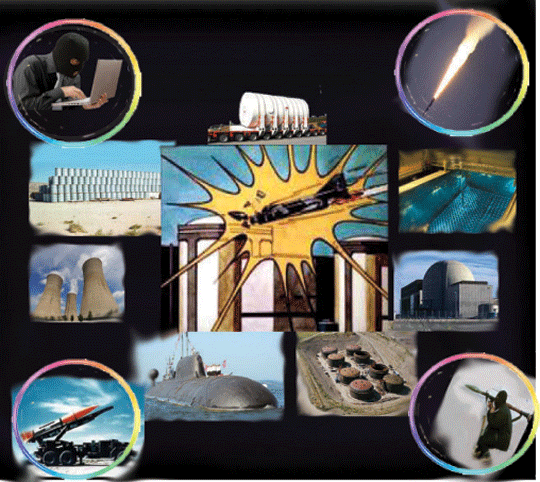 The Middle East: Culprit for my nuclear security insomnia http://thebulletin.org/what-path-nuclear-security-beyond-2016-summit/middle-east-culprit-my-nuclear-security-insomnia Nilsu Goren, 24 May 16,
What keeps me up at night—US East Coast time—is reading Turkey’s morning news concerning Syria and Iraq. The insomnia is especially severe when my thoughts turn to nuclear security not just in Syria and Iraq but in countries throughout the Middle East.
All participants in this roundtable agree that, despite the achievements of the Nuclear Security Summits, the threat of nuclear terrorism is not necessarily diminishing. In the Middle East, nuclear terrorism seems a particularly immediate concern. True, the region lacks large quantities of highly enriched uranium and plutonium. But its political instability and its tendency toward violent extremism are conditions that can enable nuclear terrorism.
According to the 2016 Nuclear Security Index, published by the Nuclear Threat Initiative (NTI), Middle Eastern nations rank poorly when it comes to safeguarding their nuclear materials from theft. Of the 24 countries that possess at least 1 kilogram of weapons-usable nuclear materials, two are Middle Eastern: Israel and Iran. The Index ranks these countries near the bottom of the theft-protection list. Israel comes in at number 20 and Iran at 23.
Among the 152 countries with less than 1 kilogram of weapons-usable nuclear materials, about a dozen are Middle Eastern. They are all over the lot in their vulnerability to theft—from the United Arab Emirates at number 24 to Syria at 151 (just above Somalia). Clearly, the region’s efforts to prevent nuclear theft are not strong enough.
Where vulnerability to nuclear sabotage is concerned, the Middle East does even worse. Of the 45 countries in NTI’s sabotage index, five are Middle Eastern. Israel—the highest-ranking of the five—comes in at number 36. Iran is tied with North Korea for last place.
And as my roundtable colleague Hubert Foy has discussed, concern about nuclear materials is not limited to fissile materials. Radiological sources are also an issue of pressing concern. The Middle East’s generally lax security environment, along with its political instability, makes the misuse of radiological sources more likely in this region than in many other places.
Civilian radiological sources are ubiquitous, particularly in medicine. They would be relatively easy to access in children’s hospitals, for example. Luckily, most radioactive sources are not easily dispersible. Their half-lives are short. They could contaminate only limited areas. Moreover, anyone attempting to steal an unshielded source might die from acute radiation exposure. Still, using a radiological source in a “dirty bomb” could create panic and terror in local populations. A dirty bomb would turn affected areas into no-go zones for a number of years, which would have profound economic repercussions.
Another reason to be concerned about Middle Eastern nuclear security is the planned expansion of nuclear power in the region. Some nations, pointing toward Iran’s limited right to enrich uranium under the Joint Comprehensive Plan of Action, will also wish to enrich uranium domestically. To be sure, such nations have the right to pursue the peaceful uses of nuclear energy, including uranium enrichment. But in order to alleviate international concerns about their enrichment capacity, these nations must develop robust laws regarding nuclear security. They must establish procedures for secure interim storage of nuclear materials. And they must make final disposition plans for spent fuel and radioactive waste.
The International Atomic Energy Agency can help with all of those tasks. It has the authority, resources, and expertise for the job. But a lot of work will nonetheless fall to state regulatory authorities. A key challenge will be for regulators to establish independence from political authorities. A key component of success, meanwhile, will be identifying nuclear security approaches appropriate to the region—via close cooperation between regulators and the nuclear industry. Here the Nuclear Security Summits can extend their legacy. The Nuclear Industry Summits that ran parallel to the Nuclear Security Summits offer a valuable model for including industry in the dialogue toward establishing good nuclear security practices in the Middle East.
1 This Month

of the week – Shut Down Drone Warfare!


Tell the Ukrainian Government to Drop Prosecution of Peace Activist Yurii Sheliazhenko

Petition to revoke the licensing of the Near Surface Nuclear Disposal Facility (NSDF) at Chalk River. https://www.ourcommons.ca/petitions/en/Petition/Details?Petition=e-7247
To see nuclear-related stories in greater depth and intensity – go to https://nuclearinformation.wordpress.com
-
Archives
- April 2026 (103)
- March 2026 (251)
- February 2026 (268)
- January 2026 (308)
- December 2025 (358)
- November 2025 (359)
- October 2025 (376)
- September 2025 (257)
- August 2025 (319)
- July 2025 (230)
- June 2025 (348)
- May 2025 (261)
-
Categories
- 1
- 1 NUCLEAR ISSUES
- business and costs
- climate change
- culture and arts
- ENERGY
- environment
- health
- history
- indigenous issues
- Legal
- marketing of nuclear
- media
- opposition to nuclear
- PERSONAL STORIES
- politics
- politics international
- Religion and ethics
- safety
- secrets,lies and civil liberties
- spinbuster
- technology
- Uranium
- wastes
- weapons and war
- Women
- 2 WORLD
- ACTION
- AFRICA
- Atrocities
- AUSTRALIA
- Christina's notes
- Christina's themes
- culture and arts
- Events
- Fuk 2022
- Fuk 2023
- Fukushima 2017
- Fukushima 2018
- fukushima 2019
- Fukushima 2020
- Fukushima 2021
- general
- global warming
- Humour (God we need it)
- Nuclear
- RARE EARTHS
- Reference
- resources – print
- Resources -audiovicual
- Weekly Newsletter
- World
- World Nuclear
- YouTube
-
RSS
Entries RSS
Comments RSS
 nuclear-news