Still possible to avert global climate change disaster – UN climate chief
 UN climate science chief: it’s not too late to avoid dangerous temperature rise
Hoesung Lee, head of the Intergovernmental Panel on Climate Change, voices hope in battle against 2C increase in warming but warns of ‘phenomenal’ costs,Guardian, Suzanne Goldenberg , 11 May 16 The head of the United Nations climate science panel has declared it is still possible to avoid a dangerous 2C increase in global warming – despite more than a dozen record hot years since 2000. But the costs could be “phenomenal”, he said.
In an interview with the Guardian, Hoesung Lee, the leader of theIntergovernmental Panel on Climate Change (IPCC), defied the bleak outlook of climate scientists who warn the world is hurtling to a 2C rise far faster than anticipated.
Governments set 2C as the danger limit for global warming at the Paris climate conference last year – and agreed to work to limit warming to 1.5C.
Global average temperatures have already risen about 1C since the pre-industrial era because of warming caused by greenhouse gas emissions. February’s hot temperatures stunned scientists, even after a string of record-breaking years.
But Lee insisted the 2C goal remained technically feasible, although it could become prohibitively expensive. “2C is achievable, and if we fail to act according to what the IPCC has been advising, the cost will rise phenomenally,” Lee said. “The sooner we act, we will be able to achieve 2C stabilisation cost-effectively,” he went on. “The longer we wait to take action, the cost will be a lot higher.”…….
Delaying until the middle of the century would be ruinously expensive. “If we fail to act properly, then the emissions reduction will have to double to something like 6% a year, which is unprecedented in any experience.” Even then, however, Lee refused to rule out the feasibility of the 2C goal. “It is achievable if there is a drastic change in the way of doing business,” he said.
Scientists have also said that the world’s carbon dioxide concentration is now on the brink of never again dipping below the 400 parts per million (ppm) milestone, as two important measuring stations, at Cape Grim in Australia and Hawaii’s Mauna Loa volcano, sit on the point of no return……..http://www.theguardian.com/environment/2016/may/11/un-climate-change-hoesung-lee-global-warming-interview
American, Russian and Chinese merchants of nuclear war and mass killing
 In War We Trust, Even If It’s Nuclear? History News Network, May 12, 2016 by Murray Polner “……The US has always needed real or imaginary enemies to make its historic addiction to war more palatable. Nowadays it’s perfectly acceptable to damn Vladimir Putin as an authoritarian but he’s no more authoritarian than some of America’s closest allies. The problem is that, like the US, he commands thousands of nuclear bombs a subject about which I’ve been writing since the start of what sounds like another Cold/maybe Hot War era. The hawkish Hillary Clinton compared him to Hitler after Moscow’s annexation of Crimea. But Henry Kissinger of all people saw through the hot air emanating from Washington’s inner circles (echoed by an uncritical media) when he wrote that excoriating Putin was no substitute for shaping a sane policy, which our foreign policy elites have regularly disdained to do, especially after past and present incompetents and worse have caused the deaths of some 38,000 US military in Korea, 58,000 in Vietnam and 7,000 in Iraq, not to mention millions of innocent Asians and Middle Easterners. No VIP has ever been tried or imprisoned for these deaths.
The US noose around Russia began in earnest when our most lethal weaponry began pouring into Russia’s erstwhile satellites adjacent to Russian borders, (great news for Merchants of Death stockholders). Continue reading
Koch brothers and power utilities connive to stop solar power
 The Koch Brothers’ Dirty War on Solar Power All over the country, the Kochs and utilities have been blocking solar initiatives — but nowhere more so than in Florida, Rolling Stone, By Tim Dickinson February 11, 2016 After decades of false starts, solar power in America is finally poised for its breakthrough moment. The price of solar panels has dropped by more than 80 percent since President Obama took office, and the industry is beginning to compete with coal and natural gas on economics alone.
Citizens’ Juries (IF FAIR AND TRANSPARENT) could help solve South Australia’s nuclear waste dilemma
 The role of Citizens’ Juries in decision-making on nuclear waste importation, Online opinion, By Noel Wauchope 13 May 2016 On May 10th South Australian Premier Jay Weatherill announced the process by which the state will decide whether or not to host a global nuclear waste import industry, as recommended by the Nuclear Fuel Cycle Royal Commission.
The first step will be to set up a “Citizens’ Jury” of 50 participants randomly selected from 25,000 invitees statewide, to be followed later by another one of 350 participants.
I think that Weatherill might have mistaken his terms here, as a Citizens’ Jury, by definition, means a group of 10 to 12 participants. The Weatherill plan sounds more like a “Deliberative Poll”, which involves a much larger group.
A properly constituted Citizens’ Jury can be a valuable process in participatory democracy. The group of 10 or 12 people serves as microcosm of the public. …… The process depends on having the oversight of a neutral but well informed advisory panel. Questions need to be framed in a way that does not risk influencing the response. Transparency is important, and complete audio or video recordings of all jury hearings should be publicly available, although the actual jury room deliberations should be private.
The citizen jury process can be an empowering one for the participants, and, as long as it is perceived to be fair and transparent, can be a valuable democratic option for assessing public opinion. It also has the advantage of being cost-effective.
The “Deliberative Poll” method is potentially another very useful form of participatory democracy. It is a lot more expensive, and more complicated. The biggest disadvantage of the Deliberative Poll method is probably its cost. Wikipedia notes:
“Imagine how much money is needed to pay for the trips, the hotel and the food for each participant, hiring the research crew and moderators, booking a venue, etc. Additional costs can include paying for participants’ compensation so that people that are randomly selected can put aside their duties to attend the events (i.e. hiring someone to milk a participant’s cow and providing child care”
Some critics insist that funding for either of these processes should not come from on single body.
“Multiple sources of funding help to ensure that the jury’s organisers are not seen as having a financial interest in producing a verdict that supports the interests of a single funding body. To maximise the scrutiny they provide, the two or more funders should have somewhat opposing interests regarding the subject likely to be under discussion.”……
In Japan, in 2012, a Deliberative Poll formed the guide to government decision-making. The Japanese government used the Center for Deliberative Democracy’s Deliberative Polling method to both inform participants and allow them to influence policymakers about the public’s will with regard to energy production issues. As a direct result of the deliberative polling process, Japan’s national government pledged to have zero percent dependency on nuclear energy after 2030. (This decision was overturned by a later government).
The South Australian government’s decision to start with a participatory democracy process is a welcome one, provided that it is done fairly and properly. Neither a Citizens Jury nor a Deliberative Poll can be a substitute for a fully democratic process like a referendum, but either could be a valuable contributor to a wider process of decision making. http://www.onlineopinion.com.au/view.asp?article=18230
Film star Michael Douglas disappointed in Obama’s sorry progress on nuclear disarmament
 Michael Douglas: Obama ‘a disappointment’ in creating nuclear-free world http://www.jpost.com/Breaking-News/Michael-Douglas-Obama-a-disappointment-in-creating-nuclear-free-world-453876 Douglas, a UN “messenger for peace,” wants President Barack Obama to issue a strong message against nuclear weapons when he visits Hiroshima in Japan later this month.
Douglas told reporters at the United Nations in Geneva, where nuclear negotiations have been stuck for 20 years, that the nuclear danger was greater than during the Cold War, largely due to a “huge escalation” in US-Russia tensions and increasing recklessness in their close-quarter contacts.
“There’s this kind of crazy tension between US and Russia. We have our issues but I don’t quite see that all of this posturing is helping anybody,” he said.
The number of weapons that are on trigger alert is frightening. So the time for somebody to possibly make a mistake and correct it is very very short.”
Douglas said he “found religion” in the anti-nuclear cause after the Three Mile Island nuclear accident in 1979, within days of the opening of his film The China Syndrome, which dealt with an emergency at a nuclear plant. Standing beside Joseph Cirincione, president of Ploughshares Fund, a global security organization, Douglas recalled Obama’s 2009 speech in Prague, where the president promised concrete steps towards a nuclear-free world.
“I think we could say he’s been a disappointment because there’s not been follow through, and I do hope now for his legacy as he begins to leave office, that he’s going to have something strong to say at Hiroshima.”
Cirincione said Obama had made good early progress on nuclear non-proliferation, but had made only modest cuts in arsenals and was leaving $1 trillion in new nuclear contracts in the pipeline for his successor.
“Every single weapon in the nuclear arsenal is now due for replacement or an upgrade. It’s a looming disaster,” he said. Douglas, 71, said he was also a friend of Donald Trump, but he was not confident the United States would make any advances in nuclear disarmament if Trump won the presidency.
South Africa: renewable energy growth, promise that nuclear development will be “corruption-free”
South Africa targets more renewable power, nuclear expansion to go ahead
*Renewable energy seen contributing 17,800 MW by 2030
* Nuclear expansion process to be affordable, above board
Africa’s most industrialised country has turned to solar and wind power to diversify its energy mix and help plug electricity shortages. The first 47 renewable energy independent power producers are due to be fully operational by July.
It also hopes to install 9,600 megawatts of nuclear power in the next 15 years to address chronic electricity shortages but the cost of the project estimated at about $100 billion has raised budgetary concerns.
Tina Joemat-Pettersson reaffirmed in parliament that the planned nuclear expansion would be “corruption free”, following concerns by opposition parties over the tender process and about the affordability of the project in a country whose economic growth has stagnated.
The department of energy would issue a request for proposal to confirm market appetite for the fleet of nuclear plants and help secure commercial and financial information for the government to make a final decision, she said.
“We will only implement what our country can afford,” Joemat-Pettersson said.
Forecasts for growth in South Africa have fallen to below 1 percent for 2016 as a global commodity slump drags on and rising inflation rates curb domestic spending.
Germany’s biggest power utility in financial problem about nuclear wastes costs
 Eon warns on capital raise to cover extra €2bn nuclear waste bill Guy Chazan in Berlin Ft.com 12 May 16 Shares in Eon, Germany’s biggest power producer, fell 5 per cent after it said it might have to raise capital to pay its share of the cost of storing Germany’s nuclear waste.
Eon has provisioned €8bn for waste storage, but under a proposal published by a government commission last month it would have to pay an extra €2bn into a special waste storage fund. Altogether, Germany’s four big utilities have been told they have to contribute a total of €23.3bn into the pool.
Michael Sen, Eon’s chief financial officer, said the company could pay the money, but doing so would reduce its equity capital and could hurt its credit rating.
He said Eon would be forced to postpone investments, cut more costs and potentially sell off marginal assets to cover the €10bn. A company presentation also said it could trigger unspecified “capital measures”.
Eon’s share price was trading down nearly 5 per cent at €8.14 on Wednesday……
The nuclear issue is just one of the problems weighing on Eon’s stock. Like its rival, RWE, Eon has been hit by Germany’s radical shift to renewables, which has squeezed electricity from fossil fuels out of the energy market.
It reported its biggest annual loss last year after writing down the value of its coal and gas-fired power plants by €8.8bn.
The company has responded by splitting itself in two: Eon is grouping its conventional power generation assets and energy trading in a new company, Uniper, while the new-look Eon will focus on renewables, networks and customer solutions. ……http://www.ft.com/cms/s/0/52d0c36e-173d-11e6-b8d5-4c1fcdbe169f.html?siteedition=uk#axzz48VIfeQb0
Head of Nebraska utility wants closing of uneconomic nuclear power station
Nebraska Utility Head Recommends Closing Nuclear Power Plant. abc news, By JOSH FUNK, ASSOCIATED PRESS OMAHA, Neb. — May 12, 2016 The head of a Nebraska utility recommended shutting down the nation’s smallest nuclear power plant by the end of the year, saying Thursday that it doesn’t make economic sense to keep it open.
Tim Burke, the president and CEO of the Omaha Public Power District, told the utility’s board that Fort Calhoun Nuclear Station isn’t financially sustainable……
Smaller nuclear plants, like Fort Calhoun, have the most difficult time competing on the price of power, especially if they have had serious safety problems, said Mark Cooper, who is a senior fellow for economic analysis with the Institute for Energy and the Environment atVermont Law School.
“The older, smaller reactors are really uneconomic,” Cooper said.
Adding to Fort Calhoun’s problems is a series of setbacks it has had in recent years.
The utility spent more than $140 million on repairs after flooding and a small fire damaged the plant in 2011. Fort Calhoun’s closure in April 2011 began with routine refueling maintenance, but massive flooding along the Missouri River that year and several safety and security violations forced it to remain closed.
Among the violations cited by regulators was the failure of a key electrical part during a 2010 test, a small electrical fire in June 2011, several security issues and deficiencies in flood planning that were discovered a year before the river spilled its banks.
It resumed operations in December 2013 after the utility hired Chicago-based Exelon, the largest U.S. operator of nuclear power plants, to run Fort Calhoun.http://abcnews.go.com/US/wireStory/nebraska-utility-head-recommends-closing-nuclear-power-plant-39071354
UN Finds the UK in Violation of Transboundary Environmental Impact Convention for Hinkley Point Nuclear Power Station; Europe at Risk

A nuclear accident anywhere in Europe may seriously impact much of Europe, as did the Chernobyl Nuclear disaster, and to an apparently lesser degree the UK’s Windscale Nuclear disaster. In fact, Europe is still so seriously contaminated, albeit in a splotchy manner, from Chernobyl that it really cannot afford another nuclear accident. Similarly, a nuclear accident in the US could seriously impact much of North America. Last year a wild boar in southern Switzerland was found to be contaminated at 9,900 Bq/kg of radioactive Cesium 137, or 99 times the amount of radiation in food allowed in Japan (100 Bq/kg all radionuclides), over 16 times the amount of radioactive Cesium allowed in European food (600 Bq/kg Cs) and over 8 times the exceedly high levels of radioactive Cesium allowed in US food (1200 Bq/kg Cs). 30 years after Chernobyl, half of the high levels of radioactive Cesium 137 which fell…
View original post 4,067 more words
May 12 Energy News

Science and Technology:
¶ Fuveme is a coastal village in Ghana, one of a number of villages that are vanishing because of coastal erosion. What was once a thriving fishing community is now best reachable by boat because of rising sea levels due to climate change. Waves have washed away whole parts of the village. [BBC]
 Fuveme is just a slither of land now.
World:
¶ South Africa will connect 7,000 MW of renewable power to its grid by the middle of this year, when the first 47 projects become fully operational, the energy minister said. Africa’s most industrialised country has turned to solar and wind power to plug electricity shortages. [Yahoo News]
¶ The UK Energy Bill, which provides for the closure of the Renewables Obligation support regime for new onshore wind in Great Britain, concluded its passage through Parliament. Industry body RenewableUK called for…
View original post 699 more words
May 11 Energy News
Opinion:
¶ “Almost Everything You Know About Climate Change Solutions Is Outdated, Part 1” • First, climate science and climate politics have been moving quickly to broad consensus. Second, technology for key climate solutions has become very affordable. Third, the media is largely clueless. [ThinkProgress]
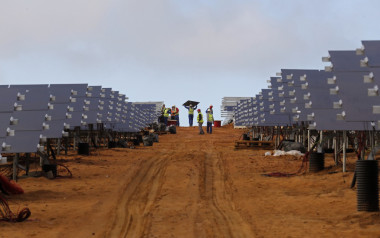 Credit: Schalk Van Zuydam, AP
¶ “It’s the economy: Maryland RPS debate illustrates national divide on clean energy policy” • States with renewable portfolio standard (RPS) laws are doubling down, while those without take little interest. Taking a look at changes in Maryland’s RPS could help explain why. [Utility Dive]
¶ “Is this the end of the centralised energy network?” • What will the death of centralised energy networks look like? Turns out, what’s going on in Western Australia right now paints a pretty good picture. Having a low customer density makes centralized power a big challenge. [RenewEconomy]
 Sandfire…
View original post 645 more words
Seniors mull share house to keep Fukushima evacuee community intact
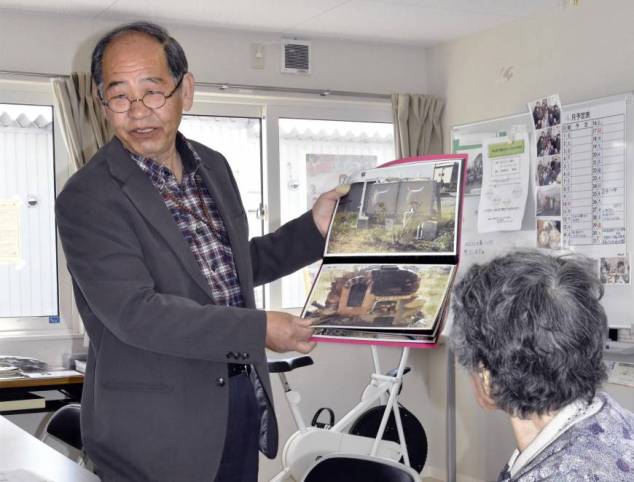
Masaharu Fujishima, who is proposing to build a share house for temporary housing residents, explains his plan to residents in a meeting in April in Minamisoma, Fukushima Prefecture.
FUKUSHIMA – As the government looks to lift the evacuation zone for part of Minamisoma, Fukushima Prefecture, elderly people currently living in temporary dwellings are considering a share house so they can stay together.
If the no-go zone is lifted, residents at temporary housing units are likely to be asked to leave. One option is to return to their hometown of Minamisoma’s Odaka district — a choice few are likely to make. Another option is to move in to city-provided public housing where they would have to start again in unfamiliar surrounds.
In Odaka, residents will be allowed to stay inside the evacuation zone to prepare for their permanent return after the designation is lifted. But of the area’s 11,700 residents, only 1,870 have registered to go back, suggesting few plan to return permanently.
It’s for this reason that Masaharu Fujishima, 70, a resident at Minamisoma’s temporary housing complex, is pitching a plan to create a share house with individual rooms and common space that will allow temporary housing residents who have bonded since the March 2011 Fukushima nuclear disaster to live together.
Fujishima evacuated from Odaka to temporary housing in the city center. Serving as head of the community association until January, he was able to talk with many residents about the troubles they faced as they attempted to rebuild their lives.
Many were worried about leaving a community of friends they bonded with over the past five years for a new one they would need to create from scratch.
“After the nuclear disaster, many people had to move around before they finally settled in the temporary housing,” said Fujishima. “I’m worried that if they leave here, they would have to go through all the trouble again of searching for a new place to live.”
So far, Fujishima has held three meetings for temporary housing residents to explain his proposal. While some feedback has been positive, with residents saying it will prevent them from becoming senile, others have voiced concern about what will happen when one of the dwellers becomes ill or dies.
To put the plan in motion, Fujishima submitted about 16,000 signatures to the Minamisoma Municipal Assembly.
The city is expected to consider the proposal, though a city official in charge of housing construction was not sure if the idea is feasible.
“It is difficult because public houses are not designed for many people to live together like a share house,” the official said.
Collision on the Joban Expressway in Fukushima
On May 4, 2016, a head-on collision between a car and a bus on the Joban Expressway in Fukushima killed a mother and her daughter on the passeger car. *link for Yahoo Japan article
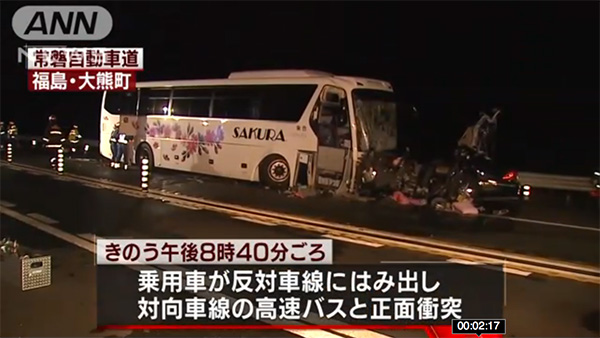
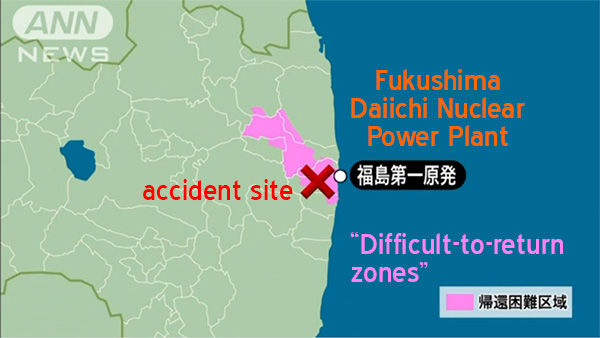
The accident happened in Okuma town which is within “Difficult-to-return” zones, due the nuclear accident at Fukushima Daiichi Nuclear Power Plant.
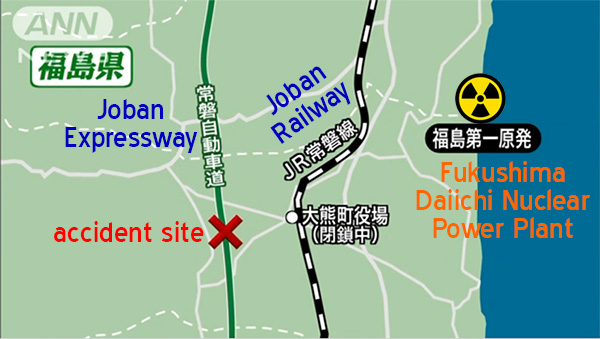
The designated area has been exposed to more than 50 millisieverts per year of radiation from the melted-down power plant. It is considered difficult for local residents to return possibly for the next several decades.
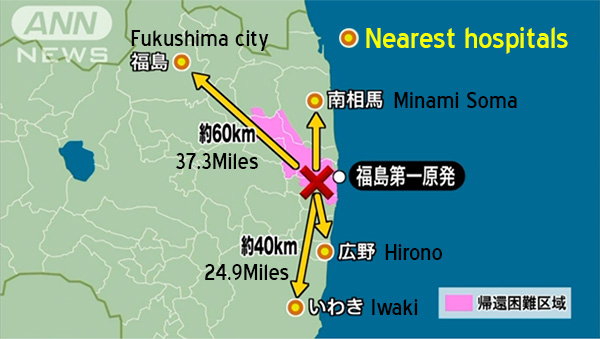
Since the entire area has been evacuated, the injured passengers on the crashed bus had be transported as far as 37Miles.
40 passengers including the bus driver had to wait for the ambulance for two hours on the side of the road. No face masks were provided.
(Cars and buses are allowed around this section of Joban Expressway, but not motorcycles due to the extreme level of radioactive contamination.)
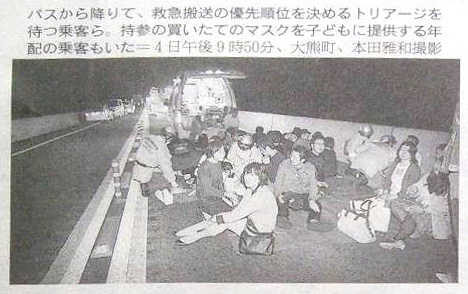
*Photo of the Japanese newspaper article courtesy of Facebook group, “NPO法人チェルノブイリへのかけはし“.

Background radiation level in Okuma town as of March 24, 25 of 2016, measured by Okuma town.
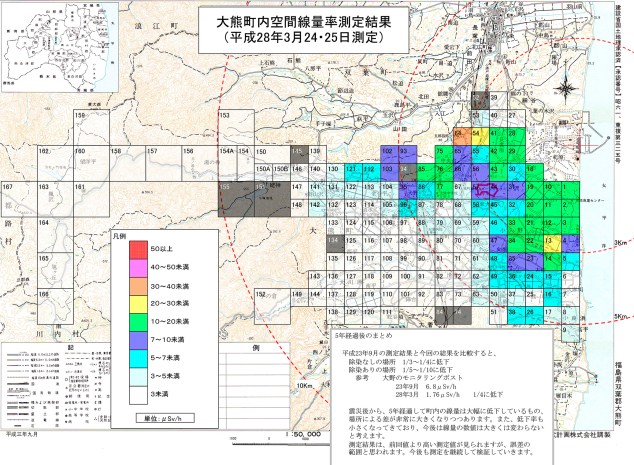

Source: http://www.mp-nuclear-free.com/main-articles/news-snippets_20160507.html
Arnie Gundersen measured 4,000 Bq/kg on a Tokyo street
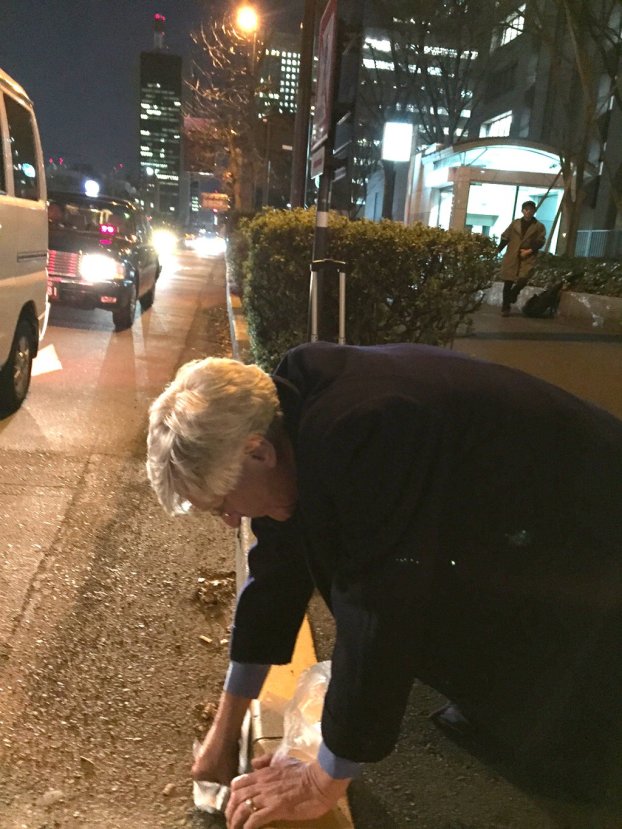
Arnie Gundersen measured 4,000 Bq/kg on a Tokyo street outside METI, Japan nuclear regulator…Olympics anyone?
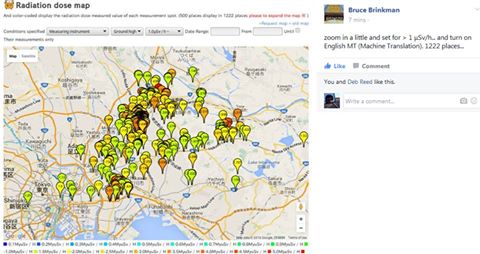
76 measurements that are over 5µS/h in the “Kashiwa hotspot”

Kashiwa city, Chiba prefecture, nearby Tokyo
Some screen caps of the new background radiation tests from Japan. Kashiwa hot spots. Thanks to Bruce Brinkman
Hakatte Geiger users have uploaded 76 measurements that are over 5µS/h in the “Kashiwa hotspot” area. You can see how they are distributed as the plume came over Kasumigaura and into eastern Tokyo. I travel through that on my way to and from work. I have to go through Matsudo and Kashiwa which are buried under the map pins.

Zoom in a little and set for > 1 μSv/h… 1222 places.
1 This Month
Chernobyl: The Lost Tapes – A good documentary on Chernobyl on SBS available On Demand for the next 3 weeks– https://www.sbs.com.au/ondemand/tv-program/chernobyl-the-lost-tapes/2352741955560

of the week–London Campaign for Nuclear Disarmament

Tell the Ukrainian Government to Drop Prosecution of Peace Activist Yurii Sheliazhenko
To see nuclear-related stories in greater depth and intensity – go to https://nuclearinformation.wordpress.com
-
Archives
- April 2026 (114)
- March 2026 (251)
- February 2026 (268)
- January 2026 (308)
- December 2025 (358)
- November 2025 (359)
- October 2025 (376)
- September 2025 (257)
- August 2025 (319)
- July 2025 (230)
- June 2025 (348)
- May 2025 (261)
-
Categories
- 1
- 1 NUCLEAR ISSUES
- business and costs
- climate change
- culture and arts
- ENERGY
- environment
- health
- history
- indigenous issues
- Legal
- marketing of nuclear
- media
- opposition to nuclear
- PERSONAL STORIES
- politics
- politics international
- Religion and ethics
- safety
- secrets,lies and civil liberties
- spinbuster
- technology
- Uranium
- wastes
- weapons and war
- Women
- 2 WORLD
- ACTION
- AFRICA
- Atrocities
- AUSTRALIA
- Christina's notes
- Christina's themes
- culture and arts
- Events
- Fuk 2022
- Fuk 2023
- Fukushima 2017
- Fukushima 2018
- fukushima 2019
- Fukushima 2020
- Fukushima 2021
- general
- global warming
- Humour (God we need it)
- Nuclear
- RARE EARTHS
- Reference
- resources – print
- Resources -audiovicual
- Weekly Newsletter
- World
- World Nuclear
- YouTube
-
RSS
Entries RSS
Comments RSS
 nuclear-news