New York Public Service Commission hearing on nuclear power stations
New York weighs future of Indian Point, upstate nuclear power plants Thomas C. Zambito, The Journal News May 17, 2016 “……..“Work with us to plan this just transition,” anti-nuclear activist Manna Jo Greene, the environmental director for the Beacon-based Clearwater, urged workers who crowded an Albany-area hearing held by the state Public Service Commission. “The handwriting is on the wall.”
The hearing was one of 22 being held across the state this month as the Public Service Commission weighs Gov. Andrew Cuomo’s proposal to establish clean energy standards so the state can continue reducing its carbon emissions.
Cuomo wants the state to rely on renewable energy sources for 50 percent of its electricity by 2030. While he’s advocated Indian Point’s shutdown, he’s pushing for the commission to offer financial incentives that would aid three upstate nuclear power plants – two in Oswego and a third near Rochester.
The owners of the James A. FitzPatrick nuclear power plant in Scriba say they will shut the plant’s doors in January 2017 and lay off half of the plant’s 600 workers.
Cuomo’s proposal envisions keeping the upstate nuclear plants open to act as a “bridge” until the state is able to rely on renewable energy sources for its electricity.
Several anti-nuclear speakers cast Cuomo’s effort to save the upstate plants as a “bailout” that shouldn’t be borne by ratepayers.
“Right now the nuclear industry, even though it’s over 50 years old still is unable to support itself,” said Susan Shapiro, a Rockland County attorney who works with the Indian Point Safe Energy Coalition. “It’s received more bailouts from the federal government than any other industry and it continues to receive bailouts from taxpayers.”…….
The Public Service Commission is scheduled to hold a vote on Cuomo’s proposals next month. http://www.lohud.com/story/tech/science/environment/2016/05/17/new-york-indian-point/84511734/
Threat of Nuclear EMP Attack on Electric Grid
Government, Industry Studying Threat of Nuclear EMP Attack on Electric Grid
High-altitude nuclear blast would cause widespread power outage, Washington Free Beacon BY: Bill Gertz May 19, 2016 American power companies are studying ways to protect electric grids against a high-altitude nuclear blast and other directed energy attacks that could severely disrupt electricity transmission, an industry representative told a Senate hearing Wednesday.
Scott Aaronson, managing director for cyber and infrastructure security at the Edison Electric Institute (EEI), stated in testimony that a consortium of U.S. electric companies is working with the Energy Department to study how to protect power grids from a nuclear blast-produced electromagnetic pulse attack or solar flares that could damage transformers and other electric components and shut down power for millions of Americans……
The hearing was called to examine threats to critical infrastructure ranging from cyber attacks and criminal activities to terrorist sabotage and nation state nuclear attacks.
Aaronson, whose institute represents all investor-owned U.S. electric companies, said in testimony that electromagnetic pulse is a concern and could be caused by a high-altitude nuclear blast or a directed energy weapon.
The Electricity Subsector Coordinating Council, a group of chief executives from 21 electric companies and nine major industry associations, is working with the Energy Department to examine the threat. Aaronson, the council’s secretary, stated that the threat study is based on research done by the Pentagon and national laboratories……..http://freebeacon.com/national-security/government-industry-studying-threat-nuclear-emp-attack-electric-grid/
Nuclear danger in Armenia
Suicidal nuclear gambit on Caucasus, Trend, 19 May 2016 “………..According to the report by Vienna-based nuclear watch-dog, International Atomic Energy Agency (IAEA), Armenia has established quite a record of illegal trafficking of nuclear and other radioactive materials. There have been a couple of serious incidents spanning from 1999 onward. A large number of reported incidents has occurred on the country`s border with Georgia, tempting the IAEA to conclude there is high probability that the so called Armenian route does in fact exist. There is a further evidence to support this assertion. There were an unusually high number of Armenians caught in nuclear trafficking activities. Additionally, some of the reported incidents that made their way to the official reports suggested that the main focus of trafficking activities is in fact smuggling of nuclear material that could be used for nuclear weapons capabilities. There were also reports suggesting the trafficking of other radioactive material that could be utilized for alternate purposes, such as the building of a so called dirty bomb. Since the stakes with nuclear weaponry are always high to the extreme, the recognition of this threat must not be underrated and dismissed easily.
However, there should be increased interest of the international community to investigate these serious claims. If documented, they would pose a grave desta-bilization factor for the already turbulent region. They would also trigger deepening of hostilities and mistrust in extremely delicate regional framework of peace.
The prospects and dangers of potential acquisition of a dirty bomb by rouge actors are rising on the international agenda. The recently detected activities in South Caucasus showed that there were substantial efforts made in order to smuggle and illegally sell Uranium 238, which is highly radioactive. At the beginning of 2016, a different group was trying to smuggle a highly radioactive Cesium isotope that usually forms as a waste product in nuclear reactors. What is also worrying is that the majority of the activities are occurring in highly instable and unmonitored territories of Azerbaijan and Georgia that are under the control of separatists, such as Nagorno- Karabakh and South Ossetia. The mere organization of the Armenian route proves to show that illegal activities can flourish in the security blind spots of the region…… http://en.trend.az/scaucasus/armenia/2535865.html
Solar energy jobs growing, as oil industry jobs decline
 There Will Be More New Jobs in Solar Than Oil by the End of the Year,Fortune by Jonathan Chew @sochews APRIL 20, 2016, Indeed just released this startling info on energy jobs.
The world’s biggest oil companies are slashing jobs to cope with decreasing revenues, and one knock-on effect has been the drop in oil job postings.
Conversely, however, if the current pace of postings hold, solar would become the largest market for energy jobs by the fourth quarter of 2016, according to numbers tabulated by Indeed, the world’s highest traffic job site…….
Tara Sinclair, chief economist at Indeed. “Whether or not solar overtakes oil on Indeed, energy workers would do well to position themselves for work in renewable fields such as solar, wind, and hydroelectricity.”
This corresponds with a recent report by The Solar Foundation that highlighted the rapid growth of the U.S. clean energy sector. By the end of this year, the solar sector should have 240,000 workers under its wings, and currently employs around 77% more workers than the coal mining industry……http://fortune.com/2016/04/20/solar-oil-jobs-indeed/
The role of renewable energy in slowing climate change
Surge in renewable energy stalls world greenhouse gas emissions Falling coal use in China and the US and a shift towards renewable energy globally saw energy emissions level for the second year running, says IEA, Guardian, John Vidal, 17 March 16, Falling coal use in China and the US and a worldwide shift towards renewable energy have kept greenhouse gas emissions level for a second year running, one of the world’s leading energy analysts has said.
Preliminary data for 2015 from the International Energy Agency (IEA) showed that carbon dioxide emissions from the energy sector have levelled off at 32.1bn tonnes even as the global economy grew over 3% .
Electricity generated by renewable sources played a critical role, having accounted for around 90% of new electricity generation in 2015. Wind power produced more than half of all new electricity generation, said the IEA.
The figures are significant because they prove to traditionally sceptical treasuries that it is possible to grow economies without increasing climate emissions.
“The new figures confirm last year’s surprising but welcome news: we now have seen two straight years of greenhouse gas emissions decoupling from economic growth. Coming just a few months after the landmark COP21 agreement in Paris, this is yet another boost to the global fight against climate changem” said IEA director, Fatih Birol…….
A seperate report by the European Environment agency (EEA) shows that the EU-wide share of renewable energy has increased from 14.3% in 2012 to 15% in 2013. This allowed the EU to cut its demand for fossil fuels by 110m tonnes of oil equivalent in 2013. This, said the EEA, is the equivalent of a gross reduction of CO2 emissions of 362m tonnes in 2013. http://www.theguardian.com/environment/2016/mar/16/surge-in-renewable-energy-stalls-world-greenhouse-gas-emissions?CMP=share_btn_tw
South East Asia must shun nuclear power – the cons far outnumber the pros
Why even SE Asia’s most advanced country must shun nuclear power , The Nation, Thailand, Francis Cheng, (From the Straits Times/ANN) May 20, 2016
The plant itself and the trucks carrying waste could also become terrorist targets since they have the potential to cause widespread destruction.
The cons far outnumber the pros.
We should focus on cleaner, renewable energy options such as solar. http://www.nationmultimedia.com/opinion/Why-even-SE-Asias-most-advanced-country-must-shun–30286316.html
EDF hoping to extend life of nuclear reactors, postpone decommisson costs
 EDF sees French energy plan shaping nuclear depreciation schedule http://uk.reuters.com/article/uk-edf-nuclear-idUKKCN0YA211 PARIS | BY GEERT DE CLERCQ 19 May 16.The French government’s energy investment plan due in July will be a key indicator for whether and for how long EDF will extend the depreciation period of its nuclear plants, an executive said on Thursday.
EDF hopes to get nuclear energy regulator ASN’s authorisation to extend the lifespan of its nuclear plants to 50 years from 40, and already wants to extend the depreciation period on these assets, which would boost bottom-line profit.
Early this year ASN said it expects to give generic guidelines on French nuclear plant life extensions by 2018, but said extensions could not be taken for granted and that they would be decided reactor by reactor.
The government’s long-awaited multi-year energy investment plan (PPE) – implementing the August 2015 energy transition law – will not specify reactor lifespan, but should set targets for the share of nuclear in France‘s power mix.
President Francois Hollande has vowed to reduce that share from 75 percent to 50 by 2025, but has taken no concrete steps towards that goal.
“The PPE, and notably its nuclear chapter, expected early July, will figure largely in our decision about the accounting lifespan of our nuclear reactors,” EDF nuclear chief Dominique Miniere told reporters.
In 2003, EDF extended the depreciation schedule for its reactors in its accounts to 40 years from 30 – six years before the ASN authorised the move.
CEO Jean-Bernard Levy said in April EDF plans to extend the depreciation period by the closing of first-half results.
Miniere said the PPE should signal how many of EDF’s 58 reactors can keep operating, which will determine over what period reactors and related maintenance costs can be depreciated.
He said life extension would also impact EDF’s 23 billion euros (1 billion pounds) worth of decommissioning and nuclear waste provisions.
“Delaying reactor decommissioning also means delaying provisions,” he said. Miniere said 80 percent of EDF’s 58 reactors were built between 1980 and 1990. From 2020, many need to close or get approval operate another decade.
Miniere said every reactor has annual maintenance costs of about 50 million euros, or about 3 billion euros per year for EDF’s fleet.
Extending EDF’s reactors by 10 years and incorporating safety lessons learned from the Fukushima disaster will boost that to 4-4.2 billion euros per year in the 2014-2025 period, a total of just over 50 billion, after which costs will ease to 4.2-3 billion euros per year, he said. (Reporting by Geert De Clercq, editing by David Evans)
Emotional plea from Former Prime Minister Junichiro Koizumi in support of U.S. sailors, victims of radiation
Tearful Koizumi backs U.S. vets suing over 2011 nuclear disaster THE ASAHI SHIMBUN CARLSBAD, California, 19 May 16, –Former Prime Minister Junichiro Koizumi broke down in tears as he made an emotional plea of support for U.S. Navy sailors beset by health problems they claim resulted from radioactive fallout after the 2011 nuclear disaster.
More than 400 veterans who were part of a mission called Operation Tomodachi to provide humanitarian relief after the Great East Japan Earthquake and tsunami filed a mass lawsuit in California against Tokyo Electric Power Co., operator of the crippled Fukushima No. 1 nuclear plant. They are seeking compensation and an explanation for their health problems.
Koizumi, 74, responded to a request from a group supporting the plaintiffs and flew to the United States to meet with 10 veterans.
At a news conference here on May 17, Koizumi said: “U.S. military personnel who did their utmost in providing relief are now suffering from serious illnesses. We cannot ignore the situation.”……
Some of the plaintiffs in the lawsuit were crew members of the nuclear-powered aircraft carrier USS Ronald Reagan, which anchored off the Tohoku coast to provide relief along the battered coastline.
Theodore Holcomb, an aviation mechanic on the flattop, was tasked with washing down U.S. helicopters that had operated in areas with high radiation. He was later diagnosed with synovial sarcoma, a rare form of cancer. He died in 2014 at age 35.
The Department of Veterans Affairs later cut off a study into the causal relationship between his exposure to radiation and his illness.
His best friend in the Navy, Manuel Leslie, 41, now is one of the plaintiffs in the lawsuit on behalf of Holcomb.
Leslie said he just wants the truth to come out for his friend.
Another crew member, Ron Wright, 26, worked on the deck. After finishing his shift one day, he was forced to remove his clothes after a high radiation reading. Subsequently, he developed a swelling of the testicles and underwent surgery four times after he returned to the United States. However, the pain was so intense that he had to rely on painkillers and sleeping pills.
A military doctor told him there was no relationship between his illness and exposure to radiation.
Wright said he was never given protective clothing or iodine during the mission. He also said he had no knowledge of radiation at the time.
According to the ship’s logs and the testimony of former crew members, sailors aboard the Ronald Reagan may well have been exposed to radiation as the carrier passed under a radiation plume that was generated by the Fukushima accident. In addition, the carrier used desalinated seawater for drinking and showers by crew members……… This article was written by Masato Tainaka and Ari Hirayama. http://www.asahi.com/ajw/articles/AJ201605190065.html
Undersea nuclear deterrence in the Indian Ocean is here to stay
The Indian Ocean Won’t Be a ‘Nuclear Free Zone’ Anytime Soon Undersea nuclear deterrence in the Indian Ocean is here to stay., The Diplomat, By Ankit Panda May 20, 2016 Sartaj Aziz, adviser to Pakistan’s prime minister on foreign affairs, presented an interesting proposal to the Pakistani Senate on Thursday. He said that he would consider having Pakistan introduce a resolution at the United Nations that would urge the body to declare the Indian Ocean a “nuclear free zone.” Leaving aside the fact that the United Nations isn’t in the business of declaring nuclear weapon free zones, Aziz’s comments reflect increasing anxieties in Pakistan about India’s burgeoning sea-based nuclear deterrent.
With the first of Arihant-class of domestically designed ballistic missile submarines rolling out and testing underway of Delhi’s K-4 submarine-launched ballistic missiles ongoing, Delhi is coming closer to operationalizing its sea-based deterrent. (The K-4 has been test launched from the Arihant‘s on-board silos, as I discussed last month.)
Aziz is well aware of these developments. ”Apart from this air defence system, India has also recently conducted tests of nuclear capable, submarine based K4 ballistic missiles. Simultaneously large nuclear powered submarines are being built to carry these nuclear armed missile as a part of its second strike nuclear capability,” he told the Senate, according to a report in Dawn.
Unfortunately, for Pakistan, the United Nations won’t be able to solve this problem anytime soon. Moreover, India won’t be the only country looking to operate nuclear-armed ballistic missile submarines (SSBNs) in the waters of the Indian Ocean. China started operating Song– and Shang-class submarines in the Indian Ocean in 2014, according to the U.S. Department of Defense. Ostensibly, Beijing’s upcoming first overseas military facility—in Djibouti—will play a role in support submarine logistics.
According to the U.S. Defense Department’s most recent report on China’s military, four Chinese Jin-class SSBNs—China’s first sea-based deterrent as well—are operational. These submarines currently operate out off the People’s Liberation Army-Navy’s submarine base at Hainan Island, in the South China Sea, but Beijing may look to have its SSBNs patrolling the Indian Ocean soon enough……
Unsurprisingly, amid increased Chinese sub-surface activity in the Indian Ocean, we’ve seen the United States and India deepen their anti-submarine warfare cooperation. Moreover, Delhi has started extending its maritime patrol and surveillance capabilities further southward; it sent a P-8I Neptune aircraft to the Seychelles earlier this year.
With India’s Arihant-class on the verge of commissioning and Chinese SSBNs possibly on the way to supplement the PLAN’s existing hunter-killer and nuclear attack submarines, the Indian Ocean won’t become a “nuclear free zone” anytime soon. Islamabad could look to build up its own undersea nuclear capabilities, but, as I’ve discussed before, that’ll be limited by a range of factors. http://thediplomat.com/2016/05/the-indian-ocean-wont-be-a-nuclear-free-zone-anytime-soon/
100% renewable energy powers Portugal for four days
Portugal runs for four days straight on renewable energy alone
Zero emission milestone reached as country is powered by just wind, solar and hydro-generated electricity for 107 hours, Guardian, Arthur Neslen, 19 May 16, Portugal kept its lights on with renewable energy alone for four consecutive days last week in a clean energy milestone revealed by data analysis of national energy network figures.
Electricity consumption in the country was fully covered by solar, wind and hydro power in an extraordinary 107-hour run that lasted from 6.45am on Saturday 7 May until 5.45pm the following Wednesday, the analysis says.
News of the zero emissions landmark comes just days after Germany announced that clean energy had powered almost all its electricity needs on Sunday 15 May, with power prices turning negative at several times in the day – effectively paying consumers to use it.
Oliver Joy, a spokesman for the Wind Europe trade association said: “We are seeing trends like this spread across Europe – last year with Denmark and now in Portugal. The Iberian peninsula is a great resource for renewables and wind energy, not just for the region but for the whole of Europe.”
James Watson, the CEO of SolarPower Europe said: “This is a significant achievement for a European country, but what seems extraordinary today will be commonplace in Europe in just a few years. The energy transition process is gathering momentum and records such as this will continue to be set and broken across Europe.”
Last year, wind providing 22% of electricity and all renewable sources together providing 48%, according to the Portuguese renewable energy association.
While Portugal’s clean energy surge has been spurred by the EU’s renewable targets for 2020, support schemes for new wind capacity were reduced in 2012.
Despite this, Portugal added 550MW of wind capacity between 2013 and 2016, and industry groups now have their sights firmly set on the green energy’s export potential, within Europe and without…….http://www.theguardian.com/environment/2016/may/18/portugal-runs-for-four-days-straight-on-renewable-energy-alone
From soldier to climate change fighter – Solar Ready Vets
Solar Ready Vets Transforms US Military Into Climate Change Fighters, Clean Technica, May 18th, 2016 by Tina Casey
At least 190,000 veterans are expected to transition out of the US military each year over the next several years, and the federal program Solar Ready Vets is gearing up to match them with solar jobs. The Energy Department has just announced that it is adding five more military bases to the program’s roster of solar training locations. The agency will also pour $10 million into 10 new training projects that will help rev up the solar industry’s ability to absorb new workers.
Solar Jobs And A Smooth Transition
Solar Ready Vets was launched in 2014 as a pilot program to help the rapidly growing US solar industry recruit enough skilled workers to meet the demand. The idea is to establish the training programs on bases and begin the training process before veterans end their military service, so they can enter the civilian workforce as seamlessly as possible.
Each base is paired with a local community college or other solar training provider, leveraging the existing framework of the GI Bill.
The training is available to active duty personnel who are within six months of leaving the service. To sweeten the pot, there is no charge to for the training program.
The program aims at all aspects of the solar industry, including sales and management as well as installation and other technical positions.
Apparently Solar Ready Vets was a success. It has already graduated 250 trainees and, from an initial five bases, this week it doubled in size to include 10 bases. The new ones are:
Camp Pendleton in California – U.S. Marine Corps
Fort Carson in Colorado – U.S. Army
Naval Station Norfolk in Virginia – U.S. Navy
Hill Air Force Base in Utah – U.S. Air Force
Fort Drum in New York – U.S. Army
These are the existing ones:
Joint Base McGuire-Dix-Lakehurst in New Jersey – U.S. Air Force, Army, and Navy
Eglin Air Force Base in Florida – U.S. Air Force
Marine Corps Base Hawaii – U.S. Marine Corps
Joint Base San Antonio in Texas – U.S. Air Force and Army
Fort Bragg in North Carolina – U.S. Army…….http://cleantechnica.com/2016/05/18/solar-ready-vets-transforms-us-military-climate-change-fighters/
Nuclear center waits over a year to report cyber-attack
Computer hackers infiltrated a server installed at a facility that oversees handling of plutonium and other nuclear materials, but the breach was not reported for over a year because officials thought it wasn’t serious.
The government-affiliated Nuclear Material Control Center acknowledged on May 18 that the server at one of its facilities in Tokai, Ibaraki Prefecture, was used as a relay point in a cyber-attack in February last year.
Under the law on regulation of nuclear source material, nuclear fuel material and reactors, such security breaches must be reported to authorities. The Tokyo-based center failed to immediately notify the Nuclear Regulation Authority about what had happened.
“We didn’t even think to make a report because we failed to recognize the fact that the attack was something serious,” said Yasuhiro Yokota, a director of the organization.
No data at the facility was compromised.
On Feb. 19, 2015, an outside information security firm notified the center, “Your server is being used as a relay point in a cyber-attack that is sending high volumes of data to an outside target.”
The center changed the settings on its server the following day to prevent further infiltration attempts. The security company did not reveal the target of the cyber-attack.
Center officials apparently learned they were required to report the breach to the NRA when they were investigating a separate computer-related incident in September 2015. A computer used by a center employee had made unauthorized access to an outside server.
The center failed to notify the NRA about this incident as well, and only announced it in January.
Resuspension and atmospheric transport of radionuclides due to wildfires near the Chernobyl Nuclear Power Plant in 2015: An impact assessment
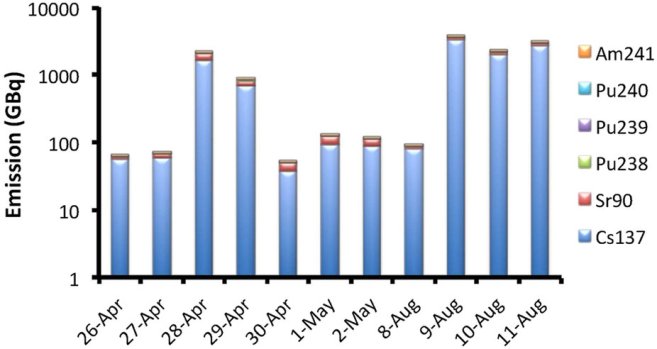
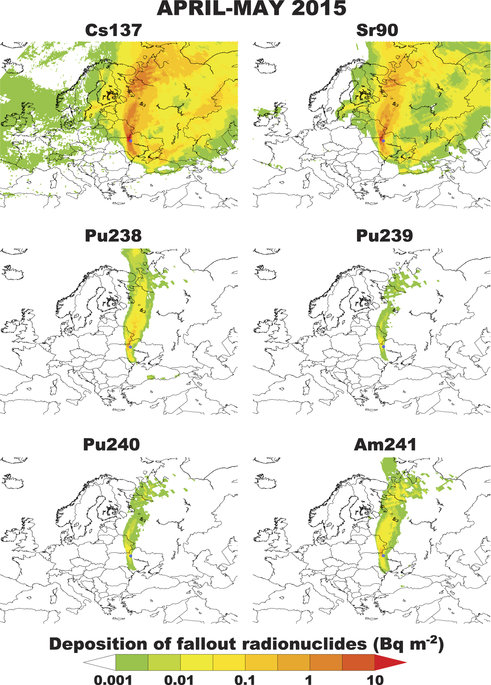
In April and August 2015, two major fires in the Chernobyl Exclusion Zone (CEZ) caused concerns about the secondary radioactive contamination that might have spread over Europe. The present paper assessed, for the first time, the impact of these fires over Europe. About 10.9 TBq of 137Cs, 1.5 TBq of 90Sr, 7.8 GBq of 238Pu, 6.3 GBq of 239Pu, 9.4 GBq of 240Pu and 29.7 GBq of 241Am were released from both fire events corresponding to a serious event. The more labile elements escaped easier from the CEZ, whereas the larger refractory particles were removed more efficiently from the atmosphere mainly affecting the CEZ and its vicinity. During the spring 2015 fires, about 93% of the labile and 97% of the refractory particles ended in Eastern European countries. Similarly, during the summer 2015 fires, about 75% of the labile and 59% of the refractory radionuclides were exported from the CEZ with the majority depositing in Belarus and Russia. Effective doses were above 1 mSv y−1 in the CEZ, but much lower in the rest of Europe contributing an additional dose to the Eastern European population, which is far below a dose from a medical X-ray.
On Sunday 26th April 2015 at 23.30 (local time), exactly 29 years after the Chernobyl Nuclear Power Plant (CNPP) accident, a massive fire started in the Chernobyl Exclusion Zone (CEZ). The next morning (April 27th) at 07.30 the fire was partially stabilised and the fire-fighters focused on only two areas of 4.2 and 4.0 hectares. However, the fire spread to neighbouring areas due to the prevailing strong winds. During the night of April 27th to 28th, 2015, the fire spread to areas close to the Radioactive Waste Disposal Point (RWDP), and burned around 10% of the grassland area at the western of the RWDP1. On April 29th and 30th, 2015, the attempts to stop the fires in the CEZ did not succeed. Fire brigades from Chernobyl and Kiev region supported extinguishing attempts and the last 70 ha were suppressed on May 2nd, 2015. The radiation background is continuously monitored in the CEZ by an automated radiation monitoring system (ARMS) at 39 points1. Given the importance of this fire, background radiation and radionuclide content in the air near the fire were also analysed online.
Another less intensive fire episode took place in August 2015. About 32 hectares were initially burned in the CEZ on August 8th 2. The fires started at three locations in the Ivankovsky area. As of 07.00 on August 9th, the fires had been reportedly localized and fire-fighters continued to extinguish the burning of dry grass and forest. The same fire affected another forested area, known as Chernobylskaya Pushcha. The fire spread through several abandoned villages located in the unconditional (mandatory) resettlement zones of the CEZ and ended on August 11th.
Forest fires can cause resuspension of radionuclides in contaminated areas3. This has caused concern about possible fires in heavily contaminated areas such as the CEZ4. While concerns were initially limited to the vicinity of the fires, Wotawa et al.5 have shown that radionuclides resuspended by forest fires can be transported even over intercontinental distances. Earlier in 2015, Evangeliou et al.6, based on a detailed analysis of the current state of the radioactive forests in Ukraine and Belarus, reported that forest cover in the CEZ has increased from about 50% in 1986 to more than 70% today. Precipitation has declined and temperature has increased substantially making the ecosystem vulnerable to extensive drought. Analysis of future climate using IPCC’s (Intergovernmental Panel on Climate Change) REMO (REgional MOdel) A1B climatic scenario7 showed that the risk of fire in the CEZ is expected to increase further as a result of drought accompanied by lack of forest management (e.g. thinning) and deteriorating fire extinguishing services due to restricted funding. The same group8 considered different scenarios of wildfires burning 10%, 50% and 100% of the contaminated forests. They found that the associated releases of radioactivity would be of such a magnitude that it would be identical to an accident with local and wider consequences9. The additional expected lifetime mortalities due to all solid cancers could reach at least 100 individuals in the worst-case scenario.
This paper aims at defining the extent of the radioactive contamination after fires that started in the CEZ on April 26th (ended 7 days after) and August 8th (ended 4 days after) 2015. We study the emission of the labile long-lived radionuclides 137Cs (t½ = 30.2 y) and 90Sr (t½ = 28.8 y) and the refractory 238Pu (t½ = 87.7 y), 239Pu (t½ = 24,100 y), 240Pu (t½ = 6,563 y) and 241Am (t½ = 432.2 y). These species constitute the radionuclides remaining in significant amounts since the Chernobyl accident about 30 years ago, and their deposition has been monitored continuously by the Ukrainian authorities. The respective deposition measurements have been adopted from Kashparov et al.10,11 and are stored in NILU’s repository website (http://radio.nilu.no). Using an atmospheric dispersion model, we simulate the atmospheric transport and deposition of the radioactive plume released by the forest fires. We also estimate the internal and external exposure of the population living in the path of the radioactive smoke. We assess the significance of the emissions with respect to the INES scale and define the regions over Europe, which were the most severely affected.
See more at: http://www.nature.com/articles/srep26062

Fukui Prefecture plans tax on spent nuclear fuel
FUKUI – The Fukui Prefectural Government is planning to submit an ordinance to an assembly session next month that calls for a tax on spent nuclear fuel stored at nuclear plants in the prefecture, informed sources said Thursday.
The ordinance is aimed at encouraging nuclear plant operators to transfer spent fuel outside the prefecture, the sources said.
It will propose a tax of ¥1,000 per kilogram of spent nuclear fuel that has been cooled for over five years at storage pools and is ready to be relocated.
If the ordinance is passed by the assembly, the prefecture will put it into effect on Nov. 10 after receiving approval from the internal affairs minister.
Fukui will become the first prefecture to tax spent nuclear fuel. Among municipalities, the city of Kashiwazaki, Niigata Prefecture, has a spent nuclear fuel tax. Kashiwazaki and the neighboring village of Kariwa host Tokyo Electric Power Co. Holdings Inc.’s Kashiwazaki-Kariwa nuclear plant.
The Fukui Prefectural Government currently collects nuclear fuel tax from power companies based on thermal output of nuclear reactors at their facilities. Its annual revenue from the tax stands at some ¥6 billion.
The planned new tax is estimated to increase the prefecture’s annual tax revenue by about ¥3 billion, the sources said.
The ordinance will also call for expanding the scope of reactors subject to the existing tax to include those in the decommissioning process — the first such move by a local government in Japan, the sources said.
Currently, local governments cannot impose such nuclear fuel tax on reactors for which the Nuclear Regulation Authority has approved decommissioning.
Noting that safety measures are necessary as long as radioactive materials remain, an official of the Fukui Prefectural Government’s tax division said that the prefecture aims to keep imposing tax until decommissioning is completed.
The amount of the existing nuclear fuel tax will be halved for reactors in the decommissioning process, the sources said.
Among reactors in Fukui, decisions for decommissioning have been made for the No. 1 unit at Japan Atomic Power Co.’s Tsuruga plant, the No. 1 and No. 2 units at Kansai Electric Power Co.’s Mihama plant, and the Japan Atomic Energy Agency’s Fugen advanced converter reactor.
INSIGHT: Fukushima’s ‘caldrons of hell’ keep questions unanswered

A convenience store in Okuma, Fukushima Prefecture, on March 12, 2016, remains as it was when the 2011 earthquake and tsunami triggered the nuclear accident
After spending slightly more than two years in the capital of Fukushima Prefecture, I was assigned to The Asahi Shimbun’s Tokyo head office starting on May 1. I moved house the other day.
I had previously never been based in Fukushima, although I have long covered energy policy and a number of nuclear accidents as a reporter for the newspaper.
On April 11, 2014, shortly after I was assigned to Fukushima, I was told the words that would serve as a starting point for my news-gathering activities there. I am citing that phrase, which I quoted in a previous column, for a second time here:
“Whatever the future of nuclear power generation, it will remain essential to expand renewable energy sources to ensure a stable energy supply and to fight global warming. Fukushima Prefecture has swaths of land and a historical background for doing so.
The energy industry has always been its leading local industry. The prefecture is home to the Joban coal field, and Iwaki was a city of coal mines. Nobody will be able to change Japan unless Fukushima takes it upon itself to do the task.”
The remark was made by Yukihiro Higashi, then professor of thermal energy at Iwaki Meisei University.
After the Great East Japan Earthquake and tsunami triggered the Fukushima nuclear disaster in 2011, the Fukushima prefectural government defined “building communities that do not rely on nuclear energy” as a leading principle of its post-disaster rebuilding efforts.
It set a goal of having renewable energy sources cover all energy demand in the prefecture by around 2040. Higashi played a central role in working out that vision.
The goal may seem preposterous, but the professor’s remarks led me to realize that it isn’t.
LEADING ENERGY PLAYER
Fukushima Prefecture produced 10 percent of Japan’s electricity before it was hit by the nuclear disaster. Most of that electricity was sent to the greater Tokyo area, so the prefecture was sometimes sarcastically referred to as a “colony of Tokyo.”
But all that would have been impossible had it not been for the “swaths of land” and the “historical background” suitable to having electric power generated there.
Energy has always been the representative local product of Fukushima Prefecture. That history dates back to the late Edo Period (1603-1867), when the Joban coal field was discovered.
Energy created in the prefecture continued to support Japan’s modernization even after electricity replaced coal as the leading player.
Living in Fukushima Prefecture provides plenty of opportunities to learn about that history.
A cluster of old hydroelectric plants stands in the environs of Lake Inawashiroko. A dozen of these plants, which were built during the Meiji (1868-1912) and Taisho (1912-1926) eras and taken over by Tokyo Electric Power Co., continue to send electricity to the greater Tokyo area to this day.
A step-like array of hydroelectric plants along the Tadamigawa river in the prefecture’s western Oku-Aizu district was built in the postwar period in a desperate drive to “rebuild Japan.”
Both hydroelectric undertakings drew on the bountiful water resources that are the blessings of the prefecture’s terrain.
Nuclear reactors and a bunch of giant thermal power plants began to spring up along the Pacific coast during the high economic growth of the postwar period.
When cast in the context of that history, the goal set forth by the prefectural government appears to betray the pride of its own “leading local industry.” The prefecture’s people pledged that they are the ones who will replace the leading player of energy.
Ten days after I met Higashi, I visited the Yamatogawa Shuzoten sake brewery in Kitakata, Fukushima Prefecture, to see Yauemon Sato, the ninth-generation chief of the brewery, which has been operating since the mid-Edo Period.
Sato had founded Aizu Electric Power Co. in August 2013, setting out on an ambitious plan to help rebuild the prefecture by means of renewable energy sources.
“You know the caldron of hell?” Sato asked me. “You will be sent to hell and will be boiled in that caldron if you do evil. There are four such caldrons in Fukushima Prefecture. And they are still gaping.”
The No. 1 through No. 4 reactors of TEPCO’s Fukushima No. 1 nuclear power plant, which caused a calamity that will go down in the history of humankind, could certainly be called “caldrons of hell.”
The use of renewable energy sources is a means for closing those caldrons and for obliterating them from Fukushima Prefecture.
More than two years later, the use of renewable energy sources is steadily gaining ground in the prefecture, covering 26.6 percent of all energy demand as of the end of March. The goal remains far in the distance, but the ratio has been gaining about 1 percentage point every year.
The caldrons are still gaping. TEPCO has yet to solve the question of how to block groundwater from flowing into the reactor buildings, which is only increasing the stockpile of water contaminated by radioactive substances. That is preventing the utility from starting serious work to decommission the reactors.
LEFT IN LIMBO
“What should we do?” a 59-year-old woman, evacuated from Okuma, which co-hosts the crippled nuclear power plant, to Koriyama, also in Fukushima Prefecture, asked me when I interviewed her about a year ago.
“Should we go on with our new life here, or should we return to our hometown? My thoughts remain in limbo, and I cannot get around to making up my mind.”
I did not know how to answer her question.
More than 94,000 people of Fukushima Prefecture continue to live as evacuees. The government of the town of Okuma, where all residents remain evacuated, plans to create a rebuilding base with a “habitable environment,” hopefully by fiscal 2018.
But full rebuilding of the town lies far beyond that goal. And that is leaving many people “in limbo.”
What should we do? My pursuit of that unanswered question will continue.
1 This Month

of the week – Shut Down Drone Warfare!


Tell the Ukrainian Government to Drop Prosecution of Peace Activist Yurii Sheliazhenko

Petition to revoke the licensing of the Near Surface Nuclear Disposal Facility (NSDF) at Chalk River. https://www.ourcommons.ca/petitions/en/Petition/Details?Petition=e-7247
To see nuclear-related stories in greater depth and intensity – go to https://nuclearinformation.wordpress.com
-
Archives
- April 2026 (114)
- March 2026 (251)
- February 2026 (268)
- January 2026 (308)
- December 2025 (358)
- November 2025 (359)
- October 2025 (376)
- September 2025 (257)
- August 2025 (319)
- July 2025 (230)
- June 2025 (348)
- May 2025 (261)
-
Categories
- 1
- 1 NUCLEAR ISSUES
- business and costs
- climate change
- culture and arts
- ENERGY
- environment
- health
- history
- indigenous issues
- Legal
- marketing of nuclear
- media
- opposition to nuclear
- PERSONAL STORIES
- politics
- politics international
- Religion and ethics
- safety
- secrets,lies and civil liberties
- spinbuster
- technology
- Uranium
- wastes
- weapons and war
- Women
- 2 WORLD
- ACTION
- AFRICA
- Atrocities
- AUSTRALIA
- Christina's notes
- Christina's themes
- culture and arts
- Events
- Fuk 2022
- Fuk 2023
- Fukushima 2017
- Fukushima 2018
- fukushima 2019
- Fukushima 2020
- Fukushima 2021
- general
- global warming
- Humour (God we need it)
- Nuclear
- RARE EARTHS
- Reference
- resources – print
- Resources -audiovicual
- Weekly Newsletter
- World
- World Nuclear
- YouTube
-
RSS
Entries RSS
Comments RSS
 nuclear-news