Belgium: staff refused access following news that terrorists had considered attack on nuclear plant
 Nuclear Staff Lose Access After Brussels Attacks http://news.sky.com/story/1666949/nuclear-staff-lose-access-after-brussels-attacks 25 Mar 16
A number of workers at the Tihange plant have their passes withdrawn as reports say nuclear sites could have been targeted. The entry badges of some workers at Belgium’s nuclear sites have been withdrawn amid reports the suicide bombers who attacked Brussels may have originally planned to target a nuclear power plant.
Nuclear control agency spokeswoman Nele Scheerlinck confirmed that “in recent days, several people have been refused access to the nuclear sites”.
The El Bakraoui brothers, who blew themselves up at the airport and metro station on Tuesday, had secretly filmed the home of the head of Belgium’s nuclear research and development programme, it has been reported. :: Terror Suspect Linked To Paris Ringleader The footage recorded the nuclear chief’s routine and caused investigators to conclude the terrorists “could have put national security in danger like never before”, according to Belgian media.
However, the arrest of Paris attacker Salah Abdeslam forced them to switch to targets, said reports.
A police source is quoted as saying: “There is no doubt that they rushed their operations because they felt under pressure. “Even if one couldn’t prevent these (Brussels) attacks, one can say that their magnitude could have been much bigger if the terrorists had been able to implement their original plan and not opted for easier targets.”
In the immediate aftermath of Tuesday’s attacks at the airport and subway, security was boosted around Belgium’s nuclear sites and hundreds of staff were evacuated.
Belgian media reports said 11 staff had their badges withdrawn at the Tihange plant. Ms Scheerlinck said the move is “not necessarily linked with the terrorist attacks”. However, she added that the decision usually takes weeks and is based on information from the intelligence services and police, as well as a person’s criminal record.
The head of the UN’s nuclear watchdog warned of Friday that countries need to do more to prevent “nuclear terrorism”.Yukiya Amano, the head of the International Atomic Energy Agency, said that it was not impossible that militants could manufacture a “primitive” device. It is now an old technology and nowadays terrorists have the means, the knowledge and the information,” he said.
Mr Amano also warned about the dangers of a “dirty bomb”. “Dirty bombs will be enough to (drive) any big city in the world into panic,” he said. “And the psychological, economic and political implications would be enormous.”
Ten disturbing facts about Ukraine’s nuclear power station s
But this can be changed.
The European Commission, the European Parliament, and EU governments – particularly in neighouring countries that could be affected by the Ukrainian government’s reckless nuclear adventure – need to demand Ukraine complies with its international obligations, especially when EU public money is involved.
For more on this Bankwatch campaign see here.

Ten things the Ukrainian government doesn’t want you to know about its nuclear energy plans http://stories.bankwatch.org/10things March 2016, The Ukrainian government appears willing to go to great lengths to make sure that people don’t talk too much about the plans it has for its ageing nuclear stations.
On Wednesday, March 23, the Supreme Economic Court if Ukraine will hear an appeal case by activsts who were sued for defamation for warning about the risk of the country’s continued dependence on outdated nuclear reactors.
The lawsuit was brought by Ukraine’s state-run nuclear operator Energoatom and the governmental nuclear energy regulator (SNRIU) in what appears as an attempt to discourage public participation in the important debate on this issue.
But this move is indicative of the Ukrainian government’s approach. Kiev has also been ignoring the opinions of people in neighbouring countries who could be affected by its nuclear plans, despite a legal obligation to consult them under international treaties.
So, what is it that Ukraine is so keen to hide? Here’s the complete lowdown:
1. Ukraine has 15 nuclear energy reactors and 6 of them will reach their expiry date by May 2020. Four others are already operating beyond their design lifetime, and two more were shut down as soon as they exceeded their original lifespan, in December and in February. Yet, Kiev is determined to keep all eight units going for at least 10 more years beyond their original expiry date.
3. All of Ukraine’s nuclear power plants are completely dependent on Russia for their fuel. And that’s not all. Three of the four nuclear stations are also dependent on Russia for either the reprocessing of spent fuel or its storage.
4. Even though most of these nuclear units will reach their expiry date in the next four years, EU taxpayer money is used for their renovation.How much? EUR 600 million from Euratom and the European Bank for Reconstruction and Development. For proportions, this is a quarter of the total EU support to Ukraine’s energy sector between 2007-2014.
5. International conventions oblige Ukraine to launch public consultations with neighbouring countries that could be affected by the prolonged operations of these nuclear stations. But so far, Kiev has consistently refused to do so. The Aarhus Convention and the Espoo Convention also stipulate that transboundary environmental impact assessments need to be carried out in such cases. Complying with these requirements is also an explicit condition of the European loans. But the Ukrainian government remains defiant.
6. Ukraine has already been found in breach of the Espoo Convention.The ruling came after it had authorized lifetime extensions for two of the units at the Rivne nuclear power plant, located less than 200 kilometres from the border with Poland. Ukrainian authorities are, unsurprisingly, challenging this ruling.
7. The Ukrainian government cannot guarantee the safety of any nuclear power plant. Since January 2015 a governmental decree prevents the nuclear energy regulator from carrying out inspections in nuclear facilities on its own initiative.
8. At least one of the four nuclear reactors already working beyond their design lifetime is in a dangerous condition. An independent expert analysis released in March 2015 found that the pressure vessel of unit 1 at the South Ukraine nuclear power plant suffers critical vulnerabilities that could potentially lead to a dangerous nuclear emergency. The state nuclear regulator disputes these findings, of course. But no matter how much is invested into renovations, a nuclear unit’s pressure vessel is one of the elements that simply cannot be replaced.
9. The Zaporizhia nuclear power plant in southeast Ukraine is Europe’s largest. It is also just 250 kilometres from the frontlines of the ongoing armed conflict in eastern Ukraine. This has officials at the power plant obviously concerned: 10. And all of this is even more urgent than you think.
Two of the oldest units in the Zaporizhia nuclear power plant were taken off the grid once they reached their expiry dates. But in two months, on May 12 and May 28, Ukraine’s nuclear regulator will consider again a lifetime extension for both reactors. Worried? So are we.
But this can be changed.
The European Commission, the European Parliament, and EU governments – particularly in neighouring countries that could be affected by the Ukrainian government’s reckless nuclear adventure – need to demand Ukraine complies with its international obligations, especially when EU public money is involved.
For more on this Bankwatch campaign see here.
Military presence increased at Belgium’s nuclear power stations
Belgium steps up security at nuclear sites in wake of attacks Military presence increased at Tihange and Doel plants as officials continue previous investigation of a secret video shot by man linked to Paris attacks, Guardian, Angelique Chrisafis 25 Mar 16 Belgian authorities have stepped up security at nuclear sites but safety officials said there was no concrete element to suggest a specific threat against the country’s reactors or plants.
Secret video footage of a senior Belgian nuclear official was found in November at the home of a Belgian man, Mohamed Bakkali, suspected to be part of the logistics network for November’s Paris attacks that killed 130 people.
The 10-hour video, shot by a hidden camera in a bush, showed a senior nuclear official coming and going out of his home in the Flanders region. …….
Earlier this month, the government had deployed 140 soldiers to guard nuclear sites………
Increased safety procedures in Belgium include system controls, screening who has access to the site, and strengthening the security in and around the site.
Belgian police are continuing to investigate a mysterious case of sabotage at part of the Doel power station in 2014. No explanation for the sabotage has yet been put forward.
In 2014, Belgian media reported that Ilyas Boughalab, 26, who was tried in absentia for his part in a “jihadi” recruitment network in Antwerp, had worked for three years as a technician for a sub-contractor with access to some areas the Doel nuclear plant. He died in Syria after leaving in 2012. http://www.theguardian.com/world/2016/mar/25/belgium-steps-up-security-at-nuclear-sites-in-wake-of-attacks
Solar WINDOWS (not panels)
 AMAZING IOT #8: SOLAR WINDOWS (NOT PANELS!) ST Smarter Together, 16 Mar 16 A handful of startups are heading toward a new window of opportunity: solar powered windows. If you think about all of the windows in the world – Manhattan alone has 10.7 million windows – creating a window that allows businesses to save on energy costs would be breaking into an almost unimaginably huge market.
Solar powered windows sound conceptually like an oxymoron: Solar panels absorb and reflect light while windows let light through. Various startups have proposed different solutions to this issue which, at its heart, is a serious one. The company Solaria, uses thin strips of photovoltaics on already existing glass, making windows appear pin-striped. Another startup called Oxford Photvoltaics uses perovskite – an oxide used for superconductors – in order to capture solar energy. ………. competitor Richard Lunt and his team at Michigan State University created solar panel windows with a new method called Transparent Luminescent Solar Concentrator (TSLC). This method has the photovoltaic strips on the edge of the glass, allowing the window to be more transparent than the other two……..http://smartertogether.telenorconnexion.com/2016/03/amazing-iot-8-solar-windows-not-panels/
Kakrapar radiation leakage highlights need for investigation of All of India’s nuclear reactors
Kakrapar leakage: Call for stronger regulation, investigation Of all nuclear reactors in the country, after determining what went wrong at the atomic power station, termed ‘lucky’ for having a radiation disaster averted, Business Standard, BS Reporter | Ahmedabad March 26, 2016 Those worried say Kakrapar was lucky to have witnessed leakage of heavy and light water from the coolant channel without any serious damage to fuel bundles in the reactor
The recent leak in coolant channels of the unit-1 reactor at the Kakrapar Atomic Power Station (KAPS, near Surat in Gujarat) is a warning which necessitates thorough investigation of all such reactors in the country, experts say.
At 9 am on March 11, a leakage in the Primary Heat Transfer (PHT) system led to the reactor being shut down and a plant emergency declared at KAPS. It has two units of pressurised heavy water reactors of 220 Mw each;Nuclear Power Corporation of India (NPCI) is the operator. According to site officials, one of the channels carrying the fuel bundles and the heavy water coolant had leaked. The high-grade radioactivity from the fuel itself was confined within the fuel bundles and no radioactive substances escaped from the reactor containment building.
The Atomic Energy Regulatory Board (AERB) has stated that, as of now, KAPS’ Unit-1 is in a shutdown state, even as all plant systems are “functioning normally”……
Any damage to fuel bundles could have resulted in thousands of times more severe radiation leakage from the reactor, and some of it could have eventually escaped into the public domain, he said.
Seconding him is nuclear activist and physicist Surendra Gadekar, monitoring the Indian nuclear industry since 1987. “The problem has been isolated but the fact is it took them 10 days to do that, with the plant emergency ending on March 22. They claim it is a ‘small leak’, which otherwise does not call for a plant emergency for 10 days. They were lucky that they didn’t find any radiation in a 20-km radius,” says Gadekar……. http://www.business-standard.com/article/current-affairs/kakrapar-leakage-call-for-stronger-regulation-investigation-116032500684_1.html
Spent nuclear fuel staying put near closed San Onofre nuclear power station
 Where is the San Onofre nuclear waste going? Spent fuel staying put for now, San Diego Union Tribune By Rob Nikolewski March 25, 2016 Some 3.6 million pounds of nuclear waste is stored at the now-shuttered San Onofre Nuclear Generating Station (SONGS) but when the waste will be transferred and where it will end up are still very open questions.
“I think everyone can agree we want to get the spent fuel off the San Onofre site sooner rather than later,” said Garry Brown, executive director and CEO of the nonprofit clean water organization Orange County Coastkeeper, Thursday night at the quarterly meeting of the Community Engagement Panel.
After the California Coastal Commission approved a site permit last October, a plan was approved to bury the waste in concrete casks within 125 feet of a seawall and the beach on a low-lying plain at the plant operated by Southern California Edison.
“We need to de-energize the plant as soon as we can,” Tom Palmisano, chief nuclear officer at Southern California Edison, told the 18-member panel during a Powerpoint presentation in Oceanside.
The prospect of casks on site has generated plenty of opposition. “We may never be able to move these,” said Gary Headrick, co-founder of San Clemente Green. “These storage containers are not reliable.”….
Among the problems is the near-paralysis on the part of the federal government to permanently deal with nuclear waste……..http://www.sandiegouniontribune.com/news/2016/mar/25/songs-nuclear-waste/
Vulnerability of San Onofre’s nuclear wastes

 Concerns over nuclear waste stored at San Onofre http://www.cbs8.com/story/31565017/concerns-over-nuclear-waste-stored-at-san-onofrePosted: Mar 26, 2016 SAN DIEGO (CBS 8) – North County residents voice their concerns over the plan to store nuclear waste at the former San Onofre power plant Thursday.
The troubled plant closed four years ago, but the spent fuel could be there for much longer.The process of decommissioning it is expected to be complete by the year 2030.
Some say it’s a plan that has sparked concern over the public safety.
“This nuclear waste at this site is as vulnerable a target as you can possibly have for the terrorist to attack us here,” Mike Aguirre, San Diego Attorney said.
Representatives from Southern California Edison countered that the stored fuel would not be a vulnerable target.
“We have a well-trained security force, reviewed and approved by the NRC to meet, what they consider the credible threats that we need to meet,” Thomas Palmisano said.
The Department of Energy has made a push to create temporary storage sites in west Texas and New Mexico. If the plan gets the green light, it could expedite the removal of nuclear waste from San Onofre.
USA’s nuclear industry in death spiral?
 Has U.S. Nuclear Power’s Death Spiral Begun? With carbon markets and subsidies in doubt, nuclear is no longer affordable IEEE Spectrum, By Peter Fairley 25 Mar 2016 U.S. nuclear power plant operators are fighting a war on two fronts: Crashing prices for natural gas and accelerating market penetration of renewable energy have both contributed to dramatic drops in wholesale power price levels—in some states, they’ve fallen by more than two-thirds over the past decade. This has left nuclear power, whose operating costs are pretty much fixed, with few options other than surrender.
That marks quite a reversal, says Gregory Jaczko, former chairman of the U.S. Nuclear Regulatory Commission. “It’s been a widely held belief that nuclear is incredibly cheap to operate. That was the case 10 years ago, when nuclear plants were cash cows. That’s not the case today, especially as the plants age,” he says.
Fission is already giving ground. Two plants, in Wisconsin and Vermont, shut down in 2013 and 2014, respectively. More shutdowns are anticipated in Massachusetts, New Jersey, and New York, and at least half a dozen more plants are teetering on the brink of insolvency.
Nuclear operators had been expecting President Obama’s Clean Power Plan, which would have established national carbon regulations and increased the cost of fossil-fuel-generated electricity, to offer them a reprieve. But their hope was short-lived: The U.S. Supreme Court decided in February to stay implementation of the plan.

Operators’ next best hope is that state governments will be motivated to step in and save them. ……
By June, state regulators plan to detail special payments for New York’s nuclear plants. For companies that open their books and show that their plants are losing money, New York is vowing to make them whole.
“It’s probably the stickiest energy policy question there is in the electric sector,” says Julien Dumoulin-Smith, a senior power markets analyst with New York City–based UBS Investment Research.
New York is not alone. Several states, including Illinois and Ohio, are seeking to give nuclear power plants an extra boost. Exelon lists the dual-reactor Quad Cities site in Illinois among its uncompetitive plants. Dumoulin-Smith says local power prices are being “pummeled” by wind power, noting that Quad Cities sits just across the border from Iowa, which leads the United States in wind power penetration.
Quad Cities, along with Exelon’s nine other reactors in Illinois, caught a break from regional grid operator PJM, which last year began offering more supplements to power plants that commit to staying in its energy market for several years, thus backstopping its power supply. Those Illinois plants raked in more than US $1.5 billion from PJM’s capacity market last September, ensuring that Quad Cities will remain in operation through mid-2018.
But experts say that tougher times could lie ahead, as the extension of tax breaks for wind and solar power voted through the U.S. Congress in December fuels further growth in renewable generation. New York’s program appears to anticipate this, positing that assistance to nuclear reactors is more of a temporary lifeline than a long-term guarantee. State aid is, according to a white paper from the N.Y. Public Service Commission, a means of supporting “a smooth emission-free transition from nuclear to nonnuclear resources” in the event that energy prices “are not able to support the continued financial viability of the [fission] plants.” This article appears in the March 2016 print issue as “U.S. Fission Fizzles.” http://spectrum.ieee.org/energy/nuclear/has-us-nuclear-powers-death-spiral-begun
March 25 Energy News

Science and Technology:
¶ A colorful goop, developed at the University of Toronto, could be a real-life blockbuster. When spread on a strip of metal and subjected to an electric current, it can break apart molecules of water at about three times the rate and far more cheaply than any substance currently available. [The Globe and Mail]
 The University of Toronto has developed a catalyst that could improve energy storage. (Marit Mitchell/University of Toronto)
World:
¶ India’s massive solar power capacity addition target is expected to revolutionize the Indian jobs market. According to a report by the Natural Resources and Defense Council, India may end up creating over a million new jobs in its endeavor to have 100 GW of solar capacity by March 2022. [Sustainovate]
¶ Chinese media reported that the country’s National Energy Administration ordered 13 provincial governments to suspend approvals of new coal-fired…
View original post 676 more words
TEPCO draws fire after apologizing to Niigata panel
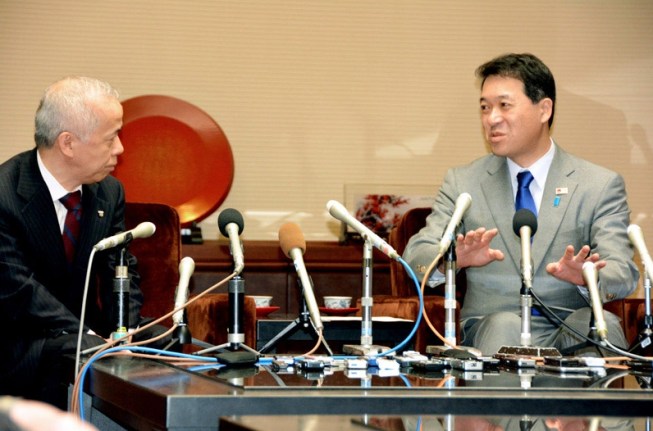
Niigata Governor Hirohiko Izumida, right, and Naomi Hirose, president of Tokyo Electric Power Co., hold a meeting at the Niigata prefectural government building in January.
NIIGATA–Even when they apologize, executives of Tokyo Electric Power Co. can still manage to draw additional criticism.
The executives, who hope to restart one of the largest nuclear power plants in the world in Niigata Prefecture, held talks here March 23 with a nuclear technology committee set up at the prefectural government.
Takafumi Anegawa, chief nuclear officer of TEPCO, offered an apology for the utility’s misleading responses to the committee’s repeated inquiries about the meltdowns at the Fukushima No. 1 nuclear power plant.
Specifically, Anegawa acknowledged that TEPCO could have declared the triple meltdown at the plant a few days after the crisis unfolded following the Great East Japan Earthquake and tsunami on March 11, 2011, instead of two months later.
TEPCO said late last month that it had found a passage detailing the criteria of a meltdown in its emergency response manual. Had the company known about that passage when the accident started, TEPCO said, it could have declared the meltdowns earlier.
When pressed by the Niigata committee on March 23 on why it took five years to find such an important passage in the emergency manual, the TEPCO executives did not give an explanation, saying the matter was still under investigation.
Committee members voiced their displeasure.
“Why did TEPCO turn it up now?” asked Masaaki Tateishi, professor emeritus of sedimentology at Niigata University. “It is out of the question for TEPCO to seek to restart its reactors, given its corporate culture.”
Mitsuhiko Tanaka, a journalist covering nuclear technology and a committee member, said TEPCO has again shown its slipshod approach toward dealing with an accident.
“TEPCO must have produced the manual but did not read it,” he said. “What it comes down to is that (its employees) had not been well trained.”
TEPCO plans to bring online two of the seven reactors at the Kashiwazaki-Kariwa nuclear plant in Niigata Prefecture and has submitted a safety screening application to the Nuclear Regulation Authority.
The Kashiwazaki-Kariwa plant has a capacity of 8.21 gigawatts.
However, Niigata Governor Hirohiko Izumida remains cautious toward restarting the nuclear plant, even if the reactors meet the NRA’s stricter safety regulations that were set following the Fukushima nuclear disaster.
The governor believes the full picture of the Fukushima disaster has not been unveiled.
The Niigata nuclear technology committee has been looking into what went wrong at the Fukushima plant, even after the Diet and the government wrapped up their investigations into the nation’s worst nuclear accident.
In autumn 2013, the committee set up an investigative panel to determine why TEPCO’s official acknowledgment of the meltdowns was delayed.
The panel demanded explanations from the company. TEPCO said in a reply in November 2015 that what constitutes a meltdown “had not been defined” within the company.
The panel kept pressing TEPCO, and in late February, TEPCO admitted that the manual used at the time of the Fukushima disaster had a passage defining a meltdown.
Anegawa told the committee on March 23 that the passage was uncovered during an investigation conducted “with the utmost care” to determine whether the delay in reporting to the government the meltdowns and other aspects of the Fukushima accident violated the law.
However, he declined to discuss details of how the company came across the passage, saying a third-party panel comprising lawyers and other experts were studying the issue.
After the meeting, Anegawa told reporters that he regretted the company’s probe “was not thorough.” He did not say when the third-party panel will release its findings.
Committee chief Ken Nakajima, professor of reactor safety at Kyoto University’s Research Reactor Institute, said the committee will continue to demand explanations from TEPCO.
“Humans are the ones who must ensure the safety (of nuclear facilities),” he told reporters. “Trust in TEPCO has been eroding. We cannot move ahead unless we are convinced of the veracity of what the company says.”
Governor Izumida, who has long questioned TEPCO’s credibility, declined an offer from TEPCO President Naomi Hirose in January to collaborate in drawing up an evacuation plan for a possible emergency at the Kashiwazaki-Kariwa plant.
“We cannot evacuate if you hide a meltdown,” the governor told Hirose during the meeting at the prefectural government building.
Izumida’s distrust of the utility runs deep.
After the Fukushima accident unfolded, Izumida confronted TEPCO officials over their previous denials over the phone that meltdowns had occurred at the plant.
The governor insisted that nuclear fuel rods must have melted, but the TEPCO officials repeated their denials by drawing a diagram of the reactors.
http://ajw.asahi.com/article/behind_news/social_affairs/AJ201603240072
TEPCO apologizes for meltdown announcement delay
Tokyo Electric Power Company has apologized to a Niigata Prefectural Government panel for not realizing sooner that 3 reactors at its Fukushima Daiichi plant had melted down in March 2011.
The panel is studying the safety of the Kashiwazaki-Kariwa nuclear plant in the prefecture. Niigata has made verification of the details of the Fukushima accident a prerequisite for the plant’s restart.
TEPCO waited 2 months after the Fukushima accident to announce the meltdowns. The panel had questioned the delay. But TEPCO insisted it had no basis for making the determination.
Last month, nearly 5 years after the disaster, the utility revealed it could have declared the reactors had melted down 3 days after the accident if it had adhered to an in-house manual.
On Wednesday, Managing Executive Officer Takafumi Anegawa apologized to the panel. He said the utility should have realized and reported the existence of the manual sooner.
Panel members asked the utility why the manual went unnoticed for 5 years. They said the utility’s longstanding and false claim that it had no standards for determining a meltdown makes it an untrustworthy nuclear plant operator.
The prefectural panel says it will resume discussions after a panel of outside experts set up by TEPCO submits a report on the cause of the delay.
http://www3.nhk.or.jp/nhkworld/en/news/20160323_30/
TEPCO says 5.3 tons of tainted water leaked at nuclear plant
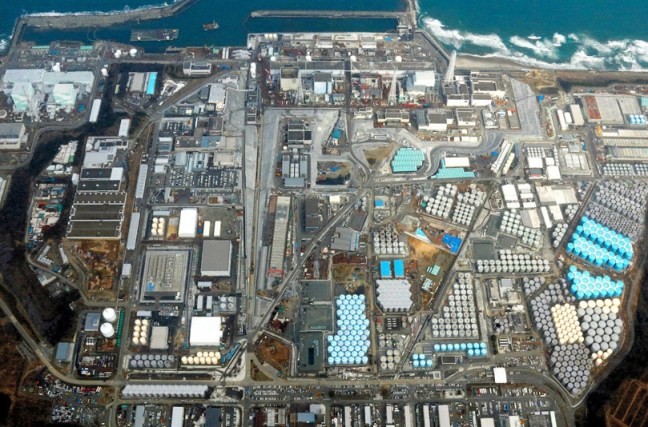
An estimated 5.3 tons of water contaminated with radiation leaked from a pipe in a building housing cesium removal equipment at the stricken Fukushima No. 1 nuclear power plant, the facility’s operator said.
The leaked water contained 383,000 becquerels of radioactive cesium per liter and 480,000 becquerels of beta ray-emitting radioactive substances per liter.
Tokyo Electric Power Co. said March 23 the water has not flowed outside the high temperature incinerator building. TEPCO said it was in the process of pumping up the water for storage.
The utility said workers doing remodeling work earlier in the day cut off a pipe inside the incinerator building. When workers subsequently operated radioactive material removal equipment in another building, contaminated water leaked from the cut section of the pipe to the floor of the incinerator building.
TEPCO said it is trying to determine the cause of the incident, adding that workers had confirmed that they closed a valve before cutting off the pipe to prevent water leakage
http://ajw.asahi.com/article/0311disaster/fukushima/AJ201603240048
Home solar energy is booming in USA
The Surprise New Boom Market for Residential Solar Huffington Post, By Barbara Grady 24 Mar 16 As the price of solar powered electricity keeps falling and rooftop panels pop up in an increasing number of neighborhoods, an interesting thing is shaping up in the market.
Residential solar is no longer for just well-to-do homeowners. Indeed, the growth market in solar is median- and low-income neighborhoods in California and other locales, according to multiple recent reports.

In 2015, a full 65 percent of residential solar getting installed in California was in zip codes with median household incomes of $70,000 or less, while just 6 percent of installations in the state were happening in neighborhoods with median household incomes above $100,000, according to a report from Kevala Analytics.
A surge in solar adoption — as well as a shift in where that adoption is taking place — is driven by economics that make solar the money saving option for electricity rate payers and by policies that offer flexible ways for people to benefit from solar.
In California, Massachusetts, New York, Colorado, the District of Columbia, Maryland and some other places, policies that extend the reach of solar to renters and residents without rooftops are widening the market for individual and community installations alike. Financing mechanisms prevalent in some markets but not in others have also made it possible for people to opt for solar without requiring they have money for big upfront costs.
Federal policies adopted in the last couple of years, such as Property Assessed Clean Energy loan funds, and National Community Solar programs have helped. …..http://www.huffingtonpost.com/greenbiz-group/residential-solars-new-bo_b_9526460.html
Brussels attack renews fears over nuclear sites as targets for terrorism
 Terror Cell Probe Puts Spotlight on Nuclear Concerns Belgium evacuated its nuclear
facilities after Brussels bombing; staffers returned to work under strict security By MATTHIAS VERBERGT and GABRIELE STEINHAUSER, WSJ March 24, 2016
BRUSSELS—The investigation into the Islamic State cell behind the Paris and Brussels attacks has renewed concerns about terrorists’ efforts to get their hands on radioactive material.
Belgium’s federal prosecutor said last month that police had discovered a 10-hour tape showing the home of a man working in Belgium’s “nuclear world” during a house search linked to the Paris attacks. The recording came from a surveillance camera installed in front of the man’s home, a spokesman for the prosecutor said at the time.
The same terrorist cell has been tied to Tuesday’s bloodshed at Brussels’ international airport and a subway station.
Authorities around the globe have long feared that terrorists could get nuclear material to build a “dirty bomb” or launch an attack on a nuclear power plant. ………Belgium is especially vulnerable as a target because of the high terrorism threat and the fact that its seven nuclear reactors are at least 30 years old, said Tom Sauer, a nuclear terrorism specialist at Belgium’s University of Antwerp…….
Germany and other countries bordering Belgium have raised concerns about general safety standards at Belgium’s nuclear plants and questioned a Belgian decision late last year to extend the lifetime of the country’s oldest reactors in Doel and Tihange to 2025 from 2015.
In 2014, 65,000 liters of lubricating oil spilled down an emergency evacuation pipe at Doel’s fourth reactor in just over 30 minutes, causing the reactor’s stoppage. FANC at the time said it had “strong evidence” that this had been caused by a “deliberate manual act.” The perpetrator hasn’t been apprehended………
A study by the U.S. organization Nuclear Threat Initiative in January showed Belgian nuclear plants aren’t protected against cyberattacks, receiving the lowest score in the survey along with China, Iran and North Korea…….. Write to Matthias Verbergt at Matthias.Verbergt@wsj.com and Gabriele Steinhauser at gabriele.steinhauser@wsj.com http://www.wsj.com/articles/terror-cell-probe-puts-spotlight-on-nuclear-concerns-1458844289
Nuclear attack was the original plan of the Brussels bombers
 Brussels attackers initially considered nuclear site: Report http://www.torontosun.com/2016/03/24/brussels-attackers-initially-considered-nuclear-site-report REUTERS, MARCH 24, 2016 BRUSSELS – Suicide bombers who blew themselves up in Brussels were originally considering an attack on a nuclear site in Belgium, but arrests started last week may have forced them to switch to targets in the Belgian capital, the DH newspaper said.
Referring to an incident in December that prosecutors confirmed in which militants covertly filmed the home of an unidentified senior official in the nuclear industry, the paper quoted a police source as saying two of the suicide bombers, brothers Khalid and Ibrahim Bakraoui, had filmed the daily routine of the head of Belgium’s nuclear research and development programme.
The police source did not address why investigators thought they had continued to plan to go through with the plan despite the discovery of the covert video three months ago and the ramping up of security around nuclear plants as a result. The sensitive inner high-security areas of a nuclear power station would almost certainly have been beyond the reach of militants such as the Bakraouis.
A 10-hour video from a camera hidden in front of the nuclear official’s house was found in December during a police raid in Belgium, linked to the Paris attacks a month before.
On February 17, Belgian prosecutors confirmed the existence of the video seized in December and said the man in it was linked to the country’s nuclear industry. Earlier this month, 140 soldiers were dispatched to guard the country’s three nuclear sites. On Tuesday after the Brussels bombings, the sites were sealed and non-essential staff evacuated as a precaution.
While investigators had known the camera with the video had been removed from its concealment by two men, they did not know their identity. DH said it was now clear that it was the two brothers.
Investigators were not available for comment.
Any plans for an assault on a nuclear site, even a symbolic operation on the perimeter, might have been foiled by a police operation last week in the Brussels borough of Forest, the newspaper said. In that raid, officers unexpectedly stumbled upon armed men in a flat that was searched in connection to the Paris attacks investigation.
One of the men in the flat, later identified as an Algerian national called Mohammed Belkaid, was killed by police in a shootout and police believe one or two others may have escaped.
But clues found in the flat led the police to the arrest three days later of the prime surviving suspect in the Paris attacks Salah Abdeslam and another suspected militant Amine Choukri also using the name of Monir Ahmed Alaaj.
The arrests may have forced the hand of the attackers who decided to shift to targets in Brussels, focusing on the airport and metro: “There is no doubt that they rushed their operations because they felt under pressure,” the police source was quoted by DH as saying.
“Even if one couldn’t prevent these (Brussels) attacks, one can say that their magnitude could have been much bigger if the terrorists had been able to implement their original plan and not opted for easier targets,” said the police source.
According to Donald Trump – OK to nuclear bomb Syria?
 Donald Trump open to nuclear retaliation after Brussels attack By REENA FLORES CBS NEWS March 24, 2016, Donald Trump is not ruling out the use of nuclear weapons in the U.S. fight against the Islamic State of Iraq and Syria (ISIS), according to an interview with the GOP front-runner that aired on Bloomberg TV Wednesday.
Asked if he would consider nuclear retaliation after this week’s terror attacks in Brussels, Trump responded: “Well, I’m never gonna rule anything out. And I wouldn’t wanna say. Even if I felt — it wasn’t going — I wouldn’t wanna tell you that because, at a minimum, I want them to think maybe that we would use it.”
“The fact is that we need unpredictability,” Trump said of his openness to using nuclear weapons. “When you ask a question like that, it’s a very – it is a very sad thing to have to answer it because the enemy is watching and I have a very good chance of winning. I frankly don’t want the enemy to know how I’m thinking. But with that being said, I don’t rule out anything.”
When pressed on whether he would have utilized America’s nuclear capabilities after September 11, Trump said that he would only have used it as a “last resort.”
During his interview, Trump emphasized that terrorists “are winning” and “we don’t do anything about it.”……http://www.cbsnews.com/news/donald-trump-open-to-nuclear-retaliation-after-brussels-attack/
1 This Month

petition to oppose the rapid increase of space-military industry threatening Jeju Island and the region.
[Petition by April 19th (KST)] Stop the joint military-Hanwha Systems-Jeju Provincial Government Sea Launch!

Chernobyl: The Lost Tapes – A good documentary on Chernobyl on SBS available On Demand for the next 3 weeks– https://www.sbs.com.au/ondemand/tv-program/chernobyl-the-lost-tapes/2352741955560

of the week–London Campaign for Nuclear Disarmament

Tell the Ukrainian Government to Drop Prosecution of Peace Activist Yurii Sheliazhenko
To see nuclear-related stories in greater depth and intensity – go to https://nuclearinformation.wordpress.com
-
Archives
- April 2026 (194)
- March 2026 (251)
- February 2026 (268)
- January 2026 (308)
- December 2025 (358)
- November 2025 (359)
- October 2025 (376)
- September 2025 (257)
- August 2025 (319)
- July 2025 (230)
- June 2025 (348)
- May 2025 (261)
-
Categories
- 1
- 1 NUCLEAR ISSUES
- business and costs
- climate change
- culture and arts
- ENERGY
- environment
- health
- history
- indigenous issues
- Legal
- marketing of nuclear
- media
- opposition to nuclear
- PERSONAL STORIES
- politics
- politics international
- Religion and ethics
- safety
- secrets,lies and civil liberties
- spinbuster
- technology
- Uranium
- wastes
- weapons and war
- Women
- 2 WORLD
- ACTION
- AFRICA
- Atrocities
- AUSTRALIA
- Christina's notes
- Christina's themes
- culture and arts
- Events
- Fuk 2022
- Fuk 2023
- Fukushima 2017
- Fukushima 2018
- fukushima 2019
- Fukushima 2020
- Fukushima 2021
- general
- global warming
- Humour (God we need it)
- Nuclear
- RARE EARTHS
- Reference
- resources – print
- Resources -audiovicual
- Weekly Newsletter
- World
- World Nuclear
- YouTube
-
RSS
Entries RSS
Comments RSS
 nuclear-news