Why are US media Presidential candidates ignoring $trillion nuclear weapons spending?
Only Bernie Sanders has adopted a position of outright rejection. In May 2015, shortly after declaring his candidacy, Sanders was asked at a public meeting about the trillion dollar nuclear weapons program. He replied: “What all of this is about is our national priorities. Who are we as a people? Does Congress listen to the military-industrial complex” that “has never seen a war that they didn’t like? Or do we listen to the people of this country who are hurting?” In fact, Sanders is one of only three US Senators who support the SANE Act, legislation that would significantly reduce US government spending on nuclear weapons. In addition, on the campaign trail, Sanders has not only called for cuts in spending on nuclear weapons, but has affirmed his support for their total abolition.
 The Trillion Dollar Question the Media Have Neglected to Ask Presidential Candidates, Moyers and company The American people will be footing the bill — but, by and large, they haven’t heard much about our country’s planned trillion-dollar nuclear weapons upgrade.BY LAWRENCE WITTNER | MARCH 21, 2016 ISN’T IT RATHER ODD THAT AMERICA’S LARGEST SINGLE PUBLIC EXPENDITURE SCHEDULED FOR THE COMING DECADES HAS RECEIVED NO ATTENTION IN THE 2015-2016 PRESIDENTIAL DEBATES?
The expenditure is for a 30-year program to “modernize” the US nuclear arsenal and production facilities. Although President Obama began his administration with a dramatic public commitment to build a nuclear weapons-free world, that commitment has long ago dwindled and died. It has been replaced by an administration plan to build a new generation of US nuclear weapons and nuclear production facilities to last the nation well into the second half of the 21st century. This plan, which has received almost no attention by the mass media, includes redesigned nuclear warheads, as well as new nuclear bombers, submarines, land-based missiles, weapons labs and production plants. The estimated cost? $1,000,000,000,000.00 — or, for those readers unfamiliar with such lofty figures, $1 trillion.
Critics charge that the expenditure of this staggering sum will either bankrupt the country or, at the least, require massive cutbacks in funding for other federal government programs. “We’re… wondering how the heck we’re going to pay for it,” admitted Brian McKeon, an undersecretary of defense. And we’re “probably thanking our stars we won’t be here to have to have to answer the question,” he added with a chuckle.
This nuclear “modernization” plan violates the terms of the 1968 nuclear Non-Proliferation Treaty, which requires the nuclear powers to engage in nuclear disarmament.
The plan is also moving forward despite the fact that the US government already possesses roughly7,000 nuclear weapons that can easily destroy the world. Although climate change might end up accomplishing much the same thing, a nuclear war does have the advantage of terminating life on earth more rapidly.
This trillion-dollar nuclear weapons buildup has yet to inspire any questions about it by the moderators during the numerous presidential debates. Even so, in the course of the campaign, the presidential candidates have begun to reveal their attitudes toward it.
On the Republican side, the candidates — despite their professed distaste for federal expenditures and “big government” — have been enthusiastic supporters of this great leap forward in the nuclear arms race. Donald Trump, the frontrunner, contended in his presidential announcement speech that “our nuclear arsenal doesn’t work,” insisting that it is out of date. Although he didn’t mention the $1 trillion price tag for “modernization,” the program is clearly something he favors, especially given his campaign’s focus on building a US military machine “so big, powerful and strong that no one will mess with us.”
His Republican rivals have adopted a similar approach. ………
On the Democratic side, Hillary Clinton has been more ambiguous about her stance toward a dramatic expansion of the US nuclear arsenal. Asked by a peace activist about the trillion dollar nuclear plan, she replied that she would “look into that,” adding: “It doesn’t make sense to me.” Even so, like other issues that the former secretary of state has promised to “look into,” this one remains unresolved. Moreover, the “National Security” section of her campaign website promises that she will maintain the “strongest military the world has ever known” — not a propitious sign for critics of nuclear weapons.
Only Bernie Sanders has adopted a position of outright rejection. In May 2015, shortly after declaring his candidacy, Sanders was asked at a public meeting about the trillion dollar nuclear weapons program. He replied: “What all of this is about is our national priorities. Who are we as a people? Does Congress listen to the military-industrial complex” that “has never seen a war that they didn’t like? Or do we listen to the people of this country who are hurting?” In fact, Sanders is one of only three US Senators who support the SANE Act, legislation that would significantly reduce US government spending on nuclear weapons. In addition, on the campaign trail, Sanders has not only called for cuts in spending on nuclear weapons, but has affirmed his support for their total abolition…….http://billmoyers.com/story/the-trillion-dollar-question-the-media-have-neglected-to-ask-presidential-candidates/#.VvGf-fJH-yw.twitter
Large number of baby deaths close to nuclear contaminated site
 Cemetery full of dead babies missing brains next to US nuclear site — Funeral Director: Almost all infants we have died the same way… “that’s pretty much all I see on death certificates” — Few miles from “most contaminated place in hemisphere” — “One of largest documented anencephaly clusters in US history” (VIDEO) http://enenews.com/one-largest-documented-clusters-history-video?utm_source=feedburner&utm_medium=email&utm_campaign=Feed%3A+ENENews+%28Energy+News%29 March 23rd, 2016
Waiting for answers: a community copes with babies’ deaths
Seattle Times, updated Jan 28, 2016 (emphasis added): How the state is missing chances to find deadly birth defect’s cause… at least 40 other mothers have lost babies to [anencephaly, which result in missing large parts of the brain] in Yakima, Benton and Franklin counties since 2010… one of the largest documented clusters of anencephaly in U.S. history… “Something’s going on and someone needs to tell us,” said [mother Sally] Garcia… Dr. Lisa Galbraith was one of the doctors… In Prosser, the obstetrician oversaw care of Garcia’s pregnancy and others affected by the disorder… “I had a total of four or five babies with anencephaly over the course of two years,” recalled Galbraith… the rate of anencephaly was much higher [than US averages]… Washington health officials… have collected no blood samples, performed no genetic tests and conducted no examination of water, soil… and have no plans to do so… In Texas, just three babies withanencephaly sparked enough outrage to overhaul the state’s birth-defects reporting system.
Seattle Times video transcript – Carlen Majnarich, funeral director: “It’s tragic… It just seems like that’s pretty much all I see on the death certificate is the same diagnosis. And nobody seems to know why. We average close to 100 families a year here in Prosser [a few miles from Hanford]. Almost all the infants that we have have died of anencephaly. It’s just what do you say?”… Sally Garcia (mother who lost her baby to anencephaly): “All these on this side [of the cemetery] are all babies… all babies, starting from right there.”
The Legal Examiner, Dec 31, 2015: [T]he strange eruption of anencephaly cases, which occurs in Washington at a rate almost 5 times as high as the national average, has highlighted a number of government policies that may actually conceal these sort of birth defect “clusters,” rather than help investigate them.
KVEW-TV, Mar 4, 2016: As of November 2015 cases of anencephaly have continued to increase with the current rate at 9.5 per 10,000 live births.
Sara Barron, MS, BSN – American Journal of Nursing, Mar 2016: In the spring of 2012 two babies without brains were born within weeks of each other at the rural hospital in Washington State where I was working… I was stunned when the delivering physician said another patient was expecting the same outcome. After speaking with colleagues at neighboring hospitals, I learned that two other babies with anencephaly had recently been born in the area. In over 30 years of nursing, I had seen only two cases of anencephaly prior to these. I called the Washington State Department of Health and reported a birth defect cluster… RISK FACTORS…Radiation exposure. Popular media and blogs have often linked the Washington State NTD cluster to the Hanford Nuclear Reservation in Benton County, Washington. Althoughleaks from nuclear power plants have been associated with a higher rate of anencephalyand other NTDs, Washington State Department of Health investigators point out that the three counties with the highest prevalence of NTDs were both upwind and upriver of the Hanford site, making the nuclear plant an unlikely cause of the 2012 cluster.
- Bulletin of the Atomic Scientists: “The Hanford Site… is widely considered to be the most contaminated place in the Western Hemisphere”
- KOIN: “The biggest, most toxic nuclear waste site in the Western hemisphere”
- Time: “The largest nuclear clean-up site in the western hemisphere”
- AFP: “The Western hemisphere’s most contaminated nuclear site“”
More infant deaths near Hanford: Cemetery blocks filled w/ babies downwind of US nuclear site — Mother: My newborns died in hours… tumors all over, brain disintegrated after massive stroke — “Body parts, cadavers, fetuses… nuke industry took in the dead of night”
Danger of terror attacks on Germany’s nuclear stations
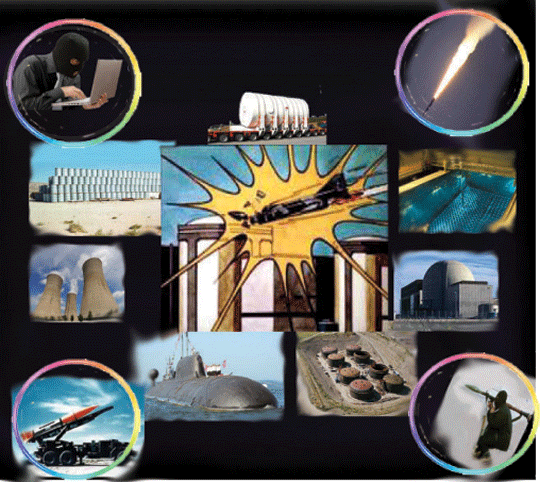 German nuclear plants are vulnerable to terrorist attacks – study Rt.com 24 Mar, 2016 Germany’s nuclear power plants are insufficiently protected against potential terror attacks, including 9/11-style ones, according to a newly-released study.
A nuclear plant’s smokescreen designed to prevent any attacks on it from air provides only minimal protection for the facility, Deutsche Presse-Agentur (DPA) news agency reported, citing findings presented by Oda Becker, a physicist and independent expert on nuclear plants, at the German Federation for the Environment and Nature Conservation (BUND) congress in Berlin on Thursday.
Such smokescreen “only slightly diminishes a chance of collision with a plane,” hijacked by terrorists. Additionally, only two out of eight currently operating nuclear plants in Germany are equipped with such systems, the report points out.
According to Becker’s research, another significant threat to German nuclear plants is posed by a possible terrorist attack using helicopters filled with explosives. A fall of an aircraft rigged with explosives on a nuclear plant could lead to a “massive release of radiation,” as nuclear facilities in Germany are not designed to withstand explosions of such scale.
Reliability tests have demonstrated that the plants’ personnel cannot possibly prevent terrorists from infiltrating the facility and committing a terrorist act there, the study adds.
In another study published March 8 and titled “Nuclear power 2016 – secure, clean, everything under control?” Becker listed insufficient security standards, natural disasters, terrorist attacks and emergencies caused by the deterioration of the German nuclear plants’ security systems as major threats to the industry.
“A serious accident is possible in case of every German nuclear plant,” she said at that time, adding that “there are no appropriate accident management plans.” Becker added that temporary nuclear waste storage sites can also pose a serious threat to people, as they can also be targeted by terrorists and lack relevant security systems.
“The interim [nuclear waste] storages lack protection against aircraft crashes and dangers posed by terrorists,” Becker said, adding that security aspects of the future nuclear waste storage should be discussed, including possible security upgrades of the existing storage sites and the establishment of new facilities.
According to Belgian media, Brussels suicide bombers Khalid and Ibrahim El-Bakraoui were already planning attacks on nuclear plants, although not in Germany but in Belgium. The arrest of Paris attacker Salah Abdeslam allegedly thwarted their plans and forced them to choose another target………
The recent news from Belgium has given some German politicians and activists additional cause for concern. Hubert Weiger, the head of the BUND, said that the Brussels attacks became another reason for immediate nuclear phase-out. “It is even more necessary than ever to abandon this technology,” he said, as quoted by DPA.
Eight nuclear plants remain operational in Germany, after Angela Merkel’s government decided to abandon the use of nuclear energy and immediately halt all operations on the country’s eight oldest nuclear plants in March 2011. Another plant was shut down in 2015. The remaining nuclear stations are due to be closed by 2022.
At the same time, Simone Peter, a co-chair of the German Green Party, demanded additional security checks at all European nuclear plants.
“EU nuclear power plant stress tests did not include [the possibility] of a terrorist attack. It is time to reassess [our] approach to security,” she tweeted. https://www.rt.com/news/337092-german-nuclear-plants-terrorists/
UK govt getting resigned to the likely scrapping of Hinkley Point C nuclear project
 U.K. Sees No Power `Black Hole’ If EDF Scraps Nuclear Plan,Bloomberg, Alex Morales AlexJFMorales 24 Mar 16 The U.K. won’t struggle to keep the lights on if Electricite de France SA decides not to proceed with its 18 billion-pound ($25 billion) plan to build a new nuclear-power plant at Hinkley Point in southwest England, Energy Secretary Amber Rudd said.
Britain has nine years to fill any gap in generation created by the loss of a 3.2-gigawatt project that could produce 7 percent of the country’s electricity supply, Rudd said in an interview Thursday.
“If there were any delay, we would have plenty of time to arrange replacements,” Rudd said after giving a speech near Rochester in southeast England. “It’s absolutely not right to think that there will be some sort of black hole in 2025.”………
EDF executives and French Economy Minister Emmanuel Macron have reiterated this month that the company will take a final decision soon to go ahead with the project. Still, the company originally said that new nuclear power would be generated by Christmas 2017, a deadline that has since slipped to 2025…….
The U.K. network operator has signed contracts for 3.6 gigawatts of reserve power that it can use to meet shortfalls. National Grid can also ask shops and factories to reduce demand during peak times to help ease pressure on the system……..
Rudd spoke after giving a speech at the U.K. end of the new 1-gigawatt BritNed interconnector, which allows electricity to flow between the Netherlands and Britain. She made the case for Britain’s continued membership of the European Union, saying that a departure would risk inflating customer energy bills by 500 million pounds a year. http://www.bloomberg.com/news/articles/2016-03-24/u-k-sees-no-power-black-hole-if-edf-scraps-nuclear-plan
America’s nationwide problem of nuclear wastes, and Edison’s experimental Holtec solution
 O.C. Watchdog: Could there be an ‘early’ nuclear cleanup at San Onofre? Orange County Register, By TERI SFORZA / March 23, 2016 “…….NATIONWIDE PROBLEM Some 72,000 metric tons of highly radioactive waste has piled up at 75 commercial reactor sites in America over the past half-century, according to a recent review by the U.S. Government Accountability Office.
That’s not how it was supposed to be.
To encourage the development of nuclear power, the federal government passed the Nuclear Waste Policy Act of 1982, promising to accept and dispose of spent fuel and high-level waste by Jan. 31, 1998.
Utilities operating nuclear power plants made payments into a Nuclear Waste Fund to pay for disposal.
About $750 million a year was collected from ratepayers, and the disposal program’s funding grew to $41 billion over three decades. But the federal government never accepted any commercial nuclear waste for permanent disposal.
The nuclear industry sued, and a federal judge found that the U.S. Department of Energy couldn’t continue charging for a service it not only wasn’t providing, but wouldn’t provide for many decades. In 2014, utilities stopped collecting the charge – about 20 cents a month on the average electric bill. After the government spent $10 billion on a now-abandoned plan to create a permanent disposal site at Nevada’s Yucca Mountain, about $30 billion remains in the fund, earning about $1 billion in interest a year.
Local governments, including San Clemente, Laguna Beach, Oceanside, Encinitas and San Diego County, are pressing Washington to fulfill its obligations.
“We all want it gone,” said San Clemente City Councilman Tim Brown last month.
BREAKTHROUGH?
Edison agrees.
“We are very much in alignment with our nearby communities, which are making efforts to get the nuclear fuel moved off-site to another location,” said Maureen Brown, Edison spokeswoman. “Before it can be moved off-site, though, it has to be in a dry storage canister for transport. We are continuing with preparations to expand dry storage and get all the fuel out of the spent fuel pools.”
That’s supposed to be done by 2019. Edison has chosen Holtec International’s Hi-Storm Umax underground system for dry storage. The fuel is expected to remain in an “underground monolith” on-site through 2049, when Edison assumes the federal government will take custody of all spent nuclear fuel.)
The Department of Energy will begin public meetings on the new push for interim storage sites on Tuesday in Chicago.A second hearing is scheduled in Atlanta on April 11 and a third in Sacramento on April 26.
“(W)e in the communities surrounding SONGS have a keen interest in removing the spent fuel from the site,” Victor wrote in a recent memo to the Community Engagement Panel. “As the option of Yucca Mountain has stalled, spent fuel has been backing up at sites around the country with no place for permanent disposal. The idea of consolidated interim storage (CIS) could be a solution.
San Onofre’s storage system will be part of a real-time experiment, as Edison partners with the Electric Power Research Institute to develop inspection techniques to monitor casks as they age.
No entity has previously done what Edison is planning – burying this kind of spent fuel in dry casks for decades. Critics have raised concerns about the ability of the casks to withstand the heat of the fuel over time.
Some don’t think temporary storage is the answer.
“If such a site were ever built, it would be a disaster for the hosting community,” said activist Ace Hoffman of Carlsbad. “DOE calls it ‘consent-based,’ but how can future generations that will have to deal with the mess give their consent? And why on earth would they?
“DOE calls it ‘interim,’ but what exactly that means has never been defined, except to mean ‘until a permanent repository opens up somewhere.’ Who’s going to fall for that line?” http://www.ocregister.com/articles/fuel-709466-nuclear-san.html
Just a ‘leak” – 5.3 tons of radioactive water from Fukushima nuclear reactor No 1!
TEPCO says  cesium leaked at nuclear plant http://ajw.asahi.com/article/0311disaster/fukushima/AJ201603240048 March 24, 2016 An estimated 5.3 tons of water contaminated with radiation leaked from a pipe in a building housing cesium removal equipment at the stricken Fukushima No. 1 nuclear power plant, the facility’s operator said.
The leaked water contained 383,000 becquerels of radioactive cesium per liter and 480,000 becquerels of beta ray-emitting radioactive substances per liter.
Tokyo Electric Power Co. said March 23 the water has not flowed outside the high temperature incinerator building. TEPCO said it was in the process of pumping up the water for storage.
The utility said workers doing remodeling work earlier in the day cut off a pipe inside the incinerator building. When workers subsequently operated radioactive material removal equipment in another building, contaminated water leaked from the cut section of the pipe to the floor of the incinerator building.
TEPCO said it is trying to determine the cause of the incident, adding that workers had confirmed that they closed a valve before cutting off the pipe to prevent water leakage.
Nuclear power far too slow to have any impact on climate change
This Map Of All The Nuclear Reactors In The World Is A Reality Check, CO.Exist ADELE PETERS 03.23.16
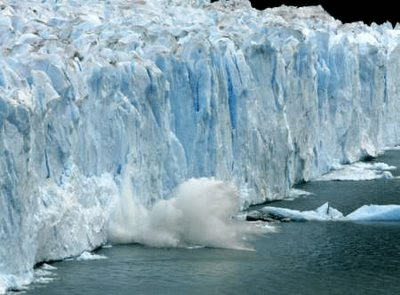 There are fewer nuclear reactors than you may realize. And by the time more
  are financed and built, the Arctic ice will be all gone anyway. Seventy years ago, some experts were convinced that nuclear power would change the world for the better. “Here was the power that would do all work…of a veritable Utopia,” the editors of a book on the Atomic Age wrote in 1945.
They also thought it would quickly grow. In the mid-1960s, one estimate predicted that by the year 2000, nuclear power would supply more than half of all the electricity in the U.S. As of 2016, it’s at a little less than 20%; globally, it’s only about 14%.
A new map from Carbon Brief shows the location of every reactor ever built around the world, including the 400 nuclear power stations now in use and others under construction. “Once you see it visually like that, you really get a sense of where the history of nuclear power is, and where it’s future is going to be,” says Simon Evans, policy editor for the U.K.-based Carbon Brief.
New nuclear power would be a real setback in terms of trying to solve the climate problem,” says Mark Jacobson, an engineering professor at Stanford who has researched how renewable power could meet all energy needs in the U.S. “Even if there were no issues like meltdown or waste proliferation—which are serious issues—it’s just so costly and it takes so long to put up new nuclear reactors that by the time the next set of nuclear reactors are planned, permitted, constructed, it takes 10-19 years. The Arctic ice will be gone.”
Nuclear power isn’t entirely “clean,” in terms of greenhouse gas pollution, because the large amount of energy used to refine uranium often comes from fossil fuels.Even keeping old reactors running may not make financial sense. In California, for example, extending the life of the Diablo Canyon plant will require new cooling towers that cost around $8 billion. It may also need billions in earthquake retrofits, because engineers realized after the project was built that it’s on a fault line.”For $8 billion, you can replace the entire Diablo Canyon with the same power produced by a combination of on-shore wind and utility-scale solar PV,” says Jacobson.
There’s also the inherent risk of even the “safest” nuclear reactors, and the problem of what happens when a plant is decommissioned. “You can’t do anything with the property for at least 60 years,” he says. “Probably there’s enough radioactivity for thousands of years.”
Instead, Jacobson says, it’s possible to produce cost-effective, reliable power from solar, wind, and hydroelectricity. It’s also possible to provide that power around-the-clock, as recent projects like a 24-hour solar farm near Las Vegas proves.
“People who are pushing nuclear aren’t driven by science or logic, but idealism and passion,” he says.http://www.fastcoexist.com/3058064/this-map-of-all-the-nuclear-reactors-in-the-world-is-a-reality-check
Chernobyl’s anti radiation sarcophagus
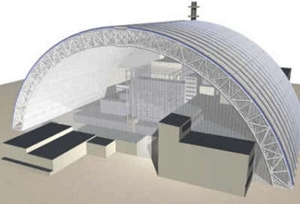 $1.7B Giant Arch to Block Chernobyl Radiation For Next 100 Years by REUTERS, 24 Mar 16 In the middle of a vast exclusion zone in northern Ukraine, the world’s largest land-based moving structure has been built to prevent deadly radiation spewing from the Chernobyl nuclear disaster site for the next 100 years.
A concrete sarcophagus was hastily built over the site of the stricken reactor to contain the worst of the radiation, but a more permanent solution has been in the works since late 2010.
Easily visible from miles away, the 30,000 tonne ‘New Safe Confinement’ arch will be pulled slowly over the site later this year to create a steel-clad casement to block radiation and allow the remains of the reactor to be dismantled safely……..
The EBRD has managed the funding of the arch, which has cost around 1.5 billion euros ($1.7 billion) and involved donations from more than 40 governments. Even with the new structure, the surrounding zone, which at 1,000 square miles is roughly the size of Luxembourg, will remain largely uninhabitable and closed to unsanctioned visitors…….
The upcoming 30th anniversary of the disaster has shone a new light on the long-term human impact of the worst nuclear meltdown in history.
The official short-term death toll from the accident was 31 but many more people died of radiation-related illnesses such as cancer. The total death toll and long-term health effects remain a subject of intense debate.
On Wednesday, Ukrainians who were involved in the cleanup of Chernobyl – the so-called “liquidators” – protested in central Kiev to demand the government acknowledge their sacrifice with improved social benefits.
“Thirty years ago, when we were young, we were saving the whole earth from a nuclear explosion. And now no one needs us. Absolutely no one,” said one of the protesters, former liquidator Lidia Kerentseva. http://www.nbcnews.com/tech/tech-news/1-7b-giant-arch-block-chernobyl-radiation-next-100-years-n544721
Nuclear dump plan for Chernobyl area
 Area around Chernobyl plant to become a nuclear dump KYODO HTTP://WWW.JAPANTIMES.CO.JP/NEWS/2016/03/24/WORLD/AREA-AROUND-CHERNOBYL-PLANT-BECOME-NUCLEAR-DUMP/#.VVRVA9J97GH KIEV – A heavily contaminated area within a 10-kilometer radius of the Chernobyl nuclear power plant in Ukraine will be used to store nuclear waste materials, the chief of a state agency managing the wider exclusion zone said in an interview.
“People cannot live in the land seriously contaminated for another 500 years, so we are planning to make it into an industrial complex,” said Vitalii Petruk, the head of the State Agency of Ukraine on Exclusion Zone Management. The zone is 30-km radius from the site of the 1986 nuclear accident — the world’s worst nuclear disaster.
“We are thinking of making land that is less contaminated a buffer zone to protect a residential area from radioactive materials,” he said.
Petruk said the agency does not plan to narrow down the exclusion zone because there is no privately owned land within the area and few people are wishing to return, unlike Fukushima, home to the 2011 nuclear disaster in Japan.
The complex will be used to store and process nuclear waste including spent nuclear fuel sent from power plants in Ukraine, he said.
“We are considering building a facility for alternative energy such as solar panels” so as to utilize the remaining electricity infrastructure including power grids for the Chernobyl nuclear power plant there, he added.
Petruk said the agency also wants to invite foreign companies to the complex. “We will ensure the maximum safety” to help their activities in the complex, he said.
As for the future dismantlement of the Chernobyl plant, Petruk said his country has been in talks with France for some two years about possible cooperation and it also wants to consider talks with Japan.
Cheaper, faster renewable energy will obliterate the prospects for “new nuclear”
The nuclear industry: a small revolution, BBC News By Roger Harrabin BBC Environment analyst 23 March 2016“………..investors scanning the world for money-making opportunities tend to turn away when they see a nuclear reactor taking years to build, fraught with technical and political risk. Solar and wind energy offer much more predictable returns in a fraction of the pay-back time.
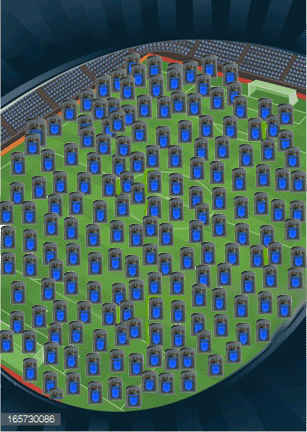
But SMR fans say mini-nukes as small as 50 megawatts (MW) could change that. They suggest it’s as simple as placing your order and waiting for a reactor to turn up. Then plug and play – and wait to get your money back.
If you want large-scale power, just line up a dozen SMRs side by side……
In his most recent Budget, the Chancellor George Osborne announced a competition for the design of small modular reactors for use in the UK.
‘Evolutionary technology’
There are two catches.
First, there’s still no solution (in the UK at least) to what to do with the nuclear waste. The government appears willing to go ahead with new nukes without knowing what happens to spent fuel and contaminated equipment.
Second, no-one has actually built an SMR yet, and it’s likely to take until the 2030s or 2040s before SMRs are widespread and making a real contribution to hitting carbon emission targets.
The firm claiming to be leading the global SMR race is the US government-funded NuScale. It expects to have its first American SMR in operation by 2025, and hopes to be ready to generate in the UK in 2026 at the earliest…
‘Jam tomorrow’
However, there are cautionary voices. Experts warn that to make it worthwhile building it, a reactor factory would need 40-70 orders. And the time scale is a big stumbling point for many.
According to John Sauven of Greenpeace there’s a high risk it will take longer than predicted to bring small scale nuclear on-stream. “Remember the nuclear industry promised in the 1950s that it would deliver energy too cheap to meter,” he says. “Since then it’s been completely overtaken by wind and solar energy which are much safer, reliable and cheaper.
“With nuclear it’s always jam tomorrow. We’ve got to decarbonise the energy industry now.”
Other critics warn that renewables and energy storage are progressing so fast that the energy industry won’t need the sort of round the clock “baseload” power produced by nuclear in the medium term future.
The energy commentator Kees van der Leun tweeted: “By the time [of the 2030s and 2040s] the growth of cheap solar and wind will have obliterated the chance of making any money with ‘baseload’.” http://www.bbc.com/news/business-35863846
Safety upgrade costs spur Shikoku Electric to ditch plan to restart aging Ehime reactor
Japan Times 25 Mar 16 OSAKA – Shikoku Electric Power Co. plans to give up restarting reactor 1 of its Ikata nuclear complex in Ehime Prefecture and scrap it because extending the aging unit’s lifespan would be hugely expensive, company sources said Friday. – (subscribers only) http://www.japantimes.co.jp/news/2016/03/25/national/safety-upgrade-costs-spur-shikoku-electric-ditch-plan-restart-aging-ehime-reactor/#.VvS2Sex97Gh

Scepticism on San Onofre nuclear station cleanup plan
 O.C. Watchdog: Could there be an ‘early’ nuclear cleanup at San Onofre? Orange County Register, By TERI SFORZA / March 23, 2016 Federal efforts to speed up the removal of spent radioactive fuel from power plants like the mothballed San Onofre Nuclear Generating Station are gaining momentum and inspiring guarded optimism among local officials.
Critics, however, remain deeply skeptical.
In January, the U.S. Department of Energy launched a new push to create temporary nuclear waste storage sites in regions eager for the business, currently in West Texas and New Mexico.
Several such sites could be up and running while the prickly question of finding a location for a permanent repository – the root of the present paralysis in nuclear waste disposal – is hashed out.
“That could mean moving the fuel from San Onofre a decade earlier than is envisioned now, maybe more,” said David Victor, who chairs the San Onofre Community Engagement Panel. The volunteer group of academic, industry, environmental and local government representatives advises the plant’s owner, Southern California Edison.
“I am cautiously optimistic,” he said. Victor, director of the Laboratory on International Law and Regulation at UC San Diego, met with officials in Washington this month to convey populous Southern California’s eagerness to solve the nuclear waste storage problem. An update on those efforts, as well as the latest on plans to dismantle the shuttered twin reactors, will be presented at 6 p.m. today at the San Onofre Community Engagement Panel’s quarterly meeting in Oceanside.
Decommissioning the plant south of San Clemente is expected to cost $4.1 billion and be mostly completed by 2030. But spent nuclear fuel is expected to remain on the beachside bluff much longer………… http://www.ocregister.com/articles/fuel-709466-nuclear-san.html
Taiwan lawmakers slam Atomic Energy Council’s (AEC) nuclear disaster drill
Legislators question nuclear safety, Taipei Times, By Chen Wei-han / Staff reporter, 24 Mar 16, Legislators slammed the Atomic Energy Council’s (AEC) nuclear disaster drill as “role-playing” and questioned the extent of evacuation zones during a review of the council’s nuclear emergency response fund yesterday.
The Education and Culture Committee reviewed the council’s budget proposal related to nuclear emergency prevention and response measures, saying some items were poorly executed and some were bloated.
Democratic Progressive Party (DPP) Legislator Chung Chia-pin (鍾佳濱) said he had taken part in four nuclear disaster drills, but they were like “role-playing,” in which soldiers were ordered to put on swimming trunks and pretend to be tourists, instead of actual residents participating in the drills.
“The council’s drill plan failed to simulate the accommodation of tens of thousands of people evacuated from New Taipei City and Taipei, which would be a major problem in the event of a nuclear disaster,” Chung said.
DPP Legislator Cheng Li-chun (鄭麗君) questioned the scope of the evacuation zones, which the council set within an 8km radius from nuclear plants.
“Immediately after the Fukushima Dai-ichi nuclear disaster in 2011, the Japanese government instructed residents living within 3km of the power plant to evacuate, but later expanded the area of evacuation to within a 20km radius of the reactor,” Cheng said, asking whether the AEC’s planned evacuation areas are large enough…….About 2 million people would need to evacuate if areas of evacuation were expanded to 20km from the two New Taipei City power plants, Chou said…….http://www.taipeitimes.com/News/taiwan/archives/2016/03/25/2003642398
Critics at NRC meeting not happy with dangers and costs of nuclear power
“…….The consumer group AARP submitted measured testimony, saying the group is “fuel neutral,” but concerned with reliability and affordability.
“Any proposed bailouts should focus primarily on the cost to consumers and the alternatives to such bailouts,” said John Erlingheuser of AARP. “Unintended consequences should be studied. For example, will bailouts stifle the development of low-cost natural gas-powered plants or renewables?”
Environmental advocates were also present during the forum and testified in opposition to subsidizing the plant when funds could be invested in renewable energy.
Chris Phelps, director of Environment Connecticut, expressed skepticism at Dominion’s claim about the effect of falling energy prices on its ability to stay profitable. He said it is the technology that is at fault, not the price of energy.
“The economics are working against the nuclear industry,” Phelps said. Mirror 24 Mar 16
China must improve its nuclear security framework

 How China needs to improve its legal framework on nuclear security, Bulletin of the Atomic Scientists, Hui Zhang, 24 Mar 16, Hui Zhang is a physicist and a senior research associate at the Project on Managing the Atom in the Belfer Center for Science and International Affairs at Harvard University’s John F. Kennedy School of Government, where he leads a research initiative on China’s nuclear policies. He is co-author, with Tuosheng Zhang, of Securing China’s Nuclear Future.
On March 31, Chinese President Xi Jinping will be among world leaders attending the fourth and last Nuclear Security Summit in Washington, D.C., where they will try to strengthen nuclear security to deal with the evolving threat of nuclear terrorism. Such efforts are badly needed, in light of the facts that there have been approximately 20 documented cases of theft or loss of highly enriched uranium or plutonium (although more may have occurred) since the early 1990s,and that there are nearly 2,000 metric tons of dangerous nuclear materials scattered across hundreds of sites around the globe.
Chinese leaders have actively participated in the last three summits, and pledged at each of them to act to strengthen nuclear security. But how successful have they been so far?
On the one hand, largely due to these earlier summits, nuclear security issues have received greatly increased national attention and awareness in China, from both national leaders and the general public. China has actively worked on several national laws and regulations related to nuclear security, and invested significant money to improve the physical protection of its nuclear facilities—including the updating of its monitoring devices, and otherwise accounting for and controlling every bit of nuclear material in China’s possession. A “center of excellence” on nuclear security—a joint US-China project initiated at the first nuclear security summit—was just commissioned on March 18 in Beijing, marking a milestone in summit outcomes. In short, China’s commitment to nuclear security is seemingly now well-established.
But on the other hand, in spite of these advances, there are still significant gaps in China’s nuclear security, which leave room for improvement. For example, the country has yet to build an overall legal framework that would govern the use of nuclear energy and related safety and security issues. In particular, China needs to update its nuclear regulations and guidelines, especially those that oversee tests of the ability of China’s nuclear facility designs to resist attacks from large-scale and well-organized armed terrorist groups; such tests are vital for identifying the strengths and weaknesses of security procedures. And cybersecurity is yet to be addressed.
So what major gaps remain, and what steps does China still need to take to improve the legal framework behind its nuclear security—a framework that is vital to making any substantial changes on the ground?
Progress on China’s nuclear laws and regulations. In China, legal documents are classified into four tiers. From high to low, these are laws, regulations, rules, and guidelines. Or, to be more precise: statutory law requiring approval by the National People’s Congress; State Council regulations; departmental rules; and regulators’ guidance or publications.
To further complicate matters, some laws and regulations are directly relevant to nuclear security, while others are much more indirect. The most direct ones are the Atomic Energy Law, the Nuclear Safety Law, and the Nuclear Security Regulations, while the ones that are indirectly relevant to nuclear security are the National Security Law and the National Counterterrorism Law.
Currently, the only major regulations on fissile material controls can be found in a document called the “Regulations for Control of Nuclear Materials,” issued in 1987, or 29 years ago—a time when the Berlin Wall was still up, Ronald Reagan was president, the World-Wide Web was not even a glint in a computer scientist’s eye, and the word “cybersecurity” was yet to be coined. Obviously, much has changed since then. Yet China’s only updating of these regulations was its “Rules for Implementation of the Regulations on Nuclear Materials Control”—issued in 1990.
In comparison, the most updated guidelines regarding the physical protection of nuclear facilities were issued in 2008—which is much more current, although itself now eight years old………..
Major gaps remain. While China has been making progress at improving the legal framework surrounding its nuclear laws and regulations, there have not been many updates of nuclear regulations and rules on the security of nuclear materials and facilities. All the existing regulations and rules were written before the attacks on New York and Washington in September 11, 2001, and the threat of nuclear terrorism was not specifically mentioned.
Although the 2008 guidelines require all civilian nuclear facilities to be designed in such a way that they consider threats to their security coming from outsiders, insiders, or a collusion of both—technically known as a “design basis threat”—they contain no clearly defined standards for how each nuclear facility should be designed for local conditions……..
while operators currently are required to do in-depth vulnerability assessments and performance tests of the individual components in their security systems, these tests do not include the realistic force-on-force exercises recommended by the International Atomic Energy Agency (IAEA). No Chinese regulations and guidelines require such tests, which are vital for identifying the strengths and weaknesses of security procedures.
Finally, China’s existing nuclear regulations and guidelines have not yet specifically addressed cybersecurity issues. Strengthening cybersecurity at nuclear facilities has become an important topic in the area of nuclear security, due to operations and security systems becoming increasingly reliant on digital control—and digitization invites cyber-attack. In practice, a number of countries like the United States and Russia have recently updated their regulations or rules regarding cybersecurity at nuclear facilities.
But China has not yet written nuclear regulations and guidelines with provisions specific to cybersecurity at nuclear facilities……..
Steps for improvement. At the 2014 nuclear security summit, President Jinping stated that “the more we do to enhance nuclear security, the less chance we will leave to terrorists.” Converting the top Chinese leader’s stated commitment into practical, sustainable reality, however, will require China to undertake several steps. In particular, China should speed the updating and issuing of any new laws, regulations, rules, and guidelines on nuclear security, especially those that have not been touched since the regulations of 1987 and the rules of 1990.
Clearer and more stringent rules and guidelines would establish a national-level design basis threat, with clarifying requirements for all military and civilian nuclear facilities. China should have at least a minimum standard for any design basis threat that includes protection against a modest group of well-armed and trained outsiders, a well-placed insider, and outsiders and an insider working together, using a broad range of possible tactics.
Moreover, China should incorporate IAEA principles and guidelines regarding nuclear security into its national laws and regulations, as suggested by a recent pledge by 35 countries to observe the terms of a joint agreement—known as Strengthening Nuclear Security Implementation—initiated at the 2014 summit at The Hague.
China should update and issue new nuclear regulations and guidelines incorporating cybersecurity explicitly. Cybersecurity should be integrated strongly and fully into the physical protection and accounting systems, and they should be an integrated component of any nuclear power plants design basis threat.
Soon, China should be issuing the Atomic Energy Law, Nuclear Safety Law, and Nuclear Security Regulations that have been under review for quite a while now. As a faster way of making progress, China should also update its 2008 guidelines on physical protection to integrate new IAEA guidelines, including the conduct of force-on-force exercises.
To ensure that the new regulations and rules are effectively implemented for facilities and transporters of nuclear weapons and weapon-usable fissile materials, China needs an effective system of enforcement and a constantly developing and improving nuclear security system that will not stagnate. http://thebulletin.org/how-china-needs-improve-its-legal-framework-nuclear-security9276
1 This Month

petition to oppose the rapid increase of space-military industry threatening Jeju Island and the region.
[Petition by April 19th (KST)] Stop the joint military-Hanwha Systems-Jeju Provincial Government Sea Launch!

Chernobyl: The Lost Tapes – A good documentary on Chernobyl on SBS available On Demand for the next 3 weeks– https://www.sbs.com.au/ondemand/tv-program/chernobyl-the-lost-tapes/2352741955560

of the week–London Campaign for Nuclear Disarmament

Tell the Ukrainian Government to Drop Prosecution of Peace Activist Yurii Sheliazhenko
To see nuclear-related stories in greater depth and intensity – go to https://nuclearinformation.wordpress.com
-
Archives
- April 2026 (194)
- March 2026 (251)
- February 2026 (268)
- January 2026 (308)
- December 2025 (358)
- November 2025 (359)
- October 2025 (376)
- September 2025 (257)
- August 2025 (319)
- July 2025 (230)
- June 2025 (348)
- May 2025 (261)
-
Categories
- 1
- 1 NUCLEAR ISSUES
- business and costs
- climate change
- culture and arts
- ENERGY
- environment
- health
- history
- indigenous issues
- Legal
- marketing of nuclear
- media
- opposition to nuclear
- PERSONAL STORIES
- politics
- politics international
- Religion and ethics
- safety
- secrets,lies and civil liberties
- spinbuster
- technology
- Uranium
- wastes
- weapons and war
- Women
- 2 WORLD
- ACTION
- AFRICA
- Atrocities
- AUSTRALIA
- Christina's notes
- Christina's themes
- culture and arts
- Events
- Fuk 2022
- Fuk 2023
- Fukushima 2017
- Fukushima 2018
- fukushima 2019
- Fukushima 2020
- Fukushima 2021
- general
- global warming
- Humour (God we need it)
- Nuclear
- RARE EARTHS
- Reference
- resources – print
- Resources -audiovicual
- Weekly Newsletter
- World
- World Nuclear
- YouTube
-
RSS
Entries RSS
Comments RSS
 nuclear-news