Fukushima Five Years On: Not a Comedy of Errors, a Calamity of Terrors
Since it began March 11, 2011, thousands of freelancers have reported on the Fukushima-Daiichi triple reactor meltdowns and radiation gusher, the deluge of accidents, leaks, faulty cleanup efforts, the widespread contamination of workers, citizens, soil, food and water, and the long series of cancer studies, lawsuits, and ever-changing clean-up and decommissioning plans. As Japan Times reports last October, “Extremely high radiation levels and the inability to grasp the details about melted nuclear fuel make it impossible for [Tokyo Electric Power Co.] to chart the course of its planned decommissioning of the reactors.”
The journalism is partly a response to the lack of mainstream US news coverage, and partly a warning against similar radiation disasters risked in the United States every day by the operation of 23 identical GE reactors (Fukushima clones) in this country.
Japanese media coverage of the catastrophe in English, along with analysis by independent scientists, researchers, and institutes is mostly available online and much of it is reliable.
Five years into the crisis, officials from Tepco have said leaks from the wreckage with “at least” two trillion Becquerels of radioactivity entered the Pacific between August 2013 and May 2014. “At least” is vague enough to beg the question: Is the actual total 5 trillion; 25; 50? Relentless drainage of contaminated water from the site is estimated to be about 300 tons a day and has continued for 60 months. “We should be carefully monitoring the oceans after what is the largest accidental release of radioactive contaminants to the oceans in history,” researcher Ken Buesseler, of the Woods Hole Oceanographic Institute said last September.
However, Japan isn’t even monitoring seawater near Fukushima, according to The Ecologist.
Greenpeace launches study of 300-year effect on oceans
On Feb. 26, Greenpeace International launched a major investigation into the gusher’s effects on the Pacific Ocean near the wrecked Fukushima complex in Northeast Japan. The group said in a press release that its investigation will employ an underwater vehicle with a sensitive gamma radiation “Spectrometer,” and a sediment sampler.
Greenpeace noted that, “In addition to the initial release of liquid nuclear waste during the first weeks of the accident, and the daily releases ever since, contamination has also flowed from the land itself, particularly nearby forests and mountains of Fukushima, and are expected to continue to contaminate the Pacific Ocean for at least the next 300 years.”
Former Japanese Prime Minister Naoto Kan, who headed the government in 2011, joined the Greenpeace crew aboard the Rainbow Warrior on the opening day of its study, and Kan used the occasion to call for a Germany-like total phase-out of nuclear power.
“I once believed Japan’s advanced technology would prevent a nuclear accident like Chernobyl from happening in Japan,” Kan said. “But it did not, and I was faced with the very real crisis of having to evacuate 50 million people… Instead, we should shift to safer and cheaper renewable energy.”
Shaun Burnie, Senior Nuclear Specialist with Greenpeace Germany said, “There is an urgent need to understand the impact this contamination is having on the ocean — how radioactivity is both dispersing and concentrating — and its implications.”
“Tepco failed to prevent a multiple reactor meltdown and five years later it’s still an ongoing disaster. It has no credible solution to the water crisis they created and is failing to prevent further contamination of the Pacific Ocean,” Burnie said.
Criminal charges leveled against reactor execs
The first criminal charges against executives of Tepco were filed Feb. 29 alleging that three officials refused to take precautionary measures that could have prevented the loss of off-site power (known as “station blackout”), and the resulting complete meltdown, or melt-through, of reactor fuel in three units. Specifically, the three are accused of negligence resulting in death and injury, having ignored explicit professional warnings about the inadequate height of the seawall, and about the improper placement (in basements) of emergency diesel generators which were destroyed by tsunami. Many of the 14,000 Japanese citizens who signed on to the lawsuit said their action was taken partly to force disclosure at trial of important information still kept secret by Tepco.
Starting from scratch with no textbook
Last October, four-½ years into the unprecedented self-destruction of three-reactors in one place, Japan’s Atomic Energy Agency opened an institute “to develop” techniques to inspect and eventually decommission the three leaky ruins. Because of the vast, daunting and novel complexity of three melted reactors, the new “Remote Technology Development Center” is starting from scratch. That’s right: No one now knows how to disassemble and safely containerize the ferociously radioactive wreckage — times three.
Naohiro Masuda, Tepco’s chief of decontamination and decommissioning, told the AP Dec. 18, “This is something that’s never been experienced. A textbook doesn’t exist for something like this.” Radiation levels inside the cores are too high for even for robots to make useful inspections.
The ultimate goal of dismantling work is to remove the melted uranium fuel. Researchers don’t yet know how to patch massive quake-caused cracks in chambers under the failed reactors, which release tons of highly contaminated water every day. The new institute is tasked with inventing a first-ever technique to find and plug the leaks. The chambers must be made watertight, because removal of the melted fuel has to be done remotely and under water.
Planners must also invent a system of possible routes by which to remove the hundreds of tons of still-unseen melted fuel, and they’ve been told to find new ways of reducing radiation doses to workers conducting the mission.
Two mayors agree to host waste dumpsites
After first opposing the government’s plans, two towns in Fukushima Prefecture have agreed to Tokyo’s proposal for using them for “permanent” radioactive waste disposal. The sites, one at an existing private facility in Tomioka, and another at Naraha, have been chosen for disposal of “designated waste” in exchange for bribes, including the construction of an industrial park and subsidies worth about $81 million.
“Designated waste” is rubbish with between 8,000 and 100,000 Becquerels of radioactivity per kilogram. Confusingly, the Japan Times called this deadly refuse “low-level nuclear waste,” while the Asahi Shimbun called it “highly radioactive.”
The Tomioka facility, now run by Ecotech Clean Center, will be nationalized and will then bury some 650,000 cubic meters of designated waste which is mostly incinerator ash, sewage sludge and rice straw. It is a small fraction of the estimated 22 million cubic meters of waste that’s been collected in large black bags and stored outdoors at thousands of sites in 11 prefectures.
Waste with higher radiation levels is to be kept at temporary facilities being built near the doomed reactor complex.
Another proposal from the Ministry of Industry is to bury high-level radioactive waste under the seabed. Experts who made the idea public said such waste could be transported by ship, but this raised alarms about transfer mishaps, transport accidents, groundings, breakups, and sinkings of cargo ships.
Pollution solution: Declare safe today what was unsafe yesterday
Following the start of the ongoing disaster, the government’s official allowable public external radiation exposure was arbitrarily raised. One milliSievert (mSv) per year was raised to 20 mSv for residents in areas affected with radioactive fallout. For radiation workers in the nuclear industry the annual limit was raised from 100 mSv to 250 mSv. This had the double effect of both saving the industry billions in cleanup costs, and increasing radiation-induced health effects — especially in women, fetuses, infants, and children.
Robert Hunzinker reported in CounterPunch Dec. 14 that Physicians for Social Responsibility has warned that the new “allowable dose” means there’s a 1 in 200 risk of children getting cancer in the first year; and over two years the risk increases to 1 in 100.
Sea wall making matters worse
In October, Tepco completed a deep seawall dug into the shore between the ocean and the wrecked reactors. Intended to halt the flow of contaminated groundwater to the Pacific, the dam has cause groundwater levels to rise behind the wall. Now, in an attempt to fix the problem caused by the wall, Tepco dug new wells to pump backed-up groundwater, planning to dump less-contaminated groundwater from new wells into the sea. But the water is so heavily poisoned with tritium that sea dumping was not allowed. Now the company is pumping and dumping the fast rising groundwater into severely radioactive reactor buildings — where the water will become even more contaminated by passing over the mass of hot melted fuel inside. It’s not really a comedy of errors, but a calamity of terrors.
Fukushima Five Years On: Not a Comedy of Errors, a Calamity of Terrors
Japan Olympics minister backs Fukushima as host venue for 2020

Toshiaki Endo, center, minister in charge of the 2020 Tokyo Olympics
TOKYO – Japan’s Olympics minister says he hopes Fukushima prefecture can host preliminary rounds of baseball and softball at the 2020 Games.
Toshiaki Endo made the comments Friday on the fifth anniversary of a magnitude 9.0-earthquake that struck offshore and triggered a devastating tsunami, killing more than 18,000 people.
The Fukushima nuclear power plant spewed radiation after being hit by the tsunami. About 180,000 people in the northeastern region of Japan remain displaced because of the disaster.
Local organizers have recommended to the International Olympic Committee that baseball and softball be added to the program for the 2020 Games, allowing areas outside Tokyo to host events.
Other prefectures in the region will host games at the Rugby World Cup in 2019 and first-round soccer matches at the 2020 Olympics.
Japan Olympics minister backs Fukushima as host venue for 2020
Fukushima+5, Part 6. “Dose” does not exist, only exposure
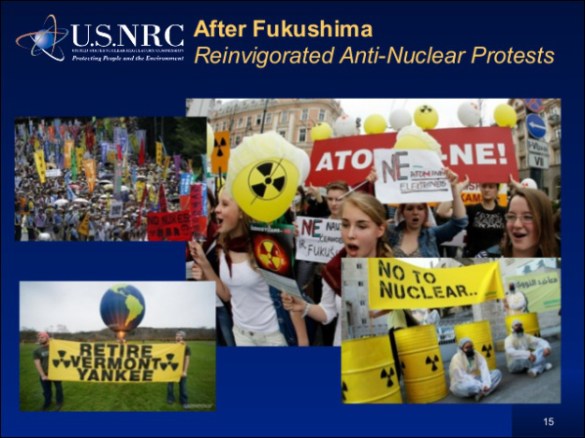
The onset of the Fukushima nuclear disaster on March 11, 2011 set off a new round of anti-nuclear protest across the world so large even the U.S. NRC was forced to take notice.
About 300 people gathered in the Diet Offices to commemorate the Tohoku earthquake, tsunami and Tepco’s meltdowns. Hosted by Friends of the Earth Japan and a large network of NGOs in Japan working on every nuclear concern, including continued aid and support to Chernobyl victims, this was a national-scale event. At 2:46 we paused to silently mark the time of the quake.
A number of people I have met previously on this tour are here. It feels good to have new friends here.
What follows is a piece I wrote in anticipation for this day. I know it is long. I hope some will read it through. It is Mary’s Manifesto on radiation, but I feel with some certainty that Rosalie Bertell would support it!
The Nuclear Dose Emperors Have No Clothes
It is now five years since three reactors melted down (and out of containment). Arnie Gundersen does not know where the melted fuel is, but he is pretty confident that it has now been cooled, and continues to be cooled to the point where it is not melting any more. He thinks maybe it is through all the metal containment, but still in the concrete of the reactor building floor. Huge amounts of radioactivity are still there, on-site, but huge amounts are distributed to the land, ground and surface waters, plants, animals children and to the men and women of Japan. And then there is the Pacific Ocean…
Interesting that the paper reports the UN Agency as saying the doses from 2012 on will not cause health problems… Does that mean they are admitting that the doses from 2011 definitely will?
The various official bodies really do not know how to think about radioactivity in an environment where people of all ages are living. Their thinking has been formed by the atomic workers of the world (all adult males) and the Hibakusha of Hiroshima and Nagasaki and a few other cases. The A-Bomb study was of a single acute dose of external radiation, much more like X-rays than like living in a “hot zone.”
We now have confirmation from Richardson, et all that many small radiation exposures over an extended time that add up deliver the same level of harm to a body as did the A-Bomb.
Citation: Risk of cancer from occupational exposure to ionizing radiation: retrospective cohort study of workers in France, the United Kingdom, and the United States (INWORKS). David B Richardson, et al. BMJ 2015;351:h5359 doi: 10.1136/bmj.h5359
Today, Lakota children in the Black Hills of the Dakotas and other uranium contaminated areas; children in Kazakhstan, Marshall Islands, Utah and other nuclear weapons test areas, children still living in contaminated areas of Ukraine and Belarus, and those living here in Japan are all effectively “swimming in radioactive “soup.” More exposure one day, less another but breathing, drinking, eating radioactivity across their lives. Here is the fundamental point that is missing from the regulator’s thinking: every adult was a child. From 2011 on, here in Japan, all children in contaminated areas (some far beyond Fukushima) are impacted to one degree or another.
Any calculation that assumes that exposure began after adulthood was attained applies only to the adults of 2011 and before. The adults that emerge from the children of Daiichi are different. They will likely continue to be exposed as adults, but the deal is done: any radiological damage in childhood will dominate. The cancers will likely come in adulthood, but not primarily from exposure as adults. This will continue. All the projections on health consequences imagine that for the rest of time there will be adults who were not exposed as children. This is magical thinking for these hot zones.
We can hope that people will leave. We know some people are paid to come in. But we cannot really imagine a real estate boon in Fukushima Prefecture. The deal is done.
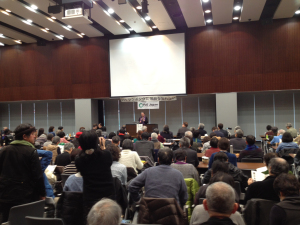
Mary Olson speaks at a Fukushima anniversary event in Japan’s Diet Building,
March 11, 2016.
Another way to speak of childhood exposure to radiation is that it is an “opportunity cost” in terms of an individual who has been exposed as a child ever fitting the assumptions the regulators use about adults. Regulators tag age groups in a large hypothetical population. They do not assume that their “adults” were exposed from birth on. People growing up in contaminated areas do become adults. They do continue to be exposed, but their exposures as children make them a different category of adult when it comes to “risk.” Most regulators do not consider this. No regulation factors the gender difference.
Radiation regulators exercise powers of life and death and like that story of an Emperor who thinks he is wearing magical cloth, it is time, once again to to point and say “Look! You are naked!” These emperors of radiation regulation are clothed in mumbo jumbo of “dose” and “risk” and “keep the people confused.” None of this is real.
Japan Diary 4 tells the story of age and gender as factors in radiation harm. We can no longer say that “a millirem is a millirem.” It matters WHO is getting that exposure. What age? What gender? Likely we will someday learn about other important factors.
We could hypothetically make new units (infant-female millirem vs elderly-woman millirem vs Reference-Man millirem) but the concept of DOSE itself is beginning to fall apart in other ways. Following is a short peak at some of the fabric of evidence that our regulators (emperors) do not consider. Together these are why I join others who question the very basis of current radiation regulation. If enough people get these points, we will all point and say “you are naked!”
Point 1: It matters WHO gets exposed;
Point 2: “Dose” is an idea from chemistry and does not fit radiation harm;
My good friend Dennis Nelson points out that damage to cells from radiation is primarily physical, from energetic particles and waves. Dennis posits that “dose” is deeply rooted in chemistry where a substance can be either “safe” or “poisonous” and the difference depends on the mass of the substance that is introduced into the body. In this case, of poison, there is some level that is safe. In radiation exposure there is no level that is safe, just a higher statistical probability of disease or death when impacted by a larger number of particle or ray emissions. (See: www.serv.org) As I first read in Dr Helen Caldicott’s Nuclear Madness (updated in 1992), it takes only one living cell and a single radioactive emission in order to have the potential for a fatal cancer. It is this fact which should remove radiation from any concept of “dose.”
It is true that elements like uranium and plutonium area also toxic (poisonous). Here I am focusing on radiological impacts only, but those who live with uranium and plutonium contamination need to know there is a “double-header” of both!
Point 3: Radioactive decay makes a different kind of chaos in our biochemistry
In 1984 I had a job as Assistant in Research in a lab at Yale. I got contaminated with a radioactive element common in biological research: Phosphorus-32 (P32). Some of the exposure was internal. Like all radioactive elements, the body responds to the chemical characteristics: cesium is similar to potassium so it tracks to muscle; strontium is similar to calcium so it finds its way to bones, teeth and Mother’s milk; phosphorus has many routes in the body—in the lab we used it to track neural activity, but also tracks to the DNA itself. Sort of like giving the bank-robber a bank-guard uniform.
P32 has a 2 week half-life, making it pretty highly radioactive. When the radioactive decay step happens, the atom is no longer phosphorus, but becomes the stable atom, Sulphur32. Here is the rub: if the body has incorporated the phosphorus into a molecule, suddenly the molecule (with no warning) now has a Sulphur atom where it thought it had a phosphorus; particularly troubling inside a DNA strand.
Other radionuclides create similar chaos as they decay.
Point 4: Invisible bullets is the best way to describe impact of ionizing radiation and there is a much wider range of harm than only “ionization;”
I don’t want to get too far into the weeds here. My readers are not generally chemists or biophysicists, but suffice it to say, industrial fission is less than 100 years old. Regulation of radiation exposure is only a little older than fission, and came soon after the concentration of radium by Marie Curie and her cadre of researchers. Doctors quickly adopted radiation because it was observed to kill growths (tumors) of various kinds. (For a great read on this history, find Catherine Caulfield’s Multiple Exposures, 1989, now available on books.google.com)
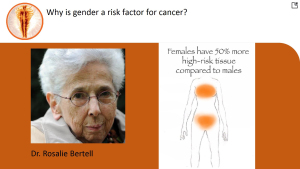
Nonetheless, anyone can follow this: It is true that a radioactive wave or particle does knock an electron off of another atom (likely in a molecule). When the electron is knocked off, the remaining configuration now has a “charge” because the electron (minus) is gone. All of radiation regulation is based on measuring the production of ions in living tissue in response to X-rays. The details of other radioactive events (decay via emission of alpha, beta and neutrons) are mixed in, but the fundamental concept of “dose” comes from the simple measurement of ions generated by exposure.
While it is true that these ions can be very damaging to the cell, and even neighboring cells, there is no similar evaluation for direct physical damage to cell structures (much greater impacts than knocking off an electron). This includes:
Damage to cell membranes
Chromosomal breaks and other deformations
Mitochondrial damage
Primary germ cell damage
This list of types of cellular damage are more likely from internalized alpha particles and beta particles. For years the radiation regulators have ignored internal exposure, and attributed zero-dose to alpha particles since they bounce off the skin. Inside the body (inhaled, ingested or injected) they are many times (some estimates as high as 1000 times) more harmful than an X-ray/gamma ray.
Here are simple reasons why this makes sense. The alpha particle (an energetic bundle of 2 protons and 2 neutrons) is enormous compared to the wave of energy (no mass) and even compared to the beta (electron-sized). Does a cannon ball do more damage than a BB?
Where internal exposure has been considered a really bizarre concept of “effective dose equivalent” is used by the emperors of radiation. While there are mitigating parameters, such as inclusion of weighting factors derived from organ-doses studies (from equally inhuman experimentation in the U.S.), the whole approach exceeds credibility: the regulators decide how much ionization the internalized radionuclide is likely causing and then they distribute those ionizations as if they were to the whole body. Averaging the high local dose across the entire body mass–with no recognition that the energy to break a chromosome is local–that the concept of “dose” from external exposures includes distance from the source as a factor. When the source is internal, distance for the immediate tissues drops to zero. This is a quantum change, not a simple matter of degree.
Let’s get to it: dose is irrelevant in this picture.
Final Point 5: No two radiation exposures result in the same harm; every is unique.
Dr. Donnell Boardman was a physician in Massachusetts who treated some of the first nuclear power workers. Donnell told me (he was retired when I met him) that no two radiation exposures, including to the same person, are ever identical. Donnell liken radioactivity’s impact on living tissue to car collisions. We do not expect to find any two accidents that are identical. Donnell saw hundreds of nuclear workers and he said that nearly every story and the problems the individuals faced were unique.
Radiation is a physical event, but it depends as much on the body and the unique chain of events at the cellular level to determine the outcome. The broad-brush dose-response work done on adults is important, but the projections based on it just do not hold water.
Radiation Regulators: you have no clothes.
Mary Olson
March 11, 2016
Permalink: http://safeenergy.org/2016/03/11/japan-diary-2016-fukushima5-part-6/
Fukushima+5, Part 5. We Are All Hibakusha: Fission Never Results in Peaceful Atoms!
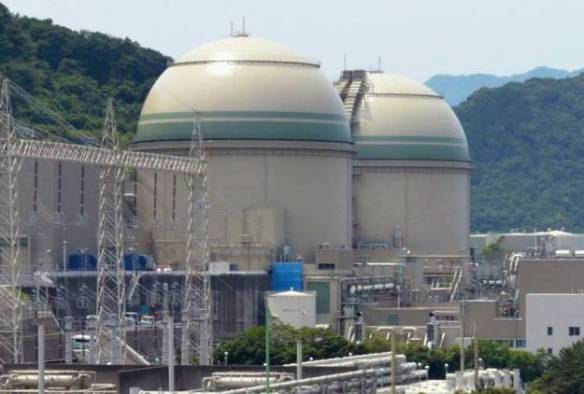
A Japanese court this week ordered the shutdown of two reactors at Takahama, leaving Japan with only two reactors (at Sendai) currently operating five years after the onset of the Fukushima disaster.
All my life I have tried to find the truth, and make it beautiful.” – Sting
It never ceases to amaze me how many wonderful people I meet in this work. Every stop on this tour is populated by exceptional hearts and minds. It reminds me of a woman I met during the years working to stop the US Department of Energy from selectively targeting Native Lands for nuclear waste. (Okay; the 1990’s round of that!) We were at an event at the Mole Lake Indian Reservation in Wisconsin. She was from the Western Shoshone Nation, home of the proposed Yucca Mountain Dump. She said she was “new” to nuclear issues. Welcoming her, I said, “this is a grim topic, but you will meet wonderful people who care about nuclear waste.”
She told me that the Shoshone People know this; she said, “It is a Law of the Universe.” What?!? She explained that uranium in the ground is neutral, but when people dig it up it becomes more and more negative. Inside a reactor uranium becomes the most negative thing on the planet. Shoshones know that the Universe IS in balance (in contrast to Judeo/Christian folks who think it “should” be). Thus, it is a Law that the most positive people drop what they are doing and pay attention to the most negative thing (nuclear energy/weapons).
This response from positive people of great integrity is the first, initial step; she explained there would be many more steps before nuclear fuel/waste is finally balanced.
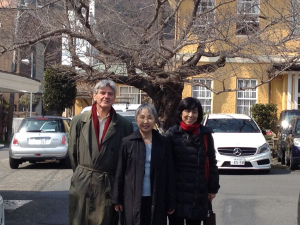
Three of the dedicated activists working in Japan and helping with this tour. From left to right, Steve Leeper, Peace Culture Village and tour organizer; Naoko Koizumi brilliant translator (my “bridge”); and Tamiko Nishijima of Peace Platform, our glue.
Here in this land of Fission Products (the contamination is at varying levels well beyond Fukushima Prefecture, see www.fairewinds.org, Arnie will be sharing more news in coming months from samples he has shipped home), I am meeting these many, many positive people.
Five years in, some are tired. Others are just beginning to realize that the Tepco disaster is not over. I think there is real potential for organizers now and Japan is blessed with some outstanding activists and service organizations. The focus for Green Action and other NGO allies is to stop the re-start of the reactors that have been on “atomic holiday” since March 2011.
NEWS! Since I began this Diary edition, my e-mail inbox tells me that a court has just issued the decision that Kansai Electric must reverse and take two Takahama nuclear reactors off-line. One unit had been lurching towards full operation after five years of no fission. It is a huge win for Green Action and all its allies that have been working to keep Japan fission-free! The ruling states that emergency planning for Takahama is not sufficient. The local activists I met were focused on what the reality of evacuation in Kyoto Prefecture could be. The largest cities near Takahama are over the Prefecture (“state”) line in Kyoto.
The report also specifies that the plan for MOX fuel use in Takahama is also insufficient! Green Action and Allies are working hard, in addition to stopping reactor re-start, to reverse the Japanese industry and federal commitment to MOX fuel.
Plutonium from reactor waste has been separated by the European nuclear giants (at one time BNFL and still AREVA) and AREVA is fabricating MOX fuel for use in the Japanese reactors as they restart. This pro-nuclear notion is profoundly disturbed thinking. MOX was in Fukushima Daiichi Unit-3 (only a small fraction, probably less than 5%). There is still expert debate about the difference between the explosions at Units 1, 2 and 3, but Arnie Gundersen has said many times there was a detonation shockwave at Unit 3, that hydrogen cannot cause that, and the MOX fuel may have had a role in what happened there.
Takahama had a small amount of MOX in the core as it limped towards restart. The plan remains to load 30% plutonium fuel there (if the plans are deemed sufficient in the future—we hope not!) Dr. Edwin Lyman (www.ucsusa.org) has done the calculations to show that when a MOX core is released in a major reactor accident, the long-term cancers that would result are twice the number from a regular uranium (LEU) core accident. Ed made that calculation initially during the NIX MOX campaign that NIRS and IEER led and UCS supported, before 2000. Long before the gender factor (see Blog 4).
It has taken traveling around the world to have this MOX thought come home:

A nuclear accident involving a fully-loaded MOX core could double the numbers in this chart based on an accident from a normal uranium core: 6 women for every 4 men could expect to suffer from a fatal cancer.
Double cancers in the MOX case for Reference Man = double cancers for little girls too. Juvenile girls when exposed will get ten times more cancer over their lives than the Reference Man (same dose, different gender, different age). Double that for a MOX fuel accident. The ratio is the same comparing the little girl to the adult man, MOX to MOX, but for policy decision making, one must now look at the consequences of a MOX accident compared to an LEU accident. Now female children will suffer twenty times more cancer compared to the Reference Man in a LEU accident.
Again: females exposed as girls, to fission products from MOX fuel in a major reactor accident would get twenty times more cancer than Reference Man exposed to LEU.
If this is not a reason for all good people to oppose MOX fuel use…what will it take?
It was deeply gratifying to me when I spoke in Northern Kyoto Prefecture and a grandmother at the back of the room began chanting “Nix MOX Takahama, Nix MOX Takahama!” NIRS launched the US grassroots NIX MOX campaign in 1996. It continues!
We are, all of us, a Law of the Universe. I am now getting ready for three of my largest events:
Citizen Nuclear Information Center talk, College Women’s Association of Japan Luncheon, and on Friday, March 11, the 5th Anniversary of the Tohoku quake and tsunami triggering the Tepco Fukushima Daiichi meltdowns, I will join NGO’s from the region at the Japanese Diet.
Mary Olson
March 10, 2016
Permalink: http://safeenergy.org/2016/03/10/japan-diary-2016-fukushima5-part-5/
Fukushima disaster sheds light on lack of preparedness for compensation
The crisis at the tsunami-hit Fukushima No. 1 Nuclear Power Plant has shed light on a lack of preparedness on the part of the government and utilities to pay massive amounts of compensation for a nuclear accident, which has placed a burden on the public.
At a panel of experts at the Japan Atomic Energy Commission (AEC), there have been calls since this past January for reviewing the current system under which nuclear plant operators are responsible for paying compensation for accidents without limits and setting an upper limit on damages.
“The number of nuclear power plant operators could decrease as long as they are required to bear risks exceeding their limits,” one member said.
“It’s important for operators to bear responsibility for such accidents on condition that they could have predicted such disasters,” another stated.
These problems emerged because operators cannot ascertain risks involving the operation of atomic power stations unless they can estimate the amount of compensation for accidents.
However, others in the panel argued that operators would cut back on their investment in safety measures unless they are to bear unlimited responsibility. As such, the overall direction of debate on the issue has not been set.
Under the current nuclear plant accident compensation system, atomic power station operators bear unlimited responsibility for compensation for accidents except in cases of massive natural disasters. However, there is no clear definition of “massive natural disasters,” and the national government is only required to extend the necessary assistance for efforts to deal with such accidents.
Following the outbreak of the Fukushima nuclear disaster, the national government placed Tokyo Electric Power Co. (TEPCO), the operator of the stricken plant, effectively under state control by providing the firm with an infusion of 1 trillion yen in public funds.
The government then created a system under which it loans necessary money for compensation payments to TEPCO via the Nuclear Damage Compensation and Decommissioning Facilitation Corp. (NDF) without interest. Thus the situation in which TEPCO would go under and become unable to pay compensation to victims of the nuclear crisis has been avoided.
When it placed TEPCO under de-facto state control, the central government explained that the operator of the plant would shoulder the responsibility in principle. However, the reality is different from the government explanation.
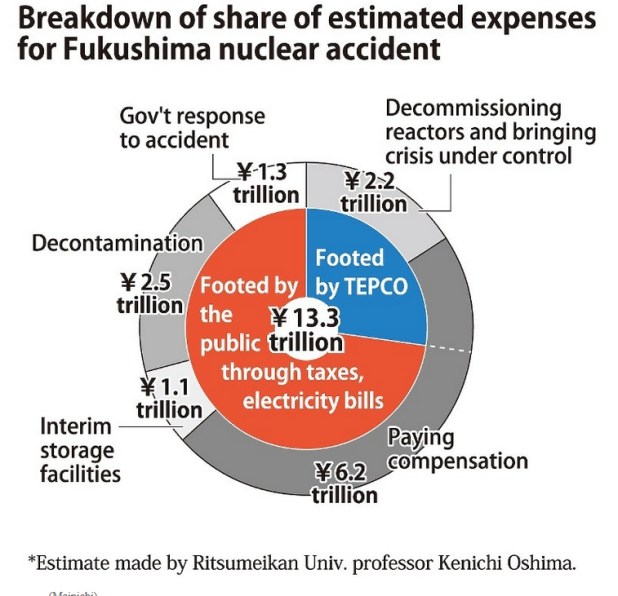
Kenichi Oshima, professor at Ritsumeikan University, estimates the total cost of dealing with the nuclear crisis at 13.3 trillion yen. The estimated cost includes 6.2 trillion yen to pay compensation, 2.5 trillion to decontaminate areas tainted by radioactive substances, 2.2 trillion yen to decommission reactors and bring the disaster under control, and 1.1 trillion yen to build interim storage facilities for waste contaminated with radioactive materials.
Of the total amount, TEPCO is likely to pay just over 3 trillion yen on its own, including part of the cost for bringing the crisis under control and paying compensation.
Most of the money needed to pay compensation will be secured from “general contributions” that operators of nuclear plants extend to the NDF. Much of the contributions are passed onto electricity bills consumers pay to utilities. Taxpayers’ money will be spent on the construction of interim storage facilities. Decontamination costs, which the government temporarily foots, will be covered with proceeds from the sales of shares the government holds in TEPCO to lessen the burden on the utility.
“The public is required to effectively shoulder over 70 percent of the costs. The public is being required to pay the costs in a way that lacks transparency,” Oshima said.
If the response to the accident progresses to a certain extent and TEPCO has rehabilitated itself, the government can recover the money it invested in the utility and prevent any increase in the burden on the public. However, this is no easy task.
A high-ranking official of TEPCO’s Kawasaki Thermal Power Plant says it has been successful in streamlining its regular checkup on its generators, shortening the checkup period, increasing the ratio of operation of the latest and most efficient generators and raising the profits by up to hundreds of millions of yen a day.
Learning how to rationalize operations from a worker who had previously worked for Toyota Motor Corp., the plant monitored plant workers’ moves by seconds to reduce time wasting.
“We succeeded in reducing the checkup period, which used to be 80 days in the pre-quake period, to 60 days,” the official said.
However, the increase in profits is attributable mainly to a sharp decline in oil prices. TEPCO posted a pretax profit of 436.2 billion yen in the April-December 2015 period on a consolidated basis. This is largely because fuel costs decreased by about 730 billion yen from the corresponding period of the previous year. If crude oil prices increase, it will offset reductions in expenses.
If the idled Kashiwazaki-Kariwa Nuclear Power Plant in Niigata Prefecture is to be reactivated, it will increase TEPCO’s monthly profits by 8 to 13 billion yen per reactor. However, there are no prospects that the plant can be reactivated in the foreseeable future.
If the government is to use the proceeds from its sales of TEPCO shares to fully cover decontamination expenses, the value of one share must exceed 1,000 yen. However, the current price is about the half that amount.
The government and electric power companies had promoted the use of atomic power by emphasizing that its costs are low. However, they failed to include risks of accidents and safety measures in power generation costs, and where the responsibility for nuclear accidents lies has remained unclear. As a result, members of the public are being forced to foot the costs and TEPCO is allowed to survive.
A system under which the government and private sector share the burden of nuclear accidents in an appropriate manner has not yet been established.
http://mainichi.jp/english/articles/20160311/p2a/00m/0na/019000c
The flight from Fukushima – and the grim return
Linda Pentz Gunter – 11th March 2016
Five years after the Fukushima nuclear disaster began to unfold, the searing psychological effects are still being felt among the 160,000 refugees who fled the fallout, writes Linda Pentz Gunter. But now there’s growing pressure to return to contaminated areas declared ‘safe’ in efforts to whitewash the disaster’s impacts. Why the rush? To clear the way for the 2020 Tokyo Summer Olympics, complete with events in Fukushima City.
“Moving under normal circumstances is a personal decision. Evacuees have no choice. They are forced to flee.”
Yoshiko Aoki knows exactly what this feels like. A petite, older woman, Aoki, like almost 160,000 of her fellow Japanese citizens, was one of those forced from her hometown when the Fukushima-Daiichi nuclear disaster of 11th March 2011 began to unfold.
She still lives in exile.
Aoki has been traveling the world to speak out for Fukushima refugees, as she did at a London event in January hosted by Nuclear Free Local Authorities, Green Cross and the Nuclear Consulting Group.
Aoki is from Tomioka, situated 10km from the Fukushima plant and one of the ghost towns that may be reopened by governmental decree in March 2017 and declared ‘safe.’ She now runs a community center for Fukushima evacuees in Koriyama.
When you flee like that, Aoki says, with the threat of radiation literally hanging over you, “you leave your home, your land, you lose your job, you are separated from family members, and your animals are abandoned or killed before you leave.”
The cries of abandoned animals gave voice to the Fukushima tragedy
It was those animals left abandoned who first gave voice to the tragedy. Harrowing videos of starving, dying cows in the Fukushima ‘zone’ emerged in the first weeks following the disaster, a searing lament of unbearable agony. Many of these videos are so painful to watch that they come with a warning of the horrors ahead.
For some, the suffering of the animals was too much. In Alone in the Zone, a 2013 video report from Vice, Naoto Matsumura, then 53 and also from Tomioka, describes how he eventually left his family to return home and look after the animals there who still survived.
“We ran for it when reactor unit 4 exploded”, he recalls in the video, while hugging an ostrich. “I grabbed my family and we escaped.”
But Matsumura and his family were turned away by a relative to whom they fled for refuge. “She wouldn’t even let us in. She said we were contaminated by radiation”, he related.
Fukushima evacuees are the new Hibakusha
Such misconceptions were widespread. Fukushima evacuees had become the new Hibakusha, the name given to survivors of the Hiroshima and Nagasaki bomb blasts, many of whom were stigmatized and treated as outcasts.
After finding no room at shelters either, Matsumura took the decision to return to Tomioka alone. When he saw the starving animals he said he had no choice but to stay on.
Matsumura’s story is less uncommon than one would expect. A 2013 ITN news feature profiled Kago Sakamoto, then 58, who refused to abandon his animal sanctuary situated less than 12 miles from the Fukushima nuclear plant.
Although he lives there illegally, Sakamoto survives on charitable in-kind donations from supporters. The older men are gambling that any radiation-borne disease will outlive them anyway, given the long latency period for illnesses like leukemia that can take a couple of decades or more to manifest.
The elderly want to die where they were born
Indeed, statistics indicate that it is the retired and the elderly who have been willing to return from exile so far. Even though studies show that reliable decontamination is unlikely and will not be long-lasting, the elderly, as Aoki explained it, “want to die where they were born and not die in an unfamiliar place.”
Dr. Ian Fairlie, writing in The Ecologist last August, estimates that as many as 2,000 people have already died due to the stress of evacuation itself.
“The uprooting to unfamiliar areas, cutting of family ties, loss of social support networks, disruption, exhaustion, poor physical conditions and disorientation can and do result in many people, in particular older people, dying”, Fairlie wrote.
Some who decline to return are ostracized by others, Aoki said. “They are accused of abandoning their homeland.” Some government officials have even tried to position the return to previous exclusion zones as some kind of patriotic duty.
That patriotic duty will be center stage in the lead-up to the 2020 Summer Olympic Games to be hosted in Tokyo. Between now and then, a comprehensive public relations effort must sweep aside all doubts about radiation risks.
Fukushima will bid for an Olympic event
In a blatant example of the depth of denial about the true extent of the disaster, Fukushima City hopes to be an Olympic venue. As Fukushima City official Hiroaki Kuwajima told AFP:
“If baseball and softball return to the Olympics, and preliminary games are played outside Tokyo, then we hope to be able to stage games. We are still in the process of recovery from the disaster and it would be a dream to have world-class athletes play here.”
Kuwajima and other officials are positioning the pariah status of Fukushima Prefecture as “harmful rumors” that can be dispelled by moving refugees back, encouraging Olympic events and luring young people into the workforce, essential to re-boot the region’s crushed economy.
“The Governor of Fukushima spoke about a safe Fukushima”, Aoki said. “We want it to become safe. But our thoughts and reality are not one and the same.”
Not everyone is cooperating. Before the Fukushima disaster, there was a cultural lockstep when it came to trust in government. But with unprecedented anti-nuclear demonstrations and the revelations of government and industry collusion, the traditional culture of group obedience has eroded to some degree. But it has not entirely vanished.
Voices of opposition dismissed as ‘extremists’
“There persists an anti-scientific stance and group mentality”, said Dr. Tetsunari Iida, executive director of the Institute for Sustainable Energy Policies in Japan, speaking at the same London conference as Aoki. “People are told they shouldn’t be expressing fearfulness. People who speak up are dismissed as extremists.”
Minamisoma city, located 14-38 km north of the Fukushima nuclear site, was one of the communities worst hit by radiation fallout. About 42% of all Fukushima Prefecture evacuees were former residents of the city. But while the Japanese Nuclear Emergency Response Headquarters has declared the city safe for residents to return, only a little over half of the former population has gone back, about 50% of whom are senior citizens.
Those who remain away – still around 110,000 people according to Aoki – lost many tangibles in their lives, but also, she says, something more fundamental: “People must not lose their dignity. How can we possibly construct something that will annihilate dignity?”
That decimation of spirit along with land and livelihood, prompted Aoki to repeat the warning she gave when she visited the Wylfa nuclear site in Wales, where two reactors are shut down but a new one is proposed. Like a Cassandra of the East, she intones:
“Please learn from Fukushima. Please learn from our mistake. You don’t want to apologize to your own children, to your grandchildren, for making the choice before they were even born.”
That choice was the blunder of nuclear power, one for which Japan is paying a terrible and still incalculable price.
Linda Pentz Gunter is the international specialist at Beyond Nuclear, a Takoma Park, MD, USA environmental advocacy group.
Takashi Hirose: veteran Japanese anti-nuclear activist on the Fukushima disaster
Today marks the 5th anniversary of the March 11th earthquake-tsunami-meltdown catastrophe in Japan. There are countless ways we could commemorate the event, and media outlets throughout the world are doing it in hundreds of ways this week. It is impossible to write one message that covers it all, and difficult to write about it without being redundant. We chose to mark the occasion with a look back at one of the Japanese citizens who first warned, long before 3-11, about the eventuality of this new kind of “triple disaster” that Japanese energy policy had created.
On March 3, 2012, at the first anniversary of the March 11 disaster, Takashi Hirose gave a short testimony for the film project Beyond the Cloud, produced by Keiko Courdy. This film was released in 2013 in French and Japanese, but many segments of it, some subtitled in English, can now be viewed at the Japan Webdoc Project YouTube channel.
More about the film Beyond the Cloud (Au-delà du nuage 霧の向こう) :
Beyond the Cloud Yonaoshi 3.11 is a web documentary and full-length film about Japan post-Fukushima and the triple disaster of March 11, 2011 (earthquake, tsunami, nuclear accident). It is based on interviews conducted by Keiko Courdy during 2011 and 2012, both with residents of the devastated areas, but also with a range of leading Japanese public figures: artists, activists, a monk, writers, investigative journalists, the erstwhile prime minister at the time of the accident.
A segment from Beyond the Cloud—Yonaoshi 3.11:
Takashi Hirose is a longtime, vocal opponent of nuclear energy. He spent many years in the marginalized wilderness that was the customary place for anti-nuclear activists in Japanese society, ignored as they were by a mass media that had been silenced by nuclear industry sponsorship. After March 11, 2011, people started listening to what he had to say.
Takashi HIROSE 広瀬隆 March 3, 2012 (transcript, the video posted below includes subtitles in English and French):
People were in shock after the accident, then gradually, everyone began to be scared. But in the end it was a good thing, a valuable scare. They understood it was no longer possible to have trust.
Unfortunately, man is every day surrounded by thousands of pieces of information. And that makes him forget even the most terrible events. This is the situation we are facing today. As we speak, radioactive material is seeping through Fukushima’s ground. It makes its way underground, reaches the ocean, to finally end up in the sky. This kind of fact does not make the news. So everyone forgets about it. If that was talked about every day in the news, the Japanese population couldn’t ignore it. Instead, all sorts of other things are being shown.
In my opinion mass media bear most of the responsibility for it. They created this situation. Nothing has changed since the incident. Incidents happen because mass media never take the problem seriously. Even though there were a few reports right after the incident, they now mention it sparingly.
The problem with contamination is that we can only measure it within items surrounding us, in the soil, the ground. A lot of people today own a Geiger counter, but it can only report airborne particles, it only measures gamma rays. In fact, when researching the radioactive content released from the reactors, and its dispersion, we do not find everything. It was about 5,000 degrees Celsius inside the reactors. This was a temperature of colossal magnitude. The uranium and plutonium were released as gases. I can find all that based on my calculations, but none of this can be detected using a Geiger counter, and the same goes for alpha and beta rays. No one even measures the strontium level. The strontium is the scariest of all. It penetrates and stays resident in bones, causing leukemia. This is particularly dangerous for the growth phase of children exposed today.
For children living near contaminated areas like Fukushima, we have to immediately set up a plan for their evacuation. But when one does not have money, one cannot escape. Even if the Fukushima population wanted to leave, they could not afford it. Now we must act to demand that TEPCO, the company that caused this accident, be required to give compensation money so that those who want to leave can do so. The country must first organize the evacuation of children from Fukushima in groups. Instead of leaving them alone to decide where to go. Children want to remain close to their schoolmates, so we must keep them in groups. This is achievable. Before Japan lost the war, we organized group evacuations We managed the escape of children from dangerous areas by bringing them to the mountains. This is something that must be done now. But the country does not do anything about it. For that I am calling this country a criminal nation. If we do not act, terrible things are looming for those children. I am worried.
See more in this series at the Japan Webdoc Project YouTube channel.
Takashi Hirose: veteran Japanese anti-nuclear activist on the Fukushima disaster
TEPCO: Accident info was not shared among workers
A survey by the operator of the damaged Fukushima nuclear plant shows that information on a cooling system at one of the reactors was not shared by plant workers at the time of the 2011 accident.
Meltdowns took place at 3 of the plant’s reactors, starting with the No.1 unit. The complete loss of power at that reactor stopped all of its cooling systems.
Surveys in the year after the accident by the government, Diet, and Tokyo Electric Power Company showed that staff at the reactor did not know whether an emergency cooling system was functioning after an indicator lamp went off following the loss of power.
Different findings were obtained in a survey carried out last year by TEPCO.
One worker said he himself stopped the cooling system just before the loss of power. Another said he thought the system had not been functioning, because pressure inside the reactor was rising after the power went out.
The manager on duty at the time said he had no memory of being informed that the emergency cooling system had been stopped.
Just before the loss of power, the system was turned on and off to cool the reactor in stages.
TEPCO officials say reactor staff may have failed to share important information on the status of the cooling system amid confusion over the loss of power.
A later analysis shows that the meltdown started at the No.1 reactor in the evening of March 11th, the day of the accident.
But members of a task force set up that day believed that the cooling system was working until midnight. They included then plant chief Masao Yoshida.
The 2015 findings suggest that the delay in sharing the correct information may have affected the response to the accident.
News coverage of Fukushima disaster found lacking
Few reports identified health risks to public
Date:March 10, 2016Source:American UniversitySummary:A new analysis finds that US news media coverage following the 2011 Fukushima Daiichi nuclear disaster in Japan minimized health risks to the general population.
Five years after the 2011 Fukushima Daiichi nuclear disaster in Japan, the disaster no longer dominates U.S. news headlines, although experts say it is a continuing disaster with broad implications. A new analysis by American University sociology professor Celine-Marie Pascale finds that U.S. news media coverage following the disaster minimized health risks to the general population.
Pascale analyzed more than 2,000 news articles from four major U.S. outlets following the disaster’s occurrence from March 11, 2011 through March 11, 2013. Only 6 percent of the coverage–129 articles–focused on health risks to the public in Japan or elsewhere. Human risks were framed, instead, in terms of workers in the disabled nuclear plant. Pascale’s research has published in the flagship journal for the International Sociology Association, Current Sociology.
Disproportionate access
“It’s shocking to see how few articles discussed risk to the general population, and when they did, they typically characterized risk as low,” said Pascale, who studies the social construction of risk and meanings of risk in the 21st century. “We see articles in prestigious news outlets claiming that radioactivity from cosmic rays and rocks is more dangerous than the radiation emanating from the collapsing Fukushima Daiichi nuclear plant.”
Pascale studied news articles, editorials, and letters to the editor from two newspapers, The Washington Post and The New York Times, and two nationally prominent online news sites, Politico and The Huffington Post. These four media outlets are among the most prominent in the United States. They also are among the most cited by television news, talk shows, other newspapers, social media and blogs Pascale said.
Nuclear disasters have potentially large-scale and long-term consequences for people, environments, and economies around the globe. Given limited public knowledge about the details of nuclear energy and encumbered access to disaster sites, the media have disproportionate power around the globe to shape public knowledge, perception, and reaction to nuclear crises, Pascale said. Pascale’s article illustrates how systematic media practices minimized the presence of health risks, contributed to misinformation, and exacerbated uncertainties.
Pascale’s analysis initially characterized the risk to the general population in one of three ways: low, uncertain, or high. However, when examining the bases on which these characterizations were made, it was clear that all media characterizations of uncertain risk were subsequently interpreted as evidence of low risk. In two years of reporting, across all four media outlets, there were only a combined total of 17 articles reporting any noteworthy risk from the largest nuclear disaster in history.
Corporations and government agencies had disproportionate access to framing the event in the media, Pascale says. Even years after the disaster, government and corporate spokespersons constituted the majority of voices published. News accounts about local impact–for example, parents organizing to protect their children from radiation in school lunches–were also scarce.
Globalization of risk
Pascale says her findings show the need for the public to be critical consumers of news; expert knowledge can be used to create misinformation and uncertainty–especially in the information vacuums that arise during disasters.
“The mainstream media–in print and online–did little to report on health risks to the general population or to challenge the narratives of public officials and their experts,” Pascale said. “Discourses of the risks surrounding disasters are political struggles to control the presence and meaning of events and their consequences. How knowledge about disasters is reported can have more to do with relations of power than it does with the material consequences to people’s lives.”
While it is clear that the Fukushima Daiichi nuclear meltdown was a consequence of an earthquake and tsunami, like all disasters, it was also the result of political, economic and social choices that created or exacerbated broad-scale risks. In the 21st century, there’s an increasing “globalization of risk,” Pascale argues.
“People’s understanding of disasters will continue to be constructed primarily by media. How media members frame the presence of risk and the nature of disaster has enormous consequence for our well-being,” she said.
Story Source:
The above post is reprinted from materials provided by American University. Note: Materials may be edited for content and length.
Journal Reference:
- C.-M. Pascale. Vernacular epistemologies of risk: The crisis in Fukushima. Current Sociology, 2016; DOI: 10.1177/0011392115627284
5 Years Living With Fukushima
I personally do not agree with their estimate for several reasons:
1. We do not know how much was the exact quantity of radiation/contamination released during those 2011 explosions.
2. We do not know how much was the exact quantity of radionuclides loaded toxic gases released into the air by Fukushima Daiichi during the past five years, every day and every hour
3. We do not know the extent of it being carried by the winds (250kms to 500kms radius minimum)
4. We do not know the extent of how many Japanese have been exposed to any external radiation and to what dosage.
4. We do not know how many Japanese have been exposed to internal radiation thru ingestion of contaminated foods and liquids
5. We do not know how much contaminated debris have been scattered in how many prefectures and incinerated there on government order ( for example in Chiba at the door of Tokyo, in Osaka in Central Japan, and as far as Kitakyushu in Southern Japan)
6. When you consider all those facts and that there has been already 35,000 workers working at Fukushima Daiichi in the past five years (“if the number is true”) I believe that the given 65,000 possible cancers maximun estimate number is way too much underestimated.
5 Years Living with Fukushima is a report outlining the devastating health effects of the still ongoing disaster of the meltdown of three reactors at Fukushima Daiichi. We estimate 10,000-66,000 excess cases of cancer, half resulting in death from this event, even using the underestimated radiation emission data from the WHO and the Japanese government. Already 16 cases of childhood thyroid cancer have been operated on in children who were cancer free two years prior. Fifty cases of possibly thyroid cancer by biopsy are awaiting surgery.
Read about the animal studies pointing to malformations, increase in mortality and reduced reproductive rates that should point to other human studies that should be addressed. Large swaths of farmland, cities and villages are included in the exclusion zone and still 100,000 are in temporary housing. Low dose radiation causes many health issues. Read the report and join PSR to avoid accidents in U.S. nuclear plants and close those that are at risk.
PSR Fact Sheet on Thyroid Ultrasound Examination (TUE) Findings in Fukushima prefecture
Dr. Yuri Hiranuma provides a concise review of the TUE findings and the surprising high numbers of thyroid cancers in the initial baseline screening. The follow up study has already found 15 news cases in children who were cancer free two years prior.
Court Orders One of Japan’s Two Operating Nuclear Plants to Shut Down

Residents cheered a decision by a court in Otsu, Japan, on Wednesday to idle the Takahama Nuclear Power Plant.
TOKYO — A court in Japan ordered one of only two nuclear power plants operating in the country to shut down on Wednesday, citing insufficient safety measures put in place after meltdowns at a facility in Fukushima five years ago.
The plant, Takahama Nuclear Power Plant, had been back online for only two months after an extended freeze on atomic power in Japan in the aftermath of the March 2011 Fukushima disaster.
Japan’s government and its power companies have struggled to get the nuclear industry back on its feet. Despite new safety standards introduced in 2013, much of the public remains wary. Only a handful of the more than 40 operable reactors in the country have met the new rules, and lawsuits have made it difficult to restart them.
Prime Minister Shinzo Abe’s government sees a revival of nuclear power as critical to supporting economic growth and slowing an exodus of Japanese manufacturing to lower-cost countries. Electricity prices have risen by 20 percent or more since the Fukushima disaster because of increased imports of fossil fuels, though the recent drop in oil prices has taken some of the pressure off.
The court ruling on Wednesday added a new twist to the legal battles over nuclear power.
Judges have enjoined idled plants from being put back into service, but the judgment against Takahama was the first in which a facility that had successfully been restarted was ordered to shut down. Takahama’s owner, Kansai Electric Power Company, brought one reactor at the facility back online in January and another last month.
The court, which is in Otsu, Shiga Prefecture, said neither restart should have happened. It was responding to a request for an injunction filed by residents, who said the plant’s owner had underestimated the size of earthquakes that could strike the plant and had not made adequately detailed plans to evacuate people living nearby in case of an accident.
Government safety regulators say Takahama meets Japan’s new safety guidelines, which address such issues. But the court ruled for the plaintiffs, saying there were “points of concern in accident prevention, emergency response plans and the formulation of earthquake models.”
Kansai Electric said it would appeal. It has won previous appeals against injunctions issued against its plants, including Takahama. The company overcame a separate lawsuit to bring the plant online in January.
Takahama is in Fukui Prefecture, a stronghold for the atomic power industry that is home to 13 commercial reactors and that has earned the nickname Genpatsu Ginza, or Nuclear Alley. But the latest lawsuit was filed by residents of the neighboring Shiga Prefecture, who said they would be affected by radiation from a serious accident at Takahama.
Radiation releases from the plant in Fukushima affected a wide swath of northeastern Japan. More than 100,000 residents were evacuated, and many are still unable or unwilling to return.
Fukushima nuclear disaster left 10.7 million 1-ton container bags with radioactive debris
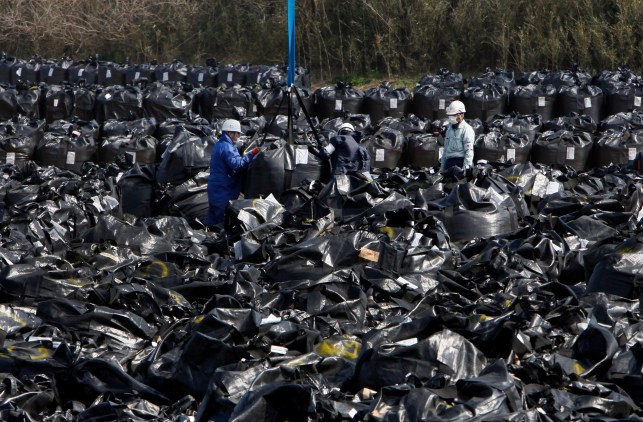
Five years after a powerful earthquake and tsunami sent the Fukushima Dai-ichi nuclear power plant in Japan into multiple meltdowns, cleaning up the mess both onsite and in surrounding towns remains a work in progress. Here’s a look, by the numbers, at the widespread effects of radiation from the March 11, 2011, disaster:
164,865: Fukushima residents who fled their homes after the disaster.
97,320: Number who still haven’t returned.
49: Municipalities in Fukushima that have completed decontamination work.
45: Number that have not.
30: Percent of electricity generated by nuclear power before the disaster.
1.7: Percent of electricity generated by nuclear power after the disaster.
3: Reactors currently online, out of 43 now workable.
54: Reactors with safety permits before the disaster.
53: Percent of the 1,017 Japanese in a March 5-6 Mainichi Shimbun newspaper survey who opposed restarting nuclear power plants.
30: Percent who supported restarts. The remaining 17 percent were undecided.
760,000: Metric tons of contaminated water currently stored at the Fukushima nuclear plant.
1,000: Tanks at the plant storing radioactive water after treatment.
10.7 million: Number of 1-ton container bags containing radioactive debris and other waste collected in decontamination outside the plant.
7,000: Workers decommissioning the Fukushima plant.
26,000: Laborers on decontamination work offsite.
200: Becquerels of radioactive cesium per cubic meter (264 gallons) in seawater immediately off the plant in 2015.
50 million: Becquerels of cesium per cubic meter in the same water in 2011.
7,400: Maximum number of becquerels of cesium per cubic meter allowed in drinking water by the U.S. Environmental Protection Agency.
Sources: Fukushima prefectural government, Japan Ministry of Internal Affairs, the Tokyo Electric Power Co., the Nuclear Regulation Authority, the Federation of Electric Power Companies and the Woods Hole Oceanographic Institution.—AP
Despite utilities’ attempts, nuclear safety myth can never be revived
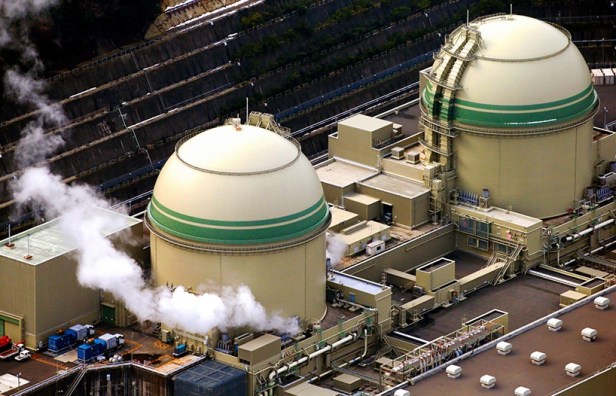
The No. 3, left, and No. 4 reactors at Kansai Electric Power Co.’s Takahama nuclear power plant in Fukui Prefecture
Japan should become a society that is not dependent on nuclear power generation as quickly as possible.
Five years have passed since the Great East Japan Earthquake and subsequent tsunami devastated wide areas in the northeastern Tohoku region on March 11, 2011, triggering the crisis at the Fukushima No. 1 nuclear power plant.
Our editorials will continue arguing for a nuclear-free future for Japanese society.
The Otsu District Court in Shiga Prefecture on March 9 issued an injunction against the operation of two reactors at Kansai Electric Power Co.’s Takahama nuclear power plant in Fukui Prefecture. The court told the utility to immediately shut down the No. 3 reactor at the plant and keep the No. 4 unit off-line. Both reactors were restarted earlier this year, but a malfunction automatically shut down the No. 4 unit on Feb. 29.
It was the first time for a Japanese court to order a halt to an online nuclear reactor.
The Abe administration can hardly claim that its policy decisions concerning nuclear power generation have been solidly based on lessons learned from the Fukushima nuclear disaster.
Rather, the administration has been trying to revive the nuclear power policy that was in place before the disaster and restart as many reactors as possible.
The court decision echoes public anxiety about the government’s move to gradually regain Japan’s nuclear capacity without serious public debate on the issue.
Prime Minister Shinzo Abe’s government should sincerely respond to the important social changes caused by the triple meltdown and take steps toward a major shift in energy policy.
MANY QUESTIONS ABOUT NEW SAFETY STANDARDS
As for the Takahama plant, the Fukui District Court issued an injunction against plans to restart the two reactors in April last year.
Although another judge at the district court repealed the injunction eight months later, the fact remains that the judiciary has twice denied the safety of reactors that passed the Nuclear Regulation Authority’s stricter safety standards introduced after the Fukushima disaster.
When the Fukui District Court in April rejected the restarts of the reactors, proponents of nuclear power generation played down the importance of the order, saying it was “an exceptional decision by an exceptional judge.”
After the Otsu District Court’s injunction, however, this argument no longer holds water.
Looking back on the harrowing accident in Fukushima Prefecture, the district court pointed out that a severe nuclear accident could cause environmental destruction beyond national borders. It is hard to assert that efficiency in power generation should be pursued even at the risk of devastating disasters, the court maintained.
The court also contended that the NRA and Kansai Electric have made insufficient efforts to pinpoint the causes of the Fukushima accident.
The NRA’s endorsement of the safety of a reactor cannot be seen as a base for a sense of security within society, the court said.
The court’s decision that meeting the new regulatory standards alone does not necessarily ensure the safety of a reactor has huge implications.
Chief Cabinet Secretary Yoshihide Suga has said the Abe administration remains committed to promoting reactor restarts in line with the NRA’s judgments.
But the administration should carefully consider the significance of the fact that the judiciary has raised fundamental questions about the entire system of post-Fukushima nuclear safety regulation.
EVACUATION PLANS IN DOUBT
An Asahi Shimbun editorial published in July 2011 called for the creation of a society without nuclear power.
While supporting the temporary operation of the minimum number of reactors that are absolutely needed to meet electricity demand, the editorial proposed that nuclear power generation should be phased out in two to three decades by decommissioning dangerous and aging reactors.
In fact, all nuclear reactors in Japan were off-line for about two years and one month over the past five years. No serious power crunches or economic upheavals took place during the period, disproving initial warnings about such possibilities.
The experiences during the period have shown that the number of “absolutely necessary nuclear reactors” is not that many. This lends weight to the argument that strict conditions must be met for restarting a reactor.
A growing number of Japanese are calling for the immediate shutdown of all reactors or a steady reduction in Japan’s dependence on nuclear energy. An Asahi Shimbun public opinion poll in February confirmed this trend; a majority of respondents voiced opposition to reactor restarts.
The Abe administration initially pledged to lower the nation’s dependence on nuclear power over time. But it has gradually ratcheted up its rhetoric in promoting nuclear power generation through remarks that appear designed to create a new “nuclear safety myth.”
In his 2013 speech supporting Tokyo’s bid to host the 2020 Summer Olympics, Abe told the world that the situation concerning radioactive water from the crippled Fukushima plant was “under control.”
He has also contended in the Diet that the NRA’s new safety standards were “the strictest in the world.”
But the Otsu District Court’s decision adjudged the standards as insufficient for giving the green light to a reactor restart.
In addition, there have been serious concerns about the lack of effective and reliable plans for emergency evacuations during severe nuclear accidents.
The new safety standards do not cover evacuation plans, and the NRA does not examine such plans when it evaluates the safety of a reactor.
In the case of the Takahama plant, a severe nuclear accident would force about 180,000 residents in Fukui, Kyoto and Shiga prefectures to evacuate. But no drill to ascertain the viability of evacuation plans was conducted before the two reactors resumed operations.
The court referred to the government’s “obligation to develop regulatory standards from a broad perspective that also covers the need of evacuation plans.” The government should immediately respond to this proposition.
NUCLEAR POWER OF GREAT PUBLIC CONCERN
Despite the enormous scale of damage caused by the Fukushima accident, the responsibility of those who had championed nuclear power generation has yet to be clarified.
As the Otsu District Court pointed out, the Japanese public who watched the disaster unfold at the Fukushima No. 1 plant understand the “overwhelming scope” of the damages caused by the accident as well as the “great confusion” that arose during the evacuation process.
Yet both the government and electric utilities are working in tandem to restart reactors as if they have forgotten what happened five years ago.
Some revelations have cast serious doubt about utilities’ commitment to learning lessons from the accident and putting the top priority on safety.
Tokyo Electric Power Co., operator of the stricken Fukushima plant, recently “discovered” a guideline in its operational manual that would have allowed it to announce core meltdowns much earlier than it did.
Kyushu Electric Power Co. has asked for the NRA’s permission to withdraw a plan to build a quake-proof building that can serve as an on-site response center during a severe nuclear accident. The company promised to build the emergency facility at its Sendai nuclear power plant before it restarted two reactors at the plant last year.
These episodes raise suspicions that the utilities are returning to their pre-disaster practice of cunningly using experts to make key decisions about their nuclear power operations within the close-knit pro-nuclear community.
Many issues concerning nuclear power policy are too complicated and arcane for ordinary citizens to easily understand. But the Fukushima nuclear crisis has reminded Japanese that nuclear power generation is an issue that is directly linked to their livelihoods and lifestyle choices.
No matter how hard they try to revive the safety myth about nuclear power, government policymakers and members of the “nuclear village,” the closed and small community of people and organizations with vested interests in promoting nuclear power, will never be able to bring the nation back to the days before the Fukushima disaster.
Nuclear power generation has already become a familiar issue and a matter of serious concern to the great majority of Japanese.
Fukushima decontamination troops often exploited, shunned

A worker clears potentially radioactive brush at the garden of a private house in Minamisoma, Fukushima Prefecture, northeastern Japan. Nearly 26,000 men work in the cleanup campaign.
MINAMISOMA, Japan — The ashes of half a dozen unidentified laborers ended up at a Buddhist temple in this town just north of the crippled Fukushima nuclear plant. Some of the dead men had no papers, others left no emergency contacts. Their names could not be confirmed, and no family members had been tracked down to claim their remains.
They were simply labeled “decontamination troops” — unknown soldiers in Japan’s massive cleanup campaign to make Fukushima livable again five years after radiation poisoned the fertile countryside.
The men were among the 26,000 workers — many in their 50s and 60s from the margins of society with no special skills or close family ties — assigned to remove the contaminated topsoil and stuffing it into tens of thousands of black bags lining the fields and roads. They wipe off roofs, clean out gutters and chop down trees in a seemingly endless routine.
Coming from across Japan to do a dirty, risky and undesirable job, the workers make up the very bottom of the nation’s murky, caste-like subcontractor system long criticized for labor violations. Vulnerable to exploitation and shunned by local residents, they typically work on three- to six-month contracts with little or no benefits, living in makeshift company barracks. And the government is not even making sure that their radiation levels are individually tested.
“They’re cleaning up radiation in Fukushima, doing sometimes unsafe work, and yet they can’t be proud of what they do or even considered legitimate workers,” said Mitsuo Nakamura, a former day laborer who now heads a citizens’ group supporting decontamination laborers. “They are exploited by the vested interests that have grown in the massive project.”
Residents of still-partly deserted towns such as Minamisoma, where 8,000 laborers are based, worry that neighborhoods have turned into workers’ ghettos with deteriorating safety. Police data show arrests among laborers since 2011 have climbed steadily from just one to 210 last year, including a dozen yakuza, or gangsters, police official Katsuhiko Ishida told a prefectural assembly. Residents are spooked by rumors that some laborers sport tattoos linked with yakuza, and by reports that a suspect in serial killings arrested in Osaka last year had worked in the area.
“Their massive presence has simply intimidated residents,” said Mayor Katsunobu Sakurai. “Frankly, the residents need their help but don’t want any trouble.”
Most of the men work for small subcontractors that are many layers beneath the few giants at the top of the construction food chain. Major projects such as this one are divided up among contractors, which then subcontract jobs to smaller outfits, some of which have dubious records.
The Ministry of Health, Labor and Welfare examined more than 300 companies doing Fukushima decontamination work and found that nearly 70 committed violations in the first half of last year, including underpayment of wages and overtime, and failure to do compulsory radiation checks. Those companies were randomly chosen among thousands believed to be working in the area.
“Violations are so widespread in this multilayer subcontract system. It’s like a whack-a-mole situation,” said Mitsuaki Karino, a city assemblyman in Iwaki, a Fukushima city where his civil group has helped workers with complaints about employers.
Karino said workers are sometimes charged for meals or housing they were told would be free, and if they lose jobs or contracts aren’t renewed, some go homeless.
“It’s a serious concern, particularly for workers who don’t have families or lost ties with them,” he said.
Government officials say they see no other way than to depend on the contracting system to clean up the radiated zone, a project whose ballooning cost is now estimated at $44 billion.
“That’s how the construction industry has long operated. In order to accomplish decontamination, we need to rely on the practice,” said Tadashi Mouri, a health and labor ministry official in charge of nuclear workers’ health.
http://www.sfgate.com/world/article/Fukushima-decontamination-troops-often-exploited-6882977.php
Mainstream media fails to cover real health effects of Fukushima nuclear disaster
Pascale’s analysis initially characterized the risk to the general population in one of three ways: low, uncertain, or high. However, when examining the bases on which these characterizations were made, it was clear that all media characterizations of uncertain risk were subsequently interpreted as evidence of low risk.
“The mainstream media–in print and online–did little to report on health risks to the general population or to challenge the narratives of public officials and their experts,”

 News coverage of Fukushima disaster found lacking http://www.eurekalert.org/pub_releases/2016-03/au-nco031016.php American University sociologist’s new research finds few reports identified health risks to public
AMERICAN UNIVERSITY (WASHINGTON, D.C.) March 10, 2016 –– Five years after the 2011 Fukushima Daiichi nuclear disaster in Japan, the disaster no longer dominates U.S. news headlines, although experts say it is a continuing disaster with broad implications. A new analysis by American University sociology professor Celine-Marie Pascale finds that U.S. news media coverage following the disaster minimized health risks to the general population.
Pascale analyzed more than 2,000 news articles from four major U.S. outlets following the disaster’s occurrence from March 11, 2011 through March 11, 2013. Only 6 percent of the coverage–129 articles–focused on health risks to the public in Japan or elsewhere. Human risks were framed, instead, in terms of workers in the disabled nuclear plant. Pascale’s research has published in the flagship journal for the International Sociology Association,Current Sociology.
Disproportionate access
“It’s shocking to see how few articles discussed risk to the general population, and when they did, they typically characterized risk as low,” said Pascale, who studies the social construction of risk and meanings of risk in the 21st century. “We see articles in prestigious news outlets claiming that radioactivity from cosmic rays and rocks is more dangerous than the radiation emanating from the collapsing Fukushima Daiichi nuclear plant.”
Pascale studied news articles, editorials, and letters to the editor from two newspapers, The Washington Post and The New York Times, and two nationally prominent online news sites, Politico and The Huffington Post. These four media outlets are among the most prominent in the United States. They also are among the most cited by television news, talk shows, other newspapers, social media and blogs Pascale said.
Nuclear disasters have potentially large-scale and long-term consequences for people, environments, and economies around the globe. Given limited public knowledge about the details of nuclear energy and encumbered access to disaster sites, the media have disproportionate power around the globe to shape public knowledge, perception, and reaction to nuclear crises, Pascale said. Pascale’s article illustrates how systematic media practices minimized the presence of health risks, contributed to misinformation, and exacerbated uncertainties.
Pascale’s analysis initially characterized the risk to the general population in one of three ways: low, uncertain, or high. However, when examining the bases on which these characterizations were made, it was clear that all media characterizations of uncertain risk were subsequently interpreted as evidence of low risk. In two years of reporting, across all four media outlets, there were only a combined total of 17 articles reporting any noteworthy risk from the largest nuclear disaster in history.
Corporations and government agencies had disproportionate access to framing the event in the media, Pascale says. Even years after the disaster, government and corporate spokespersons constituted the majority of voices published. News accounts about local impact–for example, parents organizing to protect their children from radiation in school lunches–were also scarce.
Globalization of risk
Pascale says her findings show the need for the public to be critical consumers of news; expert knowledge can be used to create misinformation and uncertainty–especially in the information vacuums that arise during disasters.
“The mainstream media–in print and online–did little to report on health risks to the general population or to challenge the narratives of public officials and their experts,” Pascale said. “Discourses of the risks surrounding disasters are political struggles to control the presence and meaning of events and their consequences. How knowledge about disasters is reported can have more to do with relations of power than it does with the material consequences to people’s lives.”
While it is clear that the Fukushima Daiichi nuclear meltdown was a consequence of an earthquake and tsunami, like all disasters, it was also the result of political, economic and social choices that created or exacerbated broad-scale risks. In the 21st century, there’s an increasing “globalization of risk,” Pascale argues.
“People’s understanding of disasters will continue to be constructed primarily by media. How media members frame the presence of risk and the nature of disaster has enormous consequence for our well-being,” she said.
1 This Month

petition to oppose the rapid increase of space-military industry threatening Jeju Island and the region.
[Petition by April 19th (KST)] Stop the joint military-Hanwha Systems-Jeju Provincial Government Sea Launch!
World Nuclear Power. Reactors 1951-2026, 75 Years of Nuclear Power.
Interactive Map– https://dv.worldnuclearreport.org/
Chernobyl: The Lost Tapes – A good documentary on Chernobyl on SBS available On Demand for the next 3 weeks– https://www.sbs.com.au/ondemand/tv-program/chernobyl-the-lost-tapes/2352741955560

of the week–London Campaign for Nuclear Disarmament

Tell the Ukrainian Government to Drop Prosecution of Peace Activist Yurii Sheliazhenko
To see nuclear-related stories in greater depth and intensity – go to https://nuclearinformation.wordpress.com
-
Archives
- April 2026 (194)
- March 2026 (251)
- February 2026 (268)
- January 2026 (308)
- December 2025 (358)
- November 2025 (359)
- October 2025 (376)
- September 2025 (257)
- August 2025 (319)
- July 2025 (230)
- June 2025 (348)
- May 2025 (261)
-
Categories
- 1
- 1 NUCLEAR ISSUES
- business and costs
- climate change
- culture and arts
- ENERGY
- environment
- health
- history
- indigenous issues
- Legal
- marketing of nuclear
- media
- opposition to nuclear
- PERSONAL STORIES
- politics
- politics international
- Religion and ethics
- safety
- secrets,lies and civil liberties
- spinbuster
- technology
- Uranium
- wastes
- weapons and war
- Women
- 2 WORLD
- ACTION
- AFRICA
- Atrocities
- AUSTRALIA
- Christina's notes
- Christina's themes
- culture and arts
- Events
- Fuk 2022
- Fuk 2023
- Fukushima 2017
- Fukushima 2018
- fukushima 2019
- Fukushima 2020
- Fukushima 2021
- general
- global warming
- Humour (God we need it)
- Nuclear
- RARE EARTHS
- Reference
- resources – print
- Resources -audiovicual
- Weekly Newsletter
- World
- World Nuclear
- YouTube
-
RSS
Entries RSS
Comments RSS
 nuclear-news